Google Ads brings back Target CPA and Target ROAS as standalone bidding strategies
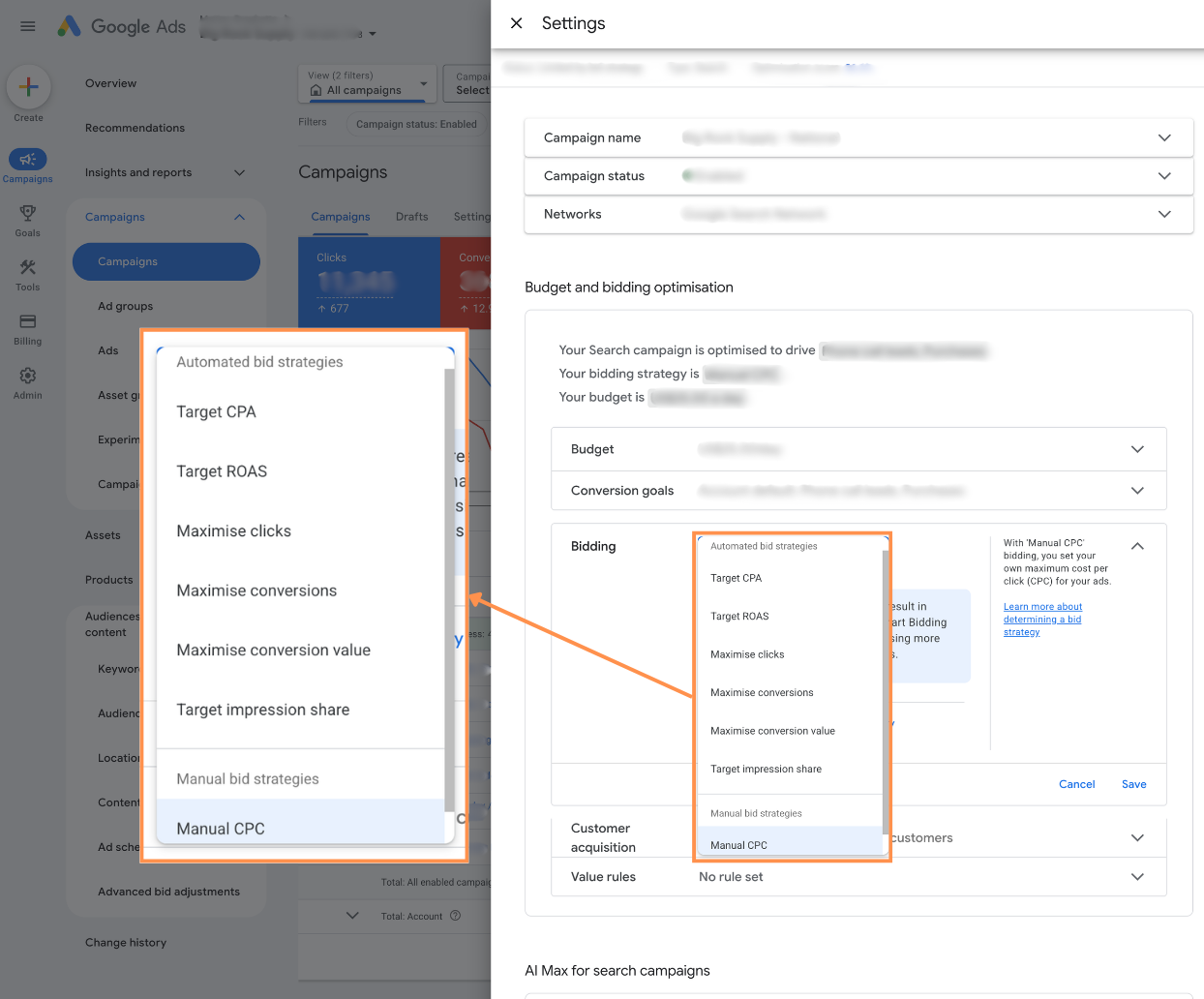
Google Ads is showing Target CPA and Target ROAS as direct bidding strategy options in some accounts, rather than presenting them only as optional targets under Maximize Conversions and Maximize Conversion Value.
For experienced advertisers, this is a small interface change with meaningful practical implications. The underlying Smart Bidding logic does not appear to have changed, but the way Google Ads frames the initial campaign decision has become clearer: should this campaign pursue the highest possible volume, or should it optimize toward a defined efficiency threshold?
Previously, the distinction could be easy to miss during campaign setup. An advertiser selecting Maximize Conversions needed to actively enable a target CPA, while Maximize Conversion Value required an additional decision to apply a target ROAS. In a fast-paced account build, that extra setting could be overlooked, resulting in a campaign optimized for volume without the intended cost or revenue guardrail.
With Target CPA and Target ROAS now visible as standalone choices, Google Ads makes the strategic intent more explicit from the beginning.
A UI change, not a new Smart Bidding model
The important point is that Target CPA and Target ROAS should not be treated as newly introduced bidding technologies. Both continue to rely on the same core Smart Bidding inputs: conversion data, auction-time signals, historical performance, attribution settings, budgets, audiences, devices, locations, and the quality of the conversion actions being optimized.
Target CPA remains a conversion-volume strategy constrained by an efficiency objective. The system seeks to generate as many conversions as possible while aiming for an average cost per acquisition around the selected target. Target ROAS follows the same principle for value-based bidding, attempting to maximize conversion value while maintaining an average return on ad spend aligned with the stated goal.
In practical terms, the new labels are likely a clearer entry point into the existing Maximize Conversions with Target CPA and Maximize Conversion Value with Target ROAS frameworks. Advertisers should not assume that selecting a standalone Target CPA option will produce different auction behavior from configuring the same target within Maximize Conversions.
The change is about clarity and campaign setup discipline, not a shift in how Google’s bidding algorithms evaluate auctions.
Why the clearer selection matters
Campaign setup choices shape expectations long before performance data is available. When Target CPA and Target ROAS are presented separately, advertisers are less likely to confuse a volume-first strategy with a target-led strategy.
That distinction matters especially in accounts where cost control is non-negotiable. A lead generation campaign with a qualified lead target is not simply trying to maximize form submissions. An ecommerce campaign with a margin-sensitive product mix is not simply trying to maximize reported revenue. In both cases, the target is central to the commercial objective, not an optional refinement.
The revised interface may also improve internal account governance. Teams building campaigns from templates, handling multiple markets, or working across paid media and performance marketing functions can identify the intended bidding direction more quickly. It becomes easier to review whether a campaign was launched to maximize outcomes broadly or to pursue outcomes within a CPA or ROAS framework.
That said, clearer labels do not remove the need for strategic judgment. A target is not automatically a safeguard. An unrealistic Target CPA can limit traffic and suppress conversion volume. An aggressive Target ROAS can restrict bidding to the point where the campaign struggles to scale, particularly in competitive auctions or during periods of changing demand.
Target selection still depends on measurement quality
The success of this approach continues to depend far more on measurement than on the bidding strategy label selected in the interface.
For Target CPA campaigns, the key question is whether the conversion being optimized reflects meaningful business value. If a campaign optimizes toward low-intent lead forms, newsletter registrations, or unqualified calls, an efficient CPA may still represent poor marketing performance. Smart Bidding can optimize toward the signal it receives, but it cannot correct for a conversion definition that is disconnected from revenue or lead quality.
For Target ROAS, reliable conversion values are essential. Ecommerce advertisers need accurate transaction revenue, while lead generation businesses increasingly need to consider offline conversion imports, enhanced conversions for leads, CRM-based values, or qualified-lead value models. A Target ROAS strategy is only as useful as the value data used to train it.
Historical data also remains a consideration. Google Ads can apply Smart Bidding across many campaign types, but target-based bidding generally performs more predictably when the system has enough recent, consistent conversion information to understand the relationship between spend, auctions, and outcomes. Frequent target changes, major budget shifts, promotional volatility, or changing conversion definitions can make that learning process less stable.
The real decision is still CPA versus value
The renewed visibility of these bidding options may encourage more deliberate thinking about whether a campaign should optimize for conversion count or conversion value.
Target CPA is appropriate when conversions are broadly comparable in economic value, or when the business has a defined acceptable acquisition cost for a specific stage of the funnel. Target ROAS is more relevant when conversion values vary materially and the account can communicate that variation accurately to Google Ads.
Neither is inherently more advanced. The right choice depends on the economics of the campaign. A business selling products with different prices and margins may benefit from value-based bidding, but only if reported revenue is a reasonable proxy for profitability. Conversely, a lead generation advertiser may need Target CPA initially, then move toward value-based optimization once qualified lead or pipeline data is reliably available.
Google Ads making Target CPA and Target ROAS standalone options is therefore a useful usability improvement. It makes the bidding objective more visible at the moment it matters most: before a campaign launches. But the strategic work remains unchanged—define the right conversion, supply credible data, and set targets that reflect real commercial constraints rather than arbitrary efficiency goals.

As a Google Ads expert, I bring proven expertise in optimizing advertising campaigns to maximize ROI.
I specialize in sharing advanced strategies and targeted tips to refine Google Ads campaign management.
Committed to staying ahead of the latest trends and algorithms, I ensure that my clients receive cutting-edge solutions.
My passion for digital marketing and my ability to interpret data for strategic insights enable me to offer high-level consulting that aims to exceed expectations.
Google Partner Agency
We're a certified Google Partner Agency, which means we don’t guess — we optimize withGoogle’s full toolkit and insider support.
Your campaigns get pro-level execution, backed by real expertise (not theory).

4.9 out of 5 from 670+ reviews on Fiverr.
That’s not luck, that’s performance.
Highly recommend Matteo to set up your server side tracking. He has a deep understanding of e-commerce tracking and will go above and beyond to make sure everything is set up correctly and working 100%. If you are scaling your store this set up is non-negotiable in my opinion and there isn't many people who have this much knowledge or put the effort in to get it right. Thanks again!

avorodesign.com
I can only recommend Matteo! He was very patient, professional and very knowledgeable about GA4, Consent Mode v2, and GDPR compliance. Communication was clear, and the setup was done professionally and efficiently. Highly recommend him for anyone needing reliable tracking implementation.

www.natureiki.life
Matteo shines in the realm of online professionals. His work is not only deep in data but also complemented by his proactive communication and cooperation, setting a new standard for freelancers. If you want someone who truly exceeds expectations, look no further. Highly recommended!

www.omanbeverlysmyth.com
Exceptional Service Beyond Expectations - Outstanding Service Impeccable depth, flawless delivery, and exceptional language fluency—this service exceeded all expectations. Highly recommended. Matteo truly ROCKS!!!

ium-paris.com
Top-notch, always highly value working with Matteo. An absolute Google Ads Genius. This is approximately the 8th time I have hired him and he's helped us get 6-7 ROAS. We are excited in continuing to improve our lead flow. Hire this guy if you need Google Ads help. Thanks Matteo!

www.dleeventgroup.com
I finally found the guy who can setup server side tracking and all the ecosystem properly. I definitely recommend Matteo. He is very responsive, kind and wants to dig into things. He configured GA4, Meta, Google Ads, Outbrain and google consent v2 with Cookiebot. Thanks Matteo.

inomega.fr
MB Adv delivered exceptional work with outstanding professionalism and lots of patience, taking time to see effects of changes made and not just do the work and submit it. The proactive communication and video summaries of the work completed made working with Matteo a pleasure, as he consistently went above and beyond. Highly recommended for web analytics projects! We are already working on another project.

www.withnellsensors.co.uk
Working with Matteo on my Google Ads was a game-changer. He's not just a strategist, he's a true partner. He understood my goals and tailored a campaign that perfectly reached my target audience. I'm grateful for his expertise and dedication.

dccargo.com
Click-driven mind
with plastic-brick obsession.
We build Google Ads campaigns with the same mindset we use to build tiny brick worlds: strategy, patience, and zero tolerance for wasted pieces.
Data is our blueprint. Growth is the only acceptable outcome.