Google Ads tests AI labels for uploaded creative assets: what advertisers need to know
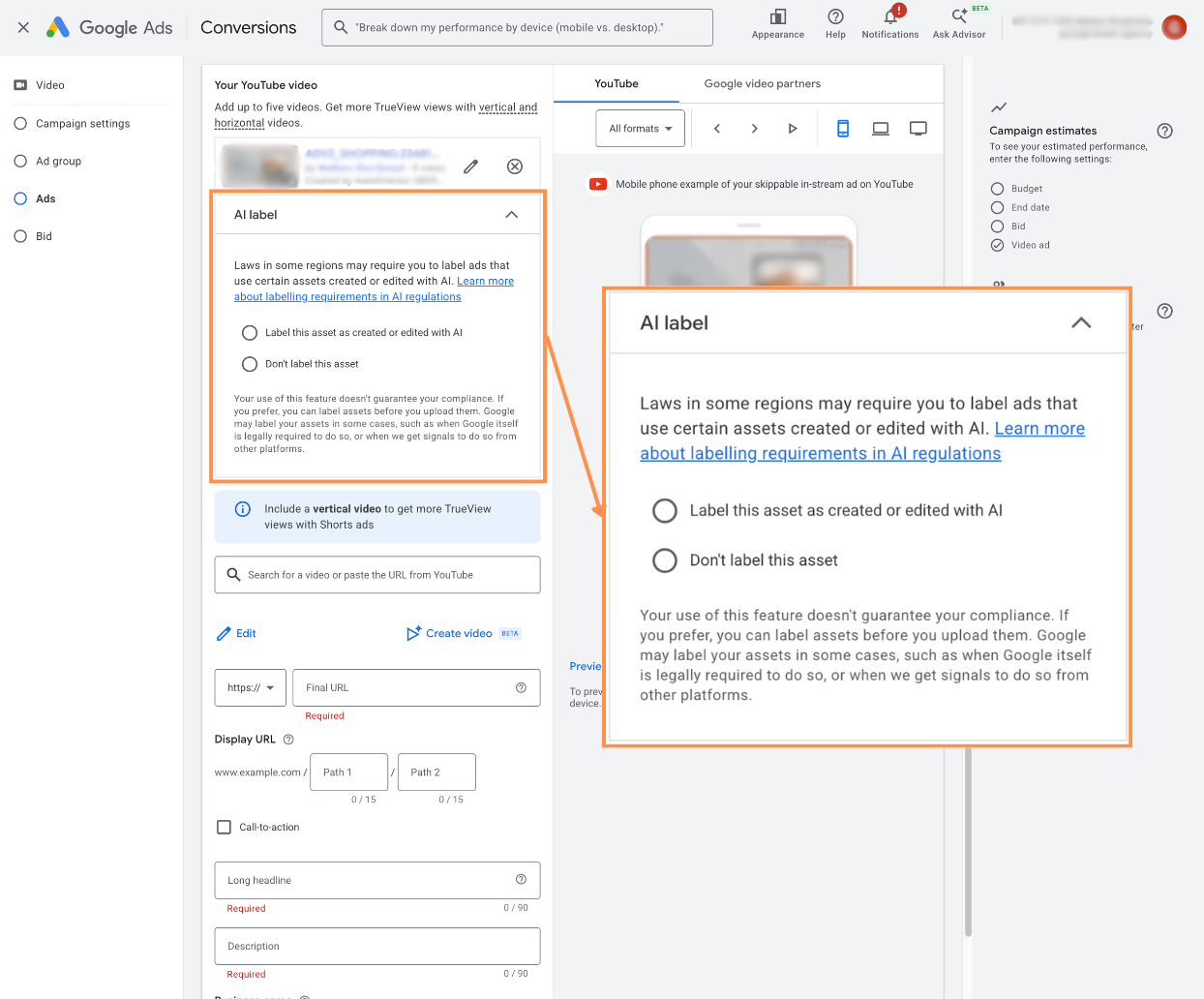
Google Ads is beginning to show some advertisers a disclosure choice when they upload creative assets, including images and videos. The prompt asks whether an asset was created or edited with AI, offering options similar to “Label this asset as created or edited with AI” and “Don’t label this asset.”
It is a small interface change with potentially significant implications for creative operations, approval processes, and advertising transparency.
The important caveat is that Google’s public documentation does not yet explain every aspect of this upload-level control in detail. That distinction matters: an interface prompt seen in an account is evidence of a product capability being deployed, but it does not automatically establish universal availability, a fixed geographic scope, or the exact circumstances in which a label will appear to users.
What Google appears to be introducing
The practical change is straightforward. When an advertiser uploads an image or video, Google Ads may ask the advertiser to declare whether generative AI was used to create or edit it.
The wording is notable. It is not limited to assets entirely generated by AI. It also covers assets “edited with AI,” which creates a much broader category.
In day-to-day production, that could potentially include:
- A product image expanded with generative fill
- A video background replaced with an AI-assisted editing tool
- An actor’s voice modified synthetically
- A visual created from a photograph and substantially altered using generative tools
- A fully AI-generated image or video
The operational question for advertisers is not simply whether an asset was made in a text-to-image tool. It is whether AI played a material role in creating or editing the final creative.
Google has also stated in other AI-related product contexts that it can identify or label content produced with its own generative AI tools. Technologies such as SynthID can embed signals into AI-generated content. However, advertisers should not assume that automatic detection removes their responsibility to assess uploaded assets accurately. Google does not publicly describe every signal, detection method, or enforcement scenario for all externally produced creative.
A broader transparency direction, not just a Google Ads feature
This development fits a wider shift toward transparency for synthetic media.
Google already has a separate policy framework for digitally altered or synthetic content in election advertising. That policy requires disclosures in specific situations where altered or synthetic content realistically depicts people or events. It should not be confused with this broader asset-upload prompt.
The election advertising policy is a policy requirement with a defined political-advertising context. The new AI asset label appears to be a creative-level disclosure mechanism applicable beyond election ads. Google has not publicly established that the two controls share the same enforcement logic, user-facing treatment, or geographic coverage.
That difference is important for PPC teams. A label for an AI-edited product video is not necessarily a policy warning, and a “don’t label” selection should not be interpreted as an exemption from every applicable advertising policy or legal obligation.
Is this connected to the EU AI Act?
It is reasonable to see a connection, but Google has not publicly confirmed that the Google Ads prompt exists specifically because of the EU AI Act.
The EU AI Act contains transparency provisions concerning AI-generated or manipulated content, including certain “deepfake” scenarios. Its requirements are more nuanced than a simple universal labeling rule for all AI-assisted marketing assets. The legal obligations can vary depending on the type of content, whether it is materially manipulated, how it is distributed, and the role of the organization involved.
For advertisers targeting European audiences, the direction of travel is clear: provenance and disclosure are becoming part of the media-buying environment.
But it would be inaccurate to state that every AI-assisted Google Ads asset must now be labeled under the EU AI Act, or that Google’s new prompt is a confirmed implementation of a specific legal provision. Google has not publicly documented that direct relationship.
Why the distinction between “created” and “edited” matters
The most difficult part of this change will be internal classification.
Many creative teams now use AI in ways that are incremental rather than obvious. A designer may remove an object, expand a canvas, enhance a background, generate alternative product staging, or clean up an audio track using AI-enabled features inside conventional creative software.
Not every advertiser will reach the same conclusion about whether that work makes an asset “edited with AI.” Google’s publicly available guidance does not yet appear to set out a detailed materiality threshold for this specific upload prompt. For example, it is not clear whether minor retouching, automated color correction, or AI-assisted resizing should be treated in the same way as generating a realistic person or product scene from scratch.
That ambiguity has practical consequences. Without a shared internal standard, a global brand can end up applying inconsistent labels across agencies, markets, and campaigns.
A sensible governance approach is to distinguish between routine automation and AI use that materially changes what an audience sees or hears. That is not a formal Google rule; it is a practical way to make disclosure decisions more consistent while official guidance evolves.
What advertisers should watch next
The key unanswered questions are not cosmetic. Advertisers need clarity on where labels appear, whether they are visible on every Google surface, whether they affect ad review, and whether opting out of a label has consequences when Google detects AI-related metadata or other signals.
Google may be able to apply labels automatically in some circumstances, particularly for content generated through Google AI products or assets carrying recognizable provenance information. Yet the precise interaction between advertiser self-declaration and automatic labeling is not fully documented publicly.
For now, the most useful interpretation is that AI disclosure is becoming a normal part of creative asset management in Google Ads. It should be treated as a transparency and governance consideration—not as proof that AI-generated advertising is restricted, and not as a substitute for careful policy review where synthetic media could mislead users.

As a Google Ads expert, I bring proven expertise in optimizing advertising campaigns to maximize ROI.
I specialize in sharing advanced strategies and targeted tips to refine Google Ads campaign management.
Committed to staying ahead of the latest trends and algorithms, I ensure that my clients receive cutting-edge solutions.
My passion for digital marketing and my ability to interpret data for strategic insights enable me to offer high-level consulting that aims to exceed expectations.
Google Partner Agency
We're a certified Google Partner Agency, which means we don’t guess — we optimize withGoogle’s full toolkit and insider support.
Your campaigns get pro-level execution, backed by real expertise (not theory).
4.9 out of 5 from 670+ reviews on Fiverr.
That’s not luck, that’s performance.
Highly recommend Matteo to set up your server side tracking. He has a deep understanding of e-commerce tracking and will go above and beyond to make sure everything is set up correctly and working 100%. If you are scaling your store this set up is non-negotiable in my opinion and there isn't many people who have this much knowledge or put the effort in to get it right. Thanks again!
avorodesign.com
I can only recommend Matteo! He was very patient, professional and very knowledgeable about GA4, Consent Mode v2, and GDPR compliance. Communication was clear, and the setup was done professionally and efficiently. Highly recommend him for anyone needing reliable tracking implementation.

www.natureiki.life
Matteo shines in the realm of online professionals. His work is not only deep in data but also complemented by his proactive communication and cooperation, setting a new standard for freelancers. If you want someone who truly exceeds expectations, look no further. Highly recommended!

www.omanbeverlysmyth.com
Exceptional Service Beyond Expectations - Outstanding Service Impeccable depth, flawless delivery, and exceptional language fluency—this service exceeded all expectations. Highly recommended. Matteo truly ROCKS!!!
ium-paris.com
Top-notch, always highly value working with Matteo. An absolute Google Ads Genius. This is approximately the 8th time I have hired him and he's helped us get 6-7 ROAS. We are excited in continuing to improve our lead flow. Hire this guy if you need Google Ads help. Thanks Matteo!

www.dleeventgroup.com
I finally found the guy who can setup server side tracking and all the ecosystem properly. I definitely recommend Matteo. He is very responsive, kind and wants to dig into things. He configured GA4, Meta, Google Ads, Outbrain and google consent v2 with Cookiebot. Thanks Matteo.

inomega.fr
MB Adv delivered exceptional work with outstanding professionalism and lots of patience, taking time to see effects of changes made and not just do the work and submit it. The proactive communication and video summaries of the work completed made working with Matteo a pleasure, as he consistently went above and beyond. Highly recommended for web analytics projects! We are already working on another project.

www.withnellsensors.co.uk
Working with Matteo on my Google Ads was a game-changer. He's not just a strategist, he's a true partner. He understood my goals and tailored a campaign that perfectly reached my target audience. I'm grateful for his expertise and dedication.

dccargo.com
Click-driven mind
with plastic-brick obsession.
We build Google Ads campaigns with the same mindset we use to build tiny brick worlds: strategy, patience, and zero tolerance for wasted pieces.
Data is our blueprint. Growth is the only acceptable outcome.