Google Ads Missed Growth Opportunity: a new signal for budget and bid decisions
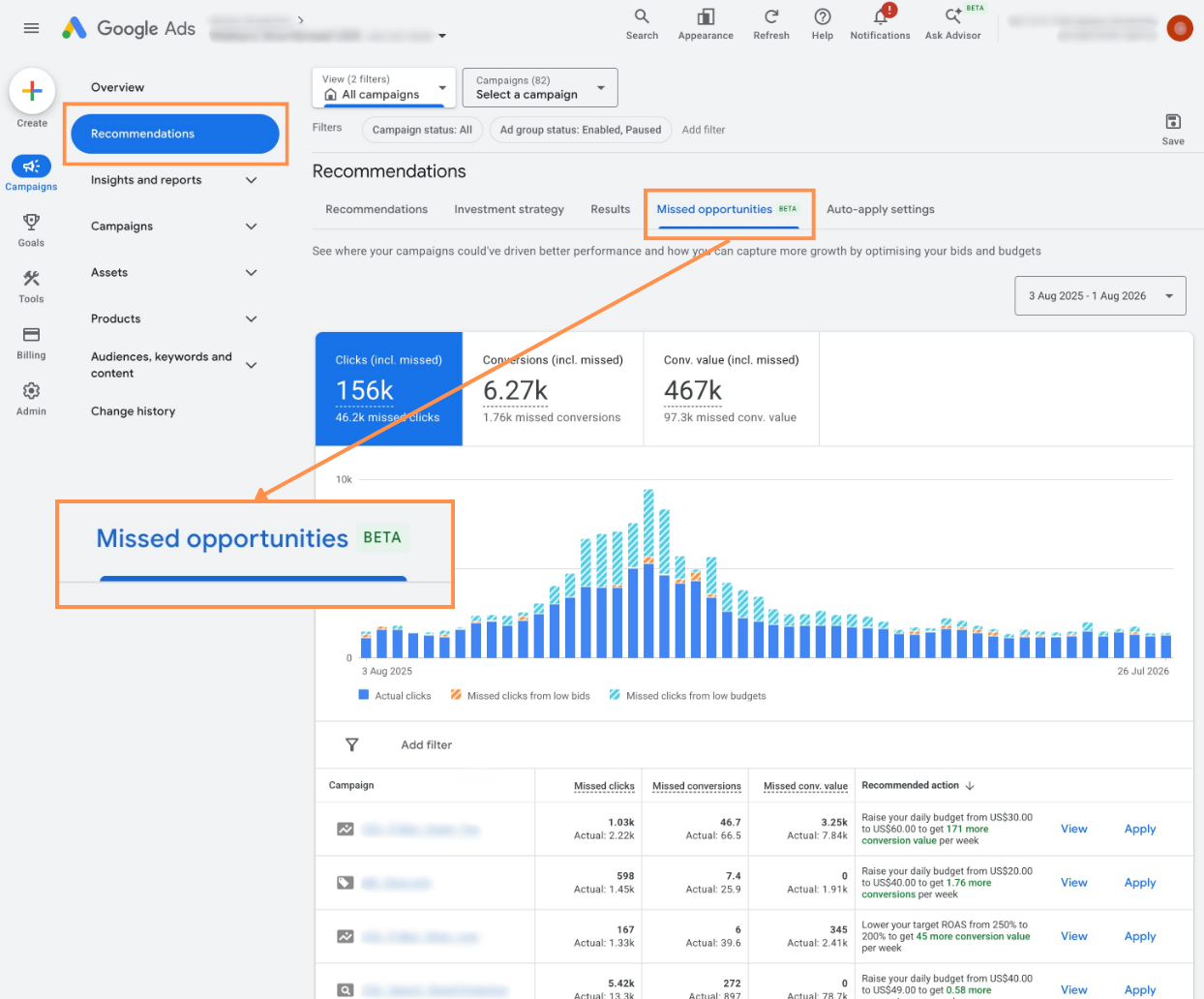
Google Ads has introduced a new Beta recommendation called Missed Growth Opportunity, designed to estimate the traffic, conversions and conversion value a campaign may be missing because of budget constraints or insufficient bid competitiveness.
For advertisers managing mature Search, Shopping or Performance Max activity, the value is not simply another recommendation card. It is the attempt to quantify an increasingly familiar question: if a campaign receives more investment, where might incremental growth actually come from—and is that growth likely to be profitable?
The recommendation appears in the Google Ads Recommendations tab when enough data is available. It presents estimated incremental clicks, conversions and conversion value, while separating the opportunity associated with budget limitations from that associated with bid limitations.
That distinction is important. A campaign can lose volume for very different reasons, and the right response is not always “increase the budget.”
Budget-limited versus bid-limited growth
A budget-limited opportunity suggests that the campaign is constrained by its daily budget. In practical terms, Google Ads believes there may be additional eligible traffic or conversion volume available if the campaign is allowed to spend more.
This can be useful for campaigns that consistently exhaust their budget early in the day, lose impression share due to budget, or have historically shown stable conversion efficiency at higher spend levels. However, a budget increase does not necessarily mean the additional spend will perform at the same CPA or ROAS. Incremental clicks are rarely identical to the clicks already being captured. As coverage expands, advertisers may reach less qualified queries, lower-value users, or inventory that sits further from the campaign’s current efficiency threshold.
The bid-limited component points to a different issue: the campaign may have available budget but is not competitive enough in relevant auctions. This could be related to target CPA or target ROAS settings, keyword bids in manual or enhanced CPC environments, bid adjustments, or auction competitiveness more broadly.
In these cases, adding budget may have little immediate impact. The real question is whether the advertiser is willing to accept a higher CPA, lower ROAS, or a different conversion mix in exchange for greater volume. For Smart Bidding campaigns, this often means reviewing whether the current target is acting as an overly restrictive constraint rather than assuming the bidding strategy is underperforming.
A useful planning signal, not a forecast
The Missed Growth Opportunity recommendation is potentially valuable because it gives account managers a more explicit view of estimated headroom. Until now, diagnosing lost opportunity often required combining Search impression share, lost impression share due to budget or rank, budget pacing, auction insights, conversion trends and historical experiments.
Google Ads is bringing part of that analysis into a single recommendation. That can speed up prioritisation, particularly in accounts with many campaigns and limited time for manual review.
Still, the estimates should be read as directional planning signals, not guaranteed outcomes. Google Ads models opportunity using available auction, campaign and conversion data, but no recommendation can fully account for commercial context. It cannot determine whether incremental conversions are profitable after margin, fulfilment costs, lead quality, returns, sales capacity or offline conversion rates.
For lead generation, this is especially relevant. An estimated increase in conversion volume is less meaningful if the extra leads have lower qualification rates or longer sales cycles. For ecommerce advertisers, estimated conversion value may not reflect contribution margin, stock availability, discounting pressure or product-level profitability.
The marginal efficiency question
The most important lens is not whether additional conversions are available, but the likely efficiency of the next increment of spend.
A campaign with a strong average ROAS can still have weak marginal ROAS. Likewise, a campaign currently operating near a target CPA may be able to grow efficiently if its budget has been artificially capped. The recommendation can help identify where to investigate, but it should be validated against historical evidence.
Useful checks include:
- Recent performance after previous budget or target changes
- Marginal CPA and marginal ROAS at higher spend levels
- Search lost impression share from budget and rank
- Conversion lag and the maturity of reported conversion data
- Changes in query mix, product mix or audience composition
- Offline conversion quality, profit data and CRM outcomes where available
Conversion lag deserves particular attention. If a campaign records most conversions several days or weeks after the click, recent performance may understate its actual efficiency. Increasing spend based on incomplete data can create misleading conclusions, especially when automated bidding is already adapting to new volume.
Better decisions through reallocation, not just expansion
The recommendation may be most useful in portfolio management rather than as an isolated campaign-level prompt. A missed opportunity in one campaign does not automatically justify more total spend; it may justify moving budget away from a lower-performing campaign, channel, product group or market.
For example, a non-brand Search campaign may show meaningful budget-limited conversion potential, while a separate campaign is spending with declining return. In that situation, the insight supports a reallocation decision. By contrast, if the account is already operating at its profitability ceiling, the opportunity may be real but commercially unattractive.
The same logic applies to bid-limited recommendations. Relaxing a target ROAS or increasing bids can unlock traffic, but the decision should reflect the advertiser’s real growth objective. A business prioritising new customer acquisition may accept lower immediate ROAS than a business constrained by cash flow or margin.
A welcome addition, with the usual Google Ads caveat
Google Ads’ Missed Growth Opportunity recommendation adds a useful layer to budget and bidding analysis. Its greatest strength is the separation between budget-limited and bid-limited opportunity, which can prevent simplistic optimisation decisions based solely on spend or impression share.
Used carefully, it can improve campaign prioritisation and sharpen discussions around incremental investment. But it should remain one input among many. The right response depends on marginal profitability, conversion quality, lag, auction conditions and the advertiser’s broader growth constraints—not only on the volume Google Ads estimates may be available.

As a Google Ads expert, I bring proven expertise in optimizing advertising campaigns to maximize ROI.
I specialize in sharing advanced strategies and targeted tips to refine Google Ads campaign management.
Committed to staying ahead of the latest trends and algorithms, I ensure that my clients receive cutting-edge solutions.
My passion for digital marketing and my ability to interpret data for strategic insights enable me to offer high-level consulting that aims to exceed expectations.
Google Partner Agency
We're a certified Google Partner Agency, which means we don’t guess — we optimize withGoogle’s full toolkit and insider support.
Your campaigns get pro-level execution, backed by real expertise (not theory).

4.9 out of 5 from 670+ reviews on Fiverr.
That’s not luck, that’s performance.
Highly recommend Matteo to set up your server side tracking. He has a deep understanding of e-commerce tracking and will go above and beyond to make sure everything is set up correctly and working 100%. If you are scaling your store this set up is non-negotiable in my opinion and there isn't many people who have this much knowledge or put the effort in to get it right. Thanks again!

avorodesign.com
I can only recommend Matteo! He was very patient, professional and very knowledgeable about GA4, Consent Mode v2, and GDPR compliance. Communication was clear, and the setup was done professionally and efficiently. Highly recommend him for anyone needing reliable tracking implementation.

www.natureiki.life
Matteo shines in the realm of online professionals. His work is not only deep in data but also complemented by his proactive communication and cooperation, setting a new standard for freelancers. If you want someone who truly exceeds expectations, look no further. Highly recommended!

www.omanbeverlysmyth.com
Exceptional Service Beyond Expectations - Outstanding Service Impeccable depth, flawless delivery, and exceptional language fluency—this service exceeded all expectations. Highly recommended. Matteo truly ROCKS!!!

ium-paris.com
Top-notch, always highly value working with Matteo. An absolute Google Ads Genius. This is approximately the 8th time I have hired him and he's helped us get 6-7 ROAS. We are excited in continuing to improve our lead flow. Hire this guy if you need Google Ads help. Thanks Matteo!

www.dleeventgroup.com
I finally found the guy who can setup server side tracking and all the ecosystem properly. I definitely recommend Matteo. He is very responsive, kind and wants to dig into things. He configured GA4, Meta, Google Ads, Outbrain and google consent v2 with Cookiebot. Thanks Matteo.

inomega.fr
MB Adv delivered exceptional work with outstanding professionalism and lots of patience, taking time to see effects of changes made and not just do the work and submit it. The proactive communication and video summaries of the work completed made working with Matteo a pleasure, as he consistently went above and beyond. Highly recommended for web analytics projects! We are already working on another project.

www.withnellsensors.co.uk
Working with Matteo on my Google Ads was a game-changer. He's not just a strategist, he's a true partner. He understood my goals and tailored a campaign that perfectly reached my target audience. I'm grateful for his expertise and dedication.

dccargo.com
Click-driven mind
with plastic-brick obsession.
We build Google Ads campaigns with the same mindset we use to build tiny brick worlds: strategy, patience, and zero tolerance for wasted pieces.
Data is our blueprint. Growth is the only acceptable outcome.