HVAC PPC St. Louis, MO
St. Louis sits in a climate corridor where January temperatures can plunge into the single digits and July heat index readings routinely exceed 105°F — and for HVAC operators competing against a dominant regional brand in Hoffmann Brothers, generic Google Ads campaigns don't survive contact with either season. <!-- stats-article-link --> <p><em>See how this city's Hvac PPC costs compare nationally in our <a href="/resources/hvac-ppc-statistics">Hvac PPC Statistics</a> report, featuring data from 40+ US cities.</em></p>
The Hoffmann Brothers Problem
Most St. Louis HVAC companies underperform on Google Ads before their first campaign even launches — not because of poor targeting or weak copy, but because they're entering a market with a structurally entrenched competitor. Hoffmann Brothers is one of the most recognized home service brands in the St. Louis metro, with aggressive bidding on both branded and generic HVAC terms, high Quality Scores built over years of campaign history, and a multi-service presence (HVAC, plumbing, electrical) that gives them efficiency advantages on per-click cost that a single-trade operator can't match head-on.
The result: HVAC companies running standard "HVAC repair St. Louis" campaigns routinely pay $10–$16 per click for terms where Hoffmann Brothers already has dominant ad position and a brand recognition advantage at the moment of conversion. Many operators spend $1,500–$2,500 per month and generate 8–12 leads — a CPL that only makes sense if those leads close at high ticket values consistently.
The second structural challenge is the campaign structure itself. Most HVAC campaigns in St. Louis treat the market as a single season with a single buyer intent. That's wrong. St. Louis is a genuinely two-season emergency market: heating emergencies peak December through February during arctic air mass intrusions (the polar vortex still hits Missouri regularly), and AC emergencies peak June through August when the heat index stays above 100°F for days at a stretch. These are not the same buyer, not the same search query, and not the same bidding environment — and running them in the same ad group with the same ad copy produces mediocre results in both seasons.
The Aging Housing Stock Factor
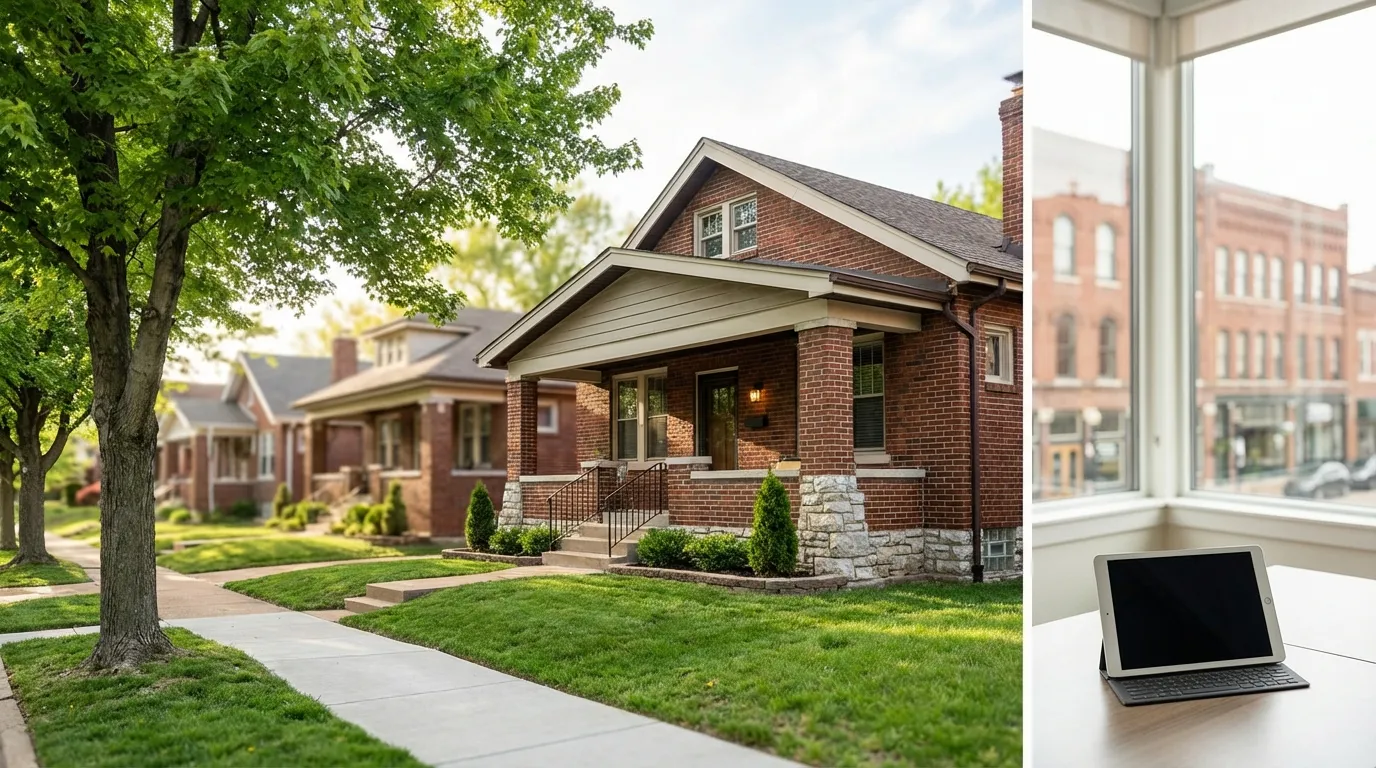
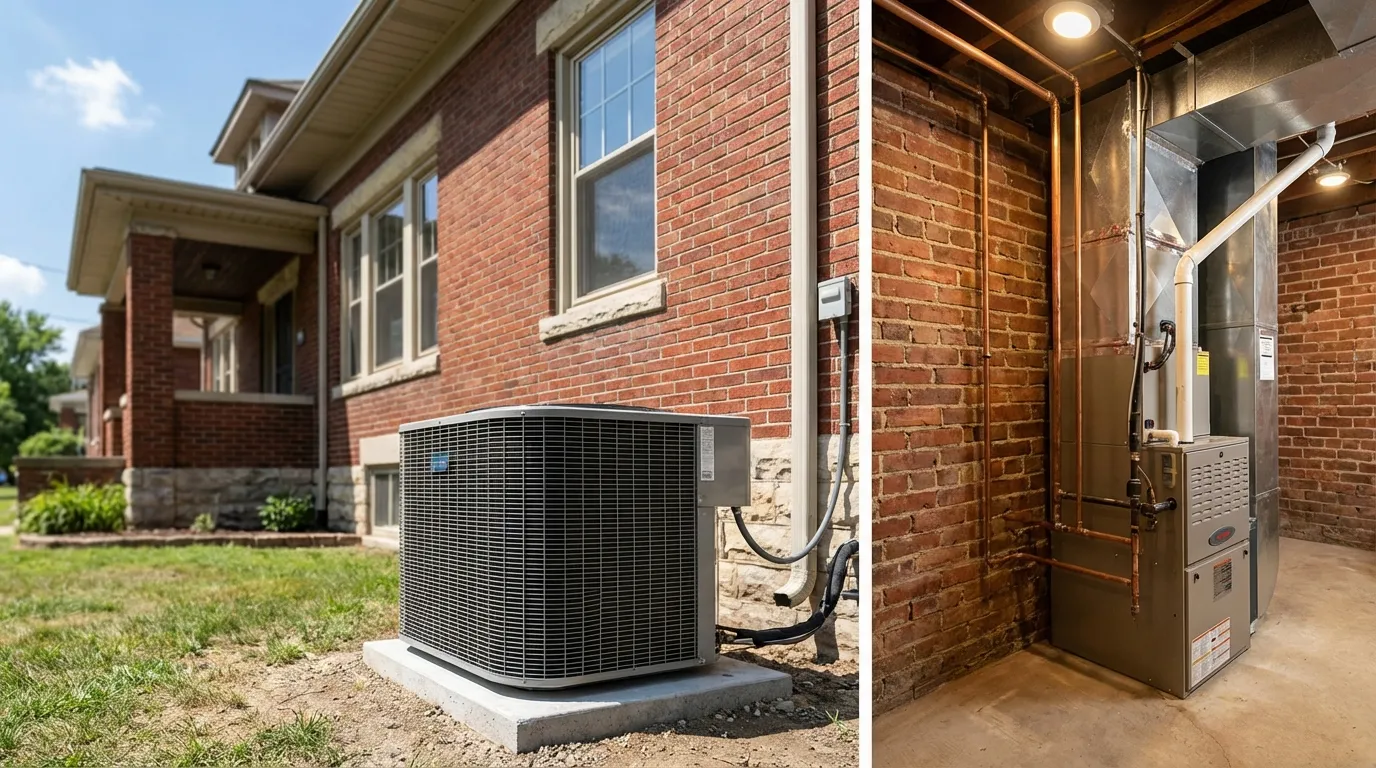
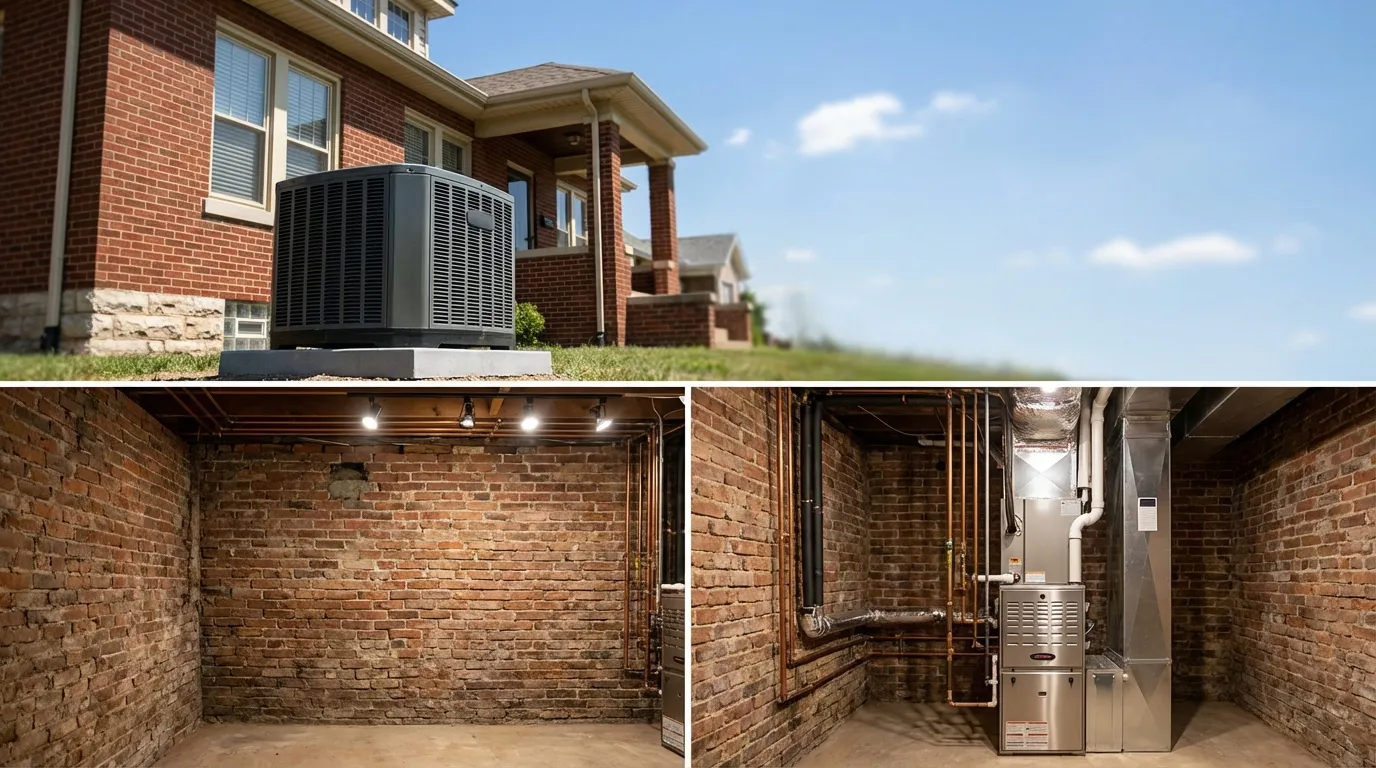
Beyond the competitive landscape, St. Louis presents an HVAC market challenge that most national campaign templates miss entirely: the housing stock. The city and inner suburbs are dense with brick homes and multi-family buildings from the 1920s through 1960s, many of which were originally built with boilers, radiators, and window units. Homeowners who purchased these properties in the 1990s and 2000s had central HVAC retrofitted into buildings not originally designed for ductwork — systems that are now 20–30 years old and operating on aging equipment, undersized ductwork, and increasingly unreliable controls.
This creates a replacement-oriented buyer segment that is distinct from the emergency repair buyer and requires completely different campaign structure. A homeowner searching "new HVAC system St. Louis MO" has a $6,000–$12,000 decision in front of them; they're in research mode, comparing contractors, and will take 3–7 days to convert. Bidding emergency-repair CPCs against this segment wastes budget. Bidding research-phase CPCs and running a remarketing strategy to bring them back — that's how you close HVAC replacement leads at $80–$110 CPL in this market.
The Ameren Missouri rebate program for high-efficiency HVAC equipment is the most systematically underused campaign element in the St. Louis HVAC PPC market. Ameren offers cash rebates for qualifying high-SEER air conditioners, heat pumps, and furnaces — and virtually no St. Louis HVAC advertiser mentions it in ad copy. The phrase "Ameren rebate" in a headline generates measurable CTR lift on replacement-oriented campaigns because it addresses the price objection before the click. That's a competitive angle that costs nothing to implement.
Campaign Architecture for the St. Louis HVAC Market
Winning in St. Louis HVAC requires building around four distinct campaign tracks rather than one generic "HVAC St. Louis" structure. Each track has its own buyer intent, conversion timeline, bid level, and ad copy requirements.
- Emergency heating track: "furnace not working St. Louis," "emergency heating St. Louis MO," "heat went out St. Louis" — CPC $12–$20, peak November–February. Ad copy: same-day response, 24/7 availability, upfront diagnostic fee. Landing page: click-to-call above the fold, emergency urgency framing.
- Emergency AC track: "AC not working St. Louis MO," "air conditioning repair St. Louis," "AC broken St. Louis heat" — CPC $13–$22, peak June–August. Copy must reference the heat index and response time. St. Louis heat emergencies are a health issue for elderly residents — "same-day AC repair" converts at materially higher rates than generic service language during July heat waves.
- Replacement track: "furnace replacement St. Louis MO," "new HVAC system St. Louis," "AC unit replacement St. Louis," "Ameren rebate HVAC St. Louis" — CPC $12–$18. These buyers are in research mode. Run RLSA to recapture them within 7 days of the initial visit. Landing pages should include financing options, efficiency ratings, and the Ameren rebate amount prominently.
- Maintenance and tune-up track: "HVAC tune-up St. Louis MO," "AC maintenance St. Louis," "furnace cleaning St. Louis" — CPC $6–$11, shoulder seasons (March–May, September–October). Lower urgency but high-margin work and strong upsell pathway to replacement campaigns.
Suburb-specific campaigns are the most effective way to reduce CPCs while maintaining coverage. Hoffmann Brothers' strongest Quality Scores are on metro-wide generic terms — their suburb-specific keyword coverage is thinner. "HVAC Chesterfield MO," "furnace repair Kirkwood MO," "AC repair Webster Groves MO" consistently run at $8–$14 CPC, 20–35% below city-wide terms, with comparable conversion rates because the geographic qualifier signals a motivated local buyer.
- Old housing keywords: "boiler repair St. Louis MO," "old furnace replacement St. Louis," "HVAC retrofit St. Louis" — CPC $9–$15, very low competition. These terms reach the aging-housing replacement buyer at a fraction of the cost of generic terms.
- Utility rebate keywords: "Ameren rebate HVAC St. Louis," "energy efficient heat pump St. Louis Ameren" — CPC $7–$12. High CTR on replacement-oriented searchers who are already motivated by the rebate framing.
Ad scheduling should activate 24/7 coverage during polar vortex events (December–February) and peak heat periods (July–August), with standard business hours coverage during maintenance season. Emergency-track campaigns should never daypart during the heating and cooling seasons — HVAC failures don't respect business hours in St. Louis's extreme climate.
Google Partner Agency
We're a certified Google Partner Agency, which means we don’t guess — we optimize withGoogle’s full toolkit and insider support.
Your campaigns get pro-level execution, backed by real expertise (not theory).

The Two-Season Emergency Market
St. Louis is one of a small number of US markets where HVAC operators face genuine dual-season emergency demand. The city's position at the convergence of cold continental air masses and humid Gulf air creates extreme weather in both directions: average January lows of 22–26°F with polar vortex events pushing temperatures into single digits, and average July highs of 88–92°F with a heat index that regularly exceeds 100°F. This isn't seasonal variation — it's two distinct emergency categories, each with its own search surge, bid spike, and buyer psychology.
The data pattern this creates is important for campaign planning. HVAC emergency search volume in St. Louis spikes 2–4x above baseline during polar vortex events in January–February and during heat waves in July–August. Those spikes last 48–96 hours — long enough to exhaust campaign budgets at normal allocation. HVAC companies that run flat monthly budgets miss the highest-value search windows entirely. Dynamic budget allocation — routing pre-set additional budget into emergency tracks when NWS severe weather watches are issued — is the single highest-ROI campaign adjustment available in the St. Louis HVAC market.
The aging housing replacement cycle is the structural demand driver that persists regardless of weather. St. Louis's brick housing stock includes a large cohort of HVAC systems installed in the 1990s and early 2000s when central air was retrofitted into older homes — systems that are now 20–30 years old and at end-of-life. The replacement market generated by this cohort will sustain high search volume for HVAC replacement keywords through the late 2020s as these systems fail one by one. Replacement campaigns produce 35–50% of total HVAC PPC leads in St. Louis for well-structured advertisers, despite running at lower urgency than emergency tracks.
Key insight: The St. Louis western suburbs — Chesterfield, Wildwood, O'Fallon, St. Charles — have above-average household incomes ($85,000–$115,000) and newer housing stock (1990s–2010s) on first or second replacement cycles. Premium system positioning (high-SEER, smart thermostat, extended warranty) performs measurably better with this demographic than it does in city-center campaigns. Suburb-specific campaigns with premium messaging outperform generic metro campaigns on both conversion rate and average job value in the West County corridor.
Running HVAC PPC in St. Louis without knowing the Hoffmann Brothers competitive dynamic, the Ameren rebate angle, and the dual-season emergency pattern is like running a campaign with one hand tied behind your back. Generic HVAC campaign templates — the kind agencies deploy across dozens of markets simultaneously — don't account for the specific competitive landscape, the aging housing stock characteristics, or the extreme weather budget dynamics that define this market.
At MB Adv Agency, our St. Louis HVAC campaigns are built on the research above: four-track campaign architecture, suburb-specific ad groups with lower CPCs, Ameren rebate messaging on replacement tracks, and dynamic budget protocols for polar vortex and heat wave events. We work with HVAC operators targeting the $2,000–$10,000 monthly ad spend range — the range where the right structure makes the difference between 15 leads and 35 leads at the same budget.
See how we structure HVAC campaigns and what results look like at our lead generation services page, or review our pricing tiers to find the right engagement level for your St. Louis HVAC operation. We also manage campaigns for the broader St. Louis metro across all home service categories.
Frequently Asked Questions
How much does HVAC Google Ads cost in St. Louis, and what can I realistically expect?
Clicks in the St. Louis HVAC market cost $10–$22 depending on the keyword category and season. Emergency terms during a polar vortex event hit the upper end of that range. Maintenance keywords during shoulder season hit the lower end. The average CPL for a well-structured campaign runs $65–$110 — meaning a $2,000 monthly budget generates approximately 18–28 leads per month, while a $3,500 budget pushes toward 32–40 leads.
The important nuance: not all HVAC leads are equal in St. Louis. An emergency furnace repair lead in January converts to a job at 70–80% close rate because the buyer has no choice — the heat is off. A replacement inquiry lead converts at 30–45% because the buyer is still comparing contractors. Running these in the same campaign and measuring aggregate CPL hides this distinction. Your emergency CPL may be $55; your replacement CPL may be $120. Both are acceptable given the different job values. The mistake is optimizing only for aggregate CPL and killing the replacement track because it "looks expensive."
Budget allocation across seasons matters as much as the monthly total. Shift 30–40% of annual budget toward January–February and July–August — the polar vortex and heat wave windows — where emergency searches spike and conversion rates peak. Running a flat $2,000/month produces worse annual results than running $1,200/month in shoulder seasons and $3,500/month during peak emergency periods at the same annual total.
How do I compete against Hoffmann Brothers in St. Louis without their advertising budget?
You don't beat Hoffmann Brothers on their terms — you beat them on territory they don't defend. Their campaign structure is built around metro-wide generic terms where their brand recognition and Quality Score give them a structural cost advantage. The competitive opportunity is in the places they don't fight: suburb-specific keywords, aging housing stock terms, utility rebate angles, and service-specific long-tail queries.
Suburb-specific campaigns are the most reliable gap. "HVAC Kirkwood MO," "furnace repair Webster Groves MO," and "AC repair Chesterfield MO" run at $8–$14 CPC — materially below the $13–$18 you'd pay on metro-wide terms — because Hoffmann Brothers' suburb-level Quality Scores are lower than their city-wide coverage. A homeowner searching "AC repair Webster Groves MO" is essentially pre-qualified by the geographic specificity; they're not shopping regionally, they want a local operator. That's a buyer you can win at a fraction of the cost.
The Ameren rebate angle is the single best copy differentiation available right now. No major St. Louis HVAC advertiser is actively using "Ameren rebate" in their headlines as of our research. A headline like "Ameren Rebate + Financing — New HVAC St. Louis" outperforms generic "HVAC Replacement St. Louis" copy on CTR for the replacement buyer who already knows about the rebate and is comparing contractors. It's free differentiation that requires only adding two words to your headline rotation.