Start
$590$990/month
1 platform · Google or MetaGoogle + Meta- Ad spend
- up to $3,000
- New creativesmade by us
- Google + Meta only4 a month
 By Matteo Braghetta, Founder · Google Ads
St. Louis real estate moves fast — median home values up 6.7% year-over-year, average days on market as low as 18–25 in active neighborhoods — and the brokerage market is fragmented enough that a well-positioned independent agent or boutique firm with precise PPC targeting can compete directly with Coldwell Banker Gundaker and Berkshire Hathaway HomeServices on the specific sub-markets that matter most.
See how this city's Real Estate PPC costs compare nationally in our Real Estate PPC Statistics report, featuring data from 40+ US cities.
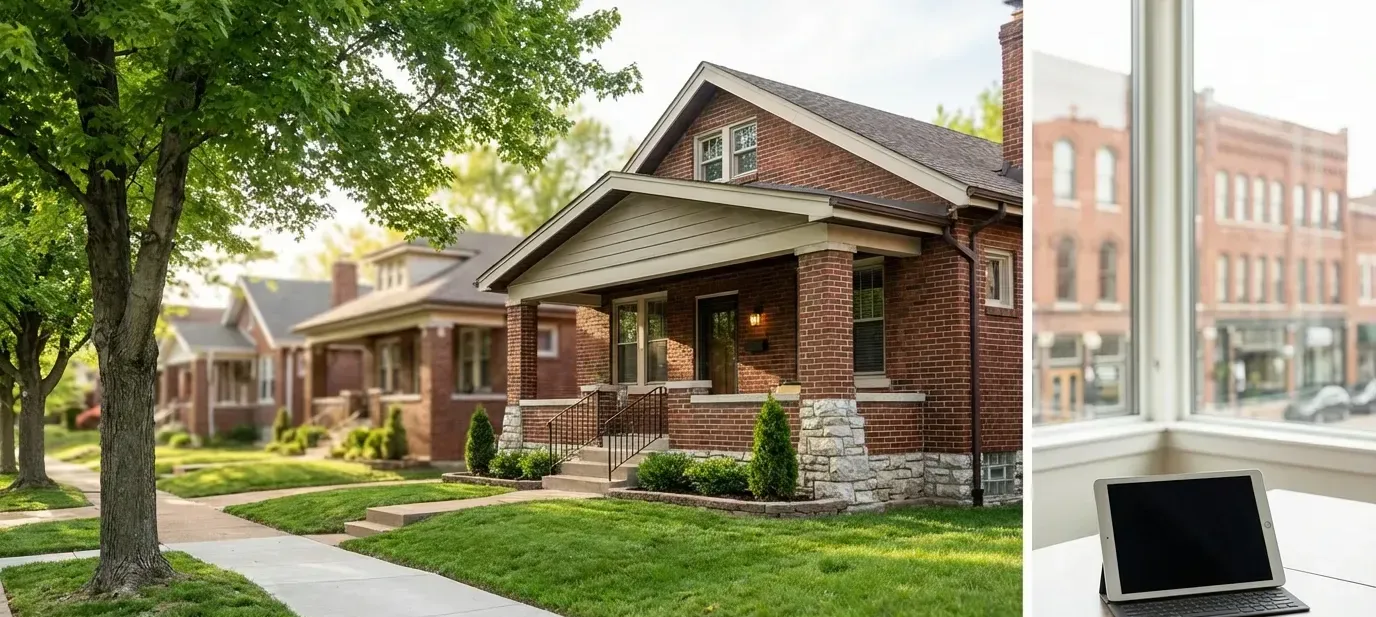
In St. Louis, MO, people search for real estate services about 4,060 times a month on Google; a top-of-page click costs $1.44–$6.90, and demand peaks in March.
Google Keyword Planner · Oct 2025 – Sep 2026
| Search | Monthly searches | Top-of-page CPC |
|---|---|---|
| houses for sale | 1,300 | $0.10–$1.98 |
| homes for sale | 1,000 | $0.10–$2.57 |
| real estate agent | 390 | $3–$13 |
| property management | 260 | $2–$10 |
| commercial real estate | 210 | $0.40–$4.32 |
| realtor near me | 140 | $4–$14 |
| condos for sale | 140 | $0.10–$0.60 |
| real estate broker | 110 | $3–$14 |
| first time home buyer | 110 | $2.00–$7.00 |
| real estate agents near me | 70 | $3–$26 |
US: $9.02
Google Keyword Planner · Oct 2025 – Sep 2026
Source: Google Keyword Planner (Google Ads), Google Search, English, St. Louis, MO, Oct 2025 – Sep 2026. Volumes are Google's monthly averages; CPC is the top-of-page bid range, weighted by search volume. How we collect these figures.
St. Louis doesn't have the single dominant regional brokerage that defines markets like Kansas City (Reece & Nichols) or Pittsburgh (Howard Hanna). Instead, the market is genuinely fragmented: Coldwell Banker Gundaker is the largest local brand, but Berkshire Hathaway HomeServices Alliance Real Estate, Keller Williams St. Louis Metro, RE/MAX Results, and multiple independent boutique firms all hold significant market share. This fragmentation is both a challenge and an opportunity for independent agents running PPC.
The challenge: without a dominant brand to differentiate against, the competitive frame is less clear. In Kansas City, an independent agent can position against Reece & Nichols with "boutique service vs. big brokerage" messaging. In St. Louis, buyers are already comparing multiple brokerages and not anchored to a single dominant brand — which means ad copy needs to differentiate on neighborhood expertise, specific service offers, and proven transaction data rather than simply "vs. the big brand."
The second challenge is the search intent fragmentation in St. Louis real estate. The metro's bistate geography — Missouri on the west, Illinois Metro East on the east — creates a buyer population that doesn't cleanly map to a single "St. Louis real estate" search market. A buyer comparing O'Fallon, MO with O'Fallon, IL (two different cities in two different states with different tax structures and school districts) uses different search queries than a buyer focused entirely on St. Louis County. Generic metro-wide real estate campaigns that don't account for this bistate complexity fail to convert buyers who are doing explicit geographic research.
St. Louis has one of the richest inventories of named historic neighborhoods of any mid-tier Midwest city — Lafayette Square, Soulard, The Hill, Benton Park, Tower Grove South, Dutchtown, Shaw, Compton Heights — and buyers interested in these neighborhoods search by neighborhood name, not by broad metro terms. "Homes for sale Soulard St. Louis" and "Lafayette Square St. Louis MO houses" are searches that large brokerage campaigns don't address with dedicated landing pages. The buyer who includes a historic neighborhood name in their search is not a casual browser — they've done their research, they've decided they want to live in that neighborhood, and they want an agent who specifically knows it. That specificity signal is worth far more than a generic metro buyer.
The most effective St. Louis real estate PPC structure separates three buyer/seller intent types that require fundamentally different campaigns: buyer neighborhood intent, seller lead generation, and bistate market research. Each has different search patterns, different conversion timelines, and different landing page requirements.
Remarketing is unusually important in real estate PPC. The average St. Louis real estate buyer takes 4–12 weeks from first search to signed contract. A campaign with no remarketing structure loses a significant percentage of its leads after the first click — buyers who visited a listing page, looked at the agent's bio, and then went back to search for more options. A 45-day remarketing window with neighborhood-specific ads that reference the property type the user viewed recovers 25–35% of these buyers.
St. Louis's historic neighborhood geography creates a PPC differentiation opportunity that is larger here than in comparable markets. Cities like Kansas City, Indianapolis, or Charlotte don't have the same density of named, distinct, identity-strong neighborhoods within the urban core. St. Louis does — 79 officially recognized neighborhoods in the city proper, many with active neighborhood associations, established resident communities, and buyers who specifically seek those neighborhoods because of architectural character, walkability, local dining, or community feel.
The search data reflects this: "homes for sale Soulard," "Lafayette Square real estate St. Louis," and "Benton Park houses St. Louis MO" generate consistent monthly search volume from buyers who have already completed their neighborhood research and are in active purchase mode. These are among the highest-converting real estate search queries available in the St. Louis market — close rates of 15–25% from inquiry to commission — because the buyer has pre-qualified themselves on neighborhood before clicking. Large brokerage campaigns don't build dedicated landing pages for every one of St. Louis's 79 neighborhoods. Independent agents who do win these buyers.
The St. Charles County growth corridor is the second major insight. O'Fallon, Wentzville, Lake St. Louis, and St. Peters have been among the fastest-growing suburban municipalities in Missouri for the past decade. New construction activity is high, and buyers relocating from St. Louis City or inner suburbs seek the combination of larger homes, newer construction, and lower price points that St. Charles County delivers. "New homes St. Charles County MO" and "new construction Wentzville MO" come with purchase timelines of 60–120 days for new construction — requiring sustained remarketing rather than single-touch conversion campaigns.
Key insight: The bistate real estate market creates an underserved PPC segment that most agents miss. Buyers comparing Missouri and Illinois suburbs — weighing Missouri's lower property tax rates against Illinois's lower sale prices, or comparing school districts across the state line — search explicitly for Illinois city terms. "Edwardsville IL homes for sale" and "O'Fallon IL real estate" face less competition than Missouri-side equivalent terms because most St. Louis real estate agents are Missouri-licensed only and don't build Illinois-specific campaigns.
St. Louis real estate PPC wins on specificity — neighborhood, suburb, seller intent, bistate — not on budget. The agent who builds a dedicated landing page for Lafayette Square buyers, a separate campaign for St. Charles County new construction, and a seller lead campaign for Webster Groves homeowners outperforms the agent running a single "St. Louis real estate" campaign with three times the budget. The market rewards local knowledge expressed through campaign structure.
At MB Adv Agency, we build St. Louis real estate campaigns with full segmentation across buyer intent, neighborhood, and geography. Every campaign is built on the local data: neighborhood-specific search volumes, bistate market dynamics, St. Charles County growth patterns, and the seller lead economics that justify premium bids on listing acquisition keywords. We work with independent agents, boutique brokerages, and multi-agent teams in the $2,000–$8,000 monthly ad spend range.
Explore our approach at lead generation services, review pricing, or see our full St. Louis PPC services.

$2,000/month is the entry point for meaningful real estate PPC coverage in St. Louis, generating 10–18 qualified buyer or seller leads per month at $110–$190 CPL with a well-structured campaign. At that budget level, focus on 2–3 specific neighborhoods or suburbs where you have genuine transaction history and can build the most credible landing pages.
Seller leads require slightly higher budget investment than buyer leads because seller-intent terms cost more per click than buyer-intent terms. But the economics justify it: one closed listing generates $6,000–$15,000 in commission, making a $120–$160 seller lead CPL one of the strongest CPL-to-revenue ratios in any industry. Agents who build dedicated seller lead campaigns — with instant home value estimates as the conversion mechanism — generate listing inventory that produces compounding returns through the buyer-seller dual commission opportunity.
Timeline expectations: first buyer inquiries in 1–2 weeks; seller leads in 2–4 weeks (longer because seller intent is more considered than immediate buyer urgency). CPL stabilizes in 6–8 weeks. Real estate has a longer attribution window than most industries — a buyer who clicks your ad in March may not close until May or June. Ensure your CRM tracks all lead sources across a 90-day window before evaluating campaign ROI.
Three things: historic neighborhood specificity, bistate market complexity, and a fragmented brokerage landscape that leaves gaps competitors don't fill. In markets with one dominant brokerage, independent agents differentiate by positioning against the brand. In St. Louis's fragmented market, the differentiation is geographic and neighborhood-level — which is actually a stronger position because it's harder for large brokerages to replicate at scale.
The historic neighborhood opportunity is uniquely St. Louis. "Homes for sale Soulard St. Louis" and "Lafayette Square St. Louis MO homes" are search queries that don't have equivalents in Kansas City, Columbus, or Indianapolis at the same density or specificity. St. Louis's grid of 79 named neighborhoods, each with distinct architectural character and community identity, creates a buyer population that pre-qualifies itself through neighborhood-specific searches. An agent with two neighborhood-specific landing pages outperforms a competitor with a $10,000 metro-wide campaign on CPL within those specific neighborhoods.
The bistate complexity — Missouri vs. Illinois property tax structures, school district comparisons, licensing requirements — creates an information asymmetry that agents can monetize through PPC. Buyers searching "O'Fallon IL vs O'Fallon MO" or "best suburbs St. Louis Metro East" are looking for exactly the kind of comparative local expertise that an agent with dual-state licensing and bistate landing pages provides. This is a buyer segment that searches with minimal competition — and converts at above-average rates because they're already deep in their research process.
How to read this Cost per click and monthly searches are measured with Google Keyword Planner (see above). Cost per lead, conversion rate, budget and leads are estimates compiled from public benchmarks such as WordStream, not measurements.
Sources WordStream Real Estate 2024; St. Louis neighborhood specificity analysis; bistate market research
$590$990/month
1 platform · Google or MetaGoogle + Meta$790$1,290/month
1 platform · Google or MetaGoogle + Meta$1,140$1,940/month
1 platform · Google or MetaGoogle + MetaChatGPT Ads: a separate pilot, $250/month, added to a plan. See the pilot →

Matteo Braghetta founded MB Adv and runs its Google Ads accounts. He takes the first call with every new client, reads the accounts every week and writes the agency’s guides.
The other half of his job is measurement: GA4, Consent Mode and server-side tracking, so the platforms learn from real sales.
MB Adv is a Google Partner agency managing about $4.4M a year in ad spend for clients in the US, the UK and Europe.
Managed on numbers you can check.
Plans for the US