Plumbing PPC Tulsa, OK
Tulsa's 2021 Winter Storm Uri left thousands of burst pipes across the metro in a 48-hour window — and the plumbers who held position one in Google Ads during that storm generated more revenue in two days than some generate in two months. The 80–130 plumbing companies competing in Tulsa's market face a campaign structure problem that goes far beyond normal keyword bidding: they need campaigns pre-engineered for ice storm surges, not tuned for flat demand.
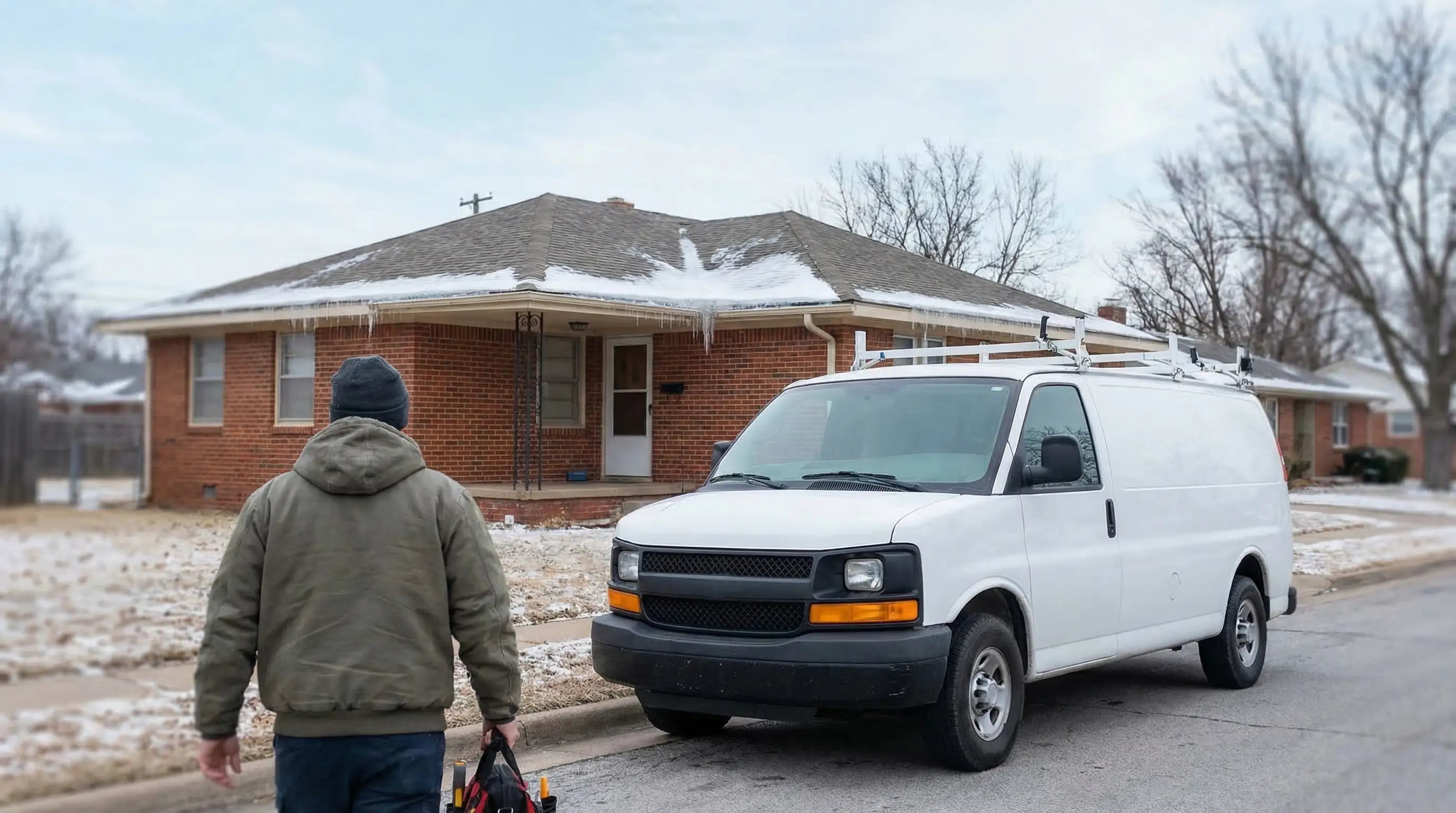
Plumbing PPC in Tulsa is a tale of two markets that require two entirely different campaign strategies — and most plumbers run one that handles neither well. The emergency market is winner-take-all, speed-driven, and seasonally explosive. The non-emergency market (water heaters, drain cleaning, repiping) is price-shopped, review-dependent, and incrementally competitive. Mixing both into one undifferentiated campaign structure produces mediocre results in both.
The National Franchise Spend Wall
Roto-Rooter and Mr. Rooter Plumbing (Neighborly brand) operate in Tulsa with nationally-funded PPC campaigns. Their budgets are not determined by what makes sense for a single Tulsa market — they're set at the brand level and deployed into every metro where they have franchise presence. Both brands run 24/7 campaigns on the highest-volume plumbing keywords, sustaining positions one and two on "plumber Tulsa OK" and "emergency plumber Tulsa" regardless of cost-per-click efficiency.
CPCs for broad emergency plumbing terms in Tulsa run $25–$50/click during normal demand periods — and spike significantly higher during ice storm events when all local plumbers try to surge their bids simultaneously. At $25–$50/click, a local SMB plumber with a $2,500/month budget gets 50–100 clicks per month on emergency terms before budget is exhausted. A franchise running $10,000/month gets 200–400 clicks. The auction math is brutal for smaller operators running undifferentiated broad-match campaigns.
The Ice Storm Timing Gap
Tulsa's most valuable plumbing PPC moment — an ice storm event — is also the moment most local plumbers are least prepared to capitalize on. When the National Weather Service issues a winter storm warning for Tulsa, homeowners begin searching for plumbers to discuss winterization, check vulnerable pipes, and schedule preventive service. Within 24 hours of the storm hitting, "burst pipe repair Tulsa" and "emergency plumber Tulsa 24/7" spike to extreme volume.
Most local plumbing campaigns run flat monthly budgets with no surge logic. When the ice storm hits and search volume triples, their impression share drops — because they don't have pre-configured bid rules to lift budgets during storm events, and because their standard daily budget cap runs out by noon on a surge day. The plumbers who capture the ice storm surge are the ones with pre-staged campaign rules — automated bid increases triggered by budget thresholds or manual pre-storm activation — not the ones with the largest average monthly spend.
The Suburban Service Area Problem
Tulsa's metro geography creates a coverage and targeting challenge for local plumbers. Broken Arrow, Owasso, Bixby, and Jenks represent significant residential plumbing demand — but the franchise presence in each corridor varies and the competitive intensity is materially different from central Tulsa. A flat metro-wide geo-targeting approach wastes budget in corridors where franchise competition is heaviest and underserves corridors where local plumbers can hold position at lower CPCs.
- Central Tulsa: Heaviest franchise presence (Roto-Rooter, Mr. Rooter); highest CPCs ($25–$50 emergency); need geo-specific bid adjustments
- Broken Arrow: Franchise presence but lower density; "plumber Broken Arrow OK" CPCs run $15–$25; local plumbers more competitive here
- Owasso / Jenks / Bixby: Lower franchise density; CPCs $12–$20; local operator with geo-targeted campaigns can build solid suburban presence
- Sand Springs / Sapulpa: West Tulsa industrial and residential corridor; aging housing stock; franchise coverage gaps create local operator opportunity
The geographic reality is that a Tulsa plumber running one metro-wide campaign is overpaying in some corridors and underserving others. Geo-stratified campaigns — with separate bid adjustments and ad copy for each major corridor — produce more efficient lead costs than flat metro targeting.
The Review Speed Problem for Emergency Calls
Emergency plumbing converts differently than any other home services vertical. A homeowner with a burst pipe at 2am searches, scans the top results in under 30 seconds, and calls the first result that shows availability and a strong review count. There is no price comparison. There is no extended research phase. A plumber with 180 Google reviews at 4.7 stars will win that 2am call over a plumber with 25 reviews at 4.9 stars — the raw volume of social proof signals trustworthiness under stress faster than any ad copy element can.
This means emergency plumbing PPC success depends as much on review infrastructure as campaign structure. Plumbers running Google Ads for emergency terms without a systematic post-service review request process are paying for clicks they're failing to convert — not because the ad failed, but because the SERP social proof failed at the decision moment.
A Tulsa plumbing PPC campaign that captures both emergency and non-emergency demand is built on service separation, geo-stratification, surge pre-staging, and review velocity. Each element solves a specific conversion failure mode.
Service-Separated Campaign Architecture
Emergency and non-emergency plumbing search intent are categorically different — and require different bid strategies, ad schedules, landing pages, and conversion paths. Running them in a single campaign dilutes Quality Scores and forces impossible bid compromises:
- Emergency campaign: "burst pipe Tulsa," "emergency plumber Tulsa 24/7," "plumber no heat Tulsa," "frozen pipe Tulsa" — CPC $25–$50; 24/7 ad scheduling; call-only ads on mobile; dedicated emergency landing page with phone number in hero; surge budget rules pre-configured
- Water heater campaign: "water heater replacement Tulsa," "water heater installation Tulsa OK," "tankless water heater Tulsa" — CPC $12–$22; standard hours; form + call conversion; financing option messaging
- Drain cleaning campaign: "drain cleaning Tulsa," "clogged drain Tulsa," "sewer cleaning Tulsa" — CPC $8–$15; standard hours; price-point messaging; same-day availability callout
- Repiping / sewer campaign: "repiping Tulsa OK," "sewer line replacement Tulsa," "galvanized pipe replacement Tulsa" — CPC $15–$28; education-focused landing page; financing messaging; longer decision cycle
- Suburban geo keywords: "plumber Broken Arrow OK," "plumber Owasso OK," "plumber Jenks OK" — CPC $12–$20; geo-specific ad copy referencing local service area; lower franchise competition
Ice Storm Pre-Staging
The highest-ROI structural element in a Tulsa plumbing campaign is not a keyword or bid adjustment — it's the pre-staged surge rule for winter storm events. The specific configuration: a campaign budget rule that automatically increases daily budget by 150–200% when triggered, combined with a manual activation checklist that runs 24–48 hours before a forecasted winter storm. This ensures budget is in place before the surge hits, not after the first day of the storm when reactive competitors have already flooded the auction.
The complementary setup: winterization-focused ads running October–November ("prepare your Tulsa home for ice season — schedule a plumbing inspection") capture proactive homeowners before the first storm and generate non-emergency revenue in the weeks before emergency demand peaks.
Google Partner Agency
We're a certified Google Partner Agency, which means we don’t guess — we optimize withGoogle’s full toolkit and insider support.
Your campaigns get pro-level execution, backed by real expertise (not theory).

Tulsa's plumbing PPC market has two structural characteristics that create outsized returns for plumbers who build their campaigns around them — and that don't appear in any national benchmark report.
The Aging Housing Stock Replacement Wave
Tulsa's housing inventory tells a specific story about plumbing demand that goes beyond the emergency call. The bulk of Tulsa's residential neighborhoods were built between the 1950s and 1980s — homes now 40–70 years old with original galvanized steel or early copper supply lines approaching or past end-of-life. Galvanized pipe life expectancy is 40–70 years. In Tulsa's older neighborhoods (Midtown, North Tulsa, older South Tulsa corridors), repiping demand is entering its peak replacement wave.
This is not an emergency demand category — it's a planned replacement market. Homeowners in these neighborhoods search "galvanized pipe replacement Tulsa," "repipe my house Tulsa," and "whole house repiping cost Tulsa" in a consideration mode, not crisis mode. They're comparing prices, reading reviews, and evaluating contractors over 1–3 weeks. The job values are high: full home repiping in Tulsa runs $5,000–$15,000. A single converted repiping lead from a $300 sub-campaign representing 10–20 clicks at $15–$20/click produces a return of 16–50x on ad spend.
Most Tulsa plumbing campaigns ignore this segment entirely because it doesn't have the urgency spike of emergency work. That's a mistake. The aging housing stock replacement wave is a multi-year demand category that will grow as Tulsa's 1960s-era housing inventory reaches peak replacement age simultaneously.
The Winter Storm Revenue Concentration
Winter Storm Uri in February 2021 is the reference event for understanding Tulsa plumbing PPC economics. In the 72-hour window during and immediately after the storm, plumbing service requests across the Tulsa metro spiked by an estimated 400–600% above typical February volume. Plumbers who were in position in Google Ads during that window — with available technicians, answered phones, and active campaigns — generated revenue equivalent to months of normal work. Plumbers who ran flat budgets that hit daily caps on day one of the storm captured a fraction of the available demand.
Key insight: The Tulsa plumbing market is not a smooth demand curve. It has periodic, predictable storm spikes that represent 3–5 day windows of compressed, extremely high-intent demand. The entire annual ROI on a plumbing PPC campaign can hinge on capturing 2–3 of those windows per year. Campaign architecture that optimizes for the average week performs adequately on average weeks and fails on the weeks that matter most. Architecture that pre-stages for surge events wins the weeks that define annual revenue.
Plumbing PPC in Tulsa is a surge-driven, geography-stratified, review-dependent market — and campaigns built around the national average plumbing advertiser profile will consistently underperform here. The Tulsa-specific factors that matter: the ice storm surge windows that concentrate demand in 48-hour bursts, the aging housing stock replacement wave driving repiping demand in older neighborhoods, and the suburban corridors (Broken Arrow, Owasso) where franchise competition is weaker and local plumbers can hold position at $12–$20/click instead of $30–$50/click.
MB Adv Agency builds Tulsa plumbing campaigns with the surge infrastructure built in from day one — pre-staged budget rules for winter storm events, service-separated campaign architecture for emergency vs. non-emergency work, geo-stratified bid adjustments for each major corridor, and review velocity tracking to ensure the social proof signal is maintaining pace with the ad spend. We understand the difference between a $1,500/month solo plumber optimizing for water heater replacements in Broken Arrow and a $4,500/month multi-truck operation seeking to dominate emergency calls across the full metro. The strategy is different — the campaign structure is different — and we build both.
See our services and pricing to see how we build plumbing PPC campaigns for Tulsa operators at every scale.
Frequently Asked Questions
How do I set up my Tulsa plumbing Google Ads campaign to handle winter storm surges?
The core principle is pre-staging, not reactive scaling. By the time your phones are ringing off the hook during a Tulsa ice storm, it's too late to log into Google Ads and increase your budget — your daily cap ran out six hours earlier while you were running service calls. The surge infrastructure needs to be in place before the storm season begins.
Specifically: set up Google Ads automated rules that can increase your emergency campaign daily budget by 150–200% with a single trigger. Create a manual activation checklist that fires 24–48 hours before a forecasted winter storm warning in the Tulsa metro — this is typically visible on NWS forecasts 36–72 hours out. The checklist: activate emergency budget surge, confirm 24/7 ad scheduling is active for the emergency campaign, switch mobile campaigns to call-only format, and verify the emergency landing page phone number is routing correctly.
The second element is budget allocation structure. Keep your emergency campaign budget separate from your water heater and drain cleaning budgets. A shared campaign budget during a storm event means your non-emergency campaigns compete with your own emergency campaign for daily cap. Separate campaigns with separate budgets ensure the emergency surge doesn't cannibalize your baseline service line ads. During a 72-hour storm event, the emergency campaign should receive 60–70% of total daily budget — that's where the highest-value calls are concentrated.
Is Google Ads worth it for a small Tulsa plumbing company with a $2,000/month budget?
Yes — but only if the $2,000 is allocated by service type, not spread equally across everything. A $2,000 budget attempting to cover emergency plumbing ($25–$50/click), water heater replacement ($12–$22/click), drain cleaning ($8–$15/click), and repiping ($15–$28/click) simultaneously will produce inadequate impression share in every category. At $2,000/month, focus on 2 service lines and own them.
The recommended allocation for a small Tulsa plumber at $2,000/month: $1,200 on emergency + water heater (the two highest-value service calls), $800 on suburban geo keywords (Broken Arrow or Owasso, where CPCs are 20–35% lower than central Tulsa and franchise competition is weaker). At $12–$20/click in the suburban geo segment, $800/month generates 40–65 clicks. Converting 15–20% to calls produces 6–13 qualified service calls per month. At average ticket values of $200–$500, that's $1,200–$6,500 in revenue from $800 in suburban spend — before emergency calls are counted.
The ROI case improves significantly during winter storm events. Pre-staging a one-time budget surge to $3,500–$4,000 for a 3-day storm window — funded by reducing spend in slower months — can produce 20–40 emergency calls during the storm at average emergency call values of $300–$2,500 (depending on repair scope). A single burst pipe repiping case from a storm event at $5,000–$8,000 covers the entire monthly ad budget for 2–4 months. The math justifies the surge investment; the campaign structure needs to be ready to execute it.