Roofing PPC Tulsa, OK
Oklahoma consistently ranks in the top 3–5 states nationally for hail damage — and Tulsa sits squarely in the highest-frequency hail corridor in the northeast part of the state. After the April 2023 hail event dropped golf ball-sized hail across Greater Tulsa, roofing lead volume surged 300–600% within 48 hours. The contractors who captured that surge weren't the ones with the best ads — they were the ones whose campaigns were already pre-staged to activate the moment the storm cleared. <!-- stats-article-link --> <p><em>See how this city's Roofing PPC costs compare nationally in our <a href="/resources/roofing-ppc-statistics">Roofing PPC Statistics</a> report, featuring data from 40+ US cities.</em></p>
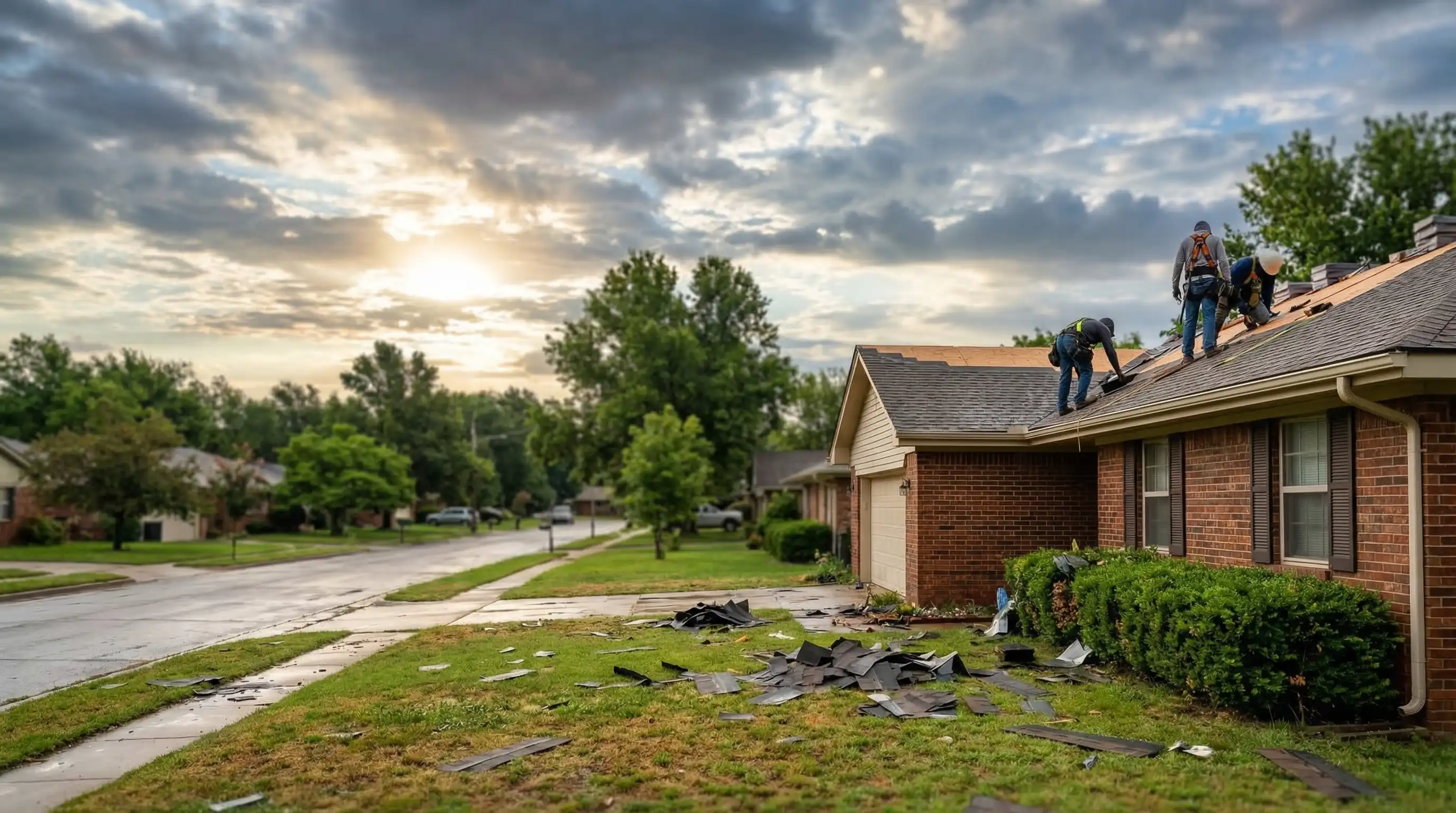
The Tulsa roofing market operates on two speeds: baseline and storm surge. Baseline demand is steady — 51.9% homeownership across a metro of 1.06 million, aging housing stock, and normal wear-and-tear replacement creates consistent search volume year-round. But storm surge is something different entirely. When a significant hail event hits the Tulsa metro, search volume for roofing services spikes 300–600% within 48 hours. The contractors who capture that demand aren't necessarily the best — they're the ones who were positioned before the storm landed.
The Out-of-State Storm Chaser Problem
Tulsa's storm-driven roofing market has a structural challenge that doesn't exist in calmer markets: out-of-state storm chasers. After every significant hail or tornado event, crews from Texas, Arkansas, and Missouri flood the Tulsa metro. They knock doors aggressively, undercut local pricing, and run temporary Google Ads campaigns targeting the same post-storm keywords your campaign targets. During the 2023 hail event, some local roofers reported seeing CPCs spike to $35–$55/click as out-of-state advertisers piled into the Tulsa market simultaneously.
The homeowner's experience during a storm surge is chaotic: 10+ door-knocks in a week, aggressive solicitations, price shopping, and confusion about who's legitimate. Messick Roofing & Construction, Roof Co., and Burggraf Roofing — established Tulsa roofers with A+ BBB ratings and decades of local presence — have to compete not just against each other but against a rotating cast of out-of-state operators who have no long-term reputation at stake. PPC campaigns for local roofers must emphasize local roots, licensing, and BBB standing in their ad copy to differentiate from the storm chasers.
Baseline Versus Surge Budget Management
The core operational challenge for Tulsa roofing PPC is budget allocation across two very different demand states. Baseline search — planned replacements, end-of-warranty repairs, insurance settlement follow-ups — runs at $15–$30/click on general roofing terms. Post-storm surge can push CPCs to $35–$55/click while simultaneously driving 5–10x the normal search volume. A flat-budget campaign that's sized for baseline demand will exhaust its daily budget within hours of a major storm event — right when the highest-value leads are searching.
This creates a counter-intuitive problem: Tulsa roofing companies often spend their entire monthly budget in a single post-storm week and then go dark for the rest of the month, missing the steady stream of planned replacement and insurance settlement searches that continue afterward. The right structure is a tiered budget system with a baseline campaign running at controlled spend and a pre-configured storm surge campaign with a separate daily budget cap that activates when needed.
- Baseline campaign CPCs: $15–$30/click — "roof replacement Tulsa," "roofing contractor Tulsa OK," "new roof Tulsa"
- Storm surge CPCs: $30–$55/click — "hail damage roof Tulsa," "storm damage roof repair Tulsa," "insurance roof claim Tulsa"
- Suburban corridor CPCs: $12–$22/click — "Broken Arrow roofing contractor," "Owasso roof replacement," "Jenks roofer"
The insurance claim keyword category deserves particular attention. "Insurance roof claim Tulsa," "hail damage roof repair Tulsa," "file roof insurance claim" — these keywords signal homeowners who are ready to act, have financial coverage in place, and are making a high-value purchase decision. Insurance-driven replacement jobs in Tulsa run $8,000–$16,000 per job. Missing these keywords because your campaign isn't structured to capture them is the single largest revenue gap in most Tulsa roofing campaigns.
A Tulsa roofing PPC campaign needs two parallel structures running simultaneously: a baseline always-on campaign that captures planned replacement and suburban corridor demand, and a storm surge infrastructure that activates within hours of a confirmed weather event.
Always-On Baseline Campaign Structure
The baseline campaign handles non-emergency demand — planned replacements, homeowners researching after noticing granule loss or age-related wear, and neighbor referral follow-up searches. This is where a consistent monthly budget generates steady lead flow without volatility:
- Replacement intent: "roof replacement Tulsa OK," "new roof Tulsa," "roofing contractor Tulsa" — CPC $15–$25; form fill preferred; longer decision cycle landing page with ROI content
- Insurance claim intent: "hail damage roof Tulsa," "insurance roof repair Tulsa," "roof insurance claim help Tulsa" — CPC $18–$35; dedicated landing page explaining the Oklahoma insurance claim process; high trust signals
- Suburban geo split: "Broken Arrow roofing contractor," "Owasso roofer," "Bixby roof replacement" — CPC $12–$22; lower competition, higher efficiency per ad dollar
- Brand/trust defense: Branded terms + competitor name modifiers — captures high-intent searchers already aware of the Tulsa roofing market
The insurance claim category is the highest-priority keyword group for Tulsa specifically. Oklahoma's consistent top-5 ranking for hail damage means that a significant percentage of Tulsa homeowners have open or pending insurance claims at any given time. Capturing them at the search stage — before a storm chaser knocks their door — is the most defensible position a local roofer can hold.
Storm Surge Infrastructure: Pre-Configuration, Not Reaction
The storm surge campaign exists in draft form year-round. It's not built in a hurry after a hail event — it's built in advance, tested, and sitting ready. When NOAA issues a severe weather watch for the Tulsa metro or a confirmed hail event is reported, the activation protocol runs within hours: the surge campaign goes live, daily budget caps lift, bid adjustments increase 40–60%, and ad copy switches to storm-response messaging ("Hail Hit Your Neighborhood? Get Your Tulsa Roof Inspected Today").
Post-storm ad copy must do specific work. It needs to establish local credibility (licensed Oklahoma roofing contractor, A+ BBB, local crews — not out-of-state), explain the insurance claim process in the headline or description, and emphasize free inspection offers that lower the first-step commitment. Storm-chaser competitors knock doors with cash offers and pressure tactics — your PPC ad needs to counter that with trustworthiness signals and a low-friction first action (free inspection, not a sales call).
Timing matters. The post-storm window has a hard edge: most homeowners file insurance claims within 7–14 days of a storm. After that, they're in the contractor selection phase, not the search phase. A campaign that takes 48–72 hours to activate because it wasn't pre-staged misses the highest-intent search window entirely.
Google Partner Agency
We're a certified Google Partner Agency, which means we don’t guess — we optimize withGoogle’s full toolkit and insider support.
Your campaigns get pro-level execution, backed by real expertise (not theory).

Tulsa's roofing market has a geographic pattern that most campaigns ignore. The highest-risk hail corridors in the Tulsa metro aren't randomly distributed — NOAA historical hail data shows that northeast Oklahoma has a documented high-frequency hail path that runs through specific parts of the metro. The areas along and east of the Broken Arrow Expressway (US-64), through Broken Arrow, Catoosa, and Claremore, see higher average hail event frequency than South Tulsa or the western suburbs.
The Post-Storm Neighbor Referral Multiplier
One of the most underappreciated dynamics in Tulsa roofing PPC: a single storm job can generate 3–5 neighbor referrals. When a roofing crew is working on a home in a Tulsa subdivision, neighbors notice — especially when the same storm damaged their roof. Homeowners who see a professional crew in their neighborhood search specifically for that contractor by name or call them directly. This means that each PPC-acquired storm job has a referral multiplier that doesn't appear in standard lead attribution.
Key insight: Targeting suburban subdivisions with tight geo-targeting during post-storm periods — not just broad Tulsa metro keywords — captures searches from homeowners who saw a crew in their specific neighborhood. "Roof repair [subdivision name] Tulsa" and hyper-local storm response keywords convert at higher rates than generic metro terms because the searcher has already seen physical proof of the contractor's presence nearby.
The Insurance Settlement Lag Opportunity
Tulsa insurance claim timelines create a search behavior pattern that most roofers miss: the settlement lag. Homeowners file a claim within days of a storm, but insurance adjusters take 4–8 weeks to process and approve Oklahoma residential roof claims. During that waiting period, search volume for "roofing contractor Tulsa" doesn't disappear — it continues. Homeowners research contractors, get estimates, and line up their chosen roofer before the check arrives.
This means that roofing PPC campaigns shouldn't drop budgets 2–3 weeks after a storm event. The lead flow continues at a moderate level for 6–10 weeks post-storm as insurance settlements process and homeowners move from research to contractor selection. A campaign that ramps down too quickly misses the second wave of planned-replacement searches that comes after the initial emergency surge fades.
- Week 1–2 post-storm: Peak emergency search volume; highest CPCs; storm inspection leads
- Week 3–6: Insurance claim processing phase; homeowners researching and estimating; moderate search volume
- Week 7–12: Insurance settlement approvals; homeowners selecting contractors; conversion-ready leads
- Month 4–6: Neighbor referral tail; planned replacements in the same affected corridors
A roofing campaign built around this timeline — rather than a spike-and-stop approach — captures the full economic value of each storm event. The difference between a roofer who runs their campaign for 2 weeks post-storm and one who sustains it for 10 weeks is often 40–60% more total revenue from the same storm event.
Tulsa roofing PPC requires a manager who understands Oklahoma's storm-driven market economics — not a national agency applying a standard contractor template. The difference between capturing a storm surge and missing it is measured in hours, and it requires pre-built infrastructure, not a reactive scramble.
At MB Adv Agency, our Tulsa roofing campaigns maintain storm surge infrastructure on standby year-round. We track NOAA severe weather alerts for the Tulsa metro, and our activation protocol for post-storm campaigns runs within hours of a confirmed hail event. We've built the insurance claim keyword strategy, the trust-differentiation ad copy, and the post-storm landing pages in advance — so when the hail hits, we're not building. We're deploying.
Our lead generation approach for Tulsa roofing focuses on the full post-storm timeline — not just the first-week spike. We sustain budget through the insurance settlement lag, capture the neighbor-referral tail, and maintain a year-round baseline campaign for planned replacements. The result is a consistent lead pipeline rather than a feast-or-famine cycle tied entirely to storm activity.
We work with Tulsa roofing companies in the $2,000–$10,000/month ad spend range. Review our pricing tiers — our flat-fee structure means we don't benefit from inflating your storm surge spend. We benefit from delivering roofing jobs at the lowest sustainable CPA, storm season and off. Your Tulsa PPC landing page is already live — add roofing campaign management to it.
Frequently Asked Questions
How quickly should I activate Google Ads after a Tulsa hail storm?
Within hours, not days. The post-storm search window is not forgiving. Homeowners who discover hail damage search immediately — most within the first 12–24 hours of the storm clearing. Out-of-state storm chasers who run Tulsa-targeted ads already have campaigns staged and ready to activate because they follow storm systems professionally. If your campaign takes 48–72 hours to get live, you're competing for the second-wave searches instead of the highest-intent first-wave calls.
The practical implication: your storm response campaign should be built before storm season, not during it. A pre-configured surge campaign with Oklahoma-specific ad copy, a storm inspection landing page, and pre-set bid rules can go from draft to active in under 2 hours. That's the standard for a Tulsa roofing market. CPCs during peak post-storm demand run $35–$55/click — high, but the math works when replacement jobs average $10,000–$16,000 each.
Timing within the post-storm window also matters for which keywords you prioritize. In the first 48 hours: emergency inspection keywords ("hail damage roof inspection Tulsa," "storm damage roof check Tulsa"). In weeks 2–6: insurance claim process keywords. In weeks 7–12: contractor selection keywords as settlements process. A campaign that runs the same keyword mix throughout the entire post-storm period misses the conversion intent signal that shifts over time.
What's a realistic lead cost and return for roofing PPC in Tulsa?
Baseline search (non-storm, planned replacements): at $15–$30/click and a landing page conversion rate of 8–12%, you're generating leads at $125–$375 per lead. With a typical close rate of 25–35% and average job values of $9,000–$13,000, baseline roofing PPC in Tulsa returns $5–$15 for every $1 spent on ads — assuming a properly structured campaign with dedicated landing pages.
Post-storm periods change the math significantly. CPCs spike to $35–$55/click, but conversion rates also increase because the purchase intent is immediate. Homeowners searching "hail damage roof Tulsa" right after a storm have zero ambiguity about their need. Conversion rates during peak post-storm windows often run 12–18% — which offsets the higher CPC. A storm-period CPL of $200–$450 against a $12,000 average insurance job still produces 25–60x return per converted lead.
The biggest ROI variable in Tulsa roofing PPC isn't the CPC — it's the close rate. Companies with fast inspection response times (same-day or next-day), strong BBB ratings, and clear insurance claim navigation support close at 35–50% of generated leads. Companies without those elements close at 15–20%. That difference — on a $12,000 average job — is the difference between a $300 CPL campaign that makes money and one that breaks even. The campaign generates the calls. The sales process determines the return.