Roofing PPC Houston, TX
Hurricane Harvey caused $125 billion in total damage across the Houston metro and post-storm roofing searches spike 300–500% above baseline — making pre-staged surge campaigns the single most important competitive advantage for Houston roofing contractors, separating the companies that win every storm window from those that react too late. <!-- stats-article-link --> <p><em>See how this city's Roofing PPC costs compare nationally in our <a href="/resources/roofing-ppc-statistics">Roofing PPC Statistics</a> report, featuring data from 40+ US cities.</em></p>
Houston Roofing PPC: Two Demand Types, One Broken Market
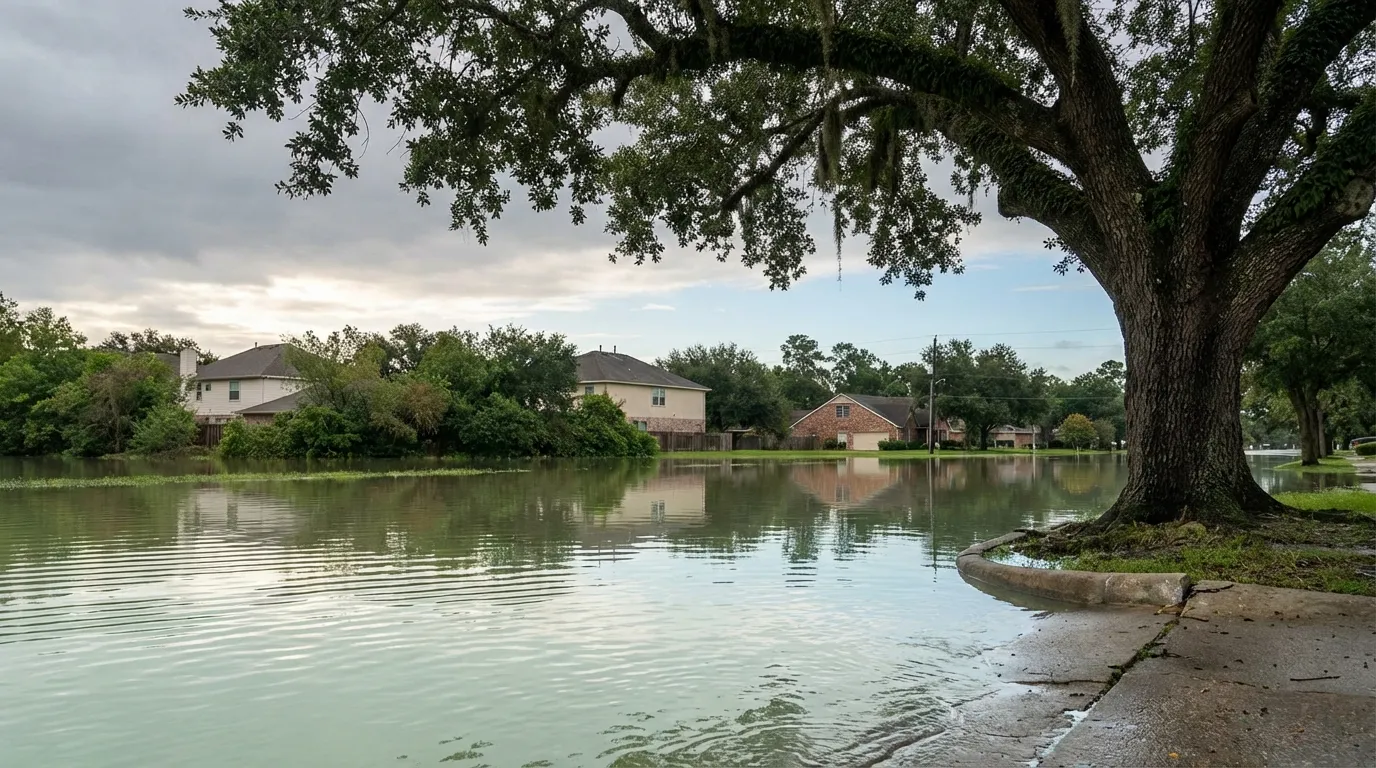
Roofing PPC in Houston operates on a compressed, high-stakes calendar unlike any other US market. Demand doesn't build gradually — it explodes. Hurricane Harvey (2017) caused $125 billion in total damage across the metro, and post-storm roofing searches spiked 300–500% above baseline within 72 hours. Every named storm, every golf ball-sized hail event in Houston's active position within national Hail Alley, every tropical depression tracking through the Gulf creates a compressed window where the right campaign structure generates 50+ qualified leads in a single week — or loses every one of those leads to a competitor whose infrastructure was already staged.
CPCs run $15–$55 in normal conditions. In the two to eight weeks following a named storm or major hail event, emergency terms spike to $30–$80+ per click as every contractor in the metro — and many from outside it — increases bids simultaneously. The competition during those windows includes established national operators: Storm Guard Roofing brings franchise PPC infrastructure optimized specifically for post-storm surge. Beldon Roofing carries regional brand recognition across Texas. Amstill Roofing and Longhorn Roofing maintain year-round Houston digital presence that accumulates Quality Score advantage before storms ever hit.
The Texas Licensing Gap and the Trust Problem It Creates
Texas has no statewide roofing contractor license requirement. After every major Houston storm, the metro floods with out-of-state storm-chasers — unlicensed, unaccountable operators who collect deposits, do incomplete work, and disappear. The Texas Attorney General's office pursued multiple enforcement actions after Harvey. This history makes Houston homeowners uniquely skeptical of roofing contractors — particularly in the weeks after a storm. A high CPC alone is not the problem; clicks are worthless if the landing page doesn't immediately resolve that credibility gap with specific signals: GAF Master Elite certification (held by fewer than 2% of US roofers), a verifiable local address, years in the Houston market, and a named contractor who answers for the work.
Two Demand Types That Need Two Campaign Architectures
Houston roofing PPC operates on two distinct demand cycles that require separate structures — not one campaign trying to serve both:
- Storm surge demand: High urgency, insurance-claim-driven, concentrated in affected zip codes, mobile-dominant. CPCs $30–$80+ post-storm. Best channel: Google Search + Facebook geo-targeted to affected zip codes within 48 hours of the event.
- Planned replacement demand: Research-intensive (2–4 week decision cycle), 3+ quote comparison, warranty documentation and certification signals matter more than speed. CPCs $18–$40. Best channel: Google Search + LSA for trust + retargeting to recapture quote-seekers.
A single campaign running identical messaging for both demand types underperforms both. A storm-period homeowner needs an inspector on their roof within 48 hours. A planned-replacement customer is researching GAF vs. CertainTeed shingles and wants transferable warranty documentation. The conversion mechanisms are different enough to require dedicated ad groups, distinct landing pages, and separate creative — not a single generic "roofing company Houston" campaign attempting to cover the full market.
Building a Houston Roofing PPC System That Wins Both Demand Windows
The structural requirement is a two-mode system: a well-optimized baseline campaign for planned replacement demand running year-round, and a pre-staged surge campaign ready to activate within 24 hours of a storm event. Companies that build only one of these capture half the market at best. Companies that build both and execute the storm pivot reliably own the full revenue calendar.
Platform Stack: Search + LSA + Facebook Storm-Targeting
Google Search Ads capture high-intent replacement and repair demand that runs year-round. Google LSA (Google Guaranteed) is critical for trust in a post-Harvey market skeptical of roofing contractors — the badge signals background-checking that storm-chasers structurally cannot replicate. Facebook and Instagram Ads perform unusually well for roofing in Houston because of one specific capability: zip-code targeting of storm-affected areas. Within 48 hours of a hail event, roofing companies can deploy "Hail damaged your roof? Free same-day inspection" ads to homeowners in the affected zip codes at CPCs 40–60% lower than Search, because Facebook competition lags behind the storm by 2–4 days. This tactic, executed consistently, is one of the highest-ROI moves in all of Houston home services advertising.
Keyword Groups by Intent and CPC Range
- Storm / emergency: "hail damage roof Houston," "storm damage roofer near me," "hurricane roof damage Houston TX" — $25–$55 CPC normal; $40–$80 post-storm
- Planned replacement: "roof replacement cost Houston TX," "roof replacement Houston," "GAF certified roofer Houston" — $18–$40 CPC; research-phase buyers
- Insurance claim: "insurance claim roof replacement Houston," "file roof damage claim Houston" — $20–$45 CPC; very high intent; insurance navigation expertise is the key differentiator
- Submarket / local: "[suburb] roofing company," "roofing contractor Katy TX," "The Woodlands roofer" — $15–$30 CPC; lower competition, high geographic relevance signal
Normal Mode vs. Storm Mode Targeting
In normal periods: 20–25 mile radius from business location, with priority bid adjustments for The Woodlands, Katy, Sugar Land, and Pearland — the highest home values in the metro, meaning the largest average contract sizes. In storm response mode: immediate pivot to affected zip code targeting. Use NOAA storm damage reports and local news coverage to identify affected zip codes, then within 24–48 hours concentrate budget on those areas with storm-specific creative. The speed advantage is decisive — most competitors react in 3–5 days. The first mover captures the highest-urgency demand window, when homeowners are simultaneously in greatest need and least resistant to scheduling an inspection.
A $5,000/month baseline budget allocates to: $2,500 Google Search, $1,000 Google LSA, $1,000 Facebook (storm geo-targeting + retargeting), $500 contingency surge reserve. When a major storm hits, reallocate immediately to $10,000–$20,000+ for the 4–6 week peak — the demand-to-advertiser ratio shifts dramatically in your favor during that window.
Google Partner Agency
We're a certified Google Partner Agency, which means we don’t guess — we optimize withGoogle’s full toolkit and insider support.
Your campaigns get pro-level execution, backed by real expertise (not theory).

Houston Roofing Market Data: The Numbers Behind Your Competitive Position
Houston's roofing market holds 2,500–3,000 contractors in normal periods — a number that inflates dramatically post-storm as out-of-state operators enter the metro. Harvey inflated the contractor count through 2019 before normalization. The baseline count overstates real competition: established, locally-credentialed SMBs who maintain consistent PPC presence are a much smaller group. The entry and exit pattern means every major storm both intensifies and temporarily obscures the competitive landscape, creating a window where local credibility and campaign infrastructure matter more than raw advertiser density.
The Insurance Restoration Revenue Layer
Approximately 25% of Houston roofing revenue flows through insurance restoration claims. Post-storm, insurance-claim customers are highly motivated buyers — their deductible is covered, the scope of work is pre-authorized, and their primary decision criteria is "is this contractor credible enough to work with my adjuster?" This is why GAF Master Elite certification — held by fewer than 2% of US roofers — converts better in ad copy than generic price or speed claims. The Houston homeowner post-Harvey has been burned; certification and documented local longevity are the trust signals that survive that skepticism and produce conversion.
Houston's position in national Hail Alley — the DFW/San Antonio/Houston triangle that receives the highest large-hail frequency in the US — generates multiple significant hail events annually, each producing a demand spike. Hail season peaks March–May and again September–October. A roofing company running no PPC during those windows is invisible to homeowners who receive a hail damage notice from their insurance company and immediately search for contractors. Both the spring and fall hail windows are predictable enough to pre-stage in advance.
The Spanish-Language Gap in Post-Storm Demand
Houston's 44% Hispanic homeowner population represents a significant post-storm roofing demand segment that almost no Houston roofers address bilingually. East Houston (zip codes 77011–77015), Pasadena (77502–77506), and Southwest Houston (77477, 77036) have dense Hispanic homeownership and sustained hail and hurricane exposure. Spanish-language roofing keywords like "reparación de techo Houston" and "daño de granizo techo Houston TX" carry CPCs 40–60% lower than English equivalents, with minimal advertiser competition. A contractor running Spanish-language surge campaigns in affected zip codes post-storm reaches a high-homeownership, underserved audience at a fraction of the cost of English-only campaigns targeting the same geography.
A national roofing PPC agency sees "Houston roofing" as a metro keyword. Local knowledge understands that The Woodlands and Memorial Village require entirely different messaging — premium warranty documentation and certification signals for an $800K home versus speed and price transparency for a storm-hit Pasadena bungalow. It knows that Harvey fraud memory is still active in Houston's older neighborhoods, and that landing pages without a local physical address, license documentation, and reviews from recognizable Houston neighborhoods convert significantly lower than those with explicit local credibility signals built in from the headline.
MB Adv Agency builds Houston roofing PPC campaigns with pre-staged storm-surge infrastructure — Facebook geo-targeting campaigns ready to activate within 24 hours of a hail or tropical storm event, LSA profiles optimized for post-Harvey consumer trust standards, and submarket-specific messaging across the full metro from River Oaks to Baytown. Our lead generation system captures both the planned-replacement customer and the emergency storm responder — because in Houston, the market shifts between those two modes without warning, and the company with both systems staged wins both windows.
See how transparent PPC pricing works for Houston roofing campaigns — no long-term contracts, no setup fees.
Frequently Asked Questions
What does roofing PPC cost in Houston?
A competitive Houston roofing PPC baseline costs $3,000–$6,000/month for consistent planned-replacement and storm-capture lead generation. During post-storm surge — the 2–8 weeks following a named storm or major hail event — effective spend scales to $8,000–$20,000+/month as demand volume and advertiser competition both spike simultaneously. CPCs in normal conditions range from $18 to $45 across primary replacement keywords; post-storm emergency terms hit $40–$80 as all contractors increase bids in the same demand window.
Expected CPL at a $3,000/month baseline: $60–$120 per qualified lead for planned replacement inquiries; $40–$80 during storm surge, when demand spikes compress CPL despite higher CPCs because the searcher pool is so much larger. Google LSA is particularly effective for Houston roofing because the Google Guaranteed badge provides the post-Harvey credibility signal that distinguishes local contractors from storm-chasers. LSA leads tend to close at 20–35% from inspection-to-contract, compared to 10–18% for standard search leads.
The most common budget mistake: maintaining a flat monthly spend that cannot capitalize on storm events. A $3,000/month annual average with a pre-authorized storm surge protocol — allowing up to $15,000 for 4–6 weeks after a major storm — will consistently outperform a flat $8,000/month campaign that burns budget in January when roofing demand is at its lowest point of the year.
How do Houston roofers compete against national franchise chains in PPC?
National roofing franchises like Storm Guard have pre-built post-storm campaign protocols, centralized budgets, and brand recognition that individual SMBs cannot match head-to-head on broad terms. The winning strategy is to compete on specificity, speed, and local trust — not raw spend. Three tactics consistently outperform franchise presence in the Houston market:
- GAF Master Elite certification messaging: Fewer than 2% of US roofers hold this designation. It's the single strongest trust signal in a post-Harvey market where homeowners have been defrauded by uncredentialed operators. A Google ad featuring "GAF Master Elite — Houston Since [year]" consistently outperforms generic franchise ads on CTR in competitive split tests because the signal is specific, verifiable, and rare.
- 24-hour storm response speed: Franchises route leads through regional call centers. An independent contractor who answers immediately and dispatches an inspector same-day captures storm inquiries sitting in franchise queues. Speed of response — not brand name — wins the post-storm inspection.
- Facebook zip-code storm targeting: National franchises run broad metro campaigns. An SMB with Facebook geo-targeted to affected zip codes — deployed within 24 hours — appears hyper-locally relevant in homeowners' feeds at 40–60% lower CPCs than Search, reaching them before competitors even update their campaigns.
The combination of these three tactics makes the "local, credentialed, fast" positioning more effective for Houston SMB roofers than trying to outspend franchises on broad terms where the budget gap is insurmountable.