
What Is International SEO? hreflang & URL Structure

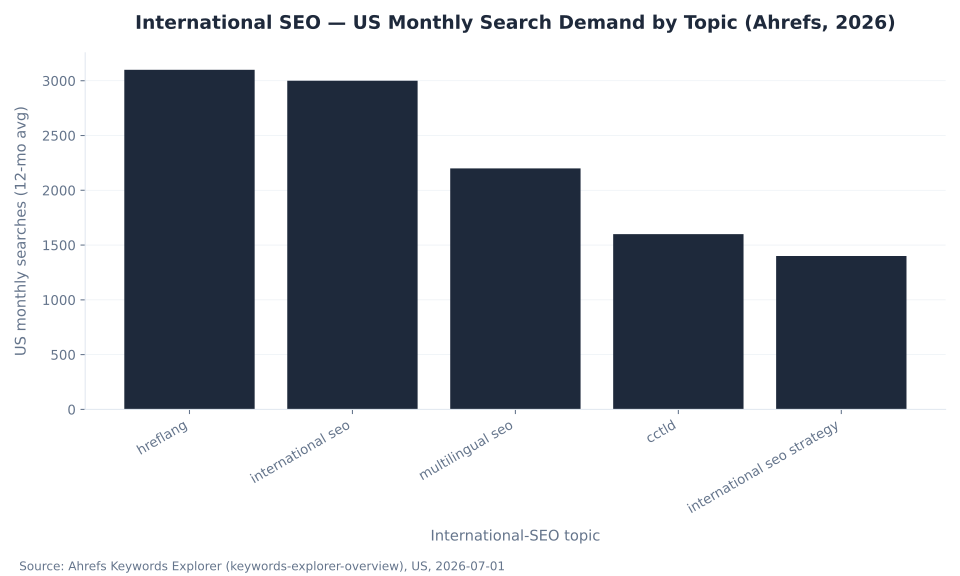
US search demand — Ahrefs, 2026
3,000/mo
US searches for “international seo” — and 8,900/mo globally, roughly 3× the US figure. That gap is the whole point: a topic that is, by definition, bigger outside any one country. “hreflang,” the mechanic that makes it work, draws another 3,100/mo US (13,000 global).
Source: Ahrefs Keywords Explorer (US, 12-month average, retrieved 2026-07-01). Not mbadv client data.
What Is International SEO?
International SEO is the practice of optimizing a website so search engines can identify — and serve — the right language and/or country version of each page to the right audience. It is the layer you add once one site has to work for more than one market, and it turns on three decisions most “just translate the site” guides skip: whether you are going multilingual, multiregional, or both; how you signal each version to Google — primarily through hreflang annotations and a deliberate URL structure (ccTLD vs subdirectory vs subdomain); and how you localize content so it converts in-market, not just reads in the local language.
This is the advanced pillar of the cluster: it assumes the crawl, index, and canonical basics are already in place. If they are not, start with what is SEO and the crawl/index foundation in what is technical SEO, then come back for the international layer, because hreflang and URL-structure work sits squarely inside technical SEO. Get the three decisions right and one site ranks cleanly in every market you target. Get them wrong and you split your authority, tell Google the wrong thing about who each page is for, and watch near-identical translated pages compete with each other. The rest of this guide takes the three decisions in order, and puts the URL-structure trade-off — the one choice that is expensive to reverse — at the center.
Key Takeaways
- International SEO serves the right language and/or country version of a page to the right searcher. It is three decisions, not one: framing (multilingual vs multiregional), signaling (hreflang plus URL structure), and localization.
- hreflang annotates language (required) and, optionally, region. Every version must reference itself and all the others — reciprocal return tags — or Google can ignore the whole cluster.
- Subdirectories are the recommended default URL structure. They consolidate link authority on one domain; ccTLDs send the strongest country signal but split authority and cost the most to run.
- You no longer set a target country in Search Console. Google removed that setting on September 22, 2022. Geotargeting is inferred from ccTLDs, hreflang, server location, and local signals.
- Translation is not localization. Localization adapts currency, formats, imagery, payment methods, and the actual words people search for market to market — which you research natively, not by translating your keyword list.
Multilingual vs Multiregional (and Both)
The first decision is a framing decision, and getting it wrong upfront cascades into the wrong URL structure and the wrong hreflang. Google draws the line cleanly: a multilingual site publishes content in multiple languages; a multiregional site targets users in different countries; and a site can be both. A Canadian site published in English and French is multilingual and multiregional at once.
The distinction decides everything downstream. If you are only translating — one company, one country, several languages — you are multilingual, and language-only hreflang (de, fr) on a single domain is usually enough. If you are targeting different countries — different currencies, shipping, legal terms, even the same language split across the US and the UK — you are multiregional, and you need language-plus-region signals and a URL structure that can carry them. Most brands expanding abroad are quietly both, and the projects that stall are the ones that treated a multiregional launch as a translation job. The MB Adv Agency read: name which one you are before you touch a single tag, because the answer picks your URL structure and your hreflang for you. Google spells out the distinction and the locale signals in its managing multi-regional and multilingual sites documentation.
URL Structure: ccTLD vs Subdirectory vs Subdomain
This is the decision at the center of international SEO, because it is the one that is expensive to reverse and it sets how link authority flows for the life of the site. There are three architectures, and Google documents the trade-offs in its own words. A ccTLD (a country-code top-level domain like example.de) sends the strongest geo signal but splits your authority across separate domains you then have to build links to individually. A subdirectory (example.com/de/) keeps every market on one domain, so link equity pools; Ahrefs frames this authority consolidation as the reason subdirectories are the most-recommended default. A subdomain (de.example.com) behaves more like a separate site, so its equity can be inconsistent.
| Structure & example | Geo-targeting signal | Link-authority behavior | Setup & upkeep | Google’s stated pro / con | Best for |
|---|---|---|---|---|---|
ccTLD example.de | Strongest — explicit country signal | Splits authority across separate domains | Most expensive; more infrastructure per market | Pro: “clear geotargeting,” server location irrelevant · Con: “expensive,” “requires more infrastructure” | A well-resourced, distinct single-country presence with links to build per domain |
Subdirectory example.com/de/ | Weakest alone — relies on hreflang | Consolidates into one domain | Easiest; “low maintenance (same host)” | Pro: “easy to set up,” low maintenance · Con: single server location; users do not read geo from the URL | Most sites — the recommended default (all authority pooled on one domain) |
Subdomain de.example.com | Moderate; needs hreflang | Separate-site behavior; equity can be inconsistent | Easy to set up; separate hosting possible | Pro: “easy to set up,” “easy separation of sites” · Con: users do not read geo from the URL | When a market needs separate hosting, infrastructure, or org separation |
Sources: Google Search Central, “Managing multi-regional and multilingual sites” (pros/cons in Google’s wording); Ahrefs, “International SEO” (authority-consolidation framing). Google also lists URL parameters (example.com?loc=de) as “not recommended.” Web-verified 2026-07-01.
The practical default is the subdirectory: it consolidates authority, it is the cheapest and lowest-maintenance to run, and combined with hreflang it targets cleanly. Override it toward a ccTLD only when you are building a distinct, well-funded presence in a country and can earn links to that domain on its own; reach for a subdomain when a market genuinely needs separate hosting or organizational separation. Do not present any single structure as universally best — name the trade-off, then default to the subdirectory. The chart below visualizes the same conclusion, ranking how much each structure keeps authority pooled on one domain.
International SEO — US Monthly Search Demand by Topic (Ahrefs, 2026)
hreflang: Telling Google Which Version Is for Whom
hreflang is the load-bearing mechanic. It is an annotation — an HTML <link> tag in the head, an HTTP Link response header, or an entry in your XML sitemap (pick one method) — that tells Google a page’s language, which is required, and, optionally, its region. The format is language or language-region: ISO 639-1 for the language, ISO 3166-1 Alpha 2 for the region (en, de, en-gb, de-ch, fr-ca). Language comes first and cannot be omitted — you cannot specify a country by itself, because Google does not derive the language from a country code.
| Scenario | hreflang value | Example <link> tag |
|---|---|---|
| Language only (no country) | de | <link rel="alternate" hreflang="de" href="https://example.com/de/" /> |
| Language + region | en-gb | <link rel="alternate" hreflang="en-gb" href="https://example.com/uk/" /> |
| Same language, different regions | en-us / en-gb | One tag per region: hreflang="en-us" → US URL, hreflang="en-gb" → UK URL |
| Script variant | zh-Hant / zh-Hans | <link rel="alternate" hreflang="zh-Hant" href="https://example.com/tw/" /> |
| Fallback / unmatched users | x-default | <link rel="alternate" hreflang="x-default" href="https://example.com/" /> |
Source: Google Search Central, “Tell Google about localized versions of your page”; Ahrefs hreflang guide. Invalid values such as es-419, EU, UN, or the non-standard UK (the ISO code is GB) are ignored. Web-verified 2026-07-01.
One rule carries more weight than the syntax: reciprocal return tags are mandatory. Every language version must list itself and every other version, and the references have to point both ways — if page A links to page B, B has to link back to A. Google is explicit that when this is not the case, those annotations can be ignored or interpreted incorrectly, so a single missing or broken return tag can make Google discard the whole cluster. The reserved x-default value is the fallback for any language you have not explicitly listed — a language-selector or global landing page. This return-tag discipline is the most common place international setups break, and it is worth auditing before anything else.

Organic international SEO, paired with paid
Expanding Into New Markets?
Your hreflang, URL structure, and localization handle the organic side. The paid search that complements your international SEO — the cross-border Google Ads campaigns that run alongside it — is where MB Adv Agency comes in. For DTC brands, that is ecommerce PPC; for companies entering new regions, B2B PPC and verticals such as SaaS PPC.
Talk to our team →Geotargeting: What Changed, and What Does the Work Now
Here is the single most out-of-date instruction in this topic: “set your target country in Google Search Console.” That setting is gone. Google removed the International Targeting report and the country-targeting control on September 22, 2022 (announced August 24, 2022). Any tutorial that tells you to open Search Console and pick a country predates that change. Do not do it — there is nothing to set.
| Signal | Status and role |
|---|---|
| Set a target country in Search Console | Removed. The International Targeting report and the country-targeting setting were taken out on September 22, 2022 (announced August 24, 2022). There is no toggle to set. |
| ccTLD (country-code domain) | Still in effect — a strong country signal. |
| hreflang annotations | Still in effect — the primary language/region signal for equivalent pages. |
| Server / IP location | Still in effect — a signal, though less decisive than a ccTLD. |
| Local signals | Still in effect — local address and phone, local currency, on-page language, links from local sites, and Google Business Profile data. |
Sources: Google Search Console Help (International Targeting deprecation); Google multi-regional documentation. Web-verified 2026-07-01.
What replaces the setting is not one control but a set of signals Google reads together: your ccTLD, your hreflang, your server location, and your local footprint. One related trap belongs here too. Google does not vary its crawler location — Googlebot crawls primarily from the US — so IP-based automatic redirects that shunt a US visitor to /us/ can stop Google from ever seeing your other locale versions. Google’s guidance is to signal variants explicitly with hreflang, ccTLDs, and links, and to let users choose their version rather than hard-redirecting them by IP. The country-targeting control is gone; the signals are what you manage now.
Content Localization: Translation Is Not Localization
The most common way international SEO fails is a machine translation with no hreflang and no local keyword research. Translation converts words; localization adapts the whole experience — currency, date and number formats, units, imagery, idiom, payment methods — and, critically, adapts to local search behavior. People in different markets search for the same product with different words, so a direct translation of your keyword list frequently targets a term almost nobody types. Localization is a content discipline; the intent-writing fundamentals you repeat for every market live in what is SEO content.
This is also where international SEO gets confused with local SEO, and they are not the same. International SEO targets countries and languages; local SEO targets a city or service area with proximity, relevance, and prominence. Name each; do not overlap them. For ecommerce brands, localization reaches past the website: product feeds are per-country and per-currency, which is where the Google Merchant Center layer starts to matter — see best practices for optimizing product feeds and how paid Shopping fits in Google Merchant Center vs Google Ads.
International Keyword Research
You research each market natively — you do not translate your English keyword list. Demand, competition, and the winning term differ country to country, and even between variants of one language: a US and a UK audience search the same product with different words. The workflow is to build the keyword set inside each market using a tool with per-country volume filters — Ahrefs and Semrush are the standard named pair — then localize the content to the terms that actually win there. The keyword mechanics (intent, long-tail vs short-tail) are the same everywhere; apply them per language using what are keywords in SEO, and measure each market separately in how to track SEO performance with Google Search Console, filtering performance by country. The Ahrefs international-SEO guide walks the same per-market approach.
Frequently Asked Questions: International SEO
Keep building the foundation
Start With the Technical Layer
hreflang and URL-structure decisions are technical SEO. If the crawl, index, and canonical basics are not solid, the international layer will not hold — read the foundation international builds on.
Read technical SEO →Methodology & Sources
This pillar is the orientation anchor for the advanced international layer of the SEO cluster; keyword mechanics live in the keyword pillar and per-market measurement in the Search Console pillar. The hreflang format — language required (ISO 639-1) plus optional region (ISO 3166-1 Alpha 2), three declaration methods, mandatory reciprocal return tags, and x-default — is from Google Search Central’s localized-versions documentation. The URL-structure pros and cons and the multilingual-vs-multiregional distinction are from Google’s managing multi-regional and multilingual sites guide, with the authority-consolidation framing from Ahrefs. The Search Console country-targeting removal (announced August 24, 2022; removed September 22, 2022) is from Google Search Console Help, and the IP-redirect caution from Google’s locale-adaptive-pages guidance. Head-term search volumes — “international seo” 3,000 US / 8,900 global (KD 41) and “hreflang” 3,100 US / 13,000 global (KD 51) — are from Ahrefs Keywords Explorer (US, 12-month average, retrieved 2026-07-01). No mbadv client metrics appear in this article: MB Adv Agency runs the paid search that complements organic international SEO, and its perspective here is qualitative. Reviewed by MB Adv Agency, July 2026.
International SEO is the practice of optimizing your website to rank well in search engines across different countries or languages. It involves understanding various factors that influence search visibility in different markets, adapting your website's content, and tailoring keyword strategies to target specific audiences. As businesses increasingly operate on a global scale, mastering international SEO has become essential for reaching potential customers around the world.
Importance of global targeting
Global targeting in SEO allows businesses to reach and engage users from various geographical locations. Here are some critical reasons why it is significant:
- Increased Reach: By focusing on international SEO, businesses can tap into new markets, reaching a larger audience beyond their local demographics.
- Market Expansion: It enables companies to grow their market footprint, catering to customers from different countries and cultures.
- Higher Conversion Rates: Tailored content and localized strategies can significantly improve conversion rates by appealing directly to the needs and preferences of a global audience.
- Competitive Advantage: An effective international SEO strategy can set your business apart from competitors who may not have considered global audiences.
Expanding into international markets isn't just about translating content; it involves understanding the cultural nuances and search behaviors of different regions. Companies that invest in global targeting can not only enhance visibility but also build brand loyalty and credibility in diverse markets.
Moreover, leveraging local search engines and platforms can further amplify a business's presence. For instance, while Google dominates many Western markets, other search engines like Baidu in China or Yandex in Russia cater to specific local audiences. Understanding these platforms and optimizing for them can lead to substantial traffic and engagement that might otherwise be overlooked. Additionally, tailoring marketing campaigns to resonate with local customs, holidays, and consumer behaviors can create a more personalized experience, fostering a deeper connection with potential customers.
Furthermore, global targeting also opens up opportunities for partnerships and collaborations with local influencers and businesses. By aligning with trusted local figures, brands can enhance their credibility and reach within new markets. This strategy not only aids in building a positive brand image but also helps in navigating the complexities of local regulations and market dynamics. As businesses continue to expand their horizons, the importance of a well-rounded global targeting strategy becomes increasingly evident, paving the way for sustainable growth and success in the international arena.
How to use hreflang tags
Hreflang tags play a crucial role in informing search engines about the language and geographical targeting of your web pages. Using these tags correctly ensures that users are shown the most relevant version of a page based on their language preferences and location.

To implement hreflang tags effectively, follow these steps:
- Identify Language and Region Variants: Determine which languages and countries you want to target. For example, you might want to create a separate version of your site for users in Spain and Latin America.
- Implement Hreflang Tags: Add the hreflang attribute in the header of your HTML or in the sitemap. For example, for a Spanish version of your page targeting Spain, you would include:
<link rel="alternate" href="http://example.com/es/" hreflang="es-ES" />
- Use the Right Codes: Use ISO 639-1 language codes alongside ISO 3166-1 country codes to specify the correct targeting.
- Ensure Self-Referencing: Each page should also reference itself with its hreflang tag to help search engines confirm the preferred versions.
- Test and Validate: Use tools like Google Search Console to test your hreflang implementation, ensuring that all tags are correctly set up and that there are no errors.
Proper implementation of hreflang tags not only aids in avoiding duplicate content issues but also enhances user experience by directing users to the appropriate version of the site, thereby increasing engagement and reducing bounce rates.
Additionally, it is important to keep in mind that hreflang tags can also influence your site's SEO performance. By ensuring that the correct content is served to the right audience, you can potentially improve your search rankings in different regions. This is particularly beneficial for businesses that operate in multiple countries or regions, as it allows them to cater their content to specific cultural nuances and preferences. For instance, a marketing campaign that resonates well in one country may not have the same impact in another due to differences in language, idioms, or local customs.
Moreover, maintaining an updated hreflang strategy is essential as your website evolves. As you add new content or expand into new markets, revisiting your hreflang tags ensures that all pages are optimized for the right audience. Regular audits can help identify any outdated tags or missing references, allowing you to make necessary adjustments. This proactive approach not only enhances user satisfaction but also reinforces your brand's commitment to providing a localized experience, which can significantly boost customer loyalty and trust.
Tips for optimizing for international markets
Optimizing for international markets involves a multifaceted approach. Below are some essential tips to enhance your international SEO efforts:

- Conduct Local Keyword Research: Understand the local search trends and phrases your target audience uses. Tools like Google Keyword Planner and SEMrush can help you find valuable keywords specific to each market.
- Create Localized Content: Rather than merely translating existing content, adapt it to reflect local culture, idioms, and user preferences. Content should resonate with the local audience and include relevant regional references.
- Utilize Country-Specific Domain Extensions: Consider using country code top-level domains (ccTLDs) such as .co.uk for the UK or .fr for France; alternatively, use subdomains or subdirectories to clearly delineate content for each country.
- Optimize for Mobile: Mobile optimization is critical, particularly in regions where mobile traffic is predominant. Ensure that your site is responsive and provides a good user experience across devices.
- Leverage Local Backlinks: Building local backlinks can improve your authority in specific markets. Collaborate with local influencers or websites to gain valuable links that can boost your visibility.
By implementing these strategies, businesses can significantly improve their performance in international markets. This not only promotes growth but also fosters a better understanding of diverse customer behaviors. Moreover, it is essential to keep an eye on the competition in each market. Analyzing competitors can provide insights into what strategies are working and what gaps exist in the market that your business can fill. Tools like Ahrefs or Moz can be particularly useful for tracking competitor keywords and backlinks.
In summary, international SEO is not just an add-on to your marketing strategy but a necessary aspect that can open doors to new opportunities. Businesses equipped with the right tools and knowledge can achieve remarkable success on a global scale. Additionally, consider the importance of local social media platforms and online communities. Engaging with users on platforms that are popular in specific regions can enhance brand visibility and foster customer loyalty, creating a more personalized experience that resonates with local audiences.

As a Google Ads expert, I bring proven expertise in optimizing advertising campaigns to maximize ROI.
I specialize in sharing advanced strategies and targeted tips to refine Google Ads campaign management.
Committed to staying ahead of the latest trends and algorithms, I ensure that my clients receive cutting-edge solutions.
My passion for digital marketing and my ability to interpret data for strategic insights enable me to offer high-level consulting that aims to exceed expectations.
Google Partner Agency
We're a certified Google Partner Agency, which means we don’t guess — we optimize withGoogle’s full toolkit and insider support.
Your campaigns get pro-level execution, backed by real expertise (not theory).

4.9 out of 5 from 670+ reviews on Fiverr.
That’s not luck, that’s performance.
Highly recommend Matteo to set up your server side tracking. He has a deep understanding of e-commerce tracking and will go above and beyond to make sure everything is set up correctly and working 100%. If you are scaling your store this set up is non-negotiable in my opinion and there isn't many people who have this much knowledge or put the effort in to get it right. Thanks again!
avorodesign.com
I can only recommend Matteo! He was very patient, professional and very knowledgeable about GA4, Consent Mode v2, and GDPR compliance. Communication was clear, and the setup was done professionally and efficiently. Highly recommend him for anyone needing reliable tracking implementation.

www.natureiki.life
Matteo shines in the realm of online professionals. His work is not only deep in data but also complemented by his proactive communication and cooperation, setting a new standard for freelancers. If you want someone who truly exceeds expectations, look no further. Highly recommended!

www.omanbeverlysmyth.com
Exceptional Service Beyond Expectations - Outstanding Service Impeccable depth, flawless delivery, and exceptional language fluency—this service exceeded all expectations. Highly recommended. Matteo truly ROCKS!!!

ium-paris.com
Top-notch, always highly value working with Matteo. An absolute Google Ads Genius. This is approximately the 8th time I have hired him and he's helped us get 6-7 ROAS. We are excited in continuing to improve our lead flow. Hire this guy if you need Google Ads help. Thanks Matteo!

www.dleeventgroup.com
I finally found the guy who can setup server side tracking and all the ecosystem properly. I definitely recommend Matteo. He is very responsive, kind and wants to dig into things. He configured GA4, Meta, Google Ads, Outbrain and google consent v2 with Cookiebot. Thanks Matteo.

inomega.fr
MB Adv delivered exceptional work with outstanding professionalism and lots of patience, taking time to see effects of changes made and not just do the work and submit it. The proactive communication and video summaries of the work completed made working with Matteo a pleasure, as he consistently went above and beyond. Highly recommended for web analytics projects! We are already working on another project.

www.withnellsensors.co.uk
Working with Matteo on my Google Ads was a game-changer. He's not just a strategist, he's a true partner. He understood my goals and tailored a campaign that perfectly reached my target audience. I'm grateful for his expertise and dedication.

dccargo.com
Click-driven mind
with plastic-brick obsession.
We build Google Ads campaigns with the same mindset we use to build tiny brick worlds: strategy, patience, and zero tolerance for wasted pieces.
Data is our blueprint. Growth is the only acceptable outcome.