Google Ads Text Disclaimer assets: why this small Search update matters for compliant advertising
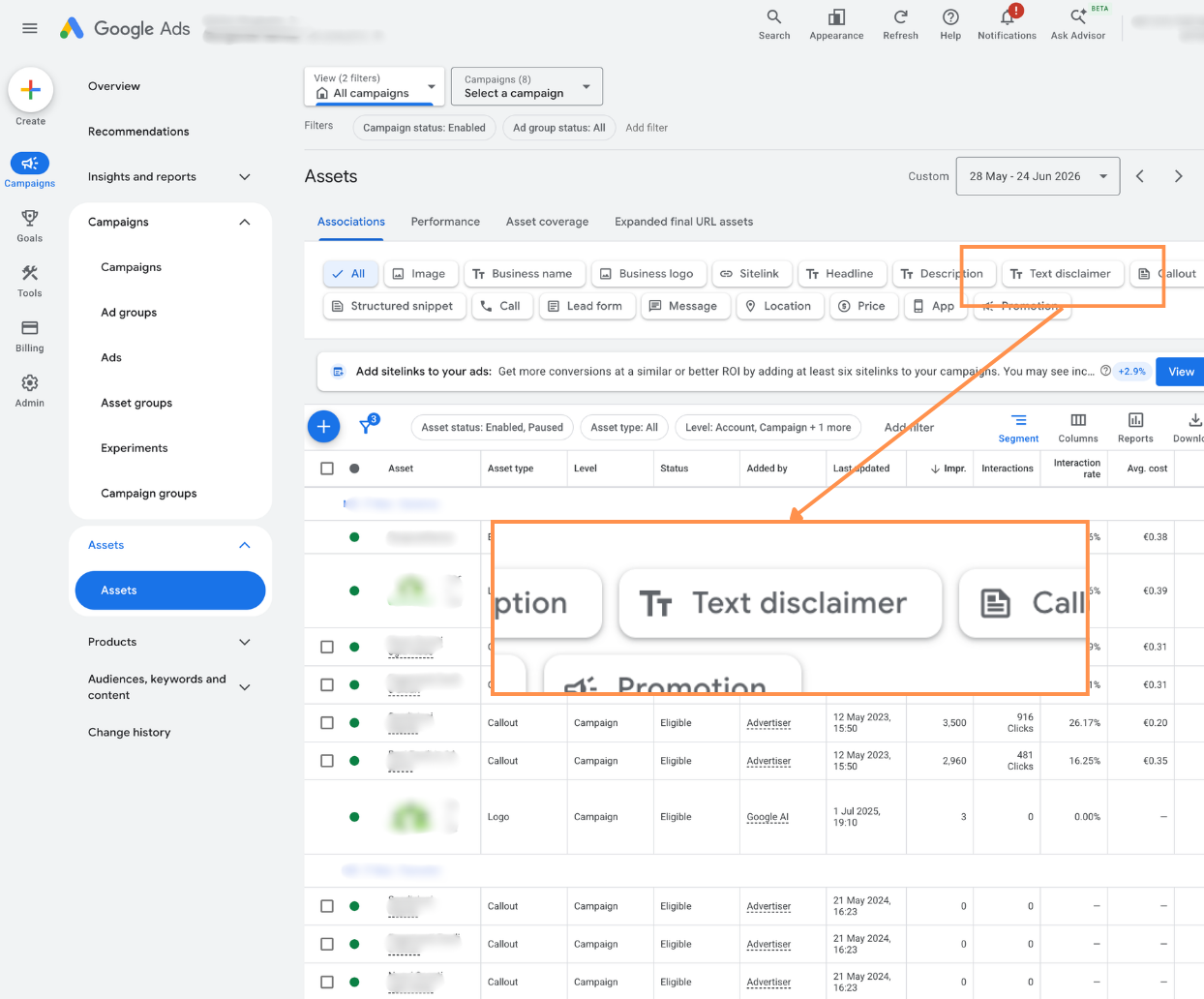
Google Ads has introduced Text Disclaimer assets in the Assets section, giving advertisers a dedicated way to attach required legal, regulatory, or compliance language to Search campaigns. On the surface, this looks like a modest product update. In practice, it solves a long-standing operational problem for teams running responsive search ads in regulated or disclosure-heavy categories.
The significance is less about creative expansion and more about control. For years, advertisers who needed mandatory terms inside ad copy often had to force that language into descriptions, pin assets in place, or maintain separate ad variants just to satisfy compliance requirements. None of those workarounds were especially elegant, and all of them created tension between policy needs and ad copy quality. With Text Disclaimer assets, Google is effectively separating disclosure management from the core messaging layer of the ad.
That distinction matters.
A structural improvement inside the RSA framework
Responsive search ads were designed to give Google flexibility in assembling combinations of headlines and descriptions. That flexibility has obvious advantages for testing and relevance, but it has always been less comfortable for advertisers who operate under strict legal review. If a disclosure is mandatory, “likely to appear” is not enough. Teams need confidence that specific language will be shown consistently and in the right place.
Google’s positioning here is important: the disclaimer is served in the description line area on both desktop and mobile Search ads, and Google states that it is guaranteed to appear there. For advertisers dealing with required terms and conditions, that changes the conversation from workaround management to asset governance.
This is why the feature should be understood as a structural update to Google Ads asset management, not as a performance feature in the usual sense. It does not create new demand, improve bidding, or unlock new audience signals. What it does is reduce friction in how compliant ads are built and maintained.
Why this matters more than it first appears
In many Google Ads accounts, compliance language has historically lived in the most inconvenient possible place: inside the ad itself. That creates several problems at once.
First, mandatory disclosure copy tends to compete with persuasive messaging for limited description space. The result is often weaker ad text, not because the copywriter lacks skill, but because the ad is being asked to do too many jobs in too few characters.
Second, every change to the core ad can trigger another round of legal or internal review if the disclosure is embedded directly in the creative. That slows testing velocity. In larger organizations, especially those with multiple stakeholders across brand, legal, and paid media, this can turn simple ad refreshes into unnecessarily complex workflows.
Third, pinned descriptions have never been an ideal compliance mechanism. Pinning can constrain Google’s ability to assemble ad combinations, and it introduces operational fragility. If the disclosure is tied to a specific pinned line, ad management becomes less flexible and more error-prone.
By moving disclaimers into a dedicated asset type, Google is making it easier to manage legal language as a distinct layer. That should improve operational efficiency, but just as importantly, it should improve copy integrity. Advertisers can keep the persuasive message focused while handling disclosures through the mechanism designed for that purpose.
Particularly relevant for regulated verticals
This feature will be most valuable in sectors where ad copy is routinely reviewed for legal or regulatory accuracy: finance, insurance, legal services, healthcare, and in some cases education, real estate, and consumer credit. In these environments, mandatory language is not optional decoration. It is often a prerequisite for launch.
For these advertisers, Text Disclaimer assets can reduce the need to compromise headline-description strategy simply to accommodate required text. Teams may be able to maintain stronger messaging frameworks while still ensuring that disclosures appear in the ad experience.
There is also a governance benefit here. When disclaimer text is separated from standard RSA copy, it becomes easier to audit, update, and apply consistently across campaigns or ad groups. That is especially useful in accounts where the same legal language needs to be reused across multiple entities, product lines, or geographies.
In other words, the feature supports not only compliance, but also account hygiene.
The strategic trade-off: control gained, but not unlimited flexibility
That said, advertisers should not mistake this for a universal fix. A guaranteed disclaimer placement is useful, but it does not eliminate the need for careful ad architecture. The description area is still part of a constrained format, and not every disclosure challenge can be solved with a single asset type.
There are also practical questions that experienced PPC teams will want to monitor. For example, how does the disclaimer interact with existing descriptions in terms of readability and message sequencing? Does the presence of compliance text alter perceived ad quality or reduce the visible persuasive space in certain layouts? Will some advertisers overuse the feature and end up recreating the same clutter problem in a different form?
These are not reasons to avoid the feature. They are reminders that Google Ads compliance tools still operate inside a performance environment. Even when a disclosure is mandatory, the surrounding copy, landing page alignment, and search intent still determine whether the ad is commercially effective.
So the right approach is not to treat Text Disclaimer assets as a creative shortcut. It is to treat them as a cleaner compliance layer that allows the main ad copy to do its actual job more effectively.
What this says about the direction of Google Ads
At a broader platform level, this release fits a familiar pattern in Google Ads: more modular asset types, more separation between messaging components, and more infrastructure for enterprise-style account management. Google increasingly wants advertisers to manage ads through composable elements rather than static units.
That trend has obvious implications for sophisticated advertisers. The more Google decomposes the ad into distinct assets and functions, the more important asset strategy becomes. Compliance language, promotional messaging, business information, and creative testing are no longer all forced into the same box. That is good for scale, but it also requires better discipline in how campaigns are structured and reviewed.
Text Disclaimer assets are a good example of this evolution. They do not make Search ads more exciting. They make them more manageable.
Final perspective
For most advertisers, this will not be the kind of Google Ads update that changes performance benchmarks overnight. But for teams balancing RSA flexibility, legal review, and campaign maintenance, it is a meaningful improvement. Text Disclaimer assets provide a more reliable and operationally cleaner way to handle required disclosures without distorting the rest of the ad.
That makes the feature easy to underestimate. It is not flashy, but it addresses a real constraint in the way compliant Search advertising has been managed for years. In mature Google Ads programs, those are often the updates that matter most.

As a Google Ads expert, I bring proven expertise in optimizing advertising campaigns to maximize ROI.
I specialize in sharing advanced strategies and targeted tips to refine Google Ads campaign management.
Committed to staying ahead of the latest trends and algorithms, I ensure that my clients receive cutting-edge solutions.
My passion for digital marketing and my ability to interpret data for strategic insights enable me to offer high-level consulting that aims to exceed expectations.
Google Partner Agency
We're a certified Google Partner Agency, which means we don’t guess — we optimize withGoogle’s full toolkit and insider support.
Your campaigns get pro-level execution, backed by real expertise (not theory).

4.9 out of 5 from 670+ reviews on Fiverr.
That’s not luck, that’s performance.
Highly recommend Matteo to set up your server side tracking. He has a deep understanding of e-commerce tracking and will go above and beyond to make sure everything is set up correctly and working 100%. If you are scaling your store this set up is non-negotiable in my opinion and there isn't many people who have this much knowledge or put the effort in to get it right. Thanks again!

avorodesign.com
I can only recommend Matteo! He was very patient, professional and very knowledgeable about GA4, Consent Mode v2, and GDPR compliance. Communication was clear, and the setup was done professionally and efficiently. Highly recommend him for anyone needing reliable tracking implementation.

www.natureiki.life
Matteo shines in the realm of online professionals. His work is not only deep in data but also complemented by his proactive communication and cooperation, setting a new standard for freelancers. If you want someone who truly exceeds expectations, look no further. Highly recommended!

www.omanbeverlysmyth.com
Exceptional Service Beyond Expectations - Outstanding Service Impeccable depth, flawless delivery, and exceptional language fluency—this service exceeded all expectations. Highly recommended. Matteo truly ROCKS!!!

ium-paris.com
Top-notch, always highly value working with Matteo. An absolute Google Ads Genius. This is approximately the 8th time I have hired him and he's helped us get 6-7 ROAS. We are excited in continuing to improve our lead flow. Hire this guy if you need Google Ads help. Thanks Matteo!

www.dleeventgroup.com
I finally found the guy who can setup server side tracking and all the ecosystem properly. I definitely recommend Matteo. He is very responsive, kind and wants to dig into things. He configured GA4, Meta, Google Ads, Outbrain and google consent v2 with Cookiebot. Thanks Matteo.

inomega.fr
MB Adv delivered exceptional work with outstanding professionalism and lots of patience, taking time to see effects of changes made and not just do the work and submit it. The proactive communication and video summaries of the work completed made working with Matteo a pleasure, as he consistently went above and beyond. Highly recommended for web analytics projects! We are already working on another project.

www.withnellsensors.co.uk
Working with Matteo on my Google Ads was a game-changer. He's not just a strategist, he's a true partner. He understood my goals and tailored a campaign that perfectly reached my target audience. I'm grateful for his expertise and dedication.

dccargo.com
Click-driven mind
with plastic-brick obsession.
We build Google Ads campaigns with the same mindset we use to build tiny brick worlds: strategy, patience, and zero tolerance for wasted pieces.
Data is our blueprint. Growth is the only acceptable outcome.