TikTok Ad Creative Best Practices: Hook, Specs, Audio & UGC (2026)
TikTok Ads — Creative Best Practices
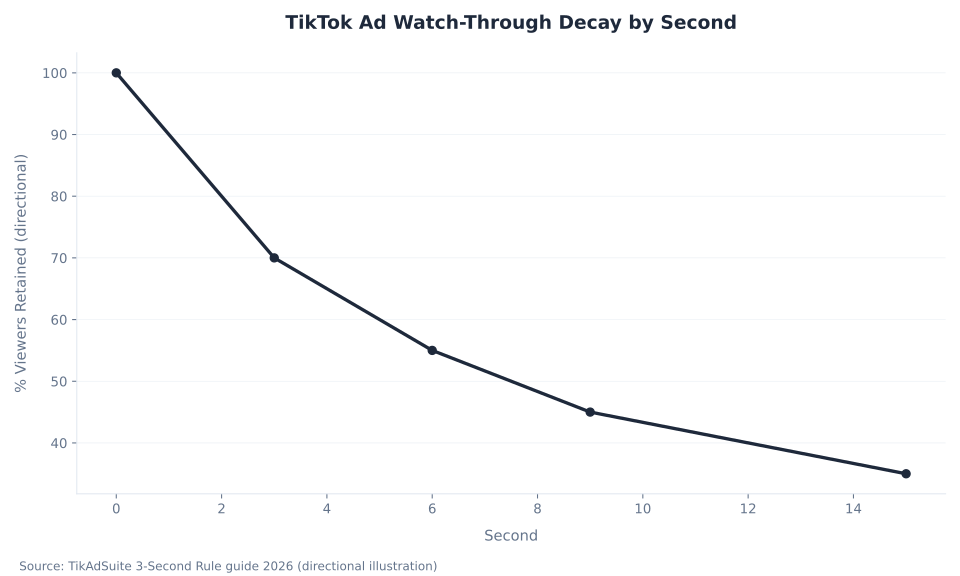
The first 3 seconds are the whole ad.
Specs, music, overlays, and interactivity amplify a hook that already works. A weak hook at second 0 is not rescued at second 10.
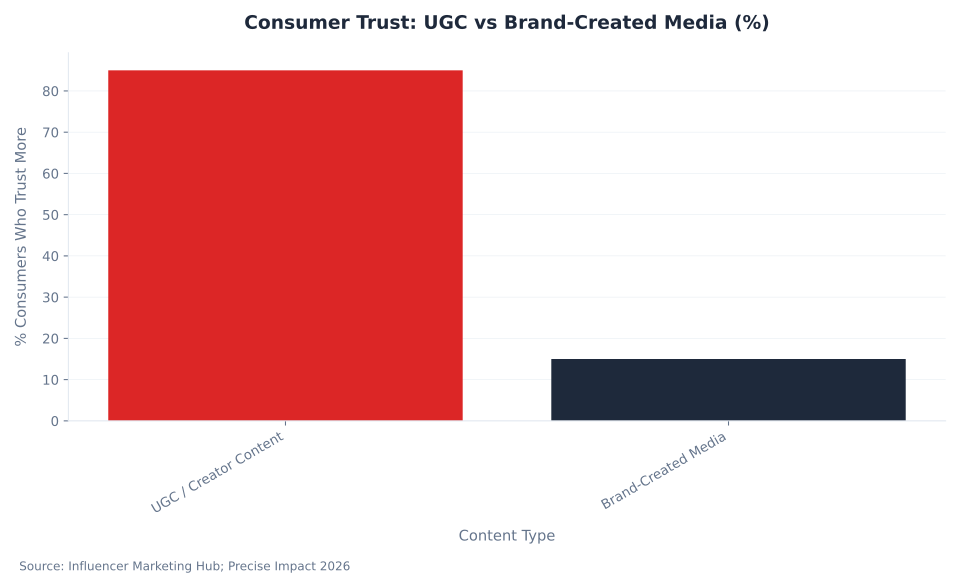
85%
of consumers find UGC more trustworthy than brand-created media
3 s
hook decision window — leading indicator for completion rate, CTR, and conversion
9–15 s
optimal ad length for completion-rate performance across most TikTok formats
What TikTok Ad Creative Best Practices Actually Cover
TikTok ad creative best practices are the production and structural decisions — hook placement, aspect ratio, audio strategy, text overlay position, and ad length — that determine whether a paid video retains attention long enough to deliver its message and drive a measurable action. They are distinct from targeting and bidding decisions, and they carry more weight on media efficiency than on any comparable paid social platform.
This pillar consolidates the creative decisions that move completion rate, CTR, and conversion on TikTok Ads. It absorbs five fragmented zombie pages into a single source of record: text overlays and CTAs, video-first content, music and trends, interactive add-ons, and TikTok-friendly design. Every benchmark cited traces to a named external source; no figures are fabricated.
TikTok creative operates under two constraints absent from other paid social channels. First, the feed is full-screen and algorithmic — a viewer who does not engage in the first 3 seconds swipes away, and the platform redistributes impressions away from that ad immediately. Second, the dominant native aesthetic is creator-style, not commercial-style — the trained ad-skip reflex fires faster on TikTok than on Facebook or YouTube, so creative that reads as a traditional ad gets treated as one. Both constraints make production decisions here the primary lever on cost efficiency, ahead of audience selection or bid type.
Creative best practices are the complement to audience and measurement strategy. TikTok audience targeting determines who sees the ad; this pillar determines whether they stay. TikTok Ads metrics and costs covers the media-cost benchmarks the creative is expected to beat. TikTok Pixel and Events API tracking ensures the conversion signals that inform creative optimization are accurate.
For e-commerce PPC campaigns, creative quality is the primary performance lever. A $5,000/month TikTok account with a strong hook converts better than a $50,000/month account running a generic brand video. Creative quality is not a production budget question — it is a strategy question.
The 3-Second Hook: Structure, Anatomy, and Why It Dominates
The first 3 seconds of a TikTok ad are not an introduction — they are the primary retention and conversion mechanism. A viewer who does not engage in that window swipes; TikTok's algorithm reads the swipe as negative signal and distributes the ad to fewer users. The hook is the ad's structural foundation, not a stylistic choice.
Three hook archetypes consistently outperform generic brand openers on TikTok In-Feed ads. Each registers in under 3 seconds without requiring prior brand familiarity, as documented by TikAdSuite's 3-Second Rule guide (2026) and confirmed by House of Marketers (2026).
- Bold claim. Lead with a specific, contestable statement. "This is why your TikTok ads are losing money" outperforms "Introducing [Brand]" because it activates a concrete curiosity gap before the brand name appears.
- Direct address. Name the viewer's situation in the first line. "If your TikTok CTR is below 1%..." creates immediate relevance for a specific segment and signals the ad is about the viewer, not the brand.
- Pattern interrupt. A visual or audio disruption that breaks the scroll rhythm. Common executions: unexpected movement in frame 1, a sound that doesn't match the visual, or an edit that implies a conclusion before showing it.
- Question hook. A question that the viewer's situation makes impossible to ignore. "Still boosting posts instead of running conversion campaigns on TikTok?" qualifies the audience while creating a knowledge gap.
- Testimonial flash. Open on a creator delivering the emotional result before any product setup. "I've tried six skincare brands — this one actually works" in second 1 earns the product reveal at second 4.
MB Adv Agency briefs every TikTok creative hook-first: the hook line is written before the concept, not after. A concept without a hook line is not ready for production. The hook determines watch-through and every downstream metric; the visual direction determines brand communication for the viewers who already committed past second 3.
Hook before concept. The production brief for any TikTok ad should open with the hook line verbatim — not a description of intent. "Stop wasting budget on broad audiences — here is the one targeting fix" is a ready hook. "We want to grab attention quickly" is a direction without a hook. Every other decision (visual, music, overlay copy) is scaffolding for the hook line.
A strong 3-second hold rate — the percentage of viewers still watching at second 3 — is the leading indicator for completion rate, CTR, and downstream conversion. Brief production teams on the hook line before visual direction. See campaign objectives for how the hook strategy shifts when the objective changes from awareness to conversion.
TikTok Ad Creative Benchmarks (2026)
The table below consolidates verified 2026 benchmarks for the creative variables that appear most frequently in TikTok campaign diagnostics. All figures trace to named external sources; no composite averages are presented without attribution.
| Creative Variable | Benchmark / Range | Source |
|---|---|---|
| Hook decision window | 3 seconds | TikAdSuite 2026 |
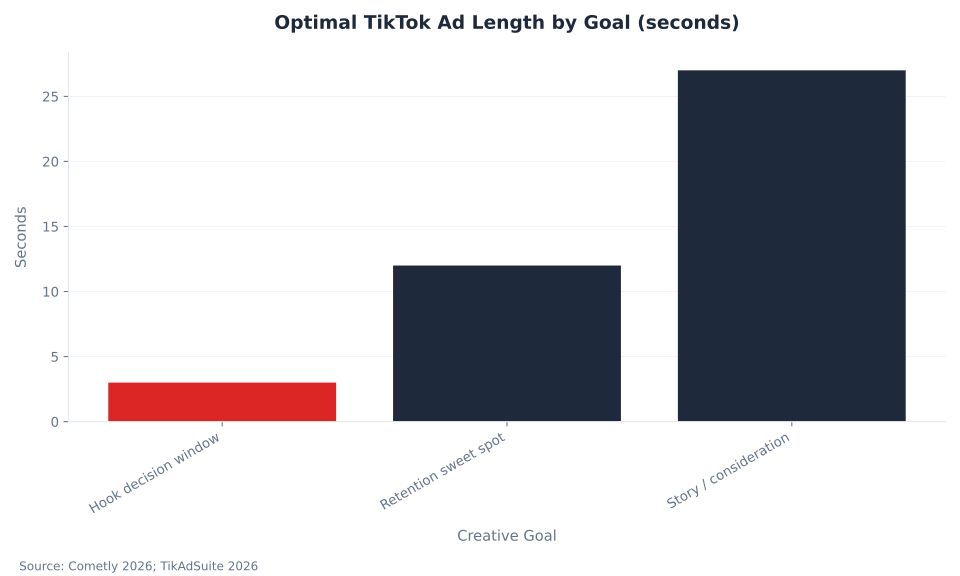
| Retention sweet spot (ad length) | 9–15 seconds | Cometly 2026 |
| Story / consideration length | 21–34 seconds | Cometly 2026 |
| Consumer trust: UGC vs brand-created media | 85% prefer UGC | Influencer Marketing Hub |
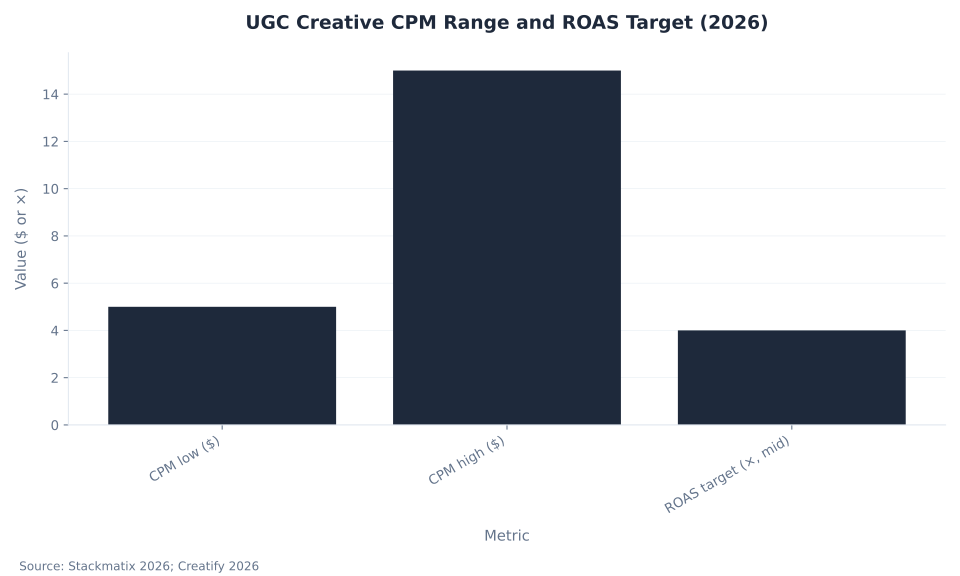
| UGC-style creative CPM range | $5–$15 | Stackmatix 2026 |
| Target ROAS — profitable UGC e-commerce | 3–5× | Creatify 2026 |
| Optimal aspect ratio | 9:16 vertical full-screen | The Brief 2026 |
| Safe zone exclusion (top and bottom) | 120 px each | The Brief 2026 |
These benchmarks are the baseline against which creative quality is measured. The $5–$15 CPM range for UGC-style creative is meaningfully lower than the $9.16 cross-industry average reported for all TikTok In-Feed placements — the difference is attributable primarily to creative quality, which affects both the auction price and the algorithm's willingness to distribute the ad broadly. See TikTok Ads metrics and costs for the full CPM and CPC breakdown by industry.
UGC vs Polished Creative: Which Performs Better and Why
Native, creator-style content outperforms polished studio footage on TikTok because it bypasses the viewer's trained ad-skip reflex. The reflex fires when creative reads as an ad; native-style content reads as a creator post. That distinction is worth more than any production budget difference.
The data on consumer trust is unambiguous: 85% of consumers find UGC more trustworthy than brand-created media, according to Influencer Marketing Hub. Precise Impact (2026) confirms the conversion mechanism: native-style TikTok ads convert at higher rates than polished commercial video because the trust baseline is higher before the product is even shown.
| Factor | UGC / Native-Style | Polished Studio |
|---|---|---|
| Consumer trust score | 85% prefer UGC | 15% |
| CPM range (TikTok In-Feed) | $5–$15 | Higher — premium placements command premium cost |
| Target ROAS (e-commerce) | 3–5× | Lower — ad-skip rate erodes impression efficiency |
| Production cost | Low — smartphone, ring light, good mic | High — studio, talent, post-production |
| Ad-skip reflex risk | Low — reads as native content | High — reads as traditional commercial |
| Best for | Direct response, product demos, testimonials | Brand awareness with large reach budgets |
The nuance most competitor pages omit: high-performing native content is casual in aesthetic, not in strategy. A UGC-style ad that outperforms polished video still has a deliberate hook line, legible text overlays placed within the safe zone, clear microphone audio, and a specific CTA. The aesthetic is native; the production intent is professional. An actual low-effort video with muddy audio and no call to action does not inherit UGC's performance advantage. It is just a bad ad.
Native aesthetic, professional intent. The creative brief for UGC-style TikTok ads should specify: hook line (verbatim), safe-zone overlay copy, approved audio track or voiceover direction, and the specific CTA at the end. None of these constraints are aesthetic — they are performance requirements that happen to be achievable on a smartphone.
For fashion PPC campaigns and beauty PPC campaigns, UGC-style creative is the default starting point because the category's purchase trigger is social proof, not brand prestige. Polished studio video is a valid consideration-stage format when the objective is brand lift, not direct conversion.
Stackmatix's TikTok UGC Ads Strategy guide (2026) confirms the $5–$15 CPM range for UGC e-commerce creative and documents the 3–5× ROAS target for profitable campaigns. Creatify's 2026 guide corroborates both benchmarks and notes that the ROAS range widens when creative testing is systematic — accounts with 3+ active hook variants running simultaneously trend toward the upper end of the ROAS range.
TikTok Ad Video Specifications (2026)
TikTok In-Feed ads require 9:16 vertical video at 1080×1920 resolution. Every other spec below is a constraint that affects delivery — files outside the accepted range are rejected at upload or downsampled during delivery in ways that degrade quality on viewer devices.
| Spec | Required Value | Notes |
|---|---|---|
| Aspect ratio | 9:16 vertical | Full-screen; other ratios letter-boxed and penalized in feed |
| Resolution | 1080 × 1920 px | 720p accepted but 1080p strongly recommended |
| File format | MP4 or MOV | H.264 codec preferred; HEVC (H.265) accepted |
| Max file size | 500 MB | Compress for upload speed without reducing bitrate below 2 Mbps |
| Bitrate | ≥ 2 Mbps | Lower bitrate causes macro-blocking on high-density screens |
| Frame rate | 23–60 fps | 30 fps standard; 60 fps preferred for product demos |
| Max duration | 60 seconds | In-Feed standard; TopView allows up to 60 s; optimal is 9–15 s |
| Min duration | 5 seconds | Under 5 s is rejected at upload |
| Safe zone (top) | Top 120 px excluded | TikTok UI: profile handle + caption overlay |
| Safe zone (bottom) | Bottom 120 px excluded | TikTok UI: like/share/comment rail |
| Caption | ≤ 100 characters | Appears below the video frame, not on-screen |
The safe zone constraint is the most commonly violated spec in first-production TikTok ads. The top 120px of a 1080×1920 frame is covered by TikTok's profile handle and caption overlay; the bottom 120px by the like, share, comment, and follow rail. Text or key visuals placed in those zones disappear on playback — but the creative passes desktop QA preview because the preview shows the full frame without the native UI overlay. Brief production teams with the safe zone dimensions before any overlay design is finalized.
For format-specific specs — TopView, Branded Hashtag Challenge, Spark Ads — see TikTok ad formats. Specs differ by placement, and the In-Feed specs above apply to standard In-Feed Ads only. TikTok Ads Manager is where specs are validated at upload; a rejected upload generates an error code that identifies the non-compliant parameter.
The Brief's TikTok Ad Specs guide (2026) and Stackmatix (2026) both confirm the 1080×1920 requirement and the 120px safe zone exclusion on each edge. The TikTok for Business help center (ads.tiktok.com) is the authoritative source for any spec update.
Optimal TikTok Ad Length by Campaign Objective
The algorithm weights watch-time retention — the proportion of viewers completing the video — over raw total watch time. A 30-second ad that loses 60% of viewers by second 12 distributes worse than a 15-second ad that retains 80% completion. The operational rule: front-load the value proposition in the first 3 seconds and close the loop by second 15 for direct-response objectives.
| Campaign Objective | Recommended Length | Rationale |
|---|---|---|
| Awareness / reach | 9–15 s | Completion rate drives distribution; short ads complete at higher rates |
| Consideration / traffic | 15–21 s | Enough time to demonstrate the product or surface the offer before CTA |
| Conversion / purchase | 9–15 s (primary) 21–34 s (testimonial variant) | Direct-response benefits from tight hook-to-CTA; testimonial format earns more time |
| App install | 9–15 s | Show the app UI in seconds 3–10; CTA on screen by second 12 |
| Lead generation | 15–21 s | Brief setup + benefit + form CTA; instant form integration shortens the conversion path |
The 9–15-second retention sweet spot is documented by Cometly's 2026 analysis of TikTok ad length. The 21–34-second range applies when the hook is strong enough to earn the additional time — typically testimonial formats where the emotional arc requires setup, payoff, and result. Treat 21–34 seconds as a tested decision, not a default. The production test: can the creative be cut to 15 seconds without losing the core message? If yes, run the 15-second cut as the primary and the 21–34 as a variant.
MB Adv Agency treats length as a hypothesis, not a production decision. Every creative brief includes two length variants — a 9–15-second cut and a longer cut — with the 9–15-second version launching first. The longer version only goes live if the shorter version's completion rate falls below the campaign's target threshold. This prevents budget from accumulating on a long ad that loses the audience before the CTA.
Length decisions interact directly with campaign objectives — TikTok's auction weighs watch-through differently depending on the objective set in TikTok Ads Manager. Conversion-objective campaigns are optimized for downstream events, not view time, which further reinforces the direct-response case for shorter creative. See TikTok strategy and trends for how the optimal length range shifts across verticals.
TikTok Audio Strategy: Sound-On Is Not Optional
TikTok is an audio-first platform. The majority of users watch with sound on — a ratio that dwarfs every other major paid social channel. Audio is a structural component of the ad, not an afterthought. An ad without an intentional audio strategy is incomplete before production begins.
TikTok's own creative guidelines (TikTok For Business, 2026) identify audio as one of the top performance levers for paid ads. TikAdSuite's 2026 music strategy guide documents four audio approaches that apply to different creative types and objectives. The choice of audio type is a creative brief decision, not a post-production detail.
| Audio Type | Description | Best For | When to Avoid |
|---|---|---|---|
| Licensed trending track | A track currently popular on TikTok's organic FYP, licensed via Commercial Music Library | Top-of-funnel awareness; first-time reach into a cold audience | Bottom-of-funnel direct response — trending tracks are distracting when viewers need to follow a CTA |
| Commercial Music Library track | A licensed track from TikTok's CML — cleared for paid ad use without rights risk | Any campaign where music energy matches the creative tone | Do not use organic trending audio in paid ads without CML clearance — this generates copyright flags |
| Voiceover (narrated) | A human voice narrating the hook, product benefit, and CTA directly to camera or off-camera | Direct-response conversion; tutorial and explainer formats; trust-building for high-consideration products | Pure awareness/reach campaigns where music energy drives engagement better than narration |
| Brand-owned / sonic identity | A consistent, recognizable audio element tied to the brand — a jingle fragment, brand voice cadence, or sonic logo | Retargeting and retention campaigns where accumulation of brand recall matters | New-audience campaigns where the brand sound is unrecognized and creates no familiarity lift |
The audio strategy most frequently underused in DTC TikTok campaigns is voiceover. A well-scripted voiceover doubles as the hook delivery mechanism — the voice states the bold claim, direct address, or pattern interrupt at second 0 while the visual hook plays. Voiceover and music are not mutually exclusive; layering a low-energy instrumental track under a voiceover is standard practice and produces better completion rates than either alone on most direct-response formats.
MB Adv Agency requires an explicit audio brief for every TikTok campaign — audio type, specific track or voiceover direction, and whether music and narration are layered or exclusive. Ads submitted for launch without an audio brief are returned to the creative team. The audio brief is a five-line document; the absence of one is a production risk, not a time-saving shortcut.
For retail PPC campaigns on TikTok, the voiceover + licensed track combination is the highest-performing audio format for conversion-objective ads. The voiceover delivers the hook and CTA; the track maintains the native aesthetic that prevents the ad-skip reflex from firing.
Text Overlays and CTAs in TikTok Ads
Text overlays and on-screen CTAs are the primary reason the GSC-winner URL in this cluster — the "adding text overlays and CTAs in TikTok ads" page — accumulated 141 keyword rankings at position 11.7 before consolidation. The question it answers is operationally critical: TikTok users do not reliably read the caption below the video, so any action-oriented message must appear on-screen, inside the safe zone, in legible font size.
The safe zone constraint is absolute: the top 120px and bottom 120px of a 1080×1920 frame are covered by TikTok's native UI on playback. Text or CTAs placed in those zones disappear. The effective creative canvas for text is a 1080×1680px vertical strip between pixel 120 and pixel 1800. Overlays centered in that strip are visible on all device sizes.
| Overlay Type | Placement | Recommended Max Length | Performance Note |
|---|---|---|---|
| Hook text (on-screen headline) | Center frame or upper-center, within safe zone | 6–10 words | Appears in frames 0–3; must match or reinforce the spoken/visual hook |
| Benefit callout | Lower-center, clear of bottom safe zone (above px 1800) | 5–8 words | Appears in seconds 3–8; the specific claim that earns continued watch time |
| Action-oriented CTA | Bottom-center within safe zone (above px 1800) | "Shop Now" / "Get Yours" / "Learn More" — 2–3 words | Appears in last 2–3 seconds; direct response consistently outperforms passive CTAs |
| Caption (below video) | Below video frame — not on-screen | ≤ 100 characters | Supplements the on-screen CTA; not a replacement — many viewers never read it |
| Interactive add-on text | On-screen widget — platform-rendered position varies by add-on type | Platform-determined | Countdown, Voting, and Display Card text are add-on controlled, not manually placed |
Action-oriented CTA copy — "Shop Now," "Get Yours," "Start Free Trial" — consistently outperforms passive CTAs ("Learn More," "See More") on direct-response TikTok formats. The mechanism is specificity: an action-oriented CTA tells the viewer exactly what to expect on the other side of the tap. Passive CTAs create friction because the viewer has to infer the destination. The benefit from on-screen CTAs is directionally large and observed across campaigns regardless of vertical — the specific magnitude varies by product category and audience, but the direction is consistent across all verified data.
Overlay copy belongs in the brief. The text overlay script — hook line, benefit callout, and CTA verbatim — should appear in the creative brief before production begins. Overlay copy written in post-production is usually too long for the safe zone, too small to read, or misaligned with the spoken hook. A 20-word brief addition prevents a reshoot.
For e-commerce PPC campaigns, the CTA overlay is a direct link between the creative and the conversion event tracked by TikTok Pixel and Events API. A mismatched CTA — one that says "Shop Now" but lands on a homepage, not a product page — is a conversion path failure that appears in the creative metrics as low post-click CVR, not as a targeting problem.
Hook Type Comparison: Five Archetypes and When to Use Each
Hook selection is the first decision in every TikTok creative brief. The archetype determines the opening 3 seconds' structure — which in turn determines watch-through, and every downstream metric. The five archetypes below are not mutually exclusive; hybrid hooks (bold claim + direct address, or testimonial flash + question) are the highest-performing executions for mid-funnel audiences.
| Hook Type | Structure | Best Funnel Stage | Example (DTC skincare) |
|---|---|---|---|
| Bold claim | A specific, contestable statement that demands a response | Top of funnel — cold audience with no brand awareness | "This is why drugstore moisturizer isn't working for you." |
| Direct address | Name the viewer's situation or identity before any product mention | Top and mid funnel — segmented audience with shared characteristic | "If your skin is oily by noon, you're using the wrong formula." |
| Pattern interrupt | An unexpected visual or audio element in frame 1 that breaks scroll habit | Top of funnel — very cold audience with high saturation of ads | Cut from silence to upbeat sound; an item dropped suddenly into frame |
| Question hook | A question that the viewer's situation makes impossible to ignore | Mid funnel — audience familiar with the problem but not the solution | "Why do expensive serums stop working after 3 weeks?" |
| Testimonial flash | Open on a creator's emotional result before any product setup | Mid and bottom funnel — retargeting warm audiences | "I've tried 11 SPFs. This is the only one I actually wear every day." |
The bold claim and direct address archetypes are the correct starting point for new TikTok creative builds targeting cold audiences. They require the least brand familiarity to land, and they generate the sharpest A/B signal — two bold claims with different tension points will produce different hold rates within the first 72 hours of delivery, giving the account a clear winner to scale.
The testimonial flash earns the highest conversion rate in retargeting contexts because the audience has already encountered the product. Opening on a creator's result removes the rational evaluation step for a viewer who already considered the product and moved on. It serves a different job than the top-of-funnel cold hook and is not a substitute for it.
See TikTok audience targeting for how funnel stage maps to audience type. New York e-commerce PPC, Los Angeles e-commerce PPC, and Chicago e-commerce PPC teams running TikTok creative typically test bold claim and direct address variants in parallel for cold audiences before introducing testimonial flash to retargeting pools.
Interactive Add-Ons: Voting, Countdown, Display Card, Gift Code
TikTok interactive add-ons are platform-rendered widgets overlaid on In-Feed ads. They extend the ad's engagement surface beyond view-through and tap-to-click by adding a native interaction layer — a vote, a countdown timer, a swipeable card — without requiring the viewer to leave TikTok. The performance lift from interactive formats is directionally positive across all reported campaign data; specific magnitude varies by add-on type, objective, and category.
| Add-On | Interaction Type | Best Use Case | Not Recommended For |
|---|---|---|---|
| Countdown Sticker | Live countdown timer to a specified end date/time | Flash sales, limited-time offers, livestream launch events — urgency is concrete and time-bound | Always-on evergreen campaigns where the countdown is artificial and damages trust |
| Voting Sticker | Tap-to-vote between 2 options — results visible to viewer | New product variants, flavor/color selection, audience preference research | High-stakes bottom-of-funnel where a comment-section debate detracts from conversion focus |
| Display Card | A swipeable card below the video with headline, subtext, and CTA button | Lead generation, app install, product launch — extends the creative's conversion surface | Awareness-only campaigns where the card's CTA conflicts with the impression objective |
| Gift Code Sticker | A tap-to-reveal discount code within the ad | Discount-driven DTC conversion; retargeting audiences who viewed the product but did not purchase | Premium brand campaigns where visible discounting undermines price positioning |
The Countdown Sticker is the strongest bottom-of-funnel interactive format for flash sales and livestream traffic driving. The timer makes urgency concrete rather than implied, which closes the gap between intent and action for a viewer who needs a reason to tap now rather than later. The interaction is passive — viewing the countdown is itself a conversion signal that feeds the algorithm's optimization loop.
MB Adv Agency audits interactive add-on usage at the campaign level before launch. The most common error: teams deploy Countdown Stickers on always-on campaigns where the countdown end date is arbitrary, not tied to a real event. A viewer who taps through after the countdown "expired" yesterday and finds full-price product loses trust in both the ad and the brand. Interactive add-ons require a campaign calendar that aligns the ad's urgency signal with an actual event.
Interactive formats are not available for all ad placements or objective types. Check the TikTok ad formats pillar for format-by-format availability and TikTok Ads Manager for the current add-on enable/disable workflow.
Pre-Launch Creative Quality Checklist
This checklist covers the decisions that, when missed, consistently produce creative that fails quality review or underperforms in the first 72 hours of delivery. Each item is a binary pass/fail. Do not launch creative that fails any item.
| Check | Requirement | Common Failure Mode |
|---|---|---|
| Hook line briefed | Hook line stated verbatim in the brief before production | Concept brief without a hook line — production team improvises; hook is vague |
| Hook in frames 0–3 | Bold claim, direct address, or pattern interrupt appears before second 3 | Brand logo or product shot in frame 1 — no tension, no curiosity, no hold |
| Resolution: 1080×1920 | 1080p minimum; 720p only if compression is unavoidable | Horizontal video cropped to 9:16 — pixelated and visually off |
| Safe zone clear | No text or key visuals within top or bottom 120px of frame | Overlay placed over TikTok UI — invisible on playback |
| Audio intentional | Audio type briefed: voiceover, CML track, or both; volume balanced | Default phone audio — muddy room sound, no music, no voiceover clarity |
| CTA overlay present | On-screen CTA appears in last 2–3 seconds, within safe zone | CTA in caption only — most viewers never see it |
| Ad length 9–15 s (primary) | Primary cut is within the retention sweet spot | Only a 30-second cut exists — no length variant to test against |
| A/B hook variant ready | Minimum 2 hook lines tested per creative concept | Single hook shipped — no signal to optimize toward within first week |
| CTA destination matches overlay | Landing page is a product page or collection matching the CTA copy | "Shop Now" CTA lands on homepage — high bounce rate misread as creative failure |
| Caption ≤ 100 characters | Caption is within the character limit | Caption truncated by TikTok with "..." — key offer context cut off |
The two most common launch failures MB Adv Agency sees in new TikTok accounts are the absence of an on-screen CTA (teams rely on the caption alone) and a CTA destination mismatch (the overlay says "Shop Now" but the link is a homepage, not the featured product). Both are brief-level decisions, not production errors. They are fixed in 10 minutes at the brief stage and in 3 days of lost budget after launch.
For systematic creative testing, pair this checklist with TikTok strategy and trends, which covers creative rotation frameworks and the signal thresholds that indicate when to iterate versus when to rebuild.
MB Adv Agency
Stop guessing on TikTok creative.
We audit your hook structure, specs, and audio strategy — then brief the fixes before your next production run.
Get a creative audit →Three TikTok Creative Misconceptions That Cost Real Budget
The three misconceptions below appear in the majority of TikTok creative briefs that underperform in the first 30 days. Each one is a misreading of a real data point. Correcting the misreading produces a more accurate brief — and a better ad.
Misconception 1: Trending audio is required for TikTok ad performance
The instruction "always use trending sounds" is accurate for organic TikTok content, where the FYP algorithm gives distribution preference to trending audio. It does not apply to paid ads. TikTok's auction buys placement; it does not distribute paid ads based on organic trending signals. Chasing a trending track for a paid ad does not improve delivery.
The more significant cost: brands that refresh ad audio every two weeks chasing trends undermine sonic brand recall. A consistent brand-owned sound or voiceover cadence across ads accumulates recognition. Audio that rotates constantly produces no recognition accumulation, even if each individual track was trending at launch.
The correct audio framework for paid ads: use a licensed trending track from the Commercial Music Library as an optional top-of-funnel engagement layer; anchor recall on a brand-owned sound or consistent voiceover. Reference: TikAdSuite's best music for TikTok ads guide (2026) and TikTok for Business creative best practices.
Misconception 2: Longer video means more persuasion
A widely shared guideline is "tell your full brand story — don't cut corners on video length." On TikTok, this produces worse results. The algorithm weights completion rate. A 30-second ad that retains 40% of viewers distributes worse than a 15-second ad that retains 75% completion. The 30-second ad also generates fewer conversion events per impression because viewers who swipe at second 12 never see the CTA.
Creatify's 2026 TikTok creative guide documents that 9–15 seconds is the dominant sweet spot across objectives. Stackmatix (2026) confirms the retention argument: the algorithm rewards proportion of completion, not duration. If the creative genuinely requires 21–34 seconds (testimonials, tutorials), treat it as a tested variant — not the primary cut.
Misconception 3: UGC-style means low production value
The finding that UGC-style ads outperform polished studio video gets misread as a license to ship underproduced content. The actual mechanism: UGC-style works because it bypasses the trained ad-skip reflex. That bypass happens only when the creative maintains native-content conventions — clear audio, legible overlays, a coherent narrative, and a specific CTA. A genuinely low-effort video with muddy audio and no CTA does not inherit UGC's performance advantage.
The correct brief framing: native aesthetic, professional intent. A UGC-style TikTok ad that converts requires a written hook line, good microphone audio, safe-zone-aware overlay copy, and at minimum one A/B hook variant. All of this is achievable on a smartphone. None of it is optional. See Precise Impact's UGC strategy analysis (2026) and Creatify's complete guide (2026) for the research underpinning the UGC performance advantage and its actual conditions.
Creative Rotation and Testing: Preventing Ad Fatigue
TikTok creative fatigue — the point at which frequency accumulation degrades CTR and completion rate — arrives faster than on most other paid social channels. The full-screen, sound-on, high-frequency nature of the feed means a viewer who sees the same creative 4–6 times in 7 days has already formed a complete opinion. Rotation strategy is a creative discipline, not a media-buying afterthought.
Three creative rotation principles that apply across verticals and objectives:
- Test hook lines, not full concepts. A 9–15-second TikTok ad is primarily its hook. Testing two hook lines on the same visual concept produces a clean signal in 72 hours. Testing two full concepts with different visuals, audio, and hooks produces noise — you cannot isolate what drove the performance difference.
- Define a fatigue threshold before launch. A frequency cap (e.g., max 3 impressions per user per 7 days) or a CTR decay trigger (e.g., rotate when CTR drops 30% from day-1 baseline over 7 days) prevents budget from accumulating on depleted creative.
- Keep a creative pipeline, not just a creative library. A library contains assets; a pipeline contains assets in production. Rotate assets before they fatigue, not after. A minimum 3-creative rotation running simultaneously allows the algorithm to distribute across hooks and reduces single-creative dependency.
For e-commerce PPC campaigns, the minimum viable creative test is two hook variants running simultaneously from launch. The winner at day 7 scales; the loser is paused and the hook learning informs the next brief iteration. This is the creative testing loop — not a one-time A/B test, but a continuous briefing rhythm informed by delivery data.
The creative pipeline rule: At any given moment, a TikTok account running active campaigns should have assets in three states simultaneously — live and delivering, in review (newly uploaded), and in production (being filmed or edited). A creative team that only produces when the live asset starts fatiguing is always 1–2 weeks behind the curve. By the time the replacement launches, budget has already degraded against an exhausted creative.
Frequently Asked Questions: TikTok Ad Creative Best Practices
Need a second opinion?
Talk to the team behind this research.
MB Adv Agency runs TikTok Ads for DTC, e-commerce, and high-LTV brands. No retainer required to start.
Meet the agency →Methodology
This pillar was compiled from external benchmark research and internal creative-strategy experience at MB Adv Agency. Data sources include TikTok for Business creative best practices documentation, TikAdSuite's 2026 3-Second Rule and music strategy guides, Cometly's ad length analysis, Influencer Marketing Hub's UGC trust research, Stackmatix's UGC strategy and creative best practices guides, Creatify's 2026 TikTok campaign guide, Precise Impact's UGC conversion analysis, The Brief's ad specs reference, and House of Marketers' hook analysis. Two statistics flagged as unverified in the source brief — an 18% text-overlay conversion lift and a 25% interactive add-on lift — are excluded; those benefits are stated qualitatively. No MB Adv client metrics are cited; agency POV is qualitative. Last updated: May 2026. Reviewed by MB Adv Agency, May 2026.

As a Google Ads expert, I bring proven expertise in optimizing advertising campaigns to maximize ROI.
I specialize in sharing advanced strategies and targeted tips to refine Google Ads campaign management.
Committed to staying ahead of the latest trends and algorithms, I ensure that my clients receive cutting-edge solutions.
My passion for digital marketing and my ability to interpret data for strategic insights enable me to offer high-level consulting that aims to exceed expectations.
Google Partner Agency
We're a certified Google Partner Agency, which means we don’t guess — we optimize withGoogle’s full toolkit and insider support.
Your campaigns get pro-level execution, backed by real expertise (not theory).

4.9 out of 5 from 670+ reviews on Fiverr.
That’s not luck, that’s performance.
Highly recommend Matteo to set up your server side tracking. He has a deep understanding of e-commerce tracking and will go above and beyond to make sure everything is set up correctly and working 100%. If you are scaling your store this set up is non-negotiable in my opinion and there isn't many people who have this much knowledge or put the effort in to get it right. Thanks again!
avorodesign.com
I can only recommend Matteo! He was very patient, professional and very knowledgeable about GA4, Consent Mode v2, and GDPR compliance. Communication was clear, and the setup was done professionally and efficiently. Highly recommend him for anyone needing reliable tracking implementation.
www.natureiki.life
Matteo shines in the realm of online professionals. His work is not only deep in data but also complemented by his proactive communication and cooperation, setting a new standard for freelancers. If you want someone who truly exceeds expectations, look no further. Highly recommended!

www.omanbeverlysmyth.com
Exceptional Service Beyond Expectations - Outstanding Service Impeccable depth, flawless delivery, and exceptional language fluency—this service exceeded all expectations. Highly recommended. Matteo truly ROCKS!!!
ium-paris.com
Top-notch, always highly value working with Matteo. An absolute Google Ads Genius. This is approximately the 8th time I have hired him and he's helped us get 6-7 ROAS. We are excited in continuing to improve our lead flow. Hire this guy if you need Google Ads help. Thanks Matteo!

www.dleeventgroup.com
I finally found the guy who can setup server side tracking and all the ecosystem properly. I definitely recommend Matteo. He is very responsive, kind and wants to dig into things. He configured GA4, Meta, Google Ads, Outbrain and google consent v2 with Cookiebot. Thanks Matteo.

inomega.fr
MB Adv delivered exceptional work with outstanding professionalism and lots of patience, taking time to see effects of changes made and not just do the work and submit it. The proactive communication and video summaries of the work completed made working with Matteo a pleasure, as he consistently went above and beyond. Highly recommended for web analytics projects! We are already working on another project.
www.withnellsensors.co.uk
Working with Matteo on my Google Ads was a game-changer. He's not just a strategist, he's a true partner. He understood my goals and tailored a campaign that perfectly reached my target audience. I'm grateful for his expertise and dedication.
dccargo.com
Click-driven mind
with plastic-brick obsession.
We build Google Ads campaigns with the same mindset we use to build tiny brick worlds: strategy, patience, and zero tolerance for wasted pieces.
Data is our blueprint. Growth is the only acceptable outcome.