TikTok Audience Targeting: Broad vs. Narrow, Lookalike, Retargeting (2026)

50%
lower CPA — warm retargeting audiences vs. cold prospecting on TikTok
Source: Stackmatix TikTok Retargeting Guide, 2026
What Is TikTok Audience Targeting?
TikTok audience targeting is the system of five mechanisms — demographic, interest, behavioral, custom audience, and lookalike — that controls who sees ads on the platform. Unlike Meta, where audience precision is the primary optimization lever, TikTok’s recommendation algorithm functions as the targeting engine, and audience settings act as filters over that algorithm, not as precision selectors.
TikTok’s official best-practices documentation (updated September 2025) makes the practical consequence explicit: campaigns reaching more than 80% of potential users in a target country achieve 15% lower CPA and 20% higher conversion rates on average vs. narrower audiences. That finding inverts the instinct of most teams migrating from Meta, where tightening the audience is a standard optimization move. On TikTok, the optimization work belongs at the creative layer, not the audience layer.
The five audience mechanisms serve distinct functions at different funnel stages. Demographic and interest layers provide a broad entry point. Behavioral signals sharpen conversion intent by capturing recent in-app actions — videos liked, accounts followed, hashtags engaged. Custom Audiences enable retargeting from first-party data. Lookalike Audiences scale prospecting from high-value seed lists. The strategic question is not which single mechanism to use, but how to layer them correctly against the algorithm’s natural tendency to expand delivery toward users most likely to convert.
Retargeting — the highest-intent layer — requires the TikTok Pixel to capture website events. Without Pixel data, retargeting is limited to in-app engagement signals only. The correct sequencing for a new account: Pixel installation on day one, Custom Audience accumulation through week four, then Lookalike construction from the verified-purchaser pool once purchase events reach 1,000. For full Pixel installation and event configuration, see the pixel and tracking pillar.
Audience targeting strategy is downstream of campaign objective. Reach campaigns tolerate broader audience pools; conversion campaigns benefit from behavioral signals and Smart Targeting enabled. The relationship between objective and targeting setup is covered in the campaign objectives pillar. For social media PPC management across Meta and TikTok simultaneously, the most common error is porting Meta’s precise audience architecture directly into TikTok Ads Manager without loosening it — a setup that consistently underperforms in the first 30 days.
The core structural difference: On Meta, audiences tell the algorithm who to reach. On TikTok, the algorithm tells the auction who to reach, and audiences tell it who to exclude. Tighter exclusion stacks on TikTok shrink auction volume and raise CPMs — the opposite of the Meta outcome.
Key Takeaways
- Broad beats narrow. TikTok’s own documentation (September 2025) confirms that reaching >80% of potential market delivers 15% lower CPA and 20% higher conversion rates vs. narrower targeting. Audience sculpting fights the algorithm.
- Lookalike minimum: 1,000 matched users. That is the creation floor; 10,000+ is the practical threshold for reliable match quality, and ~50,000 is optimal. Quality of the seed matters more than size.
- Custom Audience activation requires 1,000 matched users. Upload size is not the operative number. Email-list match rates run 20–60%; verify matched audience size in Ads Manager before building campaign architecture that depends on the audience.
- Retargeting windows segment by intent. Add-to-cart and checkout abandoners → 7–14 days; product-page viewers → 30 days; video viewers (25%+ watch time) → 60–180 days. Pooling all retargeting into one 180-day bucket dilutes auction signals for the highest-intent users.
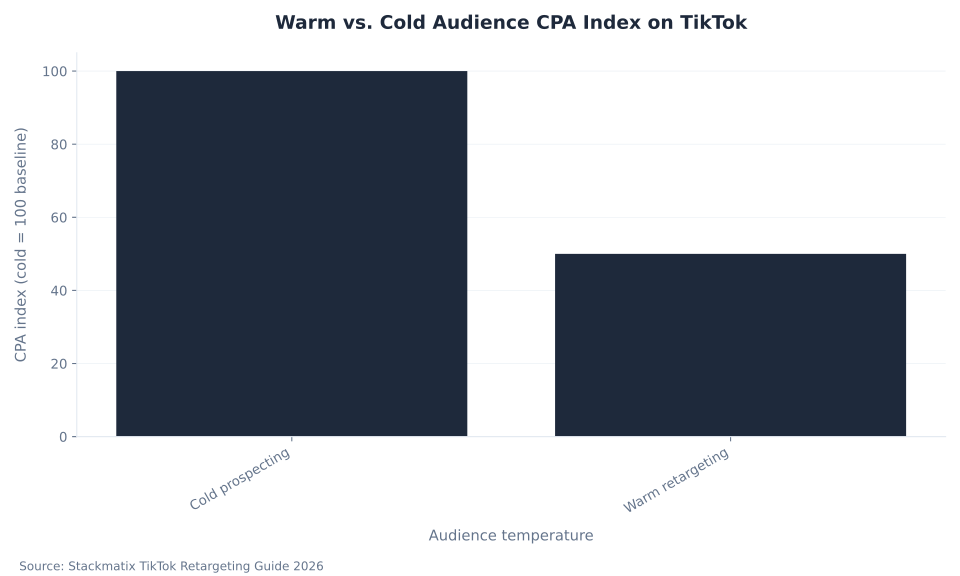
- Warm retargeting: 40–60% lower CPA. Warm audiences are the highest-ROI lever in TikTok Ads Manager. The payoff comes from segmentation, not from running one undifferentiated retargeting pool.
- Behavioral > interest for conversion campaigns. Interest targeting maps to historical content-category affinity. Behavioral targeting captures recent in-app actions — a shorter, intent-fresh signal. For conversion objectives, behavioral is the sharper layer.
TikTok Audience Targeting: Key Benchmarks (2026)
-15%
CPA reduction — broad vs. narrow targeting
TikTok official docs, Sep 2025
1,000
matched users required to activate a Custom Audience
TikTok Ads Manager, 2026
706+
interest categories in TikTok Ads Manager
eDigital Agency, 2026
How the Industry Frames TikTok Audience Targeting — and Where It Gets It Wrong
Most TikTok advertising guides present audience targeting as a direct port of Meta’s audience manager: replicate the same interest stacks and demographic filters, adjust for TikTok’s younger demographic skew, and launch. MB Adv Agency frames the problem differently — and the difference matters for first-month performance.
On Meta, the audience is the strategy. Advertisers who build precise, segmented audiences with exclusions and interest-based layering consistently outperform those who run broad delivery. The platform rewards audience craft. On TikTok, the inverse is true. TikTok’s recommendation engine — the same algorithm that surfaces organic content — is also the ad delivery system. It already models user behavior, content affinity, and purchase intent at scale. Narrowing the audience doesn’t sharpen its aim; it restricts its ability to find the best users within a broader pool.
MB Adv Agency has found that teams migrating from Meta who loosen their audience constraints on TikTok in the first 30 days consistently see lower CPA than those who port Meta’s precise audience stacks directly. The right posture for a TikTok campaign launch is: broad demographic entry (18–44, nationwide) + 2–3 behavioral signals (not stacked interest exclusions) + Smart Targeting enabled to let the algorithm expand delivery where it sees lift. Pruning on performance data comes after two to three weeks of delivery, not at the start.
TikTok’s Targeted Advertising Guide and Stackmatix’s 2026 targeting options guide both document this pattern. The most common cause of poor TikTok first-month performance is not bad creative or wrong bidding strategy — it is audience constraints that prevent the algorithm from finding the users it knows how to convert. The ad formats pillar covers how format selection interacts with this: In-Feed auction formats rely most heavily on algorithmic delivery, making broad targeting especially important for conversion campaigns.
For e-commerce PPC brands entering TikTok from Meta, the practical translation: demographics as outer boundary, 1–2 behavioral signals as refinement layers, interest targeting reserved for discovery campaigns only. New York and Los Angeles accounts with dense TikTok user bases show this most consistently: broad metro-DMA delivery outperforms interest-stacked delivery at matched spend.
MB Adv Agency has found: The single most effective first adjustment for a Meta-native team launching on TikTok is removing all interest exclusions and expanding the demographic range by 10–15 years in each direction. Creative quality then does the targeting work the audience constraints were trying to do — and does it better.
TikTok Audience Types: A Definitive Reference
TikTok Ads Manager offers five audience mechanisms. Each has distinct signal logic, freshness, and optimal use case. Understanding the mechanics before layering is the precondition for architecture that performs.
Demographic targeting provides the outer boundary of delivery. TikTok’s demographic options include age (13+), gender, language, location (country, region, DMA), device type, and operating system. Income, occupation, and education targeting — available on Meta — are not natively available on TikTok. The absence of income targeting is a genuine constraint for luxury or high-AOV brands; the workaround is behavioral signal layering over a wide demographic base, then audience refinement on performance data.
Interest targeting in TikTok Ads Manager spans 706+ categories per eDigital Agency’s 2026 interest targeting list (TikTok’s own help documentation cites 440+ subcategories). These categories reflect historical content-category engagement — users who have interacted with content in a given vertical at any point, not users who are in-market right now. Interest targeting functions as a discovery layer, not a purchase-intent signal.
Behavioral targeting, by contrast, captures recent in-app actions: videos liked, accounts followed, hashtags engaged with. The signal window is shorter and more intent-fresh than interest categories. Per MegaDigital’s 2026 interest targeting guide, the combination that consistently outperforms on conversion campaigns is: broad demographic base + 1–2 behavioral signals + Smart Targeting enabled. Interest categories alone, without behavioral refinement, produce weaker conversion rates on performance objectives.
Lookalike Audiences: Seed Size, Quality, and Size Options
TikTok Lookalike Audiences require a minimum of 1,000 matched users in the source Custom Audience to create. That is the technical floor, not the performance target. Below 10,000 matched source users, the algorithm has insufficient behavioral patterns to model against TikTok’s full user graph with reliability.
The minimum of 1,000 is a creation threshold, not a quality guarantee. A 1,200-person seed produces a functional Lookalike; it does not produce a strong one. The practical quality gap between a 2,000-person seed and a 50,000-person seed is significant, and that gap shows in CPA and ROAS at scale. Per TikAdTools’ 2026 Lookalike guide, the recommended production threshold is 10,000+ matched source users, with ~50,000 as the optimal point.
Seed quality matters more than seed size. A 3,000-person seed built from verified purchasers — users who completed a transaction — produces a stronger Lookalike than a 20,000-person seed built from raw newsletter subscribers who never interacted with the brand. TikTok’s algorithm models the behavioral fingerprint of the seed: content affinity, in-app actions, engagement patterns. A noisy, undifferentiated seed produces a noisy Lookalike. MB Adv Agency segments seed lists by conversion event: purchasers, high-value customers (top 20% by LTV), and repeat buyers as separate Lookalike seeds rather than uploading the full CRM as a single list.
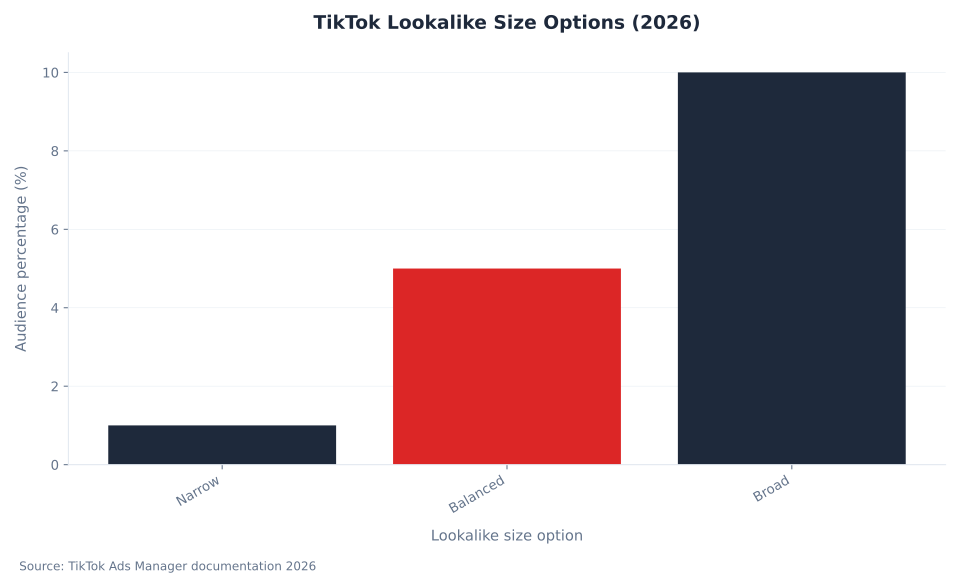
The three size options — Narrow (1%), Balanced (5%), Broad (10%) — control the similarity-vs-reach trade-off. The 2026 recommended default is Balanced (5%). The 1% Narrow option maximizes behavioral similarity but restricts auction volume, which often raises CPMs. The 10% Broad option maximizes reach at the cost of behavioral similarity; it functions closer to a discovery campaign than a prospecting one. For conversion campaigns with a high-quality purchaser seed, Balanced (5%) delivers the best mix of match quality and auction depth.
Source: TikTok Ads Manager Lookalike Audience documentation, 2026
For social media PPC accounts at scale, build separate Lookalike ad groups per seed type — purchasers (5%), ATC-but-not-purchased (5%), engaged-video-viewers (10%) — rather than stacking seeds into one ad group. Isolation identifies which seed drives the best CPA. Chicago e-commerce PPC campaigns consistently show the purchaser-seed Lookalike outperforming the engagement-based Lookalike on ROAS by 25–40% post-learning-phase.
Custom Audiences: Source Types, Match Rates, and the Activation Threshold
A TikTok Custom Audience requires 1,000 matched users against TikTok’s user graph before it activates as a targetable audience in an ad group. The upload size of the source file is not the operative number — match rate is. Email-list match rates run 20–60% depending on list age, demographic composition, and hashing consistency.
The activation threshold creates a planning requirement that most teams underestimate. An e-commerce brand uploading a 3,000-record email list with a 30% match rate produces 900 matched users — nine hundred, below the 1,000-user activation floor. The ad group cannot serve. The correct verification step is to upload the list, wait for TikTok’s matching to complete (typically 24–48 hours), check the matched audience size in Ads Manager, and only then build campaign architecture that depends on the audience. Per LeadsBridge’s Custom Audience guide, teams that skip this verification step and assume upload size equals matched size account for a disproportionate share of first-campaign failures.
The five Custom Audience source types — customer file, website traffic, app activity, engagement, and lead generation — differ materially in match quality and data requirements. Pixel-based website audiences have the highest match rate because TikTok matches its own Pixel events directly to its user graph without email hashing. Customer-file audiences have the lowest match rate due to hashing mismatches, list age, and the share of the CRM that has a TikTok account. For Pixel installation and event tracking, see the pixel and tracking pillar.
Source: TikTok Ads Manager Custom Audiences documentation; LeadsBridge TikTok Custom Audience Guide 2026
MB Adv Agency has found that building a tiered Custom Audience structure from day one — separating purchasers, ATC-abandoners, page viewers, and video engagers into distinct audiences with distinct windows — is the single most reliable predictor of retargeting performance at 30-day account age. Brands running PPC management in Miami and similar DTC-heavy markets see the cost of an undifferentiated retargeting pool most acutely during peak seasons.
Activation check: Before launching any ad group that targets a Custom Audience, verify matched audience size in Ads Manager. Matched size must reach 1,000 users before the ad group can serve. Upload size and matched size are different numbers.

Interest vs. Behavioral Targeting: Signal Depth and Use Case
TikTok Ads Manager offers two signal types beneath the broad demographic layer: interest targeting, which maps to historical content-category affinity, and behavioral targeting, which captures recent in-app actions. They have materially different conversion signal strength and belong at different positions in the audience stack.
Interest targeting’s 706+ categories (per eDigital Agency’s 2026 count) span verticals from apparel to financial services. The category assignment is based on engagement history — a user who watched five cooking videos two months ago qualifies for the “food and beverage” interest. That engagement history tells the ad system that the user has affinity for a content type. It does not signal that the user is currently in-market for a purchase. For discovery campaigns where reaching users with a demonstrated interest in a category is the correct objective, interest targeting is appropriately calibrated. For conversion campaigns, it is a weak signal.
Behavioral targeting captures what users have done on TikTok recently: which accounts they follow, which videos they have liked, which hashtags they have engaged with. The recency of these signals makes them a meaningfully sharper indicator of current interest than historical content-category affinity. The combination documented by Benly’s 2026 targeting options guide as the top-performing conversion setup is: broad demographic + 1–2 behavioral signals + Smart Targeting on. Stacking 4+ interest categories on top of behavioral signals adds audience narrowing without adding signal quality, and it reduces auction volume.
For TikTok creative best practices, the implication is direct: when behavioral targeting narrows the audience to users with demonstrated recent content affinity, the creative brief should reference that behavior explicitly. A user who has been following fitness accounts and liking workout videos responds differently to the same product ad than a user reached through broad interest in “health and fitness.” Creative specificity compounds targeting specificity.
Retargeting Strategy: Intent-Tiered Windows and the 50% CPA Gap
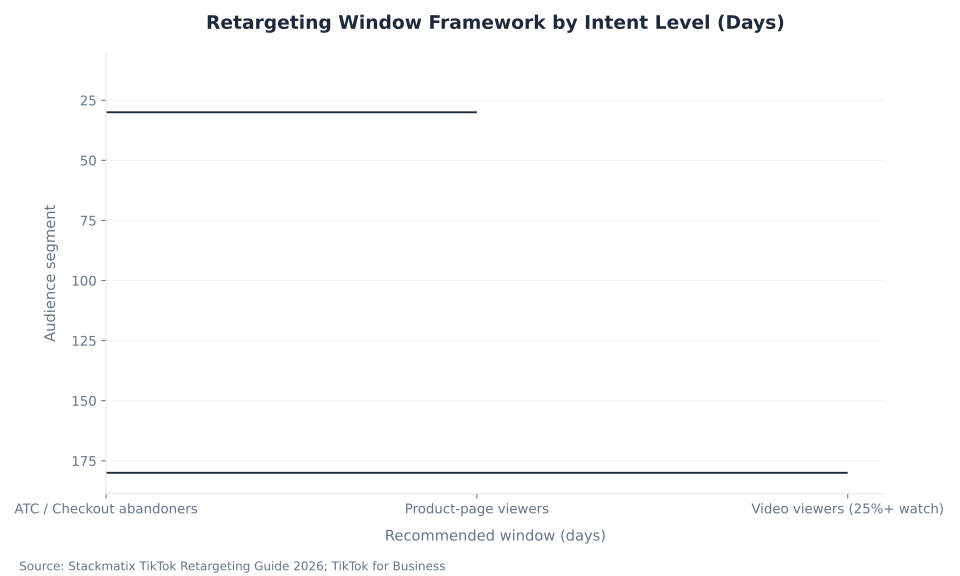
Warm retargeting audiences convert at 40–60% lower CPA than cold prospecting on TikTok. That gap is not captured by running a single undifferentiated site-visitor retargeting pool. It is captured by segmenting retargeting into at least three intent tiers, each with its own window and creative brief.
TikTok Pixel supports six time-based retargeting windows: 7, 14, 30, 60, 90, and 180 days. The window choice is not a cosmetic decision — it determines which users are in the audience and therefore which auction signals the ad group sends to TikTok’s delivery system. A 180-day window that includes a mix of checkout abandoners from last week and users who viewed a product page five months ago pools the highest-intent signal with near-zero intent. The algorithm cannot distinguish between them, so it bids the same for both. That misallocation inflates CPA for the high-intent segment.
The correct architecture is three separate ad groups, each targeting one retargeting segment: ATC/checkout-abandoners in a 7–14 day window with a direct-response creative; product-page viewers in a 30-day window with a consideration-phase creative; and video viewers (25%+ watch time) in a 60–180 day window for brand rekindling. This segmentation passes distinct auction signals to TikTok’s delivery system for each tier, which allocates spend toward the users most likely to convert at the bid level set for each group. For campaign objective selection, retargeting campaigns aimed at ATC/checkout should use the Conversion objective with a purchase event; video-viewer rekindling works with Video Views or Reach.
Post-view attribution — attributing conversions that happen after an ad is seen but not clicked — defaults to a 7-day window on TikTok. This is worth monitoring when evaluating retargeting performance: some portion of conversions attributed to the retargeting campaign reflect post-view events from users who would have converted anyway. Separating click-attributed from view-attributed conversions in the reporting column gives a cleaner read on true retargeting incrementality. For reporting and metrics definitions, see the TikTok metrics and costs pillar.
PPC management in New York and PPC management in Los Angeles accounts with high traffic volume populate all three tiers simultaneously. Smaller brands in Miami social media PPC and similar markets below 5,000 monthly site visitors should launch the ATC/checkout segment first and add lower-intent tiers as Pixel data accumulates.
TikTok vs. Meta: Audience Architecture Side by Side
The structural difference between TikTok and Meta audience mechanics is not a matter of degree — it is a difference in which layer carries the optimization work. On Meta, audiences are the strategy. On TikTok, creative is the strategy.
Meta’s Ads Manager is designed around advertiser-defined audiences as the primary signal. Detailed targeting, Lookalike Audiences, Custom Audiences, and exclusion stacks are all mechanisms for telling Meta’s delivery system which users to prioritize. Meta’s algorithm executes against that definition. Teams that invest in precise audience architecture on Meta see measurable performance differences from that investment.
TikTok’s delivery system runs differently. The recommendation engine — the same system that surfaces organic content on the For You page — is also the ad delivery system. It has its own model of user intent, content affinity, and purchase likelihood built from the platform’s behavioral data. Advertiser-defined audiences tell the system who to include in the eligible pool, not who to prioritize within it. A tightly defined audience pool of 500,000 users and a broadly defined pool of 5,000,000 users — all else equal — give the algorithm very different amounts of space to find the right users. The larger pool wins on CPA, per TikTok’s own data.
Source: TikTok official documentation; Meta Business Help Center; Stackmatix 2026
The practical transfer for a team launching on TikTok from a Meta background: broad demographic entry, one or two behavioral signals, Smart Targeting on, no interest exclusions. Let the ad format and creative do the targeting work the audience constraints were trying to do. For Chicago social media PPC programs for local clients: citywide geo + 25–54 age + Smart Targeting on + one behavioral signal as the minimum viable starting structure.
Recommended Audience Architecture by Campaign Objective
The optimal audience setup changes with campaign objective. A conversion campaign and an awareness campaign have different algorithm signals, different auction dynamics, and different tolerance for audience breadth. The table below maps each primary objective to the recommended setup and the most common setup errors.
The most common conversion-campaign failure is narrow geo + narrow age + stacked interest exclusions. Each constraint compounds the others. A campaign targeting women 25–34 in one city with interest exclusions can shrink the eligible pool below 100,000 users — too small for TikTok’s learning phase, which requires 50 conversions in 7 days at the ad-group level.
Source: TikTok for Business Targeted Advertising Guide; MB Adv Agency practice framework
The TikTok Ads Manager setup guide covers the mechanics of configuring each audience type within Ads Manager. For the Chicago PPC management clients who ask which objective to select for a new TikTok account, the answer is conversion with broad targeting — not Reach, not Traffic — because conversion objective delivers the most useful auction signal data for future optimization.
Build a TikTok audience architecture that works with the algorithm, not against it
MB Adv Agency structures TikTok audience strategy from the algorithm up — broad entry, behavioral refinement, retargeting segmentation. Start with a structured audit.
Social media PPC services →Smart Targeting and the 2026 Algorithm Direction
Smart Targeting is TikTok’s machine-learning audience expansion feature. When enabled, it allows the delivery system to serve ads beyond the explicitly defined audience when the algorithm identifies users likely to convert. It is TikTok’s equivalent of Meta’s Advantage+ Audience expansion — and on TikTok, enabling it is more consistently positive than leaving it off.
The rationale is the same as the broad-targeting argument: TikTok’s recommendation engine has a model of user intent that is often more accurate than an advertiser’s pre-defined audience. Smart Targeting allows the algorithm to act on that model by expanding delivery where it sees conversion likelihood, even outside the defined demographic or interest parameters. Per Stackmatix’s 2026 targeting guide, Smart Targeting performs best when paired with broad base targeting rather than narrow starting audiences — the algorithm has more room to expand when the starting pool isn’t already at the edge of the viable universe.
The 2026 algorithm direction continues the trend toward less manual audience sculpting and more algorithm-driven delivery optimization. TikTok’s platform roadmap, as described in its official guidance, pushes advertisers toward fewer, broader ad groups with Smart Targeting on versus many tightly defined ad groups competing against each other. This is the same structural shift Meta made with Advantage+ in 2023–2024. The advertiser skill that retains value on TikTok is not audience architecture — it is creative strategy, bid mechanics, and retargeting segmentation.
For TikTok strategy and trends, the implication for 2026 campaign structure is: one or two broad ad groups with Smart Targeting enabled at the awareness/prospecting level, plus three segmented retargeting ad groups by intent tier. That structure — two prospecting groups, three retargeting groups — is the architecture that consistently exits the learning phase fastest and accumulates conversion data at the speed the algorithm needs to optimize bidding.
Smart Targeting toggle: Enable it for prospecting and awareness campaigns. Disable it for retargeting campaigns where the Custom Audience definition is the point — expansion into cold audiences defeats the purpose of a retargeting ad group.
Three Misconceptions That Cost DTC Brands Their First TikTok Month
These three misconceptions account for the majority of first-campaign underperformance on TikTok for brands migrating from Meta. Each is sourced and refutable.
Misconception 1: TikTok audience targeting works the same way as Meta Audiences.
It does not. The structural difference is that TikTok’s algorithm is designed to do the targeting work autonomously. On Meta, audience precision is a primary optimization lever: tighter, better-defined audiences produce measurably better results from better-directed spend. On TikTok, TikTok’s own documentation explicitly recommends broad delivery (>80% potential market reach) and documents measurably better CPA outcomes at that reach level. Porting a tightly sculpted Meta audience tree directly into TikTok — without loosening age ranges, expanding geo, and removing interest exclusions — is one of the most reliable causes of poor first-month performance. The mental model for Meta audiences is an architect’s tool. The mental model for TikTok audiences is a filter over an algorithm that already knows who it wants to show content to. Source: TikTok for Business Targeted Advertising Guide.
Misconception 2: A larger Lookalike seed list always produces a better Lookalike Audience.
Size is a factor, but seed quality is the dominant factor. A 3,000-person seed of verified purchasers — users who completed a transaction — produces a stronger Lookalike than a 25,000-person seed of raw newsletter subscribers who never engaged with the brand. TikTok’s algorithm models the behavioral fingerprint of the seed: engagement patterns, content affinity, in-app actions. A noisy, undifferentiated seed (all-time email list signups, for instance) produces a noisy Lookalike because the behavioral signal being modeled is undifferentiated. The correct practice is to segment seed lists by conversion event — purchasers, high-LTV customers, repeat buyers — and build separate Lookalikes per segment rather than uploading the entire CRM as a single list. Source: TikAdSuite Custom vs. Lookalike 2026; TikAdTools Lookalike Guide 2026.
Misconception 3: Retargeting on TikTok is re-running the same ad to everyone who visited the site.
Undifferentiated site-visitor retargeting is one of the weakest setups available in TikTok Ads Manager. TikTok Pixel supports granular event-based segmentation: add-to-cart, initiate checkout, view content, complete payment — each as a separate Custom Audience with its own recency window. The high-leverage architecture is a sequential funnel: ATC and checkout abandoners in a 7–14 day window with a direct-response creative; product-page viewers in a 30-day window; video viewers (25%+ completion) in a 60–180 day window. These three segments have materially different intent signals and should never pool — doing so suppresses auction efficiency and dilutes bid signals for the highest-intent users. The 40–60% CPA reduction from warm retargeting is earned by segmentation, not by retargeting at all. Unsegmented retargeting captures a fraction of that reduction. Source: Stackmatix Retargeting Guide 2026.
Frequently Asked Questions: TikTok Audience Targeting
Questions about your TikTok audience setup?
MB Adv Agency answers audience architecture questions and audits existing TikTok account setups.
About MB Adv Agency →Methodology
This pillar consolidates four pages that generated 0 combined clicks over the 90 days to 2026-05-27 (“mastering-audience-targeting-on-tiktok,” “demographic-and-behavioral-targeting-on-tiktok,” “expanding-reach-with-lookalike-audiences-on-tiktok,” “using-retargeting-data-with-tiktok-pixel”). This is a topical-authority and internal-linking consolidation play, not a search-traffic-capture strategy; aggregate organic demand for this keyword cluster tops out at 100 monthly search visits. All performance benchmarks derive from: TikTok Ads Manager official documentation (updated September 2025); Stackmatix TikTok Retargeting Guide 2026; TikAdTools Lookalike Guide 2026; Benly Targeting Options 2026; eDigital Agency Interest List 2026. No client-specific metrics are cited; MB Adv Agency observations are qualitative and based on practitioner experience. Reviewed by MB Adv Agency, May 2026.

As a Google Ads expert, I bring proven expertise in optimizing advertising campaigns to maximize ROI.
I specialize in sharing advanced strategies and targeted tips to refine Google Ads campaign management.
Committed to staying ahead of the latest trends and algorithms, I ensure that my clients receive cutting-edge solutions.
My passion for digital marketing and my ability to interpret data for strategic insights enable me to offer high-level consulting that aims to exceed expectations.
Google Partner Agency
We're a certified Google Partner Agency, which means we don’t guess — we optimize withGoogle’s full toolkit and insider support.
Your campaigns get pro-level execution, backed by real expertise (not theory).

4.9 out of 5 from 670+ reviews on Fiverr.
That’s not luck, that’s performance.
Highly recommend Matteo to set up your server side tracking. He has a deep understanding of e-commerce tracking and will go above and beyond to make sure everything is set up correctly and working 100%. If you are scaling your store this set up is non-negotiable in my opinion and there isn't many people who have this much knowledge or put the effort in to get it right. Thanks again!

avorodesign.com
I can only recommend Matteo! He was very patient, professional and very knowledgeable about GA4, Consent Mode v2, and GDPR compliance. Communication was clear, and the setup was done professionally and efficiently. Highly recommend him for anyone needing reliable tracking implementation.

www.natureiki.life
Matteo shines in the realm of online professionals. His work is not only deep in data but also complemented by his proactive communication and cooperation, setting a new standard for freelancers. If you want someone who truly exceeds expectations, look no further. Highly recommended!

www.omanbeverlysmyth.com
Exceptional Service Beyond Expectations - Outstanding Service Impeccable depth, flawless delivery, and exceptional language fluency—this service exceeded all expectations. Highly recommended. Matteo truly ROCKS!!!

ium-paris.com
Top-notch, always highly value working with Matteo. An absolute Google Ads Genius. This is approximately the 8th time I have hired him and he's helped us get 6-7 ROAS. We are excited in continuing to improve our lead flow. Hire this guy if you need Google Ads help. Thanks Matteo!

www.dleeventgroup.com
I finally found the guy who can setup server side tracking and all the ecosystem properly. I definitely recommend Matteo. He is very responsive, kind and wants to dig into things. He configured GA4, Meta, Google Ads, Outbrain and google consent v2 with Cookiebot. Thanks Matteo.

inomega.fr
MB Adv delivered exceptional work with outstanding professionalism and lots of patience, taking time to see effects of changes made and not just do the work and submit it. The proactive communication and video summaries of the work completed made working with Matteo a pleasure, as he consistently went above and beyond. Highly recommended for web analytics projects! We are already working on another project.

www.withnellsensors.co.uk
Working with Matteo on my Google Ads was a game-changer. He's not just a strategist, he's a true partner. He understood my goals and tailored a campaign that perfectly reached my target audience. I'm grateful for his expertise and dedication.

dccargo.com
Click-driven mind
with plastic-brick obsession.
We build Google Ads campaigns with the same mindset we use to build tiny brick worlds: strategy, patience, and zero tolerance for wasted pieces.
Data is our blueprint. Growth is the only acceptable outcome.