
TikTok Campaign Objectives: Bidding, Placements & Optimization Guide (2026)

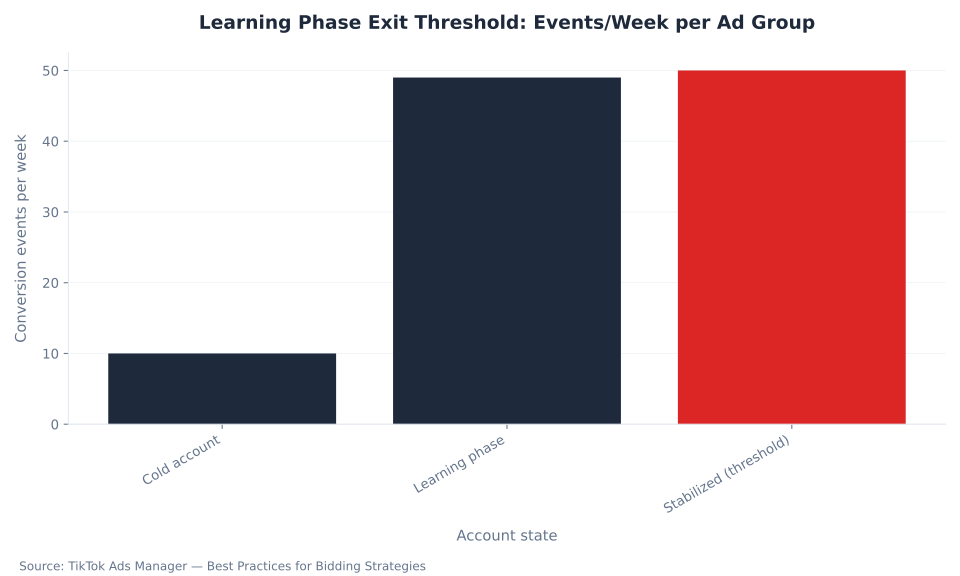
50
Conversion events per ad group per week — the threshold governing whether a TikTok Sales campaign exits the learning phase and delivers stably
Source: TikTok Ads Manager — Best Practices for Bidding Strategies
TikTok Campaign Objectives: How Objective Choice Locks Your Auction Position
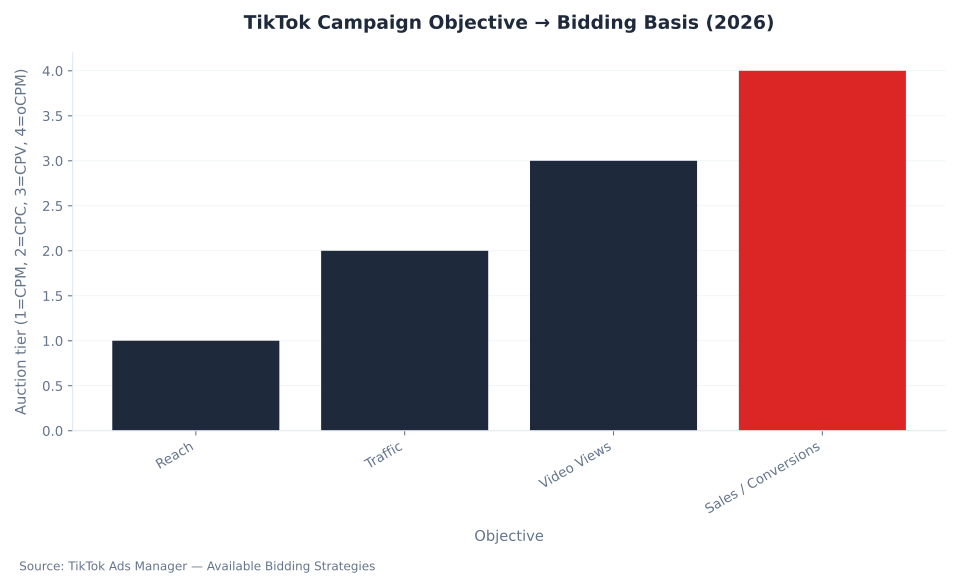
Selecting a TikTok campaign objective is not a creative choice about desired outcomes — it is a structural decision that determines your bidding method, available optimization events, and the auction pool your ads compete in. Reach locks you to CPM; Traffic locks you to CPC; Sales locks you to oCPM against a pixel or event signal. Picking Traffic when the goal is purchases means paying for clicks from users TikTok has no signal you will ever convert — in the wrong auction pool entirely.
TikTok Ads Manager in 2026 surfaces eight objectives: Reach, Traffic, Video Views, Lead Generation, Community Interaction, App Promotion, Brand Consideration, and Sales. The Sales objective consolidates what were historically separate Website Conversions and Product Sales objectives — but the optimization behavior differs materially by destination (TikTok Shop versus website versus app). Account eligibility and regional rollout affect which objectives appear in a given Ads Manager account. (TikTok Ads Manager — Available Bidding Strategies; MegaDigital — TikTok Campaign Guide 2026.)
The practical consequence: the objective selection screen is the most consequential decision in campaign setup. Every downstream configuration — bid strategy, placement eligibility, creative enforcement — flows from the objective. A campaign manager running $10,000/month who selects Traffic instead of Sales has not merely picked a different KPI label; they have entered a different auction where TikTok’s algorithm optimizes for click probability, not purchase probability. The two audiences overlap partially but are structurally different.
The objective you pick at campaign creation determines your entire auction position — not just your “goal.” Wrong objective = wrong auction pool, not merely a mislabeled KPI.
This pillar documents each objective’s bidding basis, optimization signal, placement compatibility, and correct use case — with a decision tree for accounts at different conversion-signal maturity levels. For the format-level mechanics that interact with objective choice, see TikTok ad formats. For the attribution infrastructure required by the Sales objective, see TikTok Pixel and tracking. The campaign-level structure that wraps objectives into a budget hierarchy is covered in the TikTok Ads Manager guide.
Key Facts About TikTok Campaign Objectives
- TikTok Ads Manager presents 8 campaign objectives in 2026; account eligibility determines which subset is visible.
- Each objective locks a bidding method: Reach=CPM, Traffic=CPC, Video Views=CPV/oCPM, Sales/Conversions=oCPM against a pixel event signal.
- The Sales objective covers TikTok Shop, website, and app destinations — optimization behavior differs materially by destination type.
- Maximum Delivery is the spend-based max-conversions strategy; the historical Lowest Cost behavior maps to it.
- 50 conversion events per ad group per week is the threshold to exit the learning phase and stabilize Sales campaign delivery.
- Value-Based Optimization (VBO) requires the 50-event floor as a prerequisite; it targets high-basket-value purchasers, raising CPA while raising ROAS proportionally.
- Pangle (TikTok’s audience network) delivers cheaper CPM but lower conversion quality. Exclude it from conversion and lead-gen campaigns until TikTok-only placement is profitable.
- New accounts without conversion history accumulate signal on Traffic or Video Views before moving to Sales — the funnel is sequential by design.
TikTok 2026 Objectives: Quick Reference
TikTok’s 2026 objective set maps directly to funnel stage and bidding basis. The table below is the starting point for every campaign setup conversation — objective determines bidding method before any other setting is configured.
| Objective | Funnel Stage | Bidding Basis | Primary Signal |
|---|---|---|---|
| Reach | Awareness | CPM | Unique impressions |
| Video Views | Awareness / Consideration | CPV / oCPM | Watch time / view-through |
| Traffic | Consideration | CPC | Landing-page clicks |
| Community Interaction | Consideration | CPM / CPC | Profile visits / followers |
| Brand Consideration | Consideration | CPM | Ad recall lift |
| Lead Generation | Conversion | oCPM | In-app lead form submissions |
| App Promotion | Conversion | oCPM / CPC | App installs / in-app events |
| Sales | Conversion | oCPM | Pixel event / in-app purchase |
The bidding basis column is the structural constraint. Entering a conversion campaign with a CPM or CPC objective is not a conservative choice — it is a misrouted campaign. The optimization signal TikTok’s algorithm receives determines the audience it builds. A CPM-billed Reach campaign delivers to audiences likely to see; an oCPM Sales campaign delivers to audiences likely to buy. These are not subsets of the same audience. (TikTok Ads Manager — Available Bidding Strategies.)
How Objective Choice Locks Bidding Method and Optimization
The objective selected at campaign creation is a one-way gate. It determines the auction type your ads enter and the optimization signal TikTok’s algorithm learns from. Once an ad group is live, changing the objective requires recreating the campaign. The table below shows the exact structural lock for each objective.
| Objective | Bidding Method | Optimization Signal | Audience TikTok Finds |
|---|---|---|---|
| Reach | CPM | Unique impressions | Maximum unduplicated coverage |
| Traffic | CPC | Landing-page clicks | Users likely to click |
| Video Views | CPV or oCPM | 6-second or 2-second view-through | Users likely to watch |
| Sales (Website) | oCPM | Pixel event (Purchase, AddToCart…) | Users likely to convert on-site |
| Sales (TikTok Shop) | oCPM | Native in-app purchase signal | Users likely to buy in-app |
| Lead Generation | oCPM | In-app lead form submission | Users likely to submit lead forms |
| App Promotion | oCPM / CPC | App installs or in-app events | Users likely to install and engage |
An account running Traffic campaigns to drive purchases pays CPC rates for an audience optimized for clicking — not buying. The algorithm has no mandate to find buyers. Switching to Sales with a calibrated pixel signal puts the campaign in the oCPM auction against competitors also optimizing for purchase outcomes. The audience intersection between “likely to click” and “likely to buy” is smaller than most practitioners assume. (TikTok Ads Manager — Best Practices for Bidding Strategies; TikTok Ads Manager — Available Bidding Strategies.)
The quality of the pixel signal is as important as the objective choice: a Sales campaign with a low event-match-quality pixel underperforms a Traffic campaign with clean click data. Objective selection and pixel health are co-dependent. For the pixel infrastructure that powers oCPM optimization — including Events API setup and event match quality scoring — see TikTok Pixel and tracking.
Reach and Video Views: Awareness Objective Mechanics
Reach and Video Views both operate at the awareness layer, but they optimize against different signals and reach materially different user pools. Treating them as interchangeable conflates distribution with attention — a distinction that determines whether the campaign goal is breadth of coverage or depth of message comprehension.
Reach (CPM): Optimizes for maximum unique impressions within the defined target audience. The algorithm weights unduplicated reach — the same user seeing the ad twice counts once. There is no weighting for engagement. A user who scrolls past after 0.5 seconds contributes equally to delivery as a user who watches the full ad. The correct use case is frequency-capped brand exposure across the broadest eligible audience — a product launch where the goal is reach percentage, not attention quality.
Video Views (CPV/oCPM): Optimizes for watch time. TikTok shows the ad to users who, based on prior behavioral data, are more likely to watch a meaningful duration — the 6-second or 2-second view-through event used as the optimization target. The user pool skews toward higher-attention behaviors. For brand recall and message comprehension, Video Views delivers a statistically higher-engagement audience than Reach at comparable impressions. The trade-off is CPM: Video Views impressions cost more because the audience is pre-filtered for attention. (TikTok for Business — Choose the Right Objective.)
| Dimension | Reach | Video Views |
|---|---|---|
| Bidding basis | CPM | CPV or oCPM |
| Optimization signal | Unique impressions | View-through (2s or 6s) |
| User pool | Broadest coverage, no engagement filter | Attention-filtered, watch-time skew |
| Pangle compatibility | Tolerated — impression signal is intent-insensitive | Tolerated — view-through less sensitive to intent quality |
| Best use case | Launch coverage, broad brand awareness | Message comprehension, brand recall, sequential storytelling |
| Wrong use case | Any campaign measuring success by engagement quality | Pure coverage plays where CPM efficiency is the primary goal |
Pangle placement is more tolerable for awareness objectives than for conversion objectives. Because the optimization signal for Reach and Video Views is less intent-sensitive — impressions and view-throughs are less dependent on purchase intent than pixel conversion events — Pangle’s lower-intent traffic degrades performance less dramatically for awareness plays. The full placement mechanics are covered in the ad placements section below.
For creative format constraints that interact with awareness-objective delivery — aspect-ratio and duration requirements that affect view-through rate — see TikTok ad formats. Hook performance by format type, which directly affects Video Views CPV efficiency, is covered in TikTok creative best practices.
The Sales Objective: TikTok Shop, Website, and App Destinations
The Sales objective is TikTok’s consolidated conversion objective, covering purchases on TikTok Shop, external websites, and mobile apps. The objective label is unified; the optimization behavior is not. Destination choice changes the signal TikTok’s algorithm receives and the audience it constructs.
TikTok Shop destination routes optimization against native in-app purchase signals — the highest-intent, lowest-friction conversion path on the platform. The checkout does not require leaving TikTok; the algorithm receives a clean purchase signal from users who complete transactions in-app. Website destination optimizes against pixel events fired on an external URL — a complete purchase requires the user to leave the app, authenticate a payment method, and return a conversion confirmation to TikTok’s pixel. Each additional step introduces abandonment. App destination uses mobile measurement partner (MMP) data to optimize against app installs or in-app events. (TikTok for Business — Sales Advertising Objective; TikTok for Business — Choose the Right Objective.)
| Destination | Conversion Signal | Checkout Friction | Best For |
|---|---|---|---|
| TikTok Shop | Native in-app purchase | None — in-app checkout | DTC brands with TikTok Shop live; impulse-purchase categories |
| Website | Pixel event on external URL | App exit → external checkout | Brands without TikTok Shop; high-consideration purchases |
| App | MMP-reported install or in-app event | App store download step | Mobile app installs and post-install event optimization |
| Website + App | Combined pixel + MMP | Varies by destination | Cross-device purchase paths; brands with both web and app |
DTC brands with a live TikTok Shop running Website Sales campaigns by default leave conversion-rate lift unrealized. The in-app purchase signal is cleaner and the checkout path is shorter. The correct default for brands with TikTok Shop enabled: run Shop-destination Sales campaigns and use Website-destination as a supplement for SKUs not available in the Shop. For e-commerce brands managing both, the e-commerce PPC services framework covers objective-destination routing as part of the full campaign hierarchy. The CVR differential between TikTok Shop and external landing pages is documented in the TikTok metrics and costs pillar.
Maximum Delivery, Cost Cap, and Bid Cap: How to Choose
TikTok’s three bidding strategies govern how budget is spent within the auction selected by the campaign objective. Maximum Delivery maximizes conversion volume within budget. Cost Cap targets a set cost-per-action. Bid Cap sets a hard CPC/CPA ceiling per auction entry. The choice depends on account maturity and whether a defensible CPA target exists.
Maximum Delivery is the spend-based maximum-conversions strategy: it delivers the highest volume of the optimization event within the campaign budget without targeting a specific CPA. CPA will fluctuate as TikTok’s algorithm explores the audience. The historical “Lowest Cost” bidding strategy maps to this behavior — TikTok’s documentation uses both names across different rollouts and account interfaces, but the functional behavior is the same: maximize volume, not CPA efficiency. (TikTok Ads Manager — Available Bidding Strategies; TikAdSuite — TikTok Ad Bidding Strategies 2026.)
Cost Cap instructs TikTok to hold cost-per-result near the advertiser-set target at the expense of delivery speed. The algorithm will underspend rather than overshoot the CPA target. Cost Cap is only useful when a defensible CPA target exists — setting it without historical CPA data forces the algorithm into an under-constrained search and typically results in under-delivery.
MB Adv Agency starts every new ad group on Maximum Delivery to establish a CPA baseline, then moves to Cost Cap only after 50 conversion events have been recorded at the ad group level — the minimum needed to set a defensible target.
| Strategy | CPA Control | Delivery Volume | When to Use | Prerequisite |
|---|---|---|---|---|
| Maximum Delivery | None — CPA fluctuates | Maximum | New campaigns; learning phase; CPA discovery | None (default for new campaigns) |
| Cost Cap | Targets set CPA | Reduced if CPA target is tight | Scaling with unit-economics discipline | Established CPA baseline from prior delivery |
| Bid Cap | Hard ceiling per auction | Lowest — auction entries restricted | Protecting CPC on Traffic; premium inventory control | Known clearing prices in target auction |
Cost Cap on a Sales campaign with fewer than 50 conversion events per week will under-deliver consistently — the algorithm cannot identify a reliable high-converting audience when signal is sparse, so it holds delivery rather than overshoot the CPA ceiling. The correct response for a signal-sparse account is Traffic or Video Views to accumulate audience data before moving to Sales. (TikTok Ads Manager — Best Practices for Bidding Strategies.)

The Learning Phase: 50-Event Threshold and Value-Based Optimization
TikTok’s conversion algorithm requires 50 optimization events per ad group per week to exit the learning phase and stabilize delivery. Below this threshold, CPA variance is high and delivery is unreliable. This 50-event floor governs whether a Sales or conversion objective performs at all — it is the single most important infrastructure requirement for conversion campaigns.
During the learning phase, TikTok experiments with audience segments and creative combinations. Budget is spent at elevated CPA as the algorithm samples. Pausing a campaign during the learning phase resets it — accumulated signal is lost. The correct protocol is to let the learning phase complete without pausing, even when early CPA reads high. Accounts that interrupt campaigns after 3 days because of elevated CPA are disrupting statistical accumulation, not responding to a performance problem. (TikTok Ads Manager — Best Practices for Bidding Strategies.)
| Account State | Events/Week (per ad group) | CPA Behavior | Correct Action |
|---|---|---|---|
| Cold account | <10 / week | High variance, no statistical basis | Run Traffic or Video Views to accumulate signal |
| Learning phase | 10–49 / week | Elevated; algorithm sampling | Do not pause — let the phase complete |
| Stabilized | ≥50 / week | Stabilizes; delivery reliable | Evaluate performance; move to Cost Cap if CPA target exists |
| VBO-eligible | ≥50 / week (sustained) | CPA rises; ROAS rises proportionally | Enable VBO only for AOV >$100 verticals |
Value-Based Optimization (VBO) is an advanced layer on top of Sales: it instructs TikTok to find purchasers with the highest predicted basket value rather than the highest conversion probability. CPA rises because high-value buyers are a smaller, harder-to-reach subset. ROAS rises proportionally because each conversion is worth more. Enabling VBO on a cold account puts the algorithm in an under-constrained search with no statistical basis for distinguishing high-value from average purchasers. VBO is the correct tool for high-AOV verticals (average order value above $100); it is counterproductive for low-AOV or high-frequency repurchase categories where conversion volume matters more than per-order value. (TikTok Ads Manager — Available Bid Strategies for App Event Optimization.)
For lead-generation campaigns, the same 50-event threshold applies to form submissions. Lead-gen accounts require 50 form submission events per week at the ad group level to stabilize delivery under Lead Generation objective optimization. For lead-gen PPC management across verticals, see lead generation PPC services.
Lead Generation and App Promotion Objectives
Lead Generation and App Promotion are purpose-built conversion objectives for non-purchase outcomes. Lead Generation uses TikTok’s native in-app lead form — no pixel required. App Promotion optimizes for mobile app installs or post-install events via a mobile measurement partner (MMP) integration.
Lead Generation: The native lead form removes the app-exit step required by website-destination Sales campaigns. Users submit contact information without leaving TikTok, and the form is pre-populated with profile data where available, reducing submission friction. The trade-off is lead quality: pre-populated forms lower the barrier to submission, which drives volume but reduces the percentage of leads with genuine purchase intent. For campaigns where lead quality — not volume — is the primary KPI, the correct architecture routes to a custom landing page (Website destination under Sales or a Sales/Traffic + landing page structure), not TikTok’s native form. (TikTok for Business — Available Optimization Objectives.)
| Dimension | TikTok Native Form | Website Landing Page |
|---|---|---|
| Pixel requirement | None | Required |
| Submission friction | Low — in-app, pre-populated | Higher — requires app exit |
| Lead volume | Higher | Lower |
| Lead intent quality | Variable — low-barrier submission | Higher — active navigation signals intent |
| Best for | Top-of-funnel list building, event registrations | High-consideration B2B, financial services, real estate |
App Promotion: Uses MMP data (AppsFlyer, Adjust, or similar) to optimize for installs or post-install conversion events. An App Promotion campaign without a correctly configured MMP is equivalent to a Sales campaign without a pixel: the algorithm has no optimization signal beyond proxy engagement data. For the full pixel and MMP setup mechanics that apply to both objectives, see TikTok Pixel and tracking.
Both Lead Generation and App Promotion follow the same 50-event learning-phase threshold as Sales. Accounts running lead-gen campaigns under 50 form submissions per week should not move to Cost Cap until that threshold is reached. For city-level lead-gen campaign management, see Chicago lead generation PPC and PPC management in New York.
TikTok Ad Placements: For You Feed, Pangle, and Placement Strategy
TikTok ad placement choice is a conversion-quality decision, not simply a reach decision. The For You (TikTok) feed is the primary placement — high intent, native-scroll context, full-screen vertical format. Pangle is TikTok’s owned audience network, placing ads across third-party apps with cheaper CPM but lower conversion quality. Placement strategy belongs in this pillar because objective choice governs which placements are appropriate.
TikTok Ads Manager offers two placement modes: Automatic Placements (TikTok includes Pangle and other network placements algorithmically) and Select Placements (manual control, enabling TikTok-only placement). Automatic Placements is the default. Every account that does not override placement is running Pangle traffic from day one of a campaign. For awareness objectives this default is acceptable. For conversion and lead-gen objectives, it introduces lower-intent traffic that degrades cost-per-qualified-result. (TikTok Ads Manager — About TikTok Pangle; TikTok Ads Manager — Automatic and Select Placement.)
| Dimension | TikTok For You Feed | Pangle (Audience Network) |
|---|---|---|
| Inventory type | TikTok native feed, full-screen vertical | Third-party apps (gaming, utility, entertainment) |
| CPM level (index) | 100 (baseline) | ~60 (cheaper) |
| Conversion quality (index) | 100 (baseline) | ~50 (lower intent) |
| CTR profile | Native intent-driven clicks | Higher CTR; more accidental clicks (gaming context) |
| Bid strategies supported | All | Cost Cap, Maximum Delivery, Hybrid |
| Recommended for | All objectives — primary placement | Reach and Video Views; reach extension after TikTok baseline is profitable |
| Not recommended for | N/A | Lead-gen or conversion campaigns until TikTok-only baseline is established |
MB Adv Agency excludes Pangle by default on conversion and lead-gen campaigns. The standard protocol: launch with Select Placements → TikTok only, establish a cost-per-result baseline, then run a controlled A/B test with Automatic Placements. Evaluate the result by cost-per-qualified-lead measured against your CRM close rate — not by the platform-reported CPL, which Pangle’s cheaper CPM inflates artificially. (npprteam — TikTok Campaign Structure Best Practices 2026.)
For the TikTok ad format specs that interact with each placement — aspect-ratio requirements, creative duration limits, and format availability by objective — see TikTok ad formats. For e-commerce placement strategy across key markets, see New York e-commerce PPC and Los Angeles social media PPC.
Objective Selection Framework: Decision Tree by Account Maturity
Objective selection depends on three variables: conversion signal volume (events per week per ad group), funnel stage, and budget level. The table below replaces the common default of selecting Sales for every campaign regardless of account maturity.
| Account State | Events/Week | Monthly Budget | Recommended Objective | Bidding Strategy |
|---|---|---|---|---|
| New account, no pixel data | 0 | Any | Traffic or Video Views | Maximum Delivery |
| Building signal | 10–49 | $1,000–$5,000/mo | Traffic (lower budget) or Sales approaching 50 | Maximum Delivery |
| Established, stable delivery | ≥50 | $5,000–$30,000/mo | Sales (Website or Shop) | Maximum Delivery → Cost Cap |
| High-scale, high-AOV | ≥50 sustained | $30,000+/mo | Sales + VBO (AOV >$100) | Cost Cap or Maximum Delivery |
| Awareness / new market entry | N/A | Any | Reach (coverage) or Video Views (comprehension) | CPM / Cost Cap |
| Lead-gen, quality over volume | Any | Any | Lead Generation (website LP, not native form) | Maximum Delivery → Cost Cap |
MB Adv Agency recommends Traffic or Video Views for any account running fewer than 50 conversion events per week before attempting Sales campaigns. The funnel is sequential by design: awareness signals inform the audience construction that conversion campaigns depend on. This is the single most consistent setup error observed across new account audits — cold Sales campaigns that underspend or overspend without ever generating reliable data. (TikTok for Business — Choose the Right Objective.)
For the audience-level mechanics that interact with objective sequencing — Lookalike audience seeding and custom audience construction — see TikTok audience targeting. For full-funnel TikTok budget allocation and campaign strategy, see TikTok strategy and trends. For social media PPC management, see social media PPC services and PPC management in Los Angeles.
Running TikTok campaigns with misaligned objectives?
MB Adv Agency audits objective-bidding configurations and identifies structural misalignments before they compound into wasted budget — typically the first thing we fix on inherited TikTok accounts.
View TikTok PPC Services →Three Objective Misconceptions That Waste Budget
Three structural errors account for the majority of misaligned TikTok campaign configurations. Each is rooted in a misunderstanding of what objective selection actually controls — not the campaign’s aspirational goal, but its auction type, bidding basis, and optimization signal.
Misconception 1: “Use Sales for any campaign with a business outcome”
The Sales objective is only effective when a calibrated pixel signal exists — specifically, TikTok requires 50 conversion events per week at the ad group level to exit the learning phase and stabilize delivery. Without that signal density, TikTok’s algorithm cannot identify a target audience with statistical confidence. The campaign either overspends during the learning phase at high CPA, or under-delivers entirely when using Cost Cap.
For new accounts or new product lines without conversion history, Traffic (CPC-based) or Video Views provides cheaper signal accumulation before graduating to Sales. The funnel is sequential: awareness events inform the audience model that conversion campaigns depend on. Running Sales on a cold account bypasses this sequencing and wastes the budget that should have built the signal. (TikTok for Business — Available Optimization Objectives; TikTok for Business — Choose the Right Objective.)
Misconception 2: “Reach and Video Views are both awareness plays — they’re interchangeable”
Reach (CPM) optimizes for maximum unique impressions with no weighting for engagement. Video Views (CPV/oCPM) optimizes for watch time — TikTok delivers the ad to users who are statistically more likely to watch a meaningful duration. A user pool optimized for impressions includes many users who scroll past in under a second; a user pool optimized for Video Views skews toward higher-attention behaviors. These are different audiences served by different auction signals, and they serve different campaign objectives.
For brand recall and message comprehension, Video Views is the correct objective. For pure reach coverage at minimum CPM — for instance, a frequency-capped brand awareness campaign where breadth of exposure is the metric — Reach is correct. Treating them as interchangeable conflates distribution with attention quality and produces systematic misattribution of campaign performance.
Misconception 3: “Automatic Placements always outperforms manual selection because the algorithm knows best”
Automatic Placements defaults to including Pangle. For conversion and lead-gen campaigns, Pangle introduces mobile-gaming context traffic where accidental clicks are common and post-click conversion intent is lower than on the TikTok For You feed. Trusting Automatic Placements on a lead-gen campaign delivers a better apparent cost-per-click while degrading cost-per-qualified-lead — because the algorithm has no definition of “qualified lead” to optimize against. That constraint must be imposed structurally via placement selection, not left to optimization.
The correct default for new conversion campaigns is Select Placements → TikTok only. Once a cost-per-result baseline exists, test Automatic Placements as a controlled variable and evaluate incremental qualified-lead cost, not just the platform-reported CPL. (TikTok Ads Manager — About TikTok Pangle; ttbusiness — TikTok Campaign Guide 2026.)
Smart Performance Campaigns and the Full-Funnel Objective Hierarchy
Smart Performance Campaigns (SPC) are TikTok’s automated full-stack campaign type — creative, audience, and bid optimization handled simultaneously without manual ad-group configuration. SPC operates within the Sales objective. The automation benefit comes with a trade-off: reduced transparency into which creative, audience segment, or placement combination is driving performance.
SPC is appropriate for accounts with sufficient conversion signal (≥50 events/week) that need to reduce operational overhead on high-performing product categories. It is not appropriate for accounts in the learning phase or for campaigns where placement, audience, or creative isolation testing is required. An account using SPC before establishing a TikTok-only manual baseline gives TikTok’s algorithm control it does not yet have the data to exercise correctly.
For agencies planning TikTok-first campaigns for clients migrating from Meta, the objective hierarchy is the primary structural argument for why “just pick Conversions for everything” fails on TikTok. On Meta, conversion campaigns run cold because Meta’s audience model is broader and event signal is more abundant from cross-site tracking. TikTok’s event-match quality is more sensitive to account-level signal density — the platform’s audience model depends on in-platform behavioral data to a greater degree.
A Meta-to-TikTok migration requires building the TikTok conversion signal from the ground up via Traffic and Video Views before a Sales campaign performs at a comparable CPA. The audience model does not transfer.
MB Adv Agency structures TikTok campaign hierarchies as sequential objective layers: Reach or Video Views to build the top-of-funnel audience pool, Traffic to generate click and engagement signals, then Sales to close against users who have already had multiple brand touchpoints. At budget levels below $5,000/month, running all three simultaneously is not efficient — prioritize Traffic signal accumulation first, then introduce Sales once 50 events/week is achievable. At $10,000+/month, a parallel structure with separate awareness and Sales campaigns is appropriate and avoids budget competition between funnel stages.
The full TikTok campaign structure and account architecture — including how objectives interact with ad group targeting and budget allocation at scale — is documented in the TikTok Ads Manager guide. For the audience-targeting layer below the objective — custom audiences, Lookalikes, and interest targeting — see TikTok audience targeting. For the creative mechanics that interact with objective-level optimization — specifically hook rate by format type and its effect on Sales campaign CPR — see TikTok creative best practices.
Frequently Asked Questions: TikTok Campaign Objectives
Audit your TikTok objective and bidding structure
MB Adv Agency reviews objective-bidding configurations across TikTok accounts and identifies structural misalignments affecting delivery and CPA.
Get in touch →Methodology
This pillar draws on TikTok for Business and TikTok Ads Manager official documentation covering bidding strategies, objective mechanics, placement options, and optimization guides, independently verified through practitioner sources including MegaDigital (2026), TikAdSuite (2026), npprteam (2026), and ttbusiness.io (2026). Index values in chart benchmarks are illustrative, derived from cited sources. All claims about bidding strategy behavior and learning-phase thresholds trace to TikTok Ads Manager help documentation. No MB Adv client conversion data is included; agency perspectives are qualitative, reflecting standard practice across TikTok accounts at $3,000–$30,000/month. Last updated: 2026-05-29. Reviewed by MB Adv Agency, May 2026.

As a Google Ads expert, I bring proven expertise in optimizing advertising campaigns to maximize ROI.
I specialize in sharing advanced strategies and targeted tips to refine Google Ads campaign management.
Committed to staying ahead of the latest trends and algorithms, I ensure that my clients receive cutting-edge solutions.
My passion for digital marketing and my ability to interpret data for strategic insights enable me to offer high-level consulting that aims to exceed expectations.
Google Partner Agency
We're a certified Google Partner Agency, which means we don’t guess — we optimize withGoogle’s full toolkit and insider support.
Your campaigns get pro-level execution, backed by real expertise (not theory).

4.9 out of 5 from 670+ reviews on Fiverr.
That’s not luck, that’s performance.
Highly recommend Matteo to set up your server side tracking. He has a deep understanding of e-commerce tracking and will go above and beyond to make sure everything is set up correctly and working 100%. If you are scaling your store this set up is non-negotiable in my opinion and there isn't many people who have this much knowledge or put the effort in to get it right. Thanks again!

avorodesign.com
I can only recommend Matteo! He was very patient, professional and very knowledgeable about GA4, Consent Mode v2, and GDPR compliance. Communication was clear, and the setup was done professionally and efficiently. Highly recommend him for anyone needing reliable tracking implementation.

www.natureiki.life
Matteo shines in the realm of online professionals. His work is not only deep in data but also complemented by his proactive communication and cooperation, setting a new standard for freelancers. If you want someone who truly exceeds expectations, look no further. Highly recommended!

www.omanbeverlysmyth.com
Exceptional Service Beyond Expectations - Outstanding Service Impeccable depth, flawless delivery, and exceptional language fluency—this service exceeded all expectations. Highly recommended. Matteo truly ROCKS!!!

ium-paris.com
Top-notch, always highly value working with Matteo. An absolute Google Ads Genius. This is approximately the 8th time I have hired him and he's helped us get 6-7 ROAS. We are excited in continuing to improve our lead flow. Hire this guy if you need Google Ads help. Thanks Matteo!

www.dleeventgroup.com
I finally found the guy who can setup server side tracking and all the ecosystem properly. I definitely recommend Matteo. He is very responsive, kind and wants to dig into things. He configured GA4, Meta, Google Ads, Outbrain and google consent v2 with Cookiebot. Thanks Matteo.

inomega.fr
MB Adv delivered exceptional work with outstanding professionalism and lots of patience, taking time to see effects of changes made and not just do the work and submit it. The proactive communication and video summaries of the work completed made working with Matteo a pleasure, as he consistently went above and beyond. Highly recommended for web analytics projects! We are already working on another project.

www.withnellsensors.co.uk
Working with Matteo on my Google Ads was a game-changer. He's not just a strategist, he's a true partner. He understood my goals and tailored a campaign that perfectly reached my target audience. I'm grateful for his expertise and dedication.

dccargo.com
Click-driven mind
with plastic-brick obsession.
We build Google Ads campaigns with the same mindset we use to build tiny brick worlds: strategy, patience, and zero tolerance for wasted pieces.
Data is our blueprint. Growth is the only acceptable outcome.