Google Ads tests AI-generated product titles for Shopping ads in beta
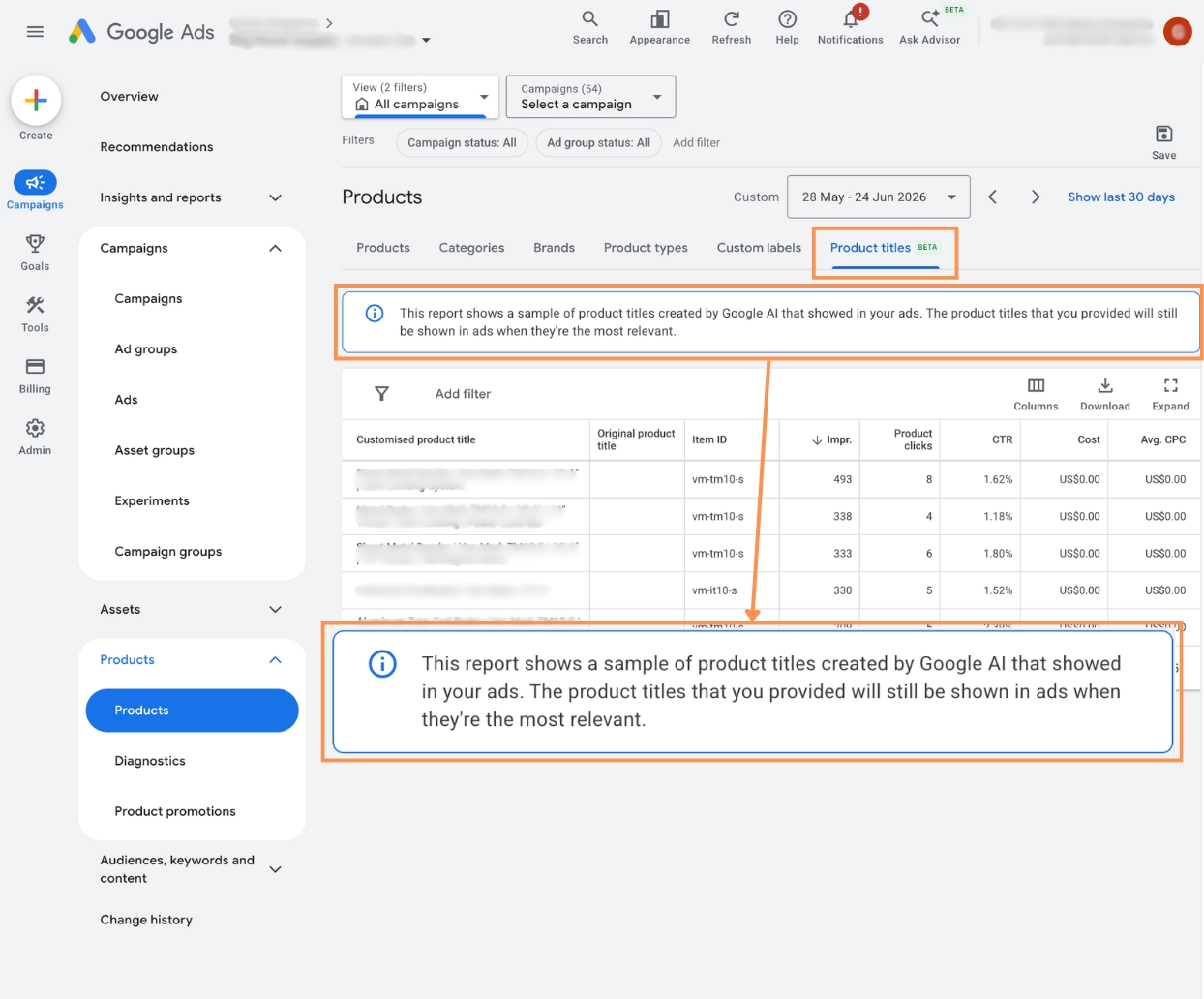
Google is testing a significant change to how Shopping ads can be presented: AI-generated product title variations that may be served instead of the title submitted in a merchant’s product feed.
The feature, described by Google as product title optimization within the AI Max for Shopping beta, does not replace the original feed title. Google says the submitted title remains the baseline, while its systems may generate and serve an alternative when they predict that version will perform better for a particular search.
That distinction matters. This is not simply another feed-editing tool. It is a serving-layer optimization: the product data an advertiser submits remains foundational, but the ad copy shown to an individual user may be adapted dynamically.
A new level of visibility into Shopping ad messaging
Google’s Product Titles reporting experience is particularly noteworthy because it gives advertisers a way to see both the original feed title and Google’s customized variation. The report can also show delivery and performance data associated with each title version, including core metrics such as impressions, clicks, CTR, cost, CPC, and selected conversion metrics.
For Shopping advertisers, this is a meaningful development. Historically, product titles have been one of the most consequential levers in feed optimization, yet advertisers have had limited visibility when Google’s automation used product data in unexpected ways. The new report does not eliminate that opacity, but it creates a much more useful audit trail.
The central question is not whether an AI-generated title looks more polished than the original. It is whether it earns incremental qualified traffic or conversion value without weakening product accuracy, brand positioning, or margin efficiency.
Google explicitly states that a customized title should serve only when its systems predict better performance than the original title. However, Google does not publicly detail the prediction model, the exact success metric being optimized, the minimum evidence required before a variation serves, or how the system balances click-through rate against conversion outcomes. Those unanswered questions are important.
A title that produces more clicks is not necessarily commercially better. In some categories, making a product title broader may increase query coverage and CTR while attracting less qualified traffic. The Product Titles report should therefore be evaluated through conversion and value-based metrics, not click metrics alone.
Product title optimization is not a substitute for feed quality
The beta reinforces a familiar principle: automation is only as strong as the underlying data available to it.
Google can potentially emphasize different attributes depending on search intent, such as material, color, compatibility, size, brand, or use case. But that does not reduce the need for accurate, complete, and structured product data. If a feed title is vague, key attributes are missing, or landing-page information is inconsistent, AI customization may have limited useful material to work with—or may surface messaging an advertiser would not have prioritized.
The original title remains strategically important because it is the submitted source data, the primary reference point in reporting, and the version Google compares against. Retailers should not interpret title optimization as permission to relax feed governance.
This is especially relevant for products with regulated claims, technical specifications, variant complexity, bundle configurations, or strict brand-language requirements. Better predicted ad performance does not automatically mean that every possible wording variation is appropriate for every business.
Controls deserve close attention
Google positions text customization as a configurable component of AI Max for Shopping. Separately, Google states that advertisers can opt out of Product Data Customization for Shopping ad title sthrough their Google account team or Google Ads support.
The terminology is worth treating carefully. “AI Max for Shopping,” “product title optimization,” and “Product Data Customization” are closely related in Google’s product communications, but advertisers should not assume that similarly named settings always have identical scope, eligibility, or operational behavior. Google’s public materials do not fully explain every relationship between these controls, particularly across beta access, campaign types, and account configurations.
That is not merely a documentation detail. Before enabling or assessing the feature, advertisers should establish which control applies to their account, whether it affects title generation specifically, and what happens to already-serving variations after an opt-out request.
The broader Shopping automation shift
Google has said product title optimization is intended for both Performance Max and Shopping campaigns. At the time of the beta announcement, however, advertisers should distinguish between Google’s stated direction and feature availability in their own accounts. Public announcements do not necessarily define universal eligibility, market coverage, or rollout timing.
Strategically, this development fits Google Ads’ wider movement toward query-level creative and product-data adaptation. In Search, Performance Max, and Shopping, advertisers increasingly provide the inputs and guardrails while Google determines the final combination most likely to perform in a specific auction.
The Product Titles report is therefore more than a reporting addition. It is a practical mechanism for judging whether that trade-off is working. If customized titles generate stronger conversion efficiency while preserving product precision, they may become a valuable incremental layer. If they mainly shift impression volume or increase low-intent clicks, the report should make that visible too.
Google’s official materials confirm the beta, the comparison between original and customized titles, and Google’s prediction-based serving logic. What remains less clear is how those predictions are calculated and how consistently controls apply across accounts. For experienced Shopping advertisers, that uncertainty makes measurement and governance more important—not less.

As a Google Ads expert, I bring proven expertise in optimizing advertising campaigns to maximize ROI.
I specialize in sharing advanced strategies and targeted tips to refine Google Ads campaign management.
Committed to staying ahead of the latest trends and algorithms, I ensure that my clients receive cutting-edge solutions.
My passion for digital marketing and my ability to interpret data for strategic insights enable me to offer high-level consulting that aims to exceed expectations.
Google Partner Agency
We're a certified Google Partner Agency, which means we don’t guess — we optimize withGoogle’s full toolkit and insider support.
Your campaigns get pro-level execution, backed by real expertise (not theory).

4.9 out of 5 from 670+ reviews on Fiverr.
That’s not luck, that’s performance.
Highly recommend Matteo to set up your server side tracking. He has a deep understanding of e-commerce tracking and will go above and beyond to make sure everything is set up correctly and working 100%. If you are scaling your store this set up is non-negotiable in my opinion and there isn't many people who have this much knowledge or put the effort in to get it right. Thanks again!

avorodesign.com
I can only recommend Matteo! He was very patient, professional and very knowledgeable about GA4, Consent Mode v2, and GDPR compliance. Communication was clear, and the setup was done professionally and efficiently. Highly recommend him for anyone needing reliable tracking implementation.

www.natureiki.life
Matteo shines in the realm of online professionals. His work is not only deep in data but also complemented by his proactive communication and cooperation, setting a new standard for freelancers. If you want someone who truly exceeds expectations, look no further. Highly recommended!

www.omanbeverlysmyth.com
Exceptional Service Beyond Expectations - Outstanding Service Impeccable depth, flawless delivery, and exceptional language fluency—this service exceeded all expectations. Highly recommended. Matteo truly ROCKS!!!

ium-paris.com
Top-notch, always highly value working with Matteo. An absolute Google Ads Genius. This is approximately the 8th time I have hired him and he's helped us get 6-7 ROAS. We are excited in continuing to improve our lead flow. Hire this guy if you need Google Ads help. Thanks Matteo!

www.dleeventgroup.com
I finally found the guy who can setup server side tracking and all the ecosystem properly. I definitely recommend Matteo. He is very responsive, kind and wants to dig into things. He configured GA4, Meta, Google Ads, Outbrain and google consent v2 with Cookiebot. Thanks Matteo.

inomega.fr
MB Adv delivered exceptional work with outstanding professionalism and lots of patience, taking time to see effects of changes made and not just do the work and submit it. The proactive communication and video summaries of the work completed made working with Matteo a pleasure, as he consistently went above and beyond. Highly recommended for web analytics projects! We are already working on another project.

www.withnellsensors.co.uk
Working with Matteo on my Google Ads was a game-changer. He's not just a strategist, he's a true partner. He understood my goals and tailored a campaign that perfectly reached my target audience. I'm grateful for his expertise and dedication.

dccargo.com
Click-driven mind
with plastic-brick obsession.
We build Google Ads campaigns with the same mindset we use to build tiny brick worlds: strategy, patience, and zero tolerance for wasted pieces.
Data is our blueprint. Growth is the only acceptable outcome.