Google Search Console’s Generative AI Control Center: What It Means for SEO and Google Ads
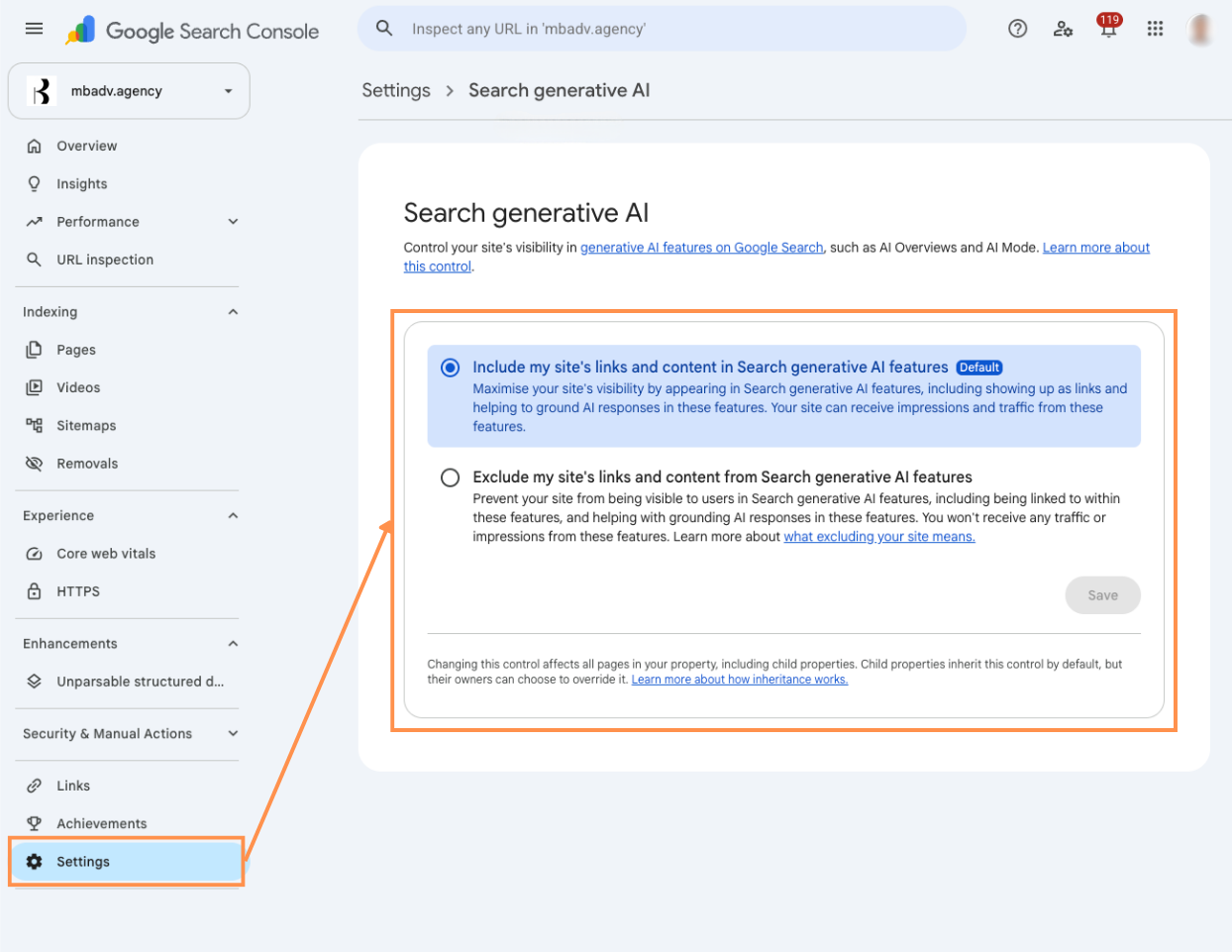
Google has introduced a new Search Console setting that gives site owners direct control over whether their links and content can be used in Search generative AI features, including AI Overviews and AI Mode.
The change is important because it separates a decision that has often been treated as implicit: whether a website is willing to participate in Google’s AI-driven search experiences. Until now, most discussions focused on visibility, traffic volatility and content optimisation. This setting adds an explicit eligibility layer.
Within Google Search Console, the option is available under **Settings > Search generative AI**. Property owners can choose to include their site’s links and content in generative AI features or exclude them entirely. The setting should be reviewed at parent-property level, while keeping in mind that child properties can apply their own overriding preference.
This is not a Google Ads setting. It does not affect campaign eligibility, bidding, targeting, Quality Score, auction mechanics or ad delivery. But it still deserves attention from PPC teams because organic generative search results increasingly influence the environment in which paid ads are evaluated.
A new variable in search visibility analysis
For SEO teams, the obvious value is control. A publisher, ecommerce business or lead-generation site may decide that inclusion in AI Overviews and AI Mode is strategically beneficial, particularly if its content can be cited or linked within generative responses. Another business may prefer not to make its content eligible, whether for brand, attribution, traffic-quality or content-governance reasons.
The more interesting implication is measurement.
When a site remains eligible for generative AI features, changes in organic impressions, clicks and branded search behaviour may reflect several overlapping factors: ranking shifts, changes in AI Overview coverage, citation patterns, user journeys that end within the search result, and changes to the query mix itself.
Excluding a property does not make organic reporting simple, but it removes one source of potential visibility from the equation. That can help teams interpret changes more cleanly. If a site is not eligible to appear as supporting content in Google’s generative search experiences, any movement in organic performance is less likely to be caused by direct inclusion in those surfaces.
That makes this setting relevant not only as a content-control mechanism, but also as an analytical decision.
Why Google Ads specialists should care
Google Ads performance will not change because a site opts in or out. An advertiser will not lose ad impressions, see a bid adjustment applied or become ineligible for a keyword because of this Search Console preference.
However, paid search does not operate in isolation. The appearance of AI Overviews and AI Mode can affect how users interact with a results page before they reach ads or traditional organic listings. For informational and early-stage commercial queries, a generative result may answer part of the question, reshape the user’s intent or move the click further down the research journey.
For PPC specialists, this reinforces the need to interpret demand and performance in context. A decline in non-branded clicks, for example, should not automatically be attributed to bid strategy, ad rank or competitor activity. It may coincide with a changing SERP composition, including increased generative AI exposure.
Likewise, branded search deserves closer attention. If a brand’s own content is eligible to appear in AI-driven answers, users may encounter the brand before conducting a direct branded query. In other cases, generative results may reduce the need for a follow-up search altogether. Neither outcome is inherently positive or negative, but both can change the relationship between organic discovery and paid conversion capture.
The governance question behind the setting
The decision should not be reduced to “more visibility is always better.” Eligibility for AI features creates potential exposure, but it does not guarantee traffic, prominence or accurate brand representation in every response. Businesses should consider the role their content plays in acquisition, trust-building and conversion.
For example, a content-led brand that relies on informational pages to introduce users to its expertise may see strategic value in remaining eligible. A business with highly controlled messaging, regulated content or a strong dependency on on-site journeys may take a more cautious position.
Property structure also matters. Large organisations often manage multiple subdomains, country sites, help centres and campaign microsites. The parent-property setting provides a useful governance baseline, but child-property overrides mean the final configuration can become fragmented. SEO, paid media, analytics and web governance teams should therefore treat this as a documented search visibility policy rather than a one-off technical preference.
A cross-channel reporting issue, not an ads lever
Google Search Console’s Generative AI Control Center does not create a new paid media lever. Its relevance to advertisers lies in what it reveals about the evolving search landscape: organic eligibility, AI-generated answers and paid search demand are becoming more connected in reporting, even when they remain operationally separate.
As AI Overviews and AI Mode become a more established part of Google Search, the strongest teams will be those that assess search performance across the full results page rather than treating SEO and Google Ads as independent channels.

As a Google Ads expert, I bring proven expertise in optimizing advertising campaigns to maximize ROI.
I specialize in sharing advanced strategies and targeted tips to refine Google Ads campaign management.
Committed to staying ahead of the latest trends and algorithms, I ensure that my clients receive cutting-edge solutions.
My passion for digital marketing and my ability to interpret data for strategic insights enable me to offer high-level consulting that aims to exceed expectations.
Google Partner Agency
We're a certified Google Partner Agency, which means we don’t guess — we optimize withGoogle’s full toolkit and insider support.
Your campaigns get pro-level execution, backed by real expertise (not theory).

4.9 out of 5 from 670+ reviews on Fiverr.
That’s not luck, that’s performance.
Highly recommend Matteo to set up your server side tracking. He has a deep understanding of e-commerce tracking and will go above and beyond to make sure everything is set up correctly and working 100%. If you are scaling your store this set up is non-negotiable in my opinion and there isn't many people who have this much knowledge or put the effort in to get it right. Thanks again!
avorodesign.com
I can only recommend Matteo! He was very patient, professional and very knowledgeable about GA4, Consent Mode v2, and GDPR compliance. Communication was clear, and the setup was done professionally and efficiently. Highly recommend him for anyone needing reliable tracking implementation.

www.natureiki.life
Matteo shines in the realm of online professionals. His work is not only deep in data but also complemented by his proactive communication and cooperation, setting a new standard for freelancers. If you want someone who truly exceeds expectations, look no further. Highly recommended!

www.omanbeverlysmyth.com
Exceptional Service Beyond Expectations - Outstanding Service Impeccable depth, flawless delivery, and exceptional language fluency—this service exceeded all expectations. Highly recommended. Matteo truly ROCKS!!!
ium-paris.com
Top-notch, always highly value working with Matteo. An absolute Google Ads Genius. This is approximately the 8th time I have hired him and he's helped us get 6-7 ROAS. We are excited in continuing to improve our lead flow. Hire this guy if you need Google Ads help. Thanks Matteo!

www.dleeventgroup.com
I finally found the guy who can setup server side tracking and all the ecosystem properly. I definitely recommend Matteo. He is very responsive, kind and wants to dig into things. He configured GA4, Meta, Google Ads, Outbrain and google consent v2 with Cookiebot. Thanks Matteo.
inomega.fr
MB Adv delivered exceptional work with outstanding professionalism and lots of patience, taking time to see effects of changes made and not just do the work and submit it. The proactive communication and video summaries of the work completed made working with Matteo a pleasure, as he consistently went above and beyond. Highly recommended for web analytics projects! We are already working on another project.

www.withnellsensors.co.uk
Working with Matteo on my Google Ads was a game-changer. He's not just a strategist, he's a true partner. He understood my goals and tailored a campaign that perfectly reached my target audience. I'm grateful for his expertise and dedication.

dccargo.com
Click-driven mind
with plastic-brick obsession.
We build Google Ads campaigns with the same mindset we use to build tiny brick worlds: strategy, patience, and zero tolerance for wasted pieces.
Data is our blueprint. Growth is the only acceptable outcome.