
Heading

OpenAI’s stated position — ChatGPT Shopping
0
ways to pay for higher placement in ChatGPT Shopping. OpenAI states product results are organic — ranked on relevance, availability, price, and quality — and that retailers cannot pay for higher placements. The only paid unit in ChatGPT is a separate, clearly labeled “Sponsored” ad card. Showing up in Shopping is earned, not bought.
Source: Stripe newsroom & OpenAI Help Center “Shopping with ChatGPT Search”; retrieved 2026-07-01
ChatGPT Shopping Is Organic Product Discovery — Not Advertising
There is a shopping layer inside ChatGPT, and the single most important thing to understand about it is what it is not: it is not an ad you can buy. OpenAI positions the commerce layer — Shopping in ChatGPT Search, Shopping Research, and Instant Checkout — as organic product discovery plus a checkout rail, not advertising and not pay-to-play. Product results are described as “organic … not ads, nor influenced by any OpenAI partnerships,” and they are ranked on relevance, availability, price, and quality. That one fact — organic, not sponsored — is the spine of this whole page.
It matters because the most common mistake a marketer makes here is assuming ChatGPT Shopping is an ad unit you bid your way into. It is not. The paid side of ChatGPT is a separate thing entirely: a single, clearly labeled “Sponsored” card that appears at the bottom of a response, sold through a relevance-weighted second-price auction. That is the product covered in what ChatGPT Ads are and in the breakdown of ChatGPT ad formats. The Sponsored card and organic Shopping sit next to each other in the same app, but they are two different systems, and conflating them is the error this page exists to correct.
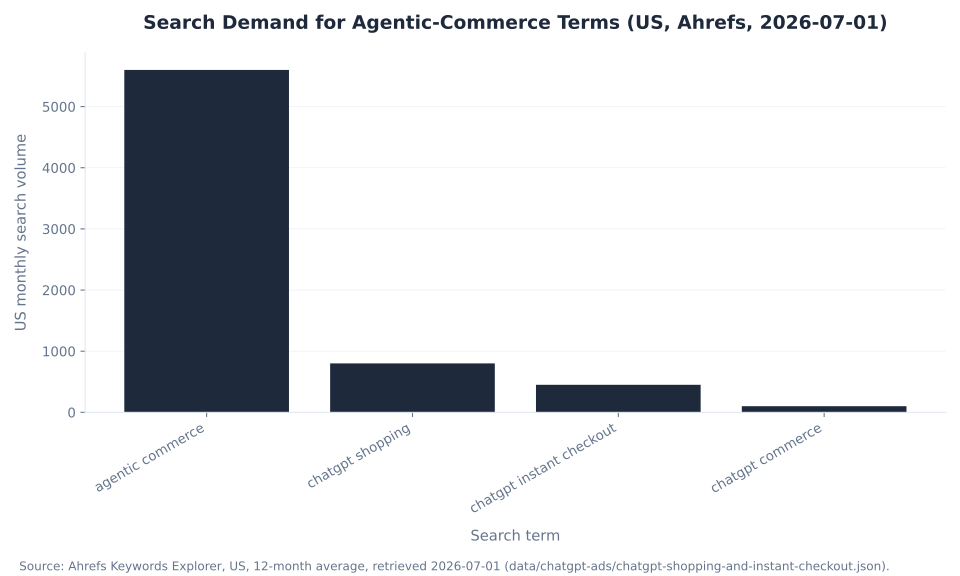
MB Adv Agency runs the paid-media programs — Google Ads, Meta, and the broader paid mix — that a new channel like this slots into, and our team also manages the Shopping feed programs the ecommerce brands we work with depend on. So we say it plainly: showing up in ChatGPT Shopping is earned, the same way an organic product feed earns visibility — it is not a placement you buy. The broad demand behind this space is real, too. Ahrefs puts US search volume for the category term “agentic commerce” at 5,600 a month, with the ChatGPT-specific queries (“chatgpt shopping” at 800, “chatgpt instant checkout” at 450) building underneath it. This guide draws a clean line between the two: what the shopping surfaces are and when each launched, how Instant Checkout and the Agentic Commerce Protocol work, what a merchant actually pays, why ranking is organic, what the early-2026 pullback changed, and how all of it connects back to a merchant who is also running ChatGPT Ads.
Key Takeaways
- ChatGPT Shopping is organic, not an ad. OpenAI states product results are organic — ranked on relevance, availability, price, and quality — and that retailers cannot pay for higher placements. The only paid unit in ChatGPT is the separate “Sponsored” card.
- The layer has three surfaces. Shopping in ChatGPT Search (about April 2025), Shopping Research (November 24, 2025), and Instant Checkout (announced September 29, 2025, co-built with Stripe) — all three organic, none carrying paid placement.
- Instant Checkout runs on the Agentic Commerce Protocol (ACP). An open standard from Stripe and OpenAI that defines a product feed, a checkout flow, and a delegated payment — and the merchant stays the merchant of record for tax, fulfillment, and returns.
- The merchant fee is reported, not published. A fee of about 4% on completed purchases has been reported by The Information; OpenAI has not published a rate card, and Sam Altman earlier referenced a figure around 2%. Treat it as reported.
- Announced is not the same as still shipping as announced. Around March 2026 OpenAI scaled back native in-chat checkout toward “agentic storefronts”: products stay discoverable in ChatGPT, but many purchases now complete on the merchant’s own storefront.
The Shopping Surfaces: Shopping in Search and Shopping Research
The commerce layer has two discovery surfaces before you ever reach a checkout. Shopping in ChatGPT Search arrived around April 2025: inside ChatGPT’s search-style answers you get AI-written product descriptions, summarized reviews, and direct purchase links. OpenAI describes these results as organic — ranked on relevance, availability, price, and quality, and “not ads, nor influenced by any OpenAI partnerships.” Shopping Research followed on November 24, 2025: a guided product-discovery mode where you give ChatGPT a budget and a use-case and it compares options for you. It is available on the Free, Go, Plus, and Pro tiers, and it is organic too — no paid placement.
The honest framing for both surfaces is descriptive: they are ways for a shopper to find products, ranked on merit, not a media buy. The question a merchant usually asks next — how do I get my products into the feed that powers this? — is the same core discipline that Google Merchant Center merchants already know. Structuring a product feed with clean identifiers, pricing, availability, and imagery is the work that makes a catalog eligible to surface, whether the surface is Google Shopping or ChatGPT. Table 1 lines up the three commerce surfaces by launch date, function, and whether placement can be paid for — and the last column reads the same all the way down.
| Surface | Launched | What it does | Paid placement? |
|---|---|---|---|
| Shopping in ChatGPT Search | About April 2025 | AI product descriptions, summarized reviews, and purchase links inside search-style answers | No — organic (relevance / availability / price / quality) |
| Shopping Research | November 24, 2025 | Guided product-discovery mode (budget + use-case → compares options); Free / Go / Plus / Pro | No — organic, no paid placement |
| Instant Checkout (ACP) | Announced September 29, 2025 (co-built with Stripe) | Buy in-chat; Etsy first, Shopify merchants following; merchant stays merchant of record | No — “retailers can’t pay for higher placements” |
Source: Stripe newsroom, OpenAI Shopping Research, and OpenAI Help Center. Verified 2026-07-01.
Instant Checkout and the Agentic Commerce Protocol (ACP)
Instant Checkout is the rail that lets a shopper buy without leaving the conversation. OpenAI announced it on September 29, 2025, co-built with Stripe and open-sourced. Etsy was the first merchant live; Shopify merchants — Stripe names Glossier, Vuori, Spanx, and SKIMS — were set to follow. Underneath it sits the Agentic Commerce Protocol (ACP), which Stripe describes as “an open standard developed jointly by Stripe and OpenAI.” It lets a retailer integrate once and sell through AI agents while keeping control of its product offerings, branding, and fulfillment.
ACP defines three flows, spelled out in OpenAI’s commerce developer docs. The product feed is where a merchant shares structured product data — identifiers, descriptions, pricing, inventory, media, and fulfillment options — the same catalog discipline behind any Merchant Center feed. The checkout flow has ChatGPT act as the buyer’s agent: it collects buyer and fulfillment details, then calls the merchant’s endpoints to create and update a checkout session, and the merchant validates the order, determines fulfillment, calculates tax, and processes payment on its own systems. The delegated payment flow is the money step: OpenAI prepares a one-time payment request and sets a maximum chargeable amount and expiry based on what the shopper selected in ChatGPT’s interface.
The piece that makes this safe is the Stripe Shared Payment Token, the first compatible implementation. It is a payment primitive scoped to a specific merchant and a specific cart that lets an application like ChatGPT initiate a payment without revealing the buyer’s card credentials. And the line that a merchant should read twice: the merchant stays the merchant of record. In Stripe’s words, merchants “can accept or reject the order, charge the payment method, calculate and remit sales tax, and manage order fulfillment and returns.” ChatGPT is the storefront window and the payment courier; the merchant still owns the sale.
How Much Search Demand Is There? Category vs ChatGPT-Specific
The demand picture is worth reading honestly, because a single blended number would overstate it. “Agentic commerce” is the broad category term — the whole idea of an AI agent buying on your behalf, of which ChatGPT’s Instant Checkout is one implementation — and Ahrefs puts it at 5,600 US searches a month. The ChatGPT-specific queries are smaller and still emerging: “chatgpt shopping” at 800, “chatgpt instant checkout” at 450, and “chatgpt commerce” at 100. The gap between the category and the ChatGPT-specific long-tail is the honest shape of a commerce layer that is only about five to fifteen months old: the category is where the demand already lives; the ChatGPT-specific terms are catching up.
| Term | US volume | Global | KD |
|---|---|---|---|
| agentic commerce | 5,600 | 15,000 | 50 |
| chatgpt shopping | 800 | 3,000 | 69 |
| chatgpt instant checkout | 450 | 1,100 | 55 |
| chatgpt commerce | 100 | 250 | — |
Source: Ahrefs Keywords Explorer (US, 12-month average), retrieved 2026-07-01.
Search Demand for Agentic-Commerce Terms (US, Ahrefs, 2026-07-01)
What Does It Cost a Merchant? The Reported ~4% Fee
Here the discipline is to answer honestly with the caveat up front. OpenAI has not published a rate card for Instant Checkout. The number that circulates — a merchant fee of about 4% on completed purchases — has been reported by The Information, and it is reported, not OpenAI-published. Sam Altman earlier referenced a figure around 2%, which is itself evidence that the number is not fixed or official. So the correct phrasing, every time, is “a reported roughly 4% fee” — never “ChatGPT charges 4%” as though it were a rate card.
It also helps to understand what the fee sits on top of. Because the merchant is the merchant of record, it still processes payment through its own payment provider and remits its own sales tax. The Instant Checkout fee is a transaction- or referral-style charge layered on top of normal payment processing, not a replacement for it. That is a different cost structure from the ad product, whose pricing (CPM, CPC, and CPA) is covered separately — commerce is a merchant fee on a completed sale, while advertising is a bid on a placement. Two different meters, and it is worth keeping them apart when you model the economics of either.
Where a new channel fits your paid mix
Organic Discovery, Paid Growth — We Run the Programs Around It
Getting products into an organic feed is the same discipline our team brings to Shopping feed management, and for DTC brands weighing where a channel like ChatGPT commerce fits, our ecommerce PPC team maps the paid mix — including the fashion and DTC verticals where in-chat commerce is landing first.
Talk to our team →Can Retailers Pay for Placement? No — Ranking Is Organic
This is the section worth citing, because it is the sharpest contrast on the page. OpenAI’s stated position is that product results are “organic and unsponsored … retailers can’t pay for higher placements.” Selection runs on relevance, availability, price, and quality — not on bids. There is no “buy your way to the top of ChatGPT Shopping” option, and presenting one would be the opposite of what OpenAI says it does. This is a stated, unaudited policy, and it is fair to present it as such — but the direction is unambiguous: the shopping ranking is earned, not purchased.
Set that against the ad product, where advertisers do pay — through a relevance-weighted second-price auction — for the labeled “Sponsored” card. The split is clean once you see it, and it mirrors a distinction ecommerce marketers already carry from Google: the difference between Merchant Center and Google Ads is exactly the organic-feed-versus-paid-auction line, transplanted into ChatGPT. And it is different again from retail media proper: unlike Amazon Sponsored Ads, where placement in the results genuinely is paid, ChatGPT Shopping placement is organic. Table 2 puts the paid ad product and the organic commerce layer side by side.
| Dimension | ChatGPT Ads (paid) | ChatGPT commerce (organic) |
|---|---|---|
| What it is | A “Sponsored” card at the bottom of a response | Shopping surfaces plus the Instant Checkout rail |
| Is it an ad? | Yes — labeled “Sponsored” | No — OpenAI: “organic … not ads” |
| Can you pay for placement? | Yes — relevance-weighted second-price auction | No — “retailers can’t pay for higher placements” |
| How placement is selected | Ad auction (context hints, landing page, ad copy) | Organic ranking (relevance / availability / price / quality) |
| Cost model | CPM / CPC / CPA (no public rate card) | About 4% merchant fee on completed purchases (reported, The Information) |
| Who is the party of record | Advertiser buys via Ads Manager | Merchant stays merchant of record (fulfillment / returns / tax) |
| Measurement | Insights API, measurement pixel, Conversions API | No OpenAI merchant dashboard; the ad-side pixel can carry commerce events |
Source: Stripe newsroom, OpenAI Help Center, and Digiday on the paid e-commerce ad format. The ~4% fee is reported by The Information, not OpenAI-published. Verified 2026-07-01.
The Strategic Pullback (~March 2026): Toward “Agentic Storefronts”
Any honest account of this layer has to include what changed. Around March 2026, OpenAI scaled back native in-chat checkout. Reporting from Modern Retail describes Instant Checkout “moving to Apps” and toward “agentic storefronts”: products stay discoverable inside ChatGPT, but many purchases now complete on the merchant’s own storefront rather than fully in-chat. This is best read as the current state, not a contradiction — the discovery layer persists; the completion step moved.
So the map for a merchant is: your products can still show up in ChatGPT’s organic shopping surfaces, and the hand-off to purchase now often lands on your own site. That is a meaningful nuance for anyone who read the September 2025 announcement and assumed the full in-chat buy flow is the permanent shape of the product. Announced is not the same as still shipping exactly as announced, and this is the clearest example of it in the commerce layer. The direction of travel — where agentic commerce and conversational advertising are heading — is the subject of a separate forward-looking guide.
How Commerce Relates to ChatGPT Ads (and Measurement)
The last thread ties commerce back to the ad cluster, and it turns on two facts. First, there is no OpenAI merchant analytics dashboard for Instant Checkout. ACP defines the product feed, checkout, and payment flows and nothing else; merchants track their sales through their own systems. If you were expecting an OpenAI-provided commerce dashboard, there is not one.
Second, the ad-side measurement pixel does carry commerce events — the standard event taxonomy includes signals like checkout_started and order_created — so a merchant who is also running ChatGPT Ads can measure shopping-style conversions through the ads stack: the Insights API, the pixel, and the Conversions API. That is the measurement stack covered in its own pillar. The important distinction: a merchant listing organically in Shopping and a merchant running Ads are two different motions. When both are in play, the same ad-side plumbing can measure the conversions — but that measurement lives on the advertising side, not inside the organic commerce layer.
Frequently Asked Questions: ChatGPT Shopping & Instant Checkout
Next in the ChatGPT Ads series
See the Paid Side of ChatGPT
You have the organic commerce layer — now go one door over to the paid one. The next guide breaks down what ChatGPT Ads are, how the “Sponsored” card works, and where the auction fits.
Read the next guide →Methodology & Sources
This pillar separates what is confirmed from what is reported, because the commerce layer is only about five to fifteen months old and moves fast. The ACP mechanics — the product feed, checkout, and delegated payment flows, the Stripe Shared Payment Token, and the merchant-of-record model — come from the Stripe newsroom and OpenAI’s commerce developer docs, both of which were fetched cleanly on 2026-07-01. The launch dates come from OpenAI’s Instant Checkout and Shopping Research announcements. The about-4% merchant fee is reported by The Information and is labeled reported throughout, never as an OpenAI-published rate; Altman earlier referenced a figure around 2%. The March-2026 pullback toward “agentic storefronts” is reported by Modern Retail and is framed as current-state and in-motion. Search volumes are from Ahrefs Keywords Explorer (US, 12-month average, retrieved 2026-07-01). No mbadv client metrics appear in this article — MB Adv Agency has no ChatGPT-Ads or ChatGPT-commerce service page, and its perspective here is qualitative. Reviewed by MB Adv Agency, July 2026.