
Heading

ChatGPT Ads Insights API — OpenAI dev docs, 2026-07-01
6
metrics are all the ChatGPT Ads Insights (Reporting) API returns — impressions, clicks, spend, ctr, cpc, and cpm. ROAS, conversions, and revenue are not columns in it. Conversions live separately in the pixel and Conversions API, which is the first thing to understand before you wire up measurement.
Source: OpenAI Ads Insights API reference; retrieved 2026-07-01
The OpenAI-Native Measurement Stack, at a Glance
Measurement for ChatGPT Ads is not bolted onto Google or Meta — it is OpenAI’s own. Everything lives under Ads Manager at ads.openai.com, organized as ad account → campaign → ad group → ad, and the whole measurement layer is made of four surfaces you meet in the order the work happens: the Insights (Reporting) API for performance data, the JavaScript pixel (oaiq) for browser-side events, the Conversions API (CAPI) for server-side events, and the broader Advertiser API for managing campaigns, ad groups, ads, ad accounts, insights, and file uploads. You set all of this up when you advertise on ChatGPT; for the full picture of what ChatGPT ads are, start with the overview pillar.
That native shape is both a strength and a limitation. It is a strength because it is first-party end to end — the pixel, the conversion events, and the reporting all come from one system, with no data-loss handoff between vendors. It is a limitation because there is no first-party GA4, Google Ads, or Meta connector: third-party Google Tag Manager templates, reporting connectors, and the Singular mobile-measurement partner bridge the OpenAI-native stack to the tools you already run, but OpenAI itself does not publish those integrations. MB Adv Agency runs the paid-media programs — Google Ads conversion tracking, server-side tagging, the Meta pixel — that a new channel like ChatGPT Ads slots into, so the mental model transfers cleanly even though the plumbing is new: a reporting API, a browser pixel, and a server-side conversions endpoint are exactly the three pieces we instrument on every mature paid channel.
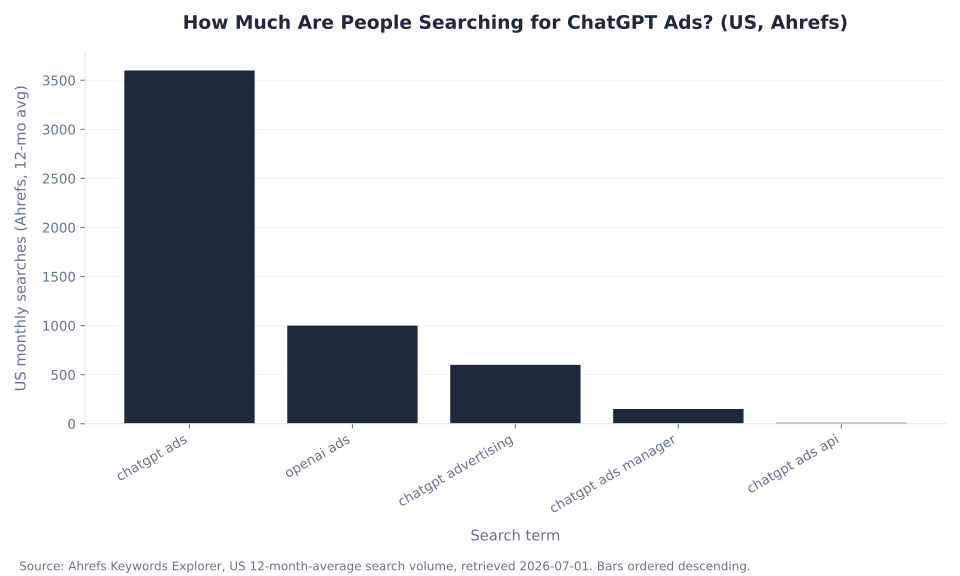
One honest framing before the mechanics. Demand for this topic is curiosity-led, not implementation-led. The head term “chatgpt ads” draws about 3,600 US searches a month (Ahrefs, KD 42, CPC $8.00), while the product-mechanic terms are tiny — “chatgpt ads manager” sits near 150 and “chatgpt ads api” near 10. The job of a measurement page for a five-month-old product is therefore to be the correct, cited answer for the small, high-intent audience actively wiring up tracking — not to chase volume, and not to invent the certainty that thinner pages fake.
How Much Are People Searching for ChatGPT Ads? (US, Ahrefs)
Key Takeaways
- Measurement runs on an OpenAI-native stack — the Insights (Reporting) API, the
oaiqJavaScript pixel, the Conversions API, and the broader Advertiser API, all under Ads Manager at ads.openai.com. - The Insights API returns six metrics — impressions, clicks, spend, ctr, cpc, and cpm. ROAS, conversions, and revenue were not columns in reporting at launch.
- Conversions are tracked with the pixel and the Conversions API. Run both and give each event a shared id so the browser and server events deduplicate into one counted conversion.
- There is no published attribution window. The only 7-day figure in the docs is a Conversions API ingestion limit — the deadline to submit an event, not a rule for which ad gets credit.
- There is no native GA4, Google Ads, or Meta integration. Singular is the only mobile-measurement partner with a published integration (May 21, 2026); third-party GTM templates and connectors bridge the rest.
Reporting With the Insights API: Metrics, Dimensions, Freshness
The Insights (Reporting) API is the layer that answers “how are the ads performing.” It returns six metrics verbatim — impressions, clicks, spend, ctr, cpc, and cpm — and you request them at one of four levels: ad_account, campaign, ad_group, or ad. You can add a single optional breakdown at a time — product (with fields like feed_id, item_id, title, price, and availability), country, or device — and bucket the result hourly, daily, monthly, or none, over date ranges expressed as unix_range, hour_range, or date_range (bounded within five years and not in the future). Reporting is hourly-fresh.
The load-bearing detail is what the list does not contain. There are six metrics here, and none of them is ROAS, conversions, or revenue — those columns were not exposed in the Insights API at launch. That is deliberate to say plainly, because it is the single most common thing people get wrong about ChatGPT Ads reporting: efficiency numbers do not arrive pre-computed the way a mature Google Ads column set delivers them. Conversions are counted elsewhere — in the conversions tab, through the pixel and Conversions API covered below — and you reconstruct efficiency yourself. Which metrics actually matter, and how to frame them into a KPI set, maps onto the same metrics and KPIs discipline you already apply on paid search.
| Element | Values (verbatim from the dev doc) |
|---|---|
| Metrics | impressions, clicks, spend, ctr, cpc, cpm |
| Report levels | ad_account, campaign, ad_group, ad |
| Optional breakdown (one at a time) | product (feed_id, item_id, title, price, availability), country, device |
| Time buckets | hourly, daily, monthly, none |
| Date ranges | unix_range, hour_range, date_range (within 5 years, not in the future) |
| Not available | ROAS, conversions, revenue columns — not exposed in reporting at launch |
Source: OpenAI Ads Insights API reference, retrieved 2026-07-01.
The JavaScript Pixel (oaiq) and Standard Events
Browser-side conversion tracking runs on a global called oaiq. You create a Pixel ID in the conversions tab of Ads Manager, initialize the pixel with oaiq("init", { pixelId }), and record events with oaiq("measure", …). It ships ten standard events — page_viewed, contents_viewed, items_added, checkout_started, order_created, lead_created, registration_completed, appointment_scheduled, subscription_created, and trial_started — plus custom events via custom and a required custom_event_name. If you know the Meta pixel and conversion tracking, oaiq will feel familiar: name a standard event, fire it on the matching page.
The pixel can attach hashed first-party data for stronger matching — email_sha256 and external_id_sha256 (sent as lowercase, 64-character SHA-256 hexadecimal strings), plus country, city, and zip_code — and it stores oppref in a first-party __oppref cookie so later page views reuse it. Treating that hashed PII and the cookie correctly is a privacy question in its own right; the consent and data-handling depth is covered in ChatGPT ads privacy and data. On the delivery side, firing the pixel cleanly is the same craft as our server-side tracking work on other channels.
| Standard event | Typical use |
|---|---|
page_viewed | Any page load |
contents_viewed | Product or content view |
items_added | Add to cart |
checkout_started | Checkout begun |
order_created | Purchase completed |
lead_created | Lead-gen form submit |
registration_completed | Account or signup created |
appointment_scheduled | Booking made |
subscription_created | Subscription started |
trial_started | Free trial started |
Source: OpenAI Ads measurement pixel, retrieved 2026-07-01.
The Conversions API (CAPI): Server-Side Events and Deduplication
The Conversions API is the server-to-server complement to the pixel. You send events to POST https://bzr.openai.com/v1/events, authenticated with a Bearer token. Each event needs a unique id, a type (a standard event name or custom), and a timestamp_ms in milliseconds. The action_source tells OpenAI where the conversion happened — one of web, mobile_app, offline, physical_store, phone_call, email, or other — and a single request batches up to 1,000 events. Server-side tagging in GTM is how most teams will actually deliver these events, and it is the same pattern as our server-side tracking engagements.
The rule that matters most sits on the timestamp. An event’s timestamp_ms “must be within the last 7 days and no more than 10 minutes ahead.” That is an ingestion window — the deadline for submitting an event so OpenAI will accept it — and it is explicitly not an attribution window. Deduplication closes the loop: send the browser event and the server event with the same value for the API id and the pixel event_id (and the same Pixel ID), and OpenAI counts one conversion rather than two. The Google Ads equivalent — conversion tracking and attribution — is the closest analog if you are translating from a paid-search setup.
| Dimension | JavaScript pixel (oaiq) | Conversions API (CAPI) |
|---|---|---|
| Where it runs | In the browser | Server-to-server |
| Transport | oaiq("measure", …) | POST https://bzr.openai.com/v1/events |
| Auth | Pixel ID (from the conversions tab) | Bearer token |
| Timing | Real-time on the page | Event timestamp_ms within the last 7 days (ingestion) |
| Batch | Per event | Up to 1,000 events per batch |
| Dedup | Shared event_id | Shared id (same value, same Pixel ID) |
Source: OpenAI Ads Conversions API, retrieved 2026-07-01.
Instrument it like any new channel
Wire ChatGPT Ads Measurement Into Your Existing Stack
MB Adv Agency runs the paid-media programs — Google Ads, Meta, and the broader paid mix — that a new channel like ChatGPT Ads slots into. The pixel-and-CAPI plumbing is the same craft as our server-side tracking and GA4 audit work, and for software companies leaning on both, see our SaaS PPC services.
Talk to our team →Attribution: What OpenAI Has Published (and What It Hasn’t)
Here is the honest center of the page: OpenAI has not published an attribution window for ChatGPT Ads. The only “7 days” anywhere in the documentation is the Conversions API ingestion constraint — an event’s timestamp_ms must be within the last 7 days (and no more than 10 minutes in the future) to be accepted. That governs when OpenAI will ingest a conversion event. It says nothing about which ad receives credit for a conversion, or over what look-back period.
Keeping the two ideas separate is the whole discipline. Ingestion is the deadline to submit an event so it is accepted. Attribution is the rule for which ad gets credit for a conversion and over what window. OpenAI publishes the former and not the latter, so any specific “7-day click” or “28-day” attribution figure you see quoted elsewhere is unverified — do not treat it as OpenAI-published. CPA bidding, turned on for select advertisers on May 28, 2026, is built on the conversion pixel and optimizes to conversions internally; that is not the same as OpenAI exposing an attribution model or a ROAS column to advertisers. How CPC and CPM are report metrics here versus how ads are actually charged is covered in how much ChatGPT ads cost, and the cross-channel view of crediting conversions lives in conversion tracking and attribution.
GA4, MMPs, and the OpenAI-Native Stack
The integrations reality is simple to state: there is no native GA4, Google Ads, or Meta integration. The stack is OpenAI-native, and third-party tools normalize into or out of it — Google Tag Manager templates to fire the pixel, connectors such as Supermetrics to pull reporting, and the Singular mobile-measurement partner’s bidirectional integration (shipped May 21, 2026) for app and mobile measurement. GA4’s own conversions and key events model is the reference point for how a native event taxonomy usually looks, and if you rely on GA4 for cross-channel reporting, a GA4 audit is where that reconciliation lives.
Be precise about the mobile-measurement boundary. Singular is the only MMP with a published ChatGPT Ads integration; there is no published AppsFlyer, Adjust, or Kochava integration as of 2026-07-01 — that is unknown, not confirmed-unavailable, and the honest word is “not yet.” For web conversions you use the pixel and Conversions API directly, the same way you would run the Meta pixel and conversion tracking on a social campaign.
What’s Not Available Yet
Advertisers deciding whether the channel is measurable enough to trust budget to deserve the gaps in one place. As of 2026-07-01: (a) no published attribution window — only the 7-day CAPI ingestion limit; (b) no ROAS, conversion, or revenue columns in the Insights API — they were not exposed in reporting at launch; (c) no native GA4, Google Ads, or Meta integration; (d) no view-through or demographic reporting; and (e) no MMP beyond Singular with a published integration.
The right way to read that list is “young but real,” not “vaporware.” The measurement primitives — a reporting API, a browser pixel, a server-side Conversions API, and clean deduplication — are genuinely shipped and documented. What is missing is the reporting polish: attribution models, ROAS columns, and first-party connectors. MB Adv Agency would measure this the way we measure any new channel with a thin native reporting layer — instrument the pixel and CAPI cleanly, deduplicate properly, and reconcile in our own reporting rather than expecting a turnkey ROAS column on day one. For how this measurement stack compares against Google and social, see ChatGPT ads vs Google and social ads.
Frequently Asked Questions
Next in the ChatGPT Ads series
See How ChatGPT Ads Stack Up
You have the measurement mechanics — now put them in context. The comparison pillar sets the ChatGPT-native stack against Google and social, from reporting depth to attribution and integrations.
Read the comparison →Methodology & Sources
This pillar grounds every product mechanic in OpenAI’s hard-primary developer docs, fetched 2026-07-01: the Insights metrics, the ten pixel standard events, the CAPI fields, the https://bzr.openai.com/v1/events endpoint, the action_source values, and the batch and deduplication rules are copied verbatim from the Insights API reference, the measurement pixel, and the Conversions API. The 7-day figure is the CAPI ingestion window, stated as such and never converted into an attribution claim, because OpenAI has published no attribution window. The absence of ROAS, conversion, and revenue columns is confirmed from the Insights API doc, not inferred. The self-serve Ads Manager, third-party-measurement promise, and CPA bidding are reported by Digiday and Search Engine Journal; the Singular integration by Singular; and CPA bidding by Digiday. Search-demand figures are Ahrefs Keywords Explorer (US, 12-month average, retrieved 2026-07-01). No mbadv client metrics appear in this article — MB Adv Agency has no ChatGPT-Ads service page, and its perspective here is qualitative. Reviewed by MB Adv Agency, July 2026.