
Heading

The confirmed-live ChatGPT ad format — 2026
1
There is exactly one confirmed-live ChatGPT ad format: a single “Sponsored” card at the bottom of a response, carrying a headline, a short description, an image, and a link. Larger images, dynamic call-to-action buttons, e-commerce cards, and a portrait carousel are in early test on a subset of ads; in-chat video and banner units do not exist.
Source: Digiday, 2026-05-21; retrieved 2026-07-01
What Does a ChatGPT Ad Look Like?
A ChatGPT ad is a single sponsored card at the bottom of a ChatGPT response — a headline, a short description, an image, and a link to the advertiser’s website — clearly labeled “Sponsored” and visually separated from ChatGPT’s answer. It is not a banner across the top of the screen, not a pop-up, not a video, and not woven into the answer text. It appears only for logged-in US adults on the Free and Go tiers, and only when a product or service is relevant to the current conversation.
This is the creative pillar of the ChatGPT Ads glossary, and its whole job is to describe the ad units accurately. That matters more than usual here: ChatGPT Ads is a five-month-old product, and most of what is written online about its “formats” is invented. Ads run on separate systems from the chat model and do not shape, rank, or alter ChatGPT’s answer — that is the serving mechanism, a separate topic. The single sponsored card at the bottom of a relevant response is confirmed live and documented in the OpenAI Help Center and in reporting from Euronews at the February 2026 test launch.
MB Adv Agency runs the paid-media programs — Google Ads, Meta, and the broader paid mix — that a new channel like ChatGPT Ads slots into, so read the description here as an accurate picture of the unit rather than a pitch for a service we sell. The honest shape of it: this is a small, native, low-friction placement — closer to a single labeled search result than to a display banner. The rest of this page draws a hard line between what is confirmed live, what is in early test, and what is rumored or fabricated.
Key Takeaways
- One confirmed-live format: the sponsored card. A headline, a short description, an image, and a destination link, labeled “Sponsored” and shown at the bottom of a relevant ChatGPT response.
- Enhanced formats are in early test on a subset of ads. A larger image, a dynamic CTA button, an e-commerce card that pulls price and customer reviews, and a portrait carousel of three to four ads.
- There are no in-chat video ads and no banner or display units. ChatGPT’s ad is a text-and-card unit, so calling it a “banner” is a category error — there is no banner strip, sidebar, or interstitial.
- Leaked strings are rumored, not shipped. “Search ad,” “search ads carousel,” and “bazaar content” came from pre-launch Android code; and there are no ads in the ChatGPT Atlas browser or in Sora.
- OpenAI has not published a creative-spec sheet. No official dimensions, aspect ratios, or file-size rules exist — build clean, legible creative and check current requirements inside Ads Manager.
The Base Sponsored Card, Element by Element
The one confirmed-live format breaks into a few simple parts. The headline is the short, advertiser-written line. The short description is a brief supporting line beneath it. The image is the product or brand visual — early creative was reported only as “a small favicon with text” by Digiday, so treat that as a reported description, not a spec. The destination link is the click-through to the advertiser’s landing page. Wrapping all of it is the “Sponsored” label and the visual separation that keep the ad distinct from ChatGPT’s answer.
Two things follow from how small this unit is. First, OpenAI has published no creative-spec sheet — no official dimensions, aspect ratios, or file-size rules for the card — so any “required” dimensions quoted on third-party blogs are unverified. To actually build these fields, see how to advertise on ChatGPT in Ads Manager. Second, selection weighs the landing page, ad title, and ad copy together, so which conversations trigger a matching card depends on that coherence, and every card goes through per-ad review and a landing-page match check.
The minimalism is the point. Compared with the many ways brands can now customize an ad in ChatGPT and the deep menu of ad assets and formats in Google Ads, ChatGPT’s single card is deliberately spare, and unlike the rich formats and creative in Meta Ads — video, stories, collections — ChatGPT offers one text-and-card unit. Table 1 lays out its parts.
| Element | What it is | Notes |
|---|---|---|
| Headline | The short advertiser-written line on the card | Selection weighs the ad title alongside copy and landing page (routed to targeting) |
| Short description | A brief supporting line beneath the headline | “Short” is OpenAI’s own framing; no character count is published |
| Image | The brand or product visual | Early creative reported only as “a small favicon with text” (Digiday) — no published dimensions |
| Destination link | The click-through to the advertiser’s landing page | Landing-page match is checked in per-ad review |
| “Sponsored” label + separation | The disclosure that marks it an ad, set apart from the answer | Always present; the card sits at the bottom of the response, in-conversation |
Source: OpenAI Help Center “Ads in ChatGPT” and Digiday. Verified 2026-07-01.
The Enhanced Formats in Early Test
In May 2026, OpenAI told advertisers it was “beginning an early test” of enhanced ways an ad can appear, per Digiday. Every item here is an early test on a subset of ads, not a rolled-out, self-serve menu. The larger image is a bigger-image variant of the same card. The dynamic CTA button is an auto-selected call-to-action — “Shop Now,” “Book Now,” “Sign Up,” or “Learn More” — that OpenAI’s system chooses, reported in a May 22, 2026 advertiser email and covered by PPC.land. The e-commerce format is a card that pulls price and customer reviews, in portrait or landscape orientation.
These are enhancements to the same sponsored card, not new ad types you buy separately, and OpenAI has published no creative-spec sheet for any of them. Keep the e-commerce ad card distinct from the organic commerce rail: price and reviews on a sponsored card is an ad, whereas ChatGPT Shopping and Instant Checkout is organic product discovery, not pay-to-play. In the way it surfaces structured product data, the e-commerce card resembles a product feed — price and reviews rendered on the placement. For product advertisers, working this channel mirrors the discipline of an ecommerce PPC program, and it fits verticals such as fashion where price and reviews carry the click.
The Portrait Carousel: Three to Four Ads Stacked
The single most-asked “advanced format” question deserves a precise answer. In the same early test, the portrait e-commerce version stacks into a carousel of three to four ads, per Digiday. So a carousel-style unit does exist — but only as the portrait product-card stack, on a subset of e-commerce ads, and only in early test.
Draw the hard line here, because it is the one people get wrong. This shipped, early-test carousel is the portrait product-card stack. It is not the leaked beta string “search ads carousel,” which came from pre-launch ChatGPT Android code surfaced by researcher Tibor Blaho and reported by BleepingComputer — that is rumored, not shipped. The honest answer to “can I run carousel ads on ChatGPT?” is therefore: a carousel-style unit exists in early test for a subset of e-commerce ads, but there is no general, self-serve “carousel campaign” you can simply select today, and OpenAI has published no carousel specs.
A new unit, the same paid-media discipline
Figuring Out Where ChatGPT Ads Fit?
MB Adv Agency runs the paid-search and social programs a new channel like this slots into. The same discipline — a tight message-to-landing-page match, clean creative, and honest claims — carries straight over to a ChatGPT sponsored card. If you want managed PPC services or an ecommerce PPC program that treats ChatGPT Ads as one part of the mix, that is the side our team owns.
Talk to our team →Live vs Early-Test vs Rumored — and What Does Not Exist
This is the honesty core of the page. Sort every format claim into four buckets. Confirmed live: the base sponsored card. Early test (a subset of ads, announced around May 2026): the larger image, the dynamic CTA button, the e-commerce card with price and reviews, and the portrait carousel. Rumored: the leaked ChatGPT Android beta strings “search ad,” “search ads carousel,” and “bazaar content” — pre-launch code found by Tibor Blaho and reported by BleepingComputer, never shipped as buyable formats.
Does not exist: in-chat video ads; display or banner units — ChatGPT’s ad is a text-and-card unit, so “banner” overstates its size and intrusiveness; the fabricated taxonomy “Sponsored Answer Cards,” “Product Spotlight Units,” and “SearchGPT Sponsored Results,” which appear on agency spam blogs and in nothing OpenAI has published; and ads in the ChatGPT Atlas browser or in Sora, neither of which carries ads during the test. One caveat worth keeping straight: Sora 2 is separately licensed for brands to create ad creative — a production tool, not an ad placement inside ChatGPT. The advertiser platform itself, documented at developers.openai.com/ads, describes an ad-account → campaign → ad-group → ad hierarchy and nothing resembling the invented taxonomy. Table 2 sorts it all.
| Format / claim | Status | Source |
|---|---|---|
| Base sponsored card (headline + description + image + link, “Sponsored”) | Confirmed live | OpenAI Help Center; Digiday 2026-05-21; Euronews 2026-02-10 |
| Larger image | Early test (subset of ads) | Digiday 2026-05-21 |
| Dynamic CTA button (“Shop Now / Book Now / Sign Up / Learn More,” auto-selected) | Early test (advertiser email May 22, 2026) | PPC.land 2026-05-22; Digiday 2026-05-21 |
| E-commerce format (price + customer reviews; portrait or landscape) | Early test (subset) | Digiday 2026-05-21 |
| Portrait carousel (three to four ads stacked) | Early test (portrait e-commerce variant) | Digiday 2026-05-21 |
| “search ad” / “search ads carousel” / “bazaar content” | Rumored (leaked Android beta strings, pre-launch code — not shipped) | BleepingComputer (Tibor Blaho, ~Nov–Dec 2025) |
| In-chat video ads | Does not exist | Not an OpenAI-published format |
| Display / banner units | Does not exist (it is a text/card unit; “banner” is imprecise) | Not an OpenAI-published format |
| “Sponsored Answer Cards” / “Product Spotlight Units” / “SearchGPT Sponsored Results” | Does not exist (fabricated taxonomy) | SEO-blog invention, not OpenAI wording |
| Ads in the ChatGPT Atlas browser or Sora | Does not exist (not ad surfaces during the test) | Sora 2 is separately licensed to create ad creative |
Source: TechCrunch, Digiday, and BleepingComputer; format hierarchy confirmed against developers.openai.com/ads. Verified 2026-07-01.
Making ChatGPT Ad Creative Work
Because this is a small, native, contextual card, the guidance stays qualitative — there are no invented specs here, because OpenAI has published none. Lead with a clear, benefit-led headline. Keep the short description genuinely short and specific — “short” is OpenAI’s own framing, and no character count is published, so tighten rather than guess a limit. Use a clean, legible image that reads at small size; the only public description of early creative was reported as “a small favicon with text” by Digiday, so simple and recognizable beats busy.
Two more habits carry the unit. Make the destination link and landing page match the ad: OpenAI’s selection weighs the landing page, ad title, and ad copy, and per-ad review checks that the landing page matches the claim, so the card, its link, and the destination should tell one coherent story. And treat the dynamic CTA as system-chosen — it appears on a subset of ads and is auto-selected, so write copy that reads well whether or not a button shows.
The mindset is the real advice: this is a relevance-first, contextual placement, so creative that fits the conversation wins — it reads more like answering a question than interrupting a feed. MB Adv Agency applies that same discipline to the paid-search and social creative our team runs every day, and it transfers cleanly. From here, route the money questions to their own pillars: what these placements cost and how bidding works, and how to build the ad in Ads Manager.
Frequently Asked Questions: ChatGPT Ad Formats
Next in the ChatGPT Ads series
What Do These Placements Cost?
You know what the unit looks like — now find out what it costs to run one. The next pillar covers the auction, the buying models (CPM, CPC, and CPA), and what OpenAI has and has not published about price.
Read the cost guide →Methodology & Sources
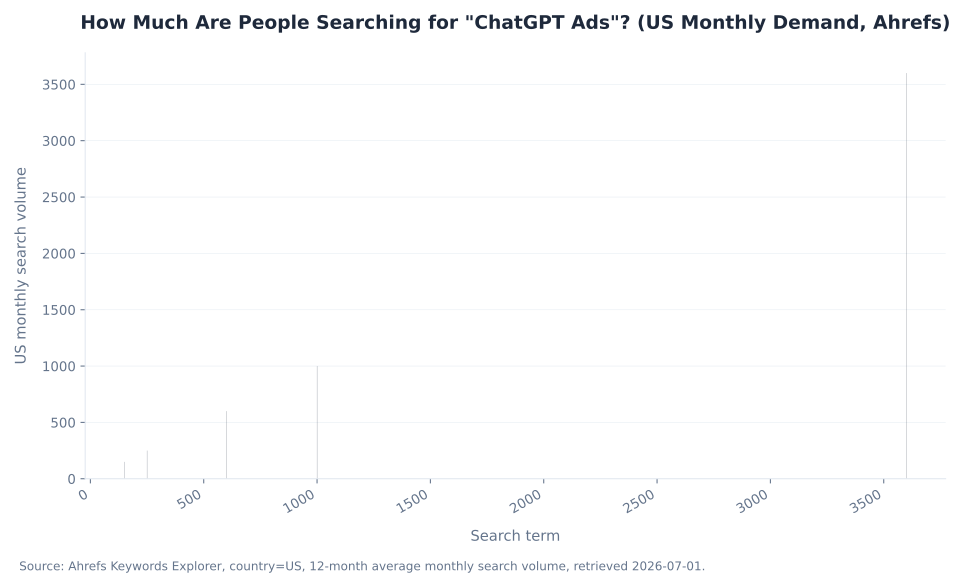
This pillar describes the ChatGPT ad units and draws a hard line between confirmed-live, early-test, rumored, and non-existent formats. The confirmed base card and the enhanced early-test formats are documented by the OpenAI Help Center and reported by Digiday, Euronews, TechCrunch, and PPC.land; the leaked pre-launch strings are from BleepingComputer and are labeled rumored throughout. The advertiser platform hierarchy is confirmed against developers.openai.com/ads. Search-demand figures are from Ahrefs Keywords Explorer (US, 12-month average, retrieved 2026-07-01) and are topic demand, not per-format demand. No mbadv client metrics appear in this article — MB Adv Agency has no ChatGPT-Ads service page, and its perspective here is qualitative; where you want help, talk to our team. OpenAI has published no creative-spec sheet, so no dimensions or file rules are stated. Reviewed by MB Adv Agency, July 2026.