
Heading

ChatGPT weekly active users — OpenAI, February 2026
900M
logged-in users every week by February 27, 2026 — up 125% in a year. Yet OpenAI reported only about 50 million paying consumer subscribers and 9 million-plus business users against that base, so the overwhelming majority pay nothing. That gap is why OpenAI turned on ads, live on the Free and Go tiers since February 9, 2026.
Source: TechCrunch, ChatGPT reaches 900M weekly active users; OpenAI-reported, retrieved 2026-07-01
What Are ChatGPT Ads? A Plain-English Definition
ChatGPT ads are OpenAI’s advertising product inside ChatGPT: a single, clearly labeled “Sponsored” card that can appear at the bottom of a ChatGPT answer, matched to what the current conversation is about. The base format is plain — a headline, a short description, an image, and a destination link — and the card sits below the answer, visually separated, not woven into it.
OpenAI uses a few names for the same thing. The product is “OpenAI Ads” or “Advertise in ChatGPT” (the landing page lives at ads.openai.com), the in-app unit is “Ads in ChatGPT,” and the self-serve buying platform is the “Ads Manager.” Whichever label you meet first, it points to one thing: a contextual ad served inside the chat. The full serving mechanism — contextual matching and the relevance-weighted auction and the sponsored-card and enhanced formats each get a dedicated pillar; this page is the orientation anchor for the whole cluster.
Two things ChatGPT ads are not. They are not a screen full of banners: it is one card, in-conversation, labeled “Sponsored” and set apart from the answer above it, on the Free and Go tiers only. And — per OpenAI’s stated position — the ad does not change the answer it sits beneath: OpenAI states ads “do not influence ChatGPT’s answers” and run on separate systems from the chat model. Treat that as OpenAI’s stated, unaudited commitment rather than independently verified fact — it is exactly the claim regulators and critics are testing.
MB Adv Agency runs the paid-media programs — Google Ads, Meta, and the broader paid mix — that a new channel like ChatGPT Ads slots into, so this glossary is written for advertisers deciding whether it belongs in their plan yet. This page settles what ChatGPT ads are, whether they are real right now, where they show up, why OpenAI built them, and what OpenAI says it will and will not do — then routes you into the depth. Framing throughout follows OpenAI’s own materials as reported by TechCrunch and Search Engine Journal.
Key Takeaways
- ChatGPT ads are one labeled “Sponsored” card at the bottom of a relevant ChatGPT answer — a headline, a short description, an image, and a link. One card, in-conversation, not a screen of banners.
- They are live, not rumored. Ads went live as a test for logged-in US adults on February 9, 2026; a self-serve Ads Manager opened to US advertisers on May 5, 2026; the UK went live around June 6, 2026 as the first European market.
- Ads show only on Free and Go. Plus, Pro, Business, Enterprise, and Edu are ad-free; users predicted under 18 and health, mental-health, or politics chats are excluded; the Atlas browser and Sora carry no ads.
- OpenAI added ads to close a monetization gap — about 900 million weekly users, well under 10% paying — a reversal from Sam Altman’s 2024 “I hate ads” / “last resort” stance.
- OpenAI publishes five ad principles (answer independence, conversation privacy, no data sale, user control, not optimizing for time spent) — presented here as stated and unaudited, with the live privacy tension flagged.
Is This Real? Does ChatGPT Have Ads Now?
The question most readers arrive with is blunt: does ChatGPT have ads now, or is this another announcement? The answer is equally blunt — yes, ChatGPT ads are live. They are a real, in-market product, best described as a live but still-expanding pilot: real ads serve to real users, real advertisers buy them, and geography, formats, and pricing are visibly still in flux.
The confirmed timeline is short and fast. OpenAI announced it would test ads on January 16, 2026. Ads went live as a test for logged-in US adults on the Free and Go tiers on February 9, 2026. A self-serve Ads Manager beta opened to US advertisers on May 5, 2026, adding cost-per-click bidding alongside CPM and shipping a conversion pixel and Conversions API. On May 22 the Ads Manager added daily budgets, geo-targeting, and dynamic call-to-action buttons; on May 28 cost-per-action bidding turned on for select advertisers. Around June 6, 2026 the pilot left the US: the UK went live as the first European market, with Japan, South Korea, Brazil, and Mexico announced or rolling out. That is the arc of a young product moving quickly — which is why the honest framing is “live pilot,” not “finished platform.” If you want the operator’s path through it, the getting-started walkthrough in Ads Manager is the next practical step. Timeline confirmed via CNBC, Axios, and Adweek.
If you use ChatGPT every day and have never seen an ad, that is expected, not a contradiction. You are almost certainly on an ad-free tier, outside the US and UK, or in a conversation that is not ad-eligible — which is exactly the where-and-who question the next section answers.
Where ChatGPT Ads Appear: Tiers, the Sponsored Card, and Who’s Excluded
Whether you or your customers see a ChatGPT ad comes down to three things: which plan you are on, where the ad sits, and whether the conversation is eligible. Ads show only on the Free and Go ($8/month) tiers. Plus, Pro, Business, Enterprise, and Edu are ad-free — OpenAI has said it will “always offer a way to not see ads in ChatGPT, including a paid tier that’s ad-free.”
Placement is a single sponsored unit at the bottom of a relevant response, in-conversation and labeled “Sponsored” — OpenAI’s own example is a recipe question followed by a grocery-delivery ad. Two groups are excluded outright: users predicted or declared to be under 18 get no ads at all, and ads are not eligible near health, mental-health, or politics conversations as messaged at launch. A reported April-2026 refinement narrowed that sensitive-topic default — labeled reported here, with the current line covered in the policies and brand-safety pillar. The ChatGPT Atlas browser and Sora carry no ads during the test. How the system decides a conversation is “relevant,” and what targeting does and does not exist, is the job of the targeting and audiences pillar: the short version is that matching is contextual, keyed to the current chat, not to demographic or interest segments.
| Surface / audience | Ads shown? | Notes |
|---|---|---|
| ChatGPT Free | Yes | Logged-in US adults; single “Sponsored” card below a relevant answer |
| ChatGPT Go ($8/mo) | Yes | Same as Free |
| ChatGPT Plus / Pro | No | Ad-free paid tiers |
| ChatGPT Business / Enterprise / Edu | No | Ad-free |
| Users predicted or declared under 18 | No | Excluded from ads entirely |
| Health / mental-health / politics chats | No (at launch) | Not ad-eligible contexts; a reported April-2026 refinement narrowed this (route to the policies pillar) |
| ChatGPT Atlas browser / Sora | No | Not ad surfaces during the test |
Source: OpenAI, via Search Engine Journal, Euronews, and Axios. Retrieved 2026-07-01.
Why Did OpenAI Add Ads? The Monetization Gap
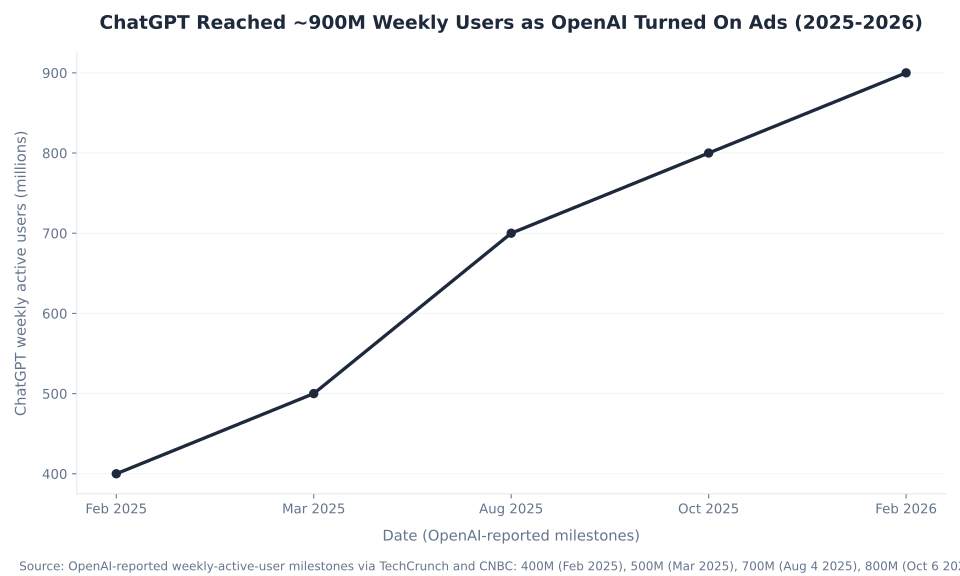
Why would a company whose CEO said he “hate[s] ads” build an ad business? Because of a gap. ChatGPT reached about 900 million weekly active users by February 27, 2026 — up from 400 million a year earlier, a 125% jump — yet OpenAI reported only about 50 million paying consumer subscribers and 9 million-plus paying business users against that base. Well under 10% of weekly users pay; the overwhelming majority use ChatGPT for free. Serving that much free usage is expensive, and ads are the business model built to fund it.
ChatGPT Reached ~900M Weekly Users as OpenAI Turned On Ads (2025–2026)
The reversal is worth telling straight. In October 2024, at a Harvard fireside, Sam Altman said he “hate[s] ads,” called mixing ads and AI “uniquely unsettling,” and described ad-funded AI as a “last resort”; he had earlier warned that modifying an AI’s output for pay would be a “trust-destroying moment.” By early 2026 he was launching ads, justifying it on X: “a lot of people want to use a lot of AI and don’t want to pay, so we are hopeful a business model like this can work.” The reach curve above is the whole argument in one line: enormous free usage, a small paying base, and a business that needs to fund the difference. These weekly-active figures are OpenAI-reported and not independently audited — disclosed as such. Sources: TechCrunch and PC Gamer.
How big that business becomes — and how it stacks up against Google and social ad revenue — is a data question with genuinely competing forecasts, so this page leaves the market-size numbers to the ChatGPT-ads-versus-Google-and-social comparison. One clarification belongs here: the product-discovery and checkout features OpenAI has shipped — the separate, organic ChatGPT Shopping and Instant Checkout layer — are not ads and not pay-to-play. OpenAI states those results are organic and that retailers cannot pay for higher placement.
Where does ChatGPT Ads fit?
A New Channel, Judged Against the Ones You Already Run
MB Adv Agency runs the Google Ads, Meta, and broader paid-media programs a channel like ChatGPT Ads slots into — and whether it belongs in a given plan yet is exactly the call this glossary helps make. Our PPC services and campaign management are where a new placement gets tested without betting the plan on it; for consumer-goods brands weighing it, see our consumer-products PPC work.
Talk to our team →OpenAI’s Five Stated Ad Principles (At a Glance)
OpenAI published five principles for how ads and answers coexist. They are the trust layer of the whole product, and they are worth reading as OpenAI’s stated, unaudited position — not as independently verified fact.
| Principle | What OpenAI states | Go deeper |
|---|---|---|
| Answer independence | “Ads do not influence ChatGPT’s answers”; ads run on separate systems; advertisers cannot shape, rank, or alter responses | How they work · Policies |
| Conversation privacy | Chats, memories, name, email, and precise location never shared with advertisers; aggregate views and clicks only | Privacy & data |
| No data sale | OpenAI “never sell[s] your data to advertisers” | Privacy & data |
| User control | Turn off ad personalization anytime; “clear ads data” (retained no more than 30 days) | Targeting · Privacy |
| Long-term value | “We don’t optimize for time spent” | The future & trust debate |
Source: OpenAI’s stated ad principles, via TechCrunch and OpenAI’s launch post. Presented as stated and unaudited. Retrieved 2026-07-01.
The honest reading pairs the principles with the live tension around them. The updated US privacy policy formalizes that OpenAI receives purchase data from advertisers for measurement, shares limited cookie IDs and device IDs with marketing partners for third-party ad targeting, and turns marketing cookies on by default for free users; ad personalization uses memory and past chats by default. A 42-state Attorney General probe opened on June 12, 2026 explicitly names OpenAI’s advertising practices, its handling of minors, and its data practices. So the principles are OpenAI’s stated commitments, actively being tested — which is why this glossary never certifies them and never states the inverse (“ads bias the answers,” “OpenAI sells your chats”) as fact either, because OpenAI denies both and no verified evidence contradicts the denial. Reported via Search Engine Land and Tom’s Hardware. The full privacy-and-data picture and where conversational advertising is heading each get a dedicated pillar.
How ChatGPT Ads Fit Your Paid-Media Mix
For an advertiser, the useful way to place ChatGPT ads is against the channels you already run. It is a new, contextual placement — matched to what a conversation is about, not to keywords or demographic segments — bought self-serve in an Ads Manager that follows a familiar shape (ad account, campaign, ad group, ad). It is also young: no public rate card, a limited format set, and US-plus-UK availability. The genuine, ownable demand behind it is real but skews curiosity, as the head-term data shows — queries such as “does chatgpt have ads” and “are ads coming to chatgpt” still outweigh advertiser how-to terms.
| Term | US volume | Global | KD | CPC (USD) |
|---|---|---|---|---|
| chatgpt ads | 3,600 | 11,000 | 42 | $8.00 |
| openai ads | 1,000 | 1,900 | 59 | $8.00 |
| chatgpt advertising | 600 | 1,400 | 43 | $8.00 |
| ads in chatgpt | 250 | 700 | — | $3.00 |
| how to advertise on chatgpt | 200 | 350 | — | $7.00 |
| are ads coming to chatgpt | 150 | 200 | — | — |
| does chatgpt have ads | 100 | 150 | 37 | — |
Source: Ahrefs Keywords Explorer (US, 12-month average), retrieved 2026-07-01.
What ChatGPT ads actually cost (honestly: no public rate card yet) and how to measure their performance through the conversion pixel and Conversions API are their own pillars — this page keeps the price and measurement depth out on purpose.
How to Use This ChatGPT Ads Glossary
Treat this glossary as a learning path, not a dictionary. Start here for the “what is this / is it real” mental model, then follow the map through the sibling pillars.
Begin with the mechanics: how ChatGPT ads work and the ad formats. Then the operator layer: how to advertise on ChatGPT, what they cost, targeting and audiences, and measuring performance. Then the trust-and-context layer: policies and brand safety, privacy and data, and where conversational advertising is heading. To place it against what you already know, read how ChatGPT ads compare to Google and social ads alongside Google Ads campaign types and Meta ads; and for the AI-search shift that opened this door, see how AI is changing search. The organic ChatGPT Shopping and Instant Checkout layer sits beside all of it.
Frequently Asked Questions: ChatGPT Ads
Next in the ChatGPT Ads series
See How ChatGPT Ads Actually Work
You have the mental model — now go one level deeper. The next pillar breaks down the serving mechanism: contextual matching, the relevance-weighted auction, and how a single sponsored card gets chosen for one conversation.
Read the next guide →Methodology & Sources
This pillar is the orientation anchor for the ChatGPT Ads glossary; depth lives in the linked siblings. Product mechanics are grounded in OpenAI’s launch and Help Center materials as quoted by reputable outlets (OpenAI returns errors to automated fetching, so its wording is confirmed through TechCrunch, Search Engine Journal, Axios, Adweek, Euronews, and Digiday). The reach curve — 400 million weekly users in February 2025 rising to about 900 million by February 27, 2026, against roughly 50 million paying consumers and 9 million-plus business users — is OpenAI-reported and not independently audited; it is disclosed as such, not presented as verified. Head-term search volumes are from Ahrefs Keywords Explorer (US, 12-month average, retrieved 2026-07-01); the CPC column is the advertiser cost-per-click on the Google search results page for each term, not a ChatGPT-ad price. This page deliberately carries no cost, CPM, or minimum-spend figures — those are unpublished by OpenAI and handled, with full caveats, in the cost pillar. The five ad principles are presented as OpenAI’s stated, unaudited commitments, paired with the countervailing privacy facts, not adjudicated here. No mbadv client metrics appear in this article — MB Adv Agency has no ChatGPT-Ads service page, and its perspective here is qualitative. Reviewed by MB Adv Agency, July 2026.