
Amazon Sponsored Ads: SP, SB & SD Guide (2026)
Sponsored Products YoY Spend Growth — Tinuiti Q1 2026 Benchmark Report ($4B+ annual digital ad spend managed)
+21%
Sponsored Products YoY Spend Growth — Q1 2026
Sponsored Products is the dominant and fastest-growing self-service format on Amazon. Q1 2026: clicks +19% YoY, CPC +2%, ROAS stable. Blended platform CVR across all Sponsored formats: 11.1% (Ad Badger, 2026) / 11.55% (Autron, 2026). Average CPC $1.22. Sponsored Products delivers the highest intent-to-purchase efficiency of any self-service format on Amazon.
What Are Amazon Sponsored Ads?
Amazon Sponsored Ads are three self-service, cost-per-click ad formats — Sponsored Products (SP), Sponsored Brands (SB), and Sponsored Display (SD) — that cover the full purchase funnel on Amazon. They are not interchangeable choices: each owns a distinct funnel stage, targets differently, and is gated differently. Understanding how the three work together is the foundational skill in Amazon advertising.
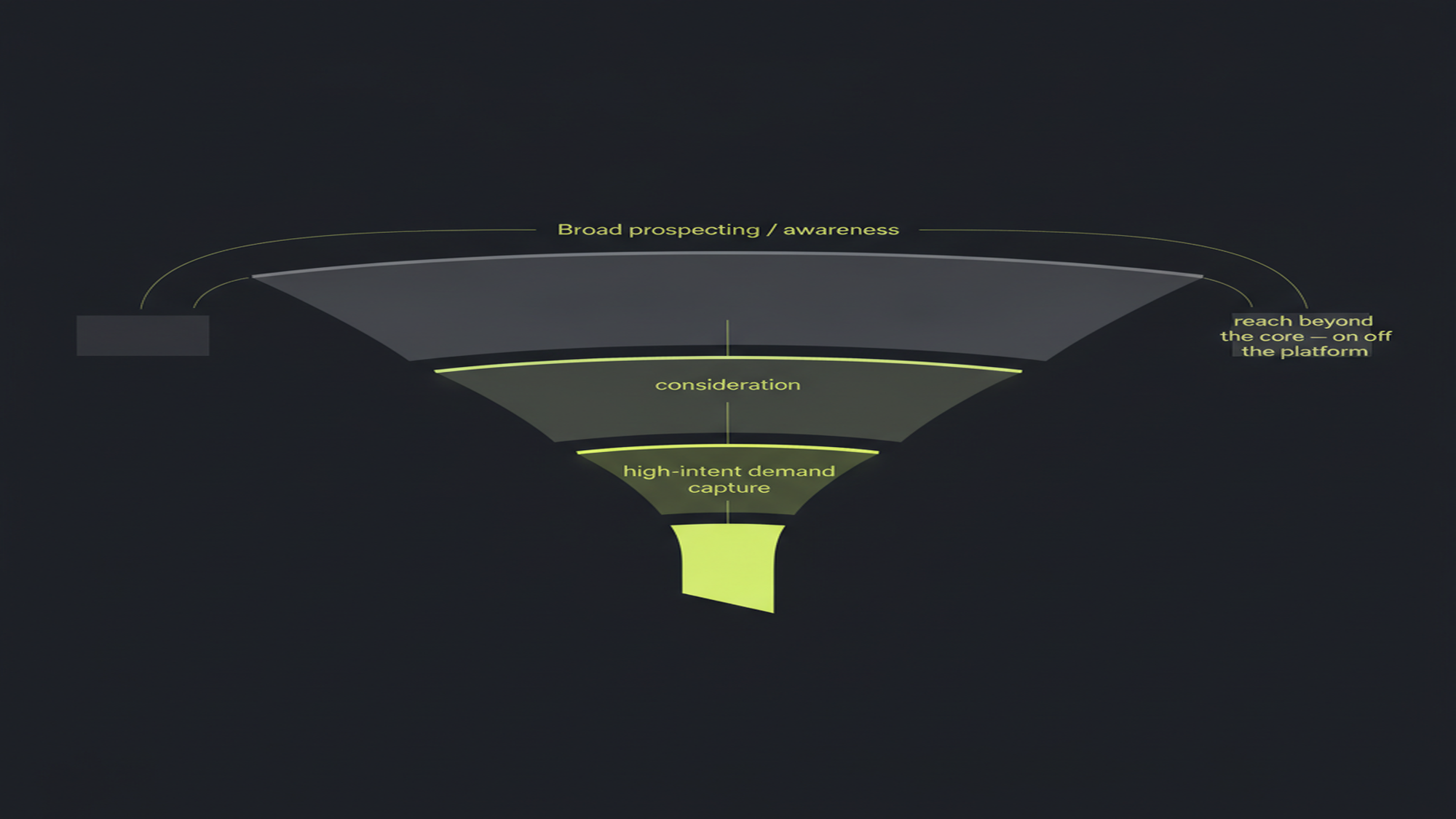
Sponsored Products is bottom-of-funnel demand capture: CPC ads in search results and on product detail pages when a shopper is actively searching for what you sell. No Brand Registry required — open to professional sellers, vendors, book vendors, KDP authors, and agencies from day one. See what Amazon Ads is for how Sponsored Ads fit within the full product family (DSP, Streaming TV, Stores, Attribution). Sponsored Brands is mid-funnel consideration and brand defense: logo-led banner and video ads at the top of search that build recognition, protect branded queries, and report new-to-brand metrics SP cannot. Brand Registry required. Sponsored Display is the prospecting and retargeting layer — the only self-service format that reaches shoppers off Amazon as well as on. Brand Registry required for most sellers.
The most consequential framing error a new advertiser makes is treating the three formats as a menu. The correct model is sequential and compounding: launch Sponsored Products first to capture existing demand, add Sponsored Brands once Brand Registry lands to defend your name and build awareness, then layer Sponsored Display for retargeting, conquesting, and off-Amazon reach. Each format feeds the next. Targeting detail — keyword match types, product/ASIN targeting, SD audiences — lives in Amazon Ads targeting.
| Dimension | Sponsored Products | Sponsored Brands | Sponsored Display |
|---|---|---|---|
| What it is | CPC ads promoting a single product listing | CPC banner/video ads with brand logo, headline & multiple products | Display/retargeting ads on and off Amazon |
| Where it serves | Search results + product detail pages | Top of search, within search, product pages | Amazon properties (Twitch, Fire TV, Echo Show) + premium third-party sites/apps |
| Billing model | CPC | CPC | CPC or vCPM |
| Targeting | Automatic or manual (keywords + product/category) | Keywords + product targeting | Audiences, product/contextual, views + purchases remarketing |
| Brand Registry? | Not required — universal entry point | Required | Required for most sellers |
| Funnel stage | Bottom — demand capture | Mid — consideration + brand defense | Top + re-engagement — prospecting + retargeting |
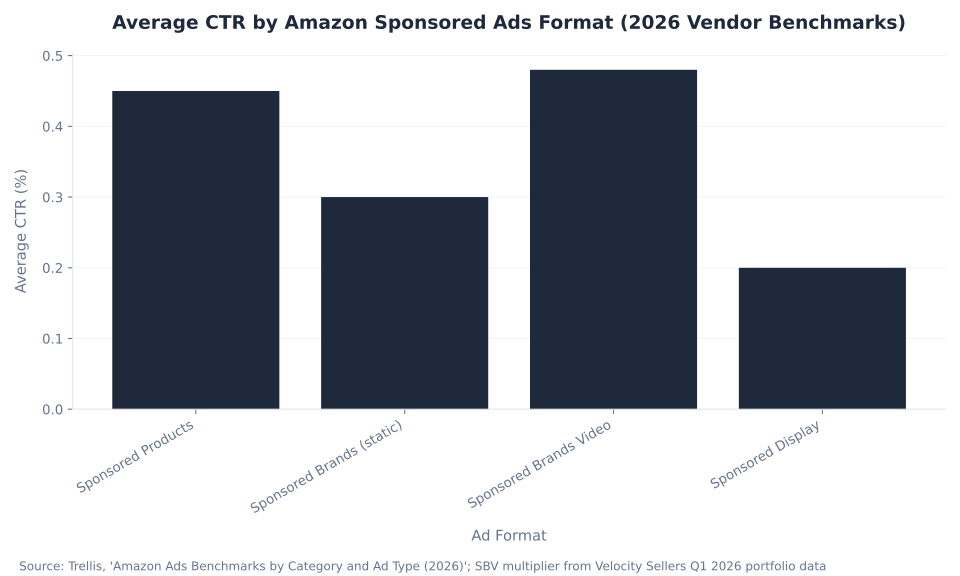
| Typical CTR | 0.3–0.6% (Trellis, 2026) | 0.2–0.4% static; ~0.48% video (Trellis/Velocity Sellers) | 0.1–0.3% blended (Trellis, 2026) |
Sources: Amazon Ads, “Sponsored Products”; Amazon Ads, “Sponsored Display”; ezCommerce, “Sponsored Brands 2026 Guide”; Trellis, “Amazon Ads Benchmarks (2026)”.
Three things this page establishes that most guides miss:
- The trio is a funnel, not a menu. Sponsored Products captures bottom-of-funnel demand. Sponsored Brands builds mid-funnel consideration and defends branded queries. Sponsored Display prospects and retargets on and off Amazon. Running all three in sequence compounds performance; picking one forfeits the full-funnel advantage.
- Brand Registry gates two of the three formats. Sponsored Products is open to any professional seller — no Brand Registry required. Sponsored Brands and Sponsored Display (for most sellers) both require Brand Registry. A seller without a registered or pending trademark runs Sponsored Products only until enrollment is complete.
- Sponsored Display is not on-Amazon retargeting only. It has three targeting motions — audiences (prospecting), product/contextual (conquesting), and views/purchases remarketing — and it reaches shoppers on Amazon-owned properties and across premium third-party sites and apps off Amazon.
Amazon Sponsored Ads Benchmarks: CTR, ACOS, CPC and CVR (2026)
Sponsored Products delivers the highest conversion rate and lowest ACOS of the three self-service formats. Sponsored Display's blended metrics are misleading — its three targeting motions have radically different efficiency profiles, with purchases remarketing often the lowest-ACOS line in the account. All figures below are third-party vendor benchmarks; see Amazon Ads ACOS, ROAS and metrics for how to interpret them.
| Format | CTR range | ACOS range | CVR range | CPC range |
|---|---|---|---|---|
| Sponsored Products | 0.3–0.6% | 20–35% | 10–15% | $0.50–$3.00 (avg $0.81–$1.20) |
| Sponsored Brands (static) | 0.2–0.4% | 25–40% | 8–12% | $1.00–$5.00 (avg $1.50–$2.50) |
| Sponsored Brands Video (derived) | ~0.48% (1.6× static) | 25–40% | ~1.3× static | $1.00–$5.00 |
| Sponsored Display (blended) | 0.1–0.3% | 30–50% (blended) | 5–10% | $0.30–$2.00 (avg $0.50–$0.80) |
| All formats blended | 0.58% (Ad Badger) / 0.59% (Autron) | 29.6% / 32.48% | 11.1% / 11.55% | $1.22 / $1.18 |
Sources: Trellis, “Amazon Ads Benchmarks (2026)” (CTR/ACOS/CVR by format); Ad Badger, “Amazon Advertising Stats 2026” (blended ACOS 29.6%, CPC $1.22, CTR 0.58%, CVR 11.1%); Autron, “Amazon Advertising Benchmarks 2026” (blended ACOS 32.48%, CPC $1.18, CVR 11.55%); Dark Room Agency, “Amazon Advertising Cost 2026” (CPC by format); Velocity Sellers, “Sponsored Brands Strategy 2026” (SBV 1.6× CTR multiplier). Vendor estimates only — not mbadv client data. SBV CTR (~0.48%) is derived: Trellis static SB midpoint (0.30%) × 1.6× Velocity Sellers multiplier.
The blended platform averages (29.6–32.48% ACOS, $1.18–$1.22 CPC, 11.1–11.55% CVR) are useful as market anchors — they show where the platform sits overall, not what any individual campaign type delivers. Sponsored Products drives the highest conversion rates and lowest ACOS in most accounts because it intercepts in-market shoppers at peak intent. Sponsored Display's blended ACOS (30–50%) masks a 6-fold spread across its three targeting types, detailed in the Sponsored Display section below.
Brand Registry: Which Sponsored Formats You Can Actually Run
Brand Registry is the single most consequential eligibility gate in Amazon advertising. Sponsored Products requires no Brand Registry — any professional seller runs it on day one. Sponsored Brands and Sponsored Display both require Brand Registry for most sellers, so a non-registered seller is limited to Sponsored Products until their trademark clears.
Amazon Brand Registry requires a registered or pending trademark on the principal register — USPTO for US sellers, or the equivalent IP office for the marketplace. Per Seller Labs' 2026 Brand Registry requirements guide, Amazon accepts both registered and pending applications, so pending status is sufficient to unlock Sponsored Brands and Display. The trademark must be text- or image-based and match the brand name on the listing.
| Format | Brand Registry required? | Who can run it |
|---|---|---|
| Sponsored Products | No | Professional sellers, vendors, book vendors, KDP authors, agencies — the universal entry point |
| Sponsored Brands (all 3 formats) | Yes | Sellers enrolled in Amazon Brand Registry, vendors, agencies |
| Sponsored Brands — Store Spotlight | Yes + a Brand Store | As above, and a Brand Store with ≥3 sub-pages each containing products. See what Amazon Stores are to build the storefront Store Spotlight requires. |
| Sponsored Display | Yes (most sellers) | Brand-registered sellers, vendors, agencies (also accessible via Amazon DSP) |
| Non-brand-registered seller | Not applicable | Sponsored Products only until Brand Registry enrollment is approved |
Sources: Amazon Ads, “Sponsored Products” (eligibility: professional sellers, vendors, book vendors, KDP authors, agencies; no Brand Registry); ezCommerce, “Sponsored Brands 2026 Guide” (Brand Registry required; Store Spotlight ≥3 sub-pages); Tinuiti, “Amazon Sponsored Display Ads” and Jungle Scout (Brand Registry for most SD sellers; non-registered = SP only).
Before planning any full-funnel Sponsored Ads strategy, the first question is whether the seller holds a registered or pending trademark. MB Adv Agency establishes Brand Registry status early in each engagement: it determines whether a full-funnel Sponsored strategy is available immediately or whether the plan is Sponsored Products — profitably, efficiently — until enrollment completes. That sequencing decision changes campaign structure, budget allocation, and metrics from week one.
For baby products, jewelry, and skincare brands — where brand differentiation is the core competitive advantage — Brand Registry urgency is highest. These verticals see Sponsored Brands and Sponsored Display drive disproportionate NTB volume; running SP-only cedes the consideration and retargeting layers to registered competitors.
Sponsored Products: Bottom-of-Funnel Demand Capture
Sponsored Products are CPC ads that promote a single product listing on Amazon search results and product detail pages, triggered by keyword or product targeting. They are the highest-ROI entry point for most Amazon advertisers because they intercept shoppers already searching for what you sell — demand exists, Sponsored Products captures it. No Brand Registry required: open to professional sellers, vendors, book vendors, KDP authors, and agencies from day one, per Amazon's official Sponsored Products page.
Sponsored Products use two targeting modes. Automatic targeting lets Amazon match your ad to relevant keywords and products based on the listing content — useful for discovering new terms but with lower cost control. Manual targeting puts you in control: specify exact, phrase, or broad-match keywords and/or product/category ASIN targets, each with its own bid. Most mature accounts run both: auto campaigns to harvest new keyword data, manual campaigns to allocate budget precisely against the best performers. Targeting mechanics are covered in depth in Amazon Ads targeting. Bid strategies and daily budget mechanics live in Amazon Ads bidding and budgets.
Sponsored Products CPC varies more by category than by format. Autron's 2026 per-category benchmark shows Books averaging $0.38 CPC with 18.0% CVR and 19% ACOS; Electronics at $1.45 CPC with 9.5% CVR and 29% ACOS; Health & Household at $1.05 CPC, 13.8% CVR, 27% ACOS. Categories with high conversion rates (Books, Food & Grocery, Pet Supplies) partially offset higher ACOS in competitive verticals (Electronics, Clothing). See electronics PPC, pet supplies PPC, and kitchen appliances PPC for vertical-specific campaign frameworks.
Category spread matters more than format. Electronics SP averages $1.45 CPC and 29% ACOS; Books averages $0.38 CPC and 19% ACOS. The format is the same — the category determines the economics. Build budget expectations from category benchmarks, not platform blended averages. Source: Autron, Amazon PPC Benchmarks by Category 2026.
| Category | Avg CPC | ACOS | CTR | CVR |
|---|---|---|---|---|
| Books | $0.38 | 19% | 0.22% | 18.0% |
| Food & Grocery | $0.58 | 21% | 0.39% | 16.5% |
| Toys & Games | $0.78 | 28% | 0.35% | 12.1% |
| Pet Supplies | $0.91 | 26% | 0.43% | 14.0% |
| Home & Garden | $0.88 | 31% | 0.32% | 11.4% |
| Health & Household | $1.05 | 27% | 0.41% | 13.8% |
| Clothing & Apparel | $0.72 | 42% | 0.38% | 8.6% |
| Electronics | $1.45 | 29% | 0.28% | 9.5% |
Source: Autron, “Amazon PPC Benchmarks by Category (2026)”. Figures are Autron platform averages for Sponsored Products; do not apply these CVR/ACOS figures to Sponsored Brands or Display campaigns in the same categories.
How to Launch a Sponsored Products Campaign
Launching a Sponsored Products campaign requires seven steps from account access to ongoing Search Term Report optimization. The first two weeks generate the keyword data that makes all subsequent bid and targeting decisions meaningful.
- Register for Amazon Ads. Log in to Seller Central or Vendor Central and navigate to the Amazon Ads console at advertising.amazon.com. If your account does not yet have advertising access, enroll from within Seller Central.
- Create a Sponsored Products campaign. In the console, select Create campaign and choose Sponsored Products as the campaign type. Assign it to an ad group once the campaign shell is created.
- Add products (ASINs) to advertise. Prioritize ASINs that are in stock, winning the Buy Box, have strong review counts and ratings, and have a track record of converting. Under-converting or out-of-stock ASINs waste budget at every click.
- Choose a targeting type. Automatic: Amazon matches your ad to keywords and products based on listing content — fast to launch, lower cost control. Manual: you specify keywords with match types (exact, phrase, broad) and/or product/category targets, each with its own bid — tighter control, requires keyword research.
- Set bids, bid strategy, and daily budget. Choose a bid strategy: dynamic down-only (Amazon lowers bids when conversion is unlikely), dynamic up-and-down (Amazon adjusts both directions), or fixed bids. Set bids per keyword or ad group and a daily budget large enough to generate at least 50–100 clicks per day for statistically useful Search Term Report data.
- Name the campaign and launch. Use a consistent naming convention (e.g., SP-[ASIN or category]-[targeting type]-[match type]). Set a start date and optional end date. Launch. The campaign enters Amazon's review and typically goes live within a few hours.
- Mine the Search Term Report and optimize. After about two weeks, download the Search Term Report from the advertising console. Identify high-converting queries to add as exact-match keywords in a dedicated manual campaign. Add wasteful or irrelevant queries as negative keywords. Adjust bids by placement (top of search, product pages, rest of search) using placement-level performance data. Repeat weekly.
Sponsored Brands: Mid-Funnel Consideration and Brand Defense
Sponsored Brands are CPC banner and video ads that feature a brand logo, custom headline, and multiple products — not a single ASIN. They appear at the top of search results, within search, and on product detail pages. Sponsored Brands require Amazon Brand Registry and are the mid-funnel layer that Sponsored Products cannot replace: they build brand recognition, protect branded queries from competitor bids, and report new-to-brand (NTB) metrics that tell you whether your spend is acquiring first-time buyers versus re-converting existing customers.
The new-to-brand data is the most structurally important metric Sponsored Brands contributes to the funnel. According to Velocity Sellers' Q1 2026 portfolio data, Sponsored Brands generates an NTB rate of about 38% — first-time brand purchasers as a share of attributed orders — versus 22% for Sponsored Products. That 16-percentage-point delta reflects the formats' structural difference: SP harvests existing demand from shoppers already aware of your brand; SB introduces the brand to shoppers who had not yet encountered it. For growth-stage brands where acquisition is the priority, SB NTB metrics are the primary success signal — raw ACOS evaluated against SP benchmarks will mislead. Source: Velocity Sellers, “Amazon Sponsored Brands Strategy 2026.”
Sponsored Brands also make branded-search defense measurably cheaper. Velocity Sellers' portfolio data shows effective CPC for branded queries via Sponsored Brands at about $0.42 — versus about $0.78 for defending the same intent through Sponsored Products alone. Competitors bid on your brand name; without an SB defense on your own branded queries, you either pay higher CPCs to hold position through SP or cede the top placement. See Feedvisor's Sponsored Brands optimization guide for branded-defense campaign structure. Brands in categories like supplements & nutrition, beauty products, and sports equipment face intense branded-query competition — the SB defense play is non-optional at scale.
The Three Sponsored Brands Formats
Sponsored Brands comes in three distinct formats — Product Collection, Store Spotlight, and Sponsored Brands Video — each with different creative requirements and click destinations. Store Spotlight requires a Brand Store with at least three sub-pages; the other two formats do not.
| Format | What it shows | Key specs / requirements |
|---|---|---|
| Product Collection | Brand logo + custom headline + custom image + a collection of products; click-through to your Brand Store or a custom landing page | ≥1 product (best practice: 3+); Brand Registry required; lands on Store or product list page |
| Store Spotlight | Brand logo + headline + up to three Brand Store sub-pages ("aisles"), each with its own image and title | Requires a Brand Store with ≥3 sub-pages, each with products; Brand Registry required. Build the storefront first — see what Amazon Stores are. |
| Sponsored Brands Video | Auto-playing video on relevant keywords, top-of-search; product-in-motion that holds attention in the search results feed | 6–45 seconds (≤20s recommended); MP4/MOV, 16:9, 1920×1080 HD, ≤500 MB, H.264/H.265 codec; Brand Registry required |
| All three formats | CPC ads featuring the brand, not just one ASIN; appear at top of search and on product pages | Eligible: sellers enrolled in Amazon Brand Registry, vendors, agencies; report new-to-brand (NTB) metrics Sponsored Products cannot |
Sources: Amazon Ads, “Sponsored Brands video — ad specs and guidelines” (6–45 sec; MP4/MOV; 1920×1080; ≤500 MB; H.264/H.265); ezCommerce, “Sponsored Brands 2026 Guide” (three formats; Store Spotlight ≥3 sub-pages with products; Brand Registry required); SellerMetrics, “Amazon Sponsored Brand Video” (auto-play on relevant keywords).
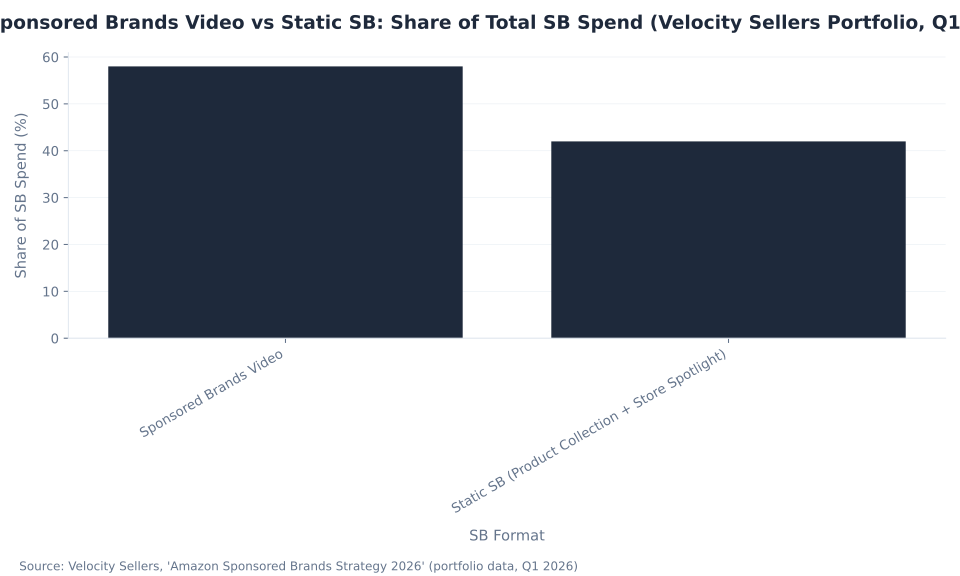
Sponsored Brands Video has emerged as the dominant format within the SB budget pool. According to Velocity Sellers' portfolio data from Q1 2026, SBV accounted for about 58% of total Sponsored Brands spend, with 1.6× higher CTR and 1.3× higher CVR than static formats (Product Collection and Store Spotlight). The derived average CTR for SBV is about 0.48% — the Trellis static SB midpoint (0.30%) multiplied by the 1.6× Velocity Sellers CTR multiplier. The video auto-plays silently, so the visual story must work without sound; captions or text overlays are standard. Per Amazon's SBV ad spec page, accepted formats are MP4 or MOV, 16:9, 1920×1080, maximum 500 MB, H.264 or H.265 codec.
Average CTR by Amazon Sponsored Ads Format (2026 Vendor Benchmarks)
Sponsored Display: Prospecting and Retargeting On and Off Amazon
Sponsored Display is the only self-service Sponsored format that reaches shoppers both on and off Amazon — across Amazon-owned properties including Twitch, Fire TV, and Echo Show, plus premium third-party websites and apps across the open web. It is also the most misunderstood format: most sellers believe it is retargeting-only and on-Amazon-only. Both assumptions are wrong.
Sponsored Display has three distinct targeting motions, not one. Audiences targets in-market, lifestyle, and interest segments — prospecting new shoppers who have not visited your product page. Product/contextual targeting places your ad on specific competitor ASIN pages or category pages — conquesting and ASIN-level defense. Views and purchases remarketing re-engages shoppers who viewed or bought your products. As SellerApp's Sponsored Display guide and Tinuiti's 2026 analysis confirm, SD's off-Amazon reach and three-motion structure distinguish it structurally from Sponsored Products, which operates primarily on Amazon search and product pages.
As of 2026, Amazon's Sponsored Display product page is headed "now part of Amazon Ads display ads offering," reflecting the unified Campaign Manager consolidation of DSP and the Sponsored Ads console announced at unBoxed 2025. The self-service product name remains Sponsored Display, and the "display ads" umbrella refers to the broader offering that includes DSP programmatic. For targeting mechanics, see Amazon Ads targeting. For performance measurement, see Amazon Ads ACOS, ROAS and metrics.
| Targeting type | Who it reaches | Best use / notes |
|---|---|---|
| Audiences — in-market | Shoppers actively browsing your product category | Prospecting near purchase intent; reaches new shoppers on and off Amazon. CTR 0.15–0.30%; ACOS 40–80%+ (Velocity Sellers) — evaluate on NTB rate, not ACOS |
| Audiences — lifestyle / interests | Long-term interest segments based on shopping + content signals | Upper-funnel prospecting; broadens reach beyond in-category browsers; NTB rate 50–80% (vendor estimate) |
| Product / contextual targeting | Shoppers on specific ASIN detail pages or category pages | Conquesting competitor ASINs; defending your own product pages from competitor SD ads |
| Views remarketing | Shoppers who viewed your product (or a similar one) and did not buy | Re-engagement; 14- and 30-day lookbacks common; CTR 0.4–0.8%; CVR 8–14%; ACOS 12–22% (Velocity Sellers) |
| Purchases remarketing | Past buyers — of your products or related ones | Replenishment + complementary cross-sell; ~30-day (replenish) / ~90-day (complementary) lookbacks; ACOS 8–18% (Velocity Sellers) |
Sources: Amazon Ads, “Guide to display ads views remarketing and lookback windows” (views vs purchases remarketing; customizable 7/14/30-day windows); SellerMetrics, “2026 Amazon Sponsored Display Tutorial” (audiences, product targeting, views remarketing); Velocity Sellers, “Amazon Sponsored Display in 2026” (ACOS by targeting type; purchases remarketing for replenishment + cross-sell). Vendor estimates — not mbadv data.
Sponsored Brands Video vs Static SB: Share of Total SB Spend (Velocity Sellers Portfolio, Q1 2026)
Sponsored Display ACOS by Targeting Type: Why the Blended Average Misleads
Sponsored Display's blended ACOS of 30–50% (Trellis, 2026) is the least informative benchmark in Amazon advertising. It averages three targeting motions with radically different efficiency profiles — purchases remarketing at 8–18% ACOS and audience prospecting at 40–80%+ ACOS sit in the same blended figure. The correct approach is to evaluate each motion independently against its own goal.
| SD targeting type | ACOS range | CVR range | CTR range | Primary success metric |
|---|---|---|---|---|
| Purchases remarketing | 8–18% | — | — | ACOS + repeat purchase rate |
| Views remarketing | 12–22% | 8–14% | 0.4–0.8% | ACOS + re-engagement rate |
| Audiences / prospecting | 40–80%+ | 2–5% | 0.15–0.30% | NTB rate (target 50–80%) |
Source: Velocity Sellers, “Amazon Sponsored Display in 2026”. Velocity Sellers portfolio characterizations — not a large-sample industry study. Attribute clearly when citing. Prospecting NTB rate of 50–80% is a vendor-cited target range; actual NTB rate depends on catalog maturity and brand awareness in the category.
Purchases remarketing (8–18% ACOS) is often the lowest-ACOS campaign in an account because the shopper already converted once — the buying signal is established. Views remarketing (12–22% ACOS, 0.4–0.8% CTR) performs well against non-buyers who showed strong intent (a product detail page view) but did not convert on the first visit. Audience prospecting (40–80%+ ACOS, 0.15–0.30% CTR) should never be evaluated against the same ACOS target as the other two — its job is to generate NTB orders at scale. A prospecting SD campaign with 60% ACOS and a 70% NTB rate is performing correctly; the same numbers on a views remarketing campaign signal a structural targeting problem.
The SD billing model also differs from Sponsored Products and Sponsored Brands: Sponsored Display supports both CPC (cost per click) and vCPM (cost per 1,000 viewable impressions). CPC is default for remarketing; vCPM becomes relevant for upper-funnel prospecting campaigns where impression volume rather than click throughput is the KPI. The Amazon Ads display-remarketing guide covers lookback window customization (7-, 14-, and 30-day options) and the ML-based related-product segment logic that powers views remarketing to audiences who viewed similar products.
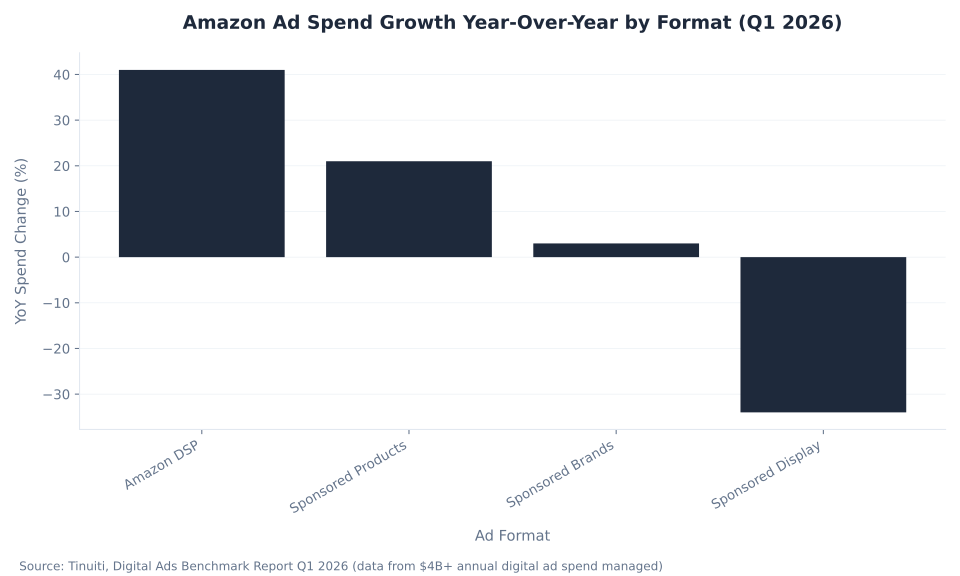
Amazon Ad Spend Growth Year-Over-Year by Format (Q1 2026)
Combining Sponsored Products and Sponsored Brands
Running Sponsored Products and Sponsored Brands together is not "running more ads" — it is a structural decision about how to divide the funnel between the two formats so they compound rather than cannibalize. The mechanism is cross-negation: negate your Sponsored Brands keyword list from your Sponsored Products campaigns, and vice versa, so both formats do not bid against each other on the same terms and inflate your costs without incremental reach.
The logic of the combination: let Sponsored Products own high-intent exact-match demand at the bottom of the funnel; let Sponsored Brands own upper-funnel and brand-led queries at the top of search, where the logo-plus-headline unit builds recognition and NTB measurement shows whether that investment is generating new customers. According to Velocity Sellers' Sponsored Brands Strategy 2026, properly structured SB campaigns measurably feed SP performance rather than competing with it — upper-funnel branded impressions reduce the effective CPC needed to capture the same shopper at bottom-of-funnel.
Branded-search defense is the most immediately valuable use of Sponsored Brands for a registered brand. Competitors bid on your brand name — "Brand X collagen" or "Brand Y wireless earbuds" — and without the top-of-search placement held by Sponsored Brands, a competitor's product appears above yours when your customers search for you. SB branded defense runs at about $0.42 effective CPC versus $0.78 via Sponsored Products alone (Velocity Sellers portfolio data) — roughly half as much per click. See Feedvisor's 2026 Sponsored Brands optimization guide for campaign structure and negative keyword management.
MB Adv Agency has found that the most common structural error when an advertiser first runs both SP and SB is treating them as parallel campaigns with the same keyword lists and no negation. Without cross-negation, SP and SB compete on the same branded queries — the seller ends up paying twice for the same click signal and neither campaign optimizes cleanly. The first step when auditing a combined SP/SB account is always to check that the two campaign types are bidding on structurally separate term sets.
| Metric | Sponsored Products | Sponsored Brands | Implication |
|---|---|---|---|
| NTB rate | ~22% | ~38% | SB generates 72% more first-time brand purchasers per attributed order |
| Effective CPC (branded queries) | ~$0.78 | ~$0.42 | SB defends branded queries at ~46% lower CPC |
| SB spend share (Q1 2026, Tinuiti $4B+) | SP: +21% YoY spend | SB: +3% YoY spend | Budget is actively migrating from SB to SP — but SB branded defense ROI remains strong |
Source: Velocity Sellers, “Amazon Sponsored Brands Strategy 2026” (NTB rates 38% SB / 22% SP; branded defense CPC $0.42 SB / $0.78 SP). Portfolio-level vendor characterizations — not a large-sample neutral study. Tinuiti Q1 2026 Benchmark (SP +21% / SB +3% YoY spend; $4B+ digital ad spend managed). Attribute clearly when citing.
Cross-Selling and Upselling with Sponsored Display
Sponsored Display purchases remarketing is the cross-sell and upsell engine in the self-service Sponsored stack. It targets past buyers — people who already purchased one of your products — and shows them ads for complementary or replenishable items. The targeting logic is first-party: Amazon uses its own purchase data to identify buyers in your catalog and serve them ads on and off Amazon.
The catalog type determines whether purchases remarketing pays. Replenishable products (coffee, supplements, protein powder, skincare, pet food) have natural reorder cycles — a shorter lookback (~30 days) re-reaches buyers just as they need to replenish. Complementary products (a keyboard stand, a water-bottle filter, a device charger) benefit from a longer lookback (~90 days), when the cross-sell opportunity peaks. A single-SKU brand with no replenishment or add-on gets far less from purchases remarketing than a 20+ SKU catalog where one purchase predicts a second. See supplements & nutrition PPC and pet supplies PPC for category playbooks where purchases remarketing outperforms the blended SD ACOS.
MB Adv Agency has found that purchases remarketing performs best where the catalog has at least two distinct SKU relationships: a higher-ticket "anchor" product that generates the first purchase, and a lower-cost consumable or accessory that serves as the natural cross-sell. Skincare brands (cleanser → moisturizer → SPF), supplement stacks (protein → creatine → pre-workout), and kitchen accessory brands all exhibit this structure. For home goods and furniture brands, where catalog depth and replenishment are less common, views remarketing is the higher-ROI SD motion.
The lookback window is configurable at the campaign level. Per Amazon's official display-remarketing guide, customizable windows of 7, 14, and 30 days are available, with ML-based related-product segments that extend reach to buyers of similar products. A 2026 best-practice structure pairs a 30-day lookback for replenishment with a 90-day lookback in a separate campaign for complementary cross-sell, allowing independent budget control and ACOS measurement. Source: Velocity Sellers, “Amazon Sponsored Display in 2026.”
For brands selling in sports equipment or kitchen appliances — categories with accessory-heavy catalogs — purchases remarketing can run as a permanent "accessory upsell" layer. The anchor product (a kettlebell, a blender) generates the first purchase; the accessory layer (resistance bands, cleaning brush kits) fires as a 30-day campaign. ACOS on this structure runs 8–18% (vendor benchmark, Velocity Sellers) because the buyer is already in a purchasing relationship with the brand.
Budget Allocation Across the SP/SB/SD Trio
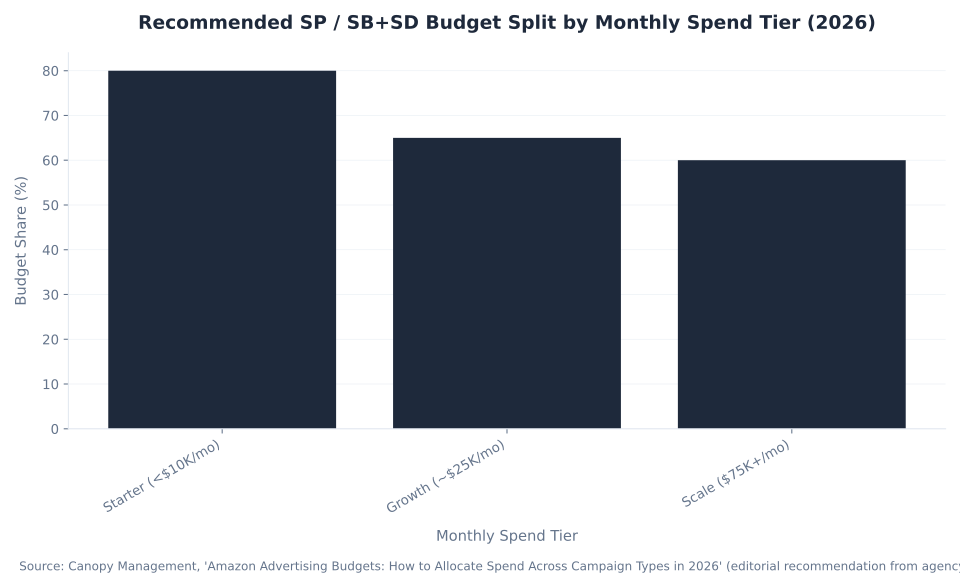
The right budget split across Sponsored Products, Sponsored Brands, and Sponsored Display is not static — it changes with monthly ad spend scale and Brand Registry status. Sponsored Products consistently commands the largest share at every tier because it is the highest-intent, highest-converting format. SB and SD shares grow as total budget grows and as the full-funnel compounding effect becomes measurable.
| Spend tier | Sponsored Products | Sponsored Brands | Sponsored Display | Amazon DSP |
|---|---|---|---|---|
| Starter (<$10K/mo) | 80% | 15% | 5% | — |
| Growth (~$25K/mo) | 65% | 20% | 15% | — |
| Scale ($75K+/mo) | 60% | 20% | 15% | 5% |
| $100K–$500K/mo (Velocity Sellers portfolio) | 60–65% | 18–25% | 8–12% | — |
Source: Canopy Management, “Amazon Advertising Budgets: How to Allocate Spend Across Campaign Types in 2026” (editorial recommendation from agency account data; Canopy disclaimer: reflects patterns in their own data and client base, not official Amazon guidance or guarantees of future performance). Velocity Sellers split from Velocity Sellers, “Amazon Sponsored Display in 2026.” Do not cite as mbadv client data or Amazon-official benchmarks.
Two constraints override the table: Brand Registry status and launch phase vs. steady-state. A non-brand-registered seller has no SB or SD allocation available — 100% Sponsored Products until enrollment completes. A brand in launch phase (fewer than 500 reviews, no steady-state conversion data) should weight SP even more heavily than the table suggests — 90%+ SP — until the account has enough Search Term Report data to identify profitable terms before investing in upper-funnel formats.
MB Adv Agency recommends new advertisers allocate at least 80% of their initial Sponsored budget to Sponsored Products before layering upper-funnel formats. Sponsored Products generates the Search Term Report data that informs every subsequent keyword decision — in Sponsored Brands, in negative keyword lists, and in Sponsored Display product targeting. Launching SB and SD before SP has generated two to four weeks of clean data wastes budget on formats that have no efficiency baseline to optimize against. For home goods, shoes, and jewelry brands entering Amazon for the first time, the standard recommendation is SP-only for the first 4–6 weeks, then SB branded defense, then SD remarketing once the product page has enough daily traffic to generate meaningful views remarketing pools.
Recommended SP / SB+SD Budget Split by Monthly Spend Tier (2026)
Amazon Sponsored Ads Management
Run Sponsored Products, Brands & Display as a full-funnel system — not three isolated campaigns
MB Adv Agency builds and manages full-funnel Sponsored Ads stacks for DTC brands across electronics, beauty products, home goods, supplements & nutrition, and sports equipment. We establish Brand Registry sequencing, cross-negation structure, and Search Term Report workflows that compound performance across all three Sponsored formats.
Map your catalog to the right Sponsored stack →Amazon Sponsored Ads Spend Trends: Q1 2026
The Q1 2026 benchmark from Tinuiti — drawn from $4B+ in annual digital ad spend managed — shows Sponsored Products accelerating while Sponsored Brands stalls and Sponsored Display posts a sharp spend decline. The SD figure is the most misread number in the dataset: the -34% YoY decline is not SD losing value. It reflects budget migrating from the Sponsored Ads console's SD format to Amazon DSP programmatic — the programmatic equivalent of SD reach at greater audience depth and off-Amazon precision.
| Format | YoY spend | YoY click/impression | YoY CPC/CPM | Context |
|---|---|---|---|---|
| Sponsored Products | +21% | Clicks +19% | CPC +2% | Third straight quarter of strong growth; ROAS stable |
| Sponsored Brands | +3% | Clicks −10% | CPC +14% | Slowest format; advertisers actively shifting budget to SP |
| Sponsored Display | −34% | — | CPC −49% | Budget migrating to Amazon DSP, not format deprecation |
| Amazon DSP | +41% | Impressions +14% | CPM +24% | Now 43% of total Amazon budgets for advertisers using both console + DSP |
Source: Tinuiti, “Digital Ads Benchmark Report Q1 2026” ($4B+ annual digital ad spend managed). Q1 2026 snapshot only — Q2+ data can diverge. SD −34% reflects structural shift to DSP programmatic, not SD format value decline. These are cross-advertiser averages; individual account trends depend on category, Brand Registry status, and campaign maturity.
The SB +3% / clicks -10% / CPC +14% combination tells a specific story: advertisers spend marginally more on Sponsored Brands but receive far fewer clicks at higher cost. Two dynamics drive it: (1) advertisers with broad SB keyword coverage are pruning to higher-intent branded terms, cutting click volume but improving efficiency; (2) the auction for branded terms is intensifying as more brands protect their own names. The takeaway is not to abandon SB but to restructure it — tighter keyword coverage, cross-negation from SP, and NTB rate as the primary success metric over ACOS or click volume.
The DSP +41% growth (now 43% of total Amazon budgets for dual-platform advertisers) signals that the display and retargeting function Sponsored Display serves in smaller accounts is handled at scale by DSP's programmatic layer. For brands spending above $75K/month on Amazon ads, the question shifts from "Sponsored Display vs not" to "Sponsored Display self-serve vs Amazon DSP — or both." See what Amazon Ads is for the distinction between self-serve Sponsored formats and the DSP programmatic layer.
What Most Sellers Get Wrong About Amazon Sponsored Ads
Three declarative corrections — each backed by Amazon documentation or verified 2026 sources — that the thin pages this pillar absorbs never stated clearly. They are precise, verifiable, and wrong in the most common guides.
1. "All three Sponsored formats are open to every seller." They are not. Sponsored Products is the only self-service Sponsored format with no Brand Registry requirement — open to professional sellers, vendors, book vendors, KDP authors, and agencies from day one, per Amazon's own Sponsored Products page. Sponsored Brands requires Amazon Brand Registry, per ezCommerce's 2026 SB guide. Sponsored Display requires Brand Registry for most sellers, per Tinuiti and Jungle Scout. A seller without a registered or pending trademark is, in practice, Sponsored-Products-only.
The eligibility gate is binary. Non-brand-registered seller: Sponsored Products only. Brand-registered seller: Sponsored Products + Sponsored Brands + Sponsored Display. There is no middle state. If a guide tells you that you can run Sponsored Brands without Brand Registry, it is wrong.
2. "Sponsored Display is on-Amazon retargeting only." Wrong on both counts. Sponsored Display reaches shoppers on Amazon-owned properties (Twitch, Fire TV, Echo Show) and across premium third-party sites and apps off Amazon, per Amazon's official Sponsored Display page. Retargeting is only one of its three targeting motions: SD also runs audience prospecting (in-market and lifestyle segments) and product/contextual targeting (competitor ASINs or category pages). Per SellerMetrics' 2026 SD tutorial and SellerApp's analysis, the off-Amazon reach and three-motion structure distinguish SD from Sponsored Products.
3. "Sponsored Products and Sponsored Brands compete — pick one." They are complementary, not substitutes. SP captures bottom-of-funnel exact-match demand; SB builds consideration, defends branded queries, and reports new-to-brand performance SP cannot measure. Run together with cross-negation on separate term sets, SB feeds SP rather than competing with it — upper-funnel branded impressions lower the effective CPC to capture the same shopper at bottom-of-funnel. Per Velocity Sellers' 2026 SB strategy guide, treating SP and SB as either/or forfeits the full-funnel compounding that is the point of running both. Sponsored Brands requires Brand Registry; Sponsored Products does not.
Frequently Asked Questions About Amazon Sponsored Ads
Not sure which Sponsored formats your Brand Registry status unlocks?
MB Adv Agency maps your catalog and trademark status to the right mix of Sponsored Products, Brands, and Display — and builds the campaign structure that compounds performance across all three formats rather than running them in isolation.
Get in touch →Methodology
This pillar draws on four input sources: (1) Ahrefs keyword data (June 2026, US) for demand framing across 7 absorbed zombie URLs; (2) Amazon Ads' own product and ad-spec documentation for eligibility, placement, and format specifications; (3) vendor benchmark reports from Trellis (CTR/ACOS/CVR by format), Autron and Ad Badger (blended platform averages and per-category SP benchmarks), Velocity Sellers (SBV performance, NTB rates, SD ACOS by targeting type, branded-defense CPC), Dark Room Agency (CPC ranges by format), and Canopy Management (budget allocation by spend tier); and (4) Q1 2026 benchmark data from Tinuiti's Digital Ads Benchmark Report ($4B+ annual digital ad spend managed). All benchmark figures are vendor-attributed; no mbadv client metrics appear anywhere in this pillar. GSC data: 7 absorbed URLs, 28 total impressions over 90 days, 0 clicks — all zero-click zombies. Reviewed by MB Adv Agency, June 2026.

As a Google Ads expert, I bring proven expertise in optimizing advertising campaigns to maximize ROI.
I specialize in sharing advanced strategies and targeted tips to refine Google Ads campaign management.
Committed to staying ahead of the latest trends and algorithms, I ensure that my clients receive cutting-edge solutions.
My passion for digital marketing and my ability to interpret data for strategic insights enable me to offer high-level consulting that aims to exceed expectations.
Google Partner Agency
We're a certified Google Partner Agency, which means we don’t guess — we optimize withGoogle’s full toolkit and insider support.
Your campaigns get pro-level execution, backed by real expertise (not theory).
4.9 out of 5 from 670+ reviews on Fiverr.
That’s not luck, that’s performance.
Highly recommend Matteo to set up your server side tracking. He has a deep understanding of e-commerce tracking and will go above and beyond to make sure everything is set up correctly and working 100%. If you are scaling your store this set up is non-negotiable in my opinion and there isn't many people who have this much knowledge or put the effort in to get it right. Thanks again!
avorodesign.com
I can only recommend Matteo! He was very patient, professional and very knowledgeable about GA4, Consent Mode v2, and GDPR compliance. Communication was clear, and the setup was done professionally and efficiently. Highly recommend him for anyone needing reliable tracking implementation.
www.natureiki.life
Matteo shines in the realm of online professionals. His work is not only deep in data but also complemented by his proactive communication and cooperation, setting a new standard for freelancers. If you want someone who truly exceeds expectations, look no further. Highly recommended!

www.omanbeverlysmyth.com
Exceptional Service Beyond Expectations - Outstanding Service Impeccable depth, flawless delivery, and exceptional language fluency—this service exceeded all expectations. Highly recommended. Matteo truly ROCKS!!!
ium-paris.com
Top-notch, always highly value working with Matteo. An absolute Google Ads Genius. This is approximately the 8th time I have hired him and he's helped us get 6-7 ROAS. We are excited in continuing to improve our lead flow. Hire this guy if you need Google Ads help. Thanks Matteo!

www.dleeventgroup.com
I finally found the guy who can setup server side tracking and all the ecosystem properly. I definitely recommend Matteo. He is very responsive, kind and wants to dig into things. He configured GA4, Meta, Google Ads, Outbrain and google consent v2 with Cookiebot. Thanks Matteo.

inomega.fr
MB Adv delivered exceptional work with outstanding professionalism and lots of patience, taking time to see effects of changes made and not just do the work and submit it. The proactive communication and video summaries of the work completed made working with Matteo a pleasure, as he consistently went above and beyond. Highly recommended for web analytics projects! We are already working on another project.

www.withnellsensors.co.uk
Working with Matteo on my Google Ads was a game-changer. He's not just a strategist, he's a true partner. He understood my goals and tailored a campaign that perfectly reached my target audience. I'm grateful for his expertise and dedication.
dccargo.com
Click-driven mind
with plastic-brick obsession.
We build Google Ads campaigns with the same mindset we use to build tiny brick worlds: strategy, patience, and zero tolerance for wasted pieces.
Data is our blueprint. Growth is the only acceptable outcome.