Pinterest Ad Formats: The Full 2026 Lineup & Specs

Pinterest Ad Specs — 2026
2:3
The master aspect ratio (1000 × 1500 px) every uploaded Pinterest ad inherits
Pinterest runs nine self-serve and premium ad formats in 2026 — Standard image, Standard-width video, Max-width video, Carousel, Idea ads, Idea ads with paid partnerships, Showcase, Quiz, and Premiere Spotlight. Almost all of them start from the same vertical 2:3 frame. The format you build is a separate decision from the fact that it is paid: “Promoted Pins” is a legacy label, not a format.
Source: Pinterest, “Review ad specs” (recommended 2:3 / 1000 × 1500 px). Pinterest revises these specs frequently — re-verify against the live spec page at publish.
Pinterest Ad Formats: The Complete 2026 Lineup, Specs, and How to Pick One
Pinterest sells attention through a fixed set of ad formats, and in 2026 that set is nine creative units you build yourself plus two catalog-driven units generated from a product feed. The self-build lineup is Standard (image), Standard-width video, Max-width video, Carousel, Idea ads, Idea ads with paid partnerships, Showcase, and Quiz; Premiere Spotlight is the premium, reservation-only takeover on top of that. Shopping ads and Collections ads round out the picture, but they are assembled from a catalog rather than uploaded, so they belong to the Pinterest shopping ads and catalogs pillar. (Pinterest, “Review ad specs”)
Two naming corrections anchor this page, because the four thin pages it replaces were built on dead vocabulary. First: Pinterest ads are no longer called “Promoted Pins.” Pinterest standardized its help system on the word “ads” — “Ads overview,” “Create an ad,” “Review ad specs.” A Promoted Pin was simply a Pin you paid to boost; today that is an ad, and the format you choose is a separate decision from the fact that it runs as paid media. Second: “Idea Pins” is a retired organic name, not a current ad format. Pinterest merged Idea Pins and regular Pins into one organic format called “Pins” in 2023 (Search Engine Land). The paid storytelling format lives on as “Idea ads,” and its creator-collaboration variant is “Idea ads with paid partnerships” (Pinterest, “Idea ads with paid partnerships”).
The 2026 self-serve and premium lineup: Standard (image) · Standard-width video · Max-width video · Carousel · Idea ads · Idea ads with paid partnerships · Showcase · Quiz · Premiere Spotlight (reserved via a Pinterest rep). Shopping and Collections ads are catalog-driven and covered in the shopping pillar.
This guide gives the full lineup, the citation-grade spec table (aspect ratio, dimensions, video length, file size, character limits), and a goal-to-format map so the creative follows the campaign goal rather than the asset you happen to own. The format choice is downstream of the objective: start with what the campaign is supposed to do, then pick the unit. For the objective layer itself, see Pinterest campaign objectives. For the craft of making a Pin convert — hooks, text overlay, calls to action — see designing Pins for Pinterest ads. New to the platform entirely? Start with what Pinterest ads are.
Six Things Pinterest Advertisers Get Wrong About Ad Formats
The format picker looks like a styling choice. It is a set of hard rules — aspect ratios, file caps, length limits — and a vocabulary that shifted under everyone's feet. Each point below corrects a recurring error.
- “Promoted Pins” is a legacy term, not a format. Pinterest ads are just “ads” now. There is no single dated deprecation to cite — the term quietly fell out of use as Pinterest standardized on “ads.”
- “Idea Pins” was retired in 2023. The organic label was merged into “Pins.” The live paid formats are Idea ads and Idea ads with paid partnerships — calling “Idea Pins” a current ad format is the single most common naming error in Pinterest content.
- Standard-width and Max-width video are different formats, not two sizes of one. Standard-width accepts 2:3, 4:5, 9:16, or 1:1; Max-width is restricted to 1:1 or 16:9 and cannot exceed the height of a 1:1 frame.
- Carousel cards must share one aspect ratio. Two to five cards, all 1:1 or all 2:3 — mixing ratios is a frequent rejection cause. Each card links to its own destination.
- The 2:3 / 1000 × 1500 px Pin is the default for almost everything. Video best practice is short — 6–15 seconds — even though the format allows up to 15 minutes.
- Shopping and Collections are catalog-driven, not creative you upload. They are a different machine and live in the shopping ads and catalogs pillar.
The sections below give the full spec sheet and the goal-to-format map. For who Pinterest ads are for and how the system fits together, see what Pinterest ads are.
Pinterest Ad Format Search Demand: The Numbers
These are the search-demand figures that frame which terms this page targets. Pinterest is a lower-search-volume topic than Google Ads or Meta Ads, so the cluster is small in absolute terms — but the difficulty is near zero and the global pool is several times the US figure. Every number traces to Ahrefs (June 2026).
US Head-Term Volume
150
“pinterest ad formats” US monthly searches — Ahrefs, June 2026
Global Head-Term Volume
350
Same term, all-countries monthly — the cluster is 2–5× larger outside the US
Head-Term Difficulty
KD 3
“pinterest ad formats” Ahrefs keyword difficulty — near-zero competition
Legacy-Term Volume
40
“promoted pins” US monthly — residual demand from outdated vocabulary, not a live format
The two 150/mo head terms (“pinterest ad formats” and “pinterest ad types”) are the volume anchors. The spec-table intent — “pinterest ad specs,” “pinterest video ads” (90/mo US), “pinterest carousel ads” (100/mo US) — is the high-intent reason a DATA-profile page wins here: a designer briefing a file searches for the exact dimensions. The “promoted pins” query (40 US / 200 global) is the legacy-term magnet; owning it with the accurate correction is the strongest long-tail value of this pillar.
Pinterest Ad Format Terms: US Monthly Search Volume (Ahrefs, June 2026)
Pinterest Ad Format Terms: Global Monthly Search Volume (Ahrefs, June 2026)
Four Pinterest Ad-Format Misconceptions, Corrected
These four errors are the ones that send advertisers to the wrong creative or get a file rejected at upload. Each correction is declarative and backed by Pinterest documentation.
Misconception 1: Pinterest ads are called Promoted Pins
False. Pinterest's own help system standardized on the word “ads” — “Ads overview,” “Create an ad,” “Review ad specs.” (Pinterest, “Review ad specs”) “Promoted Pins” lingers in a handful of old help URLs, but it is no longer the primary term, and there is no single dated deprecation announcement to point at. The honest framing is that the term quietly fell out of use. A Promoted Pin meant a paid Pin; today it is an ad, and the format you choose — image, video, Carousel, Idea, Showcase, Quiz — is a separate decision from the fact that it is promoted. Dropping the legacy mental model is the first job of this page.
Misconception 2: Idea Pins are a current ad format
False on the name. “Idea Pins” was retired in 2023 when Pinterest merged Idea Pins and regular Pins into one organic format called “Pins” (Search Engine Land). That sunset was organic. On the paid side, the multi-page storytelling format continues as Idea ads, and the creator-collaboration variant is Idea ads with paid partnerships, which carries a “Paid Partnership” disclosure label (Pinterest, “Idea ads with paid partnerships”). Calling “Idea Pins” a live ad format is the most common naming error in Pinterest content. The correct statement: “Idea Pins” (organic) is a retired name; “Idea ads” and “Idea ads with paid partnerships” are live paid formats.
Misconception 3: Standard-width and Max-width video are the same thing at different sizes
False. They are different formats with different rules. Standard-width video plays at normal Pin width and accepts vertical (2:3, 4:5, 9:16) or square (1:1). Max-width video expands across the full width of the mobile feed and is restricted to square (1:1) or widescreen (16:9), and it cannot exceed the height of a 1:1 aspect ratio (Pinterest, “Review ad specs”). Briefing a 9:16 vertical file for a Max-width placement gets it bounced. The two are not interchangeable, and a designer needs to know which placement the campaign is buying before exporting.
Misconception 4: A carousel can mix square and vertical cards
False. All cards in a Pinterest carousel share one aspect ratio — either all 1:1 or all 2:3 — with two to five cards, each able to link to its own destination URL (Pinterest, “Review ad specs”; Strike Social). Mixing ratios within a single carousel is a frequent rejection cause. Plan the set as one ratio family from the first storyboard, and decide per-card destinations up front so each swipe routes the audience where the offer lives.
The 2026 Pinterest Ad-Format Lineup at a Glance
Table 1 is the orientation map for the whole page: every current format, what it is in one line, whether it is built from a catalog, and whether it is self-serve. Read it as the answer to “what types of Pinterest ads exist?” before drilling into specs.
| Format | What it is | Catalog-driven? | Self-serve? |
|---|---|---|---|
| Standard (image) | Single native-looking image Pin — the foundation format | No | Yes |
| Standard-width video | Video at normal Pin width in the feed | No | Yes |
| Max-width video | Video that expands across the full width of the mobile feed | No | Yes |
| Carousel | 2–5 swipeable cards, each can link to its own destination | No | Yes |
| Idea ads | Multi-page set of videos/images/text in one Pin (absorbed organic “Idea Pins”) | No | Yes |
| Idea ads with paid partnerships | Creator-made Idea ad tagging the sponsoring brand; carries a “Paid Partnership” label | No | Yes (creator + brand approval) |
| Showcase ads | Title card + up to ~4 swipeable feature cards with overlays/links | No | Yes (expanding availability) |
| Quiz ads | Interactive multiple-choice → personalized product recommendation | No | Yes |
| Shopping ads (see shopping pillar) | Dynamic ad auto-built from the catalog feed (live price/availability) | Yes | Yes |
| Collections ads (see shopping pillar) | One hero asset above smaller catalog product images → full-screen shoppable view | Yes | Yes |
| Premiere Spotlight | Premium one-day home + search takeover, max-width video (~50% of mobile screen) | No | No — reserved via a Pinterest rep |
Sources: Pinterest, “Review ad specs” (current lineup: Standard image, Standard-width video, Max-width video, Carousel, Idea ads, Showcase, Quiz, Collections, Shopping); Pinterest, “Idea ads with paid partnerships” (creator tags brand; Paid Partnership label; brand approval); Pinterest, “Premiere Spotlight” (premium takeover, reserved via a rep). Showcase availability is expanding by country — confirm it is live for the target market. Shopping and Collections are catalog-driven; the deep treatment is the sibling pinterest-shopping-ads-and-catalogs pillar.
Nine of these are creative you build and upload (or, for Idea ads with paid partnerships, a creator builds). Two — Shopping and Collections — are generated from a product catalog Pinterest ingests daily, which is why they sit in their own pillar. Premiere Spotlight is the one non-self-serve unit: a reserved, managed home-and-search takeover sold through a Pinterest representative. For the objective each format pairs with, see Pinterest campaign objectives.
Pinterest Ad Specs by Format: Aspect Ratio, Dimensions, Length, File Size
Table 2 is the citation-grade spec sheet — the table a designer briefs a file against. Aspect ratio, accepted file types, recommended dimensions, length limits, and the maximum file size for every uploadable format. The recommended starting point for static and most interactive formats is the 2:3 / 1000 × 1500 px Pin.
| Format | File types | Aspect ratio (recommended) | Length | Max file size |
|---|---|---|---|---|
| Standard image | .PNG, .JPEG | 2:3 (1000 × 1500 px) | — | 20 MB (desktop) / 32 MB (in-app) |
| Standard-width video | .MP4, .MOV, .M4V (H.264/H.265) | 1:1, 2:3, 4:5 or 9:16 | 4 s–15 min (6–15 s recommended) | 2 GB |
| Max-width video | .MP4, .MOV, .M4V (H.264/H.265) | 1:1 or 16:9 (can't exceed 1:1 height) | 4 s–15 min (6–15 s recommended) | 2 GB |
| Carousel (2–5 cards) | .PNG, .JPEG | 1:1 or 2:3 (all cards must match) | — | 20 MB per image |
| Idea ads (up to ~20 pages) | Image: .BMP/.JPEG/.PNG/.TIFF/.WEBP · Video: .MP4/.M4V/.MOV | 9:16 (1080 × 1920 px) | Video ≤ 5 min per page | 2 GB (mobile) / 100 MB (web) |
| Showcase ads (≤4 cards) | Image: .BMP/.JPEG/.PNG/.TIFF/.WEBP · Video: .MP4/.MOV/.M4V | 2:3 title + cards (1000 × 1500 px) | Video 3–60 s | 32 MB |
| Quiz ads (1 title + ≤3 results) | Image: .BMP/.JPEG/.PNG/.TIFF/.WEBP · Video: .MP4/.MOV/.M4V | 2:3 (1000 × 1500 px) | Video 3–60 s | 32 MB |
| Premiere Spotlight | .MP4, .MOV, .M4V (video only) | 1:1 or 16:9 (1080p) | ~6–30 s | Confirm with rep |
Source: Pinterest, “Review ad specs” (file types, aspect ratios, dimensions, lengths, file-size caps for Standard image/video, Carousel, Idea, Showcase, Quiz). Premiere Spotlight figures (video-only, ~6–30 s, 1:1 or 16:9, 1080p, reservation-based): Pinterest, “Premiere Spotlight” and Strike Social, “The complete list of Pinterest ad specs”. Two known disagreement points: the carousel per-image cap is 20 MB per Pinterest's own page, though some 2026 guides cite 32 MB — use Pinterest's number; Premiere Spotlight has no standardized public spec sheet, so its figures are rep-confirmed. Re-confirm every row against the live spec page at publish. Secondary cross-check: soona, “Pinterest ad size and specs”.
Two cells decide most rejected uploads. The carousel ratio rule (all cards 1:1 or all 2:3, never mixed) and the Max-width video restriction (1:1 or 16:9 only) are the constraints designers miss most often. The title and description character limits sit lower on this page, in the Direct Links and character-limits section. For the design decisions that sit on top of these hard specs — what to put inside the frame — see designing Pins for Pinterest ads.

Which Pinterest Ad Format for Which Goal
Table 3 reverses the most common mistake: leading with the asset you already own. Start from what the campaign is supposed to do, then read across to the format. The goal language deliberately mirrors the objective names so the two pillars line up.
| If your goal is… | Lead with… | Why |
|---|---|---|
| Clean demand capture from a single strong product image | Standard (image) | Lowest production cost; native feel; the reliable workhorse |
| Attention + consideration (how-to, transformation, product in motion) | Standard-width video | Motion lifts engagement; 6–15 s keeps completion high |
| Maximum impact for a hero moment or brand story | Max-width video | Full-feed width is more immersive than a standard Pin |
| Show multiple products, angles, or steps; let each card link out | Carousel | 2–5 swipeable cards, each with its own destination URL |
| Tell a multi-page story (tutorial, lookbook, recipe steps) | Idea ads | Multi-page video/image/text storytelling in one Pin |
| Native creator content with disclosure | Idea ads with paid partnerships | Creator-made, brand-tagged, carries the “Paid Partnership” label |
| Interactive product discovery or personalized recommendation | Showcase or Quiz | Swipeable feature cards (Showcase) or multiple-choice → result (Quiz) |
| Sell from a live product catalog (price/availability) | Shopping / Collections (see shopping pillar) | Catalog-driven; dynamic; shoppable — a different machine from upload formats |
| Own the screen for a launch moment | Premiere Spotlight | One-day home + search takeover; reserved via a Pinterest rep |
Sources: Pinterest, “Review ad specs”; Pinterest campaign objectives (goal-to-format alignment across Awareness, Video Completion, Consideration, Conversions, Catalog Sales); Pinterest, “Premiere Spotlight”. Goal-to-format mapping is editorial guidance grounded in Pinterest's objective documentation, not a Pinterest-published matrix. Format eligibility per objective is set in Ads Manager — confirm for a given account.
The format follows the objective, and the objective follows the business goal. A single hero photo wants a Standard image; a transformation wants Standard-width video; a launch land-grab wants Premiere Spotlight. For home decor PPC and fashion PPC brands — two of Pinterest's strongest visual-discovery categories — a Carousel or Idea ad showing multiple looks or steps usually outperforms a single static Pin, because the audience is in planning mode. For food & beverage PPC and wedding PPC, recipe and event video map cleanly to Standard-width video and Idea ads.

Idea Ads vs Idea Ads with Paid Partnerships
Table 4 closes the naming confusion that the absorbed pages got most wrong. Idea ads are the brand's own multi-page storytelling format. Idea ads with paid partnerships are the same multi-page format made by a creator who tags the sponsoring brand, with a “Paid Partnership” label applied automatically.
| Dimension | Idea ads | Idea ads with paid partnerships |
|---|---|---|
| Who creates the content | The advertiser (brand's own creative) | A creator, who tags the sponsoring brand |
| Disclosure label | None | “Paid Partnership” label shown automatically |
| Approval flow | Standard ad creation in Ads Manager | Creator adds the tag; the brand approves it (email notification) before the label appears |
| Who promotes it | The advertiser | The brand/advertiser (creators cannot self-promote a paid-partnership Pin) |
| Best for | Brand-controlled storytelling, tutorials, lookbooks | Native, creator-led campaigns (e.g. via the #paid partnership, 2026) |
| Relation to “Idea Pins” | “Idea Pins” (organic) was retired in 2023 when Pinterest merged Idea Pins and Pins. These are the paid descendants — live ad formats, not the retired organic name. | |
Sources: Pinterest, “Idea ads with paid partnerships” (creator tags brand; Paid Partnership label; brand approval; creators cannot self-promote); Pinterest, “Paid partnerships for creators”; #paid + Pinterest strategic partnership, 2026 (Yahoo Finance / #paid press release); Idea Pins/Pins merge, 2023 (Search Engine Land). Idea-ads-with-paid-partnerships availability is region-limited — confirm it is live for the target market before recommending it.
The operational detail that trips brands up: a creator cannot promote a paid-partnership Pin on their own. The creator tags the brand and the brand approves the tag through an email notification; the advertiser then promotes it. In 2026, #paid became an official execution partner for Pinterest's Creator Partnership Program, delivering creator-led campaigns through this format (Yahoo Finance). For the broader automation and emerging-creative layer, see Pinterest ads optimization and AI.
Standard-Width vs Max-Width Video: The Distinction Most Advertisers Miss
The single most-misbriefed area of Pinterest creative is the difference between Standard-width and Max-width video. They look like one format at two sizes. They are two formats with different aspect-ratio rules, and getting it wrong means a re-export after rejection.
| Dimension | Standard-width video | Max-width video |
|---|---|---|
| Feed width | Normal Pin width | Full width of the mobile feed |
| Accepted aspect ratios | 1:1, 2:3, 4:5, or 9:16 | 1:1 or 16:9 only |
| Height constraint | None stated | Cannot exceed the height of a 1:1 aspect ratio |
| Max video length | 15 minutes | 15 minutes |
| File size | 2 GB | 2 GB |
| Recommended length | 6–15 seconds | 6–15 seconds |
Source: Pinterest, “Review ad specs” (aspect-ratio rules, full-feed width, the 1:1 height constraint); cross-check Strike Social. The two formats are not interchangeable: a 9:16 vertical file briefed for a Max-width placement gets rejected. Re-verify at publish — Pinterest revises specs frequently.
Standard-width video sits at normal Pin width inside the masonry feed and accepts the full ratio range, including the tall 9:16 and 2:3 frames that dominate Pinterest. Max-width video expands across the full width of the mobile feed for a bigger, more immersive moment — but it is constrained to square (1:1) or widescreen (16:9) and cannot exceed the height of a 1:1 frame. Choose Standard-width when vertical real estate carries the message; choose Max-width when a wide, cinematic moment is the point. For the design craft on top of these placements, see designing Pins for Pinterest ads.
Pinterest Video Length Limits by Format
Table 6 separates the maximum allowed length from the recommended length, because the gap is large and the recommended figure is the one that matters for completion. Standard-width and Max-width video both run up to 15 minutes technically, but Pinterest's own creative guidance sets 6–15 seconds as the target.
| Format | Minimum | Maximum | Recommended |
|---|---|---|---|
| Standard-width video | 4 seconds | 15 minutes (900 s) | 6–15 seconds |
| Max-width video | 4 seconds | 15 minutes (900 s) | 6–15 seconds |
| Idea ads (per page) | — | 5 minutes (300 s) per page | — |
| Showcase ads | 3 seconds | 60 seconds | — |
| Quiz ads | 3 seconds | 60 seconds | — |
Source: Pinterest, “Review ad specs” (verified June 2026). The format allows long-form; the platform rewards short-form — Pinterest sets the recommended window at 6–15 seconds for Standard-width and Max-width video even though the technical maximum is 15 minutes. Idea ads are the exception, with up to 5 minutes per page by design. Re-verify at publish.
Short video wins because Pinterest is a fast vertical-scroll discovery surface: the first few seconds carry the hook. Idea ads break the pattern deliberately — multi-page storytelling at up to 5 minutes per page is the format's design intent — while Showcase and Quiz cap at 60 seconds, matching their quick, interactive purpose. For food & beverage PPC and beauty products PPC brands whose creative is a recipe or a skin-treatment application, a tight 6–15 second Standard-width video usually outperforms a longer cut.
Pinterest Video Formats: Maximum Video Length by Format (Pinterest Ad Specs, 2026)
Character Limits and Direct Links: The Copy and Click Layer
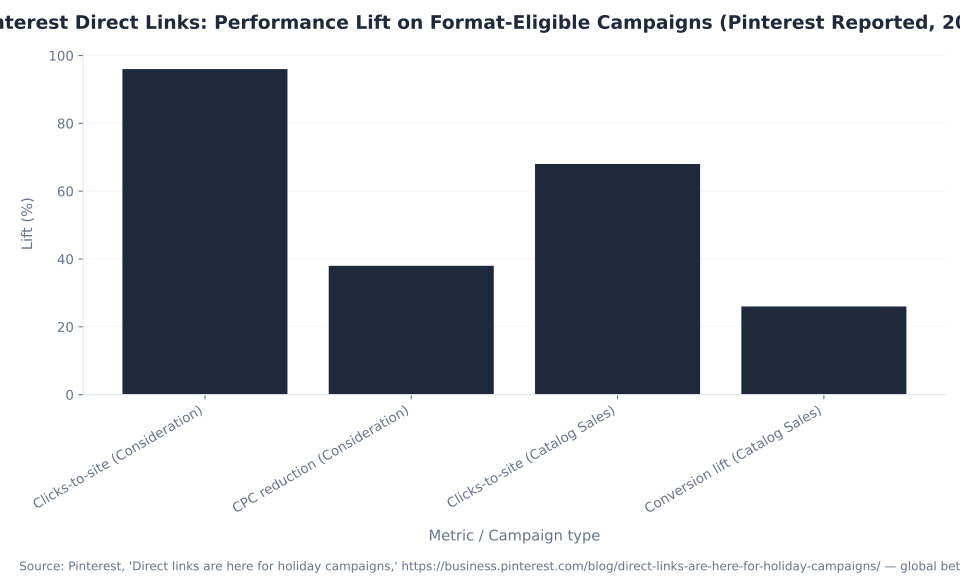
Two spec layers sit on top of the visual format: how much text a format accepts, and where a click goes. Table 7 gives the character limits a copywriter briefs against; Table 8 gives Pinterest's reported lift from Direct Links, the click behavior that now applies across eligible formats.
| Element | Limit | Notes |
|---|---|---|
| Title (all formats) | 100 characters | First 40 characters display in feeds (regular languages); first 30 for double-byte scripts |
| Description (all formats) | 800 characters | Descriptions do not appear in home/search feeds for most ad types |
| Showcase text overlay | 10 words max | Per card |
| Showcase feature text | 50 characters | Per feature card (including spaces) |
| Quiz questions | 96 characters | Per question (including spaces) |
| Quiz answers | 48 characters | Per answer option (including spaces) |
Source: Pinterest, “Review ad specs” (verified June 2026). The description limit drifts in third-party sources — some still cite 500 characters; Pinterest's live spec page shows 800. Use 800 and re-confirm at publish.
The title runs to 100 characters, but the feed shows only the first 40 (or 30 for double-byte scripts), so front-load the message. The description holds 800 characters and does not surface in home or search feeds for most ad types, which makes it a keyword and accessibility field more than a headline. Showcase and Quiz carry their own tight per-card and per-answer limits.
| Campaign type | Metric | Pinterest-reported result |
|---|---|---|
| Consideration campaigns | Clicks-to-site | +96% vs the same campaigns before Direct Links |
| Consideration campaigns | Cost per outbound click | 38% lower vs the same campaigns before Direct Links |
| Catalog Sales / Conversions | Clicks-to-site | +68% vs the same campaigns before Direct Links |
| Catalog Sales / Conversions | Click-based conversions | +26% vs the same campaigns before Direct Links |
Sources: Pinterest, “Direct links are here for holiday campaigns”; Pinterest, “Use direct links in your ads”. Pinterest beta cohort, global data June–September 2023, 289 advertisers before/after Direct Links. These are Pinterest-attributed statistics — not MB Adv Agency client data. Direct Links affect all eligible format types (static image, video, Carousel, Idea ads) within the eligible objectives, so this is an objective-level lift, not a format-level one. Direct Links are now the default and non-disablable option on eligible campaigns (Consideration, Conversions, Catalog Sales).
Direct Links send a click straight to the advertiser's site instead of opening a Pin closeup first. On eligible objectives they are the default and cannot be turned off, and the format itself — image, video, Carousel, or Idea — does not change that behavior. For the objective mechanics behind these numbers, see Pinterest campaign objectives.
Pinterest Direct Links: Performance Lift on Format-Eligible Campaigns (Pinterest Reported, 2023 Beta)

Pinterest Creative Strategy
Building Pinterest creative for a visual-discovery brand? The format should follow the goal.
A single hero image, a how-to video, a multi-product Carousel, an Idea ad, or a Premiere Spotlight takeover — each fits a different job. MB Adv Agency builds format-matched Pinterest creative for visually driven retail brands across home decor, fashion, and beauty.
Explore home decor PPC services →The “Promoted Pins” Problem: Why the Whole Vocabulary Moved On
The four thin pages this pillar absorbs were built on legacy terms — “Promoted Pins,” “Promoted Video Pins,” “Promoted Carousels.” Pinterest's own help documentation moved on. The current system standardizes on “ads”: “Ads overview,” “Create an ad,” “Review ad specs” (Pinterest, “Review ad specs”).
There was no single dated deprecation announcement for “Promoted Pins.” The term quietly fell out of use, and a few old help URLs still carry it. That nuance matters for accuracy: this page states that “Promoted Pins” is a legacy term, not that Pinterest deprecated it on a specific date — because no such announcement exists. A Promoted Pin was simply a Pin you paid to boost. Today it is an ad, and the creative format is a separate choice from the fact that it is promoted.
The Idea naming story is the higher-stakes one, and getting it exactly right is a citation moat. Pinterest merged Idea Pins and regular Pins into a single organic format called “Pins” in 2023, retiring the “Idea Pins” label (Search Engine Land). That sunset was organic. On the paid side, the multi-page storytelling format lives on as Idea ads, and its branded-content variant is Idea ads with paid partnerships, where a creator tags the sponsoring business and the Pin carries a “Paid Partnership” disclosure label (Pinterest, “Idea ads with paid partnerships”; Pinterest, “Paid partnerships for creators”). In 2026, #paid became an official execution partner for Pinterest's Creator Partnership Program, delivering creator-led campaigns through Idea ads (Yahoo Finance).
MB Adv Agency has found that the fastest way to get a new advertiser onto the right format is to strip the legacy vocabulary first. When a brand arrives asking how to run a “Promoted Pin” or a “Promoted Carousel,” the unlock is the same correction this page makes: there are no Promoted Pins, only ads, and the format you build — image, video, Carousel, Idea — is the decision that follows the goal. Anchoring on Pinterest's current terms keeps creative briefs aligned with what Ads Manager actually offers. For the system-level view of how Pinterest ads work, see what Pinterest ads are.
Standard Image and Video Ads
The Standard (image) ad is the foundation of the lineup: a single native-looking image Pin at the recommended 2:3 / 1000 × 1500 px, in PNG or JPEG, up to 20 MB on desktop. It carries the lowest production cost and reads as native content, which makes it the reliable workhorse for clean demand capture from one strong product photo.
Video splits into two distinct formats. Standard-width video plays at normal Pin width and accepts the full vertical range (2:3, 4:5, 9:16) plus square. Max-width video expands across the full mobile feed and is restricted to 1:1 or 16:9. Both run up to 15 minutes technically but perform best at 6–15 seconds, and both cap at 2 GB. MB Adv Agency treats the choice between them as a real-estate decision: vertical Standard-width when tall feed space carries the message, Max-width when a wide cinematic moment is the point. For the craft inside the frame, see designing Pins for Pinterest ads.
Carousel and Idea Ads
A Carousel holds two to five swipeable cards, and every card can link to its own destination URL. The hard rule is ratio consistency: all cards must be 1:1 or all 2:3, never mixed, in PNG or JPEG at up to 20 MB per image. Carousels suit multiple products, angles, or sequential steps where each swipe routes the audience somewhere specific.
Idea ads are the multi-page storytelling format — up to roughly 20 pages of video, image, and text in one Pin, built to a 9:16 / 1080 × 1920 px frame, with video up to 5 minutes per page. This is the format that absorbed the organic “Idea Pins” experience on the paid side. Idea ads with paid partnerships are the creator-made variant carrying the “Paid Partnership” label. For fashion PPC and food & beverage PPC brands, Idea ads map naturally to tutorials, lookbooks, and recipe sequences.
Interactive and Premium Formats: Showcase, Quiz, and Premiere Spotlight
Showcase ads pair a title card with up to four swipeable feature cards carrying overlays and links — an interactive product-discovery unit built at 2:3 with video from 3 to 60 seconds and a 32 MB cap. Quiz ads run a multiple-choice flow (one title plus up to three results) that ends in a personalized product recommendation, with the same length and file limits. Showcase availability is expanding by country, so confirm it is live for the target market.
Premiere Spotlight is the premium tier: a reservation-only, one-day home-and-search takeover running max-width video across roughly half the mobile screen (Pinterest, “Premiere Spotlight”). It is the one unit that is not self-serve — it is reserved and managed through a Pinterest representative, and it carries no standardized public spec sheet, so its figures are rep-confirmed. Use it for a launch-moment land-grab. For the AI-assisted and emerging-creative layer, see Pinterest ads optimization and AI.
Catalog-Driven Formats: Shopping and Collections
Shopping ads and Collections ads are real formats, but they are a different machine. Shopping ads are dynamic units auto-built from a product feed with live price and availability. Collections ads place one hero asset above smaller catalog product images that open into a full-screen shoppable experience. Neither is creative you upload card-by-card — both are generated from a catalog Pinterest ingests daily.
Because they are catalog-driven, they unlock retail-specific mechanics — Direct Links, dynamic retargeting, the Shop tab — that deserve their own treatment. This page names them in the lineup and stops there. The full setup, including catalog ingestion and shoppable mechanics, lives in Pinterest shopping ads and catalogs. For the photography that feeds strong catalog imagery, see photography PPC.
Frequently Asked Questions: Pinterest Ad Formats
What are the Pinterest ad formats in 2026?
Pinterest runs nine self-build and premium ad formats in 2026: Standard (image), Standard-width video, Max-width video, Carousel, Idea ads, Idea ads with paid partnerships, Showcase, Quiz, and Premiere Spotlight. Two additional formats — Shopping ads and Collections ads — are catalog-driven, generated from a product feed rather than uploaded card by card, and are covered in the shopping ads and catalogs pillar. Standard image and most interactive formats start from the 2:3 / 1000 × 1500 px Pin. Premiere Spotlight is the only non-self-serve unit, reserved and managed through a Pinterest representative as a one-day home-and-search takeover. The format you build is a separate decision from the fact that it runs as paid media, and the right unit follows the campaign goal rather than the asset you already own. Confirm each unit's aspect ratio, length, and file-size limits against Pinterest's spec sheet before exporting the file.
What are Promoted Pins?
A Promoted Pin was simply a Pin a business paid to boost. The term is now a legacy label: Pinterest standardized its help system on the word “ads” — “Ads overview,” “Create an ad,” “Review ad specs.” There was no single dated deprecation announcement; the term quietly fell out of use, and a few old help URLs still carry it. The accurate framing for anyone arriving on “what are Promoted Pins” is that Pinterest ads are just called ads today, and the creative format you choose — image, video, Carousel, Idea, Showcase, or Quiz — is a separate decision from the fact that the Pin is promoted. Tutorials built around “Promoted Pins,” “Promoted Video Pins,” and “Promoted Carousels” reflect a vocabulary that Pinterest itself has retired in its current documentation, and following them anchors briefs to terms Ads Manager no longer uses.
Are Idea Pins still a current ad format?
No. “Idea Pins” is a retired organic name, not a current ad format. Pinterest merged Idea Pins and regular Pins into a single organic format called “Pins” in 2023, retiring the “Idea Pins” label. That sunset happened on the organic side only. The paid multi-page storytelling format continues as Idea ads, and its creator-collaboration variant is Idea ads with paid partnerships, which carries a “Paid Partnership” disclosure label applied automatically once the brand approves the creator tag. Calling “Idea Pins” a live ad format is the single most common naming error in Pinterest content. The precise statement is that “Idea Pins” (organic) is a retired name, while “Idea ads” and “Idea ads with paid partnerships” are live paid formats. The paid units build to a 9:16 frame with video up to five minutes per page across roughly twenty pages.
What is the difference between Standard-width and Max-width video on Pinterest?
They are two different video formats, not one format at two sizes. Standard-width video plays at normal Pin width inside the feed and accepts vertical ratios (2:3, 4:5, 9:16) and square (1:1). Max-width video expands across the full width of the mobile feed for a larger, more immersive moment, and it is restricted to square (1:1) or widescreen (16:9); it cannot exceed the height of a 1:1 aspect ratio. Both formats accept the same file types, both cap at 2 GB, both allow up to 15 minutes technically, and both perform best at 6–15 seconds. The practical consequence: a 9:16 vertical file briefed for a Max-width placement gets rejected, because Max-width does not accept vertical ratios. Decide which placement the campaign is buying before exporting the file, and brief the editor to the exact ratio so the asset clears review on the first upload.
What size should a Pinterest ad be?
The recommended size for a Standard image Pin and most interactive formats is a 2:3 aspect ratio at 1000 × 1500 px, supplied as PNG or JPEG up to 20 MB on desktop or 32 MB in-app. Carousel cards use 1:1 or 2:3, and every card in a single carousel shares one ratio. Standard-width video accepts 1:1, 2:3, 4:5, or 9:16; Max-width video is limited to 1:1 or 16:9. Idea ads build to a 9:16 / 1080 × 1920 px frame. The 2:3 vertical Pin is the safest default because Pinterest is a vertically scrolled discovery feed and tall creative occupies more screen. Re-confirm the exact figures against Pinterest's “Review ad specs” page at publish, because Pinterest revises these specs frequently and a number that is current today shifts within months rather than years. Each carousel card caps at 20 MB, supplied in PNG or JPEG.
How long can a Pinterest video ad be?
A Pinterest video ad can run up to 15 minutes (900 seconds) for both Standard-width and Max-width video, with a 4-second minimum. Pinterest's creative guidance sets the recommended window much shorter, at 6–15 seconds, because the platform is a fast vertical-scroll discovery surface where the first seconds carry the hook. Idea ads are the exception: each page supports video up to 5 minutes, since multi-page storytelling is the format's design intent. Showcase ads and Quiz ads cap at 60 seconds with a 3-second minimum, matching their quick, interactive purpose. The takeaway for production is that the format allows long-form, but the platform rewards short-form — brief a tight 6–15 second cut for feed video and reserve longer durations for Idea ads where the storytelling earns the runtime. Re-verify the limits at publish, because Pinterest updates its spec page without notice.
Not sure which format your launch wants?
Talk to our team about Pinterest creative for your brand.
Choosing between a Max-width video, an Idea ad, and a Premiere Spotlight takeover — or mapping a full creative slate to your objectives — MB Adv Agency helps visual-discovery brands get the format mix right before the first file is exported.
Get in touch →Methodology and Sources
This pillar is built from Pinterest's own help documentation (“Review ad specs,” “Idea ads with paid partnerships,” “Paid partnerships for creators,” “Use direct links in your ads,” and the Premiere Spotlight landing page); Pinterest's business blog on Direct Links (global beta data, June–September 2023, 289 advertisers); Search Engine Land's coverage of the 2023 Idea Pins/Pins merge; the #paid and Pinterest strategic-partnership announcement (2026); and secondary spec cross-checks from Strike Social and soona. Search-demand figures are Ahrefs (June 2026). All spec figures are re-verify-at-publish because Pinterest revises its ad specs frequently. No MB Adv Agency client metrics are cited — every MB Adv attribution is a qualitative practitioner observation, and no cost, CTR, or ROAS benchmark appears in this formats page. Last updated and web-verified: June 2026. Reviewed by MB Adv Agency, June 2026.

As a Google Ads expert, I bring proven expertise in optimizing advertising campaigns to maximize ROI.
I specialize in sharing advanced strategies and targeted tips to refine Google Ads campaign management.
Committed to staying ahead of the latest trends and algorithms, I ensure that my clients receive cutting-edge solutions.
My passion for digital marketing and my ability to interpret data for strategic insights enable me to offer high-level consulting that aims to exceed expectations.
Google Partner Agency
We're a certified Google Partner Agency, which means we don’t guess — we optimize withGoogle’s full toolkit and insider support.
Your campaigns get pro-level execution, backed by real expertise (not theory).

4.9 out of 5 from 670+ reviews on Fiverr.
That’s not luck, that’s performance.
Highly recommend Matteo to set up your server side tracking. He has a deep understanding of e-commerce tracking and will go above and beyond to make sure everything is set up correctly and working 100%. If you are scaling your store this set up is non-negotiable in my opinion and there isn't many people who have this much knowledge or put the effort in to get it right. Thanks again!
avorodesign.com
I can only recommend Matteo! He was very patient, professional and very knowledgeable about GA4, Consent Mode v2, and GDPR compliance. Communication was clear, and the setup was done professionally and efficiently. Highly recommend him for anyone needing reliable tracking implementation.
www.natureiki.life
Matteo shines in the realm of online professionals. His work is not only deep in data but also complemented by his proactive communication and cooperation, setting a new standard for freelancers. If you want someone who truly exceeds expectations, look no further. Highly recommended!

www.omanbeverlysmyth.com
Exceptional Service Beyond Expectations - Outstanding Service Impeccable depth, flawless delivery, and exceptional language fluency—this service exceeded all expectations. Highly recommended. Matteo truly ROCKS!!!
ium-paris.com
Top-notch, always highly value working with Matteo. An absolute Google Ads Genius. This is approximately the 8th time I have hired him and he's helped us get 6-7 ROAS. We are excited in continuing to improve our lead flow. Hire this guy if you need Google Ads help. Thanks Matteo!

www.dleeventgroup.com
I finally found the guy who can setup server side tracking and all the ecosystem properly. I definitely recommend Matteo. He is very responsive, kind and wants to dig into things. He configured GA4, Meta, Google Ads, Outbrain and google consent v2 with Cookiebot. Thanks Matteo.

inomega.fr
MB Adv delivered exceptional work with outstanding professionalism and lots of patience, taking time to see effects of changes made and not just do the work and submit it. The proactive communication and video summaries of the work completed made working with Matteo a pleasure, as he consistently went above and beyond. Highly recommended for web analytics projects! We are already working on another project.
www.withnellsensors.co.uk
Working with Matteo on my Google Ads was a game-changer. He's not just a strategist, he's a true partner. He understood my goals and tailored a campaign that perfectly reached my target audience. I'm grateful for his expertise and dedication.
dccargo.com
Click-driven mind
with plastic-brick obsession.
We build Google Ads campaigns with the same mindset we use to build tiny brick worlds: strategy, patience, and zero tolerance for wasted pieces.
Data is our blueprint. Growth is the only acceptable outcome.