Pinterest Campaign Objectives: All 5 Explained (2026)

Pinterest Platform — Q1 2026
631M
Monthly Active Pinners
Every one reached through the campaign objective you choose on the first screen of Ads Manager. That single decision locks your bid type, your optimization signal, and whether Pinterest Performance+ automation is available to you — before you touch a single targeting parameter or upload a creative.
Source: Pinterest Q1 2026 Earnings Release. 96% of searches on Pinterest are unbranded (Pinterest-reported) — the platform audiences use to discover products before they know the brand name.
Pinterest Campaign Objectives: The Decision That Locks Everything Downstream
Pinterest's Ads Manager opens with one forced choice — the campaign objective — and that choice is not cosmetic. It determines which optimization signal Pinterest bids against, which bid type you are allowed to set, whether Pinterest Performance+ automation is available, and which ad formats and placements you can run. The current official list has five objectives: Brand Awareness, Video Completion, Consideration, Conversions, and Catalog Sales. (Pinterest, “Select a campaign objective”)
Pinterest reaches 631M monthly active Pinners as of Q1 2026 — and 96% of searches on the platform are unbranded (Pinterest-reported). That statistic defines the platform's core value: your audience arrives to discover, not to search for you by name. The objective you choose routes that discovery intent toward the outcome your business actually needs, whether that is awareness, a site visit, a checkout, or a product surfaced from your catalog against an unbranded search.
The objective choice is permanent within a campaign. You cannot switch a Brand Awareness campaign to pay per click after launch — the two bid types belong to different objectives. Brand Awareness bills on CPM; Consideration bills on CPC; Conversions and Catalog Sales bill on CPA. Video Completion is the only objective without a manual bid option at all — it runs exclusively on Performance+ bidding. (Pinterest, “Set and edit your bid”)
The five current Pinterest campaign objectives: Brand Awareness (CPM) · Video Completion (Performance+ only) · Consideration (CPC — this is where “Traffic” now lives) · Conversions (CPA) · Catalog Sales (CPA). There is no standalone Traffic objective and no App installs objective on the current self-serve list.
A large share of Pinterest advertising tutorials published before 2025 — including the three absorbed entries this pillar replaces — instruct readers to choose a “Traffic” objective to send clicks to their website. That option no longer exists as a standalone entry. The intent now lives inside Consideration, which optimizes for Pin clicks or outbound clicks on a CPC bid. An “App installs” objective also does not appear on Pinterest's current self-serve list. This pillar corrects both gaps and maps each objective to its optimization goal, bid type, funnel stage, and best-fit use case.
This guide covers all five objectives in depth. For cost mechanics by bid type, see how much Pinterest ads cost. For ad formats available under each objective, see Pinterest ad formats. For targeting options that pair with each objective, see Pinterest ads targeting.
Five Things Every Pinterest Advertiser Gets Wrong About Campaign Objectives
The objective picker on Pinterest's campaign builder looks like a simple label. It is a gate. Each point below corrects a recurring error that causes advertisers to build campaigns that optimize for the wrong signal from the very first screen.
- There is no standalone Traffic objective. Site-traffic intent now lives inside Consideration (Pin clicks / outbound clicks on CPC). Tutorials that say “choose Traffic” are stale.
- Video Completion is Performance+-only. It is the only objective without a manual bid option. You cannot set a custom CPV bid for Video Completion.
- The objective locks the bid type. Brand Awareness = CPM. Consideration = CPC. Conversions and Catalog Sales = CPA. You cannot change bid type without building a new campaign from scratch.
- Performance+ ROAS bidding requires tracked Checkout events with valid checkout values. It is available only on Conversions and Catalog Sales — not on Awareness or Consideration.
- Catalog Sales is not Conversions with products bolted on. It requires an uploaded product catalog and surfaces dynamic product ads against unbranded discovery searches. A brand without a catalog cannot run Catalog Sales.
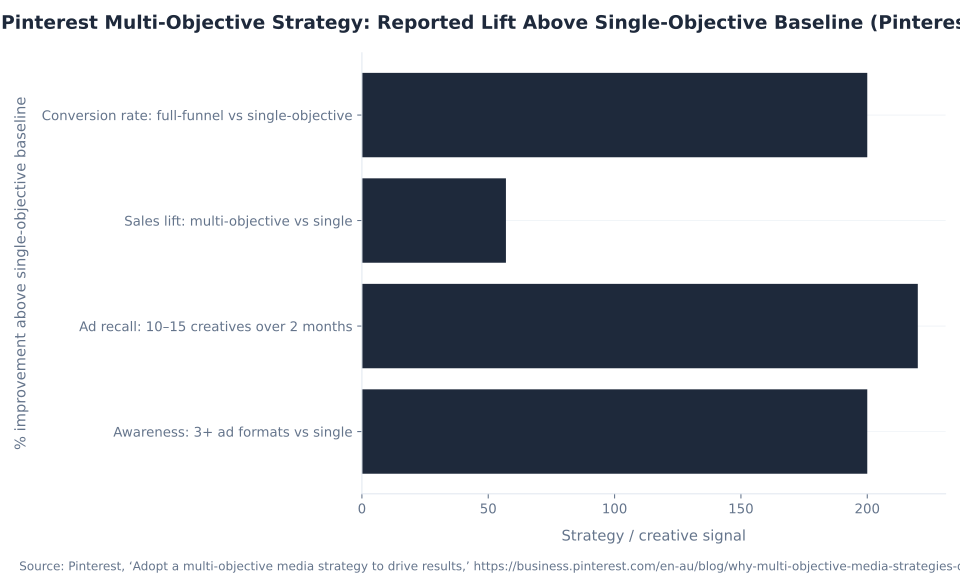
- Running all three funnel stages lifts conversion rate ~3× vs single-objective. Pinterest's 2023 Brand Lift Meta Analysis found up to 57% improvement in sales lift when brands run multiple objectives across the funnel.
The sections below walk through each objective. For cost ranges by vertical, see how much Pinterest ads cost.
Pinterest Campaign Objectives: Key Numbers at a Glance
These are the platform-level and benchmark figures that frame objective selection for a visual-discovery DTC brand. Every number traces to a named source in the methodology section.
Platform Reach (Q1 2026)
631M
Monthly active Pinners — Pinterest Q1 2026 earnings
Unbranded Search Share
96%
Of Pinterest searches carry no brand preference — Pinterest-reported
Full-Funnel CVR Lift
3×
Conversion rate when all 3 funnel stages run vs single-objective — Pinterest 2023 Brand Lift Meta Analysis
Pinterest Avg CPM (2025 YTD)
$4.67
Brand Awareness CPM average vs Meta's $8.19 — Gupta Media 2025
The 96% unbranded search share is the structural reason Catalog Sales outperforms brand-keyword campaigns for product discovery on Pinterest: your products surface against intent that has no brand preference attached. The 3× conversion-rate lift from running all three funnel stages comes from Pinterest's own 2023 Brand Lift Meta Analysis, which studied about 120,000 Pinners across eight industries over two years. (Pinterest, “Adopt a multi-objective media strategy”)
Four Pinterest Campaign Objective Misconceptions — Corrected
These four misconceptions are the most common errors in Pinterest advertising tutorials. Each is a factual error with a declarative correction backed by Pinterest, “Select a campaign objective”.
Misconception 1: Pinterest has a separate Traffic objective
False. Pinterest does not have a standalone Traffic campaign objective. The current Ads Manager objective list is Brand Awareness, Video Completion, Consideration, Conversions, and Catalog Sales — five objectives, no more. (Pinterest, “Select a campaign objective”) The intent that older tutorials label “Traffic” — driving clicks to your website — now lives inside Consideration. Set the optimization goal to “Pin clicks” for on-platform engagement or “outbound clicks” for site traffic. Outbound-click optimization within Consideration requires Performance+ bidding. Any 2023-or-earlier tutorial that says “pick Traffic” is stale; the modern equivalent is Consideration with outbound clicks as the optimization goal.
Misconception 2: You can pick any objective and optimize later
False. The objective you select on the first screen of the campaign builder locks your bid type for the entire campaign. Brand Awareness campaigns bill on CPM and cannot be converted to CPC or CPA billing. Consideration campaigns bill on CPC and cannot be converted to CPM. Conversions and Catalog Sales bill on CPA and support Performance+ ROAS bidding, which is unavailable to the other objectives entirely. (Pinterest, “Set and edit your bid”) Selecting the wrong objective means building a new campaign — there is no in-flight objective switch in Ads Manager. The decision is front-loaded and permanent.
Misconception 3: Catalog Sales is the same as Conversions with products
False. Conversions and Catalog Sales are two distinct objectives with different prerequisites and different optimization behaviors. Conversions optimizes for on-site actions — checkout, sign-up, add-to-cart — tracked via the Pinterest Tag or Conversions API (CAPI). It works with or without a product catalog; the conversion event fires based on site behavior. Catalog Sales requires an uploaded product catalog and surfaces specific products from your feed dynamically to people searching Pinterest for inspiration. Because 96% of searches on Pinterest are unbranded, Catalog Sales is particularly effective for DTC brands competing at the discovery stage. A brand without a product feed cannot run Catalog Sales; a brand with one often achieves better lower-funnel efficiency from Catalog Sales than from a generic Conversions campaign.
Misconception 4: Video Completion is just Brand Awareness for video
False. Brand Awareness and Video Completion are two separate objectives with different optimization signals. Brand Awareness optimizes for reach and impressions regardless of creative format — static, carousel, or video — billing on CPM. Video Completion optimizes specifically for views that reach the 95% completion marker, and it is the only Pinterest objective that runs exclusively on Performance+ bidding with no custom bid available. (Pinterest, “Select a campaign objective”) Use Brand Awareness when impression volume is the goal; use Video Completion when the measurement of success is whether the audience absorbed the entire story. Do not conflate Video Completion's 95% marker with a CPV (cost-per-view) bid, which pays per 2-second view — a different and substantially lower threshold used in other contexts.
The Five Pinterest Campaign Objectives — 2026 Reference Table
Table 1 is the load-bearing reference for this entire pillar. Each row maps one of the five current objectives to its optimization goal, bid type, and funnel stage as listed on Pinterest, “Select a campaign objective”. The bid type column is not advisory — it is the bid type Pinterest locks you into when you select that objective on the campaign builder's first screen.
| Objective | Optimizes for | Bid type | Funnel stage |
|---|---|---|---|
| Brand Awareness | Discovery and reach — getting people to find your brand, products, or services | Performance+ or custom CPM | Top (awareness) |
| Video Completion | Completed video views at the 95% completion marker | Performance+ only — no custom bid available | Top (awareness, video-led) |
| Consideration (absorbs “Traffic”) | Pin clicks or outbound clicks to your site | Performance+ or custom CPC (Performance+ required for outbound-click optimization) | Middle (consideration / traffic) |
| Conversions | On-site actions: checkout, sign-up, add-to-cart (via Pinterest Tag / CAPI) | Performance+ or custom CPA; Performance+ ROAS available | Bottom (conversion) |
| Catalog Sales | Surfacing catalog products to inspiration-seeking searchers (requires an uploaded catalog) | Performance+ or custom CPA; Performance+ ROAS available | Bottom (conversion / shopping) |
Sources: Pinterest, “Select a campaign objective” (five objectives, optimization goals, bid types, Video Completion Performance+-only, Consideration requires Performance+ for outbound clicks); Pinterest, “Set and edit your bid” (custom vs Performance+ bids). Verify objective list in Ads Manager at publish — Pinterest updates this page without notice. Do not add a Traffic or App installs row.
The most important column is Bid type. Once you select Brand Awareness, Pinterest bills you on CPM — cost per thousand impressions. Once you select Consideration, Pinterest bills you on CPC — cost per click. Once you select Conversions or Catalog Sales, Pinterest bills you on CPA — cost per conversion action. These are not settings you choose independently; they are locked by the objective. The only flexibility is whether to use Performance+ automated bidding or set a custom bid ceiling within that type — except for Video Completion, where Performance+ is the only option.
The funnel stage column reflects standard practitioner framing, not verbatim Pinterest labels. Brand Awareness and Video Completion sit at the top of the funnel; Consideration sits in the middle; Conversions and Catalog Sales anchor the bottom. Running a campaign at only one stage is the most common budget-allocation mistake on Pinterest. Running all three stages lifts conversion rate about 3× compared with single-objective exposure. (Pinterest, “Adopt a multi-objective media strategy”) See Table 4 for full-funnel budget guidance.
Which Pinterest Campaign Objective for Which Goal
Table 2 maps six common business goals to the correct objective. The right-hand column explains the mechanical reason each pairing works — not just naming the objective, but connecting the business goal to the optimization signal Pinterest runs on your behalf.
| Your primary goal | Choose this objective | Why it fits |
|---|---|---|
| Maximize reach and brand familiarity across new audiences | Brand Awareness | Bills on CPM; optimizes for low-cost impressions, not clicks or conversions |
| Tell a full video story: product demo, recipe, reveal, or transformation | Video Completion | Optimizes for viewers who reach the 95% marker — the audience that absorbed the complete message |
| Drive site traffic or Pin clicks — this is where the old “Traffic” intent now lives | Consideration | CPC billing; optimize for Pin clicks (on-platform) or outbound clicks (to your site) |
| Drive a specific on-site action: purchase, sign-up, add-to-cart | Conversions | Optimizes against Pinterest Tag / CAPI events; CPA bid; supports Performance+ ROAS |
| Sell products from a feed to searchers discovering your category | Catalog Sales | Dynamic product ads from your catalog; CPA bid; supports Performance+ ROAS (requires an uploaded catalog) |
| Grow the whole funnel simultaneously | Run two or more objectives together | Pinterest reports full-funnel exposure lifts conversion rate ~3× and sales lift up to 57% vs single-objective |
Sources: Pinterest, “Select a campaign objective” (objective goals and bid types); Pinterest, “Adopt a multi-objective media strategy” (full-funnel 3× conversion rate / 57% sales lift, 2023 Brand Lift Meta Analysis). Funnel-stage assignments are a practitioner framing layered on Pinterest's optimization goals, not verbatim Pinterest labels.
The sixth row — “run two or more objectives together” — is not a hedge. It is Pinterest's documented best-practice. The platform's 2023 Brand Lift Meta Analysis found that brands exposing audiences across all three funnel stages (awareness, consideration, and conversion) achieved conversion rates about 3× higher than single-objective campaigns, and up to 57% improvement in sales lift compared with single-objective approaches. (Pinterest, “Adopt a multi-objective media strategy”) The objective picker is not a single toggle; it is a portfolio decision.
For full-funnel budget allocation guidance, see Table 4 below. For measuring the right metric against each objective, see Pinterest ads metrics & ROAS.
Pinterest Multi-Objective Strategy: Reported Lift Above Single-Objective Baseline (Pinterest 2023 Brand Lift Meta Analysis)
Pinterest Objectives, Bid Types, and Performance+ Support
Table 3 answers the most error-prone area of Pinterest campaign setup: which Performance+ capability is available for which objective, and how the three Performance+ tiers differ from each other.
| Objective | Custom bid? | Performance+ bidding? | Performance+ campaign? | Performance+ ROAS bid? |
|---|---|---|---|---|
| Brand Awareness | Yes — CPM | Yes | No | No |
| Video Completion | No — Performance+ only | Yes (required) | No | No |
| Consideration | Yes — CPC (Performance+ required for outbound clicks) | Yes | Yes | No |
| Conversions | Yes — CPA | Yes | Yes | Yes |
| Catalog Sales | Yes — CPA | Yes | Yes | Yes |
Sources: Pinterest, “Select a campaign objective” (custom bid types; Video Completion Performance+-only); Pinterest, “Pinterest Performance+” (Performance+ campaigns available for Consideration, Conversions, Catalog Sales; Performance+ ROAS bidding only on Conversions and Catalog Sales; requires tracked Checkout events with valid checkout values); Pinterest, “Set and edit your bid”. Three Performance+ tiers are distinct — see copy below. Confirm availability per account and region at publish.
Three distinct Performance+ tiers — do not conflate them: (a) Performance+ bidding = AI-managed bid for lowest cost per outcome (broad availability). (b) Performance+ campaign = AI automation of targeting, bidding, and budget together (Consideration, Conversions, Catalog Sales only). (c) Performance+ ROAS bidding = value-optimized bid predicting checkout revenue per impression (Conversions and Catalog Sales only; requires tracked Checkout events with valid checkout values).
The distinction between (b) and (c) matters for lower-funnel campaigns. A Performance+ campaign for Conversions automates your targeting and bidding but still bills on a standard CPA. Performance+ ROAS bidding — the highest-automation tier — predicts the revenue value of each impression and bids to maximize return on ad spend rather than raw conversion count. To unlock ROAS bidding, you must pass valid checkout values through the Pinterest Tag or Conversions API alongside the Checkout event. (Pinterest, “Pinterest Performance+”)
Never call Pinterest's suite “Performance Max” — that is a Google product name. Pinterest's suite is explicitly branded Pinterest Performance+. The practical threshold for enabling Performance+ Conversions or Catalog Sales campaigns: 50 or more weekly conversions. If your campaign generates fewer than 50 conversions per week, start with Performance+ Consideration to build the event signal, then graduate to Performance+ Conversions or Catalog Sales once volume is sufficient. (Pinterest, “Make Performance+ campaigns your new default”)
Pinterest CPA by Industry Vertical: Conversions + Catalog Sales Objectives (AdBacklog 2025, Vendor Estimates)

Full-Funnel Pinterest Strategy: Running Multiple Objectives Together
Table 4 presents Pinterest's own published data on what happens when brands run multiple objectives simultaneously rather than a single one. The 3× conversion-rate lift and 57% sales-lift figures come from Pinterest's 2023 Brand Lift Meta Analysis — a study of about 120,000 Pinners across eight industries over two years. (Pinterest, “Adopt a multi-objective media strategy”)
| Lever | Pinterest-reported result | Source |
|---|---|---|
| Run all three funnel stages | Conversion rate ~3× higher than single-objective exposure | Pinterest (2023 Brand Lift Meta Analysis) |
| Adopt multiple objectives | Up to ~57% improvement in sales lift vs single-objective | Pinterest (2023 Brand Lift Meta Analysis) |
| 10–15 creative executions over 2 months | 3.2× increase in ad recall | Pinterest (2023 Brand Lift Meta Analysis) |
| Run 3+ ad formats vs one | 3× lift in awareness | Pinterest (2023 Brand Lift Meta Analysis) |
| Budget split recommendation | 50–60% video, 40–50% static + carousel across the funnel | |
| Flight length | Campaigns running 7+ weeks show the strongest awareness and purchase-intent impact | |
| Performance+ conversion volume threshold | 50+ weekly conversions → activate Performance+ Conversions / Catalog Sales; under 50 → start with Performance+ Consideration to build event signal | Pinterest (Performance+ setup guidance) |
Sources: Pinterest, “Adopt a multi-objective media strategy” (3× conversion rate, 57% sales lift, 3.2× ad recall, 3× awareness, 50–60% video budget split, 7+ week flights — citing 2023 Brand Lift Meta Analysis, ~120,000 Pinners, 8 industries, 2 years); Pinterest, “Make Performance+ campaigns your new default” (50+ weekly conversion threshold). All figures are Pinterest-published from the 2023 Brand Lift Meta Analysis blog post. Source year is 2023; attribute to Pinterest and re-confirm at publish. These are Pinterest-reported study results, NOT MB Adv Agency client data. The 50–60% video budget split is Pinterest's recommendation, not a universal rule.
The 50+ weekly conversion threshold (row seven) is the practical gate for activating Performance+ Conversions or Catalog Sales campaigns. Below that volume, Pinterest's machine-learning model lacks the signal to optimize effectively for on-site actions. The recommended path for new accounts: start with Performance+ Consideration to build event volume, graduate to Performance+ Conversions once weekly conversions cross 50, and add Catalog Sales once a product catalog is uploaded and event-tracking is confirmed via both the Pinterest Tag and the Conversions API.
For fashion PPC and home decor PPC brands — two of Pinterest's strongest organic categories — a full-funnel stack typically runs Brand Awareness through the discovery phase (new collection launches, seasonal campaigns), Consideration to capture mid-funnel inspiration-seekers already engaging with category content, and Catalog Sales anchoring the lower funnel against the 96% of unbranded searches. The 7+ week flight guidance reinforces that Pinterest's attribution model rewards sustained presence over short bursts.
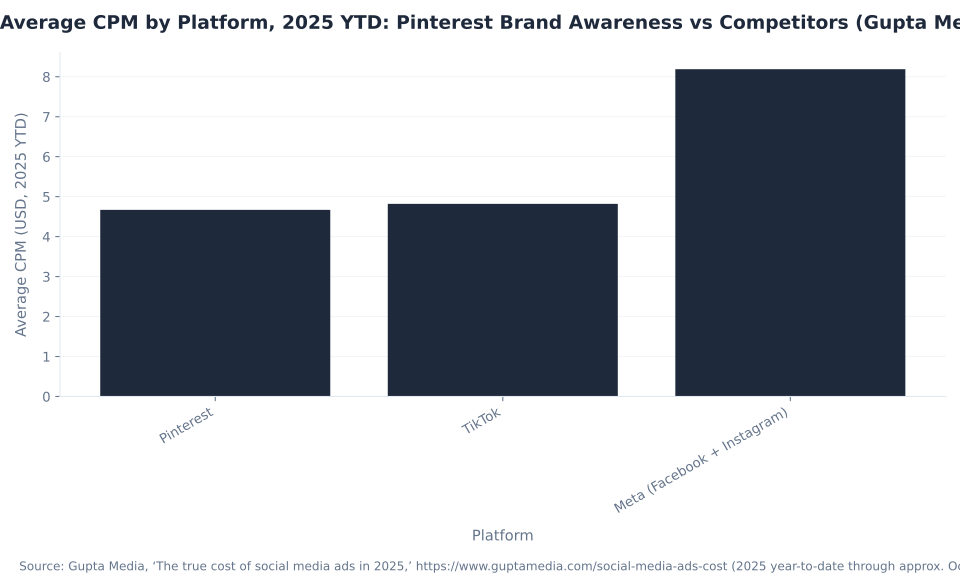
Average CPM by Platform, 2025 YTD: Pinterest Brand Awareness vs Competitors (Gupta Media)
Pinterest Ad Cost Benchmarks by Objective and Vertical (2025)
The objective you choose dictates the bid type: Consideration = CPC, Conversions and Catalog Sales = CPA, Brand Awareness = CPM. Tables 5 and 6 give industry benchmarks for CPC and CPA objectives from AdBacklog's 2025 Pinterest benchmarking report — the most granular publicly available vendor data for Pinterest-specific costs. For CPM benchmarks (Brand Awareness), see Table 7 and the cross-platform comparison below.
Table 5: CPC Benchmarks — Consideration Objective
| Industry vertical | CPC range (2025) | CPC midpoint | Source |
|---|---|---|---|
| Retail / e-commerce | $0.50–$0.70 | $0.60 | AdBacklog 2025 |
| Beauty / skincare | $0.40–$0.60 | $0.50 | AdBacklog 2025 |
| Home décor / DIY | $0.50–$0.80 | $0.65 | AdBacklog 2025 |
| Food / CPG | $0.30–$0.60 | $0.45 | AdBacklog 2025 |
| Finance | $0.80–$1.50 | $1.15 | AdBacklog 2025 |
Source: AdBacklog, “Pinterest Ads Benchmarks Per Industry (2025)”. CPC applies to the Consideration objective (CPC-billed). Vendor estimates — actual CPC varies significantly by creative quality, audience, bid strategy, and seasonality. Not MB Adv Agency client data. Re-verify at publish.
The CPC range across most verticals ($0.30–$0.80) reflects Pinterest's relatively low click-auction competition versus Meta and Google. AdRoll characterizes Pinterest as offering strong per-click value vs Meta platforms, noting that Pinterest CPC is typically well below Facebook and Instagram on a per-click basis. (AdRoll, “Social Media Ads Cost Breakdown”) This makes Consideration campaigns particularly efficient for beauty products PPC, food & beverage PPC, and food & grocery DTC PPC brands that want to build mid-funnel traffic at lower cost per visit than equivalent audiences on Meta.
Table 6: CPA Benchmarks — Conversions and Catalog Sales Objectives
| Industry vertical | CPA range (2025) | CPA midpoint | Source |
|---|---|---|---|
| Retail / e-commerce | $7–$8 | $7.50 | AdBacklog 2025 |
| Beauty / skincare | $7–$10 | $8.50 | AdBacklog 2025 |
| Home décor / DIY | $10+ (big-ticket ceiling; lower bound stated) | $10.00 (lower bound) | AdBacklog 2025 |
| Food / CPG | $5–$8 | $6.50 | AdBacklog 2025 |
| Finance (leads / sign-ups) | $12–$15 | $13.50 | AdBacklog 2025 |
Source: AdBacklog, “Pinterest Ads Benchmarks Per Industry (2025)”. CPA applies to Conversions and Catalog Sales objectives (CPA-billed). Home décor uses the lower bound ($10) since AdBacklog states “$10+” without a ceiling — actual CPA for big-ticket items can be considerably higher. WebFX also estimates a broader Pinterest CPC range of $0.50–$1.50 and conversion rates of 2–4% (up to 5–8% for luxury / home goods) across the platform (AdRoll, “Social Media Ads Cost Breakdown” for directional context). Not MB Adv Agency client data. Re-verify at publish.
CPA figures for home décor and big-ticket categories use the lower bound because AdBacklog's stated “$10+” has no ceiling — custom furniture or high-end appliances carry significantly higher CPAs. For home decor PPC and food & grocery DTC PPC brands, the $7–$10 midpoint range (retail / beauty) provides a reasonable planning baseline, with actual CPA shifting based on product price point, catalog quality, creative performance, and whether Performance+ ROAS bidding is active. See how much Pinterest ads cost for a deeper cost breakdown across bid types.
Pinterest Brand Awareness CPM vs Competing Platforms (2025 YTD)
Pinterest's Brand Awareness objective bills on CPM. At $4.67 average CPM in 2025 — 43% below Meta's combined average of $8.19 — it delivers more cost-efficient top-of-funnel reach for visual-discovery brands than equivalent audiences on Facebook or Instagram. (Gupta Media, “The true cost of social media ads in 2025”)
| Platform | Average CPM (USD, 2025 YTD) | Notes |
|---|---|---|
| $4.67 | Brand Awareness objective (CPM-billed); full range $2–$10 depending on vertical and audience | |
| TikTok | $4.82 | For context; TikTok CPM varies significantly by placement and creative type |
| Meta (Facebook + Instagram) | $8.19 | Combined Meta average; individual platform CPMs vary |
Source: Gupta Media, “The true cost of social media ads in 2025” (2025 YTD averages through about October 2025). Vendor estimates — not official Pinterest rate cards. Pinterest CPM varies significantly by vertical, audience, creative, and season; the full documented range is $2–$10 (AdBacklog / Trackbee). Not MB Adv Agency client data. Re-verify Gupta Media figures at publish; they update these benchmarks periodically.
The CPM efficiency gap between Pinterest and Meta is structural, not cyclical. Pinterest's audience skews toward high-intent discovery behavior: users actively searching and saving content related to upcoming purchases, not passively scrolling a social feed. That intent context means fewer impressions are wasted on uninterested audiences, and the cost of reaching a planning-mode shopper is lower. For fashion PPC, home decor PPC, and subscription boxes PPC brands running Brand Awareness campaigns, the CPM advantage compounds when creative quality aligns with the platform's visual-first discovery behavior.
MB Adv Agency has observed that brands allocating top-of-funnel budget across both Pinterest Brand Awareness and mid-funnel Consideration campaigns — rather than consolidating all spend into Conversions — build the audience pool that makes lower-funnel Performance+ campaigns more effective over time. The platform's own guidance (50–60% of budget to video across the funnel) reflects the same principle: reach efficiency at the top creates the event signal the bottom needs.
Pinterest Performance+ Impact: What the Data Shows
Performance+ campaigns are available for three objectives: Consideration, Conversions, and Catalog Sales. Table 8 presents Pinterest's own published impact figures for Performance+ campaigns. Source year and study methodology are not disclosed on Pinterest's help pages — present all figures as Pinterest-attributed directional findings, not guaranteed benchmarks.
| Metric | Figure | Source note |
|---|---|---|
| Share of lower-funnel revenue now flowing through Performance+ | ~30% | Pinterest-reported share (source year unspecified) |
| Checkout revenue lift — Performance+ creative vs standard | +19% | Pinterest internal testing — methodology not disclosed |
| Conversion rate lift — Performance+ AI-generated backgrounds (testing) | +11% | Pinterest internal testing |
| CTR lift — Walgreens early test, Performance+ creative vs white backgrounds | +55% | Pinterest-attributed brand case; source: Pinterest, “Make Performance+ campaigns your new default” |
| CPC reduction — Walgreens early test (same source) | −13% | Pinterest-attributed brand case |
| Lower-funnel spend growth rate — Performance+ adopters vs non-adopters | ~2× faster | Pinterest-reported adoption metric |
Sources: Pinterest, “Pinterest Performance+”; Pinterest, “Make Performance+ campaigns your new default”. All figures are Pinterest-attributed. Source year and study methodology are not disclosed on Pinterest's help or blog pages — attribute as “Pinterest reports” and flag the absence of date. Performance+ campaigns (targeting + bidding automation) are available for Consideration, Conversions, and Catalog Sales. Performance+ ROAS bidding is available for Conversions and Catalog Sales only. Not MB Adv Agency client data.
The 50+ weekly conversion rule: if your Conversions or Catalog Sales campaign generates fewer than 50 conversions per week, Performance+ ROAS bidding cannot optimize effectively. Start with Performance+ Consideration to build event volume, then graduate. (Pinterest, “Make Performance+ campaigns your new default”)
For beauty products PPC and subscription boxes PPC brands with catalog-driven lower-funnel campaigns, the +19% checkout revenue lift and +55% CTR figures (Walgreens brand case) represent the ceiling of what Performance+ creative automation produces in favorable conditions — not a guaranteed floor. The practical argument for testing Performance+ Catalog Sales first is that it automates creative variation, targeting, and bidding simultaneously, compressing the time to identify what combination maximizes ROAS for your specific catalog and audience mix.
Pinterest Performance+ Impact Metrics: Consideration, Conversions & Catalog Sales Objectives (Pinterest-Attributed)

Pinterest Advertising Strategy
Running Pinterest ads for fashion, home decor, or beauty? Objective selection is just the start.
The objective you choose locks your bid type and automation options. The brands that get the most from Pinterest pair the right objective stack with strong creative, accurate conversion tracking, and a product catalog that covers the 96% of unbranded searches where most discovery happens. See how MB Adv Agency approaches full-funnel Pinterest strategy for fashion, home decor, beauty, and jewelry brands.
Explore fashion PPC services →How Pinterest Performance+ Changes by Objective
Pinterest Performance+ is not a single feature — it is three distinct capabilities that apply selectively depending on which objective you have chosen. Understanding which tier is available for your objective determines the automation level you can activate and the bid strategy you can target. (Pinterest Performance+)
The first tier, Performance+ bidding, is available across most objectives and is the simplest automation: Pinterest's AI manages your bid in real time to achieve the most outcomes at the lowest cost within your budget. You set a budget; Performance+ bidding decides the per-impression or per-click price. This tier is compatible with Brand Awareness (CPM), Consideration (CPC), Conversions (CPA), and Catalog Sales (CPA).
The second tier, Performance+ campaign, automates targeting and budget allocation alongside bidding — a higher-automation mode available only for Consideration, Conversions, and Catalog Sales. In a Performance+ campaign, Pinterest selects audiences, manages creative placements, and allocates budget across ad groups automatically. This is the mode that delivers the largest structural efficiency gains but requires more event data to optimize effectively. Performance+ campaigns for Conversions and Catalog Sales need 50+ weekly conversions to reach full optimization. (Pinterest, “Make Performance+ your new default”)
Direct Links are the default on eligible campaigns (Consideration, Conversions, Catalog Sales for static, video, carousel, and Idea ads). Direct Links send users straight to your website without the intermediate Pin detail page. Pinterest-reported lift from Direct Links: Consideration campaigns saw +96% clicks-to-site and −38% cost-per-outbound-click; Catalog Sales and Conversions saw +68% clicks-to-site and +26% click-based conversions. Direct Links are enabled by default and cannot be disabled on eligible campaign types.
The third and most powerful tier, Performance+ ROAS bidding, predicts the checkout revenue value of each impression and bids to maximize return on ad spend rather than raw conversion count. This tier is exclusive to Conversions and Catalog Sales objectives. To activate it, you must track Checkout events via the Pinterest Tag and pass valid checkout values through the Conversions API (CAPI) with enhanced match for deduplication. Without accurate checkout values, Pinterest cannot compute a ROAS target to bid toward.
MB Adv Agency advises brands to treat the three Performance+ tiers as a progression, not a menu: start with Performance+ bidding at whatever objective fits the business goal, activate Performance+ campaigns once the account generates sufficient event volume, and unlock Performance+ ROAS bidding only after Checkout tracking and CAPI integration are confirmed and deduplication is active. Skipping to ROAS bidding without confirmed Checkout event quality typically results in inflated ROAS numbers that do not reflect actual revenue, because the model optimizes for the signal it receives — which must be accurate. For targeting options that work alongside Performance+ campaigns, see Pinterest ads targeting.
Brand Awareness Campaigns on Pinterest
Brand Awareness is Pinterest's top-of-funnel objective. It optimizes for reach and discovery — the number of unique Pinners who see your ad — and bills on CPM. The optimization signal is not a click or a conversion; it is an impression delivered to an audience likely to be interested in your brand or category.
At a 2025 YTD average CPM of $4.67 (Gupta Media), Brand Awareness is the most cost-efficient objective for building awareness at scale on Pinterest. For fashion PPC, home decor PPC, and jewelry PPC brands entering a new market or launching a new product line, Brand Awareness campaigns running 7+ weeks generate the strongest purchase-intent lift, per Pinterest's 2023 Brand Lift Meta Analysis. The recommended creative format mix for awareness campaigns is 50–60% video to capture attention, with static pins supplementing reach. Pair with Pinterest ad formats to select creatives that work at the top of the funnel.
Video Completion Campaigns on Pinterest
Video Completion is the objective most advertisers skip — and the one whose optimization signal is the most distinctive. It targets views that reach the 95% completion marker, meaning the audience absorbed the full message. This is the correct objective when the product is the demo.
For food brands whose creative is a recipe, beauty brands whose creative is a skin-treatment application, or home brands whose creative is a room transformation reveal, Video Completion ensures Pinterest optimizes for the audience who watched to the end — not just the audience who saw the first frame. Video Completion is Performance+-only: there is no custom bid available, and no manual CPV setting. Pinterest manages the bid entirely. For beauty products PPC and food & beverage PPC brands, this objective pairs naturally with Idea ads featuring step-by-step content. Do not conflate the 95% completion marker with a CPV bid, which pays per 2-second view and applies in different contexts.
Consideration Campaigns on Pinterest — and the Traffic Correction
Consideration is the middle-funnel objective on Pinterest, and it is also where the most enduring naming confusion lives. There is no standalone Traffic objective. The intent to send people to your website now lives inside Consideration, which optimizes for Pin clicks or outbound clicks.
When you select Consideration, you choose between two optimization goals: Pin clicks (users clicking the Pin itself, staying on Pinterest) and outbound clicks (users clicking through to your website). Outbound-click optimization requires Performance+ bidding. Both goals bill on CPC. The distinction matters for campaign goals: if you want people engaging with your content on Pinterest and saving it for later discovery, optimize for Pin clicks. If you want measurable site traffic and landing-page visits attributable to Pinterest ads, optimize for outbound clicks with Performance+ active.
MB Adv Agency has found that Consideration campaigns work most effectively as a bridge between awareness exposure and lower-funnel conversion intent — particularly for subscription boxes PPC and organic & natural products PPC brands where the purchase decision cycle is longer and the audience needs multiple touchpoints before converting. For targeting these mid-funnel audiences precisely, see Pinterest ads targeting.
Conversions Campaigns on Pinterest
The Conversions objective optimizes for on-site actions tracked by the Pinterest Tag and Conversions API — checkout, sign-up, add-to-cart, or any custom event you define. It bills on CPA and is the correct lower-funnel objective when you want Pinterest to find the people most likely to complete an action on your website, not just view or click.
Conversions campaigns support both custom CPA bidding and Performance+ CPA bidding. The highest-automation tier — Performance+ ROAS bidding — is also available and predicts checkout revenue value per impression. Accurate ROAS bidding requires the Pinterest Tag, CAPI integration, enhanced match for deduplication, and valid checkout values passed with each conversion event. The 50+ weekly conversion threshold applies: below that volume, standard CPA bidding or Performance+ Consideration produces better results while event volume builds. For beauty products PPC and skincare PPC brands with strong repeat-purchase catalogs, Conversions paired with Performance+ ROAS is the recommended lower-funnel configuration once event tracking is confirmed.
Catalog Sales Campaigns on Pinterest
Catalog Sales is the lower-funnel objective for brands with a product feed. It surfaces specific products from your uploaded catalog dynamically to people searching Pinterest for inspiration in your category — and it does so against the 96% of Pinterest searches that carry no brand preference.
This objective requires an uploaded and approved product catalog. Pinterest generates the ad creative automatically from your catalog data — product image, title, price, and availability — and matches it to relevant searches in real time. The result is that a home goods brand's catalog appears when someone searches “modern dining table” without specifying a brand. Catalog Sales bills on CPA and supports Performance+ ROAS bidding on the same conditions as Conversions. For the full catalog setup and shopping ad mechanics, see Pinterest shopping ads & catalogs. For fashion PPC, home decor PPC, and jewelry PPC brands, Catalog Sales anchoring the lower funnel while Brand Awareness runs at the top is the full-funnel configuration Pinterest's own data supports most strongly.
Frequently Asked Questions: Pinterest Campaign Objectives
What are the five Pinterest campaign objectives?
Pinterest currently lists five campaign objectives in Ads Manager: Brand Awareness, Video Completion, Consideration, Conversions, and Catalog Sales. Brand Awareness optimizes for discovery and reach, billing on CPM. Video Completion optimizes for completed video views at the 95% completion marker and runs on Performance+ bidding only — no custom bid is available for this objective. Consideration optimizes for Pin clicks or outbound clicks to your website on a CPC bid; this objective absorbs the former “Traffic” intent — there is no standalone Traffic objective on Pinterest. Conversions optimizes for on-site actions — checkout, sign-up, add-to-cart — tracked via the Pinterest Tag or Conversions API, billing on CPA. Catalog Sales dynamically surfaces products from an uploaded catalog to people searching Pinterest for inspiration, also billing on CPA. Both Conversions and Catalog Sales support Performance+ ROAS bidding. This is the complete current list — Pinterest does not offer a standalone Traffic or App installs objective. (Pinterest, “Select a campaign objective”)
Is there a Pinterest Traffic campaign objective?
No. Pinterest does not have a standalone Traffic campaign objective. The current Ads Manager objective list is Brand Awareness, Video Completion, Consideration, Conversions, and Catalog Sales — five objectives, none of which is labeled Traffic. (Pinterest, “Select a campaign objective”) The intent that older tutorials labeled “Traffic” — driving clicks to your website — now lives inside the Consideration objective. Within Consideration, set the optimization goal to “outbound clicks” to direct users to your website; outbound-click optimization requires Performance+ bidding. Set it to “Pin clicks” for on-platform engagement. Tutorials published before 2025 that instruct advertisers to “pick Traffic” reflect a stale objective list. There is also no standalone App installs objective on the current self-serve list. Always verify the current objective list in your own Ads Manager account, as Pinterest updates the interface without notice.
What is the difference between the Pinterest Conversions and Catalog Sales objectives?
Both Conversions and Catalog Sales are lower-funnel objectives billing on CPA and both support Performance+ ROAS bidding, but they serve different use cases and have different prerequisites. The Conversions objective optimizes for on-site actions — checkout, sign-up, add-to-cart — tracked by the Pinterest Tag combined with the Conversions API (CAPI) with enhanced match for deduplication. It works with or without a product catalog and is the right choice when the conversion event is a form fill, service inquiry, or account sign-up. The Catalog Sales objective requires an uploaded product catalog. It surfaces specific products from your feed to people searching Pinterest for inspiration in your category. Because 96% of Pinterest searches are unbranded, Catalog Sales is particularly effective for DTC brands competing at the discovery stage. If you have a product catalog, Catalog Sales is typically the more efficient lower-funnel path; if you do not have a catalog, Conversions is the route.
Which Pinterest campaign objective should I choose?
Match your primary business goal to the objective that optimizes for it. If your goal is brand reach and discovery among new audiences, choose Brand Awareness (CPM billing). If your goal is delivering a complete video story — a product demo, recipe, transformation, or reveal — choose Video Completion (Performance+-only; optimizes for 95% completion). If your goal is sending people to your website or driving Pin clicks, choose Consideration (CPC billing; this is where “Traffic” intent now lives). If your goal is a specific on-site conversion such as purchase or sign-up, choose Conversions (CPA billing; requires Pinterest Tag or CAPI integration). If your goal is selling products from a catalog to people searching Pinterest for inspiration in your category, choose Catalog Sales (CPA billing; requires an uploaded product feed). The objective you pick locks your bid type. You cannot change it in-flight; you build a new campaign.
What is Pinterest Performance+ and which objectives support it?
Pinterest Performance+ is Pinterest's AI-powered ad automation suite, but the term covers three distinct capabilities. (a) Performance+ bidding — AI-managed bid for lowest cost per outcome — is available across most objectives. (b) Performance+ campaigns — full automation of targeting, bidding, and budget allocation — are available for Consideration, Conversions, and Catalog Sales only. (c) Performance+ ROAS bidding — value-optimized bid predicting checkout revenue — is available only for Conversions and Catalog Sales and requires tracked Checkout events with valid checkout values via the Pinterest Tag and CAPI. Pinterest reports that about 30% of lower-funnel revenue now flows through Performance+. The practical threshold: 50 or more weekly conversions to activate Performance+ Conversions or Catalog Sales; below that volume, start with Performance+ Consideration to build event signal. Never call it “Performance Max” — that is a Google product name. (Pinterest Performance+)
How much do Pinterest ads cost by objective type?
The bid type your objective locks you into determines the cost model. Brand Awareness bills on CPM: Pinterest's 2025 YTD average CPM is $4.67 (Gupta Media 2025), significantly below Meta's combined average of $8.19. For Consideration (CPC), industry benchmarks by vertical range from $0.30–$0.60 for food and CPG, $0.40–$0.60 for beauty and skincare, $0.50–$0.70 for retail and e-commerce, $0.50–$0.80 for home décor and DIY, and $0.80–$1.50 for finance (AdBacklog 2025). For Conversions and Catalog Sales (CPA), typical ranges are $7–$8 for retail and e-commerce, $7–$10 for beauty and skincare, $5–$8 for food and CPG, and $10+ for home décor and big-ticket categories. These are vendor-estimated ranges — actual costs shift with creative quality, audience targeting, bid strategy, and seasonality. For a full cost breakdown by objective and vertical, see how much Pinterest ads cost.
Not sure which objective fits your funnel?
Talk to our team about Pinterest strategy for your brand.
Choosing between Conversions and Catalog Sales, figuring out whether your event volume supports Performance+ ROAS bidding, or building a full-funnel objective stack — MB Adv Agency helps visual-discovery brands on Pinterest get the objective mix right before the first dollar of budget is committed.
Get in touch →Methodology and Sources
This pillar is based on four inputs: Pinterest's own help documentation (“Select a campaign objective,” “Set and edit your bid,” “Pinterest Performance+”); Pinterest's 2023 Brand Lift Meta Analysis published via the multi-objective media strategy blog post (~120,000 Pinners, 8 industries, 2 years); AdBacklog's 2025 Pinterest Ads Benchmarks Per Industry report for CPC and CPA ranges by vertical; and Gupta Media's 2025 YTD social media cost benchmark for cross-platform CPM comparison. All benchmark figures are vendor estimates and carry named attributions. No MB Adv Agency client metrics are cited — all MB Adv attributions are qualitative practitioner observations. Last updated and web-verified: June 2026. Reviewed by MB Adv Agency, June 2026.

As a Google Ads expert, I bring proven expertise in optimizing advertising campaigns to maximize ROI.
I specialize in sharing advanced strategies and targeted tips to refine Google Ads campaign management.
Committed to staying ahead of the latest trends and algorithms, I ensure that my clients receive cutting-edge solutions.
My passion for digital marketing and my ability to interpret data for strategic insights enable me to offer high-level consulting that aims to exceed expectations.
Google Partner Agency
We're a certified Google Partner Agency, which means we don’t guess — we optimize withGoogle’s full toolkit and insider support.
Your campaigns get pro-level execution, backed by real expertise (not theory).

4.9 out of 5 from 670+ reviews on Fiverr.
That’s not luck, that’s performance.
Highly recommend Matteo to set up your server side tracking. He has a deep understanding of e-commerce tracking and will go above and beyond to make sure everything is set up correctly and working 100%. If you are scaling your store this set up is non-negotiable in my opinion and there isn't many people who have this much knowledge or put the effort in to get it right. Thanks again!

avorodesign.com
I can only recommend Matteo! He was very patient, professional and very knowledgeable about GA4, Consent Mode v2, and GDPR compliance. Communication was clear, and the setup was done professionally and efficiently. Highly recommend him for anyone needing reliable tracking implementation.

www.natureiki.life
Matteo shines in the realm of online professionals. His work is not only deep in data but also complemented by his proactive communication and cooperation, setting a new standard for freelancers. If you want someone who truly exceeds expectations, look no further. Highly recommended!

www.omanbeverlysmyth.com
Exceptional Service Beyond Expectations - Outstanding Service Impeccable depth, flawless delivery, and exceptional language fluency—this service exceeded all expectations. Highly recommended. Matteo truly ROCKS!!!

ium-paris.com
Top-notch, always highly value working with Matteo. An absolute Google Ads Genius. This is approximately the 8th time I have hired him and he's helped us get 6-7 ROAS. We are excited in continuing to improve our lead flow. Hire this guy if you need Google Ads help. Thanks Matteo!

www.dleeventgroup.com
I finally found the guy who can setup server side tracking and all the ecosystem properly. I definitely recommend Matteo. He is very responsive, kind and wants to dig into things. He configured GA4, Meta, Google Ads, Outbrain and google consent v2 with Cookiebot. Thanks Matteo.

inomega.fr
MB Adv delivered exceptional work with outstanding professionalism and lots of patience, taking time to see effects of changes made and not just do the work and submit it. The proactive communication and video summaries of the work completed made working with Matteo a pleasure, as he consistently went above and beyond. Highly recommended for web analytics projects! We are already working on another project.

www.withnellsensors.co.uk
Working with Matteo on my Google Ads was a game-changer. He's not just a strategist, he's a true partner. He understood my goals and tailored a campaign that perfectly reached my target audience. I'm grateful for his expertise and dedication.
dccargo.com
Click-driven mind
with plastic-brick obsession.
We build Google Ads campaigns with the same mindset we use to build tiny brick worlds: strategy, patience, and zero tolerance for wasted pieces.
Data is our blueprint. Growth is the only acceptable outcome.