
Heading

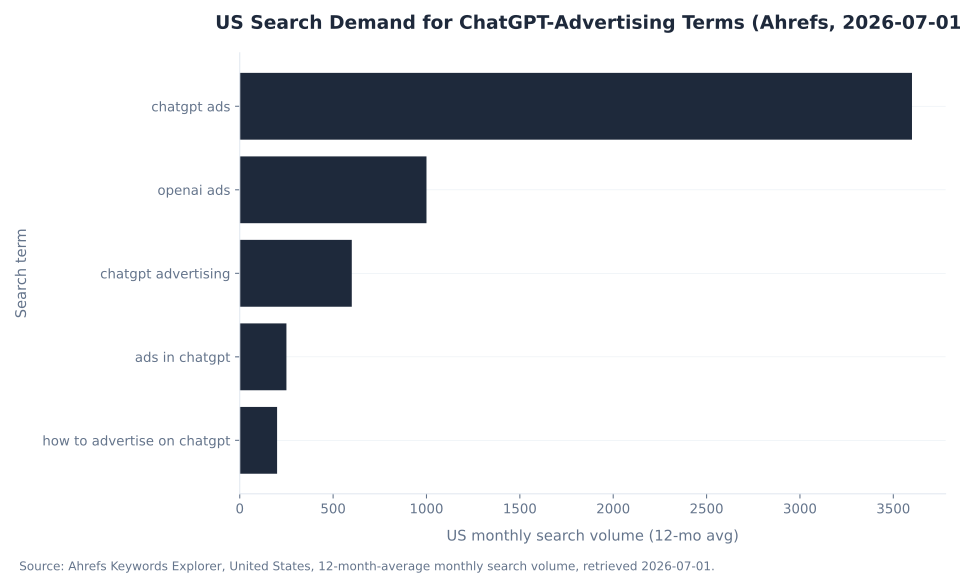
ChatGPT-ad search demand — Ahrefs, 2026-07-01
3,600
US searches a month for “chatgpt ads” (11,000 global) — real, active interest in a product that only went live on February 9, 2026. This page opens the machine behind that interest: how ChatGPT picks a sponsored card, where it lands, and whether an ad ever changes the answer.
Source: Ahrefs Keywords Explorer (US, 12-month average); retrieved 2026-07-01
How ChatGPT Picks an Ad, in One Pass: Match → Auction → Render
ChatGPT ads work in one pass with three moves: match, auction, render. The system reads the topic and intent of your current chat, matches that against ads whose advertiser context hints, landing page, ad title, and ad copy make them relevant, runs a relevance-weighted, second-price auction to pick the single best ad for that moment, and — only when a genuinely relevant sponsored match exists — renders one labeled “Sponsored” card at the bottom of the response, on the Free and Go tiers. That is the whole mechanism; everything else on this page traces back to it.
Two clarifications matter up front, because both are where intuition from other platforms misleads. This is not exact-match keyword bidding: the advertiser inputs are context hints, and OpenAI is explicit that they are not exact-match keywords and do not guarantee delivery. And it is not a plain highest-bidder auction: relevance is weighed against the bid, so a more relevant ad can beat a higher one. The Sponsored card this page dissects is the same unit introduced in what ChatGPT ads are — here we open the machine and show how the card gets chosen.
MB Adv Agency runs the paid-media programs — Google Ads, Meta, and the broader paid mix — that a new channel like ChatGPT Ads slots into, so the intuition our team carries over is simple: relevance can beat budget, the same principle behind Google’s Ad Rank and the discipline we bring to PPC campaign management. ChatGPT went live with ads for logged-in US adults on the Free and Go tiers on February 9, 2026, so this guide writes plainly about what OpenAI has confirmed and labels everything still in flux reported.
US Search Demand for ChatGPT-Advertising Terms (Ahrefs, 2026-07-01)
Key Takeaways
- ChatGPT ads work in three moves — match, auction, render. The system matches your current chat’s topic and intent to relevant ads, runs an auction, and shows one labeled Sponsored card only when a genuinely relevant match exists.
- Selection is contextual, not keyword bidding. Advertisers supply context hints — not exact-match keywords — and OpenAI states they do not guarantee delivery; the conversation’s context, not a keyword lookup, drives the match.
- The auction is relevance-weighted and second-price. A more relevant ad can beat a higher bid, and the winner’s charge is derived from the runner-up’s bid — the same intuition as Google’s Ad Rank.
- Ads run on separate systems from the chat model. OpenAI’s stated position is that advertisers cannot shape, rank, or alter ChatGPT’s answers — an advertiser wins the card beneath the response, never a mention inside it. Treat it as OpenAI’s stated, unaudited commitment.
- Ads show on Free and Go only, to logged-in adults. Plus, Pro, Business, Enterprise, and Edu are ad-free; advertisers receive only aggregate views and clicks, never your chats, memory, or personal identifiers.
Contextual Matching: How a Chat Becomes an Ad Opportunity
Contextual matching is the core mechanism, and OpenAI describes it in its own words: its ads system “primarily selects ads based on how relevant they are to the context and intent of the conversation,” and it starts “with what’s being discussed in your current chat thread” to match those topics to relevant ads. The starting point is the current conversation, not a stored profile of who you are.
For anyone arriving from Google Search, the crucial clarification is the advertiser input. Advertisers provide context hints — descriptions of the conversations, topics, and keywords where their product or service fits — and OpenAI states plainly that these “are not exact-match keywords and do not guarantee delivery.” Selection considers the context hints, the landing page, the ad title, and the ad copy, plus “basic context such as general location or language.” There is no keyword match-type system and no promise that a given term triggers a given ad; the system reads the whole chat’s context, not a lookup table of exact terms.
That makes ChatGPT selection closer to topic and placement matching than to audience lists. Unlike Meta’s audience targeting, which builds on interests and demographics, ChatGPT ad selection is driven by the live conversation. The full picture — context hints, geo, first-party audiences, and the list of targeting options that do not exist here — lives in ChatGPT ads targeting and audiences.
The Relevance-Weighted Second-Price Auction (Why It Isn’t Just Highest-Bidder)
Eligible ads compete in what OpenAI calls “a relevance-weighted, second-price auction to find the best ad for eligible conversations.” Two words carry the load. Relevance-weighted means an ad’s relevance to the conversation is factored into whether it wins, so a more relevant ad can beat a higher bid — the closest familiar analogy is Google’s Quality Score and Ad Rank, where quality can outweigh bid. Second-price means the winner’s charge is derived from the runner-up’s bid rather than their own.
There is one official price figure, and it is easy to misread. OpenAI publishes a recommended CPC max bid of $3 to $5 per click — a recommended maximum bid, not a charged per-click price. OpenAI has not published a public rate card, and there is no official CPM and no current minimum spend for self-serve. How the auction actually charges you — the CPM, CPC, and CPA buying models and the reported price movement — is the job of how much ChatGPT ads cost, not this page. The auction discipline itself will feel familiar to any team that runs Google auctions; it is the same logic behind Google Ads campaign types and the day-to-day work of PPC.
The table below lays out what the ad system actually weighs when it chooses a card — and where each input’s full treatment lives in the rest of this glossary.
| Input | What it is | Where the depth lives |
|---|---|---|
| Current chat topic & intent | The conversation the ad must be relevant to — the starting point of contextual matching | This page (contextual matching) |
| Advertiser context hints | Advertiser-described topics and keywords where a product fits — not exact-match keywords; no guaranteed delivery | Targeting & audiences |
| Landing page | The destination page, read for relevance to the conversation | Targeting · policies (per-ad review) |
| Ad title & ad copy | The creative text, factored into relevance | Ad formats |
| General location & language | “Basic context” — general (not precise) location; language | Targeting (geo: state/DMA/ZIP) |
| Relevance weighting (in the auction) | Relevance is weighed against the bid, so a more relevant ad can beat a higher one | Cost & bidding |
| Past chats, memory & prior ad interactions | Added only when ad personalization is on (the default) | Privacy & data |
Source: OpenAI Help Center wording (“Ads in ChatGPT” / “The Basics”), as reported by reputable outlets; retrieved 2026-07-01.
What Signals Feed Selection — and What Changes with Ad Personalization
The signal set has one switch that changes it: ad personalization, which is on by default. Some inputs are always used — the current chat thread’s topic and intent, the advertiser’s context hints, the landing page, the ad title and copy, and basic context such as general location and language. When ad personalization is on, OpenAI adds “your past chats and memory” and how you interact with ads. When it is off, “only the current chat thread” is used.
Whatever the signals, the guardrail is the same, and OpenAI states it in absolute terms: “Advertisers never receive your chats, chat history, memories, name, email, precise location, IP address, or sensitive information.” They get aggregate views and clicks, nothing more. You can turn ad personalization off and clear your ads data in settings at any time. The deeper data picture — the cookie and device-ID tension, marketing-partner sharing, and the opt-outs — is the subject of ChatGPT ads privacy and data.
| Signal | Personalization ON (default) | Personalization OFF |
|---|---|---|
| Current chat thread (topic & intent) | Used | Used |
| Context hints, landing page, ad title/copy | Used | Used |
| General location & language | Used | Used |
| Past chats & memory | Used | Not used |
| Prior ad interactions | Used | Not used |
| What advertisers receive | Aggregate views & clicks only — never chats, memory, name, email, precise location, or IP | Aggregate views & clicks only |
Source: OpenAI Help Center (“Ads in ChatGPT”) via TechCrunch; retrieved 2026-07-01.
Where a new channel fits your paid mix
New Surface, Same Auction Discipline
ChatGPT Ads is a new lane, but the auction logic — relevance weighed against bid — is the one MB Adv Agency runs every day on Google and Meta. Our team manages the paid programs a channel like this slots into: PPC services, campaign management, and, for software companies, SaaS PPC.
Talk to our team →Where and When a Sponsored Card Appears
Placement is deliberately narrow. A ChatGPT ad is a single sponsored unit at the bottom of a response, in-conversation, labeled “Sponsored” and visually separated from the answer. It shows only when the ad system finds a relevant sponsored product or service that matches the current chat — most responses carry no ad, and there is no fixed ad slot that has to be filled.
Who sees it is narrow too. Ads show to logged-in adults on the Free and Go ($8/mo) tiers; Plus, Pro, Business, Enterprise, and Edu are ad-free, and accounts with a meaningful probability of belonging to a minor are excluded. During the test, the ChatGPT Atlas browser and Sora do not carry ads. The creative specification — headline, description, image, destination link, and the enhanced units in early test — is the subject of ChatGPT ad formats. Advertisers can also layer geo targeting by US state, DMA, or ZIP on top of the contextual match.
| Dimension | What is confirmed |
|---|---|
| Placement | A single sponsored card at the bottom of a response, in-conversation, labeled “Sponsored” and visually separated |
| Trigger | Only when the ad system finds a relevant sponsored product or service that matches the current chat — no fixed ad slot |
| Tiers | Free and Go ($8/mo) only; Plus, Pro, Business, Enterprise, and Edu are ad-free |
| Audience | Logged-in US adults; accounts with a meaningful probability of belonging to a minor are excluded |
| Non-surfaces | The ChatGPT Atlas browser and Sora do not carry ads during the test |
Source: OpenAI Help Center via Euronews and Search Engine Journal; retrieved 2026-07-01.
Do the Ads Change the Answer? Ad–Answer Separation, Stated Honestly
The question that decides whether anyone trusts the product is whether an ad can change what ChatGPT tells you. OpenAI’s answer is one of its five stated advertising principles: “Ads do not influence ChatGPT’s answers. Ads run on separate systems from our chat model, and advertisers have no ability to shape, rank, or alter ChatGPT’s responses.”
State it precisely: this is OpenAI’s stated, unaudited position, not an independently verified fact. The whole point is that a reader has to decide how much to trust it — and OpenAI has a public stake in the claim, with CEO Sam Altman calling the idea of modifying model output for pay a “trust-destroying moment.” The mechanical corollary is the part an advertiser cares about: because the systems are separate and advertisers get only aggregate metrics, an advertiser cannot buy a mention inside the answer — only the labeled card beneath it. OpenAI frames the separation as one of five principles it published in its ad policies.
That separation is also why measurement is aggregate: advertisers see the aggregate performance metrics — views, clicks, and their own conversions — never the conversations behind them. The full policy framework, the five integrity principles, and OpenAI’s brand-safety exclusions live in ChatGPT ads policies and brand safety, and the genuine privacy tension in privacy and data. MB Adv Agency’s read is straightforward: a labeled card that cannot touch the answer is a cleaner separation than most ad formats offer, and the honest caveat is that the separation is a policy commitment rather than an audited guarantee.
Frequently Asked Questions: How ChatGPT Ads Work
Next in the ChatGPT Ads series
What You Actually Pay
You have the mechanism — now follow the money. The next pillar breaks down what ChatGPT ads cost: the CPM, CPC, and CPA buying models, the recommended $3 to $5 bid, and the reported price movement OpenAI has not officially confirmed.
Read the next guide →Methodology & Sources
This pillar is the mechanism anchor for the ChatGPT Ads glossary; the depth lives in the linked siblings. ChatGPT Ads is a five-month-old product — live since February 9, 2026 — so training data is unreliable and every load-bearing claim here is grounded in a dated, attributed source. OpenAI’s Help Center pages (“Ads in ChatGPT” and “The Basics”) return an automated-access block, so their wording is verified through reputable outlets that quote them — TechCrunch, Search Engine Journal, Euronews, AdTechRadar, Digiday, and PPC.land — and re-checked against the live pages. Search-demand figures are from Ahrefs Keywords Explorer (US, 12-month average, retrieved 2026-07-01). The answer-independence claim is OpenAI’s stated position and has not been independently audited; it is presented as OpenAI’s commitment, quoted exactly, with the epistemics labeled. No mbadv client metrics appear in this article — MB Adv Agency has no ChatGPT-Ads service page, and its perspective here is qualitative. Reviewed by MB Adv Agency, July 2026.