Meta Ads Formats & Creative Specs (2026)
+125%
Reels reach advantage over static photos
Socialinsider 2025 — Instagram, all industries
What Are Meta Ad Formats?
Meta ad formats are the structural creative containers — single image, single video, carousel, collection, Reels, Stories, and Advantage+ catalog — each with placement-specific dimensions, aspect ratios, file limits, and character caps that determine whether a creative ships clean, gets cropped, or loses delivery priority at auction.
Creative is the biggest lever in Meta advertising in 2026. Targeting latitude has narrowed — Advantage+ audience, broad targeting, and Meta's AI-driven delivery systems have consolidated audience control to a handful of inputs. The remaining optimization variable is the creative: its format, its ratio, its copy, and its match to the placement where it will appear. Format choice is not a design preference; it is an auction input.
Meta's Andromeda delivery system, expanded across 2024 and 2025, evaluates creative quality and placement fit as first-class ranking signals at every auction. An asset built for feed (4:5) letterboxes in Reels (9:16). A carousel asset built at 4:5 is auto-cropped to 1:1 at delivery. These are not edge cases — they are the default outcome when a single creative is repurposed across placements without format-specific production. The result is reduced delivery score, higher CPMs, and lower reach on the placements that now carry the largest share of Meta's ad inventory.
This pillar covers the full Meta ad format roster — specs, character limits, and production rules — plus the catalog and Advantage+ Creative mechanics that automate format delivery at scale. Format choice follows the campaign objective; the objective constrains which formats and placements are eligible. See Meta Ads campaign objectives for how the objective layer shapes format eligibility before the creative is built.
The six absorbed articles consolidated here covered format introductions, creative best practices, Reels strategy, Stories usage, and catalog management as separate entries. The highest-traffic URL in that set — "how-to-write-high-converting-ad-copy-for-meta-ads" — ranked at position 33 with a 33-keyword footprint across ad copy and character-limit queries. That topic anchor is preserved in depth in the ad copy section below.
Key Takeaways
- 4:5 is the primary feed ratio, not 1:1. Meta's recommended resolution for feed image and video ads is 1080×1350 px (4:5 portrait). The 4:5 frame occupies about 20% more mobile screen than 1:1 and outperforms it on click-through for feed placements.
- 9:16 is the only ratio that fills the Reels and Stories screen. Any other aspect ratio letterboxes at full-screen placements. A campaign with no 9:16 creative is ineligible for Reels and Stories inventory regardless of bid or budget.
- Primary text truncates at 125 characters on Feed and 40 on Facebook Reels. About 1% of users tap "See more." The offer, the hook, and the call to action belong in the first sentence.
- Carousel cards enforce uniform 1:1 aspect ratio. A 4:5 feed asset placed in a carousel is auto-cropped to 1:1 by Meta at delivery. Build carousel cards at 1080×1080 px natively.
- Advantage+ catalog ads are fully dynamic. Meta assembles product cards per impression from the feed using Pixel or CAPI signals. Feed hygiene — clean images at ≥1024×1024 px, accurate pricing, daily updates — governs performance more than the hero template does.
- All Advantage+ Creative enhancements are pre-selected by default since February 2026 on new Sales, Leads, and App Promotion campaigns. Audit and selectively disable enhancements that rewrite copy or alter image composition before scaling.
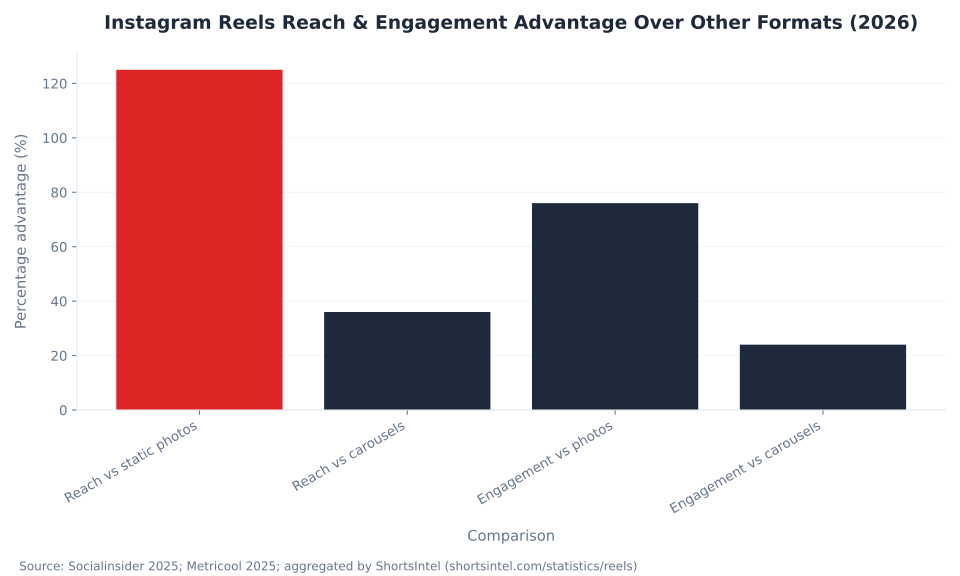
- Reels account for >50% of Instagram ad impressions. The Reels ad audience is 726.8 million globally (DataReportal 2025). Reels deliver +125% reach versus static photos and +36% versus carousels on Instagram (Socialinsider 2025).
726.8M
Reels ad audience globally
DataReportal 2025
>50%
Instagram ad impressions
via Reels in 2025
CNBC / Sensor Tower
$4.29
Average Reels ad CPM
WebFX 2025
Meta Ad Format Taxonomy (2026)
Seven formats are active across Meta placements as of June 2026: single image, single video, carousel, collection, Reels, Stories, and Advantage+ catalog. Meta discontinued Flexible Ads as a standalone format in March 2026 — its capabilities were absorbed into Advantage+ Creative and Advantage+ campaigns. Reels post-loop ads were removed in November 2025.
Format choice follows objective — not creative preference. The Meta Ads campaign objectives layer determines which formats and placements are eligible for a given campaign. Collection ads require a catalog and a Sales objective. Advantage+ catalog requires Catalog Sales. Reels and Stories are available across most objectives but require native 9:16 assets. Confirm format–objective eligibility before building creative.
| Format | Primary placements | Rec. aspect ratio | Rec. resolution (px) | Max file size | Max duration |
|---|---|---|---|---|---|
| Single image | FB & IG Feed | 4:5 (primary); 1:1 supported; 1.91:1 link | 1080×1350 (4:5) / 1080×1080 (1:1) | 30 MB | — |
| Single video | FB & IG Feed | 4:5 or 1:1 (feed); 9:16 for Reels/Stories | 1080×1350 / 1080×1080 | 4 GB | 241 min (FB Feed); 60 min (IG Feed) |
| Carousel | FB & IG Feed | 1:1 (uniform across all cards) | 1080×1080 per card | 30 MB (image); 4 GB (video) | 240 min per card |
| Collection | FB & IG Feed, FB Marketplace, FB Reels (mobile-only) | 1:1 or 4:5 hero (feed); 9:16 (Reels) | ≥1080×1080 (1:1) or 1080×1350 (4:5) | 30 MB (image); 4 GB (video) | 15–60 sec (rec.) |
| Reels | FB & IG Reels | 9:16 | 1080×1920 | 4 GB | 90 sec cap; 5–15 sec optimal |
| Stories | FB & IG Stories | 9:16 | 1080×1920 | 30 MB (image); 4 GB (video) | 120 sec (video); 5 sec (image) |
| Advantage+ catalog | All eligible placements (dynamic) | 1:1 (rec.); 1.91:1 accepted | ≥1024×1024 (rec.); 500×500 min | 8 MB per product image | — |
Sources: Buffer 2026; Superscale 2026; Get-Ryze 2026. Verify durations against Meta Business Help Center before publish.
Build every creative concept in the ratios it will inhabit — 4:5 for feed, 9:16 for full-screen — rather than building one 1:1 asset and repurposing it across placements. Repurposing 1:1 into Reels letterboxes. Repurposing 4:5 into carousel crops. See Advantage+ and AI automation in Meta Ads for how Advantage+ campaigns select among these formats at delivery without manual placement targeting.
Facebook Ad Sizes, Aspect Ratios, and File Specs (2026)
The recommended resolution for Meta feed image ads is 1080×1350 px (4:5 portrait). For feed video, 1080×1350 px (4:5) or 1080×1080 px (1:1). For Reels and Stories, 1080×1920 px (9:16). These are recommended working resolutions — higher quality exports at 1440×1800 px (4:5) or 1440×2560 px (9:16) render sharper on retina displays.
The 4:5 ratio is Meta's primary recommendation for feed because it fills about 78% of the iPhone 13 viewport versus roughly 60% for 1:1. The additional screen real estate is not cosmetic — it translates directly to attention capture before the scroll. Meta's Andromeda delivery system scores creative fit as an auction ranking signal, meaning a letterboxed or undersized asset on a given placement can increase CPMs and reduce delivery priority independent of bid strategy. Source: Superscale 2026, Get-Ryze 2026.
For fashion PPC and furniture PPC advertisers where product imagery fills the frame, 4:5 is the starting ratio for all feed creative. The production workflow: build at 4:5 (1080×1350 px), export a cropped 1:1 version (1080×1080 px) separately for carousel use. Never reuse the 4:5 directly in a carousel — Meta crops it to 1:1 at delivery without preview or notification.
4:5 occupies ~20% more mobile screen real estate than 1:1. Meta's Andromeda delivery system scores creative fit as an auction variable — letterboxed creative increases CPMs, not just visual degradation.
| Spec | Value |
|---|---|
| Recommended aspect ratio | 4:5 (primary); 1:1 supported; 1.91:1 for link/landscape |
| Recommended resolution | 1080×1350 px (4:5) / 1080×1080 px (1:1) |
| High-quality resolution | 1440×1800 px (4:5) / 1440×1440 px (1:1) |
| Minimum resolution | 600×750 px (4:5) / 600×600 px (1:1) |
| Aspect ratio tolerance | ±3% |
| File types | JPG, PNG |
| Max file size | 30 MB |
Source: Buffer 2026; Superscale 2026.
The file size limits — 30 MB for JPG/PNG, 4 GB for MP4/MOV — apply per asset. For single video feed ads, the aspect ratio recommendation matches image: 4:5 (1080×1350 px) or 1:1 (1080×1080 px). The video codec must be H.264, with AAC stereo audio at ≥128 kbps, fixed frame rate at ≤30 fps, and progressive scan. Facebook Feed accepts video up to 241 minutes; Instagram Feed caps at 60 minutes. Files under 1 GB upload more reliably than those near the 4 GB ceiling. Source: Buffer 2026.
Meta Ad Copy Character Limits by Placement (2026)
Primary text character limits are recommended display values — not hard field maximums. The Meta Ads API accepts up to 4,096 characters for primary text. The limits in this section represent the truncation point: where "See more" appears on Feed or where text is cut entirely on Reels and Stories overlays.
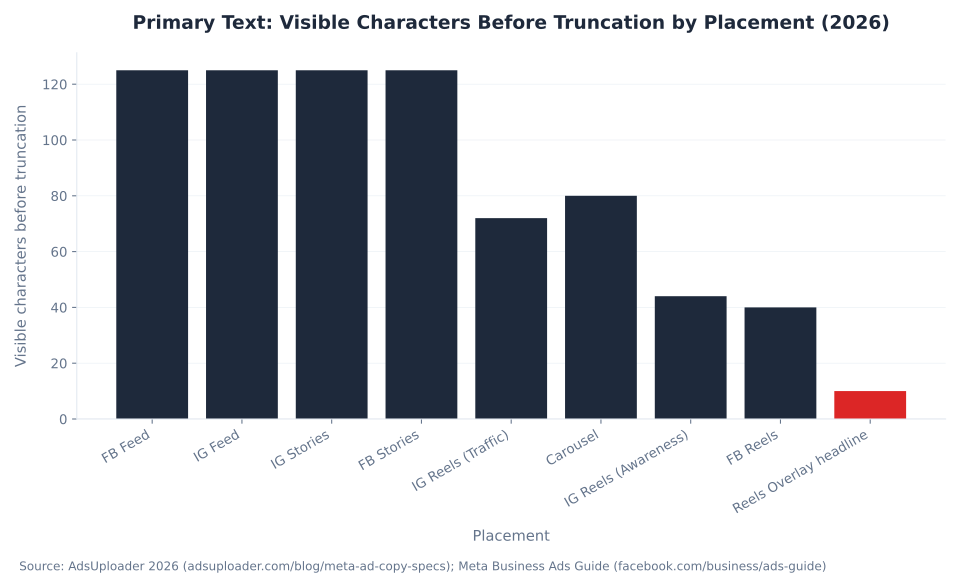
About 1% of users tap "See more" to expand truncated primary text. That statistic defines the copy discipline: every word past the truncation point is invisible to 99% of the audience on that placement. The offer, the hook, and the call to action belong in the first sentence — not paragraph three. On Facebook Reels, the truncation is at 40 characters. On the Reels Overlay headline, 10 characters. A five-paragraph rationale is invisible on every full-screen placement.
| Placement | Primary text visible | Headline visible | Description |
|---|---|---|---|
| Facebook Feed | ~125 chars ("See more" at ~125) | ~27 chars | Not shown |
| Instagram Feed | 125 chars | 40 chars (rec.) | Not shown |
| Facebook Reels | 40 chars | 55 chars (Reels); 10 chars (Overlay) | Not shown |
| Instagram Reels (Traffic) | 72 chars | — | Not shown |
| Instagram Reels (Awareness) | 44 chars | — | Not shown |
| Facebook / Instagram Stories | 125 chars | 40 chars (rec.) | Not shown |
| Carousel (ad-level) | ~80 chars | 45 chars per card | 18 chars per card |
| Collection | 125 chars | 40 chars | Not shown |
| Marketplace / Search / In-Stream | 125 chars | 40 chars | 30 chars (shown here only) |
Sources: AdsUploader 2026; Ridge Marketing; Meta Business Ads Guide. Values are truncation/optimal-display points, not API field maximums (API accepts 4,096 chars for primary text).
Facebook Reels primary text truncates at 40 characters. The Reels Overlay headline shows 10 characters. A single feed-optimized copy block is silent on the two fastest-growing placements.
The description field is the most misused copy block in Meta Ads: it renders in exactly four placements — Marketplace, Facebook Search Results, In-Stream Video, and Audience Network. It does not appear on Feed, Stories, or Reels. Writing extended descriptions expecting them to surface in the main feed is a production error. When the description field is used, 25–30 characters is the effective visible window. Source: AdsUploader, Meta Ad Copy Specs 2026.
Carousel primary text operates differently from single-image: the ad-level text shows about 80 characters (versus 125 for single image), and each card carries its own headline (45 characters) and description (18 characters). Each carousel card is independently linkable — headline, image, and landing URL differ across the 2–10 cards. For shoes PPC and jewelry PPC multi-SKU campaigns, the per-card structure means each product gets its own destination and copy line, not a shared ad-level block.
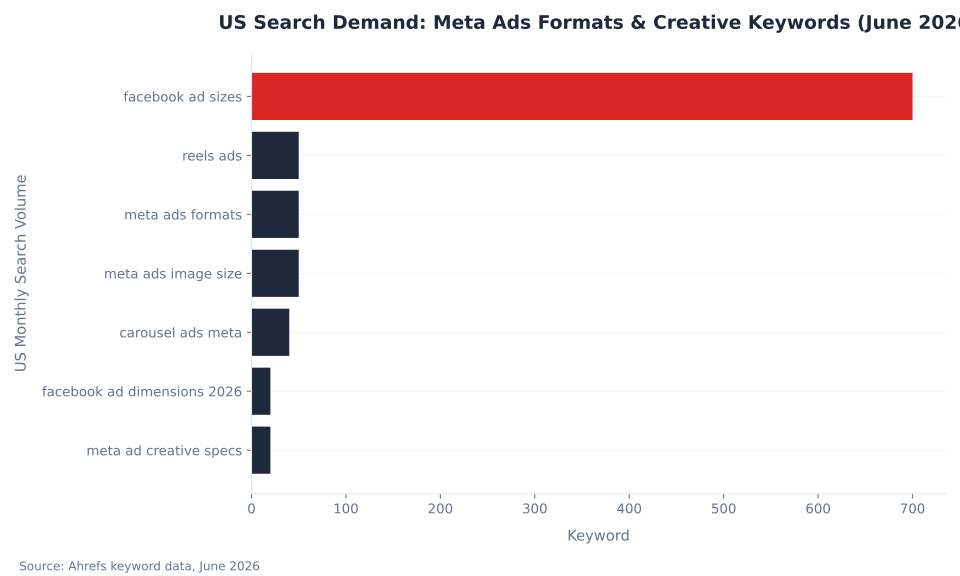
US Search Demand: Meta Ads Formats & Creative Keywords (June 2026)
Reels and Stories: Full-Screen Vertical Ad Specs (2026)
Reels and Stories are the two full-screen vertical placements in the Meta ecosystem. Both require 9:16 creative at 1080×1920 px. Reels runs up to 90 seconds with a 5–15 second engagement sweet spot. Stories images auto-advance at 5 seconds; Stories video runs up to 120 seconds and is automatically split into 15-second segments by Meta at delivery.
Reels delivered more than 50% of Instagram ad impressions in 2025, up from 35% in 2024. The Reels ad audience is 726.8 million globally — 55.1% of Instagram's total ad reach (DataReportal 2025). US Instagram users spend 46% of their total Instagram time watching Reels, up from 37% in 2024 (ShortsIntel 2026). A campaign with no 9:16 vertical creative is ineligible for Reels inventory — the format cannot be approximated with a 1:1 or 4:5 asset.
| Spec | Value |
|---|---|
| Recommended aspect ratio | 9:16 |
| Recommended resolution | 1080×1920 px |
| High-quality resolution | 1440×2560 px |
| Minimum resolution | 500×889 px |
| File types | MP4, MOV, GIF (MP4 strongly preferred) |
| Video codec | H.264, square pixels, fixed frame rate, progressive scan |
| Frame rate | ≤30 fps |
| Audio | AAC stereo, ≥128 kbps |
| Max file size | 4 GB |
| Duration cap | 90 seconds (5–15 sec optimal for ad engagement) |
| Safe zone — top | ≥14% of frame height (≈268 px on 1920 px canvas) |
| Safe zone — bottom | ≥20% of frame height (≈384 px) |
| Safe zone — sides | ≥6% of frame width (≈65 px) |
Sources: Meta Business Ads Guide — Reels; Superscale 2026; Get-Ryze 2026. Safe-zone values reflect UI chrome at delivery — not published hard specs from Meta.
Safe zones are best-practice guidance, not Meta-published hard specs — they reflect the screen space consumed by the account handle, caption overlay, and CTA button that Meta renders over the creative at delivery. Keep key creative elements (faces, product, text) inside the safe zone to avoid them being obscured by UI chrome. Source: Superscale 2026.
| Spec | Value |
|---|---|
| Recommended aspect ratio | 9:16 |
| Recommended resolution | 1080×1920 px |
| Image file types | JPG, PNG |
| Image max file size | 30 MB |
| Image display duration | 5 seconds (auto-advance) |
| Video file types | MP4, MOV, GIF |
| Video max file size | 4 GB |
| Video max duration | 120 seconds (split into 15-sec segments at delivery) |
| Safe zone — top | ≥250 px (≈13% of 1920 px canvas) |
| Safe zone — bottom | ≥340 px (≈18% of canvas) |
Sources: Adnabu 2026; Superscale 2026. Stories 120-sec split-to-15-sec behavior: verify against Meta Business Help before publish.
Reels post-loop ads were removed by Meta in November 2025 and are no longer an available placement option. Stories video longer than 15 seconds is automatically split into 15-second segments — a 45-second Stories ad delivers as three discrete segments with tap-to-skip between them, making the first 15 seconds the decisive creative window. Source: Get-Ryze 2026.
For beauty products PPC advertisers, Reels is the primary top-of-funnel format — it delivers a 1.23% average engagement rate versus 0.70% for static photos and 0.99% for carousels (Metricool 2025), and reaches 125% more accounts than static and 36% more than carousels (Socialinsider 2025). The average Reels CPM of $4.29 (WebFX 2025) runs below comparable Feed CPMs for equivalent reach. For HVAC PPC in Flagstaff and other local-service verticals, short-form 9:16 video demonstrating a problem-and-solution scenario is the highest-intent creative format at top of funnel. 68% of brands significantly increased Reels investment in the past 12 months (Marketing LTB 2026).
Recommended Creative Resolution (Height, px) by Meta Ad Format (2026)

Carousel and Collection Ads: Specs and Production Rules (2026)
Carousel ads run 2–10 cards at uniform 1:1 aspect ratio (1080×1080 px per card), each independently linkable with its own headline, image or video, and landing URL. Collection ads are mobile-only, with a hero asset above a 2-column product grid that opens an Instant Experience on tap — mobile browse-to-buy in a single ad unit.
The critical production rule for carousels: the format enforces 1:1 across all cards regardless of the source asset ratio. A 4:5 (1080×1350 px) feed image placed directly into a carousel is auto-cropped to 1:1 by Meta at delivery — the top and bottom are cut without advertiser preview or notification. Build carousel cards at 1080×1080 px natively. For fashion PPC and multi-SKU campaigns, carousel is the primary mid-funnel comparison format where each card shows one product with its own URL and a per-card headline capped at 45 characters.
| Spec | Value |
|---|---|
| Aspect ratio | 1:1 (uniform across all cards; 4:5 auto-cropped at delivery) |
| Resolution per card | 1080×1080 px |
| Card count | 2–10 cards per carousel |
| Image file types | JPG, PNG |
| Image max file size | 30 MB per card |
| Video file types | MP4, MOV |
| Video max file size | 4 GB per card |
| Video max duration | 240 min per card (15-sec sweet spot for engagement) |
| Ad-level primary text | ~80 chars visible |
| Per-card headline | 45 chars |
| Per-card description | 18 chars |
| Per-card landing URL | Each card independently linkable |
Source: AdsUploader 2026; Superscale 2026.
Collection ads require a Facebook catalog and are mobile-only. Placements: Facebook Feed, Instagram Feed, Facebook Marketplace, and Facebook Reels. Desktop News Feed is excluded. As of March 2026, collection moved from Ad Setup into Ad Creative > Format Display settings in Ads Manager. The collection unit opens an Instant Experience — a full-screen mobile canvas — on tap, where the product grid is displayed. Source: AdLibrary 2026.
| Spec | Value |
|---|---|
| Hero image aspect ratio | 1:1 or 4:5 (feed); 9:16 (Reels) |
| Hero image resolution | ≥1080×1080 px (1:1) or 1080×1350 px (4:5) |
| Hero video aspect ratio | 4:5 (1080×1350 px) or 9:16 (1080×1920 px) |
| Hero video duration | 15–60 seconds (recommended) |
| Image file types | JPG, PNG (max 30 MB) |
| Video file types | MP4, MOV H.264 (max 4 GB) |
| Product grid | 2-column layout; catalog-sourced product images |
| Instant Experience | Required — opens on tap (mobile only) |
| Primary text | 125 chars |
| Headline | 40 chars |
Source: AdLibrary 2026; AdManage 2026.
The collection hero asset is the creative hook — it captures attention and frames the product category. The product grid below it is the catalog surface — it closes the browse-to-buy action. For PPC management in Chicago and Austin DTC clients running collection campaigns, the decisive creative investment is in the hero (4:5 or 9:16 video at 15–60 seconds) — not in the catalog product tiles, which are auto-rendered from the feed.
Primary Text: Visible Characters Before Truncation by Placement (2026)
Advantage+ Catalog Ads: The Product Feed as Creative Asset
Advantage+ catalog ads — formerly Dynamic Product Ads — assemble per-impression ad units from a product feed using Pixel or Conversions API (CAPI) intent signals. The advertiser does not design individual ad units. The product feed's images, titles, and prices are the creative. Feed hygiene governs Advantage+ catalog ad performance more than any hero template or overlay design.
Product images in the catalog render best at 1024×1024 px or larger. The 500×500 px minimum is the floor for catalog acceptance — it is not a production target. Images below 1080 px on the short edge are scaled aggressively across placements and appear blurry, degrading the ad unit at every impression. White or light neutral product backgrounds perform best across most categories and pass Meta's catalog review criteria without friction. Source: Vizup 2026.
| Spec | Value |
|---|---|
| Recommended resolution | ≥1024×1024 px |
| Minimum resolution | 500×500 px (catalog acceptance floor — not production target) |
| Recommended aspect ratio | 1:1 square; 1.91:1 also accepted |
| File types | JPG or PNG |
| Max file size per image | 8 MB |
| Background | White or light neutral (recommended for most categories) |
Source: Vizup 2026; Adnabu 2026.
The Pixel's content_id must exactly match the feed's id field for dynamic retargeting to function. A mismatch between the Pixel event parameter and the catalog identifier silently breaks the personalization loop — products are pulled from the catalog without user-intent matching. This is the most common catalog integration failure in accounts where the Pixel is firing correctly but dynamic retargeting is not personalizing.
| Field | Requirement |
|---|---|
id | Unique SKU; must match Pixel/CAPI content_id exactly |
title | Product name — populated into ad headline/template |
description | Product description — populated into ad template body |
availability | "in stock" / "out of stock" |
price | Format: "19.99 USD" (value + currency code) |
link | Product page URL |
image_link | Hosted product image URL |
brand | Recommended for most categories |
| Feed formats | CSV, TSV, or XML |
| Update cadence | Daily minimum for live inventory/pricing |
| Delivery methods | Hosted scheduled file, API push, or platform integrations (Shopify, BigCommerce) |
Source: Vizup 2026.
Feed updates must run at a daily minimum for live inventory and pricing accuracy. Stale pricing causes Advantage+ catalog ads to display outdated figures, which creates post-click friction and increases return rates. For supplements and nutrition PPC advertisers with subscription SKUs or frequent price changes, daily feed refreshes are the baseline — not an optimization. For furniture PPC advertisers with high-AOV catalog items, product image quality at ≥1024×1024 px directly governs the visual quality of every dynamic ad impression across the campaign lifetime.
Advantage+ Creative: What Meta Rewrites at Delivery
Since February 2026, new campaigns in Sales, Leads, and App Promotion objectives launch with all Advantage+ Creative enhancements pre-selected by default. Meta generates and tests creative variants automatically — rewriting copy, adding music, generating AI backgrounds, and expanding image edges to fit placements — without individual ad-level approval. A single uploaded asset becomes dozens of machine-assembled variants across placements and audiences.
Advantage+ Creative groups its 20+ enhancement types into two categories. Generative AI enhancements create new content from the uploaded asset: Text Improvements rewrites ad copy to optimize engagement metrics; Generate Background produces AI-generated product backgrounds; Expand Image extends image edges to fit different placement ratios; Add Overlays places Meta-generated text and graphic overlays on static images; 3D Animation adds motion to static images. Standard enhancements modify the existing asset: Visual Touch-ups adjusts brightness and contrast; Music adds auto-selected background audio; Adapt to Placement reformats creative per placement; Relevant Comments surfaces social proof comments. All run simultaneously unless individually disabled.
New Sales, Leads, and App Promotion campaigns launch with every Advantage+ Creative enhancement enabled since February 2026. The default is opt-in-to-everything — advertisers must actively disable individual enhancements to regain control over served creative.
| Enhancement | Category | What it does | Brand-control risk |
|---|---|---|---|
| Text Improvements | Generative AI | Rewrites ad copy to optimize engagement | High — buries compliance disclaimers, alters brand voice |
| Generate Background | Generative AI | AI-generates product image backgrounds | High — can produce off-brand imagery or wrong demographic |
| Music | Standard | Adds auto-selected background music | High — Meta selects the track; conflicts with brand tone or regulated verticals |
| Add Overlays | Generative AI | Places Meta-generated text/graphic overlays on images | Medium — overlays are generated by Meta, not designed by advertiser |
| 3D Animation | Generative AI | Adds motion to static images | Medium — motion added without brand-specific art direction |
| Expand Image | Generative AI | Extends image edges to fit different placement ratios | Low — improves placement fit; does not rewrite the core image |
| Adapt to Placement | Standard | Reformats creative per placement requirements | Low — placement-specific reformatting without creative rewrite |
Sources: AdsUploader 2026; AdMove 2026. Default since Feb 2026: all enhancements pre-selected on Sales, Leads, App Promotion campaigns.
MB Adv Agency has found that the most common Advantage+ Creative oversight is leaving all enhancements on at campaign launch and never auditing the variants Meta actually serves. The audit step — reviewing served variants in the Ads Manager ad preview before scaling spend — identifies copy rewrites that dilute the offer, AI backgrounds that misrepresent the product, and music selections that conflict with brand tone or vertical compliance requirements. Individual enhancements toggle at the ad level in Ads Manager; disable high-risk enhancements selectively rather than turning off Advantage+ Creative entirely, since low-risk enhancements like Adapt to Placement and Expand Image improve delivery without distorting the creative.
The underlying automation capabilities of Advantage+ Creative are distinct from the campaign-level AI features that automate audience and format selection — for those, see Advantage+ and AI automation in Meta Ads. Flexible Ads — a standalone format that offered automatic format selection — was discontinued in March 2026; its capabilities were absorbed into Advantage+ Creative and Advantage+ campaign types. Source: Campaign Builder 2026.
How to Write High-Converting Ad Copy for Meta Ads
The first 125 characters of primary text on Facebook and Instagram Feed are visible before a “See more” link appears. ~1% of users tap “See more” — the other 99% form their entire impression from the opening characters. On Facebook Reels, primary text truncates at 40 characters. The Reels Overlay headline shows 10 characters. Copy that works on the placements carrying the largest share of Meta inventory in 2026 must front-load the offer and the hook within the first sentence.
The discipline that follows: a single primary text block cannot perform across all placements. A 125-character opening sentence clears the Feed truncation but is invisible on Facebook Reels. A 40-character hook fits Reels but leaves nothing in the Instagram Feed window. The correct approach is placement asset customization — distinct copy per surface, each front-loaded with the value proposition — rather than one medium-length string that gets cut mid-sentence across the placements that receive the most delivery.
The Reels Overlay headline shows 10 characters. A five-word brand name fills the entire visible headline space on the most-delivered Meta placement. Write for the truncation, not the field maximum.
MB Adv Agency has found that the most common copy error on Meta campaigns with Reels placements is writing primary text for the Feed truncation point (125 characters) while simultaneously running that copy on Facebook Reels, where only the first 40 characters are visible to viewers. The copy block that explains the offer in characters 41–125 is read by ~1% of Feed viewers and 0% of Reels viewers. Front-load the offer: the primary value proposition belongs in the first five to eight words, not after a contextual setup sentence.
| Placement | Primary text window | Headline window | Copy strategy |
|---|---|---|---|
| Facebook Feed | ~125 chars | ~27 chars | Lead with hook + offer; headline is your CTA |
| Instagram Feed | 125 chars | 40 chars | First sentence = entire visible copy for most users |
| Facebook Reels | 40 chars | 10 chars (Overlay) / 55 chars (Reels) | Brand + offer in first 5–7 words; no preamble |
| Instagram Reels (Traffic) | 72 chars | — | One direct sentence; action verb first |
| Carousel (ad-level) | ~80 chars | 45 chars per card | Ad-level intro; per-card headline = product/feature |
| Stories (FB & IG) | 125 chars | 40 chars | Same as Feed; first sentence carries the full load |
Sources: AdsUploader 2026; Ridge Marketing. Values are truncation/display points, not API field limits (API accepts up to 4,096 chars for primary text).
Primary text supports up to five variations per field. Using all five variations lets Meta’s delivery system test and optimize toward the best-performing variant for each audience and placement combination. Each variation must be independently front-loaded — not five versions of the same paragraph. For beauty products PPC campaigns running across Feed and Reels simultaneously, the minimum viable copy set is: one 125-character Feed variant, one 40-character Reels variant, and per-card carousel headlines at 45 characters each. Creative copy performance is read in conversion data, not the copy preview — see Meta Ads metrics, reporting, and optimization for which signals isolate which copy variant is driving conversions at the placement level.
Instagram Reels Reach & Engagement Advantage Over Other Formats (2026)
Meta Ads Creative Management
Format strategy and Advantage+ catalog for DTC brands
MB Adv Agency handles format production, catalog setup, and creative testing for fashion, beauty products, jewelry, and footwear advertisers on Meta spending $5K–$50K/month.
See fashion PPC services →Reels Advertising: Reach, Cost, and Engagement Data (2026)
Reels delivered more than 50% of Instagram ad impressions in 2025, up from 35% in 2024 (CNBC / Sensor Tower via ShortsIntel 2026). The Reels ad audience is 726.8 million globally — 55.1% of Instagram’s total ad reach (DataReportal 2025). US Instagram users spent 46% of total Instagram time on Reels in 2025, up from 37% in 2024. The platform economics have shifted: Reels is the primary paid delivery surface on Instagram by impression volume.
| Metric | Figure | Source |
|---|---|---|
| Share of Instagram ad impressions via Reels (2025) | >50% | CNBC / Sensor Tower via ShortsIntel |
| Reels ad audience globally | 726.8 million | DataReportal 2025 |
| Reels ad audience as % of IG total ad reach | 55.1% | DataReportal 2025 |
| US IG time spent on Reels (2025) | 46% (up from 37% in 2024) | CNBC / Sensor Tower |
| Average Reels CPM | $4.29 | WebFX 2025 |
| Average Reels engagement rate | 1.23% | Metricool 2025 |
| Average photo engagement rate | 0.70% | Metricool 2025 |
| Average carousel engagement rate | 0.99% | Metricool 2025 |
| Reels reach advantage over carousels | +36% | Socialinsider 2025 |
| Reels reach advantage over static photos | +125% | Socialinsider 2025 |
| Brands that significantly increased Reels investment (past 12 months) | 68% | Loopex Digital 2025 |
| Marketers using short-form as primary video format | 29.18% | Marketing LTB 2026 |
| Marketers who landed new customers via short-form social video | 93% | Marketing LTB 2026 |
Source: ShortsIntel 2026 aggregating DataReportal 2025, CNBC/Sensor Tower, Socialinsider 2025, Metricool 2025, Loopex Digital 2025; Marketing LTB 2026.
MB Adv Agency treats format diversity as a structural requirement of any Advantage+ campaign setup, not a creative preference. A campaign with no 9:16 vertical asset cannot bid for Reels or Stories inventory at any budget level. For local service advertisers — including roofing PPC in Flagstaff and legal PPC in Missoula where short-form video demonstrating a problem-and-solution scenario drives top-of-funnel reach — the absence of 9:16 creative is a structural delivery cap, not a bidding or budget issue. For skincare PPC advertisers using before-and-after or tutorial formats, Reels’ 1.23% average engagement rate versus 0.70% for static photos defines the top-of-funnel creative priority.
| Format | Funnel stage | Best for | Key creative constraint |
|---|---|---|---|
| Reels / Stories | Top (attention) | New-audience reach, demos, hooks | 9:16 only; 5–15 sec optimal; sound-on or captioned |
| Single image | Top–mid (test/scale) | Rapid concept testing, offer angles | Ratio decides feed real estate; 4:5 primary |
| Single video | Top–mid (storytelling) | Demos, before/after, narrative | First 3 sec carry retention; sound-on or captioned |
| Carousel | Mid (comparison) | Multi-product, multi-feature, sequential story | 1:1 uniform; 2–10 cards; each independently linkable |
| Collection | Bottom (browse-to-buy) | Mobile catalog browse from a hero asset | Mobile-only; hero + product grid via Instant Experience |
| Advantage+ catalog | Bottom (conversion/retargeting) | Dynamic personalized retargeting + prospecting from a feed | Product feed quality (image, title, price) is the creative |
Source: AdManage 2026; Get-Ryze 2026.
Three Misconceptions About Meta Ad Creative That Reduce Delivery
Three beliefs about Meta ad creative are widespread enough to produce systematic delivery problems — lower reach, higher CPMs, or creative that ships broken across placements. Each is correctable at the production stage before a campaign launches.
Misconception 1: “1:1 square is the safe default for Facebook ads.”
It is not the format Meta recommends. For feed image and video ads, Meta’s primary recommendation is 1080×1350 px at 4:5 — not 1:1. A 4:5 frame occupies ~20% more vertical mobile screen than 1:1, increasing attention capture before the scroll. Meta’s Andromeda delivery system scores creative fit as an auction ranking signal: a letterboxed or undersized asset on a given placement raises CPMs and reduces delivery priority, not just visual quality. For Reels and Stories, 1:1 letterboxes entirely — the placement requires 9:16 to fill the screen. Shipping 1:1-only creative concedes feed real estate and full-screen placement eligibility. Build 4:5 for feed, 9:16 for full-screen, and treat 1:1 as a carousel-native format, not a general default. Sources: Superscale 2026; Buffer 2026.
Misconception 2: “One set of ad copy runs everywhere.”
Character limits are placement-specific and one string truncates differently across surfaces. Primary text shows ~125 characters before “See more” on Feed but only 40 characters on Facebook Reels. The Reels Overlay headline shows 10 characters — a five-word brand name fills the entire visible space. Carousel primary text displays ~80 characters at the ad level, with 45 per card for headlines. A single 100-character primary text block fits none of these cleanly: it overruns Reels, underuses Feed, and fills only 55% of the carousel headline field. The correct approach is placement asset customization — distinct copy per surface, each front-loaded with the value proposition — not one compromise string. Source: AdsUploader 2026.
Misconception 3: “Collection ads and Advantage+ catalog ads are interchangeable e-commerce formats.”
They are different mechanisms with different creative inputs. A collection ad is a fixed hero asset above a manually or dynamically configured product grid, built in the Instant Experience, mobile-only. The hero creative is the primary design decision — the grid is sourced from the catalog but is not dynamically personalized per viewer. An Advantage+ catalog ad is fully dynamic: Meta assembles the entire ad unit per impression from the product feed using Pixel or CAPI intent signals. No fixed ad unit exists per viewer. Treating them as the same format leads advertisers to hand-build collection creative when the catalog format would have automated it — or to expect dynamic personalization from a static collection layout that does not have it. Source: AdLibrary 2026.
Frequently Asked Questions: Meta Ad Formats & Creative (2026)
What is the recommended image size for Facebook ads in 2026?
The recommended resolution for Facebook Feed image ads in 2026 is 1080×1350 px at a 4:5 aspect ratio. This is Meta’s primary recommendation — not the 1:1 square that older guides default to. A 4:5 image occupies ~20% more vertical mobile screen than 1:1, increasing attention capture before the scroll. For maximum sharpness on retina displays, produce at 1440×1800 px (4:5) and export a downscaled version for upload. The minimum Meta accepts is 600×750 px (4:5) — an acceptance floor, not a production standard. File types are JPG or PNG with a 30 MB maximum. The aspect ratio tolerance is ±3%. For Reels and Stories placements, the spec is different: 1080×1920 px at 9:16 is required. A 4:5 or 1:1 image at a Reels placement letterboxes — displaying with black bars — and cannot compete for full-screen inventory regardless of bid. Build 4:5 for feed, 9:16 for Reels and Stories, and 1:1 natively for carousel cards (never repurpose a 4:5 feed asset into a carousel without cropping first). Sources: Buffer 2026; Superscale 2026.
How much does it cost to run Reels ads on Meta?
The average CPM for Meta Reels ads is $4.29 (WebFX 2025). The reach calculation on a $1,000 budget: $1,000 ÷ $4.29 × 1,000 = 233,100 estimated impressions. At the average Instagram Reels engagement rate of 1.23% (Metricool 2025): 233,100 × 0.0123 = 2,867 estimated engagements. These are averages across all industries and geographies — actual CPMs vary by audience size, objective, seasonality, and auction density. Reels CPMs run significantly below comparable Feed video placements for equivalent reach in most verticals. The Reels ad audience is 726.8 million globally — 55.1% of Instagram’s total ad reach (DataReportal 2025) — at an average CPM that currently underprices that reach relative to Feed inventory. For fashion, beauty, and DTC categories where creative quality drives engagement, the $4.29 Reels CPM baseline represents underpriced inventory for advertisers who produce native 9:16 video that outperforms the 1.23% average engagement rate. Source: ShortsIntel 2026 aggregating WebFX 2025, DataReportal 2025, Metricool 2025.
What is the difference between a collection ad and an Advantage+ catalog ad?
A collection ad is a manually configured unit: a fixed hero asset — image or video — above a product grid drawn from a catalog, opening an Instant Experience on tap. Collection ads are mobile-only, available in Facebook Feed, Instagram Feed, Marketplace, and Facebook Reels. The hero creative is the primary design decision; the product grid is sourced from the catalog but not dynamically personalized per individual viewer. An Advantage+ catalog ad is fully dynamic: Meta assembles the entire ad unit per impression from the product feed using Pixel or Conversions API signals tied to the user’s on-site behavior. No fixed ad unit exists per viewer. The personalization mechanism is the content_id/feed id match — the system identifies which products a specific user viewed, added to cart, or purchased, then assembles those items into the ad at delivery. Collection is a browse-to-buy format with a fixed creative layout. Advantage+ catalog is a personalized retargeting and prospecting format where the feed is the creative. Both require a product catalog. Sources: AdLibrary 2026; Adnabu 2026.
What is the correct aspect ratio for Meta Reels and Stories ads?
The required aspect ratio for Facebook and Instagram Reels is 9:16, at a recommended resolution of 1080×1920 px. For retina quality, produce at 1440×2560 px; the minimum accepted is 500×889 px, an acceptance floor only. Stories use the same specs: 9:16, 1080×1920 px. The 9:16 requirement is structural, not stylistic: any other ratio — 1:1, 4:5, 1.91:1 — letterboxes at full-screen placements with black bars on the sides or top. An advertiser with only 1:1 or 4:5 feed creative cannot access Reels inventory at any bid — the placement requires 9:16 to fill the screen. Safe zones for Reels keep key elements (face, product, text) out of the top 14% of frame (≈268 px on a 1920 px canvas), where the account handle overlays at delivery, and out of the bottom 20% (≈384 px), where the CTA button and caption sit. Stories safe zones differ: top ≥250 px (≈13% of canvas), bottom ≥340 px (≈18%). These are practitioner-documented best practices reflecting Meta’s UI chrome at delivery — not published hard specs from Meta. Sources: Meta Business Ads Guide; Superscale 2026.
How do Advantage+ Creative enhancements work and which should I disable?
Advantage+ Creative generates and tests variants of uploaded assets automatically, using 20+ enhancement types in two categories. Generative AI enhancements create new content: Text Improvements rewrites ad copy; Generate Background produces AI product backgrounds; Expand Image extends image edges for different placement ratios; Add Overlays adds Meta-generated overlays; 3D Animation adds motion to static images. Standard enhancements modify existing assets: Visual Touch-ups adjusts brightness; Music adds auto-selected background audio; Adapt to Placement reformats per placement. Since February 2026, new Sales, Leads, and App Promotion campaigns launch with all enhancements pre-selected — advertisers must actively disable them. Disable high-risk enhancements first: Text Improvements buries compliance disclaimers and rewrites brand voice; Generate Background produces off-brand images; Music is auto-selected and conflicts with regulated-category restrictions. Enhancements that improve placement fit without rewriting the creative — Adapt to Placement, Expand Image — carry lower risk and can stay enabled. Audit served variants in Ads Manager preview before scaling. Sources: AdsUploader 2026; AdMove 2026.
What should I put in the first 125 characters of Meta ad copy?
The first 125 characters of primary text on Facebook and Instagram Feed are the entire ad for ~99% of viewers — ~1% of users tap “See more” to expand truncated copy. The impact: if an ad delivers 100,000 Feed impressions and primary text truncates at 125 characters, 99,000 users form their entire impression from those 125 characters. On Facebook Reels, the truncation is 40 characters — 99,000 of 100,000 Reels viewers form their impression from 40 characters or fewer. In that character budget, lead in order: the offer or value proposition first, the brand differentiator second, the call to action third. A concrete opener like “Free shipping on orders over $50” (34 characters) clears the Reels primary-text window and the Feed truncation. A setup opener like “If you’re looking for a better way to...” wastes the Reels visible window entirely on preamble. Meta allows up to five primary text variations per ad — use all five, each independently front-loaded. Source: AdsUploader 2026.
How do I match the right Meta ad format to my campaign objective?
Format choice follows funnel stage and objective, not creative preference. Reels and Stories — 9:16, 5–15 second sweet spot — are top-of-funnel attention formats for new-audience reach. Single image and single video are top-to-mid-funnel test-and-scale formats: fastest to build, best for rapid concept testing across offer angles. Carousel is a mid-funnel comparison format — 2–10 independently linkable cards, each with its own headline and URL — for multi-product showcases or sequential storytelling. Collection and Advantage+ catalog are bottom-of-funnel conversion formats: collection for browse-to-buy via Instant Experience, Advantage+ catalog for dynamic personalized retargeting. A full-funnel campaign requires creative at all relevant ratios: 9:16 for Reels and Stories, 4:5 for feed, 1:1 for carousel. Running one format type across all funnel stages means the campaign cannot compete for the placements it does not fit. Format eligibility is also constrained by objective — Catalog Sales unlocks Advantage+ catalog; Sales is required for Collection. See Meta Ads campaign objectives for the full objective-format eligibility map. Sources: AdManage 2026; Get-Ryze 2026.
Audit your Meta creative and format strategy
MB Adv Agency reviews active formats, placement coverage, Advantage+ Creative settings, and product feed hygiene for Meta advertisers spending $5K+ per month.
Get in touch →Methodology and Data Sources
Ad format specifications are cross-verified across Buffer 2026, Superscale 2026, AdsUploader 2026, Get-Ryze 2026, and Postfast 2026, all referencing the Meta Business Help Center as the primary authority. Reels performance data are sourced from ShortsIntel 2026, aggregating DataReportal 2025, CNBC/Sensor Tower, Socialinsider 2025, Metricool 2025, and Loopex Digital 2025. Catalog specifications from Vizup 2026 and Adnabu 2026. Advantage+ Creative enhancement details from AdsUploader 2026 and AdMove 2026. Character limits are optimal-display truncation values, not API field maximums; verify against the live Meta Business Help Center before publish. Last updated: June 2026. Reviewed by MB Adv Agency, June 2026.

As a Google Ads expert, I bring proven expertise in optimizing advertising campaigns to maximize ROI.
I specialize in sharing advanced strategies and targeted tips to refine Google Ads campaign management.
Committed to staying ahead of the latest trends and algorithms, I ensure that my clients receive cutting-edge solutions.
My passion for digital marketing and my ability to interpret data for strategic insights enable me to offer high-level consulting that aims to exceed expectations.
Google Partner Agency
We're a certified Google Partner Agency, which means we don’t guess — we optimize withGoogle’s full toolkit and insider support.
Your campaigns get pro-level execution, backed by real expertise (not theory).

4.9 out of 5 from 670+ reviews on Fiverr.
That’s not luck, that’s performance.
Highly recommend Matteo to set up your server side tracking. He has a deep understanding of e-commerce tracking and will go above and beyond to make sure everything is set up correctly and working 100%. If you are scaling your store this set up is non-negotiable in my opinion and there isn't many people who have this much knowledge or put the effort in to get it right. Thanks again!

avorodesign.com
I can only recommend Matteo! He was very patient, professional and very knowledgeable about GA4, Consent Mode v2, and GDPR compliance. Communication was clear, and the setup was done professionally and efficiently. Highly recommend him for anyone needing reliable tracking implementation.

www.natureiki.life
Matteo shines in the realm of online professionals. His work is not only deep in data but also complemented by his proactive communication and cooperation, setting a new standard for freelancers. If you want someone who truly exceeds expectations, look no further. Highly recommended!

www.omanbeverlysmyth.com
Exceptional Service Beyond Expectations - Outstanding Service Impeccable depth, flawless delivery, and exceptional language fluency—this service exceeded all expectations. Highly recommended. Matteo truly ROCKS!!!

ium-paris.com
Top-notch, always highly value working with Matteo. An absolute Google Ads Genius. This is approximately the 8th time I have hired him and he's helped us get 6-7 ROAS. We are excited in continuing to improve our lead flow. Hire this guy if you need Google Ads help. Thanks Matteo!

www.dleeventgroup.com
I finally found the guy who can setup server side tracking and all the ecosystem properly. I definitely recommend Matteo. He is very responsive, kind and wants to dig into things. He configured GA4, Meta, Google Ads, Outbrain and google consent v2 with Cookiebot. Thanks Matteo.

inomega.fr
MB Adv delivered exceptional work with outstanding professionalism and lots of patience, taking time to see effects of changes made and not just do the work and submit it. The proactive communication and video summaries of the work completed made working with Matteo a pleasure, as he consistently went above and beyond. Highly recommended for web analytics projects! We are already working on another project.

www.withnellsensors.co.uk
Working with Matteo on my Google Ads was a game-changer. He's not just a strategist, he's a true partner. He understood my goals and tailored a campaign that perfectly reached my target audience. I'm grateful for his expertise and dedication.

dccargo.com
Click-driven mind
with plastic-brick obsession.
We build Google Ads campaigns with the same mindset we use to build tiny brick worlds: strategy, patience, and zero tolerance for wasted pieces.
Data is our blueprint. Growth is the only acceptable outcome.