
Heading

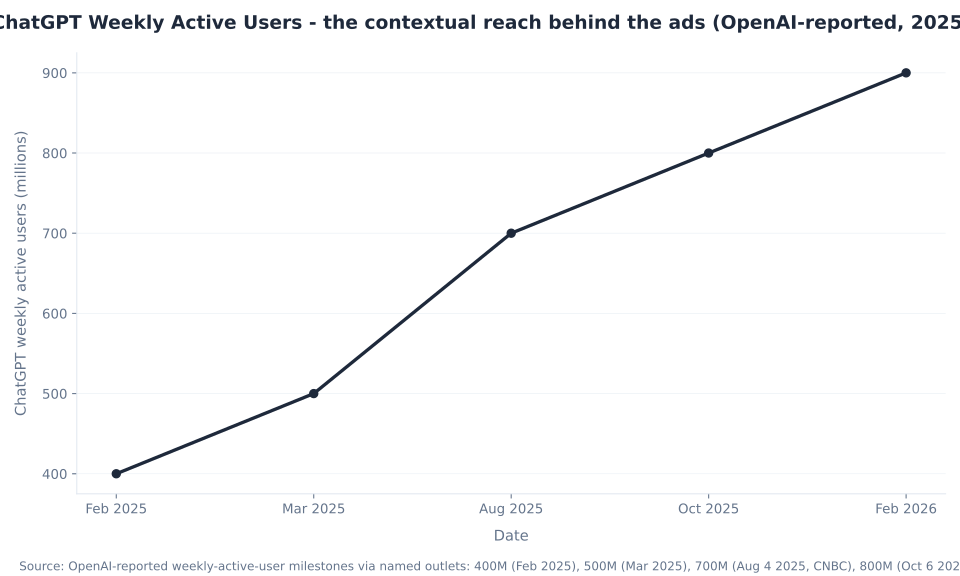
ChatGPT reach — OpenAI-reported, Feb 2026
900M
weekly active users OpenAI reported in February 2026 — the contextual audience a ChatGPT ad can be matched against. Reach is not targeting: ads serve only on the Free and Go tiers, to logged-in US adults at launch, and are matched by the topic of the conversation, not by who the user is.
Source: TechCrunch; retrieved 2026-07-01
How ChatGPT Ad Targeting Works: Contextual Matching
ChatGPT ad targeting is contextual first. OpenAI describes the mechanism plainly: “We start with what’s being discussed in your current chat thread and match those topics to relevant ads,” and its ads system “primarily selects ads based on how relevant they are to the context and intent of the conversation.” The starting point is the conversation happening right now — not a demographic, not a bid, not a stored profile of the person. This is the overview of ChatGPT ads made concrete on the targeting side.
For a buyer arriving from Google Ads or Meta, that is the whole mental shift. On those platforms you target who the user is — age, interests, past behavior, the audience graph. On ChatGPT the primary signal is what the user is discussing in the moment. Relevance to context begins the selection; the deeper serving mechanics — the relevance-weighted second-price auction and the separation of ads from ChatGPT’s answers — are covered in how ChatGPT ads work. This page stays on the targeting half: who decides which ad a user sees, and what audience controls an advertiser actually gets.
ChatGPT Weekly Active Users: The Contextual Reach Behind the Ads (OpenAI-Reported, 2025–2026)
MB Adv Agency runs the paid-media programs — Google Ads, Meta, and the broader paid mix — that a new channel like ChatGPT Ads slots into, and the audience model is where the difference is sharpest. So it is worth being precise about what exists, what steers delivery, and what emphatically is not here.
Key Takeaways
- ChatGPT ad targeting is contextual, not behavioral. The system matches ads to the topic and intent of the current conversation — the primary signal is the chat, not a profile of the person.
- Advertisers get four controls, and only four: contextual matching, context hints, US geo-targeting, and a gated first-party custom-audience upload. That is the entire toolkit.
- Context hints are not keywords. They describe topics where a product is relevant, are not exact-match, and do not guarantee delivery — there is no exact, phrase, or broad match-type system.
- Demographic, interest, device, placement, and lookalike targeting do not exist. These are confirmed absences, not undocumented features — a campaign planned around them cannot be built on ChatGPT.
- Advertisers never receive your chats, memories, or personal data. Personalization changes which ad the system shows a user; advertisers see only aggregate views and clicks.
Context Hints: How Advertisers Steer Delivery (and What They Are Not)
Context hints are the one input an advertiser gives the matching system. In OpenAI’s Help Center wording, advertisers “provide context hints that describe the conversations, topics, or keywords where their products or services” could be relevant — and, critically, “they are not exact-match keywords and do not guarantee delivery.” Selection considers “context hints, landing page, ad title, and ad copy,” plus “basic context such as general location or language.”
The contrast a search buyer needs is load-bearing: context hints are not the exact, phrase, and broad match types of Google Search. There is no match-type system, no guaranteed serve when a hint is relevant, and the ad’s own landing page, title, and copy feed the relevance match — so your ad copy and creative are part of what gets matched, not separate from it (Digiday). If you plan hints the way you would build keyword match types in a search campaign, you are misreading a contextual system as a keyword auction.
The practical takeaway is qualitative, because no relevance-score metric is published: write clear, specific hints and on-topic ad copy, since the content of the ad is itself an input to the match. How budgets and bids sit on top of that is covered in ChatGPT ad pricing.
What ChatGPT Ad Targeting Does NOT Have
State it as fact, not as a caveat. ChatGPT ad targeting has no demographic targeting (age, gender), no interest targeting, no device targeting, no placement targeting, and no lookalike audiences. These are confirmed absences — not undocumented features waiting in a menu, not “coming soon,” and not something a workaround unlocks.
Why it matters: a paid-media buyer who plans a ChatGPT campaign the way they plan a Meta campaign will design audiences that cannot be built. The audience segments, in-market lists, and demographics you assemble in Google Ads audience targeting have no equivalent here, and there is nothing like Meta’s detailed and lookalike audience targeting. ChatGPT trades the behavioral targeting graph for contextual relevance in the moment of the conversation. The honest way to scope the channel is to build around the four controls that do exist and drop the five that do not.
| Capability | ChatGPT Ads | Detail / source |
|---|---|---|
| Contextual matching (current chat topic + intent) | Exists — core mechanism | Primary signal — Help Center “Ads in ChatGPT” |
| Context hints (topics/keywords, not exact-match) | Exists — advertiser input | No guaranteed delivery — Help Center “The Basics” |
| Geo-targeting (US state / DMA / ZIP) | Exists (US, added May 22, 2026) | Reported — advertiser email via PPC.land |
| First-party custom audiences (include/exclude/suppression) | Exists — gated rollout | Own data only, SHA-256 hashed — Ad Tools Terms + PPC.land |
| Demographic targeting (age, gender) | Does not exist | Confirmed absent |
| Interest targeting | Does not exist | Confirmed absent |
| Device targeting | Does not exist | Confirmed absent |
| Placement targeting | Does not exist | Confirmed absent |
| Lookalike audiences | Does not exist | Confirmed absent — no modeled seed-list expansion |
Source: OpenAI Help Center “Ads in ChatGPT” and “The Basics”; Ad Tools Terms; geo and custom-audience mechanics reported via PPC.land. Verified 2026-07-01.
Put the three platforms side by side and the shape of the difference is clear: ChatGPT keys off the conversation, while Google and Meta key off the person and their history.
| Targeting dimension | ChatGPT Ads | Google Ads | Meta Ads |
|---|---|---|---|
| Primary signal | Conversation context (topic + intent) | Keyword / audience intent | Behavioral & interest graph |
| Demographic (age/gender) | No | Yes | Yes |
| Interest targeting | No | Yes (affinity / in-market) | Yes (detailed targeting) |
| Device targeting | No | Yes | Yes |
| Geo-targeting | Yes (US state / DMA / ZIP) | Yes | Yes |
| First-party custom lists | Yes (gated, first-party only) | Yes (Customer Match) | Yes (Custom Audiences) |
| Lookalike / similar audiences | No | Yes | Yes (Lookalike Audiences) |
Source: ChatGPT column web-verified 2026-07-01 (OpenAI Help Center, Ad Tools Terms, PPC.land); Google and Meta columns are those platforms’ standard capabilities. Not mbadv client data.
Personalization and Memory: The Signals That Widen or Narrow the Match
Personalization is on by default, and it is a user control — not an advertiser targeting lever. At launch OpenAI explained that it decides which ad to show “by matching ads ... with the topic of your conversation, your past chats, and past interactions with ads.” Its Help Center is precise about the inputs: with ad personalization on, the signals are “your current chat thread ... how you interact with ads ... past chats and memory”; with it off, only the current chat thread is used.
The distinction that matters for trust: personalization changes how wide the system’s contextual signal is for a given user — the advertiser never selects “people with memory X.” Users hold the controls. You can turn ad personalization off at any time, and you can “clear ads data,” which is retained for up to 30 days and then removed. OpenAI states it “never sell[s] your data to advertisers.” The fuller picture of what data ChatGPT uses and shares — including the cookie and device identifiers OpenAI shares with marketing partners — is its own subject.
| Ad personalization | Signals used to select an ad | Advertiser receives |
|---|---|---|
| On (default) | Current chat thread + how you interact with ads + past chats and memory | Aggregate views/clicks only |
| Off | Current chat thread only | Aggregate views/clicks only |
| User controls | Turn personalization off anytime; “clear ads data” (retained up to 30 days, then removed) | — |
Source: OpenAI Help Center “Ads in ChatGPT” and the February 2026 launch post. Verified 2026-07-01.
Where a contextual channel fits
ChatGPT Ads Is a New Lane in Your Paid Mix
MB Adv Agency runs the paid-media programs — Google Ads, Meta, and the broader paid mix — that a contextual channel like ChatGPT Ads slots alongside. To map where it fits and how its audience model differs from the platforms you already run, our team can help: managed PPC campaign management, and for software companies, SaaS PPC services.
Talk to our team →Geo-Targeting: The One Location Control That Exists
Geography is the first of two hard audience controls an advertiser gets. As of a May 22, 2026 OpenAI advertiser email reported by PPC.land, Ads Manager added geo-targeting by US state, DMA (designated market area), or ZIP code, alongside daily budgets and dynamic calls-to-action. It is US-only at that stage — label the granularity “reported,” since it comes from an advertiser email rather than an OpenAI public post.
Keep this separate from the “general location” that already feeds contextual selection. OpenAI’s matching uses basic context such as general location or language on its own; geo-targeting is the explicit advertiser constraint layered on top of that.
First-Party Custom Audiences (No Lookalikes)
The second hard control is an emerging, gated custom-audience upload — and it is first-party only. The legal framework is official: OpenAI’s Ad Tools Terms require “Audience Data” to be “first-party data ... not purchased ... from data brokers,” and permit “suppression/exclusion data.”
The product mechanics are reported from Ads Manager screenshots surfaced by Juozas Kaziukenas on May 14, 2026 (PPC.land): a CSV or TXT upload up to 512MB of raw or SHA-256-hashed emails and phone numbers, used for include, exclude, or suppression lists. Two facts anchor how you scope it. First, it is first-party only — your own customer data, never a broker’s. Second, there are no lookalike audiences: you cannot expand a seed list into a modeled “similar” audience the way you would on Google or Meta. Treat the feature as gated and emerging rather than something every advertiser can switch on today, and set it up inside Ads Manager.
What Advertisers Actually Receive: Aggregate Metrics Only
The trust question every compliance reviewer asks has a precise answer. In OpenAI’s Help Center wording: “Advertisers never receive your chats, chat history, memories, name, email, precise location, IP address, or sensitive information (such as health, mental health, political topics).” What advertisers get is aggregate views and clicks — nothing that identifies the person.
Hold the two ideas apart, because conflating them is the source of the biggest myth about this channel. Personalization and memory affect which ad the system shows a user; they are never handed to the advertiser. So “ChatGPT gives advertisers my chats” is simply false — the advertiser-visible layer is aggregate performance data, and OpenAI states it never sells user data to advertisers. The separate, real tension — what OpenAI does share with marketing partners, such as limited cookie and device identifiers — belongs to ChatGPT ads privacy and data, not to the advertiser-visibility guarantee itself.
Frequently Asked Questions: ChatGPT Ads Targeting
Next in the ChatGPT Ads series
See How ChatGPT Ads Actually Work
You have the targeting picture — now go one level deeper into the serving mechanics: the relevance-weighted auction, the separation of ads from answers, and how a single sponsored unit gets chosen.
Read the next guide →Methodology & Sources
This pillar covers the targeting and audience-control layer of ChatGPT ads; auction mechanics, pricing, and the fuller privacy story live in the linked siblings. The contextual-matching quotes, the context-hints wording (“not exact-match ... do not guarantee delivery”), the personalization on/off signals, and the advertiser-visibility guarantee are OpenAI-primary, from the Help Center articles “Ads in ChatGPT” and “The Basics” and the February 2026 launch post. The Ad Tools Terms first-party requirement is OpenAI-primary from the policy page. The geo-targeting granularity (US state, DMA, ZIP) and the custom-audience product mechanics (CSV/TXT up to 512MB, SHA-256 hashing, include/exclude/suppression) are reported via PPC.land — an advertiser email and Ads Manager screenshots — and are labeled reported above. The reach figures are OpenAI-reported milestones via CNBC (700M, August 2025) and TechCrunch (900M, February 2026); weekly active users are total reach, not the addressable ad audience. OpenAI Help Center and policy pages return errors to automated fetch, so every verbatim quote was cross-checked against reputable outlets quoting those pages. No MB Adv Agency client metrics appear here — MB Adv Agency has no ChatGPT-Ads service page, and its perspective is qualitative. Reviewed by MB Adv Agency, July 2026.