
Heading

ChatGPT reach — OpenAI-reported, Feb 2026
~900M
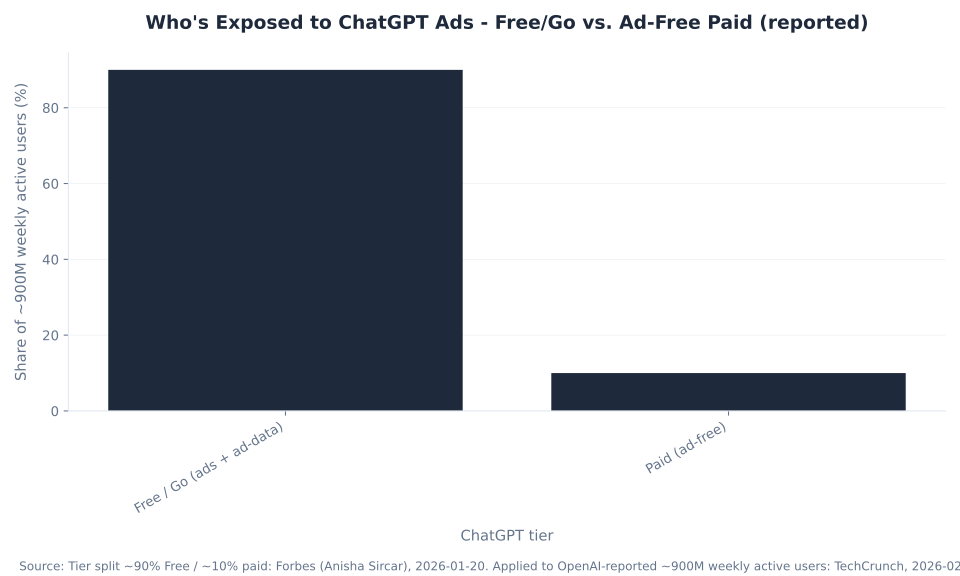
weekly active users. Ads — and every ad-data practice on this page — reach only the roughly 90% of them on the ad-supported Free and Go tiers (a reported estimate); the paid tiers are ad-free and sit outside ad-data collection entirely.
Source: TechCrunch (900M weekly active users, Feb 27 2026); the ~90% free-tier split reported by Forbes. Retrieved 2026-07-01.
The Headline: Contextual, Not Behavioral
Start with OpenAI’s own framing, because it is accurate. ChatGPT’s ad system “primarily selects ads based on how relevant they are to the context and intent of the conversation” — it begins with what you are discussing in your current chat thread and matches that topic to a relevant sponsored result at the bottom of a response. With ad personalization on, it also draws on your past chats and how you have interacted with ads before. What it does not do is build interest-based audience segments from your web-browsing history or purchased third-party data the way a classic display network does. That is what “contextual, not behavioral” means, and it is a genuinely more private starting point than programmatic advertising. For where ads sit in the product see the ChatGPT Ads overview, and for how a single sponsored unit gets chosen see the serving mechanism behind ad selection.
Two limits matter up front. First, your memories are never accessible to advertisers — personalization can read them to pick an ad, but they never leave OpenAI. Second, none of this touches the paid tiers. This entire privacy conversation applies only to the ad-supported Free and Go tiers. OpenAI reports about 900 million weekly active users, and Forbes reports that roughly 90% of them sit on the free tier — the reported slice where ads and ad-data practices apply. Users on Plus, Pro, Business, Enterprise, and Edu see no ads and no ad-data collection at all. The chart below frames that scope before we get into what is shared and what is not.
Who’s Exposed to ChatGPT Ads — Free/Go vs. Ad-Free Paid (reported)
Key Takeaways
- ChatGPT ad targeting is contextual, not behavioral. It matches ads to the topic of your current chat (plus, with personalization on, your past chats and prior ad interactions). OpenAI states it does not build interest-based segments from your browsing history or third-party data.
- Advertisers get aggregate views and clicks — never your chats. OpenAI’s guardrail: advertisers never receive your chats, chat history, memories, name, email, precise location, IP address, or sensitive topics. That confirmed limit is the strongest part of the privacy case.
- But the data picture is two-sided. OpenAI’s updated US privacy policy formalizes that it receives purchase data from advertisers, shares limited identifiers (cookie IDs, device IDs) with marketing partners for third-party ad targeting, and uses data to market its own products. Marketing cookies are on by default for free users.
- OpenAI does not sell your data — and denies it. Identifier-sharing for measurement and targeting is real, but it is not the same as selling your conversations. Calling it “selling your data” overstates it; the accurate word is identifier-sharing.
- You have controls, and a clean opt-out. Turn off ad personalization, clear your ads data, or opt out of marketing cookies in settings — and any paid, ad-free tier removes ads and ad-data collection entirely. Under-18 accounts are excluded from ads regardless.
What Advertisers Actually Receive (and Never Receive)
This is the confirmed guardrail, and it is the strongest part of OpenAI’s privacy case. Advertisers receive aggregate views and clicks — performance data about the ad, not about you as an individual. OpenAI’s exact line is unambiguous: “Advertisers never receive your chats, chat history, memories, name, email, precise location, IP address, or sensitive information (such as health, mental health, political topics).” No individual conversation, identity, or profile is handed to a brand. Table 1 lays out what flows out, what flows in, and what stays private.
OpenAI also states a principle worth naming here: ads run on separate systems from the chat model, and advertisers have no ability to shape, rank, or alter ChatGPT’s answers. Treat that as OpenAI’s stated, unaudited position rather than an independently verified fact — the full brand-safety and answer-integrity treatment lives in ad policies and the answer-independence principle. The mechanics of how a conversation gets matched to an ad, and what targeting does and does not exist, are covered in the targeting model and what does not exist.
| Data element | Does it leave to advertisers / ad partners? | Source |
|---|---|---|
| Aggregate ad views & clicks | Yes — advertisers receive aggregate performance only | OpenAI Help Center |
| Purchase / conversion data | In, not out — OpenAI receives this from advertisers for measurement | US Privacy Policy (Adweek / SEL) |
| Cookie IDs & device IDs | Yes — shared with marketing partners for third-party ad targeting | US Privacy Policy (Adweek / SEL) |
| Data to market OpenAI’s own products | Yes — used to promote OpenAI products (e.g. whether you signed up after an ad) | US Privacy Policy (Adweek / SEL) |
| Your chats & chat history | No — never sent to advertisers | OpenAI Help Center |
| Your memories | No — never accessible to advertisers | OpenAI Help Center |
| Name, email, precise location, IP | No — never sent to advertisers | OpenAI Help Center |
| Sensitive info (health, mental health, political) | No — never sent to advertisers | OpenAI Help Center |
Source: OpenAI Help Center, “Ads in ChatGPT”; US Privacy Policy specifics as reported by Adweek and Search Engine Land. Verified 2026-07-01.
The Tension: Cookies, Device IDs, and Marketing On by Default
Here is the other half of the story, and it is just as confirmed as the first. OpenAI’s updated US privacy policy formalizes three ad-related practices. First, OpenAI receives purchase and conversion data from advertisers to measure how ads perform. Second, it shares limited user identifiers — cookie IDs and device IDs — with marketing partners for third-party ad targeting. Third, it uses user data to market its own products, for example to measure whether you signed up for a tool after seeing an OpenAI ad on another platform. And marketing cookies are on by default for free users — you opt out in settings, not in. This is the crux of the critical coverage, and a reader who only hears “contextual and private” has been told half of it.
Frame it precisely. As Adweek notes, this structure mirrors the identifier-sharing models Google and Meta have run for years: advertiser conversion data flows in, and limited user identifiers flow out to ad partners. That is a real, disclosed data flow. It is not, however, the same as selling your conversations. OpenAI states it does not sell your data to advertisers, and the confirmed guardrail — advertisers never receive your chats or your identity — supports that denial. The accurate description is identifier-sharing for measurement and targeting; describing it as “selling your data” overstates what happens. Both things are true at once, and both belong in an honest account. For how identifier collection and sharing works on the analytics side, see data collection and privacy, and for the server-side pixel angle, server-side tracking changes what identifiers you collect and share.
Two honesty notes. OpenAI has not published a precise revision date for this policy update, and press timelines differ, so this page does not pin the change to a single day — what is confirmed is the substance, reported by Adweek and Search Engine Land. And some outlets report that paid tiers such as Plus and Enterprise are exempt from marketing cookies; the full tier list is not OpenAI-confirmed, so treat that as reported rather than a universal rule.
Memory-for-Ads: On by Default, and How to Switch It Off
Personalization uses your memory and past chats, and on the ad-supported tiers it is on by default. With personalization on, ChatGPT picks ads using your current chat thread, how you interact with ads, and your past chats plus memory. With it off, only your current chat thread is used. The distinction is the whole point: turning personalization off makes ads less tailored — it does not remove ads. Only a paid, ad-free tier does that.
Two controls carry most of the weight. The ad-personalization toggle (Settings → Ads controls) governs whether past chats and memory feed ad selection. And clear ads data deletes your ads history and topics — not your chats — with full removal taking up to 30 days. OpenAI documents both in its Data Controls FAQ. If you want the aggregate-reporting and measurement-pixel side of this — what the advertiser actually sees on the other end — that is the measurement pixel and aggregate reporting pillar, and the broader consent machinery has a direct analog in consent mode and privacy. Source: OpenAI Help Center Data Controls FAQ.
Read the fine print before you buy in
Where Does ChatGPT Ads Fit in Your Paid-Media Mix?
MB Adv Agency runs the paid-media programs — Google Ads, Meta, and the broader paid mix — that a new channel like ChatGPT Ads slots into. Talk to our team about where it fits, and what its data-and-consent tradeoffs mean for your stack — alongside managed PPC services.
Talk to our team →Regulation and the Trust Debate
The accountability layer is moving, and it names advertising directly. On June 12, 2026, New York Attorney General Letitia James served OpenAI a subpoena on behalf of a 42-state coalition; the subpoena explicitly names advertising practices alongside data handling, the treatment of minors and seniors, and model sycophancy. It is information-gathering, not a finding, and OpenAI states it will cooperate — but it arrived four days after OpenAI’s confidential IPO filing, and advertising is on the list. In parallel, the European Commission is reviewing whether ChatGPT qualifies as a Very Large Online Search Engine under the Digital Services Act, which bans targeted ads to minors and imposes ad-transparency duties. California’s SB 243 took effect January 1, 2026.
The trust debate around advertising inside an AI assistant is live, too. Ex-OpenAI economist Zoë Hitzig resigned and warned in a February 2026 essay that ChatGPT holds an “unusually sensitive archive” and that ads risk manipulation the industry does not yet have the tools to measure. And Perplexity abandoned the ads it had tested since 2024, going subscription-only in February 2026 and citing trust — the clearest competitor proof-point that the ad model is contested, not settled. The full ethics-and-future treatment routes to the trust-and-ethics debate; for how another platform structures ad review and approval, see ad policy and approval, and for the social-privacy comparison, Meta ads policy, compliance, and privacy.
MB Adv Agency runs the paid-media programs that a new channel like ChatGPT Ads would slot into, and for a marketer the practical read is simple: the confirmed guardrails are strong, the identifier-sharing is real and disclosed, and the regulatory picture is unsettled — all three belong in any defensible recommendation.
| Jurisdiction / action | What it targets | Date | Source |
|---|---|---|---|
| 42-state AG probe (NY AG subpoena) | Advertising practices, data handling, minors / seniors, model sycophancy | Jun 12, 2026 | Tom’s Hardware |
| EU DSA / VLOSE review | Whether ChatGPT is a Very Large Online Search Engine; DSA bans targeted ads to minors + ad-transparency duties | 2026 (ongoing) | PYMNTS |
| California SB 243 | Chatbots must disclose they are AI + minor safeguards | In effect Jan 1, 2026 | State of California |
Sources: Tom’s Hardware; PYMNTS. Verified 2026-07-01.
Your ChatGPT Ads Privacy Controls, in One Place
If you want to act on any of the above, here is the practical set — every control, what it does, its default, and where to find it. There are five levers plus one clean exit. You can turn off ad personalization, clear your ads data, opt out of marketing cookies, manage memory, and rely on the automatic age gate. And the ultimate control is a paid, ad-free tier: OpenAI states, “we’ll always offer a way to not see ads in ChatGPT, including a paid tier that’s ad-free.” Plus, Pro, Business, Enterprise, and Edu accounts see no ads and no ad-data collection.
| Control | What it does | Default (Free/Go) | Where |
|---|---|---|---|
| Ad-personalization toggle | Off → ads use only your current chat thread (not past chats or memory) | On | Settings → Ads controls |
| Clear ads data | Deletes ads history / topics (not your chats); removed within ~30 days | — | Settings → Ads controls |
| Marketing cookies | Third-party ad-targeting cookies; opt out to stop identifier-based targeting | On | Settings / cookie controls |
| Memory | Past chats + memory feed ad relevance when personalization is on | On | Settings → Personalization |
| Age gate | Accounts likely under 18 are excluded from ads entirely | Automatic | — |
| Paid, ad-free tier | Plus / Pro / Business / Enterprise / Edu see no ads and no ad-data collection | — | Upgrade |
Source: OpenAI Help Center “Ads in ChatGPT” + Data Controls FAQ; ad-free-tier quote via Search Engine Journal. Verified 2026-07-01.
Age Gating: Who Is Excluded From Ads Entirely
Ads are shown only to logged-in adults. If there is a meaningful probability that an account belongs to someone under 18, OpenAI excludes that account from ads entirely — no contextual matching, no ad-data collection. This is not just a product choice; it tracks the regulatory environment. The EU’s Digital Services Act bans targeted advertising to minors, and California’s SB 243 (in effect January 1, 2026) adds chatbot disclosure and minor-safeguard requirements. The treatment of minors is also one strand of the multi-state Attorney General probe opened in June 2026, covered in the next section.
Frequently Asked Questions
Next in the ChatGPT Ads series
See What Advertisers Can Actually Measure
You know what stays private and what is shared. The measurement pillar goes one level deeper into the pixel, the Conversions API, and the aggregate reporting an advertiser sees on the other end of a ChatGPT ad.
Read the measurement guide →Methodology & Sources
This pillar tells a deliberately two-sided story, and every load-bearing fact traces to a named source. The confirmed guardrail (aggregate-only reporting; advertisers never receive your chats, memories, identity, or sensitive topics) and the contextual-matching framing come from the OpenAI Help Center “Ads in ChatGPT” article and Data Controls FAQ. The crux tension — purchase data received, cookie and device IDs shared with marketing partners, data used to market OpenAI’s own products, and marketing cookies on by default for free users — is OpenAI’s updated US privacy policy as reported by Adweek and Search Engine Land. The reach figure (~900M weekly active users) is OpenAI-reported via TechCrunch; the ~90% free-tier split is a reported estimate from Forbes and is labeled as such on the chart. The regulatory items come from Tom’s Hardware (the 42-state AG probe), PYMNTS (the EU DSA review), and the State of California (SB 243).
Three things are deliberately not asserted: the exact privacy-policy update date (sources conflict, and OpenAI has not published one); a universal “paid tiers are exempt from marketing cookies” rule (reported, not OpenAI-confirmed); and any claim that OpenAI sells your data (it denies it, and the confirmed facts back the denial). No mbadv client metrics appear here — MB Adv Agency has no ChatGPT-Ads service page, and its perspective is qualitative. Reviewed by MB Adv Agency, July 2026.