Google Ads Ad Approval: Policy, Disapprovals & Appeals

8.3B
ads blocked or removed by Google in 2025 — a 63% increase year-over-year. Over 99% were stopped before reaching a single user. For the advertisers whose ads were among them, the path back runs through documented compliance, not persistence.
Source: Google 2025 Ads Safety Report
Google Ads Policy and Ad Approval: How the Review System Works
Google's ad review system processes every ad automatically — every new ad, every edit, every pause-and-reactivate. In 2025, that system blocked or removed 8.3 billion ads and restricted 4.8 billion more to limited serving, according to the Google 2025 Ads Safety Report. For most advertisers running legitimate campaigns, those aggregate numbers are irrelevant. What matters is understanding the three distinct status outcomes a single ad can receive — and what each one requires.
"Disapproved" means the ad violated a specific policy rule: misleading copy, a destination that doesn't match the display URL, or restricted content without the required certification. The fix is specific and re-submission triggers automatically once changes are made. "Eligible (Limited)" means the ad passed review but carries a reach restriction — it is running, but to a fraction of the audience an unrestricted ad would reach. "Suspended" is an account-level outcome triggered by behavioral patterns: repeated violations, circumvention attempts, or zero-tolerance category violations. Treating a disapproval as a suspension signal leads to over-cautious copy that underperforms. Treating a string of escalating disapprovals as routine leads to the opposite error.
Google's policy framework is organized into four top-level categories, each with a distinct enforcement outcome. Editorial and technical violations — the most common source of individual disapprovals — are correctable by editing. Prohibited content and prohibited practices violations are hard blocks, with circumvention violations triggering suspension without prior warning. Restricted content violations produce conditional serving: advertisers who complete the required certification and targeting restrictions can serve; those who do not see 'Eligible (Limited)' status or outright disapproval depending on the specific product. For a complete breakdown of which Google Ads campaign types are available to restricted-category advertisers, campaign-type selection directly determines which inventory is accessible before certification is in place.
The highest-leverage intervention is not the appeal itself — it is documenting the compliance posture before any appeal is filed. A landing-page screenshot, a certification reference number, or a business-license upload clears human review faster than the explanation field alone.
This pillar consolidates five previously separate pages: the approval process, disapproval causes and fixes, editorial guidelines, trademark policy, and restricted-content overview. For how ad assets and formats interact with editorial requirements, or how keyword match types affect policy compliance at the query level, see Google Ads keywords and match types. For how policy status interacts with auction performance, see Google Ads bidding strategies.
Key Takeaways
Six facts that define how Google Ads policy enforcement works in 2026.
- Google blocked 8.3 billion ads in 2025 — up 63% year-over-year — while restricting 4.8 billion more to limited serving. Over 99% of policy-violating ads were stopped before reaching any user. Source: Google 2025 Ads Safety Report.
- Disapproval and suspension are distinct enforcement actions. A single disapproved ad poses no account-suspension risk when the advertiser responds correctly. Suspension requires a pattern: repeated violations, circumvention attempts, or zero-tolerance category violations.
- "Eligible (Limited)" is a reach penalty in disguise. The ad runs — but to a significantly smaller eligible audience. The status does not self-resolve; each cause requires a specific fix: certification completion, targeting adjustment, or landing-page edit.
- Advertiser Identity Verification (AIV) is now required for every new advertiser before campaigns serve. Financial services, gambling, and healthcare add a second certification layer. Debt service providers in six additional countries faced a verification deadline of June 3, 2025.
- Bidding on a competitor's trademark as a keyword is permitted in the US. Displaying that trademark in ad text is not. The February 2025 policy update narrowed complaint-specific enforcement: a trademark complaint now restricts only the specific advertiser named, not all advertisers using that term in ad copy.
- AI-generated content depicting real people has required an "AI Generated" label since March 5, 2026. SynthID watermarking is embedded in all images generated through Google's AI tools. Unlabeled AI content falls under Google's Misrepresentation framework — same severity as fabricated testimonials.
Restricted and Sensitive Categories: Access Requirements by Vertical
Restricted categories — healthcare, gambling, financial products, political advertising, alcohol, and AI-generated content depicting real people — are not closed to advertising. They are open to advertisers who complete the required verification, certification, and targeting restrictions. The distinction Google draws is between restricted (allowed with requirements) and prohibited (not allowed under any circumstances). Source: WordStream 2026.
| Category | Blanket ban? | What is required to serve | Key targeting restriction |
|---|---|---|---|
| Healthcare / pharmaceuticals | No* | Google category-specific certification (updated process February 2026); some prescription drug ads require special authorization | No remarketing against sensitive health data; no custom segments based on medical conditions |
| Gambling & games of chance | No | Google certification; updated March 2026 to require demonstrable "good policy health" across the account | Age-gating required; geo restricted to eligible jurisdictions only |
| Financial products & services | No | Advertiser Identity Verification (AIV) required; Financial Services Verification for loans, insurance, investment products, debt services (expanded June 2025) | Transparent disclosure of fees, rates, and risks in ad or landing page |
| Political advertising | No* | Advertiser verification for election ads; identity disclosure required; US prediction markets permitted for federally regulated entities only (January 2026) | Country-specific rules vary; verify current Help Center before serving EU political campaigns |
| Alcohol | No* | Ads must not target minors; must not appear on non-adult-verified inventory | Age-gating required; some markets prohibit alcohol advertising entirely |
| AI-generated content depicting real people | Partial | "AI Generated" label required for creative with AI-generated or synthetically altered depictions of real people; active March 5, 2026 | Deepfake depictions of real, identifiable people prohibited outright |
The practical order of operations for any restricted-category advertiser: complete Advertiser Identity Verification first (required for every account), then complete the category-specific certification, then set required targeting restrictions before submitting the first campaign. Skipping any step produces 'Eligible (Limited)' status or a disapproval, with no indication of which step was missed unless the disapproval reason is reviewed explicitly in Policy Manager.
Verticals with the highest policy-compliance overhead: financial services PPC and insurance PPC (Financial Services Verification required per target country); dental PPC and supplements and nutrition PPC (healthcare certification, sensitive data restrictions); CBD and hemp PPC (availability depends on jurisdiction — verify current policy before any campaign goes live); real estate PPC (listings are standard; mortgage and loan products require Financial Services Verification). For PPC management in Chicago, IL, restricted-vertical onboarding is a standard component of the new-account setup process.
Google Ads Policy Categories: Four Enforcement Tiers
Google's policy structure has four top-level categories, each with a different enforcement mechanism. The category a disapproval falls into determines whether the fix is a copy edit, a certification submission, or an appeal. Source: Google Ads Policies Help Center, verified May 2026.
| Category | What it covers | Enforcement outcome |
|---|---|---|
| Prohibited content | Counterfeit goods, dangerous products (illicit drugs, illegal weapons), enabling dishonest behavior, hate speech, graphic violence | Hard block — ads do not serve; repeated or severe violations lead to account suspension |
| Prohibited practices | Abusing the ad network, misrepresentation (false claims, impersonation), data collection violations, circumventing review systems | Hard block — circumvention violations trigger suspension without prior warning; 1.29B ads blocked under this category in 2025 |
| Restricted content & features | Alcohol, gambling, healthcare, financial products, political ads, adult content (moderate), trademarks, AI-generated content depicting real people | Conditional serving — requires certification, targeting restrictions, or disclosures; "Eligible (Limited)" when conditions not met |
| Editorial & technical requirements | Ad copy quality (capitalization, punctuation, repeated words), destination requirements, display URL match, image and video standards | Disapproval — fixable by editing the ad or landing page; carries no suspension risk on its own |
The single-largest enforcement category in Google's 2025 data is "abusing the ad network" — 1.29 billion ads blocked or removed — followed by personalisation violations (755 million) and legal requirements (646.7 million). Misrepresentation accounted for 421.5 million blocked or removed ads. (Source: Google 2025 Ads Safety Report.) These figures describe the aggregate enforcement scale. For the advertiser who just received a first disapproval, the most relevant category is Editorial and Technical — the only one where the fix is a copy edit rather than a certification or appeal.
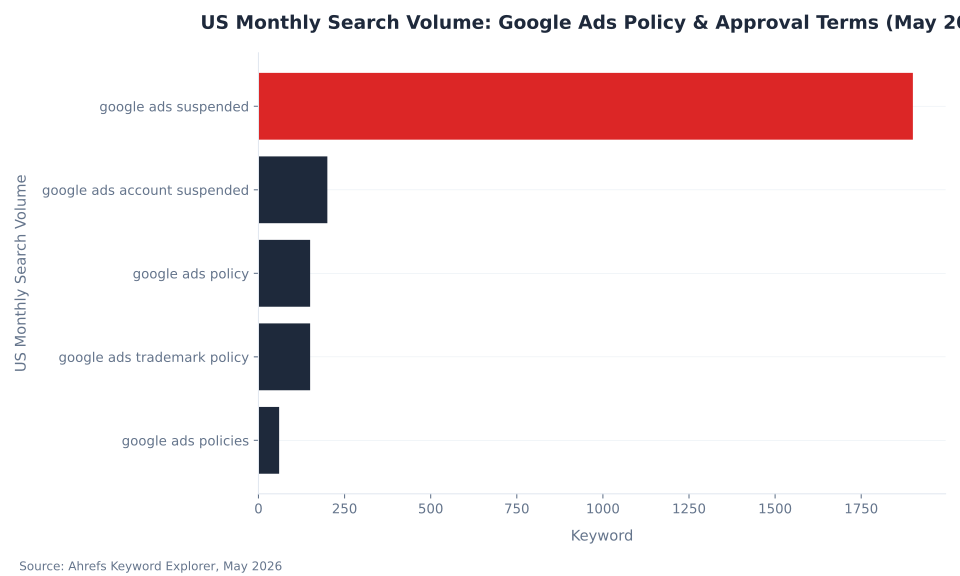
US Monthly Search Volume: Google Ads Policy & Approval Terms (May 2026)
Google Ads Disapproved: Common Causes and How to Fix Them
Third-party analysis of 2026 disapproval data identifies five causes behind the majority of rejected ads. These percentages are from industry analysis — AuditSocials and Digital Marketing Knight — not from a Google-published breakdown.
| Disapproval reason | Share | Typical cause | Fix |
|---|---|---|---|
| Misleading content | ~31% | Ad claims (guarantees, superlatives, implied promises) not substantiated on the landing page | Remove unsubstantiated claims; align ad copy to landing-page proof points |
| Destination mismatch | ~24% | Display URL domain does not match final URL domain; redirect chains that change domain | Match display URL to final URL domain exactly; eliminate cross-domain redirect chains |
| Editorial violations | ~19% | Excessive capitalization, punctuation abuse, repeated words, non-standard characters | Edit to standard sentence case; remove extra exclamation marks (one maximum per ad) |
| Restricted content | ~15% | Ad for a restricted-category product without required certification or targeting restriction | Complete the relevant Google certification; add required age and geo targeting |
| Trademark complaint | ~11% | Competitor trademark appearing in headline, description, or display URL without authorization | Remove trademark from ad text; trademark use as a keyword target remains permitted in the US |
Two of the top five causes — misleading content (31%) and destination mismatch (24%) — are structural, not copywriting errors. They stem from account-setup decisions made before the ad was written. An ad that promises a guarantee the landing page doesn't substantiate, or a display URL that doesn't match the final URL domain, fails review every time regardless of how the copy is edited. The practical fix is upstream: a pre-submission checklist that verifies landing-page proof points and URL alignment before any ad enters review. For legal PPC and financial services PPC clients, editorial violations frequently compound with restricted-category triggers — the two causes need separate fixes applied in the correct order.

Running ads in a restricted vertical?
MB Adv Agency handles pre-launch policy compliance — verification, certification, and targeting audit — as a standard step for every new account in financial services, healthcare, and legal. See how we structure legal PPC and financial services PPC engagements.
View Legal PPC Services →Google Ads Trademark Policy: The Rule That Works in One Direction
Google's trademark policy applies to ad text and display URLs — not to keyword bidding. Bidding on a competitor's trademarked brand name as a keyword is legal under US law and permitted under Google's current policy: Google explicitly does not investigate trademarks used as keyword targets. Source: Google Ads Trademarks policy. The competitor-keyword strategy that many advertisers assume is categorically forbidden is, in the US, a permitted tactic — declining to use it is a unilateral disarmament decision, not a compliance requirement.
The restriction is unidirectional: a competitor's trademark cannot appear in your ad headline, description, or display URL without the trademark owner's authorization. The practical consequence: an advertiser can bid on 'Salesforce CRM' as a keyword and show their own CRM ad to those searches, provided the word 'Salesforce' does not appear in the ad copy itself. In February 2025, Google narrowed its complaint-specific enforcement mechanism: a trademark complaint filed against one advertiser now restricts only that specific advertiser — not all advertisers using that trademark in ad text. Source: GrowLeads.io 2026. A trademark owner filing a complaint against one advertiser no longer automatically blocks all advertisers from using that trademark in ad copy.
If a competitor is using your trademark in their ad text (not just bidding on it as a keyword), the correct channel is Google's trademark complaint form — not a disapproval appeal. Disapproval appeals apply to your own ads; they have no mechanism for actioning competitor behavior. The two processes are separate and cannot substitute for each other.
AI-Generated Ad Content: The March 2026 Disclosure Requirement
As of March 5, 2026, any ad that uses AI-generated creative elements — across Search, Display, YouTube, Shopping, and Performance Max — must carry a clearly visible 'AI Generated' label within the ad unit. Source: AuditSocials 2026. Google activated SynthID watermarking for all images generated through Gemini, Vertex AI, and Google Ads tools in November 2025, enabling automated detection of AI-generated assets before review.
Unlabeled AI content is treated under Google's Misrepresentation framework — the same severity as fabricated testimonials or false credentials. Deepfake depictions of real, identifiable people are prohibited outright, not subject to disclosure. For advertisers using AI creative tools to produce ad imagery at scale, the compliance overhead is operational: every asset depicting real individuals needs to pass a prohibition check before upload, and assets generated through Google's own tools carry SynthID watermarks that automated detection will flag if the disclosure label is absent. For fashion PPC advertisers generating lifestyle imagery at scale, this is the policy change with the largest production footprint in 2026.
The Appeal Process: How to Respond to a Disapproved Ad
Two paths exist after a disapproval: fix-and-resubmit, or appeal. Fix-and-resubmit is the correct path when the disapproval reason is clear — editorial violations, destination mismatch, or missing targeting restrictions. Appeal is for cases where the advertiser believes the policy decision is incorrect. Since November 2025, Google's AI-improved (Gemini-based) review system has resolved 99% of account suspension appeals within 24 hours — an 80% reduction in incorrect suspension rates and a 70% acceleration in appeal processing. Source: Search Engine Land, November 2025. The 99% within 24 hours figure applies to account suspension appeals specifically, not to all standard ad disapproval reviews. Standard ad review completes within one business day for most ads, per Google's stated SLA.
The in-platform appeal path: Tools menu → Troubleshooting → Policy Manager → Policy Issues tab → select 'Appeal' on the affected ad → choose 'Dispute decision' or 'Made changes to comply with policy' → add a 500-character explanation → attach supporting documentation → submit. Google enforces a limit of two appeals per ad. Exceeding that limit flags the account for escalating enforcement, particularly for ads targeting minors or containing disputed factual claims. A 24-hour cooldown applies between appeals on the same ad — submitting within that window causes appeals to be treated as duplicates and deprioritized. Source: Google Ads Help, 'Fix a disapproved ad or appeal a policy decision'; StubGroup 2026.
MB Adv Agency has found that the highest-leverage intervention is not the appeal itself — it is documenting the account's compliance posture before any appeal is filed. Appeals that arrive with a landing-page screenshot, a certification reference number, or a business-license upload clear human review faster than appeals that rely on the explanation field alone. For accounts spending over $10,000/month, or for complex restricted-category cases where the disapproval reason reflects a genuine policy ambiguity, direct contact with Google Ads support routes the case to a human reviewer from the start. That path runs 5–10 business days but is appropriate when the automated queue lacks context for the specific account situation.
Status: Eligible (Limited)
Ad is running — reach is restricted
Passes review but serves to a fraction of eligible audience. Does not self-resolve. Fix: complete certification, add targeting restrictions, or update landing page.
Status: Disapproved
Ad is blocked — specific rule violated
Ad-level action. Correct the specific violation and resubmit, or appeal if the decision is incorrect. Two-appeal limit per ad. No account-suspension risk on first occurrence.
Status: Suspended
Account blocked — pattern triggered
Account-level enforcement. Triggered by repeated violations, circumvention attempts, or zero-tolerance category violations. Different process from a disapproval — escalate through support.
Advertiser Identity Verification: Now Required for Every New Account
Advertiser Identity Verification (AIV) is required for every new advertiser before campaigns serve. Google has been rolling out mandatory AIV globally since 2022; as of 2025–2026, the requirement applies across all markets. Source: Google Ads, Advertiser Verification. Agencies onboarding new clients who skip AIV see campaigns pause at launch — not after a run that reveals the gap.
Financial services — loans, insurance, investment products, credit, and debt services — add a second verification layer: Financial Services Verification, which requires proof of regulatory standing in each target country. In June 2025, debt service providers in Australia, Brazil, Germany, Ireland, South Korea, and Spain were required to complete verification by June 3, 2025. Source: Google 'Update to Verification Process for Debt Services,' June 2025. Malaysia was added in April 2026, with enforcement from April 14, 2026. Any financial services client entering a new market needs to verify their certification scope before the campaign launch date.
MB Adv Agency treats pre-launch policy compliance — AIV, category certification, targeting restriction audit — as a standard onboarding step for every new client in a regulated vertical. The cost of completing certification before launch is a few days of lead time. The cost of discovering a missing certification after a campaign has been running is a pause, an appeal queue, and performance data loss during the gap. For insurance PPC clients specifically, Financial Services Verification is the single most common cause of delayed campaign launches — completing it during the proposal stage rather than the setup stage eliminates the delay entirely. Local service businesses, including those seeking legal PPC in Missoula, MT or HVAC PPC in Flagstaff, AZ, rarely encounter restricted-category verification requirements — their policy challenges are editorial, not certification-based.
Google Ads Policy: Frequently Asked Questions
The five questions advertisers ask most often about Google Ads policy, approval, and enforcement.
How long does Google Ads ad review take?
Most ads complete review within one business day. Google's stated SLA is 'most ads reviewed within one business day' — the exact language from its Help Center, verified May 2026. Sensitive-category and restricted-category ads trigger manual review, which typically runs 3–7 business days. The review timer resets each time an ad is edited during review — a common mistake that extends wait time without accelerating the outcome. If an ad has been marked 'Under Review' for more than two full business days without a status change, contact Google Ads support directly rather than resubmitting — resubmitting resets queue position. Standard Search ads in non-restricted categories rarely exceed 24 hours. For new accounts that have recently completed Advertiser Identity Verification, first-ad reviews occasionally take longer than standard SLA while verification systems sync. Political advertising triggers multi-layer manual review due to additional disclosure requirements and consistently runs at the longer end of the 3–7 business day range. Source: Google Ads Help, 'About the ad review process'.
What does "Eligible (Limited)" mean in Google Ads?
"Eligible (Limited)" means the ad is approved but its serving is restricted by a policy condition. The ad runs — but to a fraction of the eligible audience an unrestricted ad would reach. The status does not self-resolve. The three most common causes: the account is in a restricted category (gambling, healthcare, financial services) and has not completed the required certification; the ad or landing page contains terms associated with a regulated industry even if the actual product is compliant; or age-gating and geographic targeting have not been set to match policy requirements. The practical test: review the Limitations column in Policy Manager — it specifies which restriction is applying and links to the relevant certification or fix. Running with 'Eligible (Limited)' status for multiple days while assuming normal delivery is the error that compounds. Impression share data from that period understates actual market availability, making performance analysis misleading and bid optimization decisions structurally incorrect until the restriction is resolved.
Can competitors bid on my trademarked brand name in Google Ads?
Yes, in the United States. Bidding on a trademarked brand name as a keyword is permitted under Google's current trademark policy — Google does not investigate trademarks used as keyword targets. The restriction applies to ad text and display URLs: a competitor cannot display your trademark in their headline, description, or display URL without your authorization. If a competitor is doing exactly that — showing your trademark in their ad copy — you can submit a complaint through Google's Trademark Troubleshooter. If they are simply bidding on your brand-name keywords and showing their own ad copy, that is permitted and cannot be blocked through policy channels. In February 2025, Google narrowed complaint-specific enforcement: a trademark complaint filed against one advertiser restricts only that advertiser, not all advertisers using that keyword in ad text. The practical implication: a complaint is now a surgical tool against a specific violator, not a broad keyword lockout. Source: Google Ads Trademarks policy.
What is the correct process for appealing a disapproved Google ad?
Navigate to Tools → Troubleshooting → Policy Manager → Policy Issues tab, then select 'Appeal' on the affected ad. Choose 'Dispute decision' if you believe the policy call was incorrect, or 'Made changes to comply with policy' if you have already fixed the issue. Add a 500-character explanation, attach supporting documentation, and submit. Google enforces a limit of two appeals per ad — exceeding that limit flags the account for escalating enforcement. A 24-hour cooldown applies between appeals on the same ad; submitting within that window causes appeals to be treated as duplicates and deprioritized. Since November 2025, Google's AI-improved appeal system has resolved 99% of account suspension appeals within 24 hours — but that figure applies to suspension appeals specifically, not to standard ad disapproval reviews. The single most effective action to accelerate human review is attaching documentation (landing-page screenshot, certification reference, or business license) rather than relying on the explanation text field alone. Source: Google Ads Help.
What categories are restricted in Google Ads?
Restricted categories include alcohol, gambling and games of chance, healthcare and pharmaceuticals, financial products and services (loans, insurance, investment products, credit, debt services), political advertising, adult content (moderate), and AI-generated content depicting real people. Restricted does not mean prohibited — it means the advertiser must complete required verification, apply specific targeting restrictions, and include required disclosures. Prohibited categories — counterfeit goods, illicit drugs, malware, enabling wrongdoing — are not available under any circumstances. The compliance path varies by category: healthcare advertisers complete Google's category-specific certification (updated February 2026) and cannot use remarketing against sensitive health data; gambling advertisers need certification plus geo restriction to eligible jurisdictions; financial services advertisers complete Advertiser Identity Verification and Financial Services Verification for applicable products. Failure to complete the correct step produces either a disapproval or 'Eligible (Limited)' serving status, depending on the category and the specific missing requirement. Source: Google Ads Restricted Content policy.
Have a specific policy question?
For advertisers navigating a disapproval or suspension, or setting up a first campaign in a regulated vertical.
Get in touch →Methodology
Research conducted May–June 2026. Primary sources: Google Ads Policies Help Center (support.google.com/adspolicy) and Google Ads Help Center (support.google.com/google-ads). Policy-structure and SLA claims verified against current primary-source pages. Third-party sources used for: disapproval-reason share percentages (AuditSocials, Digital Marketing Knight — attributed as industry analysis, not Google data); appeal timeline context (StubGroup 2026); advertiser verification scope (Oyova 2026, NovaBeyond 2025); trademark policy nuance (GrowLeads.io 2026); AI content policy (AuditSocials 2026); enforcement scale statistics (Google 2025 Ads Safety Report). The "99% within 24 hours" figure applies to account suspension appeals (November 2025 announcement) — not to standard ad disapproval reviews. Reviewed by MB Adv Agency, June 2026.

As a Google Ads expert, I bring proven expertise in optimizing advertising campaigns to maximize ROI.
I specialize in sharing advanced strategies and targeted tips to refine Google Ads campaign management.
Committed to staying ahead of the latest trends and algorithms, I ensure that my clients receive cutting-edge solutions.
My passion for digital marketing and my ability to interpret data for strategic insights enable me to offer high-level consulting that aims to exceed expectations.
Google Partner Agency
We're a certified Google Partner Agency, which means we don’t guess — we optimize withGoogle’s full toolkit and insider support.
Your campaigns get pro-level execution, backed by real expertise (not theory).

4.9 out of 5 from 670+ reviews on Fiverr.
That’s not luck, that’s performance.
Highly recommend Matteo to set up your server side tracking. He has a deep understanding of e-commerce tracking and will go above and beyond to make sure everything is set up correctly and working 100%. If you are scaling your store this set up is non-negotiable in my opinion and there isn't many people who have this much knowledge or put the effort in to get it right. Thanks again!
avorodesign.com
I can only recommend Matteo! He was very patient, professional and very knowledgeable about GA4, Consent Mode v2, and GDPR compliance. Communication was clear, and the setup was done professionally and efficiently. Highly recommend him for anyone needing reliable tracking implementation.
www.natureiki.life
Matteo shines in the realm of online professionals. His work is not only deep in data but also complemented by his proactive communication and cooperation, setting a new standard for freelancers. If you want someone who truly exceeds expectations, look no further. Highly recommended!

www.omanbeverlysmyth.com
Exceptional Service Beyond Expectations - Outstanding Service Impeccable depth, flawless delivery, and exceptional language fluency—this service exceeded all expectations. Highly recommended. Matteo truly ROCKS!!!

ium-paris.com
Top-notch, always highly value working with Matteo. An absolute Google Ads Genius. This is approximately the 8th time I have hired him and he's helped us get 6-7 ROAS. We are excited in continuing to improve our lead flow. Hire this guy if you need Google Ads help. Thanks Matteo!

www.dleeventgroup.com
I finally found the guy who can setup server side tracking and all the ecosystem properly. I definitely recommend Matteo. He is very responsive, kind and wants to dig into things. He configured GA4, Meta, Google Ads, Outbrain and google consent v2 with Cookiebot. Thanks Matteo.

inomega.fr
MB Adv delivered exceptional work with outstanding professionalism and lots of patience, taking time to see effects of changes made and not just do the work and submit it. The proactive communication and video summaries of the work completed made working with Matteo a pleasure, as he consistently went above and beyond. Highly recommended for web analytics projects! We are already working on another project.

www.withnellsensors.co.uk
Working with Matteo on my Google Ads was a game-changer. He's not just a strategist, he's a true partner. He understood my goals and tailored a campaign that perfectly reached my target audience. I'm grateful for his expertise and dedication.
dccargo.com
Click-driven mind
with plastic-brick obsession.
We build Google Ads campaigns with the same mindset we use to build tiny brick worlds: strategy, patience, and zero tolerance for wasted pieces.
Data is our blueprint. Growth is the only acceptable outcome.