Meta Ads Audience Targeting: Custom, Lookalike & Advantage+

75%
of iOS users cannot be tracked by the Meta Pixel as of 2026 — the direct result of Apple's App Tracking Transparency mandate (iOS 14.5, April 2021). With only 25% of iOS users granting cross-app tracking permission globally, website Custom Audiences and pixel-based retargeting pools are structurally smaller than raw site traffic. The durable alternative is the Customer List audience: hashed CRM data matched against Meta's own logged-in user graph, with no IDFA or cookie dependency. For any advertiser running Meta campaigns in 2026, a clean, regularly refreshed CRM list is the most reliable audience asset available.
Meta Ads Audience Targeting in 2026: Four Types, One Fundamental Shift
Meta Ads offers four audience targeting types in 2026: Core/Saved audiences built on demographics, interests, and behaviors; Custom audiences sourced from your own first-party data; Lookalike audiences seeded from a Custom Audience source; and Advantage+ audience, Meta's AI-driven default that treats all manual inputs except location and minimum age as optional suggestions. The decisive shift is in how targeting actually works: Advantage+ audience is now the default for new campaigns, and entering interests or demographic ranges does not fence the campaign to matching users — it hints. Meta's algorithm expands past those suggestions when it finds higher-converting users elsewhere.
Advertisers who treat Advantage+ inputs as hard filters — expecting the system to behave like Facebook targeting through 2021 — see wider-than-expected delivery and interpret it as a bug. It is not. The correct mental model in 2026: audience inputs teach Meta about your best customers; they do not confine the campaign to a defined list. The only genuinely constraining inputs in Advantage+ are location (country, region, city, radius) and minimum age. Everything else is a signal the AI weights against its own conversion-optimized predictions. See Advantage+ and AI automation for the full set of Advantage+ features and controls.
Two structural changes reshaped what targeting options exist. On January 19, 2022, Meta removed thousands of detailed targeting categories covering health causes, race and ethnicity, political affiliation, religious practices, and sexual orientation — enforced by March 17, 2022. Then on June 23, 2025, Meta consolidated remaining specific interests (individual sports teams, niche food preferences, music sub-genres) into broad groups and removed detailed targeting exclusions entirely. Active campaigns using deprecated interests stopped delivering January 15, 2026. The interest-stacking and layered-exclusion tactics that defined Facebook advertising for a decade are no longer rebuilable from the current option set. See Meta's detailed targeting updates for the current state of the interest library.
On the first-party data side, iOS 14.5 ATT (April 2021) permanently shrank pixel-based retargeting. Roughly 75% of iOS users globally opted out of cross-app tracking, removing the IDFA Meta relied on to match ad impressions to off-platform behavior. Website Custom Audiences and retargeting pools skew away from iOS as a result — the gap is not a transitional phase but the operating environment. Customer List audiences (hashed email and phone matched on Meta's logged-in graph) carry no IDFA dependency and are the structurally durable retargeting and lookalike-seed source. The Meta Pixel and conversion tracking pillar covers the signal-recovery tools (Conversions API, browser-side redundancy) that partially offset ATT's impact on event measurement.
Key Takeaways
- Advantage+ audience is the default, not an option. New campaigns in most conversion objectives default to Advantage+ audience in 2026. Manual inputs are suggestions; only location and minimum age are hard constraints. Fighting this default with interest stacking produces under-delivery, not precision.
- Interest stacking ended January 15, 2026. The June 23, 2025 interest consolidation and exclusion removal made the layered-audience playbook inoperable. Precision now comes from Custom Audiences and lookalikes seeded on first-party data, not interest layer combinations.
- 75% of iOS users are invisible to the Meta Pixel. ATT opt-in stabilized at about 25% globally. Website Custom Audiences and retargeting pools are materially smaller than raw site traffic as a result. Customer List audiences carry no IDFA dependency and are unaffected.
- Lookalike quality is source intent, not source size. Meta's hard minimum is 100 records; the practical quality floor is ~1,000. A 1% lookalike seeded on 500 verified purchasers outperforms one seeded on 10,000 newsletter signups. The percentage slider is a secondary lever.
- The 2026 structure is a hybrid, not a binary choice. Sophisticated DTC accounts run 70–80% Advantage+ broad, 10–20% Custom Audience retargeting, and 5–10% lookalike or interest-seeded testing. Neither "Advantage+ everything" nor "manual everything" is the right architecture.
75%
iOS users with ATT opted out — pixel cannot track them (AdNabu 2026)
100
Meta's hard minimum source records to build a lookalike audience
15.8%
Average CVR for retargeting (warm) audiences vs 4.3% cold (AdAmigo 2026)
$1.72
Average Meta CPC all objectives, 2026 (WordStream/LocaliQ)
$23.10
Average cost per lead, lead-gen objective (WordStream/LocaliQ 2026)
~$50/day
Estimated budget floor where Advantage+ audience outperforms manual targeting
Meta Ads Audience Types: The 2026 Taxonomy
Meta groups its audience options into four categories. Core/Saved audiences are the manual interest-and-demographics selector — the original Facebook targeting layer. Custom audiences use your own data (pixel events, CRM lists, on-platform engagement, app activity) to target known contacts or site visitors. Lookalike audiences find new users resembling a Custom Audience source. Advantage+ audience is the AI-driven default that treats your Core inputs as suggestions and expands past them. Conversios's 2026 guide to Advantage+ vs detailed targeting confirms the Controls-vs-Suggestion distinction in the current Ads Manager UI.
The table below maps each type to its data basis, funnel stage, and best use case. The "targeting is" column is the critical column for 2026: the distinction between a hard constraint and a suggestion is the difference between delivering to a defined audience and training an AI toward a conversion goal. Which campaign objective you select also determines which audience controls are available — see Meta Ads campaign objectives for how the objective choice constrains targeting options.
| Audience type | Data basis | Funnel stage | Targeting is | Best use |
|---|---|---|---|---|
| Core / Saved | Demographics, interests, behaviors, location | Top–mid funnel | Suggestion in most objectives | New accounts; hyper-local; niche B2B; <$30/day budgets |
| Custom — website | Pixel-tracked site visitors and events | Bottom funnel | First-party (shrunk by iOS 14.5 ATT) | Retargeting visitors — pool smaller than raw traffic |
| Custom — customer list | Hashed CRM data (email, phone) on Meta's graph | Bottom / retention | No IDFA or cookie dependency | Most durable retargeting + lookalike seed |
| Custom — engagement | On-platform actions: video views, Page/IG engagement, lead-form opens | Mid–bottom funnel | First-party, on-platform; ATT-independent | Warm retargeting without pixel dependency |
| Lookalike | Users resembling a source Custom Audience; 1%–10% | Top–mid funnel (prospecting) | Algorithmic, seeded by first-party source | Scaling beyond existing customers from a high-intent seed |
| Advantage+ audience | Meta AI across the full user base; your inputs are optional | Any (default for new campaigns) | AI-controlled — only location + min age are hard constraints | Accounts with conversion history; budget ≥$50/day |
Sources: Meta Business Help, "Updates to Detailed Targeting"; Stackmatix, "Facebook Ads Targeting Options: Complete Guide 2026"; Factors.ai, "Meta Ads Targeting Strategies". App-activity Custom Audiences (SDK / App Events API signals) also exist for mobile app advertisers.
Custom Audiences in 2026: The First-Party Data Layer
Custom audiences are the most durable targeting lever on Meta in 2026 because they are built on data you own. There are five active source types: website visitors (pixel), customer lists (CRM), on-platform engagement, app activity, and — added March 2026 — two new engagement recency/frequency filters that enable retargeting precision without pixel dependency. The structural difference between these sources is their iOS ATT exposure: pixel-based website visitors lost coverage when ~75% of iOS users opted out; customer list and engagement audiences carry no IDFA dependency and were not affected.
For any advertiser with a CRM above ~500 contacts, the customer list is the primary retargeting mechanism. MB Adv Agency structures Meta retargeting with the customer list as the foundation layer, treating website Custom Audiences as a secondary signal for advertisers who also have server-side Conversions API coverage to partially recover ATT-blocked iOS events. Customer List audiences also serve as the highest-quality lookalike seeds available — the hashed match runs against Meta's logged-in graph, not against device identifiers that iOS privacy eroded.
| Source type | How it is built | ATT impact | Best for |
|---|---|---|---|
| Website visitors | Meta Pixel or Conversions API event data | Reduced: ~75% of iOS users not trackable | Retargeting active browsers; cart abandonment (pool smaller than raw traffic) |
| Customer list | CSV upload of hashed email / phone matched on Meta's graph | None — no IDFA or cookie dependency | Most durable retargeting layer; lookalike seed; suppression |
| Engagement | On-platform actions: video views, Page/IG interactions, lead-form opens, event RSVPs | None — on-platform signals only | Warm-audience retargeting without pixel; video-view sequences |
| App activity | Meta SDK or App Events API install, registration, purchase signals | Partial: iOS app installs require ATT permission | Mobile app advertisers; re-engagement campaigns |
| Engagement (2026 filters) | "At Least" (min. engagement frequency) + "In the Past" (recency window) — added March 2026 | None | Precise warm retargeting by engagement depth without a pixel |
Sources: Stackmatix, "Facebook Ads Targeting Options: Complete Guide 2026"; AdNabu, "iOS 14 Impact on Facebook Ads: Key Changes & Solutions 2026". March 2026 engagement filters confirmed via AdLibrary, "Custom Audience in 2026: The First-Party Layer."
Building a customer list audience in Ads Manager: navigate to Audiences → Create Audience → Custom Audience → Customer list. Upload a CSV with hashed or unhashed email addresses and/or phone numbers in E.164 format; Meta hashes unhashed values on upload. Typical email match rates run 50–80% of uploaded records against Meta's active user graph. Refresh the list monthly to capture new purchases and suppress recent converters from prospecting campaigns.
What Changed in Meta Detailed Targeting: 2021–2026
The Meta targeting playbooks circulating before 2022 describe a platform that no longer exists. Three structural changes since April 2021 permanently reshaped what is possible: iOS ATT shrank pixel-based retargeting pools; the January 2022 sensitive-category removals gutted the precision niche-audience options; and the 2025 interest consolidation plus exclusion removal ended the interest-stacking and layered-exclusion workflows. The timeline below maps each change to its enforcement date and practical effect.
| Date | Change | Effect on targeting |
|---|---|---|
| April 2021 | iOS 14.5: App Tracking Transparency mandatory | ~25% ATT opt-in globally; website Custom Audiences and retargeting pools shrink for iOS users |
| Jan 19, 2022 | Removal of "sensitive" detailed targeting categories begins | Health, race/ethnicity, political, religious, sexual-orientation options removed (enforced through March 17, 2022) |
| Feb 2025 | Advantage+ Shopping rebranded to Advantage+ Sales (ASC) | Expanded scope: sales, leads, app installs; some audience exclusion/suggestion controls added |
| March 31, 2025 | Detailed targeting exclusions removed from standard ad campaigns | Cannot exclude audiences by interest or behavior in standard campaigns; Custom Audience exclusions still work |
| June 10, 2025 | Detailed targeting exclusions removed from boosted posts | Exclusion removal now covers all campaign types |
| June 23, 2025 | Specific interest categories consolidated into broad groups | EDM fans, SUVs, vegan food, individual sports teams and similar merged; interest stacking largely eliminated |
| January 15, 2026 | Full enforcement of June 2025 changes | Campaigns with deprecated interests or exclusions stop delivering |
| 2026 (ongoing) | Advantage+ audience is the default for new campaign creation | Manual inputs become suggestions; only location + min age are hard constraints |
Sources: Meta Business Help, "Updates to Detailed Targeting"; Search Engine Land, "Meta will remove targeting options for sensitive topics on January 19" (2022); Social Media Today, "Meta Is Consolidating More of Its Detailed Ad Targeting Options" (2025); Adligator, "Meta Broad Targeting 2026".
The practical implication: any Meta playbook that describes "adding 5–10 interests and excluding broad categories to create a precise custom audience" is describing a 2019–2021 workflow. That workflow is operationally dead. The targeting precision available in 2026 comes from Custom Audiences seeded on first-party data (customer lists, verified purchasers), from lookalikes built on those sources, and from Advantage+'s AI optimization — not from interest-layer combinations.
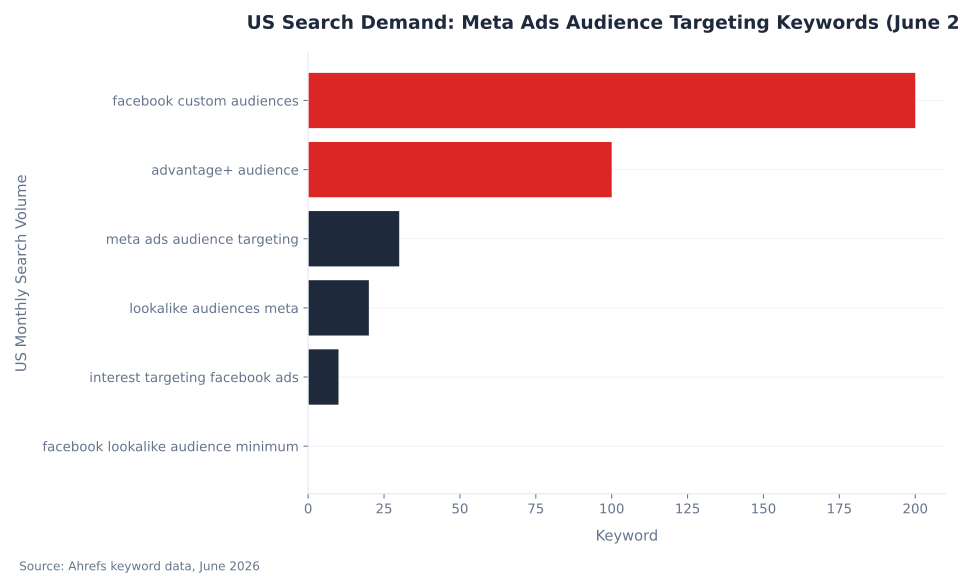
US Search Demand: Meta Ads Audience Targeting Keywords (June 2026)
Advantage+ Audience: Meta's AI Default and Its Hard Constraints
Advantage+ audience is not a campaign type — it is the audience configuration that Meta now defaults new campaigns to, particularly in Sales and Leads objectives. It works by taking optional audience inputs (age ranges, locations, interests, demographics) and treating them as a starting suggestion for the delivery algorithm, which then expands past those inputs as it collects conversion signals. The Ads Manager UI distinguishes between "Controls" (inputs Meta treats as hard constraints: location, minimum age) and "Audience suggestion" (everything else). AdNabu's 2026 Advantage+ explainer confirms the Controls/Suggestion distinction is visible in the current interface.
Advantage+ audience outperforms manual detailed targeting for accounts that have the data to feed it: a minimum of ~50 weekly conversions, a budget of about $50/day or more, and an established pixel or Conversions API setup. Below those thresholds, the algorithm cannot accumulate enough signal to learn efficiently, and a tighter Core/Saved audience with defined interest seeds produces more predictable early results. The threshold is not a hard rule but a signal-density floor: the AI needs data to optimize against.
Advantage+ audience is not "Advantage+ Shopping" or "Advantage+ Sales campaign." Those are campaign types. Advantage+ audience is the targeting configuration — a feature available within multiple campaign types. The naming overlap causes persistent confusion. See Advantage+ and AI automation for the full Advantage+ product map.
| Feature | Advantage+ audience | Manual detailed targeting (Core/Saved) |
|---|---|---|
| 2026 status | Default for new conversion/sales campaigns | Available; inputs treated as audience suggestions |
| Location | Hard constraint — delivery stays in defined locations | Hard constraint |
| Minimum age | Hard constraint — no delivery below the set floor | Hard constraint |
| Interest inputs | Suggestion: AI uses as a starting hint, then expands | Suggestion in most 2026 objective flows |
| Demographic inputs | Suggestion: AI expands past gender/age range when profitable | Suggestion in conversion-objective flows |
| Expansion behavior | Active: continuously widens delivery to find converters | Passive: inputs set initial seed, AI can still expand |
| Performs best when | Conversion history ≥50/week; budget ≥~$50/day; established pixel | New accounts; niche B2B; hyper-local; budget <~$30/day |
Sources: Conversios, "Meta Advantage+ Audience vs Detailed Targeting (2026 Guide)"; AdNabu, "What Is Meta Advantage+ Audience? How It Works in 2026"; AlexNeiman, "Advantage+ Audience 2026: When It Works (and When It Doesn't)".
The most common misconfiguration in inherited accounts: an advertiser enters a narrow interest set in an Advantage+ campaign expecting it to fence delivery, sees traffic from unexpected demographics, and concludes "the targeting is broken." The targeting is working as specified. Advantage+ is designed to find converters outside the initial suggestion set. MB Adv Agency has found that clients who expect Advantage+ to behave like a locked interest filter consistently diagnose under-delivery as a targeting problem when it is a mental-model problem — understanding the Controls/Suggestion distinction resolves most of these cases before any campaign changes are needed.
Lookalike Audience Size vs. Cost Per Lead (AdEspresso $1,500 Experiment)

Meta Ads Benchmarks 2026: Performance Context by Metric
Platform-wide Meta benchmarks provide context for evaluating campaign efficiency by audience type. The all-industry averages below come from the 2026 WordStream/LocaliQ and Triple Whale benchmark reports. These figures are aggregates across objectives, verticals, and audience configurations; retargeting campaigns (Custom Audience bottom-funnel) consistently outperform cold prospecting on CVR and CPA, while CPM is higher for the high-purchase-intent segments that retargeting targets. Use these as directional context, not as targets for specific verticals.
| Metric | All-objective figure | Lead-gen objective | Note |
|---|---|---|---|
| CTR (average) | ~2.19% | ~2.50% | Traffic objective lower at ~1.51%; most verticals 2–3% |
| CPC (average) | ~$1.72 | ~$1.92 | Traffic CPC ~$0.70; legal/insurance highest |
| CPM (average) | ~$13.48 | — | Reflects auction competition across all placements |
| Conversion rate (on-site) | ~1.57% | — | On-site purchase CVR; varies heavily by vertical and offer |
| CVR (lead-form) | — | ~8.25% | Instant Form CVR far exceeds on-site purchase CVR |
| Cost per lead | — | ~$23.10 | Lead-gen objective average across industries |
| CPA (average) | ~$38.17 | — | All-industry median; varies widely by vertical and audience quality |
| ROAS (median) | ~1.93 | — | E-commerce-weighted; DTC margin-dependent |
Sources: WordStream/LocaliQ, "Facebook Ads Benchmarks 2026"; Triple Whale, "Facebook Ad Benchmarks by Industry". Figures are all-industry aggregates; vertical-specific benchmarks differ significantly.
The CVR gap between lead-form (8.25%) and on-site purchase (1.57%) explains why lead-gen businesses running Instant Form campaigns see lower CPA than DTC accounts running to landing pages at similar budget levels. For legal PPC, dental PPC, and financial services PPC — sectors where Meta lead-form campaigns are common — the $23.10 average CPL and 8.25% form CVR are the most relevant benchmarks, not the all-objective CPC.
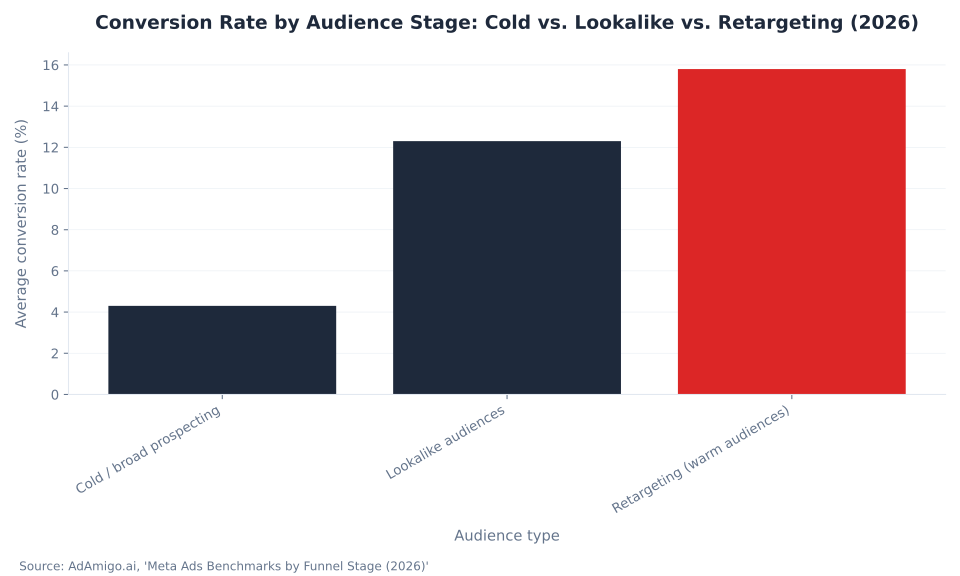
Conversion Rate by Audience Stage: Cold vs. Lookalike vs. Retargeting (2026)
Interest and Behavioral Targeting on Meta Ads
Interest and behavioral targeting on Meta — the Core/Saved audience selector in Ads Manager — still exists in 2026, but at substantially reduced granularity. The two-phase removal process that began in January 2022 and completed enforcement in January 2026 eliminated the sensitive-category options and then consolidated remaining specific interests into broad groups. Behavioral signals (purchase behavior, device usage, travel frequency) and life events remain available and useful for audience seeding. The niche-interest layer that enabled precise targeting through ~2021 is gone.
What changed most in practice is not the removal of any single interest, but the loss of the combination effect. Interest stacking — layering "yoga" + "organic food" + "SUV owners" to create a narrow custom segment — required both the specific interest options (now consolidated) and the exclusion capability (now removed). Neither is available in the 2026 interface. The remaining use case for Core/Saved audiences is seeding: supplying a behavioral or broad-interest starting point for campaigns in accounts that lack the conversion data to run pure Advantage+ efficiently. For fashion PPC, beauty products PPC, and supplements & nutrition PPC — sectors where behavioral signals like "frequent online buyers" and "engaged shoppers" are available — Core/Saved seeding still adds directional value for new accounts before Advantage+ accumulates conversion data.
| Category | Status in 2026 | Examples |
|---|---|---|
| Broad demographic interests | Available | "Music", "Sports & outdoors", "Technology", "Business & industry" |
| Behavioral signals | Available | "Frequent online buyers", "Engaged shoppers", "Small business owners", "Frequent travelers" |
| Life events | Available | "Newly engaged", "Recently moved", "Expecting parents", "New job" |
| Specific niche interests | Removed June 23, 2025 | Individual car models, music sub-genres (EDM, K-pop), specific food preferences (vegan, keto) |
| Sensitive categories | Removed Jan 19, 2022 | Health causes, race/ethnicity, political affiliation, religious practices, sexual orientation |
| Detailed targeting exclusions | Removed March–June 2025 | Cannot exclude by interest/behavior in any campaign type (Custom Audience exclusions still work) |
Sources: Meta Business Help, "Updates to Detailed Targeting"; Search Engine Land, 2022 removal coverage; Social Media Today, 2025 consolidation coverage.
Behavioral signals deserve specific attention because they are first-party Meta data, not third-party inferences that iOS ATT touches. Signals like "Frequent international travelers" or "Engaged shoppers" come from on-platform behavior — payment data, app usage, interaction patterns within the Meta ecosystem. These are not pixel-dependent and were not weakened by ATT. For local service businesses running HVAC PPC in Flagstaff, AZ or roofing PPC in Flagstaff, AZ, combining geographic targeting (hard constraint) with a homeownership behavioral signal remains a valid Core/Saved seed strategy.
Lookalike Audiences: Sizing, Percentage, and the Source Quality Rule
A lookalike audience finds Meta users who resemble your source Custom Audience. The percentage parameter (1%–10%) controls the tradeoff between similarity and reach: 1% delivers the tightest match to a smaller pool; 10% trades resemblance for volume. But the percentage slider is the secondary variable. The source quality is the primary one. A 1% lookalike seeded on 500 verified purchasers outperforms a 1% lookalike seeded on 5,000 newsletter signups. The algorithm mirrors the signal you give it — feed it buyers, it finds buyers.
| Setting | Value | What it means | When to use it |
|---|---|---|---|
| Hard source minimum | 100 records | Meta's documented floor to build a lookalike | Floor only — quality is weak at this count |
| Practical quality floor | ~1,000 records | Enough for stable pattern-matching (Meta's recommended floor) | Most small/mid accounts; 1% lookalikes |
| Sweet spot (broad) | 5,000–10,000 records | Strong matching without diluting source quality | 5–10% lookalikes; scaling prospecting |
| Source intent rule | Intent > size | 500 verified purchasers beat 10,000 newsletter signups as a seed | Always — seed on purchasers/high-LTV contacts first |
Sources: Flighted, "Meta Lookalike Audiences: Complete Guide for 2026"; Stackmatix, "Facebook Lookalike Audiences in 2026"; Lionelz, "Lookalike Audiences in Meta Ads: Complete 2026 Guide". The 100-record floor is Meta's documented minimum; quality thresholds are practitioner consensus, not a Meta-published figure.
The "facebook lookalike audience minimum" is a question that comes up constantly in new Meta accounts. Meta's documented hard floor is 100 source records. Practical quality starts around 1,000. The common mistake is waiting to "get enough" contacts before building a lookalike, when most advertisers with any customer list are already past the 100-record floor and sitting on a better source than they recognize. For jewelry PPC and furniture PPC brands with average order values above $500 — categories where purchaser lists tend to be smaller but high-LTV — a 1% lookalike seeded on even a few hundred buyers is operationally valid. MB Adv Agency has found that for DTC accounts in these high-AOV verticals, a 1% purchaser lookalike consistently produces the lowest prospecting CPA available on Meta, outperforming both interest-seeded Core audiences and broader Advantage+ cold starts when the account lacks historical conversion data.
| Percentage | Approx. US reach | Similarity to source | Best use case |
|---|---|---|---|
| 1% | ~2.3–2.5 million | Tightest match | Purchaser/high-LTV seeds; bottom-funnel scaling; lowest CPA |
| 3% | ~7 million | Balanced | Mid-funnel prospecting; new market testing |
| 5% | ~11.5 million | Greater reach | Top-funnel; larger source available |
| 10% | ~23 million | Lowest similarity | Awareness only; large budget required to convert |
Source: ROASPIG, "Best Lookalike Audience Percentage (0–1%, 1–5%, 5–10%)". US reach figures are estimates; global and non-US market reach scales proportionally to Meta's active user base in that country.
The AdEspresso controlled experiment below provides directional evidence for the 1% vs. 10% CPA gap. In a $1,500 lead-gen test, the 1% lookalike delivered a cost per lead 70% lower than the 10%, with equal CTR for 1% and 5% but a drop at 10% suggesting the broad pool includes users with meaningfully lower intent. The source in that experiment was a high-intent seed; with a low-quality source, the gap narrows because both the tighter and broader lookalikes are working from a weak signal.
| Lookalike size | Cost per lead (USD) | CTR | Vs. 1% |
|---|---|---|---|
| 1% (tightest) | $3.75 | 0.82% | Baseline |
| 5% (balanced) | $4.16 | 0.82% | +11% CPL vs 1% |
| 10% (broadest) | $6.36 | 0.66% | +70% CPL vs 1% |
Source: AdEspresso, "The $1,500 Facebook Audience Experiment: 1% vs. 5% vs. 10% Lookalike". Single controlled experiment (lead-gen objective, $1,500 budget); directional context, not a large-panel aggregate. Source quality effects dominate percentage effects in accounts with high-intent seed lists.
Audience Strategy in 2026: The Hybrid Structure
The most common structural mistake in Meta accounts in 2026 is treating audience selection as a binary: either full Advantage+ broad or manual Core/Saved targeting. The prevailing high-performance structure is a hybrid: the majority of budget runs on Advantage+ broad campaigns that let the algorithm optimize across the full user base, while a dedicated retargeting layer targets known contacts and site visitors who are already in the consideration funnel. A small test budget covers lookalike or interest-seeded campaigns for creative experimentation and new market entry.
| Audience stage | CTR range | Avg CVR | CPA range | Audience type to use |
|---|---|---|---|---|
| Cold / broad prospecting | 0.94%–1.71% | 4.3% | — | Advantage+ broad or 5% lookalike |
| Lookalike (warm prospecting) | — | 12.3% | — | 1%–3% lookalike seeded on purchasers |
| Re-engagement (warm) | 1.5%–3.0% | — | $10–$20 | Website visitors (30d), video viewers, engagers |
| Retargeting (bottom-funnel) | Up to 3.0%+ | 15.8% | — | Customer list; 14-day cart abandoners; DPA catalog |
Source: AdAmigo.ai, "Meta Ads Benchmarks by Funnel Stage (2026): Prospecting vs. Retargeting". CVR figures are platform-wide averages across verticals; retargeting CPL is typically 3–5× lower than cold prospecting.
The CVR contrast in the funnel table explains the structural logic: cold prospecting converts at 4.3%, lookalike at 12.3%, and retargeting warm audiences at 15.8%. Retargeting CPL is typically 3–5 times lower than cold prospecting at equivalent budgets. Running "Advantage+ everything" without a dedicated retargeting layer leaves the bottom-funnel conversion rate unmined. MB Adv Agency structures inherited DTC accounts on this hybrid and treats "Advantage+ everything" as a single point of failure when conversion history is thin — the algorithm has no prior-purchaser signal to optimize against.
| Segment | Budget share | Audience type | Qualifying condition |
|---|---|---|---|
| Advantage+ broad | 70–80% | Advantage+ audience (AI default) | ≥50 weekly conversions; budget ≥$50/day; established pixel or CAPI |
| Retargeting | 10–20% | Website Custom Audience + customer list + engagement | Any account with a pixel or CRM list; bottom-funnel conversion |
| Lookalike / interest testing | 5–10% | 1% purchaser lookalike or behavioral Core seed | Creative testing; new markets; early-stage accounts |
Note: Budget share is a directional structure, not a fixed formula. Accounts under ~50 weekly conversions should weight manual targeting higher until Advantage+ has signal to optimize. "Advantage+ everything" without retargeting or first-party data investment is a single point of failure when conversion history is thin.
For shoes PPC, pet supplies PPC, and other DTC categories with repeat purchasers, the customer list feeds both the retargeting segment (exclude recent converters from prospecting; target lapsed buyers with win-back messaging) and the lookalike seed for the testing budget. For legal PPC in Missoula, MT and plumbing PPC in Missoula, MT — local lead-gen businesses where the customer list is small — the engagement Custom Audience (video viewers, page engagers) fills the retargeting layer when the CRM list is below ~500 contacts.
iOS ATT Opt-In vs. Opt-Out: Share of iOS Base (2026)

Your audience structure determines whether Advantage+ has signal to optimize against — or nothing.
MB Adv Agency builds Meta audience architecture for DTC e-commerce brands and lead-gen businesses. First-party data audit, custom audience build, hybrid campaign structure, and ongoing optimization.
Fashion PPC services →Beauty products PPC →iOS 14.5 and the Retargeting Pool Reality
Apple's App Tracking Transparency became mandatory with iOS 14.5 in April 2021. Every app was required to ask permission before tracking users across other apps and websites. Globally, the opt-in rate stabilized at about 25%, meaning roughly 75% of iOS users block cross-app tracking. AdNabu's 2026 iOS impact analysis describes the direct consequence for Meta: "roughly three out of four iOS users are now invisible to the Facebook Pixel." iOS represents about 55–60% of the US smartphone market, so the share of US smartphone users invisible to pixel tracking is material.
The mechanism: without the IDFA (Apple's Identifier for Advertisers), Meta cannot match an ad impression served to an iOS user to that user's subsequent on-site behavior. The user visits your site, but Meta's pixel does not receive a signal attributable to that specific user, so they are not added to website Custom Audiences. Retargeting pools are therefore smaller than raw site traffic — the gap is not a measurement error but a structural coverage gap. Cometly's ATT impact guide confirms the equilibrium is permanent: ATT is the operating environment of 2026, not a temporary disruption from 2021.
The customer list is the structurally durable alternative. Customer List Custom Audiences match hashed email and phone against Meta's own logged-in user graph — a Meta-internal match that carries no IDFA or cookie dependency. For any advertiser with a CRM list above ~500 contacts, this is the most reliable first-party retargeting and lookalike-seed source available, regardless of the iOS device composition of their customer base. See Meta Pixel and conversion tracking for the server-side signal recovery tools (Conversions API) that partially offset ATT's impact on event measurement.
For local service verticals — PPC management in Austin and PPC management in Chicago — the retargeting pool reality has a different shape than for DTC e-commerce. Local service businesses typically do not have large pixel-tracked site traffic. Their retargeting layer depends on engagement Custom Audiences (video viewers, lead-form openers, page engagers), which are on-platform signals that ATT does not affect. Building that engagement audience is an active strategy — video content that qualifies intent before a conversion event is a functional substitute for pixel retargeting when the iOS-constrained website pool is thin.
Four Audience Targeting Misconceptions to Correct
The four misconceptions below circulate widely in Meta advertising guides and courses. Each one produces a different category of avoidable error. Correcting them before building audience structure saves weeks of debugging campaigns that are working as designed.
1. "Advantage+ audience and detailed targeting are the same thing with a new name."
They are different products. Manual detailed targeting (the interest-and-demographics selector) still exists in Ads Manager in 2026, but in most objectives its inputs are treated as suggestions the algorithm uses as a starting hint, then expands past. Advantage+ audience is the AI-driven default that honors only location and minimum age as hard constraints. Setting an interest in Advantage+ does not restrict delivery to that interest. The Ads Manager UI labels this explicitly: "Controls" vs. "Audience suggestion." Source: AdNabu, "What Is Meta Advantage+ Audience" (2026).
2. "Interest stacking and detailed exclusions still give you precise Facebook audiences."
Both mechanisms are gone. The January 2022 removals eliminated sensitive-category interests; the June 2025 consolidation merged thousands of specific interests into broad groups; and detailed targeting exclusions were removed from standard campaigns March 31, 2025, from boosted posts June 10, 2025, with full enforcement January 15, 2026. Precision now comes from Custom Audiences and lookalikes built on first-party data, not from interest layer combinations.
3. "Your retargeting audience size equals the number of people who visited your site."
It does not, and has not since iOS 14.5. Opted-out iOS users — about 75% of the iOS base globally — cannot be tracked back to your site and added to a website Custom Audience. The usable pixel retargeting pool is materially smaller than raw Google Analytics traffic, and it skews away from iOS. Customer List audiences (hashed CRM data) have no IDFA dependency and are not affected by ATT. Source: AdNabu, "iOS 14 Impact on Facebook Ads" (2026).
4. "You need a huge list to build a lookalike audience."
Meta's hard minimum is 100 source records. The real requirement is intent quality, not raw count: a 1% lookalike seeded on a few hundred actual purchasers outperforms one seeded on tens of thousands of low-intent email signups. Size only becomes the constraint at the broad end (5%–10% lookalikes benefit from 5,000–10,000 source records). Advertisers who defer building a lookalike until they have "enough" contacts are often already past the functional minimum and sitting on a higher-quality source than they estimate. Source: Flighted, "Meta Lookalike Audiences: Complete Guide for 2026".
Frequently Asked Questions: Meta Ads Audience Targeting
Questions about audience architecture for your Meta account?
MB Adv Agency audits existing Meta accounts, identifies first-party data gaps, and builds audience structures designed for the 2026 platform — not the 2021 one.
Talk to MB Adv Agency →Methodology
This pillar draws from Meta Business Help ("Updates to Detailed Targeting," "About Advantage+ audience"), Search Engine Land's 2022 removal coverage, Social Media Today's 2025 consolidation reporting, AdNabu's 2026 iOS 14.5 impact analysis, Cometly's ATT impact guide, practitioner guides from Conversios, AlexNeiman, Adligator, Flighted, and Stackmatix; benchmark data from WordStream/LocaliQ 2026 and Triple Whale 2026; and funnel-stage data from AdAmigo.ai 2026. All platform-mechanic claims were corroborated against ≥2 practitioner sources. No mbadv client metrics appear in this pillar — MB Adv attributions are qualitative operating practices, not quantified results. Reviewed by MB Adv Agency, June 2026.

As a Google Ads expert, I bring proven expertise in optimizing advertising campaigns to maximize ROI.
I specialize in sharing advanced strategies and targeted tips to refine Google Ads campaign management.
Committed to staying ahead of the latest trends and algorithms, I ensure that my clients receive cutting-edge solutions.
My passion for digital marketing and my ability to interpret data for strategic insights enable me to offer high-level consulting that aims to exceed expectations.
Google Partner Agency
We're a certified Google Partner Agency, which means we don’t guess — we optimize withGoogle’s full toolkit and insider support.
Your campaigns get pro-level execution, backed by real expertise (not theory).

4.9 out of 5 from 670+ reviews on Fiverr.
That’s not luck, that’s performance.
Highly recommend Matteo to set up your server side tracking. He has a deep understanding of e-commerce tracking and will go above and beyond to make sure everything is set up correctly and working 100%. If you are scaling your store this set up is non-negotiable in my opinion and there isn't many people who have this much knowledge or put the effort in to get it right. Thanks again!
avorodesign.com
I can only recommend Matteo! He was very patient, professional and very knowledgeable about GA4, Consent Mode v2, and GDPR compliance. Communication was clear, and the setup was done professionally and efficiently. Highly recommend him for anyone needing reliable tracking implementation.

www.natureiki.life
Matteo shines in the realm of online professionals. His work is not only deep in data but also complemented by his proactive communication and cooperation, setting a new standard for freelancers. If you want someone who truly exceeds expectations, look no further. Highly recommended!

www.omanbeverlysmyth.com
Exceptional Service Beyond Expectations - Outstanding Service Impeccable depth, flawless delivery, and exceptional language fluency—this service exceeded all expectations. Highly recommended. Matteo truly ROCKS!!!

ium-paris.com
Top-notch, always highly value working with Matteo. An absolute Google Ads Genius. This is approximately the 8th time I have hired him and he's helped us get 6-7 ROAS. We are excited in continuing to improve our lead flow. Hire this guy if you need Google Ads help. Thanks Matteo!

www.dleeventgroup.com
I finally found the guy who can setup server side tracking and all the ecosystem properly. I definitely recommend Matteo. He is very responsive, kind and wants to dig into things. He configured GA4, Meta, Google Ads, Outbrain and google consent v2 with Cookiebot. Thanks Matteo.

inomega.fr
MB Adv delivered exceptional work with outstanding professionalism and lots of patience, taking time to see effects of changes made and not just do the work and submit it. The proactive communication and video summaries of the work completed made working with Matteo a pleasure, as he consistently went above and beyond. Highly recommended for web analytics projects! We are already working on another project.

www.withnellsensors.co.uk
Working with Matteo on my Google Ads was a game-changer. He's not just a strategist, he's a true partner. He understood my goals and tailored a campaign that perfectly reached my target audience. I'm grateful for his expertise and dedication.

dccargo.com
Click-driven mind
with plastic-brick obsession.
We build Google Ads campaigns with the same mindset we use to build tiny brick worlds: strategy, patience, and zero tolerance for wasted pieces.
Data is our blueprint. Growth is the only acceptable outcome.