Meta Ads Cost, Budgeting & Bidding (2025 Data)

$27.66
US median cost per lead on Meta leads campaigns — across 15 industries, April 2024–June 2025. CPL ranges from $3.16 (Restaurants) to $76.71 (Dental).
Source: WordStream / LocaliQ Facebook Ads Benchmarks 2025 · n = 726 US leads campaigns
What Meta Ads Actually Cost
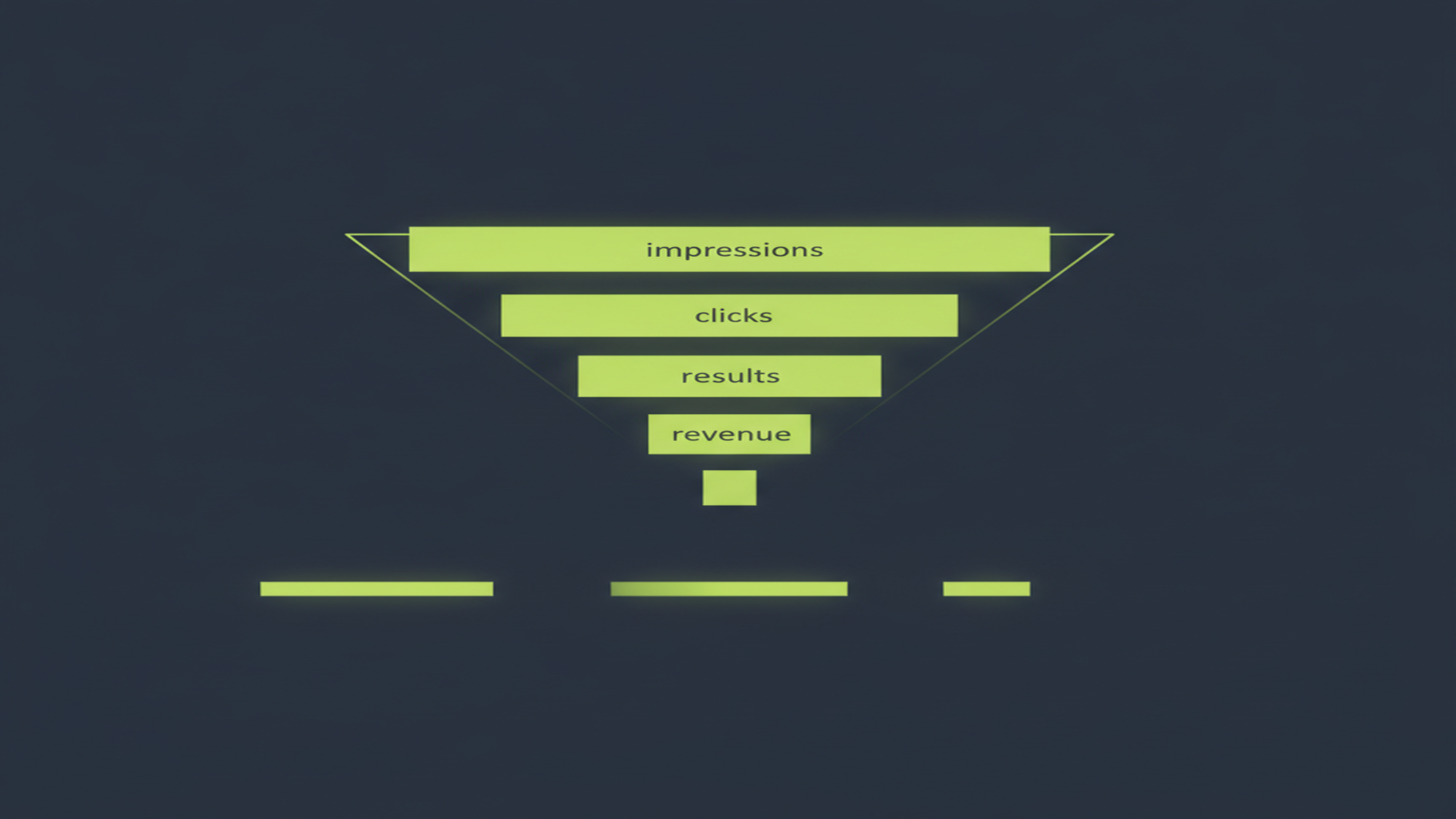
Meta ads cost a median of $27.66 per lead and $1.92 per click across US industries on leads campaigns — but those are medians across 15 verticals with a 24× CPL spread. The number that matters for any specific account is not a market average; it is the cost-per-result your objective, creative, and audience produce together. Before benchmarks, understand the three-level funnel those benchmarks measure: CPM (what the auction charges to reach 1,000 people), CPC (derived from CPM and your click-through rate), and CPL or CPA (derived from CPC and your conversion rate).
Each level is controlled by different levers. CPM is set by auction competition, creative relevance, and audience overlap. CPC is CPM divided by click-through rate — a $13 CPM with a 2.0% CTR produces a $0.65 CPC; the same CPM with a 0.8% CTR produces a $1.63 CPC. CPL is CPC divided by conversion rate — a $1.92 CPC with a 7.72% CVR produces a $24.87 CPL. A '$0.74 CPC' in Restaurants and a '$4.10 CPC' in Legal tell you almost nothing until you carry both to cost per lead: $3.16 versus $18.17 (WordStream/LocaliQ 2025). Optimizing the wrong level of the funnel is the most common budget error in Meta accounts.
| Metric | Formula | What it measures | Funnel position |
|---|---|---|---|
| CPM (Cost Per Mille) | Total spend ÷ Impressions × 1,000 | Auction density + creative relevance | Top — cost to reach 1,000 people |
| CTR (Click-Through Rate) | Clicks ÷ Impressions × 100 | Creative and targeting relevance | Converts CPM into CPC |
| CPC (Cost Per Click) | Total spend ÷ Clicks (= CPM ÷ (CTR × 10)) | Cost to earn one click | Middle — derived from CPM and CTR |
| CVR (Conversion Rate) | Conversions ÷ Clicks × 100 | Landing page + offer effectiveness | Converts CPC into CPL |
| CPL / CPA (Cost Per Lead) | Total spend ÷ Conversions (= CPC ÷ CVR) | Cost per result | Bottom — the metric budgets target |
| ROAS (Return on Ad Spend) | Revenue ÷ Ad spend | Revenue efficiency | E-commerce outcome metric |
| Frequency | Impressions ÷ Reach | How often one person sees the ad | Leading indicator of CPM creep |
Source: Meta Business Help — About ad auctions. Formulas are platform-stable definitions.
The funnel runs one direction: improving CPM reduces CPC; improving CVR reduces CPL. Fixing CPM does not fix CPL if your landing page converts at 2% when your vertical averages 9%.
The sections below work down the chain — auction mechanics and CPM first, then industry benchmarks, then the budget and bid strategy levers that influence each level. See also Meta ads metrics, reporting & optimization for how to read CPM, CPC, and CPL together in Ads Manager.
How the Meta Ads Auction Works
The Meta ads auction does not award the impression to the highest bidder. The winning ad is the one with the highest total value — the combination of three inputs: the advertiser's bid, the estimated action rate (per-user probability that the optimized action occurs), and ad quality. An advertiser bidding $5 with a 3% estimated conversion rate and strong creative regularly beats one bidding $15 with a 0.8% rate and weak relevance.
Total Value = Advertiser Bid × Estimated Action Rate × Ad Quality
This is the canonical teaching model. Meta also describes a user-value component representing the ad's relevance to the viewer. The formula is a directional model of how three inputs combine, not a literal arithmetic spec with published coefficients. Source: Meta Business Help; Wittelsbach AI (2026).
Meta runs a second-price auction: the winner pays just enough to beat the second-highest total-value bid, not their maximum. A $10 bid wins against a second bidder whose total value equates to $6.49 — the winner pays $6.50, not $10. Higher bids raise the floor for winning; they do not set what the winner actually pays. The practical read: spending more does not buy cheaper results if your estimated action rate is low. Source: Iqra Digital Solutions — How the Meta Ads Auction Works (2026).
Creative quality directly affects two of the three total-value inputs simultaneously — estimated action rate and ad quality. When those two inputs decay (same creative, same audience, rising frequency), the algorithm charges more to keep placing the ad. The fix is creative refresh, not a bid increase. MB Adv Agency treats a sustained CPM climb on flat creative as a refresh trigger before touching bid strategy.
The campaign objective you select determines which action the estimated action rate is predicting: a link click for Traffic campaigns, a purchase for Conversion campaigns, a submitted lead for Lead Generation. See Meta ads campaign objectives for how the six outcome objectives map to bid strategy options.
Estimated Action Rate: The Variable That Amplifies Your Bid
Estimated action rate (EAR) is Meta's per-user, per-millisecond prediction of how likely each specific person is to take your optimized action. It is not an account-level metric — it is recalculated for every user in every auction. Your creative, audience targeting, and Pixel or CAPI data quality are the three factors that shape the EAR Meta's algorithm assigns your ad.
| Input | What it is | Who controls it |
|---|---|---|
| Advertiser Bid | Maximum you are willing to pay for your target action; determined by your bid strategy | Advertiser |
| Estimated Action Rate (EAR) | Meta's ML prediction — per user, per auction — of how likely that person is to take your optimized action (click, lead, purchase) | Meta's algorithm, shaped by creative, audience, and Pixel/CAPI data quality |
| Ad Quality | Composite of engagement signals, hide and report rates, landing page experience, and content authenticity | Advertiser (creative quality, landing page) |
Source: Ads Analysis, Mastering Estimated Action Rate and Ad Quality Rank; Wittelsbach AI — EAR in Meta Ads (2026).
EAR is not exposed as a number in Ads Manager. The proxy columns are Quality Ranking, Engagement Rate Ranking, and Conversion Rate Ranking — each compares your ad's performance to competing ads shown to the same audience. When all three rank 'Below Average,' EAR is likely low and the auction is charging a premium to continue placing your ad. The fix is creative variation (new hook, new format, new visual) — not a bid increase.
Concrete example: an advertiser bidding $5 with a 3.0% estimated conversion rate and high ad quality generates a total value of 5 × 0.03 × quality multiplier. An advertiser bidding $15 with a 0.8% rate and low quality generates 15 × 0.008 × quality multiplier — and loses. Creative quality that raises EAR from 0.8% to 3.0% triples your competitive weight in the auction without touching the bid. Source: Ads Analysis (2026).
Facebook Ads Benchmarks by Industry — Leads Campaigns (2025 Data)
The most comprehensive US Facebook benchmark dataset is the WordStream / LocaliQ Facebook Ads Benchmarks 2025 report: 726 US leads campaigns, April 2024–June 2025, all figures are medians. The table below covers 15 industries. CPM is not published in this report — the CPM column in every row is '—' by design (see the CPM section below for secondary-source figures).
| Industry | Avg CTR | Avg CPC | Avg CVR | Avg CPL |
|---|---|---|---|---|
| Restaurants & Food | 2.97% | $0.74 | 18.25% | $3.16 |
| Real Estate | 3.75% | $1.57 | 9.53% | $16.61 |
| Career & Employment | 2.81% | $0.86 | 5.77% | $17.64 |
| Arts & Entertainment | 3.92% | $1.08 | 9.34% | $18.17 |
| Attorneys & Legal Services | 2.11% | $4.10 | 10.53% | $18.17 |
| Sports & Recreation | 3.41% | $1.07 | 5.48% | $19.30 |
| Education & Instruction | 1.86% | $1.65 | 10.08% | $28.22 |
| Personal Services | 1.99% | $2.08 | 6.51% | $30.57 |
| Industrial & Commercial | 2.08% | $1.80 | 9.34% | $37.34 |
| Furniture | 1.48% | $2.18 | 3.77% | $40.04 |
| Home & Home Improvement | 1.94% | $2.23 | 5.22% | $41.26 |
| Physicians & Surgeons | 3.02% | $2.23 | 4.51% | $47.47 |
| Beauty & Personal Care | 2.55% | $3.06 | 5.29% | $51.42 |
| Health & Fitness | 1.72% | $2.64 | 5.63% | $52.98 |
| Dentists & Dental Services | 1.05% | $9.78 | 6.38% | $76.71 |
| Overall median (leads) | 2.59% | $1.92 | 7.72% | $27.66 |
Source: WordStream / LocaliQ, Facebook Ads Benchmarks 2025 (April 2024–June 2025; leads sample n = 726 US campaigns; all figures are medians; CPM not published by WordStream in this report). Leads campaigns only — do not compare to traffic-campaign benchmarks.
Year-over-year context from the 2025 report: median CPL on leads campaigns rose 20.94% from $22.87 in 2024 to $27.66, reflecting rising auction competition. Median CPC increased from $1.88 to $1.92. Despite the increase, Meta's $27.66 median CPL is substantially below Google Ads' average CPL of $70.11 over the same period — making Meta the lower-cost channel on a leads basis for most US verticals.
The 24× CPL spread across industries makes an 'average Meta ads cost' without an industry qualifier meaningless for budget planning. Attorneys at $4.10 CPC with a 10.53% CVR land at $18.17 CPL — a high CPC offset by a strong conversion rate. Dentists at $9.78 CPC with a 6.38% CVR land at $76.71 CPL — the highest CPC in the set, compounded by a below-average CVR. Legal PPC services covers the full cost-per-lead picture for attorneys and legal firms. Dental PPC services covers managing cost-per-booked-patient at the $76.71 industry median. Real Estate PPC services covers the 3.75% CTR and 9.53% CVR combination that keeps real estate CPL at $16.61.
Traffic vs. Leads Campaigns: Why the Numbers Diverge
WordStream's 2025 Facebook benchmark report publishes separate tables for leads campaigns (n = 726) and traffic campaigns (n = 554). The numbers differ sharply: the overall traffic CPC median is $0.70 versus $1.92 for leads. These are not benchmarks for the same product — they are benchmarks for two different optimization objectives. Never compare a traffic CPC to a leads CPL in the same account evaluation.
| Industry | Avg CTR | Avg CPC |
|---|---|---|
| Shopping, Collectibles & Gifts | 4.13% | $0.34 |
| Sports & Recreation | 2.60% | $0.41 |
| Travel | 2.76% | $0.51 |
| Arts & Entertainment | 2.10% | $0.49 |
| Restaurants & Food | 1.67% | $0.72 |
| Beauty & Personal Care | 1.81% | $0.74 |
| Health & Fitness | 1.63% | $0.80 |
| Attorneys & Legal Services | 1.76% | $0.86 |
| Home & Home Improvement | 1.28% | $0.99 |
| Finance & Insurance | 0.98% | $1.22 |
| Overall median (traffic) | 1.71% | $0.70 |
Source: WordStream / LocaliQ, Facebook Ads Benchmarks 2025 (April 2024–June 2025; traffic sample n = 554 US campaigns; medians). CVR and CPL not published for traffic objective.
A reader quoting '$0.70 CPC' for Facebook ads is citing the traffic benchmark. A leads advertiser should reference the $1.92 median. Traffic campaigns optimize for link clicks — the algorithm does not prioritize audiences likely to convert, only audiences likely to click. The lower CPC reflects that optimization target, not a cheaper audience pool. Running a traffic campaign and measuring CPL against the leads benchmark produces a false cost comparison.
For DTC brands running traffic campaigns to cold audiences before retargeting: Fashion PPC services covers traffic-to-conversion funnel economics on Meta. Beauty Products PPC services covers how DTC beauty brands manage CPM and creative refresh to hold traffic CPC at the low end of the range.
Meta Ads CPM: What Drives It and When It Climbs
CPM is the cost per 1,000 impressions — what the auction charges to place your ad in front of people, before any click or conversion occurs. CPM is not a performance metric; it is an auction density and creative relevance signal. An account can drive CPM down by chasing broad, cheap reach that never converts, ending with a low CPM and a catastrophic CPL.
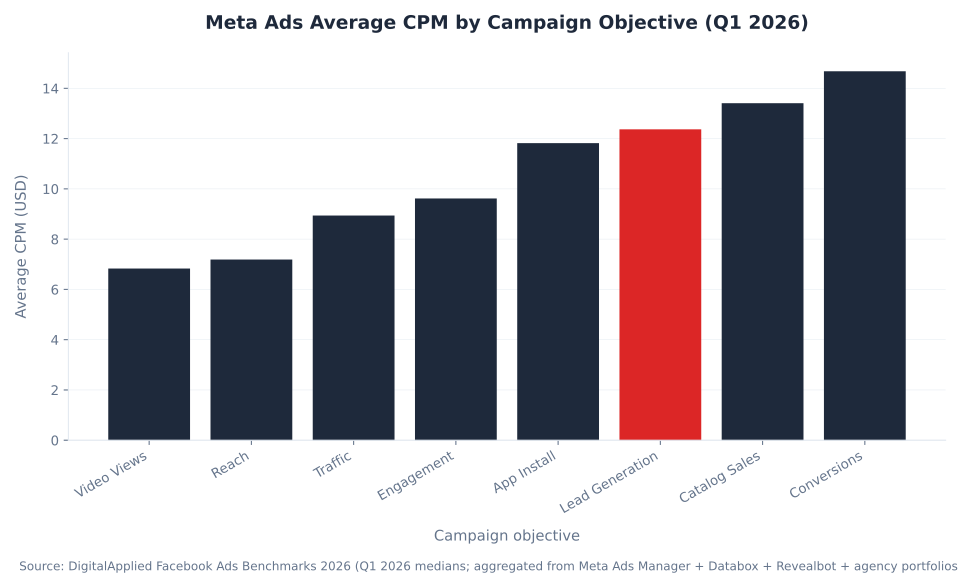
WordStream's Facebook benchmark report does not publish CPM by industry. Secondary data from Visible Factors (2025/2026) — which aggregates Triple Whale, WordStream/LocaliQ, Lebesgue, and Databox data — puts the median CPM across all industries at $13.48. CPM varies by campaign objective: DigitalApplied (Q1 2026 medians, aggregated secondary benchmark) shows Lead Generation campaigns at $12.37 CPM and Conversion campaigns at $14.68 CPM. Both figures are directional; the methodology is aggregated, not a primary publisher dataset.
| Campaign objective | Avg CPM |
|---|---|
| Video Views | $6.83 |
| Reach | $7.19 |
| Traffic | $8.94 |
| Engagement | $9.62 |
| App Install | $11.82 |
| Lead Generation | $12.37 |
| Catalog Sales | $13.41 |
| Conversions | $14.68 |
Source: DigitalApplied, Facebook Ads Benchmarks 2026 (Q1 2026 medians; aggregated from Meta Ads Manager, Databox, Revealbot, and agency portfolio data — secondary benchmark. Label as secondary when citing; do not compare directly to WordStream leads-campaign rows.)
CPM rises from three distinct causes. Creative fatigue: the same ad shown to the same audience repeatedly increases frequency, depresses engagement, and drops the estimated action rate — the algorithm charges more to maintain placement. The diagnostic is frequency above 3–4 on a 7-day window paired with a rising CPM and flat CTR. Audience saturation: small, tightly defined audiences exhaust faster, driving up the cost to reach remaining users. Seasonal auction pressure: Q4 retail demand and major US events increase competition for the same impressions, bidding CPM up market-wide regardless of account quality.
MB Adv Agency treats a sustained CPM climb on flat creative as a creative-refresh trigger, not a budget problem. Fresh creative and audience expansion reset the estimated action rate and typically lower CPM within 1–2 weeks of launch — without a bid increase. For beauty and personal care brands, where Beauty & Personal Care CPL sits at $51.42 in the WordStream benchmarks, creative refresh cadence is the primary CPM lever.
US Search Demand: Meta Ads Cost & Bidding Keywords (June 2026)

Facebook Ads Budget: How Much You Actually Need
Before setting any budget number, calculate the minimum spend needed to exit the learning phase — the period during which Meta's algorithm is accumulating conversion events to optimize delivery. The learning phase requires about 50 conversion events per ad set per week. The practitioner minimum daily budget formula: Target CPA × 50 ÷ 7.
Learning-phase minimum daily budget = Target CPA × 50 ÷ 7
Example using the WordStream 2025 median CPL of $27.66: $27.66 × 50 ÷ 7 = $197/day per ad set to generate 50 leads/week and clear the standard 7-day learning window. Most SMB accounts run below this and accept a 2–4 week learning phase instead. Source: Get Ryze, Meta Ads Minimum Budget 2026.
At $50/day against a $27.66 CPL target, the account generates roughly 12.7 leads per week — the learning phase extends to 3–4 weeks before the algorithm reaches 50 events. The trade-off is time: a lower budget takes longer to exit learning, not a fundamentally different outcome. Below $50/day for conversion-optimized campaigns, the learning phase rarely clears within the 7-day standard window. Meta's technical minimum budget is $1/day across all campaign types, but that floor is irrelevant for conversion-optimized accounts. Source: Get Ryze (2026).
Advantage Campaign Budget vs. Ad-Set Budgets
Advantage campaign budget — formerly Campaign Budget Optimization (CBO), renamed as part of Meta's Advantage+ automation push — moves budget control from the ad-set level to the campaign level. Meta's algorithm allocates spend in real time toward the ad sets producing results. Advantage campaign budget is the 2026 default for new campaigns; ad-set budgets are opt-in. Source: Meta Business Help — About Advantage campaign budget; Meta for Business — Advantage campaign budget product page.
| Dimension | Advantage campaign budget (former CBO) | Ad-set budget (ABO) |
|---|---|---|
| Where budget lives | Campaign level | Each ad set individually |
| Who allocates spend | Meta's algorithm, in real time | Advertiser, fixed per ad set |
| Learning phase speed | Faster — pools conversion events across all ad sets in the campaign | Slower — each ad set must independently reach the ~50-event threshold |
| Best for | Ad sets sharing one conversion goal; let the algorithm find the winner | Guaranteeing spend on a specific audience for a structural reason (retargeting pool, geo requirement) |
| Spend concentration risk | Budget concentrates on the winning ad set; underfunded ad sets get little data — by design | Even budget splits waste spend on losing audiences |
| 2026 platform default | Yes | Opt-in |
Source: Meta Business Help — About Advantage campaign budget; Meta for Business — Advantage campaign budget.
MB Adv Agency uses Advantage campaign budget as the default for new Meta campaigns when all ad sets in the campaign share one conversion goal. It pools conversion events across ad sets, exits the learning phase faster, and lets the algorithm move spend toward the winner rather than requiring the advertiser to guess which ad set to fund. Ad-set budgets are reserved for cases where a specific audience must be funded regardless of short-term performance — a retargeting pool that must stay active, or a city or geo that is contractually required. Where the budget and bid strategy sit within the three-level campaign hierarchy is covered in Meta ads account structure.
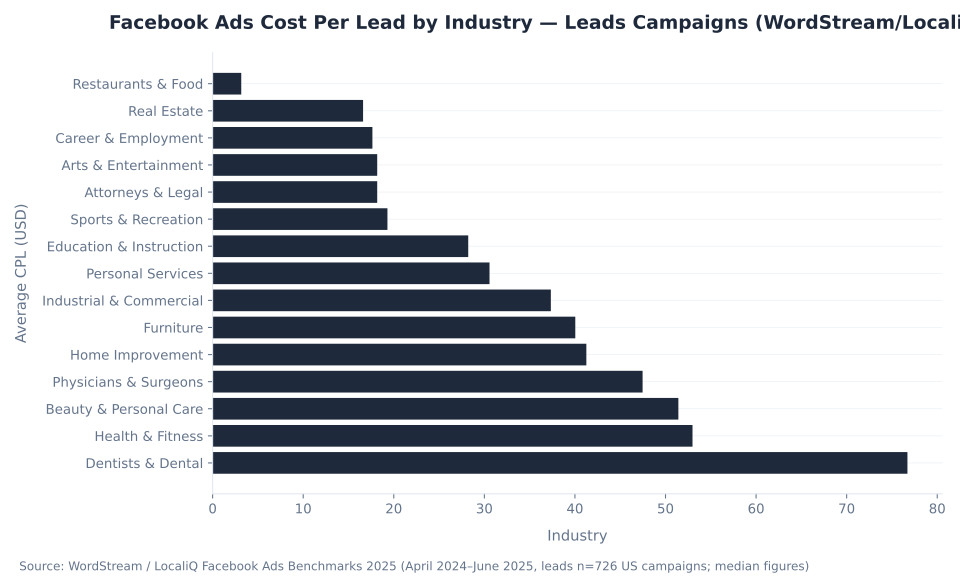
Facebook Ads Cost Per Lead by Industry — Leads Campaigns (WordStream/LocaliQ 2025)
Daily vs. Lifetime Budget
A Meta daily budget is an average, not a hard per-day cap. Meta can spend up to 175% of your stated daily budget on a single high-opportunity day — if daily budget is $100, Meta can spend up to $175 on a single day. Over a 7-day rolling window, total spend will not exceed 7× your daily budget ($700 for a $100/day campaign). Source: Get Ryze — Meta Ads Account Spending Limit (2026); AdPace — Meta Ad Budget Overspend Protection.
| Feature | Daily budget | Lifetime budget |
|---|---|---|
| How Meta treats it | An average, not a hard per-day cap | Total spend across the campaign flight |
| Overspend allowance | Up to 175% of daily budget on a single day; 7× weekly cap overall | N/A — Meta paces to the scheduled end date |
| Algorithm pacing | Meta front- or back-loads spend based on real-time auction opportunity | Meta spreads spend based on the end date and projected demand curve |
| Best for | Always-on campaigns with no fixed end date | Event-driven or flight-date campaigns |
| Works with Advantage campaign budget | Yes | Yes |
| Campaign objective | Meta technical minimum | Practical minimum for optimization data |
|---|---|---|
| Awareness / Reach | $1/day | $5–$10/day |
| Traffic | $1/day | $15–$25/day |
| Lead Generation | $1/day | $50–$150/day |
| Purchase / Conversion | $1/day | $75–$200/day |
Source: Get Ryze, Meta Ads Minimum Budget 2026. Technical minimum = $1/day platform floor. Practical minimums are practitioner-derived directional figures, not official Meta specifications.
The $1/day technical minimum is confirmed by the platform; the practical minimums reflect how much spend an account needs to accumulate sufficient conversion data for the algorithm to optimize reliably. For Lead Generation and Conversion campaigns, the practical minimum is determined by the learning-phase formula: Target CPA × 50 ÷ 7. Setting a budget well below this threshold does not prevent the campaign from running — it just extends the period before Meta's algorithm has enough signal to perform efficiently. For local service verticals where CPL is competitive, see Plumbing PPC services and HVAC PPC services for budget-pacing context in high-intent, seasonal verticals.
Meta Ads Average CPM by Campaign Objective (Q1 2026)
Meta Ads Bid Strategies: All Five Explained
Meta's five bid strategies split into three groups: spend-based strategies (Highest Volume, Highest Value) spend the full budget chasing the most results or most purchase value; goal-based strategies (Cost Per Result Goal, ROAS Goal) hold a target cost or return and under-deliver when the target is set below what the auction will bear; and the manual strategy (Bid Cap) sets a hard per-auction ceiling and carries the highest under-delivery risk. Source: Flighted — Meta Ads Bid Strategies Explained (2026); TheOptimizer — Meta Ads Bidding in 2026.
| Bid strategy | Category | Former name | What Meta does | Signal required | Best starting point |
|---|---|---|---|---|---|
| Highest Volume | Spend-based | Lowest Cost | Spends the full budget chasing the most results at any cost per result | None — correct default for new accounts | Default for all new accounts |
| Highest Value | Spend-based | (always this name) | Spends the full budget for the highest total purchase value | Value optimization on; accurate purchase values via Pixel/CAPI | E-commerce with reliable value tracking |
| Cost Per Result Goal | Goal-based | Cost Cap | Holds an average cost per result over time — not per auction | Historical CPA baseline; ~50 conversions/week recommended | Established lead-gen with a known, realistic CPL target |
| ROAS Goal | Goal-based | Minimum ROAS | Holds a minimum return-on-ad-spend target across the campaign | Accurate conversion-value tracking; ~50 conversions/week | Mature e-commerce with stable ROAS history |
| Bid Cap | Manual | (always this name) | Hard ceiling on the per-auction bid — highest control, highest under-delivery risk | Real auction data; proven CPA baseline; some practitioners cite 100+ conversions minimum | Experienced advertisers managing strict efficiency ceiling |
Sources: Flighted (2026); TheOptimizer (2026); Stackmatix (2026).
Bid strategy name changes (2024–2026)
Lowest Cost → Highest Volume • Cost Cap → Cost Per Result Goal • Minimum ROAS → ROAS Goal. Behavior is unchanged; only the Ads Manager labels changed. Content still using the old names predates the rename. Source: TheOptimizer (2026).
Spend-based strategies (Highest Volume, Highest Value) always spend the full budget — they prioritize delivery volume over cost control. Highest Volume is the correct default for any account that has not yet built a dense conversion history. Highest Value requires that purchase value data flows reliably through Pixel and CAPI — it is for e-commerce accounts where value optimization is possible. Fashion PPC and Insurance PPC are representative verticals where value optimization is structurally relevant.
Goal-based strategies (Cost Per Result Goal, ROAS Goal) hold a target and will throttle delivery when the auction environment cannot meet it. They only earn their keep once the account clears roughly 50 conversions per week — enough signal for the algorithm to hold a target without starving reach. Setting an aggressive cost goal below what the auction will bear on an account with insufficient history causes systematic under-delivery. MB Adv Agency starts new lead-gen accounts on Highest Volume and graduates them to Cost Per Result Goal only after the conversion data is dense enough to support a realistic target.
Bid Strategy Availability by Campaign Objective
Not every bid strategy is available for every campaign objective. Highest Value and ROAS Goal are restricted to the Sales objective, where accurate conversion-value data is required. The matrix below is directionally correct for 2026 — Meta updates availability without announcement, so verify against a live Ads Manager account before setting strategy.
| Campaign objective | Highest Volume | Highest Value | Cost Per Result Goal | ROAS Goal | Bid Cap |
|---|---|---|---|---|---|
| Awareness | Yes | No | No | No | No |
| Traffic | Yes | No | Yes | No | Yes |
| Engagement | Yes | No | Yes | No | Yes |
| Leads | Yes | No | Yes | No | Yes |
| App Promotion | Yes | No | Yes | No | Yes |
| Sales (purchases) | Yes | Yes | Yes | Yes | Yes |
Sources: Meta Business Help — About Advantage campaign budget; Flighted (2026); TheOptimizer (2026). Verify against a live Ads Manager account — Meta updates availability without announcement.
The most important restriction: Highest Value and ROAS Goal are available only for Sales campaigns, and only when value optimization is active and accurate purchase-value data flows through Pixel or CAPI. For lead-generation objectives (Leads), the available efficiency strategies are Cost Per Result Goal (for cost control) and Bid Cap (for strict auction ceiling control). For financial services and insurance — verticals with $1.22 and higher traffic CPCs — the leads objective with Cost Per Result Goal is the standard structure once the account clears the 50-conversion threshold. Local service verticals like legal in Missoula and plumbing in Missoula typically start on Highest Volume with the Leads objective.
When to Switch Bid Strategies
The correct starting point for any new Meta account or new campaign is Highest Volume on the Leads or Sales objective. Do not switch bid strategies before the account has 50 conversions per week. Switching earlier forces the algorithm to hold a cost target or auction ceiling with insufficient data, causing under-delivery or missed spend.
The progression: start on Highest Volume and run for at least 2–4 weeks to accumulate conversion history. Once the account consistently clears 50 conversions per week, calculate the average CPL from historical data. Set Cost Per Result Goal at or slightly above that historical average — not at an aspirational target below what the auction has demonstrated it will bear. A Cost Per Result Goal set 30–40% below historical CPL causes the campaign to under-deliver and fail to spend the budget, producing the illusion of efficiency while actually suppressing reach.
Bid Cap is the highest-risk option and is for advertisers with real auction data: a known winning auction price range and a proven CPA baseline. Some practitioners cite 100+ historical conversions as the minimum before setting a Bid Cap with confidence. Setting a Bid Cap below the clearing price for your audience means losing every auction where that audience appears, including profitable conversions. Source: TheOptimizer (2026); Stackmatix (2026).
MB Adv Agency graduates accounts to Cost Per Result Goal only after the account clears roughly 50 conversions per week — the minimum threshold for Meta's algorithm to hold a cost target without throttling reach. New local-service campaigns in verticals like HVAC and plumbing typically need 4–8 weeks on Highest Volume before conversion data is dense enough to set a cost goal. Local competition affects that timeline — metro markets like Chicago generate more auction competition and faster data accumulation than smaller markets. See HVAC PPC in Flagstaff, AZ and Roofing PPC in Flagstaff, AZ for regional CPL context that affects the cost target you set.
Facebook Ads Average CPL by Industry (WordStream/LocaliQ 2025)

Running Meta ads in a high-CPL vertical?
Financial services, legal, and insurance accounts reward precise audiences and realistic cost goals — not bigger budgets. MB Adv Agency builds the bid strategy around what the auction will actually bear.
See Financial Services PPC →Four Common Meta Ads Cost Misconceptions
These are the four most consequential errors in how advertisers understand Meta ads cost — each one leads to a different type of budget or bidding mistake.
1. The highest bid wins the Meta auction (FALSE)
Meta's auction ranks ads by total value — the combination of advertiser bid, estimated action rate, and ad quality — not by bid alone. An advertiser bidding $15 with a 0.8% estimated conversion rate and weak creative generates lower total value than one bidding $5 with a 3% rate and strong creative, and loses the auction. Per Meta's own auction documentation, the system optimizes for total value to the user, not for the highest bidder's revenue. Budgeting on the assumption that more money buys cheaper results inverts how the auction actually prices impressions. See the Meta ads account structure guide for where bid strategy sits in the three-level campaign hierarchy.
2. There is one 'Meta ads cost' (FALSE)
The WordStream/LocaliQ 2025 benchmark dataset (n = 726 US leads campaigns) shows CPL ranging from $3.16 in Restaurants & Food to $76.71 in Dentists & Dental Services — a 24× spread — against an overall median of $27.66. CPC ranges from $0.74 to $9.78 with a $1.92 median. A 'good' cost in Restaurants is a catastrophic result in Dental. Any single-number quote for 'average Facebook ads cost' without naming the industry, campaign objective, and bid strategy carries no decision value. Source: WordStream / LocaliQ Facebook Ads Benchmarks 2025.
3. A low CPM means a cheap campaign (FALSE)
CPM measures what the auction charges to reach 1,000 people — it measures auction density and creative relevance, not business outcome. An account can drive CPM down by chasing broad, cheap reach that never converts: low CPM, catastrophic CPL. The correct cost diagnostic chains down the funnel: CPM informs CPC (via CTR), CPC informs CPL (via conversion rate). Optimizing for a low CPM in isolation is how advertisers buy impressions nobody acts on.
4. "Cost Cap" is a current Meta bid strategy (FALSE)
Meta renamed 'Lowest Cost' to Highest Volume and 'Cost Cap' to Cost Per Result Goal as part of the Advantage+ rebranding push. Advertisers searching for 'cost cap meta ads' are reading content written before the rename. The behavior is unchanged — set a target average cost per result and the algorithm aims to hold it on average over time — but the Ads Manager label changed. Any guide still using 'Cost Cap' as the current name predates the 2024–2025 rename. Source: TheOptimizer — Meta Ads Bidding in 2026; Flighted (2026).
$27.66
US median CPL — leads campaigns (WordStream/LocaliQ 2025, n=726)
$1.92
US median CPC — leads campaigns (WordStream/LocaliQ 2025)
$13.48
Overall median Meta CPM across all industries (Visible Factors 2025/2026, aggregated)
24×
CPL spread across industries — $3.16 (Restaurants) to $76.71 (Dental)
Regional cost context: local market competition affects CPL outside national medians. Roofing PPC in Flagstaff, AZ and Plumbing PPC in Missoula, MT illustrate how secondary-market CPL differs from the WordStream national benchmarks. PPC management in Chicago contextualizes these numbers against major-market auction density where CPM runs higher than the national median.
Meta Ads Cost & Bidding: Frequently Asked Questions
Not sure whether your Meta budget is large enough to leave the learning phase?
MB Adv Agency reviews your current budget, conversion volume, and bid strategy and tells you exactly what needs to change. No commitment required.
Talk to MB Adv Agency →Methodology
Performance benchmarks in this article are drawn from the WordStream / LocaliQ Facebook Ads Benchmarks 2025 report (April 1, 2024–June 30, 2025; leads sample n = 726 US campaigns; traffic sample n = 554 US campaigns; all figures are medians). CPM figures are from Visible Factors (2025/2026 aggregated benchmark, median $13.48) and DigitalApplied (Q1 2026 medians, aggregated secondary dataset) — both clearly labeled as secondary sources distinct from the WordStream primary dataset. Bid strategy mechanics, auction formula, and budget mechanics are sourced from Meta Business Help documentation, Flighted (2026), TheOptimizer (2026), Stackmatix (2026), and Get Ryze (2026). No mbadv client metrics are cited — all MB Adv Agency attributions are qualitative editorial POV. Reviewed by MB Adv Agency, June 2026.

As a Google Ads expert, I bring proven expertise in optimizing advertising campaigns to maximize ROI.
I specialize in sharing advanced strategies and targeted tips to refine Google Ads campaign management.
Committed to staying ahead of the latest trends and algorithms, I ensure that my clients receive cutting-edge solutions.
My passion for digital marketing and my ability to interpret data for strategic insights enable me to offer high-level consulting that aims to exceed expectations.
Google Partner Agency
We're a certified Google Partner Agency, which means we don’t guess — we optimize withGoogle’s full toolkit and insider support.
Your campaigns get pro-level execution, backed by real expertise (not theory).

4.9 out of 5 from 670+ reviews on Fiverr.
That’s not luck, that’s performance.
Highly recommend Matteo to set up your server side tracking. He has a deep understanding of e-commerce tracking and will go above and beyond to make sure everything is set up correctly and working 100%. If you are scaling your store this set up is non-negotiable in my opinion and there isn't many people who have this much knowledge or put the effort in to get it right. Thanks again!

avorodesign.com
I can only recommend Matteo! He was very patient, professional and very knowledgeable about GA4, Consent Mode v2, and GDPR compliance. Communication was clear, and the setup was done professionally and efficiently. Highly recommend him for anyone needing reliable tracking implementation.

www.natureiki.life
Matteo shines in the realm of online professionals. His work is not only deep in data but also complemented by his proactive communication and cooperation, setting a new standard for freelancers. If you want someone who truly exceeds expectations, look no further. Highly recommended!

www.omanbeverlysmyth.com
Exceptional Service Beyond Expectations - Outstanding Service Impeccable depth, flawless delivery, and exceptional language fluency—this service exceeded all expectations. Highly recommended. Matteo truly ROCKS!!!

ium-paris.com
Top-notch, always highly value working with Matteo. An absolute Google Ads Genius. This is approximately the 8th time I have hired him and he's helped us get 6-7 ROAS. We are excited in continuing to improve our lead flow. Hire this guy if you need Google Ads help. Thanks Matteo!

www.dleeventgroup.com
I finally found the guy who can setup server side tracking and all the ecosystem properly. I definitely recommend Matteo. He is very responsive, kind and wants to dig into things. He configured GA4, Meta, Google Ads, Outbrain and google consent v2 with Cookiebot. Thanks Matteo.

inomega.fr
MB Adv delivered exceptional work with outstanding professionalism and lots of patience, taking time to see effects of changes made and not just do the work and submit it. The proactive communication and video summaries of the work completed made working with Matteo a pleasure, as he consistently went above and beyond. Highly recommended for web analytics projects! We are already working on another project.

www.withnellsensors.co.uk
Working with Matteo on my Google Ads was a game-changer. He's not just a strategist, he's a true partner. He understood my goals and tailored a campaign that perfectly reached my target audience. I'm grateful for his expertise and dedication.

dccargo.com
Click-driven mind
with plastic-brick obsession.
We build Google Ads campaigns with the same mindset we use to build tiny brick worlds: strategy, patience, and zero tolerance for wasted pieces.
Data is our blueprint. Growth is the only acceptable outcome.