Meta Ads Campaign Objectives: 6 ODAX Guide 2026

6
Meta Ads campaign objectives in 2026, consolidated from eleven under the Outcome-Driven Ad Experiences (ODAX) framework introduced in December 2021. The six outcomes — Awareness, Traffic, Engagement, Leads, App promotion, Sales — replaced the three-banner funnel structure (Awareness / Consideration / Conversion) retired when ODAX became the exclusive campaign-creation path in 2023. The objective trains Meta’s delivery algorithm toward a specific conversion event and cannot be changed after a campaign is launched.
Source: Meta for Developers, Dec 2021; Flighted 2026; Birch 2026
Meta Ads Campaign Objectives: The Six ODAX Outcomes
Meta Ads has six campaign objectives in 2026 — Awareness, Traffic, Engagement, Leads, App promotion, and Sales — introduced under the Outcome-Driven Ad Experiences (ODAX) framework Meta announced in December 2021 and made the exclusive campaign-creation path in 2023. Each objective tells Meta’s delivery algorithm which machine learning model to deploy and which type of user to pursue. It cannot be changed after a campaign is launched.
These six objectives replaced eleven that existed under three banners — Awareness, Consideration, and Conversion — in a consolidation that removed the three-banner funnel structure from the Ads Manager picker entirely. Returning advertisers who last ran Facebook ads before 2023 will not find “Brand Awareness,” “Conversions,” or “Catalog Sales” as standalone selections. Those objectives were absorbed into the six ODAX outcomes; the decisions they used to make at the campaign level now live one level down, inside optimization-goal and conversion-location settings.
The objective is the most consequential and least reversible decision in any Meta Ads account. Every other setting — audience, placement, budget, creative — is editable after launch. The objective is not. A campaign set to Traffic when the business goal is purchases trains Meta’s algorithm on link-clickers from day one. The only fix is a new campaign under the Sales objective, which resets the learning phase. For how objective choice cascades into account structure, see Meta Ads account structure; for how it interacts with audience targeting, see Meta Ads audience targeting.
The Objective Is a Training Signal, Not a Campaign Label
Meta’s delivery system reads the objective to determine which optimization model to run — and consequently, which sub-segment of its user database to target. The algorithm does not distribute ads evenly across a defined audience; it finds the users within that audience statistically most likely to produce the chosen conversion event and concentrates delivery there.
Two campaigns with identical creative, identical audiences, and identical budgets return completely different buyers if their objectives differ. A Traffic campaign finds the cheapest link-clickers. A Sales campaign with a Purchase optimization event finds users who complete transactions. The difference is not a naming convention; it is the machine learning model receiving the objective as its instruction. See Meta Ads cost, budgeting & bidding for how objective choice constrains available bid strategies.
Key Takeaways
- Six ODAX objectives, not eleven. Meta consolidated Brand Awareness, Reach, Traffic, Engagement, Video Views, Lead Generation, Messages, App Installs, Conversions, Catalog Sales, and Store Traffic into six flat outcomes: Awareness, Traffic, Engagement, Leads, App promotion, Sales. The three-banner funnel (Awareness / Consideration / Conversion) no longer exists at the campaign level.
- The objective is locked on launch. It is the only campaign setting that cannot be edited after creation. Choosing Traffic instead of Sales trains the algorithm on the wrong signal; the fix is a new campaign.
- The objective is an optimization instruction, not a funnel stage. Pick the objective that matches the conversion event you can track — not the one that sounds like your current funnel position.
- Leads and Sales are not interchangeable. Leads optimizes for a contact (form fill, call, Messenger conversation). Sales optimizes for a transaction. Running Sales without purchase pixel data starves the algorithm; running Leads for an e-commerce store fills a CRM, not a cart.
- “Conversions” became “Sales” — many-to-one. Both the old Conversions and Catalog Sales objectives map to the single Sales objective. The conversion-location dropdown inside Sales is where the old catalog distinction now lives.
- App promotion has a closed mandate. It is the only objective that optimizes for app installs or in-app events. No other objective supports installs.
- ODAX naming drift is real. Some API integrations and third-party tools still label Sales as “Conversions.” That is a legacy label; the current Ads Manager objective is Sales.
6
ODAX objectives replacing 11 legacy objectives (2023)
2.19%
Median CTR across all Meta Ads objectives and industries (Digital Applied 2026)
$13.48
Median CPM across all objectives and industries (Digital Applied 2026)
$23.10
Median cost per lead for the Leads objective (WordStream 2026)
From Eleven to Six: How the Legacy Objective Structure Became ODAX
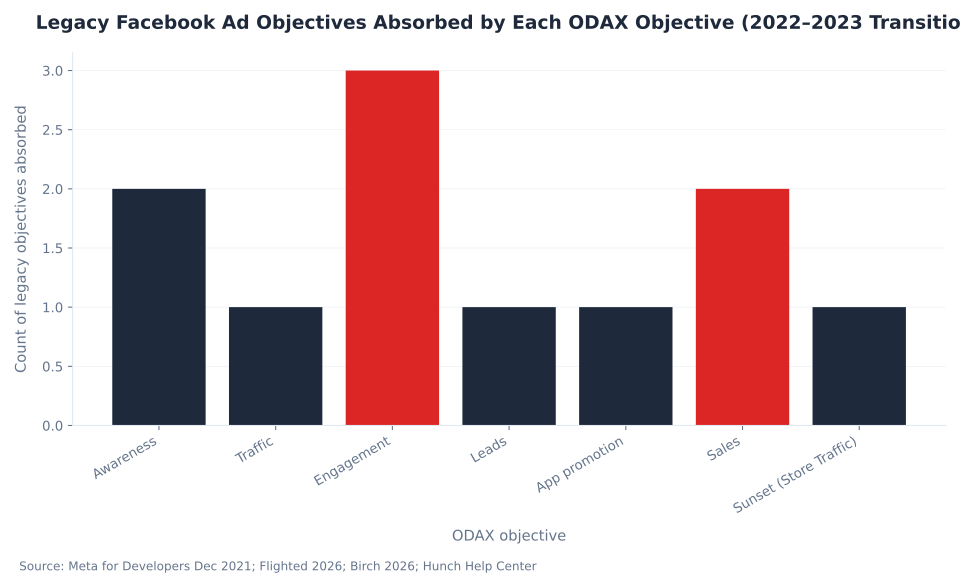
Before December 2021, Meta Ads Manager organized eleven campaign objectives under three funnel banners: Awareness (Brand Awareness, Reach), Consideration (Traffic, Engagement, Video Views, Lead Generation, Messages, App Installs), and Conversion (Conversions, Catalog Sales, Store Traffic). Meta’s ODAX announcement retired that structure entirely, consolidating eleven objectives into six flat outcomes. By 2023 ODAX was the only campaign-creation path. There is no “consideration campaign” to select in any current Ads Manager account.
The mapping is not one-to-one. Video Views was not preserved as an objective; ThruPlay and 2-second continuous video views are now optimization goals inside both Awareness and Engagement. Store Traffic was excluded from ODAX at launch and sunset for new campaign creation in January 2024, with delivery halted in H2 2024 — no ODAX replacement exists at the campaign-objective level. Conversions and Catalog Sales both collapsed into the single Sales objective; the distinction between them now lives in conversion-location and catalog settings.
| Legacy banner | Legacy objective (pre-2022) | ODAX objective | Mapping note |
|---|---|---|---|
| Awareness | Brand Awareness | Awareness | Optimization goal: ad recall lift |
| Awareness | Reach | Awareness | Optimization goal: reach |
| Consideration | Traffic | Traffic | Unchanged in name |
| Consideration | Engagement | Engagement | Post engagement + page-level interactions |
| Consideration | Video Views | Awareness or Engagement | No standalone objective; ThruPlay and 2-sec video views are optimization goals inside Awareness and Engagement |
| Consideration | Lead Generation | Leads | Instant Forms + other lead locations |
| Consideration | Messages | Engagement | Messenger / Instagram Direct / WhatsApp optimization goals now live under Engagement |
| Consideration | App Installs | App promotion | Renamed; closed mandate preserved |
| Conversion | Conversions | Sales | Conversion location (Website, App, Messenger/WhatsApp) set inside Sales |
| Conversion | Catalog Sales | Sales | Catalog configured inside Sales, not a separate objective |
| Conversion | Store Traffic | Sunset (Jan 2024) | Not included in ODAX; new campaigns disabled Jan 2024; delivery halted H2 2024 |
The eleven-to-six consolidation shifted where specificity lives. Before ODAX, objective names were granular enough to define campaign behavior (Brand Awareness vs. Reach; Conversions vs. Catalog Sales). In ODAX, the objective names are broader — the distinctions moved down into optimization-goal and conversion-location settings inside the ad set. An advertiser who wants video views now selects Awareness or Engagement as the objective and chooses ThruPlay as the optimization goal; those two decisions together replace what “Video Views” used to express in one click.
ODAX Objectives Explained: Optimization Goals and Conversion Locations
Each ODAX objective exposes a distinct set of optimization goals and conversion locations at the ad set level. The choice of objective determines which optimization goals are available; the optimization goal determines what event Meta bids toward. Selecting the wrong objective blocks access to the optimization goal the campaign actually needs.
| Date | Event |
|---|---|
| December 21–22, 2021 | Meta announced ODAX on the Meta for Developers blog: 11 objectives consolidate to 6 |
| February 2022 | Gradual rollout began; Meta estimated completion by Q3 2022 |
| Q2–Q3 2022 | Rollout complete for most accounts |
| 2023 | ODAX became the exclusive campaign-creation interface for all advertisers |
| January 2024 | New campaign creation with legacy objectives disabled |
| H2 2024 | Legacy campaign delivery halted; API v21 (Oct 2024) further restricted legacy objective usage |
| ODAX objective | What Meta optimizes for | Conversion locations | Best for |
|---|---|---|---|
| Awareness | Reach, ad recall lift, impressions, ThruPlay, 2-sec video views | None (visibility objective) | Brand launches, video reach, maximum impressions |
| Traffic | Link clicks, landing-page views | Website, App, Instagram profile, calls | Driving qualified clicks off-platform; building retargeting pools |
| Engagement | Post interactions, messaging conversations, video views, page activity | On-post, Messenger, Instagram Direct, WhatsApp, on-video, on-event | Conversations, content interaction, Page growth, video views |
| Leads | Instant Form submissions, website lead events, Messenger conversations, calls | Instant Forms, Website, Messenger, Calls, App | Lead-gen and service businesses collecting contact details |
| App promotion | App installs, in-app events, in-app purchase value | Mobile app only | Any app install or in-app conversion — closed mandate |
| Sales | Purchase, Add to Cart, Initiate Checkout events; catalog sales; messaging conversions | Website, App, Website and App, Messenger/WhatsApp | E-commerce purchases, catalog ads, bottom-funnel revenue |
Awareness is the only objective with no conversion location; it is a visibility objective, not an action objective. App promotion is the only objective with a closed mandate: it optimizes exclusively for app installs and in-app events. No other objective optimizes for an install — if the conversion event is an install, App promotion is non-negotiable.
Awareness Campaigns on Meta: What the Objective Does
The Awareness objective absorbed the old Brand Awareness and Reach objectives from the legacy structure and also picked up ThruPlay and 2-second continuous video views as optimization goals that previously lived under the standalone Video Views objective. It is the only ODAX objective with no conversion location — it is a visibility objective, not an action objective — and Meta’s algorithm uses it to maximize the number of unique users who see or remember the ad.
Awareness has about five primary optimization goals, drawn from Meta’s ThruPlay documentation and 2026 practitioner sources:
| Optimization goal | What Meta optimizes toward |
|---|---|
| Reach | Maximize unique users who see the ad |
| Impressions | Maximize total ad impressions (user can see ad multiple times) |
| Ad recall lift | Show to users most likely to remember the ad within 2 days |
| ThruPlay | Optimize for video views of ≥15 seconds (or full video if shorter) |
| 2-Second Continuous Video Views | Optimize for ≥2 continuous seconds with ≥50% of pixels on screen |
The Awareness objective is the correct selection for brand launches, product awareness campaigns where no conversion action is being tracked, and video distribution optimized for watch time rather than clicks. It is the wrong selection when the business goal involves any downstream action — a click, a lead, a purchase — because there is no conversion location to attach. Using Awareness for lead generation trains the algorithm to maximize reach among users who will not be asked to act.
DTC brands running Awareness campaigns before launching a Sales retargeting pool should see fashion paid-social management and beauty products advertising for how awareness spend integrates with bottom-funnel conversion structure.
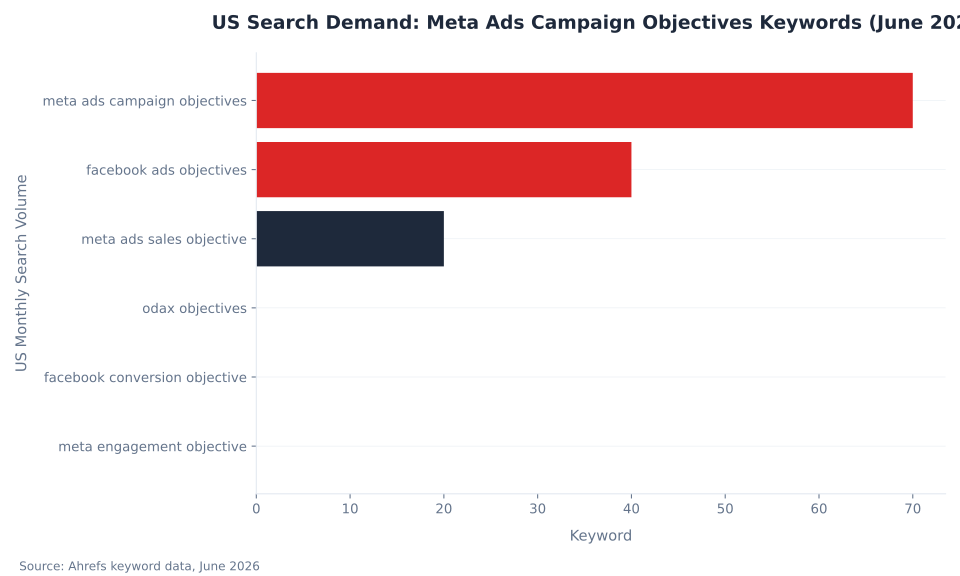
US Search Demand: Meta Ads Campaign Objectives Keywords (June 2026)
Which Meta Ads Objective Should You Choose?
The correct selection rule is outcome-first: name the conversion event you can track, then choose the objective that optimizes for it. The table below is a goal-first lookup — start from the business outcome and work back to the objective, rather than starting from the objective name and guessing at intent.
| Business goal | Choose this objective | Why (the optimization signal) |
|---|---|---|
| Sell products on a website | Sales | Optimizes toward purchase events via Pixel / Conversions API |
| Sell from a product catalog (DTC, retargeting) | Sales (catalog configured inside) | Catalog Sales no longer a separate objective; configure catalog inside Sales |
| Collect leads via a native in-app form | Leads (Instant Forms) | Optimizes for in-platform form submissions; no website required |
| Drive leads to a form on your website | Leads (website) | Optimization event: website lead; requires Pixel lead event |
| Get phone calls from prospects | Leads (calls) | Optimizes for call placements across Meta properties |
| Send clicks to a blog or landing page | Traffic | Optimizes for link clicks or landing-page views; builds retargeting pool |
| Grow Messenger or WhatsApp conversations | Engagement (messaging) | Optimizes for message thread initiations |
| Get video views | Awareness or Engagement (ThruPlay) | No standalone Video Views objective; ThruPlay is an optimization goal |
| Maximize brand reach on launch | Awareness | Optimizes for reach or ad recall lift; no conversion location needed |
| Drive app installs or in-app events | App promotion | The only objective that optimizes for installs — non-negotiable for app advertisers |
The rule that determines every row in this table: name the event you can measure, then pick the objective that bids toward it. The common failure is picking the objective that describes the campaign’s position in the funnel (“we’re in the awareness phase, so Awareness”) rather than the event that defines success (“we want purchases, so Sales”). High-value service advertisers choosing between Leads and Sales objectives should see legal paid-social management, dental practice advertising, and financial services PPC.
Legacy Facebook Ad Objectives Absorbed by Each ODAX Objective (2022–2023 Transition)
Leads vs. Sales: The Costliest Confusion in Meta Advertising
Leads and Sales both produce conversions, so advertisers treat them as interchangeable. They are not. Each optimizes for a fundamentally different user action, and choosing the wrong one caps account performance at the contact stage rather than the transaction stage.
| Attribute | Leads objective | Sales objective |
|---|---|---|
| What Meta optimizes for | Users likely to submit contact details | Users likely to complete a transaction |
| Primary conversion events | Instant Form, website lead event, Messenger conversation, phone call | Purchase, Add to Cart, Initiate Checkout |
| Conversion locations | Instant Forms, Website, Messenger, Calls, App | Website, App, Website and App, Messenger/WhatsApp |
| Tracking requirement | Meta Pixel (lead event) or Conversions API | Meta Pixel (purchase event) + Conversions API |
| Learning phase threshold | ~50 lead events per ad set per week | ~50 purchase events per ad set per week |
| Best for | Service businesses, high-ticket, B2B, any business collecting contacts | E-commerce, DTC, subscription brands tracking transactions |
| Median CPL / CPP (2026) | $23.10 median CPL (WordStream 2026) | No single authoritative benchmark; varies by vertical |
The failure modes run in both directions. A DTC e-commerce store running the Leads objective fills a CRM with email signups but never trains Meta’s algorithm on who actually buys; the account grows a list and loses revenue. A high-ticket service business running the Sales objective with no purchase pixel starves the algorithm of conversion data because there are no transactions to signal against — the ad set enters “learning limited” status and underdelivers.
MB Adv Agency has found that the most common defect in inherited Meta accounts is a Traffic or Engagement campaign asked to produce sales: the account reports strong click volume and high engagement rate but low ROAS, because the algorithm was trained on click-likelihood, not purchase-likelihood, from day one. Changing the objective requires a new campaign — not an edit to the existing one.
High-ticket service advertisers for whom Leads is the correct objective should confirm which conversion location matches their sales process. Instant Forms (in-app forms served directly in the Meta feed) eliminate the website and landing page but deliver leads without attribution via the site pixel. Website leads require a working Pixel lead event and produce better CRM data for downstream qualification. The conversion-leads optimization goal goes further: it requires a Conversions API integration that feeds CRM qualification data back to Meta, training the algorithm on leads that become customers rather than all leads. For legal and professional-services advertisers, see legal PPC services, real estate advertising, and legal PPC in Missoula.
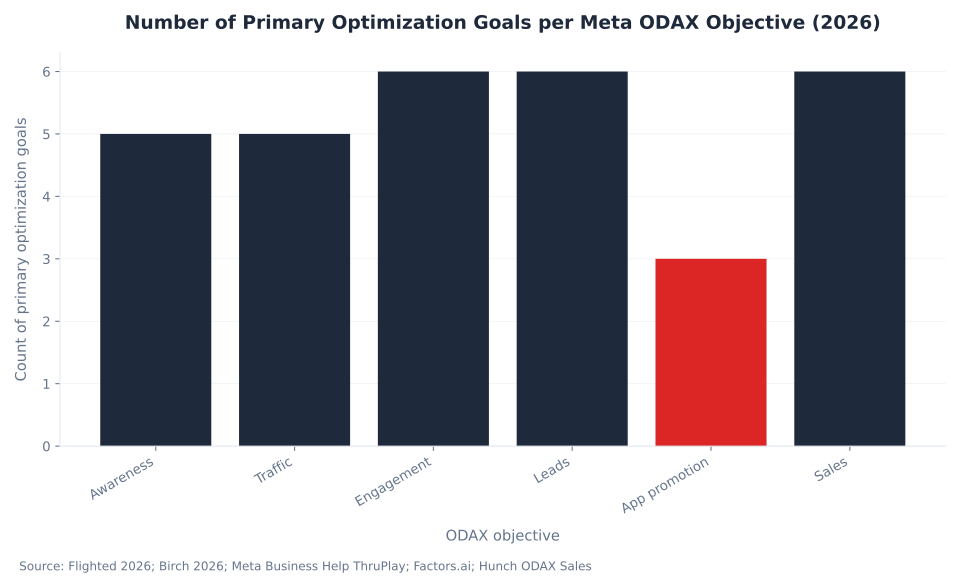
Number of Primary Optimization Goals per Meta ODAX Objective (2026)
Optimization Goals by Objective: The Full Decision Matrix
The optimization goal is the event Meta bids toward within the campaign objective. Each objective exposes a different set of goals; the counts below are drawn from 2026 practitioner documentation and reflect what is available in Ads Manager. Meta does not publish a single canonical count, and options shift as the platform updates.
| ODAX objective | Goal count | Key optimization goals | Note |
|---|---|---|---|
| Awareness | ~5 | Reach, impressions, ad recall lift, ThruPlay, 2-sec video views | No conversion location |
| Traffic | ~5 | Link clicks, landing-page views, Messenger conversations, Instagram profile visits, calls | Optimizes for clicks, not conversions |
| Engagement | ~6 | Post engagement, ThruPlay, 2-sec video, messaging conversations, event responses, page likes | Absorbed Messages and Video Views from legacy |
| Leads | ~6 | Instant Forms, conversion leads (CAPI required), website leads, Messenger, calls, app | Conversion leads requires CRM + CAPI integration |
| App promotion | ~3 | App installs, app events, value (in-app purchase value) | Closed mandate; lowest goal count reflects narrow scope |
| Sales | ~6 | Purchase, Add to Cart, Initiate Checkout, catalog sales, messaging conversions, value | Requires Pixel + CAPI; ~50 events/week/ad set for learning phase |
App promotion’s low goal count (3) is intentional: the closed mandate means there is no general-purpose variant. Engagement and Sales (both ~6) reflect the highest flexibility, but flexibility within an objective is not the same as the objective being the right choice. Sales’ six optimization goals serve DTC accounts that need different event depths (purchase vs. add-to-cart vs. initiate-checkout) depending on their available conversion volume. An account generating fewer than 50 weekly purchases should select Add to Cart or Initiate Checkout — both higher-frequency events — to build the signal volume that sustains the learning phase.
For HVAC and home-services advertisers using the Leads objective to drive calls and form fills, see HVAC PPC services, plumbing PPC services, and HVAC PPC in Flagstaff. For roofing contractors: roofing PPC in Flagstaff and plumbing PPC in Missoula.
Meta Ads Performance Benchmarks by Objective (2026)
Unlike Google Ads, Meta does not publish a single authoritative benchmark report. The figures below are aggregated from 2026 third-party panels — Visible Factors, Digital Applied, Get-Ryze, and Lebesgue — each with different panel compositions. Objective-level and industry-level figures carry panel-composition variance; they signal directional magnitude, not single-source precision. Every cell traces to a cited source; none of these figures come from MB Adv Agency client data.
| Metric | Value | Source |
|---|---|---|
| CTR (median, all industries) | 2.19% | Digital Applied / Visible Factors 2026 |
| CPM (median) | $13.48 | Digital Applied 2026 |
| Conversion rate (median) | 1.57% | Digital Applied 2026 |
| ROAS (median) | 1.93 | Digital Applied 2026 |
| CPC — Traffic objective | $0.70 | Visible Factors 2026 |
| CPC — Leads objective | $1.92 | Visible Factors 2026 |
| CTR — Traffic objective | 1.51% | WordStream roundup 2026 |
| CTR — Leads objective | 2.50% | WordStream roundup 2026 |
| CVR — Leads objective | 8.25% | WordStream roundup 2026 |
| CPL — Leads objective | $23.10 | WordStream roundup 2026 |
| Industry | Avg CPM | Avg CPA / CPL | Top CTR |
|---|---|---|---|
| Insurance | $21.40 | $198.42 | — |
| Legal | $20.85 | $187.60 | — |
| Beauty & Health | $12.46 | — | — |
| Food & Beverage | $8.14 | — | — |
| Education | $7.60 | — | — |
| Art & Home Decor | — | — | 2.92% |
| Clothing & Fashion | — | — | 2.84% |
The variance between the Traffic CPC ($0.70) and the Leads CPC ($1.92) reflects the optimization premium: Meta charges more to reach users it predicts will convert, not just click. The higher Leads CTR (2.50% vs. 1.51% for Traffic) confirms this — the audience Meta finds for lead-gen campaigns responds at higher rates because the algorithm is selecting for intent, not raw click volume. For DTC and supplements brands: see supplements & nutrition advertising and PPC management in Austin.
Funnel-Stage Budget Allocation and Objective Selection
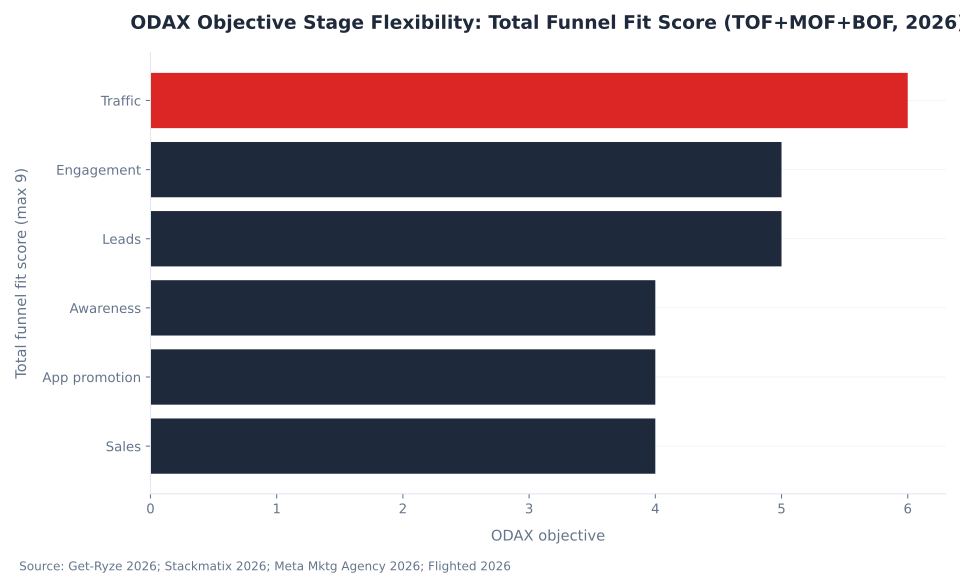
The funnel-stage alignment table below reflects practitioner consensus from 2026 guides — not a Meta-published framework. Meta does not publish a canonical funnel-to-objective mapping. The 60/25–30/10–15 budget split is a heuristic starting point that accounts should rebalance toward whichever stage shows the strongest incremental ROAS.
| Funnel stage | Primary objectives | Starting budget share | Audience temperature |
|---|---|---|---|
| Top of funnel (new audiences) | Awareness, Traffic | 60% | Cold |
| Middle of funnel (warm audiences) | Engagement, Leads | 25–30% | Warm (site visitors, video viewers, page engagers) |
| Bottom of funnel (ready to convert) | Sales, App promotion | 10–15% | Hot (cart abandoners, CRM lists, past purchasers) |
The funnel alignment in this table is a practitioner starting point. Traffic sits in the top-of-funnel column, but the article’s core warning applies here too: using Traffic in a TOF campaign to build a retargeting pool is correct; using Traffic as the permanent campaign type when sales is the goal is the failure mode. The funnel stage and the optimization signal are separate questions, and Table 10 addresses stage, not signal.
MB Adv Agency structures Meta campaigns by conversion stage: prospecting campaigns on Advantage campaign budget with broad audiences, retargeting campaigns on ad-set budgets with spend floors per intent-rich custom audience. This separation keeps learning-phase signal clean per objective and prevents the algorithm from routing retargeting budget toward higher-volume prospecting ad sets. See fashion PPC services, supplements advertising, and PPC management in Chicago for how this structure is applied across DTC and service verticals.
ODAX Objective Stage Flexibility: Total Funnel Fit Score (TOF+MOF+BOF, 2026)
The objective is locked on launch. Getting it wrong costs every campaign that follows.
MB Adv Agency builds and audits Meta Ads accounts for DTC brands and high-ticket service businesses — from objective selection and pixel configuration to learning-phase optimization and full-funnel structure.
Fashion & DTC paid-social management →The Wrong Objective Failure Mode
The wrong objective produces a campaign that looks healthy in the dashboard and fails in the business. Traffic campaigns generate strong click volume, low CPCs, and impressive CTRs — because Meta is doing exactly what it was instructed: finding the cheapest link-clickers. Those users click and bounce. The ROAS is low because the algorithm was never pointed at buyers.
The same logic applies to Engagement campaigns asked to produce leads: Meta finds users who like, comment, and share — the social-engagement audience — not the contact-submission audience. The account accumulates page followers and post interactions while the CRM stays empty. Changing the objective is not an edit; it requires building a new campaign under the correct objective and accepting a fresh learning phase. The old campaign’s performance history does not transfer.
MB Adv Agency reviews the objective against the advertiser’s pixel configuration as the first step in any Meta Ads account audit. The two most common findings: (1) a Traffic campaign is the primary “conversion” campaign, with no Sales campaign in the account; (2) the Sales campaign exists but the Pixel purchase event is not firing, leaving the algorithm with no signal and the ad set in permanent “learning limited” status.
ODAX naming drift. Some third-party reporting tools, API integrations, and older Meta surfaces still display the sixth objective as “Conversions” rather than “Sales.” This is a legacy label from the pre-ODAX Marketing API constant CONVERSIONS, which Meta flagged for deprecation in API v21 (October 2024). When a dashboard tool shows “Conversions” as an objective, it maps directly to what Ads Manager now labels Sales. Similarly, some Meta help articles still reference “Lead Generation” as an objective name — this maps to Leads. The three-banner framing (Awareness / Consideration / Conversion) persists in pre-2023 documentation indexed by search engines; any article that describes how to create a “consideration campaign” is working from a campaign-creation path that no longer exists. Source: Jon Loomer, ODAX 2022; Swipe Insight, API v21 2024.
Three Misconceptions About Meta Ads Campaign Objectives
The three most expensive misconceptions about Meta campaign objectives are all rooted in pre-ODAX thinking that persists in outdated articles, agency templates, and third-party tools. Each is refutable against Meta’s documented platform behavior.
“Meta still has awareness, consideration, and conversion campaigns”
This is false, and it is the costliest outdated assumption in Meta advertising. The three-banner funnel was retired when ODAX consolidated eleven objectives into six flat outcomes, announced December 2021 and the only campaign-creation path in Ads Manager by 2023. There is no “consideration campaign” to create. The consideration-stage objectives (Traffic, Engagement, Lead Generation, App Installs, Video Views, Messages) were redistributed: Traffic stayed Traffic; Engagement, Video Views, and Messages collapsed into Engagement; Lead Generation became Leads; App Installs became App promotion. Any agency or playbook still using the three-stage labels is working from pre-2022 documentation. Source: Social Media Today, ODAX rollout 2022.
“Pick the objective that matches your funnel stage”
This is a false framing that sends advertisers to Traffic and Engagement when they want sales. Funnel-stage thinking is a holdover from the old banner structure, and it produces the busy-but-broke account pattern: Traffic because the product is “new and needs awareness,” Engagement because the brand “needs more reach.” Neither trains Meta’s algorithm on buyers. The correct selection rule is outcome-first: name the conversion event you can track, then choose the objective that optimizes for it. Sales optimizes toward purchase; Traffic optimizes toward link clicks. Choosing Traffic for a “top of funnel” e-commerce campaign trains the system on the cheapest clickers in the audience, not the highest-intent buyers. MB Adv Agency addresses this framing in every Meta account audit: the funnel stage describes where the customer is; the objective describes what Meta is being asked to find. Those are separate decisions.
“Sales and Conversions are the same objective, just renamed”
This is partly false: the mapping is many-to-one, not a flat rename. Sales absorbed both the old Conversions objective and the old Catalog Sales objective. The distinction those two objectives used to make at the campaign level — website conversions versus dynamic catalog ads — now lives inside the Sales objective’s conversion-location and catalog settings. An advertiser who ran Catalog Sales before ODAX will not find that option in the objective list; they select Sales and configure the catalog inside the ad set. Treating the change as a simple rename causes buyers to assume features disappeared when they only moved one level down. Source: Flighted 2026; Hunch Help Center.
Frequently Asked Questions: Meta Ads Campaign Objectives
Not sure your Meta campaigns are running on the right objective?
MB Adv Agency audits Meta Ads accounts for DTC brands and local service businesses — identifying wrong-objective campaigns, pixel gaps, and learning-phase issues before they drain budget.
Get a Meta Ads objective audit →Methodology
This pillar draws from Meta for Developers (ODAX announcement, December 2021), Social Media Today (ODAX rollout 2022), Hunch Help Center (legacy-to-ODAX mapping; Sales objective; Jan 2024 editing cutoff), Swipe Insight (Marketing API v21 restrictions, October 2024), Jon Loomer Digital (ODAX 2022), Flighted (2026), Birch (2026), Get-Ryze (2026 objectives and benchmarks), Stackmatix (2026 funnel strategy), Meta Business Help Center (ThruPlay; Leads with forms), and four benchmark panels: Visible Factors (2026), Digital Applied (2026), Get-Ryze/Sovran (2026), and Lebesgue (2026). Meta’s Help Center blocks automated fetch requests; all platform-mechanic facts are corroborated across two or more independent 2026 practitioner sources. Benchmark figures are third-party panel aggregates — not Meta-published data and not MB Adv Agency client data. Keyword search volume from Ahrefs, June 2026. Reviewed by MB Adv Agency, June 2026.

As a Google Ads expert, I bring proven expertise in optimizing advertising campaigns to maximize ROI.
I specialize in sharing advanced strategies and targeted tips to refine Google Ads campaign management.
Committed to staying ahead of the latest trends and algorithms, I ensure that my clients receive cutting-edge solutions.
My passion for digital marketing and my ability to interpret data for strategic insights enable me to offer high-level consulting that aims to exceed expectations.
Google Partner Agency
We're a certified Google Partner Agency, which means we don’t guess — we optimize withGoogle’s full toolkit and insider support.
Your campaigns get pro-level execution, backed by real expertise (not theory).

4.9 out of 5 from 670+ reviews on Fiverr.
That’s not luck, that’s performance.
Highly recommend Matteo to set up your server side tracking. He has a deep understanding of e-commerce tracking and will go above and beyond to make sure everything is set up correctly and working 100%. If you are scaling your store this set up is non-negotiable in my opinion and there isn't many people who have this much knowledge or put the effort in to get it right. Thanks again!
avorodesign.com
I can only recommend Matteo! He was very patient, professional and very knowledgeable about GA4, Consent Mode v2, and GDPR compliance. Communication was clear, and the setup was done professionally and efficiently. Highly recommend him for anyone needing reliable tracking implementation.

www.natureiki.life
Matteo shines in the realm of online professionals. His work is not only deep in data but also complemented by his proactive communication and cooperation, setting a new standard for freelancers. If you want someone who truly exceeds expectations, look no further. Highly recommended!

www.omanbeverlysmyth.com
Exceptional Service Beyond Expectations - Outstanding Service Impeccable depth, flawless delivery, and exceptional language fluency—this service exceeded all expectations. Highly recommended. Matteo truly ROCKS!!!

ium-paris.com
Top-notch, always highly value working with Matteo. An absolute Google Ads Genius. This is approximately the 8th time I have hired him and he's helped us get 6-7 ROAS. We are excited in continuing to improve our lead flow. Hire this guy if you need Google Ads help. Thanks Matteo!

www.dleeventgroup.com
I finally found the guy who can setup server side tracking and all the ecosystem properly. I definitely recommend Matteo. He is very responsive, kind and wants to dig into things. He configured GA4, Meta, Google Ads, Outbrain and google consent v2 with Cookiebot. Thanks Matteo.

inomega.fr
MB Adv delivered exceptional work with outstanding professionalism and lots of patience, taking time to see effects of changes made and not just do the work and submit it. The proactive communication and video summaries of the work completed made working with Matteo a pleasure, as he consistently went above and beyond. Highly recommended for web analytics projects! We are already working on another project.

www.withnellsensors.co.uk
Working with Matteo on my Google Ads was a game-changer. He's not just a strategist, he's a true partner. He understood my goals and tailored a campaign that perfectly reached my target audience. I'm grateful for his expertise and dedication.

dccargo.com
Click-driven mind
with plastic-brick obsession.
We build Google Ads campaigns with the same mindset we use to build tiny brick worlds: strategy, patience, and zero tolerance for wasted pieces.
Data is our blueprint. Growth is the only acceptable outcome.