Meta Advantage+ & AI Automation (2026)

What Advantage+ and Advantage Actually Mean
Meta uses two related names for two different tiers of automation. "Advantage+" (with the plus sign) names the fully automated campaign types — Advantage+ Sales and Advantage+ App — where the algorithm controls audience selection from a broad pool, placement across all Meta surfaces, budget distribution across ad sets, and creative selection together. "Advantage" (no plus) names the individual feature enhancements that attach to an otherwise manual campaign: Advantage campaign budget, Advantage+ audience, Advantage+ creative, and Advantage+ detailed targeting. These are independent toggles, not a unified system.
The distinction matters because conflating the two leads to a specific and expensive mistake: enabling an Advantage+ campaign type when the advertiser only wanted budget optimization across ad sets. Advantage campaign budget — the former CBO — gives the algorithm control of budget distribution. An Advantage+ Sales campaign gives the algorithm control of budget distribution and audience selection and placement and creative simultaneously, with demographic and interest targeting available only as suggestions, not hard constraints. Location, minimum age, language, and exclusions are the only true hard limits that remain. Those are not the same lever.
The naming rule: If it says "Advantage+" and it is a campaign type — Advantage+ Sales, Advantage+ App — it is full automation. If it says "Advantage campaign budget" (no plus in "campaign budget"), it is one feature bolt-on. Meta's own UI uses both names on the same screen.
The most useful mental model: Advantage+ campaign types are the whole car driving itself. Advantage feature enhancements are cruise control on a car you are still steering. Meta's Advantage+ campaign experience flow, introduced in 2025, defaults new campaign creation to automation. Knowing which product is actually running requires reading past the interface nudge — and auditing which toggles are on is the prerequisite for any optimization work. Several enhancements, including text improvements and image expansion under Advantage+ creative, are on by default and require active opt-out at the ad level. Sources: Meta Business Help — Advantage+ campaign experience; Prism Digital, Advantage+ features explained 2026.
Key Takeaways
Three facts settle the majority of Advantage+ setup decisions before the first dollar is spent.
- Advantage+ Sales — renamed from Advantage+ Shopping in February 2025 — is a campaign type that removes demographic and interest targeting as hard constraints. Enabling it without intending to cede audience control is the most common Advantage+ mistake.
- Meta's delivery stack (Andromeda, GEM, Lattice) runs under every campaign, manual or automated. "Manual targeting" refers to the configuration layer — the delivery machinery has been automated since late 2024 regardless of campaign type.
- When the algorithm owns targeting from a broad pool, creative becomes the targeting signal. The value of differentiated creative rises as automation expands, not falls.
- Flexible ads were removed from Meta's ad-setup format picker in March 2026. The multi-asset delivery logic was absorbed into Format display options and Advantage+ creative — the capability survived; the label did not.
Advantage+ Feature Map: What the AI Automates
The table below maps each Advantage+ campaign type and Advantage feature enhancement to what the algorithm controls and what the manual equivalent was. The "Type" column is the deciding column — it distinguishes full-automation campaign types from individual feature bolt-ons.
| Product | Type | What the AI automates | Manual equivalent |
|---|---|---|---|
| Advantage+ Sales | Campaign type — full automation | Audience from broad pool, placement, budget across ad sets, creative selection from up to 50 ads per ad set | Sales campaign with defined audiences, ad sets, placements |
| Advantage+ App | Campaign type — full automation | Targeting, placement, bid optimization, audience expansion for app installs | Manual app-install campaign with defined audiences |
| Advantage campaign budget | Feature enhancement (former CBO) | Budget distribution across ad sets toward better performers | Per-ad-set (ABO) manual budgets |
| Advantage+ audience | Feature enhancement | Expands beyond your targeting inputs from a broad pool; treats interests and demographics as suggestions | Detailed targeting with hard interest and demographic limits |
| Advantage+ creative | Feature enhancement | Per-asset enhancements: background generation, image expansion, text variations, image-to-video; several on by default | Hand-produced creative variants and aspect-ratio crops |
Advantage+ Sales now runs three objectives: sales (e-commerce conversions), app installs, and lead generation. Before the February 2025 rename from Advantage+ Shopping, the format was e-commerce only. The expanded objective scope means Advantage+ Sales is now relevant for DTC verticals including fashion PPC, beauty products PPC, shoes PPC, and supplements and nutrition PPC, and also for lead-gen verticals such as legal PPC and dental PPC that are now within scope. The hard-constraint rule applies across all objectives: location, minimum age, language, and exclusions are enforced as limits; interest and demographic targeting are signals.
MB Adv Agency's audit of new Advantage+ Sales setups consistently surfaces the same misconfiguration: the campaign objective is correctly set, but the advertiser is unaware that interest targeting is functioning as a suggestion. The result is spend reaching audiences outside the intended scope before the algorithm has gathered enough signal to self-correct. Pre-flight review of which constraints are hard versus soft is the single most skipped step in Advantage+ onboarding. See Meta audience targeting for a full treatment of when manual targeting outperforms broad-pool expansion.
Advantage+ Sales: What Changed in the Rename
Advantage+ Shopping Campaigns (ASC) were renamed Advantage+ Sales in February 2025. The rename was structural: the campaign type now runs sales, lead generation, and app install objectives, where legacy ASC ran only e-commerce conversions. The legacy Advantage+ Shopping creation API was deprecated across all Marketing API versions in Q1 2026.
Three structural changes came with the rename. First, Advantage+ Sales removed legacy ASC's single-ad-set constraint — the campaign now supports unlimited ad sets. Second, the existing_customer_budget_percentage API field was deprecated at Marketing API v25.0; the two-ad-set method (one ad set for new customers, one for existing customers) replaced it for separating audience types. Third, audience suggestions and custom exclusions were added as optional advertiser inputs, giving the algorithm directional signals without converting them to hard limits. Sources: PPC.land, October 2025; Bir.ch, Advantage+ Sales guide.
The legacy API deprecation has a direct operational implication for agencies. Meta announced on October 8, 2025 that creation of new Advantage+ Shopping and Advantage App Campaign objects via legacy API versions would be prohibited; the full deprecation took effect with Marketing API v25.0 in Q1 2026. Campaigns created through Meta Ads Manager UI are unaffected. Agencies running volume-scale Advantage+ Sales programs through API integrations or third-party tools built on API versions 23.0 or earlier needed to migrate before Q1 2026; after v25.0, legacy creation endpoints are disabled across all versions.
Advantage+ App campaigns (A+AC) succeed Automated App Ads (AAA) under the same full-automation model: targeting, placement, bid optimization, and audience expansion are machine-controlled; location, minimum age, language, and exclusions are the only hard limits. Meta's product marketing reports "up to 7% lower CPA" for Advantage+ App versus legacy AAA — this is a Meta-reported figure from internal testing, not independently audited. Source: Meta Business Help, Advantage+ App Campaigns.
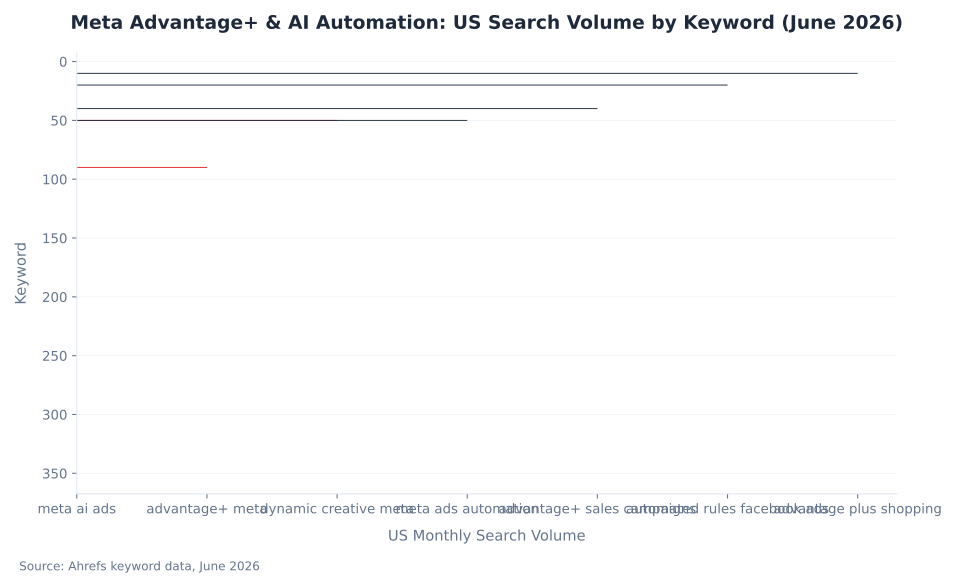
Meta Advantage+ & AI Automation: US Search Volume by Keyword (June 2026)
What to Hand to the Machine vs. What to Keep Manual
The decision is not binary. Meta's automation has three layers: the delivery infrastructure (always automated, no opt-out), the campaign-configuration layer (partially automated through Advantage+ types and feature enhancements), and the creative and signal layer (always the advertiser's responsibility). The table maps the practical recommendation for each lever.
| Lever | Recommendation | Rationale |
|---|---|---|
| Ad delivery / auction (Andromeda, GEM, Lattice) | Already automated — no opt-out | Runs under every campaign regardless of settings |
| Budget distribution across ad sets (Advantage campaign budget) | Hand off — generally safe | Reliable optimization toward better-performing ad sets; low downside |
| Placement | Hand off in most cases | Cross-placement delivery outperforms hand-picked placements; exclude only for brand-safety reasons |
| Audience (Advantage+ audience / full Advantage+ campaign type) | Test, do not default | Broad-pool targeting wins on high-volume DTC; wastes spend on tight B2B or restricted-category accounts |
| Creative production (generative Advantage+ creative) | Use as cost lever; review every output | Speeds variant production; goes off-brand and generic without human review |
| Creative strategy / offer / message-to-audience match | Keep manual — always | The algorithm optimizes which creative wins; it does not invent the right message or offer |
| Conversion-event definition and tracking | Keep manual — always | The signal sent back is what the entire automated stack optimizes toward; wrong event = misaligned campaign |
The audience automation question separates DTC from B2B performance. Advantage+ Sales with broad-pool targeting works when ad volume is high enough for the algorithm to find buyers through creative signal — DTC categories such as jewelry PPC and furniture PPC generate that impression volume. Tightly defined B2B audiences, restricted categories, or low-traffic accounts do not give the algorithm enough signal to expand accurately. Running broad audiences in those contexts is not "letting Meta optimize" — it is spending before the data exists to optimize anything.
MB Adv Agency's position on conversion signals: the Andromeda retrieval, GEM prediction, and Lattice ranking pipeline optimizes toward whatever conversion event is defined. A campaign optimized toward add-to-cart sends a different signal than one optimized toward purchase. Meta's automation amplifies misaligned event definitions; it does not correct them. The campaign objectives guide covers event selection in detail. Getting the signal right before enabling full Advantage+ automation is the single highest-leverage pre-launch action. For PPC management in Austin or PPC management in Chicago, where local service businesses run lead-gen objectives, the conversion event is almost always a form submission or phone call — and the default event Meta proposes is rarely either.

Running Advantage+ for a DTC brand?
MB Adv Agency structures Meta automation so you know exactly which layer has been handed to the machine — and which has not. PPC management for fashion, beauty, and DTC e-commerce brands.
Supplements & nutrition PPC services →The Delivery Stack Underneath Every Meta Campaign
Andromeda, GEM, and Lattice are Meta's three-stage AI delivery infrastructure. They run under every campaign — Advantage+ and manual alike — and no campaign setting disables them. Understanding this stack reframes the "manual vs. automated" question: what advertisers control is the configuration layer on top of a delivery system that was already automated.
Andromeda is the retrieval engine, deployed across Facebook and Instagram and announced via Meta Engineering on December 2, 2024. Its job is the first stage of ad delivery: narrowing the eligible ad pool to a smaller candidate set for the ranking stage. Meta Engineering reports the following on selected segments: +6% recall improvement and +8% ads quality improvement, over 100× improvement in feature-extraction latency and throughput versus prior CPU-based components, and over 3× improvement in end-to-end model inference QPS. Hardware foundation: NVIDIA Grace Hopper Superchips. These are Meta Engineering's figures on selected segments, not independent advertiser-outcome audits.
Meta Engineering reports Andromeda delivered +6% recall improvement and +8% ads quality improvement on selected segments (December 2024). First-party figures — not independently audited advertiser outcomes. Source: Meta Engineering blog.
GEM (Generative Ads Recommendation Model) was deployed across Facebook and Instagram in mid-2025 and described by Meta Engineering in November 2025 as "the largest foundation model for recommendation systems in the industry." Meta Engineering's first-party performance figures: +5% increase in ad conversions on Instagram and +3% on Facebook Feed in Q2 2025, 4× more efficient at driving performance gains per unit of data and compute versus prior models, and a 23× increase in effective training FLOPs from the re-engineered training stack. Attribution: Meta Engineering's own post, not independent audit.
Lattice handles prediction and final auction ranking after Andromeda's retrieval stage. Meta has released fewer technical details on Lattice than on Andromeda or GEM. According to Meta's Q3 2025 earnings materials as reported by Search Engine Land and ALM Corp, rolling Lattice out to app ads drove nearly 3% gain in conversions for that objective — a Meta-reported earnings figure, not independently audited.
The architecture implication for campaign management: the Andromeda/GEM/Lattice pipeline retrieves, predicts, and ranks before campaign configuration touches the outcome. Setting a manual audience defines the pool Andromeda retrieves from; the delivery machinery does the rest. "Manual targeting" is a campaign-configuration choice, not a delivery mechanism. Agencies presenting manual Meta campaigns as non-automated are describing the configuration layer while ignoring the delivery layer.
Dynamic Creative, Flexible Ads, and What Replaced Them
Dynamic Creative was Meta's original multi-asset testing format. Flexible ads replaced it as the labeled option for multi-asset, auto-format delivery in the ad-setup picker. In March 2026, Flexible ads were removed from that picker entirely — not sunset, but absorbed into Format display options and Advantage+ creative.
The removal was quiet. According to Campaign Builder's March 2026 coverage, the automatic format-selection and multi-creative delivery logic was not deleted: it moved into Format display options (where Meta selects format automatically) and Advantage+ creative (which handles per-asset optimization and generative enhancements). The multi-asset delivery capability persists; the standalone format label does not. See Meta ads formats and creative for current spec requirements per asset type.
The durable lesson: Meta keeps the capability and discards the label on a roughly annual cycle. Dynamic Creative → Flexible → absorbed into Advantage+ creative is the third rename of the same underlying job since 2020. Build creative processes around the underlying task — feeding the algorithm multiple distinct, differentiated assets — rather than around whichever branded surface currently exposes that task.
Advantage+ creative in 2026 includes rule-based enhancements (aspect-ratio crops, placement adaptation) and generative AI: background generation (contextual lifestyle backgrounds behind product shots), image expansion (generative fill for additional aspect ratios), text improvements (alternative headline and body variations generated from one description), image-to-video (static product photos converted to multi-scene video), and 3D animation. Sources: AdSUploader 2026; Meta, Advantage+ overview. Text improvements and image expansion are on by default in most placements and require opt-out at the ad level under "Optimize Media." They cannot be disabled globally at the campaign or account level. Source: Jon Loomer Digital.
MB Adv Agency's position: generative Advantage+ creative reduces production time for format variants; it does not produce brand voice, offer framing, or the message-to-audience match that separates a strong ad from a generic one. For verticals with tight visual brand standards — beauty products PPC, fashion PPC — AI background generation in particular requires a human review gate before any generated variant serves at scale.
Two Misconceptions About Meta's AI Automation
The two misconceptions below produce the highest-cost configuration errors. Both trace to the same root: conflating the campaign-configuration layer with the delivery layer.
Misconception 1: "Advantage+ is just a setting I toggle on, and all the automation is the same."
It is not one setting and it is not one product. Advantage+ campaign types — Advantage+ Sales, Advantage+ App — hand the algorithm simultaneous control of audience, placement, budget distribution, and creative selection. Advantage feature enhancements — Advantage campaign budget, Advantage+ audience, Advantage+ creative — are individually toggled layers on a campaign the advertiser still steers. Treating them as interchangeable leads advertisers to enable a full-automation campaign type when they only wanted budget optimization across ad sets, surrendering targeting and placement control they never meant to give up.
Misconception 2: "Meta's AI runs the whole thing now, so creative and structure do not matter."
The opposite is true. As targeting, placement, and bidding move under the algorithm — and as Andromeda, GEM, and Lattice handle retrieval, prediction, and ranking automatically — the advertiser's remaining levers concentrate into two: the creative fed in, and the conversion signal sent back. When Meta selects the audience from a broad pool and serves from a set of loaded creative assets, the creative is the targeting signal — the algorithm uses resonance patterns to find the audience. Thin, undifferentiated creative gives the machine nothing to discriminate against. Automation raises the value of good creative and clean conversion tracking; it does not remove the need for them. For further context on structuring creative inputs, see Meta ads formats and creative.
Frequently Asked Questions
What is the difference between Advantage+ and Advantage on Meta?
"Advantage+" (with the plus sign) names the fully automated campaign types — Advantage+ Sales and Advantage+ App — where the algorithm controls audience selection from a broad pool, placement across all Meta surfaces, budget distribution across ad sets, and creative selection together. Demographic and interest targeting are not available as hard constraints; only location, minimum age, language, and exclusions remain as true limits. The advertiser supplies creative assets, a budget, and a conversion objective. "Advantage" (no plus) names individual feature enhancements that attach to an otherwise manual campaign: Advantage campaign budget (the former CBO), Advantage+ audience (targeting expansion beyond your inputs), Advantage+ creative (per-asset modifications), and Advantage+ detailed targeting (interest expansion). Each toggle is independent. Enabling Advantage campaign budget automates budget distribution across ad sets on a campaign you still control at the audience and placement level. Enabling an Advantage+ Sales campaign hands the algorithm control of budget, audience, placement, and creative together. Meta's interface pushes both through similar-looking flows. Sources: Meta Business Help; Prism Digital 2026.
What happened to Advantage+ Shopping campaigns?
Meta renamed Advantage+ Shopping Campaigns (ASC) to Advantage+ Sales in February 2025. The rename was structural: Advantage+ Sales now runs three objectives — sales, lead generation, and app installs — where legacy ASC ran only e-commerce conversions. The per-campaign existing-customer budget cap field (existing_customer_budget_percentage) was deprecated; the two-ad-set method now handles new-versus-existing customer separation. The single-ad-set constraint of legacy ASC was removed. On October 8, 2025, Meta announced the deprecation of the legacy Advantage+ Shopping and Advantage App Campaign creation APIs. The full deprecation took effect with Marketing API v25.0 in Q1 2026. Campaigns created through Meta Ads Manager are unaffected. Agencies using third-party tools or CRM integrations that created ASC campaigns programmatically via older API versions needed to migrate before Q1 2026. Any guide that uses the name "Advantage+ Shopping" is describing a campaign type that no longer accepts new campaigns. Sources: PPC.land, October 2025; Meta for Developers, v25.0 changelog.
Which Advantage+ creative enhancements are on by default in Meta Ads Manager?
As of 2026, the following Advantage+ creative enhancements are on by default in most placements and require active opt-out at the ad level: text improvements (Meta generates alternative headline, primary text, and description variations from your original copy), image expansion (generative fill extends image edges to fit additional aspect ratios such as 9:16 for Reels and Stories), visual touch-ups (brightness and contrast adjustments), dynamic descriptions, dynamic overlays, and profile end cards. For video ads, music addition is also on by default. To disable a specific enhancement, open the ad in Ads Manager, go to "Optimize Media," and toggle off the relevant item. Enhancements cannot be disabled globally at the campaign or account level — each ad requires individual configuration. Background generation, image-to-video, and 3D animation require opt-in rather than opt-out. For brand-sensitive verticals, auditing Advantage+ creative toggles on each active ad is a necessary maintenance step. An ad that has not been reviewed since launch is running unknown AI modifications on your brand assets. Sources: Jon Loomer Digital; AdSUploader 2026.
Does enabling Advantage+ audience mean I have an Advantage+ campaign type?
No. Advantage+ audience is a feature enhancement that can be applied to a manually configured campaign. It treats advertiser-supplied targeting inputs — interests, demographics, detailed targeting — as suggestions rather than hard constraints, allowing the algorithm to expand beyond them when it identifies higher-value users. What remains as hard constraints even with Advantage+ audience active: location, minimum age, language, and exclusions. All other targeting criteria become directional signals the algorithm can expand beyond. An Advantage+ campaign type (Advantage+ Sales, Advantage+ App) is a full-automation campaign experience where audience, placement, budget distribution, and creative selection are all machine-controlled. Enabling Advantage+ audience on a manual campaign does not convert it into an Advantage+ campaign type — it adds one targeting-expansion layer while the campaign remains manually structured otherwise. Advantage+ audience is the default targeting mode for Sales, App, and Leads objectives as of 2025–2026; for Link Clicks and Landing Page Views objectives, the expansion toggle cannot be disabled. Sources: Meta Business Help; Adnabu 2026.
What are the limits of Meta automated rules in Ads Manager?
Meta automated rules apply conditional logic to campaign, ad set, or ad performance data and trigger actions — pause, budget change, bid change, or notification — when conditions are met. Current verified limits (2026): a maximum of 250 rules per ad account; rules checked at minimum once every 30 minutes with actions executing within one hour; each rule supports one condition (e.g., "if CPA exceeds $50 over the last 7 days"); rules apply at one campaign hierarchy level and cannot span campaigns and ad sets in the same rule; rules cannot apply to ads about social issues, elections, or politics. Automated rules sit on the configuration layer — pausing a campaign stops spend, but the Andromeda/GEM/Lattice delivery pipeline running under other active campaigns is unaffected. For agencies managing city-level service campaigns — HVAC PPC in Flagstaff, plumbing PPC in Missoula — automated rules for off-hours budget protection are a practical complement to Meta's AI delivery, not a substitute for campaign strategy. Sources: Meta Business Help, Automated Rules; Meta Business Help, Limits to Automated Rules.
Need a structured approach to Meta’s AI automation for your accounts?
Get in touch →Methodology
Data sources: Ahrefs keyword data (US, June 2026); Meta Engineering blog posts (Andromeda, December 2024; GEM, November 2025); Meta Business Help Center (verified June 2026); Meta for Developers, Marketing API v25.0 changelog; practitioner sources (Foxwell Digital, PPC.land, Campaign Builder, Jon Loomer Digital, AdSUploader, Vizup, Bir.ch) cross-checked against each other. All Meta-reported performance figures are attributed as such and are not presented as independently audited benchmarks. No MB Adv Agency client metrics are cited; agency perspective is qualitative throughout. Last updated: June 2026. Reviewed by MB Adv Agency, June 2026.

As a Google Ads expert, I bring proven expertise in optimizing advertising campaigns to maximize ROI.
I specialize in sharing advanced strategies and targeted tips to refine Google Ads campaign management.
Committed to staying ahead of the latest trends and algorithms, I ensure that my clients receive cutting-edge solutions.
My passion for digital marketing and my ability to interpret data for strategic insights enable me to offer high-level consulting that aims to exceed expectations.
Google Partner Agency
We're a certified Google Partner Agency, which means we don’t guess — we optimize withGoogle’s full toolkit and insider support.
Your campaigns get pro-level execution, backed by real expertise (not theory).

4.9 out of 5 from 670+ reviews on Fiverr.
That’s not luck, that’s performance.
Highly recommend Matteo to set up your server side tracking. He has a deep understanding of e-commerce tracking and will go above and beyond to make sure everything is set up correctly and working 100%. If you are scaling your store this set up is non-negotiable in my opinion and there isn't many people who have this much knowledge or put the effort in to get it right. Thanks again!
avorodesign.com
I can only recommend Matteo! He was very patient, professional and very knowledgeable about GA4, Consent Mode v2, and GDPR compliance. Communication was clear, and the setup was done professionally and efficiently. Highly recommend him for anyone needing reliable tracking implementation.

www.natureiki.life
Matteo shines in the realm of online professionals. His work is not only deep in data but also complemented by his proactive communication and cooperation, setting a new standard for freelancers. If you want someone who truly exceeds expectations, look no further. Highly recommended!

www.omanbeverlysmyth.com
Exceptional Service Beyond Expectations - Outstanding Service Impeccable depth, flawless delivery, and exceptional language fluency—this service exceeded all expectations. Highly recommended. Matteo truly ROCKS!!!
ium-paris.com
Top-notch, always highly value working with Matteo. An absolute Google Ads Genius. This is approximately the 8th time I have hired him and he's helped us get 6-7 ROAS. We are excited in continuing to improve our lead flow. Hire this guy if you need Google Ads help. Thanks Matteo!

www.dleeventgroup.com
I finally found the guy who can setup server side tracking and all the ecosystem properly. I definitely recommend Matteo. He is very responsive, kind and wants to dig into things. He configured GA4, Meta, Google Ads, Outbrain and google consent v2 with Cookiebot. Thanks Matteo.

inomega.fr
MB Adv delivered exceptional work with outstanding professionalism and lots of patience, taking time to see effects of changes made and not just do the work and submit it. The proactive communication and video summaries of the work completed made working with Matteo a pleasure, as he consistently went above and beyond. Highly recommended for web analytics projects! We are already working on another project.

www.withnellsensors.co.uk
Working with Matteo on my Google Ads was a game-changer. He's not just a strategist, he's a true partner. He understood my goals and tailored a campaign that perfectly reached my target audience. I'm grateful for his expertise and dedication.

dccargo.com
Click-driven mind
with plastic-brick obsession.
We build Google Ads campaigns with the same mindset we use to build tiny brick worlds: strategy, patience, and zero tolerance for wasted pieces.
Data is our blueprint. Growth is the only acceptable outcome.