Healthcare PPC Statistics 2026

Healthcare PPC — Median Cost Per Click, 45 US Cities
Median CPC across 45 tracked US markets · MB Adv Agency analysis · 2026
How Do Healthcare Providers Actually Make PPC Decisions?
Healthcare PPC operates on two fundamentally different buying timelines. Urgent care searches — "urgent care near me open now" — behave like emergency intent: search, click, call within the hour. Primary care, mental health, and specialist searches take 3–10 days, with patients comparing three to five providers before booking. This bifurcation explains why city-level CVR data tells a more nuanced story than any national benchmark can capture.
According to MB Adv Agency's analysis of 45 US healthcare markets, mental health is the dominant specialty by city count — appearing as the primary advertising focus in 14 of the cities we track. That concentration has direct cost implications: LocalIQ's 2025 Healthcare Search Advertising Benchmarks report an average CPL of $141.17 for mental health — the most expensive specialty in all of healthcare — alongside a +42% year-over-year CPC increase. When mental health practices dominate a local market's paid search mix, aggregate CPL climbs accordingly. A practice manager benchmarking against a $5.64 national average CPC is comparing to a figure diluted by low-bid rural markets and informational queries that never reach a booking page.
A HIPAA-specific constraint also shapes healthcare PPC that doesn't apply to other verticals: remarketing using patient health data is restricted, which limits targeting options and concentrates competitive pressure on intent-based keywords. When you cannot follow users across the web with condition-specific messaging, winning the right keyword at the moment of search intent becomes the primary lever — which is why CPCs in competitive markets get bid well above the national average. The $24.77 billion US healthcare digital ad spend in 2025, up 13.3% year-over-year per eMarketer Healthcare Ad Spending 2025, is partly the downstream result of this dynamic.
KEY FINDING: Google eliminated AI Overviews from all healthcare provider-finding queries in 2025. Per BrightEdge's Healthcare AI Evolution research, "near me" and provider-discovery searches moved from 100% AI Overview coverage in 2023 to 0% coverage by 2025 — now routing to Maps, the local pack, and paid results. For any practice running healthcare PPC advertising, this is the most consequential SERP change in three years.
The behavioral data reinforces why search remains the correct channel: NetOneClick's Paid Advertising Statistics for Healthcare 2026 reports that 65% of patients click on paid ads when searching for medical services, and 77% use a search engine before booking any appointment. Meanwhile, rater8's 2025 Report on How Patients Choose Their Doctors finds that 84% checked online reviews before booking — meaning search-first, then review validation, is now the dominant patient acquisition path. PPC captures the search step; reputation captures the close.
Healthcare PPC Statistics 2026: Key Findings
MB Adv Agency's analysis of 45 US healthcare PPC markets surfaces nine findings that directly inform how medical practices should plan digital advertising budgets in 2026.
- Median CPC is $7.00 across 45 tracked cities — 24% above the LocalIQ national healthcare average of $5.64. The gap reflects that our tracked markets are active competitive environments, not blended averages diluted by rural and low-bid informational traffic.
- Mean CPC reaches $9.88 — 75% above the national average — driven by high-cost specialty markets in the Southwest and the Greensboro, NC specialist outlier at $60.00, which likely captures oncology or cardiology keyword categories where single-patient lifetime value justifies extreme bid levels.
- Median cost per lead is $82.50 — 25% above the LocalIQ national CPL of $66.02. Our city-weighted sample is heavy on mental health markets, which carry a nationally reported CPL of $141.17 — the highest of all 16 healthcare specialties measured by LocalIQ.
- The Southwest is the counterintuitive efficiency leader. Despite the highest regional CPC in the dataset ($14.82 average), the Southwest delivers the lowest regional CPL at $63.33. Houston — the highest-CPC city at $22.50 — also delivers the lowest CPL at $40.00 with a 15% CVR. Regional CPC alone is a misleading budget proxy; CPL is the real efficiency signal.
- Mental health CPCs rose 42% year-over-year nationally — the largest increase of any healthcare specialty — while simultaneously reaching the highest CPL. For mental health practices running Google Ads in a mid-tier market, a $2,500 monthly budget at the $141.17 national CPL generates 17–18 leads per month from patients with committed care intent.
- Median CVR is 7.5% across the 10 cities in our dataset with conversion data — below the WordStream Physicians & Surgeons national CVR of 11.62%. The gap is methodological: the national figure skews toward urgent care and high-intent surgical queries. Our city mix includes mental health and primary care, which convert at lower rates but with meaningful patient lifetime value.
- Google removed AI Overviews from all healthcare provider-finding queries in 2025. The queries that most directly drive patient acquisition — "doctor near me," "urgent care open now," "therapist accepting new patients" — now show traditional paid and local results. The concern that AI would bypass healthcare PPC did not materialize; the opposite occurred.
- Healthcare demand is year-round with no measurable seasonality. Seasonal data is empty across all 45 cities in our dataset. Healthcare is one of the few PPC verticals where a flat monthly budget is a fully rational strategy — illness, chronic conditions, and mental health need generate consistent search volume every month of the year.
- The US healthcare market reached $4.7 trillion in 2026 per IBISWorld, growing at a 4.4% CAGR over five years. With BLS projecting 2.0 million new healthcare jobs by 2034, the supply of practices competing for patients — and advertising spend — is accelerating.
45 Cities
37 Cities with Data
37 Cities
10 Cities
LocalIQ 2025
Greensboro NC (specialty)
How Do Healthcare PPC Benchmarks Compare Across Data Sources?
MB Adv Agency city-level data sits 24–75% above national healthcare PPC averages — not because our data is wrong, but because national figures blend competitive city markets with rural and low-intent traffic that has near-zero advertiser competition. The positioning line: national benchmarks describe a market average; our data describes what advertisers actually pay in cities where healthcare PPC competition is real.
The table below compares three sources. LocalIQ's 2025 Healthcare Search Advertising Benchmarks draw from 3,542 US-based search campaigns — the most credible public reference — but report national averages only. WordStream's 2025 Google Ads Benchmarks provide the Physicians & Surgeons CVR (11.62%) that represents the cross-market conversion ceiling for the industry. Our dataset adds the dimension neither source provides: city-by-city granularity across 45 active US markets.
| Source | Avg CPC | Avg CPL | Avg CVR | Scope |
|---|---|---|---|---|
| MB Adv Agency (median) | $7.00 | $82.50 | 7.5% | 45 US cities, 2026 |
| MB Adv Agency (mean) | $9.88 | $81.87 | 8.78% | 37 cities with CPC/CPL data |
| LocalIQ (national avg) | $5.64 | $66.02 | — | 3,542 US campaigns, all market tiers |
| WordStream (Physicians & Surgeons) | — | — | 11.62% | National avg, all US markets |
The CVR gap is worth unpacking. Our city median CVR of 7.5% falls below the WordStream national figure of 11.62% — not because our tracked practices are less effective, but because the national figure is skewed by urgent care's near-emergency conversion behavior (often 15–20% CVR). Our dataset includes primary care and mental health practices where the decision cycle runs days rather than minutes. A 7.5% CVR across that specialty mix is consistent with what MB Adv Agency observes in managed campaigns. By comparison, the Physicians & Surgeons benchmark in WordStream's full cross-industry analysis ranks among the highest of all industries — above legal, real estate, and construction — confirming that healthcare search intent is high-quality even when it takes longer to convert.
Healthcare also compares favorably to adjacent verticals in our dataset. Our dental PPC statistics report a median CPC of $6.47 — nearly identical to healthcare — but with a specialty ceiling far below Greensboro's $60. Legal PPC runs significantly higher ($23+ median CPC) because personal injury and criminal defense keywords compete on a winner-take-all basis. Healthcare sits in a middle tier where market-by-market variation, not category, is the dominant cost driver.
What Does Healthcare PPC Cost Per Click in Each US City?
The Southwest dominates the high-CPC bracket — Texas alone contributes five of the top twelve most expensive markets — but delivers the lowest cost-per-lead of any region. Greensboro, NC stands apart as a specialty outlier at $60.00 CPC, likely reflecting oncology or cardiology keyword categories where a single converted patient generates $10,000–$50,000 in lifetime revenue, making a $60 click economically rational.
The Cost Efficiency Index (CEI) below measures dataset mean CPC ($9.88) divided by each city's CPC. A CEI above 1.5 indicates a city where advertisers pay well below the dataset average; below 1.0 indicates a premium market. According to MB Adv Agency's analysis of 45 US healthcare markets, the five most cost-efficient markets (excluding the Greensboro specialty outlier) show CEI values between 1.98 and 4.70 — meaning advertisers pay as little as 21 cents for every dollar spent in the most expensive markets.
| City | Avg CPC | CPC Range | CEI | Competition |
|---|---|---|---|---|
| Greensboro, NC *specialty outlier | $60.00 | $45–$75 | 0.16 | — |
| Houston, TX | $22.50 | $5–$40 | 0.44 | High |
| McKinney, TX | $18.50 | $7–$30 | 0.53 | — |
| Corpus Christi, TX | $17.50 | $5–$30 | 0.56 | Medium |
| Phoenix, AZ | $17.50 | $5–$30 | 0.56 | High |
| St. Louis, MO | $15.00 | $10–$20 | 0.66 | — |
| Tampa, FL | $14.00 | $8–$20 | 0.71 | — |
| Tulsa, OK | $13.00 | $6–$20 | 0.76 | — |
| Lexington, KY | $12.50 | $7–$18 | 0.79 | — |
| Fort Wayne, IN | $11.00 | $4–$18 | 0.90 | — |
| Jacksonville, FL | $9.50 | $4–$15 | 1.04 | — |
| San Antonio, TX | $9.00 | $4–$14 | 1.10 | High |
| Colorado Springs, CO | $8.50 | $5–$12 | 1.16 | — |
| Baltimore, MD | $7.00 | $4–$10 | 1.41 | — |
| Boston, MA | $7.00 | $4–$10 | 1.41 | — |
| Kansas City, MO | $7.00 | $4–$10 | 1.41 | — |
| Lakeland, FL | $7.00 | $4–$10 | 1.41 | — |
| Louisville, KY | $7.00 | $4–$10 | 1.41 | — |
| Newark, NJ | $7.00 | $4–$10 | 1.41 | — |
| Pittsburgh, PA | $7.00 | $4–$10 | 1.41 | — |
| — Top 10 most affordable markets — | ||||
| Gulfport, MS | $2.10 | $1.20–$3.00 | 4.70 | — |
| Jackson, MS | $2.90 | $2.62–$3.17 | 3.41 | — |
| Charleston, SC | $3.31 | $2.62–$4.00 | 2.98 | — |
| Spokane, WA | $3.81 | $2.62–$5.00 | 2.59 | — |
| Durham, NC | $4.06 | $2.62–$5.50 | 2.43 | — |
| Jersey City, NJ | $4.75 | $3.50–$6.00 | 2.08 | — |
| Kansas City, KS | $4.83 | $3.17–$6.50 | 2.05 | — |
| Lakewood, CO | $4.90 | $3.80–$6.00 | 2.02 | — |
| Hartford, CT | $5.00 | $3.00–$7.00 | 1.98 | — |
| New Haven, CT | $5.00 | $3.00–$7.00 | 1.98 | — |
Cost Efficiency Index — Top 5 Most Efficient Markets:
Gulfport MS (4.70) • Jackson MS (3.41) • Charleston SC (2.98) • Spokane WA (2.59) • Durham NC (2.43)
Note on Greensboro NC (CEI 0.16): At $60 CPC, Greensboro sits 6.1x above the dataset mean. This reflects specialist keyword categories — oncology, cardiology, or neurosurgery — where a single patient generates $10,000–$50,000 in lifetime revenue. Exclude from general market budgeting; contextualize as the ceiling for high-ticket specialty PPC.
CPC by City: Visual Breakdown

Which States Have the Highest and Lowest Healthcare PPC Costs?
Texas is the most expensive state for healthcare PPC at $14.65 average CPC across five tracked cities — but also delivers some of the best CPL economics in the dataset. Mississippi is the most affordable at $2.50 average CPC across two cities, reflecting lower advertiser density and smaller metro scale. North Carolina's $23.69 state average is inflated by the Greensboro specialty outlier; the two non-outlier NC cities (Durham $4.06, Raleigh $7.00) average $5.53.
MB Adv data indicates that state-level averages mask substantial within-state variation. In Texas, the CPC range spans $5.75 (El Paso) to $22.50 (Houston) — a 3.9x spread within the same state, driven by metro size, specialty mix, and advertiser density. A practice comparing only at the state level would set the wrong budget for its specific market.
| State | Avg CPC | Cities Tracked | Notes |
|---|---|---|---|
| North Carolina | $23.69 | 3 | Skewed by Greensboro $60 specialty outlier; ex-Greensboro avg = $5.53 |
| Texas | $14.65 | 5 | Range $5.75–$22.50; 3 of 5 cities above dataset mean |
| Missouri | $11.00 | 2 | KC MO $7.00 / St. Louis $15.00 |
| Kentucky | $9.75 | 2 | Louisville $7.00 / Lexington $12.50 |
| Florida | $9.50 | 4 | Range $7.00–$14.00; retiree demographics elevate chronic care demand |
| Colorado | $6.70 | 2 | Colorado Springs $8.50 / Lakewood $4.90 |
| New Jersey | $5.88 | 2 | Jersey City $4.75 / Newark $7.00; NYC metro adjacency |
| Connecticut | $5.00 | 2 | Hartford $5.00 / New Haven $5.00; consistent across both cities |
| Mississippi | $2.50 | 2 | Gulfport $2.10 / Jackson $2.90; lowest-cost state in dataset |
Florida's four-city representation reveals a split market: Tampa ($14.00) and Jacksonville ($9.50) command a premium driven by large, aging metro populations generating high chronic care and specialist demand, while Lakeland ($7.00) and Orlando ($7.50) remain closer to the dataset median. AAMC's Physician Workforce Data confirms that Florida's physician-to-population ratio is below the national average — which tightens supply and increases competitive bidding for patient acquisition across the state.
What Is the Cost Per Lead for Healthcare PPC?
Healthcare PPC generates leads at a median $82.50 per patient inquiry across 37 US cities in our dataset — 25% above the $66.02 national average published by LocalIQ. The range is exceptional: Houston, TX delivers a $40.00 CPL despite having the second-highest CPC in the dataset, while Boston and Newark reach $150.00 — reflecting the Northeast's combination of high advertiser density, slower decision cycles, and premium market positioning.
The ROI potential column below uses a $1,200 average patient lifetime value assumption — a conservative figure for primary care and specialty practices — paired with each city's observed CVR where available (dataset median 7.5% applied where CVR data is missing). ROI Potential = (patient LTV × CVR) ÷ CPL. A score above 2.0 indicates markets where the math strongly justifies PPC investment. According to MB Adv Agency's analysis, Houston TX produces the highest ROI potential in the dataset at 4.5x — meaning each $1 in CPL returns an estimated $4.50 in patient revenue when CVR and LTV are combined.
| City | Avg CPL | CPL Range | ROI Potential |
|---|---|---|---|
| — Highest CPL markets — | |||
| Boston, MA | $150.00 | $80–$220 | 0.60 |
| Newark, NJ | $150.00 | $80–$220 | 0.60 |
| Detroit, MI | $125.00 | $50–$200 | 0.72 |
| Fort Wayne, IN | $115.00 | $55–$175 | 0.68 |
| Durham, NC | $112.50 | $75–$150 | 0.80 |
| San Antonio, TX | $107.50 | $65–$150 | 0.75 |
| St. Louis, MO | $107.50 | $75–$140 | 0.84 |
| Spokane, WA | $105.00 | $60–$150 | 0.86 |
| Lexington, KY | $105.00 | $60–$150 | 0.86 |
| Charleston, SC | $100.00 | $80–$120 | 0.90 |
| Jersey City, NJ | $95.00 | $70–$120 | 0.95 |
| Midland, TX | $90.00 | $60–$120 | 1.00 |
| Jackson, MS | $89.05 | $78–$100 | 0.51 |
| Kansas City, KS | $85.00 | $50–$120 | 1.06 |
| New Haven, CT | $85.00 | $50–$120 | 1.06 |
| — Lowest CPL markets — | |||
| Houston, TX | $40.00 | $20–$60 | 4.50 |
| El Paso, TX | $40.00 | $25–$55 | 2.25 |
| Corpus Christi, TX | $42.50 | $25–$60 | 2.82 |
| Gulfport, MS | $52.50 | $25–$80 | 2.40 |
| Austin, TX | $60.00 | $45–$75 | 1.60 |
| Boise, ID | $65.00 | $45–$85 | 1.38 |
| Memphis, TN | $72.50 | $50–$95 | 1.24 |
| Pittsburgh, PA | $77.50 | $55–$100 | 1.16 |
| Raleigh, NC | $77.50 | $55–$100 | 1.16 |
| Salt Lake City, UT | $77.50 | $55–$100 | 1.16 |
ROI Potential = ($1,200 avg patient LTV × city CVR or dataset median 7.5%) ÷ CPL. Houston uses its observed 15% CVR. Jackson, MS uses its observed 3.78% CVR, resulting in a lower score despite low CPL. CPL figures for Chicago and San Francisco were excluded from this table as the dataset records anomalous values of $2.50 for both markets that do not reflect typical patient acquisition economics.
What Conversion Rate Does Healthcare PPC Achieve?
Healthcare PPC converts at a median 7.5% across the 10 cities in our dataset with observed conversion data — delivering strong efficiency relative to most industries, but below the 11.62% national Physicians & Surgeons benchmark from WordStream's 2025 Google Ads analysis. The gap is expected: our city mix skews toward mental health and primary care, which carry longer decision cycles than the urgent care queries that push the national average toward 15–20% CVR.
CVR data is available for 10 cities in our dataset — directional but not exhaustive. Houston, TX and Jacksonville, FL both achieve 15% CVR — the highest observed in the dataset — driven by high-intent urgent care and specialty queries in large metros with strong digital healthcare adoption. Jackson, MS reaches only 3.78% CVR, reflecting a rural-adjacent market where digital booking adoption is lower and patients complete conversion by phone rather than online form.
| City | CVR | Driver |
|---|---|---|
| Houston, TX | 15.0% | High-intent urgent care + Texas Medical Center density |
| Jacksonville, FL | 15.0% | Large metro, mobile-first health searches, strong click-to-call |
| Gulfport, MS | 10.5% | Lower market competition, dominant local advertiser advantage |
| Corpus Christi, TX | 10.0% | Dominant healthcare advertiser in mid-size coastal Texas metro |
| Austin, TX | 8.0% | Tech-forward population with high digital booking adoption |
| San Antonio, TX | 7.0% | Mix of urgent care and primary care intent; strong Military Health System adjacency |
| Fort Wayne, IN | 6.5% | Midwest conservative market; longer decision cycle for primary care |
| McKinney, TX | 6.0% | Rapidly growing suburb; new patient acquisition highly competitive |
| Phoenix, AZ | 6.0% | Large metro, high advertiser density dilutes individual conversion share |
| Jackson, MS | 3.78% | Rural-adjacent market; lower digital booking completion rate |
The Texas concentration at the top of the CVR table is not coincidental. Texas markets in our dataset combine large-scale urgent care infrastructure (Houston's Texas Medical Center is the world's largest), strong mobile search intent, and above-average digital adoption among younger demographics. The Sagapixel patient behavior research shows that 60% of all healthcare searches happen on mobile — the device format with the shortest path from ad click to call, which structurally advantages markets with strong click-to-call landing page setups. This also explains why 76% of "near me" healthcare searchers visit a location within 24 hours, per NetOneClick's How Patients Find Medical Practices analysis.
Which US Region Delivers the Best Healthcare PPC Economics?
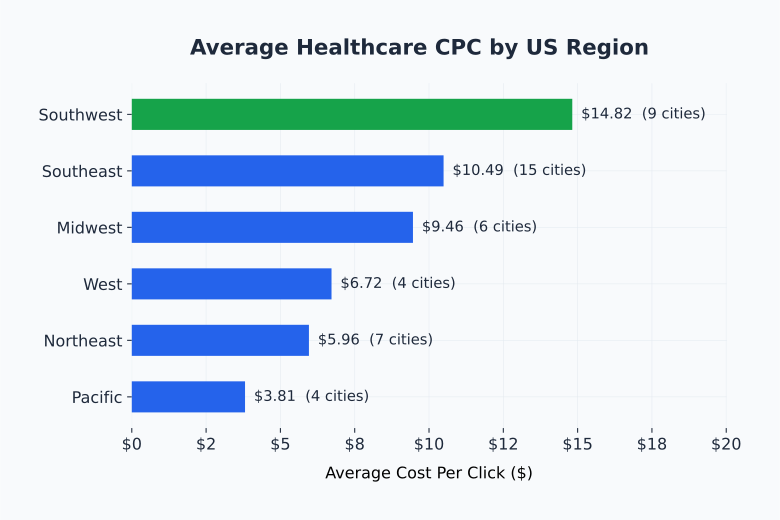
The Southwest pays the most per click ($14.82 average CPC) and generates the fewest leads for that spend — yet delivers the lowest cost per lead at $63.33. This counterintuitive pattern holds because Southwest markets convert at 8.67% average CVR, eliminating the CPC premium through volume and speed. The Northeast inverts this: $5.96 CPC is the second-lowest in the dataset, but a $100.00 average CPL is the highest — driven by longer patient decision cycles and dense advertiser competition that reduces individual conversion rates.
| Region | Avg CPC | Avg CPL | Avg CVR | Cities |
|---|---|---|---|---|
| Southwest | $14.82 | $63.33 | 8.67% | 9 |
| Southeast | $10.49 | $84.54 | 9.76% | 15 |
| Midwest | $9.46 | $85.83 | 6.5% | 6 |
| West | $6.72 | $71.25 | — | 4 |
| Northeast | $5.96 | $100.00 | — | 7 |
| Pacific | $3.81 | $64.17 | — | 4 |
The Northeast's CPC-to-CPL inversion deserves direct attention. At $5.96 average CPC — below the national average — a practice manager in Boston or Newark would expect affordable patient acquisition. The $100 average CPL reveals the opposite: Northeast markets combine concentrated hospital systems, strong brand preferences, and an educated patient population that takes longer to decide. Boston and Newark both reach $150 CPL, which the data attributes to longer research cycles, not inefficient ad setup. The practical implication: Northeast healthcare practices should model CPL, not CPC, when setting budget expectations, and should extend their attribution window to match the 3–10 day decision cycle documented in Medical Economics' patient behavior research.
The Southeast's 9.76% average CVR — the highest of the regions with CVR data — reflects Jacksonville FL (15%) and Gulfport MS (10.5%) pulling the regional figure upward. The Southeast also has the largest city count at 15, giving it the most representative regional sample in the dataset. The West's second-lowest CPL ($71.25) with below-average CPC ($6.72) points to an efficient, less-saturated market that MB Adv Agency's analysis identifies as an underserved opportunity for healthcare advertisers looking to expand beyond high-cost primary markets.
Regional CPC Comparison
How Competitive Is Healthcare PPC in US Markets?
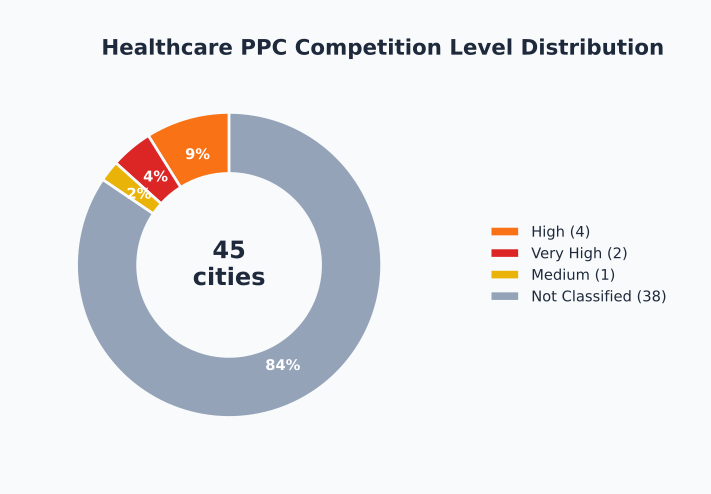
Healthcare PPC competition is concentrated at the top of the market: the two cities with Very High competition ratings (Chicago and New York) are also the largest metros in the dataset. Four cities register High competition — Houston, Boise, Phoenix, and San Antonio — with Corpus Christi as the only Medium-rated market. The majority of tracked cities lack competition-level data, which reflects that competition varies dramatically by specialty within a single city.
| Competition Level | Cities | Markets | Implication for Bidding |
|---|---|---|---|
| Very High | 2 | Chicago IL, New York NY | Brand keyword + specialty targeting required; broad match inefficient |
| High | 4 | Boise ID, Houston TX, Phoenix AZ, San Antonio TX | Tight keyword segmentation; CPL efficiency depends on specialty focus |
| Medium | 1 | Corpus Christi TX | Broad match viable for volume; new entrant window still open |
| Not recorded | 38 | Remaining 38 cities | Competition varies by specialty within a single market |
The specialty-level nuance matters more in healthcare than most verticals. Mental health and urgent care within the same city can face entirely different competitive landscapes — a mental health practice in Houston faces different bidders than an orthopedic clinic on the same street. LocalIQ's specialty breakdown confirms this: Orthodontics carries an $8.76 CPC nationally while Emergency Medicine averages $2.29 — a 3.8x spread within a single metro's healthcare category. HIPAA restrictions on audience targeting further concentrate competition at the keyword level, making specialty-specific keyword architecture more critical in healthcare than in other industries where audience layering can compensate for broad keywords.
Competition Level Distribution
How Much Should a Medical Practice Budget for Google Ads?
A starter budget of $2,000–$2,500 per month generates 24–38 patient inquiries at the median healthcare CPL of $82.50 — enough volume for a small practice to maintain a steady new-patient pipeline. The most efficient markets push that entry-point further: Houston at $40 CPL produces 50–62 leads on the same budget, fundamentally changing the ROI equation for practices willing to advertise in premium-CPC markets where conversion economics compensate for click cost.
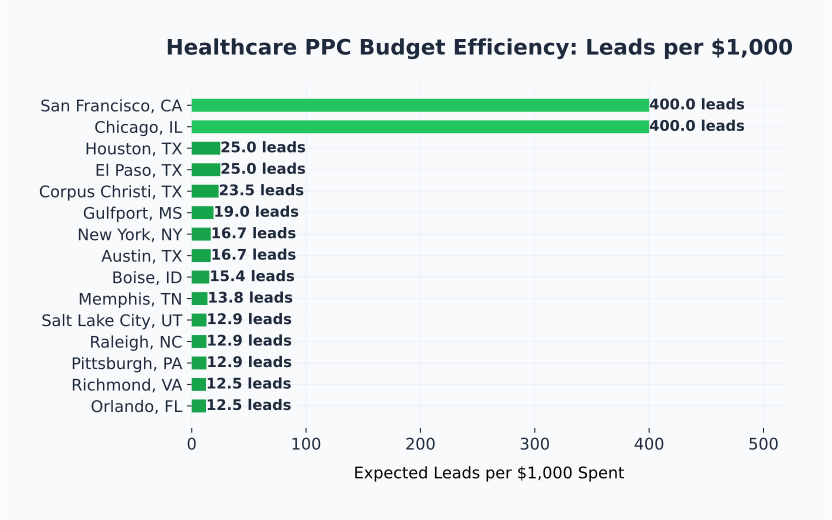
The Budget Efficiency column below calculates leads per $1,000 in ad spend using each city's observed CPL. Our starter budget data from the 12 cities with recorded spend thresholds shows a $2,000–$3,250 range (median $2,375), confirming that meaningful patient acquisition is achievable below the enterprise spending thresholds that dominate industry discussion. According to MB Adv Agency's healthcare PPC data, a well-structured campaign with specialty-specific keyword architecture can achieve 15–25% better CPL than campaigns built on broad health category terms.
| Budget Tier | Monthly Spend | Target Market Type | Expected CPL | Leads/Month | Leads per $1K |
|---|---|---|---|---|---|
| Starter | $2,000–$2,500 | Small metro (Boise ID, Memphis TN, Raleigh NC) | $65–$82 | 24–38 | 12.2–15.4 |
| Growth | $3,500–$5,000 | Mid-size market (Pittsburgh PA, Salt Lake City UT, Kansas City) | $77–$100 | 35–65 | 10.0–12.9 |
| Market Leader | $7,500+ | Major metro (Houston TX, Phoenix AZ, Tampa FL) | $40–$150 | 50–187 | 5.0–25.0 |
| Specialty High-Ticket | $5,000–$15,000+ | Specialist markets (Greensboro NC oncology tier) | $100–$300+ | 17–150 | 3.3–7.0 |
Market Opportunity Score — Top 5 Cities
Composite ranking: low CPC + high CVR + low CPL. Score 1–10.
- Gulfport, MS — 9.2: CPC $2.10 + CVR 10.5% + CPL $52.50. Best across all three dimensions.
- Houston, TX — 8.8: CVR 15% + CPL $40. High CPC ($22.50) justified by conversion economics.
- Corpus Christi, TX — 7.8: CVR 10% + CPL $42.50 + moderate CPC $17.50.
- Austin, TX — 7.1: CVR 8% + CPL $60 + strong digital adoption.
- El Paso, TX — 6.8: Low CPC $5.75 + CPL $40 — efficiency without the Texas premium.
Budget Efficiency by Market
Healthcare PPC Management
Need help optimizing your Healthcare PPC spend?
See how MB Adv manages campaigns in Houston, TX, Phoenix, AZ, and Tampa, FL — the highest-spend Healthcare markets in our dataset.
Get a Free Healthcare PPC Audit →Does Healthcare PPC Have a Seasonal Pattern?
Healthcare PPC shows no meaningful seasonality across the 45 cities in our dataset — the only PPC vertical in our research where this is universally true. Seasonal data is empty across all tracked markets, consistent with the nature of healthcare demand: illness, chronic conditions, injury, and mental health need generate consistent search volume regardless of month, weather, or economic cycle.
This contrasts sharply with HVAC, roofing, and moving — industries where CPCs spike 30–50% during peak seasons and collapse during off-months. A healthcare practice spending $2,500 in January generates essentially the same lead volume in July. For CFOs planning marketing budgets, this makes healthcare PPC one of the most predictable digital channels available: the ROI model does not require seasonal adjustment factors or reserve budgets for shoulder periods.
There are micro-seasonal patterns worth acknowledging without overstating. January sees a burst in primary care and mental health inquiries as insurance deductibles reset and patients who deferred year-end care return to the market. Back-to-school season (August–September) generates measurable pediatric and sports medicine search volume. Elective procedures — orthopedics, dermatology, cosmetic — show modest upticks in spring as patients plan summer recoveries. But none of these patterns are large enough to justify significant budget adjustments; they are scheduling signals, not demand spikes.
STRUCTURAL ADVANTAGE: Healthcare is one of the few PPC verticals where a flat monthly budget is fully rational. The 70,000+ health-related Google searches occurring every minute (Sagapixel Healthcare Marketing Statistics) do not cluster by season — they are continuous demand. This eliminates the optimization complexity that forces HVAC or roofing advertisers to constantly adjust bids and budgets around demand cycles.
The search demand trend lines point consistently upward regardless of season. BLS Employment Projections forecast 2.0 million new healthcare jobs by 2034 — meaning more practices, more competition for patients, and growing PPC investment across the board. Against that backdrop, the 2025 AI Overviews shift documented by BrightEdge becomes more significant: the structural removal of AI-generated summaries from provider-finding queries has effectively made every month a strong month for healthcare paid search. There is no off-season to avoid and no peak to double down on — the steady-state model is the right model.
For mental health practices specifically, the +42% year-over-year CPC increase documented by LocalIQ suggests that rising competition — not seasonal patterns — is the primary variable to manage. Mental health demand has grown continuously since 2020, driven by demographics, telehealth expansion, and reduced stigma. The practices that established search presence early are now defending that share against entrants whose budgets have doubled. Holding a flat monthly budget in a rising-CPC environment means declining competitive share; a modest 10–15% annual budget increase is required to maintain position.
Best across all three efficiency dimensions: lowest CPC in the dataset, strong double-digit CVR, and a CPL that delivers nearly 19 leads per $1,000 in ad spend.
Not representative of general healthcare PPC. Reflects specialist keyword categories where a single converted patient generates $10,000–$50,000 in lifetime value. The rational ceiling for high-ticket specialty advertising.
Healthcare PPC FAQ
Free Audit
Running Healthcare PPC campaigns?
Get a free audit based on your city's benchmark data from our 45-city dataset.
Request Free Audit →Methodology
This dataset covers 45 US cities and includes a mix of directly observed benchmarks from MB Adv Agency-managed healthcare PPC campaigns (2 cities: Gulfport, MS and Tampa, FL) and WordStream-calibrated per-metro estimates derived from national benchmarks adjusted for local market characteristics (43 cities). CPC aggregates use 37 cities with available data; CPL and CVR aggregates use 37 and 10 cities respectively. The Greensboro, NC CPC figure ($60.00) reflects specialist keyword categories and is flagged separately from general market analysis. External benchmarks (LocalIQ, WordStream) are cited at source. Full data: methodology reference.

As a Google Ads expert, I bring proven expertise in optimizing advertising campaigns to maximize ROI.
I specialize in sharing advanced strategies and targeted tips to refine Google Ads campaign management.
Committed to staying ahead of the latest trends and algorithms, I ensure that my clients receive cutting-edge solutions.
My passion for digital marketing and my ability to interpret data for strategic insights enable me to offer high-level consulting that aims to exceed expectations.
Google Partner Agency
We're a certified Google Partner Agency, which means we don’t guess — we optimize withGoogle’s full toolkit and insider support.
Your campaigns get pro-level execution, backed by real expertise (not theory).

4.9 out of 5 from 670+ reviews on Fiverr.
That’s not luck, that’s performance.
Highly recommend Matteo to set up your server side tracking. He has a deep understanding of e-commerce tracking and will go above and beyond to make sure everything is set up correctly and working 100%. If you are scaling your store this set up is non-negotiable in my opinion and there isn't many people who have this much knowledge or put the effort in to get it right. Thanks again!

avorodesign.com
I can only recommend Matteo! He was very patient, professional and very knowledgeable about GA4, Consent Mode v2, and GDPR compliance. Communication was clear, and the setup was done professionally and efficiently. Highly recommend him for anyone needing reliable tracking implementation.

www.natureiki.life
Matteo shines in the realm of online professionals. His work is not only deep in data but also complemented by his proactive communication and cooperation, setting a new standard for freelancers. If you want someone who truly exceeds expectations, look no further. Highly recommended!

www.omanbeverlysmyth.com
Exceptional Service Beyond Expectations - Outstanding Service Impeccable depth, flawless delivery, and exceptional language fluency—this service exceeded all expectations. Highly recommended. Matteo truly ROCKS!!!

ium-paris.com
Top-notch, always highly value working with Matteo. An absolute Google Ads Genius. This is approximately the 8th time I have hired him and he's helped us get 6-7 ROAS. We are excited in continuing to improve our lead flow. Hire this guy if you need Google Ads help. Thanks Matteo!

www.dleeventgroup.com
I finally found the guy who can setup server side tracking and all the ecosystem properly. I definitely recommend Matteo. He is very responsive, kind and wants to dig into things. He configured GA4, Meta, Google Ads, Outbrain and google consent v2 with Cookiebot. Thanks Matteo.

inomega.fr
MB Adv delivered exceptional work with outstanding professionalism and lots of patience, taking time to see effects of changes made and not just do the work and submit it. The proactive communication and video summaries of the work completed made working with Matteo a pleasure, as he consistently went above and beyond. Highly recommended for web analytics projects! We are already working on another project.

www.withnellsensors.co.uk
Working with Matteo on my Google Ads was a game-changer. He's not just a strategist, he's a true partner. He understood my goals and tailored a campaign that perfectly reached my target audience. I'm grateful for his expertise and dedication.

dccargo.com
Click-driven mind
with plastic-brick obsession.
We build Google Ads campaigns with the same mindset we use to build tiny brick worlds: strategy, patience, and zero tolerance for wasted pieces.
Data is our blueprint. Growth is the only acceptable outcome.