YouTube Ads Manager & Setup: It's Google Ads (2026)

Where YouTube Is Watched — 2026
1 billion+ hrs/day
YouTube watched on TV screens every day — TV is now the primary YouTube viewing device in the US, and YouTube is the #1 streaming platform on US TV at 13.4% of total TV viewing (Nielsen “The Gauge,” April 2026). The console where you set all of this up is Google Ads — there is no standalone “YouTube Ads Manager.”
Source: Neal Mohan, YouTube CEO, 2025 annual letter (Feb 2025)
There Is No “YouTube Ads Manager” — YouTube Ads Run Inside Google Ads
The short version every new YouTube advertiser needs first: there is no standalone “YouTube Ads Manager” product. Every YouTube advertising campaign — ad formats, audience targeting, bidding, budgets, creative, and reporting — is built and managed inside Google Ads (ads.google.com). You create a campaign, pick an objective and a campaign type, build an ad group, attach a video, and set a bid and budget — all in Google Ads. There is no YouTube-branded ad console (source: Google Ads Help, About video ad formats).
The confusion has a clear cause: YouTube Studio (studio.youtube.com) looks like it should be the ad manager, but it is the creator and channel tool — organic uploads, channel analytics, comments, and creator monetization. It has no campaign creation, no bidding, and no ad reporting. If you open YouTube Studio searching for audience targeting or bid controls, you are in the wrong tool.
This is a naming problem more than a product problem, and naming it correctly unblocks people fast. Search demand confirms how common the confusion is: “youtube ads manager” and “how to run youtube ads” each register 150 monthly US searches (Ahrefs, June 2026) — people actively hunting for a console that was never built. The MB Adv framing we give every new client is one sentence: stop looking for a “YouTube Ads Manager,” open Google Ads, link your YouTube channel, and you are already in the right place. From there the work is setup and routing, covered in campaign types and objectives and the sections below.
The only time a YouTube ad buy leaves Google Ads is a reserved or managed placement — the homepage Masthead or a YouTube Select premium lineup — which runs through a Google sales representative or Display & Video 360 rather than the self-serve auction. For every standard self-serve format — skippable in-stream, in-feed, bumper, and Shorts — Google Ads is the single console, detailed in YouTube ad formats.
YouTube Campaign Setup: US Monthly Search Volume by Keyword (Ahrefs, June 2026)
Key Takeaways
- YouTube ads are built and run in Google Ads — not a separate “YouTube Ads Manager.” YouTube Studio handles organic channel management only; it has no campaign, bidding, or ad-reporting controls.
- Setup is wiring five things together: a Google Ads account, a linked YouTube channel, conversion tracking via the Google tag (or a GA4 import), an optional Google Merchant Center feed, and the video hosted on YouTube.
- The build is the same four decisions every time — objective, campaign type, ad group, video ad. The objective routes the type, and Video Action Campaigns are retired; conversion video is Demand Gen.
- Smart Bidding already factors time of day, so manual ad scheduling is a constraint (call-center hours, budget pacing), not a bid-optimization tactic. There is no universal “best time.”
- The device question is no longer “mobile vs desktop.” TV screens lead YouTube watch time (1 billion+ hours/day; 13.4% of US TV viewing) — design creative for sound-off mobile and the lean-back CTV screen.
The Real Setup Path: Wiring Five Things Together
Setup is not “open an account.” It is wiring five components together, and the wiring — not the account — is what unlocks audiences, conversion bidding, and shopping. Skip a step and the campaign still launches, but the features that make YouTube worth running stay dark.
| Component | What it is | Why it matters |
|---|---|---|
| Google Ads account | Create at ads.google.com | The console where every YouTube campaign, bid, and report lives |
| Linked YouTube channel | Connect your channel in account settings | Unlocks “your data” segments (viewers, subscribers, likers) and video-level reporting; auto-linking rolls out as an opt-out about Apr–Jun 2026 |
| Conversion tracking (Google tag) | The Google tag (gtag.js) fires on your site, or import GA4 key events | Gives Smart Bidding a signal and enables engaged-view and view-through conversion reporting |
| Google Merchant Center (optional) | Connect a product feed | Powers shoppable product tiles in Demand Gen; Google reports +33% conversions at similar CPA and +18% clicks when a feed is added |
| Video hosted on YouTube | Upload the creative to YouTube (can be unlisted) | The ad points to a YouTube video URL — the interface does not accept raw file uploads |
Sources: Google Ads Help, About video ad formats; Link your YouTube channel to your Google Ads account; Set up conversion tracking / the Google tag. The “+33% conversions / +18% clicks” product-feed figure is Google self-reported — a platform claim, not an audited benchmark.
Two pieces carry most of the weight. Linking your YouTube channel to the Google Ads account is what lets you build “your data” segments from channel engagement — people who viewed, subscribed to, or liked your videos — and what surfaces video-level metrics in reporting; the full taxonomy is in YouTube ads targeting. Google is rolling out automatic channel-to-account linking as an opt-out change about April to June 2026, so audit your linked-channel settings to confirm the correct channel is connected.
Conversion tracking is the other load-bearing step: the Google tag (the renamed “global site tag,” gtag.js) fires on your site, or you import GA4 key events into Google Ads — without it, Smart Bidding has nothing to optimize toward and engaged-view and view-through reporting have no signal (the mechanics live in metrics and measurement, and a GA4 audit confirms the wiring). If you sell products, a Google Merchant Center feed powers shoppable tiles in Demand Gen. The MB Adv rule: setup is not done when the account exists — it is done when the channel is linked, the Google tag is firing, and, for product sellers, Merchant Center is connected. Everything downstream depends on that foundation.
The Campaign Build Is the Same Four Decisions Every Time
The campaign build is the same four decisions every time — objective → campaign type → ad group → video ad — and in 2026 the objective you pick quietly routes you to the right campaign type. The routing is what changed.
| Objective / goal | Routes to (2026) | Notes |
|---|---|---|
| Sales | Demand Gen or Performance Max | Demand Gen for YouTube-first; PMax for cross-channel |
| Leads | Demand Gen | The conversion-video job VAC used to do |
| Website traffic | Demand Gen | Maximize clicks / Target CPC |
| Awareness & consideration (“YouTube reach, views, and engagements”) | Video subtypes: Video reach, Video views, Ad sequence, Audio reach | Bumper + skippable + in-feed + Shorts mix; Target CPM or Target CPV |
| Cross-channel ecommerce | Performance Max | YouTube is one inventory surface inside PMax |
Sources: Google Ads Help, Video Action Campaigns are upgrading to Demand Gen (answer/15110871); About Demand Gen campaigns (answer/13695777). VAC cannot be created or edited as of mid-2026.
The correction that costs people an afternoon: Video Action Campaigns (VAC) no longer exist as a creatable type. New VAC creation was removed around April 2025, and existing campaigns auto-upgraded to Demand Gen through April 2026 (source: Google Ads Help, Video Action Campaigns are upgrading to Demand Gen). A tutorial telling you to “create a Video Action Campaign for conversions” describes a button that is gone. Demand Gen is now the conversion and performance video product — it bids toward Target CPA or Target ROAS, supports engaged-view conversions, and serves across YouTube, Discover, and Gmail (source: About Demand Gen campaigns).
Performance Max is the cross-channel option where YouTube is one inventory surface alongside Search, Shopping, and Display — useful when the goal spans channels rather than targeting YouTube specifically, while awareness and consideration goals route to the Video subtypes. Budget and bid strategy are part of every build — see how much YouTube ads cost — and before ads serve, they pass review, covered in policies and compliance. For a team to own the build end to end, our PPC campaign management covers it.
Ad Scheduling and Dayparting: A Real Lever, the Wrong First Instinct
Ad scheduling is a real lever, and it is the wrong first instinct in 2026. Google Ads ad scheduling lets you choose the specific days and hours a campaign is eligible to run, and under manual bidding you can apply bid adjustments by day-part (source: Google Ads Help, About ad scheduling).
Here is the catch the “best time to run youtube ads” searcher needs: most YouTube conversion campaigns run on Smart Bidding through Demand Gen (Target CPA, Target ROAS, or Maximize conversions), and Smart Bidding already incorporates time of day as a signal and ignores manual hour-of-day bid adjustments. A manual “no ads between midnight and 6 AM” schedule on a Smart Bidding campaign has no effect on bid optimization — the system handles timing through real-time signals, not a manual table. Hand-tuning a “best time” just starves the algorithm of data.
Manual scheduling earns its keep when there is a concrete business reason outside the algorithm’s view: restricting lead-gen ads to staffed call-center hours so a human answers the phone — the case for legal advertisers and other B2B lead-gen programs — aligning a launch or live-event push to a window, or pacing a limited budget away from low-value overnight hours. The MB Adv guidance is direct: there is no universal best time to run YouTube ads, so use ad scheduling as a constraint on when ads run, not as a bid-optimization tactic the machine already owns. A SaaS advertiser with a one-time-zone sales team schedules to working hours; a brand chasing efficient conversions leaves Smart Bidding unconstrained.


YouTube & Video Advertising
Want a Team to Own the Build?
MB Adv Agency wires the full YouTube setup — linked channel, the Google tag, Merchant Center, and the right campaign type — then runs scheduling, device, and creative as one plan. Talk to us before you spend your first dollar in Google Ads.
Get YouTube Ads advice →Optimizing for Mobile, Desktop, and the TV Screen
“Should I optimize for mobile or desktop?” is a 2018 question. The real device story in 2026 is that YouTube is mostly watched on the living-room TV, so the job is creative that survives both a sound-off phone and a ten-foot screen.
The framing has flipped. Over 1 billion hours of YouTube are watched on TV screens every day, and TV is now the primary device for YouTube viewing in the US (source: Neal Mohan, YouTube CEO, 2025 annual letter). YouTube is the most-watched streaming platform on US TV at 13.4% of total US TV viewing (Nielsen “The Gauge,” April 2026, via TheWrap), #1 for nearly three consecutive years. CTV ad conversions grew more than 200% year over year, and YouTube reaches 244 million-plus US adults across devices (source: YouTube Brandcast 2026). Mobile is still huge; desktop is the smallest of the three contexts that matter.
Practically, Google Ads exposes device bid adjustments for computers, mobile devices, tablets, and TV screens (source: Google Ads Help, About bid adjustments) — useful to lean into or away from a surface, or to exclude one with a −100% modifier. Under Smart Bidding, which governs most Demand Gen and video conversion campaigns, device-level bidding is largely automated, so adjustments are a blunt instrument, not the main lever.
The MB Adv reframing: stop asking “mobile or desktop” and design for two real contexts at once — a sound-off, thumb-stopping mobile and Shorts view, with brand and hook in the first frames and captions, and a lean-back CTV view that is legible at distance, with audio that lands and a clear call to action. One creative that respects both beats a device-targeting spreadsheet every time. The format-by-format creative requirements are in YouTube ad formats, and fashion advertisers with strong product video are a clear fit for the Shorts-plus-CTV pairing.
When Setup Leaves Google Ads: Masthead and YouTube Select
Two YouTube placement types live entirely outside the self-serve Google Ads interface — the only setups that leave the console.
| Placement | What it is | How to buy | Billing |
|---|---|---|---|
| Masthead | Homepage / home-feed takeover across all devices; guaranteed 100% share of voice | Google sales rep, or Google Ads Reservation / YouTube Programmatic Guaranteed | CPM, CPH, or CPD |
| YouTube Select / Select CTV | Curated premium creator and content lineups (incl. live sports, Originals) | Google sales rep or Display & Video 360 | CPM / reservation |
Source: Google Ads Help, About video ad formats. Reserved buys are not available in the standard self-serve auction.
Both are managed buys: they require a relationship with a Google sales representative or a Display & Video 360 seat and cannot be activated through the self-serve auction (source: Google Ads Help, About video ad formats). For most advertisers, every YouTube activity stays in self-serve Google Ads; the reserved path is for large reach plays and brand moments. If a managed buy fits your plan, our PPC campaign management team coordinates it alongside the self-serve campaigns, and a Google Ads audit confirms the self-serve foundation is wired right first. The full self-serve PPC picture is in our PPC services.
Frequently Asked Questions: YouTube Ads Manager & Setup
Next in the YouTube Ads series
Campaign Types & Objectives
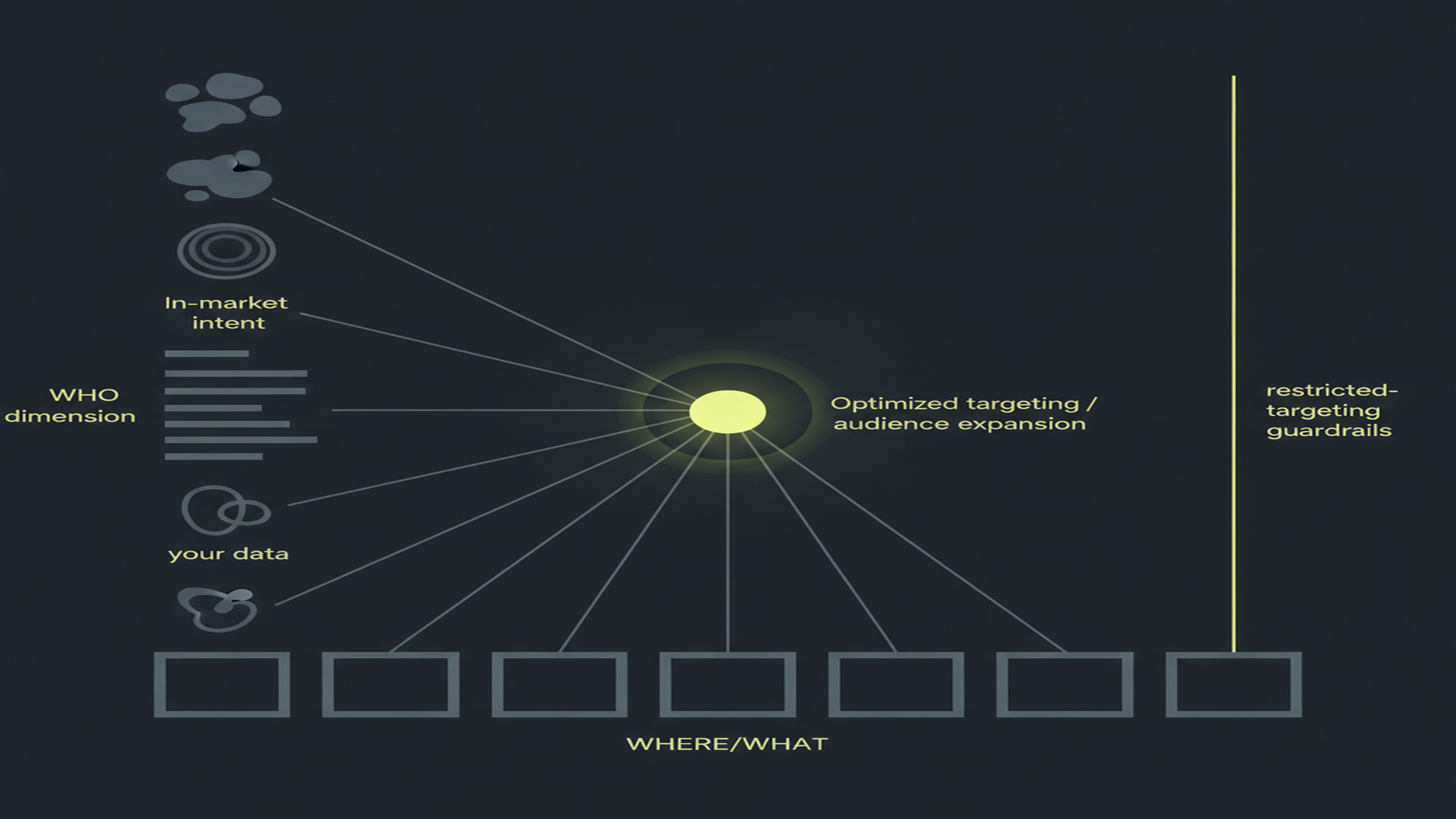
The objective you pick at setup routes the campaign type. The campaign types and objectives guide maps how Sales and Leads route to Demand Gen, how awareness routes to the Video subtypes, and where Performance Max fits.
Read the campaign types guide →Methodology & Sources
This pillar consolidates three absorbed URLs from the mbadv.agency YouTube Ads cluster into one setup-and-operations guide. Console and format facts are from Google Ads Help, About video ad formats. The VAC-to-Demand Gen retirement timeline and Demand Gen mechanics (including the +33% product-feed figure) are from Google’s own documentation. Ad scheduling and the Smart Bidding behavior are from About ad scheduling; device bid adjustments from About bid adjustments. Watch-surface figures are from Neal Mohan’s February 2025 annual letter; the 13.4% US TV share is Nielsen “The Gauge,” April 2026; CTV growth and the 244M US-adult reach are from YouTube Brandcast 2026. Search-demand figures are Ahrefs, June 2026. No mbadv client metrics appear in this article. Reviewed by MB Adv Agency, June 2026.

As a Google Ads expert, I bring proven expertise in optimizing advertising campaigns to maximize ROI.
I specialize in sharing advanced strategies and targeted tips to refine Google Ads campaign management.
Committed to staying ahead of the latest trends and algorithms, I ensure that my clients receive cutting-edge solutions.
My passion for digital marketing and my ability to interpret data for strategic insights enable me to offer high-level consulting that aims to exceed expectations.
Google Partner Agency
We're a certified Google Partner Agency, which means we don’t guess — we optimize withGoogle’s full toolkit and insider support.
Your campaigns get pro-level execution, backed by real expertise (not theory).

4.9 out of 5 from 670+ reviews on Fiverr.
That’s not luck, that’s performance.
Highly recommend Matteo to set up your server side tracking. He has a deep understanding of e-commerce tracking and will go above and beyond to make sure everything is set up correctly and working 100%. If you are scaling your store this set up is non-negotiable in my opinion and there isn't many people who have this much knowledge or put the effort in to get it right. Thanks again!
avorodesign.com
I can only recommend Matteo! He was very patient, professional and very knowledgeable about GA4, Consent Mode v2, and GDPR compliance. Communication was clear, and the setup was done professionally and efficiently. Highly recommend him for anyone needing reliable tracking implementation.

www.natureiki.life
Matteo shines in the realm of online professionals. His work is not only deep in data but also complemented by his proactive communication and cooperation, setting a new standard for freelancers. If you want someone who truly exceeds expectations, look no further. Highly recommended!

www.omanbeverlysmyth.com
Exceptional Service Beyond Expectations - Outstanding Service Impeccable depth, flawless delivery, and exceptional language fluency—this service exceeded all expectations. Highly recommended. Matteo truly ROCKS!!!

ium-paris.com
Top-notch, always highly value working with Matteo. An absolute Google Ads Genius. This is approximately the 8th time I have hired him and he's helped us get 6-7 ROAS. We are excited in continuing to improve our lead flow. Hire this guy if you need Google Ads help. Thanks Matteo!

www.dleeventgroup.com
I finally found the guy who can setup server side tracking and all the ecosystem properly. I definitely recommend Matteo. He is very responsive, kind and wants to dig into things. He configured GA4, Meta, Google Ads, Outbrain and google consent v2 with Cookiebot. Thanks Matteo.

inomega.fr
MB Adv delivered exceptional work with outstanding professionalism and lots of patience, taking time to see effects of changes made and not just do the work and submit it. The proactive communication and video summaries of the work completed made working with Matteo a pleasure, as he consistently went above and beyond. Highly recommended for web analytics projects! We are already working on another project.

www.withnellsensors.co.uk
Working with Matteo on my Google Ads was a game-changer. He's not just a strategist, he's a true partner. He understood my goals and tailored a campaign that perfectly reached my target audience. I'm grateful for his expertise and dedication.

dccargo.com
Click-driven mind
with plastic-brick obsession.
We build Google Ads campaigns with the same mindset we use to build tiny brick worlds: strategy, patience, and zero tolerance for wasted pieces.
Data is our blueprint. Growth is the only acceptable outcome.