Creating Effective YouTube Video Ads (2026)

YouTube Ads 2026 — The Creative Spine
5 sec
The skip window — the only guaranteed view on a skippable in-stream ad
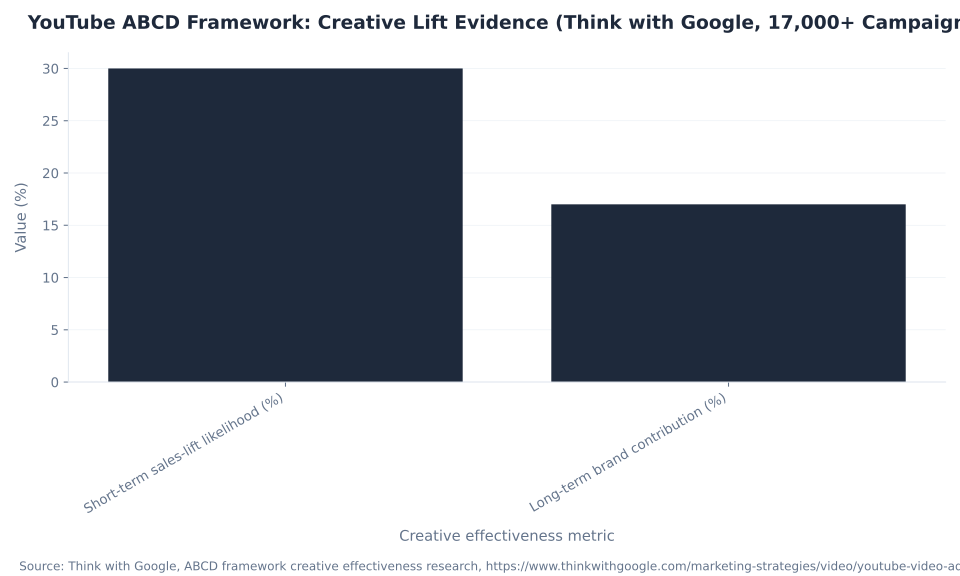
ABCD creative framework built on 17,000+ campaigns measured with Ipsos, Nielsen & Kantar (Google Ads Help) · ABCD-compliant ads carry up to about 30% short-term sales-lift likelihood and about 17% long-term brand contribution (Think with Google) · YouTube is #1 on US TV screens — 13.4% of total US TV viewing (Nielsen “The Gauge,” April 2026)
Build the Ad on Google’s ABCD Framework
A YouTube video ad that performs is not a TV spot uploaded to a new pipe — it is a creative designed around the skip button. Google’s evidence-based model for that work is the ABCD framework: Attention, Branding, Connection, Direction. Each letter is a job the creative has to do — grab attention fast, surface the brand early, make a human connection, and give clear direction with a CTA. The canonical wording is the noun form; the older verb phrasing (Attract, Brand, Connect, Direct) is widely used and acceptable, but Attention / Branding / Connection / Direction is Google’s official wording.
ABCD is evidence, not opinion. Google built and validated it on 17,000+ campaigns measured with Ipsos, Nielsen, and Kantar, and Think with Google’s creative-effectiveness research reports that ABCD-compliant ads carry up to about 30% short-term sales-lift likelihood and about 17% long-term brand contribution. That is why the framework is the spine of this pillar: it unifies the levers most advertisers treat in isolation — the CTA, the story, the music, the sequence. The full lineup of formats those creatives run in is covered in YouTube ad formats, and which campaign type to run is covered in YouTube campaign types and objectives.
| Letter (canonical noun · verb form) | What it means | Concrete do for video |
|---|---|---|
| A — Attention (Attract) | Grab and hold attention from the very first frame | Start mid-action; frame people and faces tightly; fast pacing; land the one idea inside the first 5 seconds (pre-skip) |
| B — Branding (Brand) | Surface the brand early and often — visually and through audio | Show the product or brand in the first 5 seconds and keep reinforcing it; use a sonic or brand cue. Do not save the logo for the end |
| C — Connection (Connect) | Help people think or feel something | Tell a human story; use emotion or humor; feature real people; make the value relatable, not just stated |
| D — Direction (Direct) | Tell viewers clearly what to do next | One explicit, singular CTA — on-screen, spoken, end card, and the system CTA button — matched to the objective |
Source: Google Ads Help, “About the ABCD creative guidance” (canonical nouns Attention / Branding / Connection / Direction; verb form Attract / Brand / Connect / Direct acceptable; built on 17,000+ campaigns measured with Ipsos, Nielsen & Kantar). The first-5-seconds hook applies specifically to skippable in-stream — bumper (≤6s) and non-skippable (7–15s) are forced views.
YouTube ABCD Framework: Creative Lift Evidence (Think with Google, 17,000+ Campaigns)
MB Adv Agency has found that the most useful first instruction to anyone briefing a YouTube ad is to run it through ABCD before you shoot — the failures we see most are not production quality but a slow open and a brand that arrives too late. A new advertiser starting from what YouTube ads are should treat ABCD as the design contract for every asset.
The First 5 Seconds Decide Everything on a Skippable Ad
On a skippable in-stream ad the viewer can skip after 5 seconds (Google Ads Help), which means those 5 seconds are the only portion you are guaranteed to deliver. The non-negotiable correction is to front-load both the hook and the brand into the opening 5 seconds — show a face, start mid-action, land the one idea, and make the brand unmistakable before the skip button arrives. The people who skip at second 6 never see second 25.
This is where the single most common piece of bad creative advice goes to die: “save the logo for the big reveal at the end.” ABCD’s Branding lever is explicit — surface the brand early and often, visually and through audio. Brand in the first 5 seconds, then keep reinforcing it.
Misconception: “Save the logo and brand reveal for the end of the ad.” This is the single most damaging instinct on YouTube. On a skippable in-stream ad the viewer skips after 5 seconds, so a brand that first appears at second 25 reaches only the minority who did not skip. Brand early and throughout — that is what ABCD’s Branding lever asks for. Source: Google Ads Help, “About the ABCD creative guidance.”
Bumper (≤6 seconds) and non-skippable (7–15 seconds) ads are forced views, so the whole ad is guaranteed — but the discipline holds: every second earns the next one, and a bumper’s single idea and brand cue arrive immediately. The table below maps the first-seconds job to each format; the deeper spec detail is in YouTube ad formats.
| Format | Viewer control | What the opening has to do | Why |
|---|---|---|---|
| Skippable in-stream | Skip after 5 seconds | Land the hook and the brand inside the first 5 seconds | Second 6 onward is optional — only the first 5 seconds is guaranteed |
| Bumper | Forced view, ≤6 seconds | Deliver one idea with the brand visible throughout | All six seconds are guaranteed, so the whole ad is the hook |
| Non-skippable in-stream | Forced view, up to 15 seconds (16–20s some markets) | Still front-load; complete a full arc in the time | The view is guaranteed, but front-loading keeps attention |
| In-feed video | Click to play; preview often muted | Thumbnail and title earn the click; caption the muted preview | The viewer chooses to watch — the thumbnail is the hook |
| Shorts | Swipe to skip, vertical 9:16 | Hook in the first two seconds; caption for muted autoplay | Swipe friction is zero; users scroll continuously |
Source: Google Ads Help, “About video ad formats” (skippable in-stream skip after 5 seconds; bumper ≤6s; Shorts 9:16); Google Ads Help, “Non-skippable in-stream ads” (standard up to 15s, 16–20s some markets). The first-5-seconds rule is specific to skippable in-stream; the other formats are forced or click-to-play.
Creative Specs by Format: Design for the Surface
One asset cannot be optimal for every YouTube placement. A 6-second bumper, a 15-second non-skippable spot, a skippable in-stream story, and a vertical 9:16 Short each do a different job and carry different specs. The creative inputs — duration, aspect ratio, the first-seconds job, and how the format bills — are the constraints the concept has to fit, so treat the spec sheet as a creative brief.
The duration ceiling tells the creative how much story it can carry. Bumper is the one-idea unit. Skippable in-stream has no hard maximum, but Google recommends keeping it under 3 minutes, and for direct response shorter cuts (15–30 seconds) with a strong hook in the first 5 seconds outperform long films. Shorts runs short-form (up to about 60 seconds) and has to feel native to a vertical, muted feed — a horizontal ad letterboxed into 9:16 with black bars does not perform like a natively vertical Short.
| Format | Duration | Aspect ratio(s) | The first-seconds rule / creative job | Billed |
|---|---|---|---|---|
| Skippable in-stream | No hard max (rec. under 3 min); skip after 5 sec | 16:9 primary; also 1:1 / 9:16 | First 5 sec = the only guaranteed view — hook + brand must land before the skip | Target CPV (30s / complete / interact) or Target CPM / tCPA |
| Bumper | ≤6 sec, non-skippable | 16:9 / 1:1 / 9:16 | All 6 sec is the hook — one idea, brand visible throughout; reach and recall, not story | Target CPM |
| Non-skippable in-stream | Standard up to 15 sec (16–20s some markets); separate 30s CTV tier | 16:9 (30s must be horizontal); 1:1 / 9:16 for shorter | Forced full view — still front-load; brand throughout; complete an arc in the time | Target CPM |
| In-feed video ads | Host video any length (click opens the watch page) | Thumbnail-led; video any ratio | Thumbnail + title earn the click; preview often autoplays muted — caption | Per click or 10s autoplay view |
| Shorts ads | Short-form (up to about 60 sec); swipe to skip | 9:16 vertical | Vertical-native, fast hook, captioned for muted autoplay; native-feeling, not a cropped 16:9 | Target CPV / Target CPM / per-action |
Sources: Google Ads Help, “About video ad formats” (skippable in-stream skip after 5 sec, no hard max, rec. under 3 min; bumper ≤6 sec; in-feed thumbnail + text; Shorts 9:16; billing models); Google Ads Help, “Non-skippable in-stream ads” (standard 7–15 sec, 16–20s some markets, separate 30s CTV tier, 30s assets horizontal). Do not write non-skippable “up to 60 seconds” — that conflates reservation/DV360 with the auction format.
YouTube Ad Creative Duration Specs by Format (Google Ads Help, 2026)
Naming precision keeps the brief from asking for dead units. The current names are skippable in-stream (not “TrueView in-stream”), in-feed video ads (not “TrueView Discovery”), bumper, non-skippable in-stream, and Shorts. Standard non-skippable is up to 15 seconds plus a separate 30-second connected-TV tier — never 60 seconds. For which format to pick for a given goal and the full billing detail, see YouTube ad formats and how much YouTube ads cost.
How to Add Effective CTAs to YouTube Ads
A YouTube call to action is not one phrase you type into the video — it is a layered stack, and it is the highest-leverage creative move in this pillar. To add an effective CTA to a YouTube ad, make the next action explicit and singular, repeat it across every layer the format offers, and match it to the campaign objective. This is ABCD’s Direction lever: tell viewers clearly what to do next.
The 2026 reality that older “youtube ad cta” guides predate is that a YouTube CTA renders in several places at once: the on-screen text or overlay baked into the creative, the end card or end screen in the final seconds, the system CTA button and headline rendered by Demand Gen and skippable in-stream, and the spoken CTA in the script. Make every layer say the same thing: “Shop now” for a sales campaign, “Learn more” for consideration, “Sign up” for lead generation — with the on-screen and spoken CTA reinforcing the button, not competing with it.
| CTA layer | What it is / where it shows | Match to objective · example |
|---|---|---|
| System CTA button + headline | Asset-driven button and headline on Demand Gen and skippable in-stream (renders beside or below the player) | Sales → “Shop now” · Leads → “Sign up” / “Get quote” · Consideration → “Learn more” |
| On-screen text / overlay | Graphic CTA baked into the creative; readable when muted | Reinforces the button; short, high-contrast — “Get the look,” “Start free trial” |
| End card / end screen | Final 5–20 sec frame: brand + product + the next action | Closes the loop on longer skippable ads — restate the brand and a single CTA |
| Spoken CTA (voiceover) | The CTA said aloud in the script (sound-on in-stream and CTV) | Works where audio plays; mirror the on-screen CTA, do not contradict it |
| Sitelink / companion assets | Extra clickable links or banner beside eligible ads | Add destinations without crowding the creative — secondary paths |
Sources: Google Ads Help, “About the ABCD creative guidance” (Direction = tell viewers clearly what to do; one explicit CTA); Google Ads Help, “About video ad formats” (Demand Gen CTA button, headline, end-screen and sitelink-style assets). Which layers are available depends on the format and campaign type — confirm in Google Ads.
MB Adv Agency has found that the most common CTA failure is not a weak verb — it is two or three different asks fighting inside one ad. An overlay that says “Learn more,” a voiceover that says “Visit our site,” and a system button set to “Sign up” split the viewer’s intent three ways. Pick one action, write it once, and let every layer echo it. Which CTA layers are available depends on the campaign type — Demand Gen renders the richest button and headline set. The campaign mechanics are in YouTube campaign types and objectives, and the team that builds CTA-led video systems end to end is our PPC campaign management practice.
Storytelling in YouTube Ads: The Connection Lever
Storytelling in YouTube ads is ABCD’s Connection lever in practice: help people think or feel something so the brand is remembered, not merely seen. A YouTube ad narrative does not need a three-act film — it needs a human moment, an emotion or a laugh, a real face, and a single relatable value. Connection turns a guaranteed view into a memory that drives a later search or purchase.
The craft of a YouTube ad story is shaped by the skip button. The arc has to start paying off immediately — a slow, cinematic build that resolves at second 40 loses the skippable audience at second 6. Open mid-action, put a person on screen fast, and let the emotional turn land inside the window you are guaranteed to deliver. Humor and emotion are the two most reliable connection devices because both register in the first seconds.
| Technique | What it does | Where it fits |
|---|---|---|
| Open mid-action | Drops the viewer into a moment rather than a setup; buys attention before the skip | Skippable in-stream, Shorts — the first-5-seconds and first-two-seconds hooks |
| Emotion or humor | Makes people feel something so the message is remembered, not just stated | Skippable in-stream and CTV story ads with room for an arc |
| Real people / faces | Human faces and voices read as relatable; tight framing holds attention | All formats; especially the opening frame of a skippable ad |
| Single, relatable value | One clear benefit a real person would care about, shown not told | Bumper (one idea) through to longer skippable stories |
| Problem → payoff arc | Sets up a tension and resolves it with the product as the turn | 15s non-skippable and longer skippable in-stream; the hero ad in a sequence |
Source: Google Ads Help, “About the ABCD creative guidance” (Connection = help people think or feel something; tell a human story, use emotion or humor, feature real people). Technique labels are editorial guidance grounded in ABCD’s Connection lever, not fixed Google strings.
Connection is also where format discipline and story meet. A bumper carries one feeling, not a plot. For visually-driven categories, the story is the product in motion: fashion and beauty brands live or die on the first five seconds of a transformation or a reveal. Whether the story actually moved the audience shows up in view rate, watch time, and conversions — the signals covered in YouTube ads metrics and measurement.
Music and Sound in YouTube Ads: Design Audio for the Surface
The muted-social-feed assumption fails for the formats that matter most. Whether YouTube ads need sound turns on the surface: skippable and non-skippable in-stream — and especially CTV / TV-screen viewing, now YouTube’s most-watched surface in the US — play with sound on, so voiceover, a music bed, and sonic branding do real work. In-feed video previews and Shorts often autoplay muted, so those need on-screen captions to carry the message.
This makes audio a genuine creative lever. Sonic branding extends ABCD’s Branding lever into sound — a recognizable audio cue is a brand asset the same way a logo is. Over 1 billion hours of YouTube are watched on TV screens every day (Neal Mohan, 2025 annual letter), and on a TV screen a forced-view in-stream ad arrives at full volume in a lean-back room. Design audio as an asset for in-stream and CTV, and caption for in-feed and Shorts.
| Surface | Sound behavior | Creative implication |
|---|---|---|
| Skippable / non-skippable in-stream | Plays with sound on by default | Voiceover, music bed, and sonic branding do real work — design audio as an asset |
| CTV / TV screens | Plays with sound on; TV is YouTube’s primary US viewing device | Audio is especially critical — a living-room, lean-back, full-volume impression |
| In-feed video ads | Preview often autoplays muted | Caption on-screen; the thumbnail and title carry the intent signal |
| YouTube Shorts | Often autoplays muted in the swipe feed | Captions are essential; vertical-native 9:16, not a cropped 16:9 |
Sources: Google / Neal Mohan, 2025 annual letter (over 1 billion hours of YouTube watched on TV screens daily; TV is YouTube’s primary US viewing device); Google Ads Help, “About video ad formats” (in-feed preview behavior; Shorts feed). Sound-on / muted characterizations are Google-attributed.
Licensing is the other half of the sound decision. Use the YouTube Audio Library or properly licensed tracks; an unlicensed track can draw a Content ID claim that mutes or demonetizes the creative. For categories built on sound-on, appetite-appeal video — food and beverage brands above all — the music bed and the sizzle are part of the product. Match the audio decision to the surface, and confirm the format your audio is built for in YouTube ad formats.
YouTube Ad Sequencing: A Narrative Across Ads
Most advertisers serve one ad to everyone. YouTube ad sequencing is the better move: the live Ad sequence campaign subtype shows a viewer a series of ads in a defined order to tell a story across touchpoints. It survived the 2026 reshuffle — it sits under the objective Google renamed “YouTube reach, views, and engagements,” and it was not swept up in the Video Action Campaign sunset. A 6-second tease, a 15-second hero, and a bumper reminder, told in order, beat a single long film that gets skipped at second 6.
Google offers pre-built sequence templates, each a different way to pace a tease, a hero, and an echo against where the viewer is in the funnel. Introduce & reinforce tells the full story once and then keeps it top-of-mind. Prime & amplify warms a cold audience with a short primer before going deep. Tease, amplify & echo is the classic launch arc. Engage & direct earns attention first, then pushes the conversion step. Each step carries its own ad, format, and bid, so the creative job is to write what each ad in the arc should say — the tease withholds, the hero delivers, the echo reminds.
| Template | Structure (the order of ads) | What it is for |
|---|---|---|
| Introduce & reinforce | Longer hero / story ad → shorter reinforcing ad(s) | Tell the full story once, then keep the message top-of-mind |
| Prime & amplify | Short primer (e.g. a bumper) → longer ad that amplifies the story | Warm up a cold audience, then go deep once they are primed |
| Tease, amplify & echo | Teaser → hero / launch ad → shorter echo reminder(s) | Build anticipation pre-launch, deliver at launch, sustain after |
| Engage & direct | Engaging story ad → action / response ad(s) | Earn attention first, then push the conversion step |
| Custom | Build your own order plus per-step format and bid | When none of the presets fit your funnel arc |
Sources: Google Ads Help, “About video ad sequence campaigns” (a series of ads shown in a set order; pre-built templates — introduce & reinforce, prime & amplify, tease/amplify/echo, engage & direct — plus custom; each step has its own ad, format and bid); Google Ads Help, “Video subtypes” (Ad sequence is a surviving subtype, not retired with VAC). Treat the labels as illustrative of the pattern.
Sequencing is the direct antidote to “make one long ad for everything.” Rather than cramming a brand story, a product demo, and a hard CTA into one film, the arc gives each job its own ad and its own moment. The creative craft of the arc lives here; the campaign mechanics — building the sequence, the objective and bidding, and the VAC-to-Demand-Gen history — live in YouTube campaign types and objectives.

Four Misconceptions That Sink YouTube Creative
Four instincts carried over from TV and muted social feeds sink more YouTube creative than any production problem: brand early, not late; build a set, not one ad; use current format names; and design audio for the surface. Each is backed by Google documentation, and each is among the fastest fixes for an underperforming ad.
The deepest of the four is “make one long ad and run it everywhere.” It is wrong on two counts. First, format fit: a 6-second bumper, a 15-second non-skippable spot, a skippable in-stream story, and a vertical 9:16 Short each carry different specs and do different jobs — one asset cannot be optimal for all. Second, sequencing: the Ad sequence subtype exists precisely so a story can run across several ads in order.
| Misconception | The 2026 truth | Source |
|---|---|---|
| “Save the logo and brand reveal for the end.” | ABCD’s Branding lever asks for the brand early and often; a skippable ad is skipped after 5 seconds, so a reveal at second 25 is invisible to most viewers. | ABCD guidance |
| “Make one long, polished ad and run it everywhere.” | Each format does a different job with different specs; one asset cannot be optimal for all. The Ad sequence subtype exists to tell a story across multiple ads in order. | video ad formats; ad sequence |
| “It’s called TrueView — that’s the format.” | “TrueView in-stream” is now skippable in-stream; “TrueView Discovery” is in-feed video ads; “TrueView for action” folded into Demand Gen. Only the “TrueView views” metric survives. | video ad formats |
| “Design YouTube ads sound-off like a social feed.” | In-feed and Shorts often autoplay muted, so caption those — but skippable / non-skippable in-stream and CTV play with sound on, and CTV is YouTube’s most-watched US surface. | Mohan 2025 letter |
Sources as cited per row: Google Ads Help, ABCD guidance; About video ad formats; About video ad sequence campaigns; Google / Neal Mohan, 2025 annual letter. Nielsen “The Gauge” (April 2026) supplies the CTV-share context.
MB Adv Agency has found that the live-versus-dead boundary is where most YouTube briefs go wrong. Overlay ads (ended April 6, 2023), sponsored cards (retired), and the whole TrueView naming family appear in briefs regularly despite being years out of date. A brief that asks for a “TrueView Discovery” placement or an “overlay ad” is requesting formats that no longer exist, which stalls setup before creative is even discussed. The current lineup is in YouTube ad formats.
What Advertisers Are Searching: Creative Keyword Demand
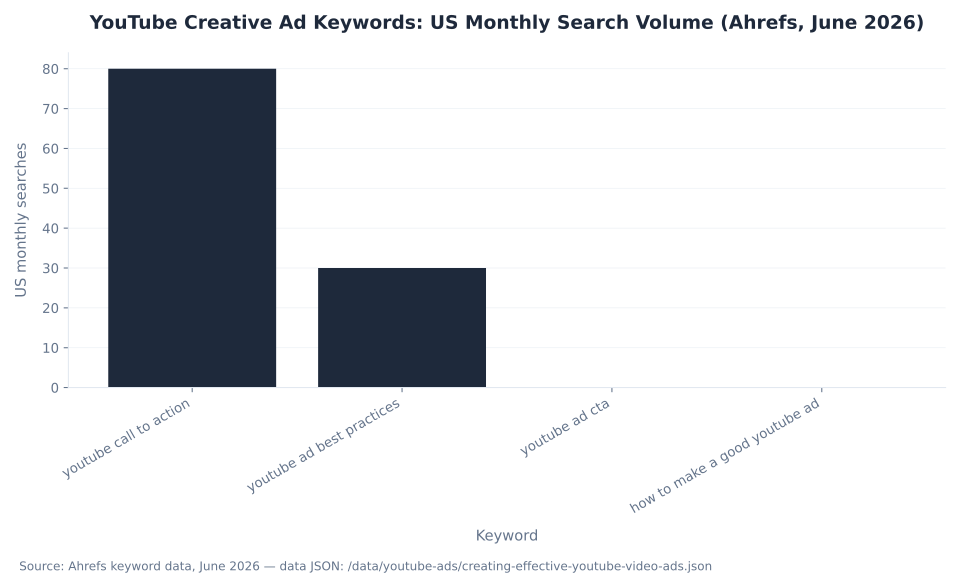
“YouTube call to action” leads this cluster’s creative search demand at 80 US monthly searches (Ahrefs, June 2026, 150 global, KD 0) — the CTA-craft intent the id="ctas" section is built to anchor. “YouTube ad best practices” at 30/mo US (KD 5, CPC $2.50) is the ABCD and craft-principles audience. The absolute volumes are modest, but they understate the cluster’s real SEO footprint.
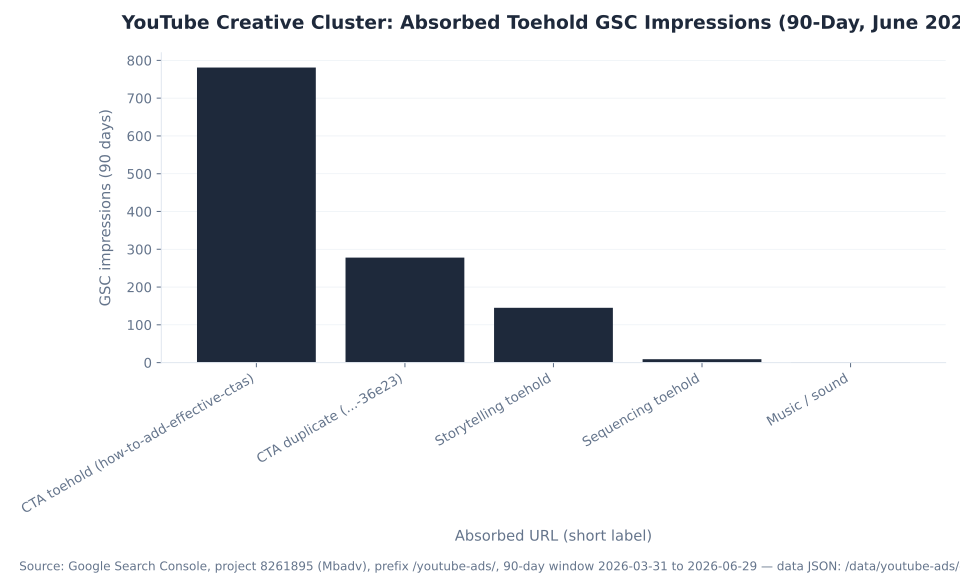
The footprint that matters is in Search Console, not the keyword tool. Five absorbed pages hold 1,214 combined GSC impressions — the CTA toehold alone pulled 781 impressions across 50 keywords. This pillar’s job is to convert that impression footprint into rankings the thin pages never could, which is why the CTA section leads with declarative guidance on “how to add effective ctas to youtube ads” and the “youtube call to action” intent.
| Keyword | US Monthly Vol. | Global Vol. | KD | CPC (USD) | Notes |
|---|---|---|---|---|---|
| youtube call to action | 80 | 150 | 0 | — | ★ CTA-craft intent — the id="ctas" section earns this |
| youtube ad best practices | 30 | 40 | 5 | $2.50 | ABCD / craft-principles audience |
| youtube ad cta | 0 | 10 | — | — | No US volume; global demand only; served via the CTA section |
| how to make a good youtube ad | 0 | 0 | — | — | Zero-volume but high-intent phrase; pillar narrative anchor |
Source: Ahrefs keyword data, June 2026 — data JSON. US monthly volume is the latest 12-month average. The cluster head term “youtube ads” runs 19,000/mo US for context. Low absolute volumes are offset by 1,214 combined GSC impressions across the five absorbed pages.
YouTube Creative Ad Keywords: US Monthly Search Volume (Ahrefs, June 2026)
The CTA Toehold and the Absorbed Pages
This pillar is an all-301 absorption: five thin pages — the CTA toehold and its duplicate, the storytelling toehold, the sequencing page, and the music-and-sound page — redirect into it. No separate ranking winner is upgraded in place. The job is to consolidate a scattered impression footprint into one strong page, with each absorbed intent inheriting a dedicated anchor.
The CTA toehold (781 impressions, 50 keywords, position 23.78) is the cluster’s highest-value asset, and its duplicate slug adds another 278 impressions across 30 keywords — both 301 to the same target, the id="ctas" section. The storytelling toehold (145 impressions, position 8.3) inherits id="storytelling"; the sequencing page maps to id="ad-sequencing"; the music-and-sound page maps to id="music-and-sound". Every absorbed slug has an anchor that preserves its footprint.
| Absorbed page (301s into this pillar) | GSC impressions | Keywords | Avg position | Anchor that inherits it |
|---|---|---|---|---|
| how-to-add-effective-ctas-to-youtube-ads ★ | 781 | 50 | 23.78 | id="ctas" |
| how-to-add-effective-ctas-to-youtube-ads-36e23 (duplicate) | 278 | 30 | 25.6 | id="ctas" (same target) |
| storytelling-in-youtube-ads-how-to-craft-engaging-narratives | 145 | 11 | 8.3 | id="storytelling" |
| youtube-ad-sequencing-crafting-a-narrative-across-ads | 9 | 3 | 10.11 | id="ad-sequencing" |
| using-music-and-sound-effects-in-youtube-ads | 1 | 1 | 56.0 | id="music-and-sound" |
Source: Google Search Console, project 8261895 (Mbadv), prefix /youtube-ads/, 90-day window 2026-03-31 to 2026-06-29 — data JSON. All five URLs 301 into this pillar; all five had 0 clicks in the window. Impressions are SERP appearances, not site traffic.
YouTube Creative Cluster: Absorbed Toehold GSC Impressions (90-Day, June 2026)
All five pages had zero clicks across the 90-day window — the toehold value is impression footprint and keyword diversity, not traffic. When the creative is right but the campaign still underperforms, the fixes move to bidding, audience, and AI — see YouTube ads optimization and AI for the playbook this page hands off to.
How to Build a High-Performing YouTube Video Ad
The build sequence runs ABCD first, format second, and testing last. The eight steps below are the order that produces creative that performs instead of just airing — concept against ABCD, fit the format, design the audio and the CTA, sequence the story, then confirm specs and test.
- Hook in the first 5 seconds (Attention). Open mid-action, frame people tightly, and land the one idea before the skip button arrives on a skippable in-stream ad.
- Brand early and often (Branding). Show the product or brand in the first 5 seconds, visually and through audio. Do not save the logo for the end — most viewers never reach it.
- Make a connection (Connection). Tell a human story; use emotion or humor; feature real people; make the value relatable rather than merely stated.
- Pick the format that fits the job. Bumper (≤6s) for reach and recall, skippable in-stream for story, 9:16 Shorts for the vertical feed, in-feed video for active intent — and build the right aspect ratios.
- Design audio for the surface. Sound-on (voiceover, music bed, sonic branding) for in-stream and CTV; captions for muted in-feed and Shorts autoplay; use the YouTube Audio Library or licensed tracks.
- Give clear Direction (CTA). One explicit CTA across the layered stack — system button, on-screen text, end card, spoken line — matched to the campaign objective.
- Sequence the story if you have more than one ad. Use an Ad sequence template — introduce & reinforce, prime & amplify, tease/amplify/echo, or engage & direct — to pace a tease, a hero, and an echo.
- Check specs and test. Confirm duration and aspect ratio per format before upload, and build two or three variations to test against view rate, CTR, and conversions.
For DTC and ecommerce brands the creative is the conversion lever on Demand Gen and Shopping on YouTube — see how our ecommerce PPC agency builds video that sells. Creative quality is also a cost lever: Google’s auction rewards engaging ads, so a stronger hook moves the CPV and CPM math, as covered in how much YouTube ads cost.
YouTube Creative, Built to Perform
ABCD-checked hooks, format-fit assets, and layered CTAs
YouTube ads run inside Google Ads. Our team builds the creative system — first-five-seconds hooks, sound-on and sound-off variants, sequenced storytelling — and manages the campaigns end to end.
PPC campaign management →CTV Is YouTube’s Biggest Screen — and It Plays Sound On
The headline 2026 creative context is the television set. YouTube is the most-watched streaming platform on US TV screens at 13.4% of total US TV viewing (Nielsen “The Gauge,” April 2026), #1 every month for about three years, and over 1 billion hours of YouTube are watched on TV screens every day (Neal Mohan, 2025 annual letter). A forced-view in-stream ad in a living room, at full volume, on a large screen, is a fundamentally different impression from a muted mobile preview — and it changes the creative.
Connected TV is also YouTube’s fastest-growing surface: CTV ad conversions grew 200%+ year over year (Q1 2025 to Q1 2026, Brandcast 2026), and YouTube reaches 244M+ US adults across devices. The creative consequence is that audio, pacing, and brand presence built for a lean-back screen carry real weight — sonic branding, a music bed, and a confident voiceover are assets on CTV, not decoration. The platform’s scale is large (potential ad reach of about 2.53 billion, DataReportal January 2025; about $40.37 billion in FY2025 ad revenue, Alphabet), but the creative point is narrower: design for the screen the impression lands on.
| Fact | Value | Source |
|---|---|---|
| YouTube’s share of total US TV viewing | 13.4% (April 2026) — #1 streaming platform on US TV screens | Nielsen “The Gauge,” April 2026 |
| US adults 18+ reached by YouTube across devices | 244M+ (about 91% of US adults), Nov 2025 | YouTube / Brandcast 2026 |
| YouTube watched on TV screens daily | Over 1 billion hours | Neal Mohan, 2025 annual letter |
| YoY growth in CTV ad conversions | 200%+ (Q1 2025 → Q1 2026) | YouTube / Brandcast 2026 |
| YouTube potential ad reach | About 2.53 billion (advertising reach, not a logged-in / MAU count) | DataReportal, Jan 2025 |
| YouTube FY2025 ad revenue | About $40.37 billion (ads only; the $60B figure is ads + subscriptions) | Alphabet FY2025 earnings |
Sources as cited per row: Nielsen “The Gauge,” April 2026; YouTube / Google, Brandcast 2026; Neal Mohan, YouTube 2025 annual letter; DataReportal, Essential YouTube Statistics, Jan 2025; Alphabet FY2025 earnings. Reach figures are YouTube- or Nielsen-attributed, not MB Adv data.
MB Adv Agency has found that brands moving TV-style creative onto YouTube CTV win when they keep the sound-on craft and front-load the brand, and lose when they treat the placement like a muted feed. The 30-second non-skippable CTV tier and YouTube Select CTV are the premium reach surfaces for this work. How the CPV and CPM math responds across surfaces — CTV runs the highest CPM, Shorts the lowest — is in how much YouTube ads cost.
Match the Creative to the Objective and the Format
The creative follows from the objective, not from the video on hand. The sequence that produces better outcomes is: objective first, ABCD concept second, format and specs third, audio and CTA fourth, sequence last. Each decision narrows the next.
- Name the objective. Awareness and recall, consideration and views, or conversions — the objective decides which campaign types and formats are in play. See campaign types and objectives.
- Concept against ABCD. Attention in the first frame, Branding in the first 5 seconds, Connection through a human story, Direction with one CTA — before anything is shot.
- Fit the format and specs. Bumper for recall, skippable in-stream for story, 9:16 Shorts for the feed, 30s horizontal for the CTV tier. Build the aspect ratios the placement needs — see YouTube ad formats.
- Design audio and the CTA. Sound-on for in-stream and CTV, captions for muted in-feed and Shorts; one explicit CTA across every layer the format renders.
- Sequence if there is more than one ad. Pace a tease, a hero, and an echo with an Ad sequence template rather than one film for every stage.
- Read the signals and iterate. View rate, CTR, and conversions show whether the ABCD changes worked — see metrics and measurement and optimization and AI.
MB Adv Agency has found that the most productive first question on a new YouTube brief is not “what video do you have?” but “what does the campaign need to do?” Running the hero film you happen to have is not wrong, but it means the format was chosen by default rather than by design. To build a YouTube creative system that performs instead of just airing, get in touch.
Creating Effective YouTube Video Ads: FAQ
DTC & Ecommerce Video
Video that sells — Shorts, in-stream, and Demand Gen creative
For DTC and retail brands building creative for Shorts, skippable in-stream, and Demand Gen with product feeds, our ecommerce PPC team handles ABCD-checked concepts, format-fit specs, and feed management end to end.
Ecommerce PPC management →Get in touchMethodology
This pillar consolidates five absorbed YouTube Ads creative pages (how-to-add-effective-ctas-to-youtube-ads and its duplicate, storytelling-in-youtube-ads-how-to-craft-engaging-narratives, using-music-and-sound-effects-in-youtube-ads, and youtube-ad-sequencing-crafting-a-narrative-across-ads), all of which 301 into it. The ABCD framework, format durations, aspect ratios, the 5-second skip rule, and the Ad sequence templates are sourced from Google Ads Help, “About the ABCD creative guidance”, “About video ad formats”, “Non-skippable in-stream ads”, and “About video ad sequence campaigns”, verified June 29, 2026. The creative-lift figures (up to about 30% short-term sales-lift likelihood; about 17% long-term brand contribution) are from Think with Google’s ABCD research. Scale and CTV context are attributed to Nielsen “The Gauge” (April 2026), Neal Mohan’s 2025 annual letter, Brandcast 2026, and DataReportal (January 2025). Search-volume data is Ahrefs, June 2026; GSC figures are from Google Search Console, 90-day window March 31–June 29, 2026. No MB Adv client metrics are used — agency POV is qualitative. Reviewed by MB Adv Agency, June 2026.

As a Google Ads expert, I bring proven expertise in optimizing advertising campaigns to maximize ROI.
I specialize in sharing advanced strategies and targeted tips to refine Google Ads campaign management.
Committed to staying ahead of the latest trends and algorithms, I ensure that my clients receive cutting-edge solutions.
My passion for digital marketing and my ability to interpret data for strategic insights enable me to offer high-level consulting that aims to exceed expectations.
Google Partner Agency
We're a certified Google Partner Agency, which means we don’t guess — we optimize withGoogle’s full toolkit and insider support.
Your campaigns get pro-level execution, backed by real expertise (not theory).
4.9 out of 5 from 670+ reviews on Fiverr.
That’s not luck, that’s performance.
Highly recommend Matteo to set up your server side tracking. He has a deep understanding of e-commerce tracking and will go above and beyond to make sure everything is set up correctly and working 100%. If you are scaling your store this set up is non-negotiable in my opinion and there isn't many people who have this much knowledge or put the effort in to get it right. Thanks again!
avorodesign.com
I can only recommend Matteo! He was very patient, professional and very knowledgeable about GA4, Consent Mode v2, and GDPR compliance. Communication was clear, and the setup was done professionally and efficiently. Highly recommend him for anyone needing reliable tracking implementation.

www.natureiki.life
Matteo shines in the realm of online professionals. His work is not only deep in data but also complemented by his proactive communication and cooperation, setting a new standard for freelancers. If you want someone who truly exceeds expectations, look no further. Highly recommended!

www.omanbeverlysmyth.com
Exceptional Service Beyond Expectations - Outstanding Service Impeccable depth, flawless delivery, and exceptional language fluency—this service exceeded all expectations. Highly recommended. Matteo truly ROCKS!!!
ium-paris.com
Top-notch, always highly value working with Matteo. An absolute Google Ads Genius. This is approximately the 8th time I have hired him and he's helped us get 6-7 ROAS. We are excited in continuing to improve our lead flow. Hire this guy if you need Google Ads help. Thanks Matteo!

www.dleeventgroup.com
I finally found the guy who can setup server side tracking and all the ecosystem properly. I definitely recommend Matteo. He is very responsive, kind and wants to dig into things. He configured GA4, Meta, Google Ads, Outbrain and google consent v2 with Cookiebot. Thanks Matteo.

inomega.fr
MB Adv delivered exceptional work with outstanding professionalism and lots of patience, taking time to see effects of changes made and not just do the work and submit it. The proactive communication and video summaries of the work completed made working with Matteo a pleasure, as he consistently went above and beyond. Highly recommended for web analytics projects! We are already working on another project.

www.withnellsensors.co.uk
Working with Matteo on my Google Ads was a game-changer. He's not just a strategist, he's a true partner. He understood my goals and tailored a campaign that perfectly reached my target audience. I'm grateful for his expertise and dedication.

dccargo.com
Click-driven mind
with plastic-brick obsession.
We build Google Ads campaigns with the same mindset we use to build tiny brick worlds: strategy, patience, and zero tolerance for wasted pieces.
Data is our blueprint. Growth is the only acceptable outcome.