Google Algorithm Updates: Core Updates & E-E-A-T (2026)

Understanding Google Algorithm Updates · 2026
15
confirmed broad core updates rolled out between May 2022 and May 2026 — and a broad core update is a site-wide reassessment of relevance and quality, not a penalty.
15 broad core updates, 2022–2026 (Google Search Status dashboard) · March 2024 was the largest and most complex ever (~45 days) · E-E-A-T is a Quality Rater Guidelines concept, not a ranking factor (Google Search Central)
What Is a Google Algorithm Update?
A Google algorithm update is a change to the ranking systems Google uses to order search results. Google runs thousands of adjustments every year, but the ones that move rankings enough to matter fall into four types: broad core updates, spam updates, the now-retired standalone helpful-content update, and manual actions. The single most important thing to understand before you diagnose a traffic change is that these types are not the same event, and only one of them — a manual action — is a penalty in the ordinary sense. “Google algorithm update” draws 2,700 US and 7,800 global searches a month at a keyword difficulty of 74 (Ahrefs Keywords Explorer, 2026-07-01), and most of that demand comes from site owners who watched rankings move and want to know what happened.
The reframe that matters: the great majority of confirmed updates are broad core updates, and a broad core update is a periodic, index-wide reassessment of content relevance and quality — not a strike against your site. Google’s own guidance states there is nothing wrong with pages that drop during a core update; the systems simply re-evaluate the whole index, and content that was relatively under-rewarded rises while other content settles. That is why the recovery path for a core-update drop is durable content quality and patience, not the removal of a penalty. New to the topic entirely? Start with what SEO is, then use Search Console to track performance so you can tell an update apart from a seasonal dip.
| Update type | What it changes | Cadence | Shown in GSC? | Key note |
|---|---|---|---|---|
| Broad core update | A broad reassessment of relevance and quality across the whole index | Several per year (2–4) | No individual notice | Not a penalty — recover with durable quality and wait for the next reassessment |
| Spam update | Enforces the spam policies algorithmically (including SpamBrain) | Periodic | No | Targets policy violations; link spam is neutralized, not penalized (December 2022 link spam update) |
| Helpful content (standalone) | Formerly a separate classifier for unhelpful, search-first content | Aug 2022, Dec 2022, Sep 2023 | No | Retired as a standalone update — folded into core with the March 2024 core update; helpfulness is now assessed by multiple core systems |
| Manual action | A human reviewer demotes or removes a page for a policy violation | Case-by-case | Yes — Manual Actions report | Fix the violation, then submit a reconsideration request |
Source: Google Search Central, “March 2024 core update & new spam policies”; Google Search Central, “Core updates”; shared verified-facts §3. Not mbadv client data.
MB Adv Agency frames every ranking-movement conversation the same way: identify the update type first, because the response is completely different for each. A broad core update calls for better, more helpful content; a spam update calls for fixing a policy violation; a manual action calls for a reconsideration request; and a great many “my rankings dropped” cases turn out to be a tracking artifact, an indexing problem, or a competitor’s gain rather than an update at all. The sections below decode each type, give you the full 2022–2026 core-update timeline, and settle the two questions that generate the most bad advice online: what E-E-A-T actually is, and whether the “Helpful Content Update” still exists.
Broad Core Updates: The 2022–2026 Timeline
A broad core update reassesses relevance and quality across Google’s entire index, and Google confirms several per year. The full sequence from May 2022 through May 2026 comes to fifteen confirmed broad core updates — the load-bearing reference for anyone matching a traffic change to a date. “Google core update” carries the biggest global demand in this cluster: 1,700 US and 10,000 global searches a month at a difficulty of 58 (Ahrefs, 2026-07-01), which is why the timeline itself is the most-cited asset on this page.
| Update | Started | ~Ended | Notes |
|---|---|---|---|
| May 2022 Core | May 25, 2022 | Jun 9, 2022 | — |
| September 2022 Core | Sep 12, 2022 | Sep 26, 2022 | — |
| March 2023 Core | Mar 15, 2023 | Mar 28, 2023 | — |
| August 2023 Core | Aug 22, 2023 | Sep 7, 2023 | — |
| October 2023 Core | Oct 5, 2023 | Oct 19, 2023 | — |
| November 2023 Core | Nov 2, 2023 | Nov 28, 2023 | — |
| ★ March 2024 Core | Mar 5, 2024 | ~Apr 19, 2024 | Largest and most complex ever (~45 days); folded Helpful Content into core |
| August 2024 Core | Aug 15, 2024 | ~Sep 3, 2024 | — |
| November 2024 Core | Nov 11, 2024 | ~Dec 5, 2024 | — |
| December 2024 Core | Dec 12, 2024 | ~Dec 18, 2024 | 2nd core update in one month |
| March 2025 Core | Mar 13, 2025 | ~Mar 27, 2025 | — |
| June 2025 Core | Jun 30, 2025 | ~Jul 17, 2025 | Then a ~5-month gap (no core update Jul–Nov 2025) |
| December 2025 Core | Dec 11, 2025 | ~Dec 29, 2025 | — |
| March 2026 Core | Mar 27, 2026 | ~Apr 8, 2026 | — |
| May 2026 Core | May 21, 2026 | ~Jun 2, 2026 | Most recent as of publish |
Source: Google Search Status dashboard + Google Search Central, “Core updates”. 2024+ end dates are the start date plus Google’s stated rollout duration (±1 day). Shared verified-facts §3. Not mbadv client data.
Read the timeline for two patterns. First, the March 2024 core update is the outlier: Google called it the largest and most complex core update it had ever run, it took roughly 45 days to complete (March 5 to about April 19, 2024), and it is the update that folded the Helpful Content system into core. Second, cadence is not perfectly regular — December 2024 delivered a second core update inside a single month, and then there was a roughly five-month gap with no core update between the June 2025 and December 2025 updates. When you see a ranking movement, confirm the date against Search Console performance data and then check it against this timeline before assuming an update was the cause. Re-verify the most recent rows against the live Search Status dashboard at read time, because a new mid-year core update changes the count.
What People Search Around Google Updates
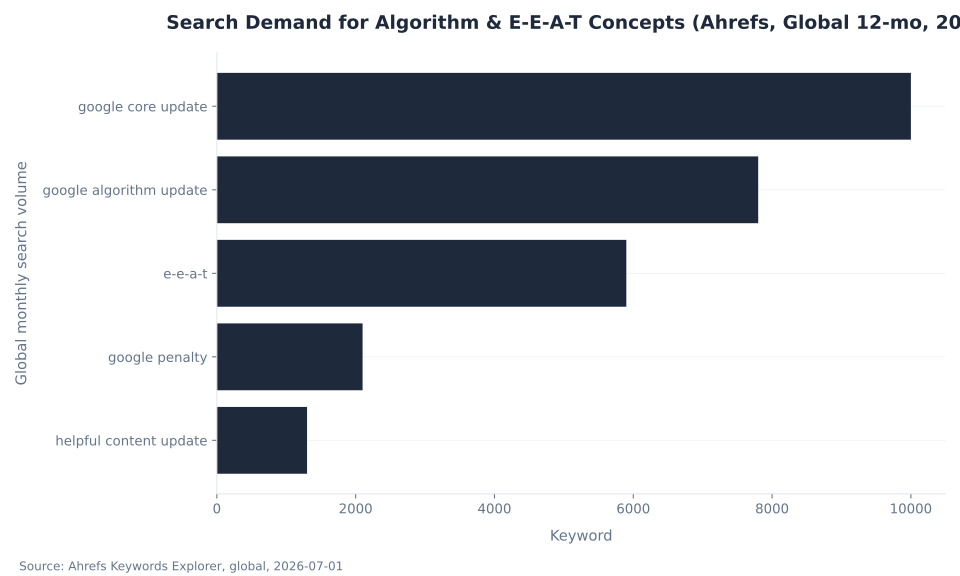
Demand for update concepts is enormous and global. “Google core update” runs 10,000 searches a month worldwide, “google algorithm update” 7,800, and “e-e-a-t” 5,900 — the last one carrying only 200 US searches a month against that 5,900 global figure, which marks it as a global-audience concept term (Ahrefs Keywords Explorer, 2026-07-01). The gap tells you who is asking: a worldwide audience trying to understand quality assessment, and a US audience concentrated on recovery and mistakes.
| Keyword | Global monthly volume | US monthly volume | Note |
|---|---|---|---|
| google core update | 10,000 | 1,700 | Biggest global demand in the cluster; the timeline table answers it |
| google algorithm update | 7,800 | 2,700 | The head term this pillar owns (KD 74) |
| e-e-a-t | 5,900 | 200 | Outsized global demand; the absorbed page 301s into the #e-e-a-t section |
| google penalty | 2,100 | 600 | Recovery intent — manual vs algorithmic (KD 31) |
| helpful content update | 1,300 | 150 | Answered “folded into core in March 2024” (KD 50) |
Source: Ahrefs Keywords Explorer, global and US 12-month average volume, 2026-07-01. Not mbadv client data.
This page consolidates that demand into one authoritative resource for the algorithm-system subtopic. It absorbs an older E-E-A-T explainer, which now redirects into the E-E-A-T section below, so a reader searching “what is E-A-T in SEO” lands on the accurate, current answer rather than a stale standalone page. The global demand for “e-e-a-t” is exactly why the misconception around it — that it is a ranking factor with a score — is worth correcting plainly and early.
The Helpful Content System Is Now Part of Core
The most persistent stale idea in SEO right now is that a separate “Helpful Content Update” is still running and penalizing sites. It is not. The standalone Helpful Content system shipped as its own classifier three times — August 2022, December 2022, and September 2023 — and then, with the March 2024 core update, Google folded it into the core ranking systems. There is no separate helpful-content signal, no standalone “HCU,” and no distinct “helpful content penalty” in 2026. Helpfulness is now assessed by multiple core systems as part of the ordinary core reassessment. “Helpful content update” still draws 150 US and 1,300 global searches a month (Ahrefs, 2026-07-01), so the search demand for the old model persists even though the model itself is gone.
This matters for diagnosis and recovery. A 2026 ranking drop that a blog post attributes to “the HCU” is a core-quality reassessment, and the response is the same as for any core update: make the content genuinely more useful to the people it is written for, demonstrate first-hand experience, and satisfy the query more completely than the pages that now outrank you. There is nothing to “remove” and no penalty to lift — the recovery is durable, people-first SEO content, reassessed at the next core update. Google’s framing across the Google Search Central, “March 2024 core update & new spam policies” is explicit that helpfulness became part of how the core systems work, not a bolt-on classifier you can fail in isolation.
MB Adv Agency treats the “is the Helpful Content Update penalizing me?” question as a teaching moment: the honest answer is that the question itself is built on a retired model. Chasing a phantom update wastes the effort that should go into the content itself. The correct mental model is one integrated core system that rewards helpfulness — and the way to win with it is the same durable quality work that has always paid off, now assessed continuously rather than by a separate switch.
How Often Google Ships Broad Core Updates
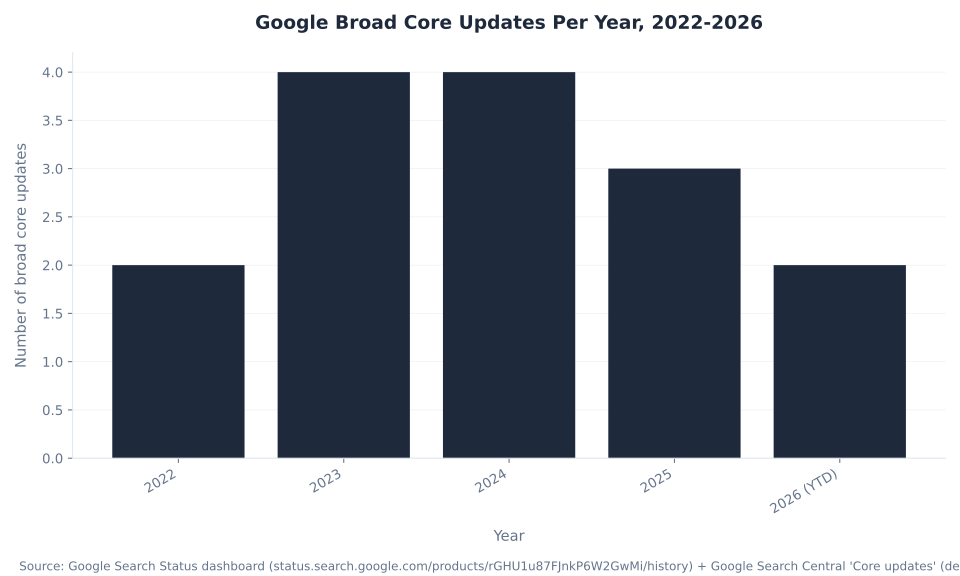
Reduced to a count per year, the cadence is steady but not fixed: two broad core updates in 2022, four in 2023, four in 2024, three in 2025, and two so far in 2026 (as of 2026-07-01). That is the number to anchor on when someone claims Google “constantly” changes core rankings — the confirmed broad core updates arrive a handful of times a year, each one a distinct, dated event you can plan around.
| Year | Broad core updates | Note |
|---|---|---|
| 2022 | 2 | May and September core updates |
| 2023 | 4 | March, August, October, November |
| 2024 | 4 | March (the ~45-day outlier), August, November, December |
| 2025 | 3 | March, June, December — note the ~5-month mid-year gap |
| 2026 (year-to-date) | 2 | March and May, as of 2026-07-01 |
Source: Google Search Status dashboard; counts derived from the confirmed broad-core-update timeline (Table 1), shared verified-facts §3. 2026 is year-to-date as of 2026-07-01. Not mbadv client data.
The count also punctures a common worry. Because there are only a few broad core updates a year and each takes one to three weeks to roll out, a real core-update impact is dated and observable — it is not a mysterious daily erosion. If your traffic slid on a day with no confirmed update, the cause is more likely an indexing issue, a technical regression, seasonality, or a competitor’s improvement than “an algorithm change.” The five-month gap between the June 2025 and December 2025 updates is the clearest proof that stretches with no core update are normal.
Core Updates Take Weeks to Complete — Don’t Judge Early
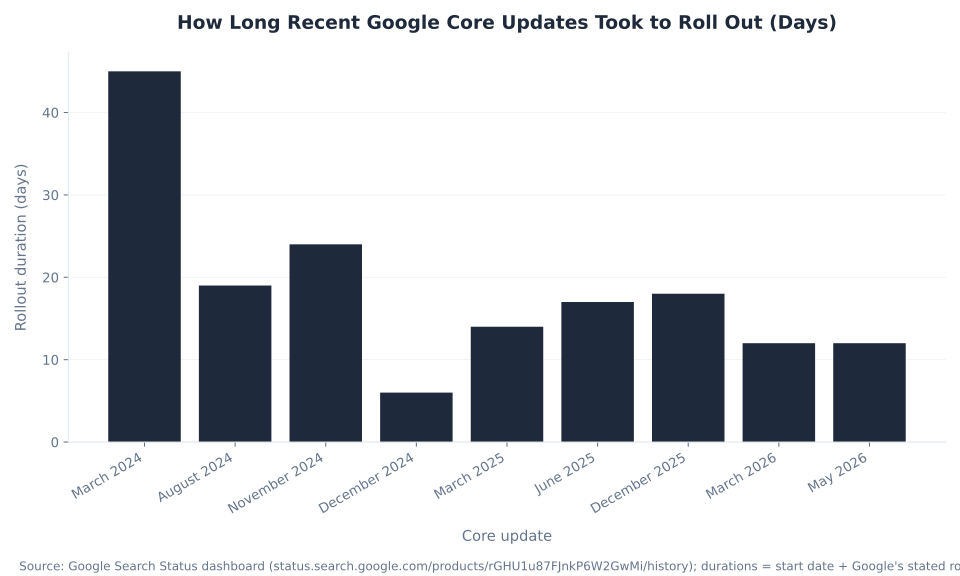
A broad core update is not an overnight switch. Recent rollouts have taken from 6 to 45 days, and the March 2024 core update — at roughly 45 days — is the exceptional case, the largest and most complex Google had ever run. Typical rollouts land around two weeks. The practical rule follows directly: do not judge the impact of an update until Google marks the rollout complete on the Search Status dashboard, because rankings can swing in both directions while it is still rolling out.
| Core update | Rollout (days) |
|---|---|
| March 2024 | 45 (the spike — largest and most complex ever) |
| August 2024 | 19 |
| November 2024 | 24 |
| December 2024 | 6 |
| March 2025 | 14 |
| June 2025 | 17 |
| December 2025 | 18 |
| March 2026 | 12 |
| May 2026 | 12 |
Source: Google Search Status dashboard; durations are the start date plus Google’s stated rollout duration (±1 day). Shared verified-facts §3. Not mbadv client data.
This is where owners hurt themselves most. Seeing a drop on day three of a rollout, they rewrite pages, cut content, or change strategy — and then rankings recover on their own by day twenty when the rollout finishes, leaving them unable to tell what actually worked. Hold changes until the rollout completes, then compare a clean before-and-after window in Search Console. Volatility during a rollout is expected; the settled state is the only signal worth acting on.
Spam Updates, the Three 2024 Policies & SpamBrain
A spam update is different from a core update: it enforces Google’s spam policies rather than reassessing quality broadly. The March 2024 announcement introduced three new spam policies — site reputation abuse, scaled content abuse, and expired domain abuse — all enforced with the help of SpamBrain, Google’s AI spam-prevention system. Search demand here is small but the citation value is high: “spam update” and “site reputation abuse” each run about 40 US searches a month (Ahrefs, 2026-07-01), asked mostly by owners doing damage control.
| Policy / system | What it targets | Enforcement |
|---|---|---|
| Site reputation abuse (“parasite SEO”) | Third-party pages published to exploit a strong host site’s ranking signals | Policy launched Mar 2024; manual enforcement began May 5, 2024; policy expanded Nov 19, 2024 (removed the first-party-oversight exemption). Google described enforcement as manual; broad algorithmic detection was anticipated, not confirmed |
| Scaled content abuse | Producing content at scale to manipulate rankings — regardless of automation, human, or hybrid (replaced “spammy auto-generated content”) | Algorithmic and manual |
| Expired domain abuse | Buying expired domains to boost thin or low-value content on the domain’s residual authority | Algorithmic and manual |
| SpamBrain | Google’s AI-based spam-prevention system underlying spam updates | Continuous; the December 2022 link spam update used it to neutralize spammy links rather than penalize |
Source: Google Search Central, “March 2024 core update & new spam policies”; Google Search Central, site reputation abuse update; Google Search Central, Spam policies; Google Search Central, December 2022 link spam update; shared verified-facts §3, §8. Not mbadv client data.
Two precision points protect you from stale advice. First, link spam is neutralized, not penalized: the December 2022 link spam update was the first to use SpamBrain to turn off the credit from spammy links, with no Search Console notification — so a wave of junk links pointed at you generally does nothing rather than triggering a penalty. If you want the safe way to earn links instead, see link building in SEO. Second, be careful with the site-reputation-abuse timeline: Google launched the policy in March 2024, began manual enforcement on May 5, 2024, and expanded the policy on November 19, 2024 to remove the first-party-oversight exemption — but Google described that enforcement as manual, and broad algorithmic detection was anticipated rather than confirmed. Do not state that site reputation abuse “went fully algorithmic” in November 2024; that overstates what Google actually said.
Manual Action vs Algorithmic Adjustment
The most useful distinction in all of update recovery is manual versus algorithmic, because the recovery path is completely different. A manual action is a human reviewer at Google demoting or removing a page for a policy violation — it appears in the Search Console Manual Actions report and has a formal reconsideration path. An algorithmic adjustment is automatic, comes from a core or spam update, is never shown in Search Console, and is recovered by fixing the underlying issue and waiting for the systems to reassess. “Google penalty” draws 600 US searches a month and “manual action” about 40 (Ahrefs, 2026-07-01) — and the word “penalty” strictly applies only to the manual case.
| Manual action | Algorithmic adjustment | |
|---|---|---|
| Trigger | A human reviewer at Google | Automated ranking systems (a core or spam update) |
| Shown in Search Console? | Yes — the Manual Actions report notifies you | No — no notification |
| How to recover | Fix the violation, then submit a reconsideration request | Fix the underlying quality or policy issue, then wait for the systems to reassess (often the next update) |
| Typical cause | A clear policy breach (unnatural links, cloaking, thin content) | A broad quality or relevance reassessment, or a spam-update sweep |
Source: Google Search Console Help, Manual Actions report; shared verified-facts §3. Not mbadv client data.
Your first move after a drop is therefore a single check: open the Manual Actions report. If there is a notice, it is manual — fix exactly what Google flags and file a reconsideration request. If the report is clean, it is algorithmic — there is nothing to submit; you improve the substance and wait for the next reassessment. Because a manual action shows up only in Search Console, see Links, Manual Actions & Security in GSC for where the notice appears and the reconsideration path, and rule out a plain indexing problem first with Index Coverage & Indexing before you blame any update.
What US Searchers Reach For After a Ranking Drop
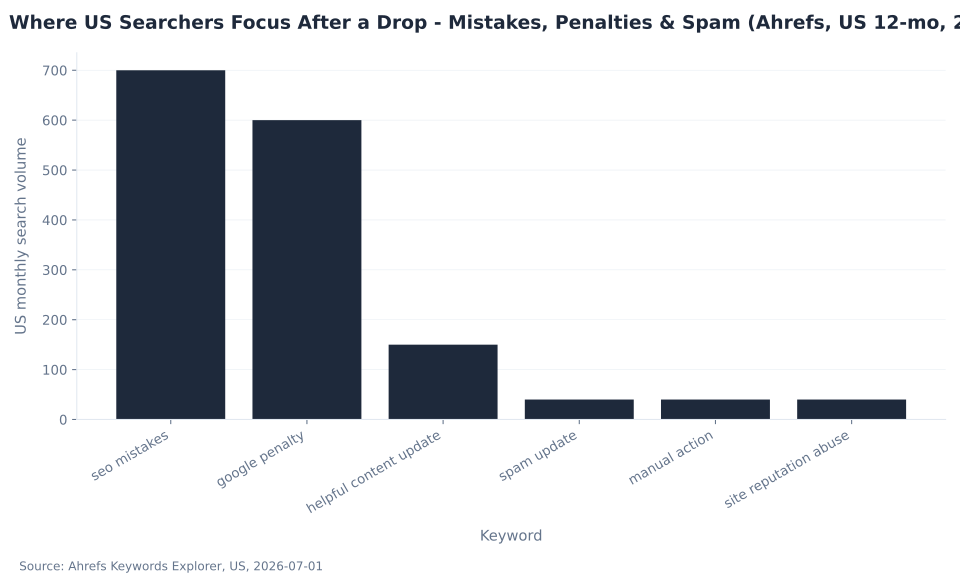
US search behavior after a drop is revealing. The demand concentrates on “mistakes” and “penalty” language: “seo mistakes” runs 700 searches a month at a low difficulty of 10, “google penalty” 600, and the spam-policy terms trail at about 40 each (Ahrefs, 2026-07-01). Owners reach for the vocabulary of fault — what did I do wrong, was I penalized — even though the most common cause of a core-update drop is neither a mistake nor a penalty but a routine quality reassessment.
| Keyword | US monthly volume | Difficulty (KD) | Note |
|---|---|---|---|
| seo mistakes | 700 | 10 | Winnable head term; the absorbed page 301s into #common-mistakes |
| google penalty | 600 | 31 | Recovery intent — distinguish manual vs algorithmic |
| helpful content update | 150 | 50 | Answered “folded into core in March 2024” |
| spam update | 40 | — | 2024 spam-policy intent |
| manual action | 40 | 6 | The one true “penalty” case |
| site reputation abuse | 40 | — | High citation value, low volume |
Source: Ahrefs Keywords Explorer, US 12-month average volume, 2026-07-01. Not mbadv client data.
This page meets that intent head-on. It absorbs an older “common SEO mistakes” explainer, which now redirects into the common-mistakes section below, and it pairs the mistakes-to-fixes table with the manual-versus-algorithmic decoder so a worried owner can separate a real policy violation from a normal reassessment. The low difficulty on “seo mistakes” reflects how much of the existing content on the topic is thin or fear-driven — a plain, accurate answer wins here.
E-E-A-T Explained: A Rater Concept, Not a Ranking Factor
E-E-A-T stands for Experience, Expertise, Authoritativeness, and Trustworthiness. Google added the leading “E,” Experience, to the older E-A-T on December 15, 2022, and it made Trust the central member — the other three exist to support it. The term draws only 200 US searches a month but 5,900 globally (Ahrefs, 2026-07-01), which is why it needs a plain, correct answer: E-E-A-T is a concept from Google’s Search Quality Rater Guidelines, a framework human raters use to evaluate results. It is not a direct ranking factor, and there is no “E-E-A-T score” that Google computes for your page.
| Component | What raters look for |
|---|---|
| Experience (added Dec 15, 2022) | First-hand or life experience with the topic — did the author actually use, visit, or do the thing? |
| Expertise | The knowledge and skill of the content creator in the subject |
| Authoritativeness | The reputation of the creator and the site as a go-to source for the topic |
| Trust (the central member) | Accuracy, honesty, safety, and reliability — the most important of the four; the other three support Trust |
Source: Google Search Central, “E-E-A-T”. E-E-A-T is a Search Quality Rater Guidelines concept — not a direct ranking factor, and there is no “E-E-A-T score.” QRG known updates: Jan 23, 2025 and Sep 11, 2025. Shared verified-facts §4. Not mbadv client data.
The distinction is not pedantic — it changes what you do. Raters do not set your rankings; they assess the quality of search results, and their aggregate feedback trains the ranking systems over time. So you cannot “raise your E-E-A-T score,” because none exists. What you can do is build the genuine signals the systems reward: demonstrate first-hand experience, show real expertise, earn a reputation as an authority, and be accurate and trustworthy. Those improve the content itself, which is what durable people-first SEO content has always meant. Google’s guidelines were last updated on January 23, 2025 and September 11, 2025, so the framework is current — but the way to use it is to build trust, not to chase a number.
MB Adv Agency draws the line clearly for clients: treat E-E-A-T as a quality checklist for your content and your authors, never as a metric to game. A byline with real credentials, first-hand testing, cited sources, and an accurate, well-maintained site all strengthen the signals the ranking systems actually use — indirectly, through the quality of the page. That is the honest version of “improving E-E-A-T,” and it is the opposite of installing an author-schema plugin and calling it done.
Common SEO Mistakes That Cost Rankings — and the Fix
When rankings fall, the honest first question is whether you tripped a spam policy. Six mistakes cause most policy-driven ranking loss: thin or doorway content, keyword stuffing, cloaking, unnatural or paid links, sneaky redirects, and hidden text (with scaled and scraped content close behind). “SEO mistakes” is a winnable 700-searches-a-month term at difficulty 10 (Ahrefs, 2026-07-01) precisely because a clear mistakes-to-fixes answer is scarce.
| Mistake (spam-policy risk) | Why it hurts | The fix |
|---|---|---|
| Thin / doorway content | Low-value pages that do not satisfy intent; core systems demote unhelpful content | Consolidate, deepen, or remove; write people-first content that answers the query fully |
| Keyword stuffing | Unnatural repetition or lists of keywords — a spam-policy violation | Write naturally for readers; cover the topic and related concepts, not a density target |
| Cloaking | Showing different content to Google than to users — a spam-policy violation and a manual-action risk | Serve identical content to users and crawlers; remove user-agent or IP-based swaps |
| Unnatural / paid links | Link schemes that pass PageRank violate the link-spam policy (value neutralized; manual-action risk) | Use rel=“sponsored” or rel=“nofollow” on paid and UGC links; earn links through quality; disavow only with a manual action |
| Sneaky redirects | Redirecting users to a different URL than crawlers — a spam-policy violation | Send users and Google to the same destination; audit JavaScript and conditional redirects |
| Hidden text / scaled & scraped content | Text hidden from users, or mass-produced or scraped pages — scaled-content-abuse territory | Remove hidden text; produce original, genuinely useful content at any scale |
Source: Google Search Central, Spam policies + link-spam guidance; shared verified-facts §3, §8. A drop after a core update is usually not one of these violations — it is a quality reassessment. Not mbadv client data.
The crucial caveat sits under the table: a drop after a core update is usually not one of these violations — it is a quality reassessment, and the fix is better content, not a spam cleanup. So diagnose before you act. Most of these mistakes live on the technical and on-page side of SEO: cloaking and sneaky redirects are covered in technical SEO, while keyword stuffing and thin content sit on the on-page side. Fix a genuine violation directly; if the Manual Actions report is clean and no policy is breached, the answer is durable quality, reassessed at the next core update — not a frantic hunt for a penalty that is not there.
Rankings Moved After an Update?
A second set of eyes tells you whether it was an update — or something you can fix
MB Adv Agency runs the paid search — Google Ads and PPC — that complements your organic SEO, so demand stays steady while your content recovers from a core update. Talk to our team about stabilizing traffic during a reassessment.
Talk to our team →How to Recover After an Update or a Ranking Drop
Recovery is a diagnosis problem before it is a content problem. The sequence that works: confirm the date of the drop in Search Console; check that date against the core-update timeline above; open the Manual Actions report to separate a human penalty from an algorithmic adjustment; fix the substance; and then wait for the systems to reassess. There is no instant reversal for an algorithmic drop — recovery lands when the next core update rolls out and the improved content is re-evaluated.
Work the two branches differently. If the Manual Actions report shows a notice, it is a manual action: fix exactly what Google flags, then submit a reconsideration request and wait for a human review. If the report is clean, it is algorithmic: there is nothing to submit. Improve the content’s quality and helpfulness, fix any genuine spam-policy mistakes from the table above, and hold your changes so you can measure them cleanly. Diagnose when the change happened in the Performance report, confirm the movement in Search Console, and read Google’s own recovery guidance in Google Search Central, “Core updates” before you change anything drastic.
One honest note on timing: sites hit by a core update sometimes need to wait several core updates, with real content improvement in between, before rankings recover — and some content that dropped was genuinely surpassed by better pages and will not fully return. That is not a penalty and not a bug; it is the system rewarding the better result. While organic recovers, paid search keeps demand alive: content-heavy sites, especially in SaaS, feel core updates most, which is why our SaaS PPC services and a focused Google Ads PPC audit are the fastest way to stabilize traffic through a reassessment.
Three Myths About Google Updates — Corrected
Three misconceptions generate most of the bad advice about Google updates. Stating the accurate version of each plainly is the highest-value thing this page does, because every one is easy to get wrong from stale sources and each is backed by Google’s own documentation.
Myth 1: “E-E-A-T is a ranking factor and Google gives your page an E-E-A-T score.” It is not, and it does not. E-E-A-T is a Quality Rater Guidelines concept used by human raters to evaluate results — not a direct ranking signal, and there is no computed score. Building genuine experience, expertise, authority, and trust improves the signals the systems do use, indirectly, through better content (Google Search Central, “E-E-A-T”).
Myth 2: “The Helpful Content Update is a separate live update that penalized my site.” It is not. The Helpful Content system was folded into the core ranking systems with the March 2024 core update — it is no longer a standalone update or a penalty. A drop attributed to “the HCU” is a core-quality reassessment, and the fix is durable, people-first content (Google Search Central, “March 2024 core update & new spam policies”).
Myth 3: “Site reputation abuse became fully algorithmic in November 2024.” Overstated. Google expanded the site-reputation-abuse policy on November 19, 2024 (removing the first-party-oversight exemption), but described enforcement as still manual; broad algorithmic detection was anticipated, not confirmed. MB Adv Agency keeps this kind of precision in every audit, and for the accurate baseline you can always start from what SEO is and named trackers like Search Engine Land and Search Engine Roundtable rather than a recycled blog claim.
Google Algorithm Updates FAQ
An Update Dented Your Organic Traffic?
Stabilize demand with paid search while your content recovers
A core update recovery takes time. A Google Ads PPC audit is the fastest way to keep qualified traffic flowing while organic rankings reassess — the paid complement to your SEO.
Google Ads PPC audit →All PPC servicesMethodology & Sources
Every fact in this guide is sourced to a Google primary page, the Google Search Status dashboard, or Ahrefs. Core-update dates and rollout durations come from the Google Search Status dashboard and Google Search Central, “Core updates” (2024+ end dates are the start date plus Google’s stated rollout duration, ±1 day). The E-E-A-T facts come from Google Search Central, “E-E-A-T”; the spam-policy facts from Google Search Central, “March 2024 core update & new spam policies”, Google Search Central, site reputation abuse update, and Google Search Central, Spam policies; and the manual-versus-algorithmic framework from Google Search Console Help, Manual Actions report.
Search-demand numbers are Ahrefs Keywords Explorer figures (US and global 12-month average volume, 2026-07-01). No WordStream or LocaliQ figure appears anywhere in this guide — those publish paid-search cost data, which is irrelevant to organic algorithm updates. Two drift-prone claims were web-verified against Google’s own documentation before publish: that the Helpful Content system was folded into core with the March 2024 core update, and that E-E-A-T is a Quality Rater Guidelines concept rather than a ranking factor. Named trackers Search Engine Land and Search Engine Roundtable were used for real-time update context only.
MB Adv Agency has no SEO or local-SEO service page and no SEO client-benchmark dataset, so the point of view here stays qualitative: our team runs the paid search — Google Ads and PPC — that complements your organic SEO, and we never invent a client recovery metric. No mbadv client number appears anywhere in this guide. Because SEO drift is monthly, re-verify the most recent core-update rows against the live dashboard at read time. Last updated 2026-07-01. To discuss the paid side of search while your organic presence recovers, talk to our team.
In the ever-evolving landscape of digital marketing, Google’s algorithm updates play a crucial role in shaping how websites rank in search engine results. Understanding these updates is essential for any SEO professional or online business owner seeking to navigate the complexities of search engine optimization effectively. This article delves into the major updates made by Google over the years, their impacts on SEO strategies, and the tools available for monitoring these significant changes.
Overview of major updates
Google has implemented numerous algorithm updates since its inception, each designed to improve the quality of search results and enhance user experience. These updates frequently target specific issues such as content quality, link building strategies, and overall website performance.
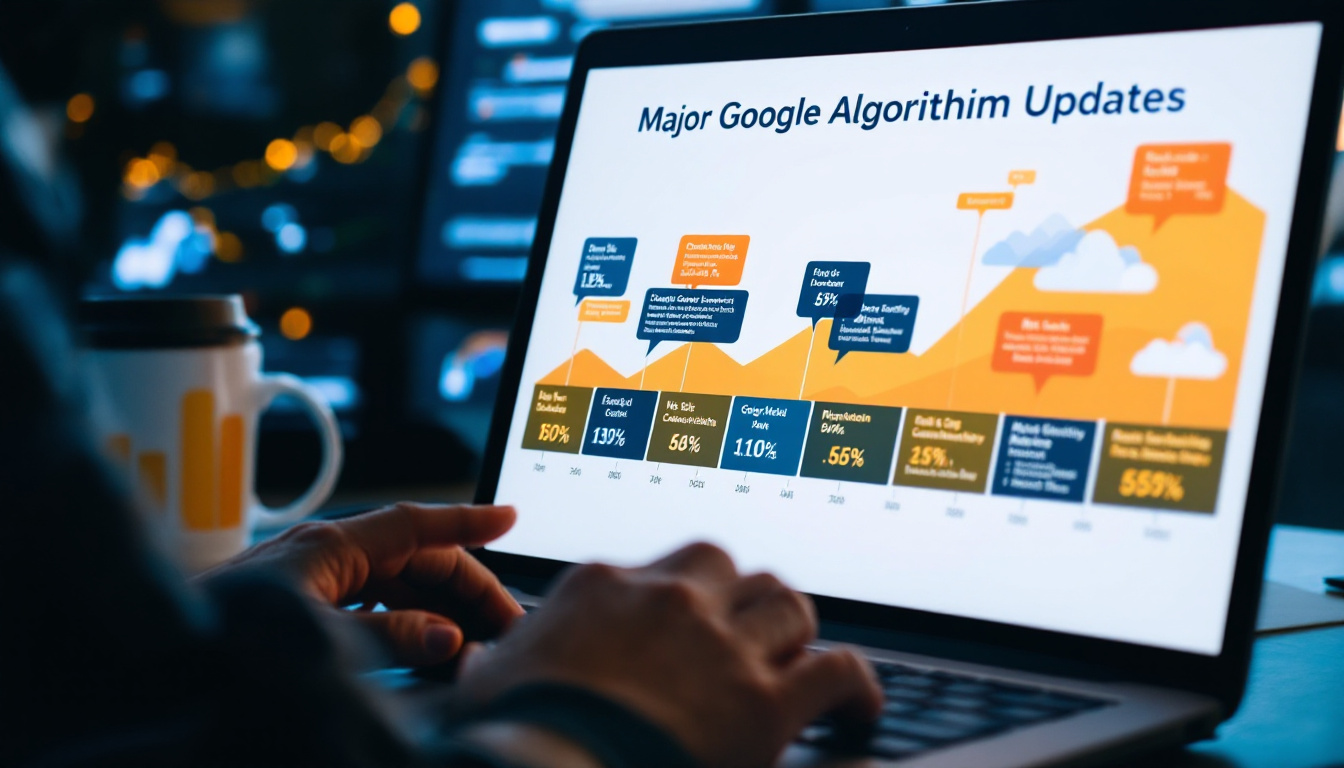
Some of the most notable updates include:
- Panda: First launched in 2011, the Panda update focused on quality content by penalizing sites with thin or duplicate content.
- Penguin: Introduced in 2012, this update targeted spammy link practices and aimed to promote websites with clean backlink profiles.
- Hummingbird: Launched in 2013, Hummingbird improved the understanding of search queries, allowing Google to better process conversational searches.
- Mobilegeddon: In 2015, this update prioritized mobile-friendly websites in mobile search results, reflecting the growing trend of mobile internet usage.
- RankBrain: This was a significant update in 2015 that applied machine learning to improve the relevance of search results, interpreting search intent more accurately.
- Bert: Released in 2019, BERT enhanced Google’s understanding of natural language, enabling the search engine to grasp the context of words in searches.
These major updates reflect Google’s commitment to enhancing user experience by rewarding high-quality content and punishing manipulative practices designed to game the system. Each update not only reshapes the landscape of search engine optimization (SEO) but also influences how content creators approach their strategies. For instance, the introduction of the Panda update forced many website owners to reevaluate their content strategies, leading to a significant shift towards creating more valuable, informative, and engaging material that genuinely serves the needs of users.
Additionally, the evolution of these algorithms has also ushered in a new era of SEO practices, where the focus has shifted from merely optimizing for search engines to prioritizing user experience and satisfaction. As Google continues to refine its algorithms, businesses and content creators must stay agile and informed about these changes to maintain their visibility in search results. This ongoing evolution highlights the importance of adaptability in digital marketing, as strategies that once worked may quickly become obsolete in the face of new updates.
Impact on SEO strategies
As Google continues to refine its algorithms, the impact on SEO strategies is profound. Marketers and webmasters must be agile and adaptable to keep their sites compliant with the changing landscape. Below are some significant ways in which Google algorithm updates have influenced SEO strategies:
Content Quality
With the arrival of updates like Panda, the emphasis on high-quality content has never been clearer. Websites that prioritize informative, engaging, and original content tend to fare better in search rankings. This shift forces marketers to invest in developing valuable content rather than focusing solely on keyword stuffing or link generation.
Moreover, content should cater to user intent, meaning it should meet the needs and expectations of users effectively. This requires understanding your audience’s questions and providing comprehensive answers through your content. Additionally, incorporating multimedia elements such as images, videos, and infographics can enhance the user experience and keep visitors engaged longer, signaling to search engines that the content is valuable.
Link Building Practices
The Penguin update revolutionized link-building approaches. It shifted the focus from the quantity of backlinks to their quality. Websites with spammy or irrelevant backlinks faced dire consequences, while those building genuine relationships and earning organic links benefited significantly.
This has led to SEO strategies that prioritize outreach, guest blogging on reputable sites, and building a strong digital reputation. Link analysis tools have become essential for checking the health of a site's backlink profile. Furthermore, the rise of social media has opened new avenues for link building, as sharing quality content on these platforms can lead to natural backlinks and increased visibility, creating a more holistic approach to online presence.
Technical SEO and User Experience
With the emphasis on factors like mobile-friendliness from the Mobilegeddon update, technical SEO has become a cornerstone of effective optimization strategies. Sites must load quickly, be mobile-responsive, and have a user-friendly layout to rank well.
Investing in core web vitals such as page speed, interactivity, and visual stability is crucial. Not only do these technical elements contribute to better performance in SERPs, but they also improve user experience, which ultimately enhances conversion rates. Additionally, the importance of structured data cannot be overlooked; implementing schema markup can help search engines understand the content better and may lead to rich snippets in search results, further improving click-through rates and user engagement.
Tools for monitoring algorithm changes
Given the frequency of updates and the impact they have on SEO strategies, monitoring algorithm changes is vital for digital marketers. Several tools assist in tracking these changes effectively:

Analytics Tools
Google Analytics and Google Search Console are indispensable for monitoring website performance. They provide insights into traffic changes, keyword rankings, and user engagement. Analyzing this data helps identify trends that may correlate with algorithm updates.
For instance, a sudden drop in organic traffic can alert you to a possible algorithm change, prompting a deeper analysis of your content and backlink profiles. Moreover, these tools allow you to segment your audience and assess how different demographics may be affected by updates, enabling a more tailored approach to your SEO strategy.
Rank Tracking Software
Using rank tracking tools like SEMrush or Ahrefs allows SEOs to observe fluctuations in keyword rankings systematically. These tools can often notify users of shifts in rankings that may be tied to Google’s updates.
This information can be critical for adapting strategies quickly and efficiently. If specific keywords drop after an update, further investigation will be needed to understand how those keywords may have been affected. Additionally, many of these tools offer competitive analysis features, allowing you to see how your competitors are responding to algorithm changes and what strategies they might be implementing to maintain or improve their rankings.
SEO Community and Forums
The SEO community plays an essential role in sharing information regarding algorithm updates. Online forums, social media groups, and industry-focused websites allow professionals to discuss their experiences and observations following updates.
Participating in these communities can provide valuable insights into how others are adjusting their strategies, and it can highlight emerging trends that might influence your approach. Furthermore, many industry experts share case studies and detailed analyses of algorithm impacts, which can serve as a learning tool for those looking to refine their own practices. Engaging in discussions can also lead to networking opportunities that may benefit your business in the long run.

As a Google Ads expert, I bring proven expertise in optimizing advertising campaigns to maximize ROI.
I specialize in sharing advanced strategies and targeted tips to refine Google Ads campaign management.
Committed to staying ahead of the latest trends and algorithms, I ensure that my clients receive cutting-edge solutions.
My passion for digital marketing and my ability to interpret data for strategic insights enable me to offer high-level consulting that aims to exceed expectations.
Google Partner Agency
We're a certified Google Partner Agency, which means we don’t guess — we optimize withGoogle’s full toolkit and insider support.
Your campaigns get pro-level execution, backed by real expertise (not theory).

4.9 out of 5 from 670+ reviews on Fiverr.
That’s not luck, that’s performance.
Highly recommend Matteo to set up your server side tracking. He has a deep understanding of e-commerce tracking and will go above and beyond to make sure everything is set up correctly and working 100%. If you are scaling your store this set up is non-negotiable in my opinion and there isn't many people who have this much knowledge or put the effort in to get it right. Thanks again!

avorodesign.com
I can only recommend Matteo! He was very patient, professional and very knowledgeable about GA4, Consent Mode v2, and GDPR compliance. Communication was clear, and the setup was done professionally and efficiently. Highly recommend him for anyone needing reliable tracking implementation.
www.natureiki.life
Matteo shines in the realm of online professionals. His work is not only deep in data but also complemented by his proactive communication and cooperation, setting a new standard for freelancers. If you want someone who truly exceeds expectations, look no further. Highly recommended!

www.omanbeverlysmyth.com
Exceptional Service Beyond Expectations - Outstanding Service Impeccable depth, flawless delivery, and exceptional language fluency—this service exceeded all expectations. Highly recommended. Matteo truly ROCKS!!!
ium-paris.com
Top-notch, always highly value working with Matteo. An absolute Google Ads Genius. This is approximately the 8th time I have hired him and he's helped us get 6-7 ROAS. We are excited in continuing to improve our lead flow. Hire this guy if you need Google Ads help. Thanks Matteo!

www.dleeventgroup.com
I finally found the guy who can setup server side tracking and all the ecosystem properly. I definitely recommend Matteo. He is very responsive, kind and wants to dig into things. He configured GA4, Meta, Google Ads, Outbrain and google consent v2 with Cookiebot. Thanks Matteo.

inomega.fr
MB Adv delivered exceptional work with outstanding professionalism and lots of patience, taking time to see effects of changes made and not just do the work and submit it. The proactive communication and video summaries of the work completed made working with Matteo a pleasure, as he consistently went above and beyond. Highly recommended for web analytics projects! We are already working on another project.

www.withnellsensors.co.uk
Working with Matteo on my Google Ads was a game-changer. He's not just a strategist, he's a true partner. He understood my goals and tailored a campaign that perfectly reached my target audience. I'm grateful for his expertise and dedication.
dccargo.com
Click-driven mind
with plastic-brick obsession.
We build Google Ads campaigns with the same mindset we use to build tiny brick worlds: strategy, patience, and zero tolerance for wasted pieces.
Data is our blueprint. Growth is the only acceptable outcome.