Amazon Ads Bidding & Budgets: The 2026 Auction Guide

$1.18
Average Amazon Ads CPC — 2026, blended across all formats
Up 8–12% year over year. Up 60%+ since 2020. No subscription — cost-per-click only. Source: Epinium, Amazon Advertising Cost: CPC Benchmarks 2026
How Amazon Ads Pricing Works: An Auction, Not a Rate Card
Sponsored Products, Sponsored Brands, and Sponsored Display all run cost-per-click, priced in a real-time auction for each ad impression. The minimum daily budget for Sponsored Products is $1, and the blended average CPC across all formats reached ~$1.18 in 2026 — up 8–12% year over year, per Epinium's 2026 Amazon Advertising Cost benchmarks. What you pay per click is set by your maximum bid against every competing advertiser in that auction — not a published rate you look up in a pricing table.
The useful version of "how much do Amazon ads cost" is a profitability question, not a price question. The correct ceiling is your maximum profitable CPC: Target ACOS × Product Price × Conversion Rate = max CPC. For a $30 product with a 25% target ACOS and 10% conversion rate, that formula produces a $0.75 maximum CPC. Feedvisor's 2026 Amazon bidding report confirms that Amazon's suggested bids run 20–50% above the average seller's profitable ceiling, because they are calibrated to maximize Amazon's revenue, not your margin.
Three mechanisms control what you pay per click on Amazon Ads: (1) your maximum bid or dynamic bid strategy, which sets the ceiling per auction; (2) placement bid adjustments at the campaign level, which can raise your base bid by up to +900% for specific placement groups; and (3) the auction outcome itself — a second-price-style mechanism where you pay just above the second-highest bid, not necessarily your maximum. This pillar covers all three, the budget structure across formats, and the automatic-vs-manual campaign distinction that determines targeting control.
Key Takeaways
- No subscription. Pay per click. Amazon Ads charges CPC only when a shopper clicks — Sponsored Products, Sponsored Brands, and Sponsored Display carry no platform fee and no minimum commitment beyond a $1 daily budget for Sponsored Products.
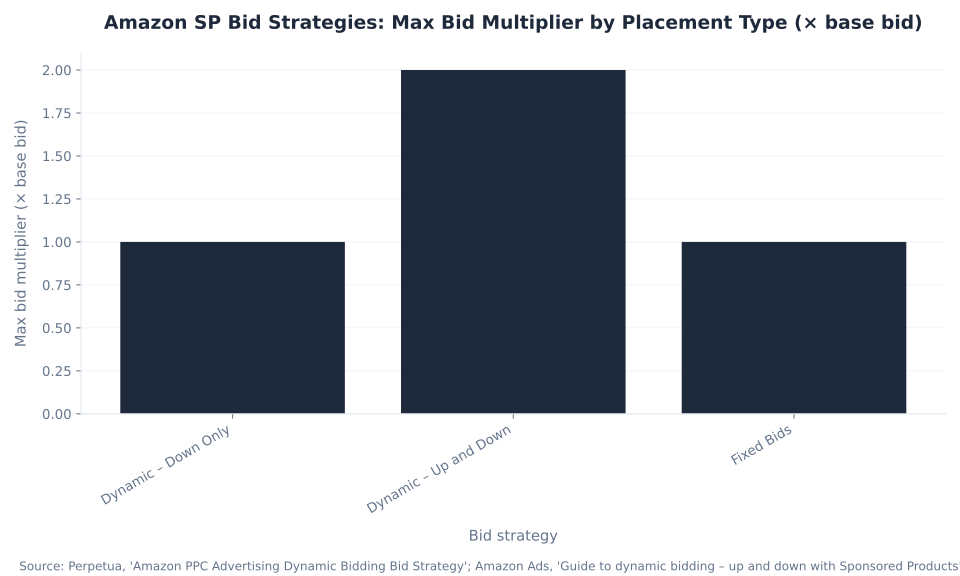
- Three Sponsored Products bid strategies, one default. Dynamic bids – down only (default for new campaigns, never raises your bid), Dynamic bids – up and down (raises up to +100% at Top of Search, +50% at other placements), and Fixed bids (exact bid, no movement). The choice maps to product lifecycle stage.
- Placement adjustments up to +900%. A separate campaign-level control raises your base bid for Top of Search, Rest of Search, or Product pages — available for all targeting types and bid strategies. It stacks multiplicatively with dynamic bid raises: a $1.00 base bid with +900% Top of Search and Up-and-Down resolves to a $20.00 theoretical max CPC.
- Sponsored Products is daily-budget-only. There is no lifetime budget option for Sponsored Products. Lifetime budget is a Sponsored Brands option (minimum $100, campaign spends down then stops). Sponsored Display runs daily budgets; Amazon DSP uses flight budgets over a campaign date range.
- Daily budgets average across the month, not day by day. For campaigns created after March 27, 2023, Amazon can spend up to 100% over your daily budget on a high-traffic day, balancing it on slower days so the monthly total never exceeds daily budget × days in month (Perpetua 2026).
- CPC has risen 60%+ since 2020. The blended average is ~$1.18 in 2026, climbing 8–12% per year. Supplements/Vitamins is the most expensive category at $2.50–$7.00+ per click; Books is cheapest at $0.30–$0.75 (Feedvisor / Epinium 2026).
- Automatic campaigns discover; manual campaigns control. Auto campaigns let Amazon pick targets from your listing; manual campaigns give you keyword-level bid control and negative targeting. The standard workflow: run both, then graduate converting terms from auto into manual with profitability-anchored custom bids.
~$1.18
Blended avg CPC, all formats (Epinium 2026)
+900%
Max placement bid adjustment per group (Amazon Ads)
+60%
CPC rise across Amazon Ads since 2020 (Epinium 2026)
$100
Minimum Sponsored Brands lifetime budget (Amazon Ads)
3
Sponsored Products bid strategies (Amazon Ads)
20–50%
How far suggested bids overshoot profitable ceiling (Feedvisor 2026)
The Three Sponsored Products Bid Strategies
Amazon offers exactly three bid strategies for Sponsored Products campaigns. The choice determines whether Amazon adjusts your bid in real time and in which direction. Per Amazon Ads' official dynamic bidding guide, new campaigns default to Dynamic bids – down only. The strategy is set at the campaign level and can be changed at any time.
| Bid strategy | What Amazon does to your bid | Max adjustment | Best for |
|---|---|---|---|
| Dynamic bids – down only (default) | Lowers bid in real time when a click is unlikely to convert; never raises it above what you set | Down up to 100% | New campaigns with no conversion history; ACOS-control focus |
| Dynamic bids – up and down | Raises bid when a conversion looks likely — up to +100% at Top of Search, up to +50% at other placements — and lowers it when it does not | +100% (ToS) / +50% (other) | Proven products where rank and velocity outweigh short-term ACOS |
| Fixed bids | Uses your exact bid for every auction — no automatic raise or lower in either direction | 0% (no movement) | Brand-defense and tightly controlled campaigns; maximum predictability |
Sources: Amazon Ads dynamic bidding guide (three strategies; +100% ToS / +50% other for Up-and-Down; Down Only as default); Perpetua, "Amazon PPC Advertising Dynamic Bidding Bid Strategy" (Up-and-Down ceilings confirmed); SellerMetrics, "Amazon Bidding Strategies: Fixed vs Dynamic" (lifecycle guidance).
The three strategies are not interchangeable settings — they map to product lifecycle stage. MB Adv Agency structures new product launches on Down Only to cap downside spend while the algorithm learns the auction. Once a product converts reliably and rank matters, Up and Down lets Amazon opportunistically chase high-intent Top of Search impressions at a higher CPC ceiling. Fixed bids work for brand-defense campaigns where no automatic adjustment should interfere with placement decisions. For automating strategy changes at scale, see Amazon Ads optimization & automation.
| Product stage | Recommended strategy | Rationale |
|---|---|---|
| New launch (no conversion history) | Dynamic – down only | Caps downside while Amazon learns the auction; avoids overpaying on non-converting impressions |
| Proven product (stable ACOS, rank matters) | Dynamic – up and down | Lets Amazon chase high-intent ToS impressions; accept higher CPC for velocity and rank |
| Brand defense / precision control | Fixed bids | Predictable spend; no automatic adjustment; pairs cleanly with manual placement decisions |
Source: SellerMetrics, "Amazon Bidding Strategies: Fixed vs Dynamic" (lifecycle guidance); Perpetua, "Amazon PPC Advertising Dynamic Bidding Bid Strategy" (campaign-type recommendations). Editorial framework — not mbadv client data.
How Much Do Amazon Ads Cost? 2026 CPC Benchmarks
Amazon Ads has no subscription fee and no fixed CPC — the price of each click is the outcome of an auction. The blended average CPC across all formats reached ~$1.18 in 2026. That single number conceals a 10× range between the cheapest and most expensive categories. supplements & nutrition PPC brands and beauty products PPC brands face the steepest Amazon CPCs; commodity categories like books and toys sit at a fraction of that cost. electronics PPC and home goods PPC sellers navigate a mid-range that rewards precise bid discipline.
| Ad format | CPC range (2026) | YoY change |
|---|---|---|
| Sponsored Products | $0.75–$1.50 | Up 8–12% |
| Sponsored Brands | $1.10–$2.50 | Up 8–12% |
| Sponsored Display | ~$3.72 avg | Up ~49% YoY |
| Blended (all formats) | ~$1.18 avg | Up 8–12% from 2025; up 60%+ since 2020 |
Source: Epinium's Amazon Advertising Cost: CPC Benchmarks 2026. All figures are vendor estimates — not mbadv client data.
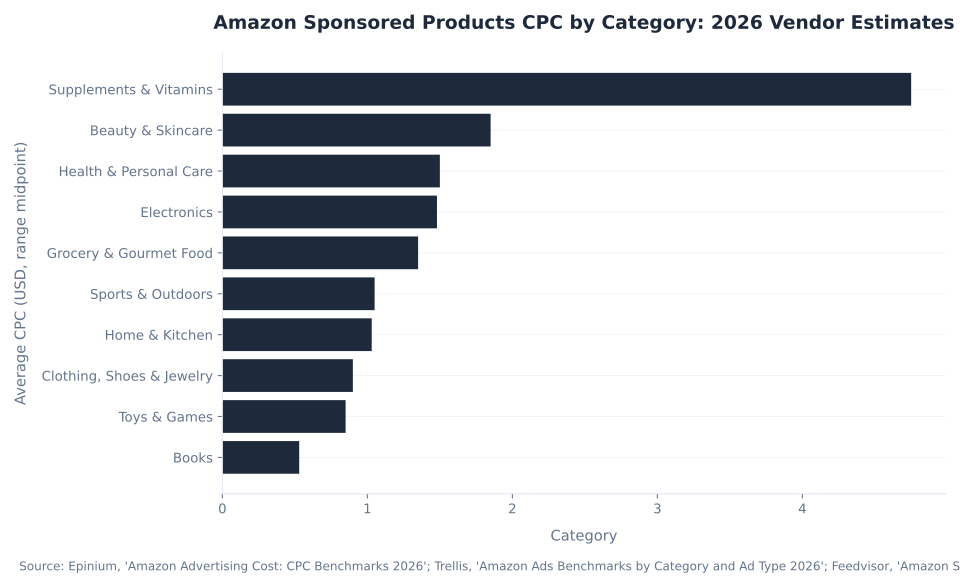
Category-level CPC variation is more actionable than the blended average. The table below combines data from three independent vendor sources — Epinium, Trellis, and Feedvisor — to give the most verified range for each product type. Use your own category range as the sanity-check for your cost-per-click, and use the maximum profitable bid formula (Target ACOS × Price × CVR) as your ceiling.
| Category | CPC range (2026) | Source |
|---|---|---|
| Supplements & Vitamins | $2.50–$7.00+ | Epinium + Feedvisor |
| Beauty & Skincare | $1.20–$2.50+ | Epinium |
| Health & Personal Care | $1.45–$1.55 | Epinium |
| Electronics | $1.35–$1.60 | Epinium |
| Grocery & Gourmet Food | $1.20–$1.50 | Trellis |
| Sports & Outdoors | $0.90–$1.20 | Trellis |
| Home & Kitchen | $0.95–$1.10 | Trellis |
| Clothing, Shoes & Jewelry | $0.85–$0.95 | Trellis |
| Toys & Games | $0.70–$1.00 | Trellis |
| Books | $0.30–$0.75 | Feedvisor |
Sources: Epinium's Amazon Advertising Cost: CPC Benchmarks 2026 (supplements, beauty, health, electronics); Trellis, "Amazon Ads Benchmarks by Category and Ad Type (2026 Update)" (grocery, sports, home, clothing, toys); Feedvisor, "Amazon Sponsored Products Bids: Default, Suggested & Dynamic (2026)" (books, blended SP average). All are vendor estimates — not mbadv client data.
Placement Bid Adjustments: The Under-Used Lever
Separate from your bid strategy, Amazon lets you raise your base bid for specific placement groups by up to +900% at the campaign level. This control is available for both automatic and manual targeting and works with all three bid strategies. Per Amazon Ads' Rest of Search bid adjustment announcement, all three placement groups — Top of Search, Rest of Search, and Product pages — share the same +900% ceiling. Rest of Search was the newest addition to this control set.
| Placement group | Where ads appear | Adjustment range |
|---|---|---|
| Top of Search (first page) | First ad slot(s) at the top of search results page 1 — highest-visibility position | +0% to +900% |
| Rest of Search | Middle and bottom of page 1 plus pages 2–4 of search results | +0% to +900% |
| Product pages | Product detail pages and add-to-cart pages — often converts well despite lower CTR | +0% to +900% |
| Applies to | All targeting types (auto + manual) and all bid strategies (Fixed + Dynamic) | Stacks multiplicatively on base bid — see compounding table below |
Sources: Amazon Ads, "Rest of Search Bid Adjustment for Sponsored Products" (all three placement groups adjustable to +900%); Scale Insights, "Amazon Bid Modifiers: Top of Search, Rest of Search, and Product Placements" (product-page placement insight). The adjustment is an increase-only control (0% to +900%) — dynamic bid strategies handle real-time reductions separately.
Scale Insights finds that product-page placements often deliver more sales than search placements, even at lower click-through rates — because you appear on a competitor's detail page at the moment of comparison. Read the placement report before applying a blanket Top of Search adjustment.
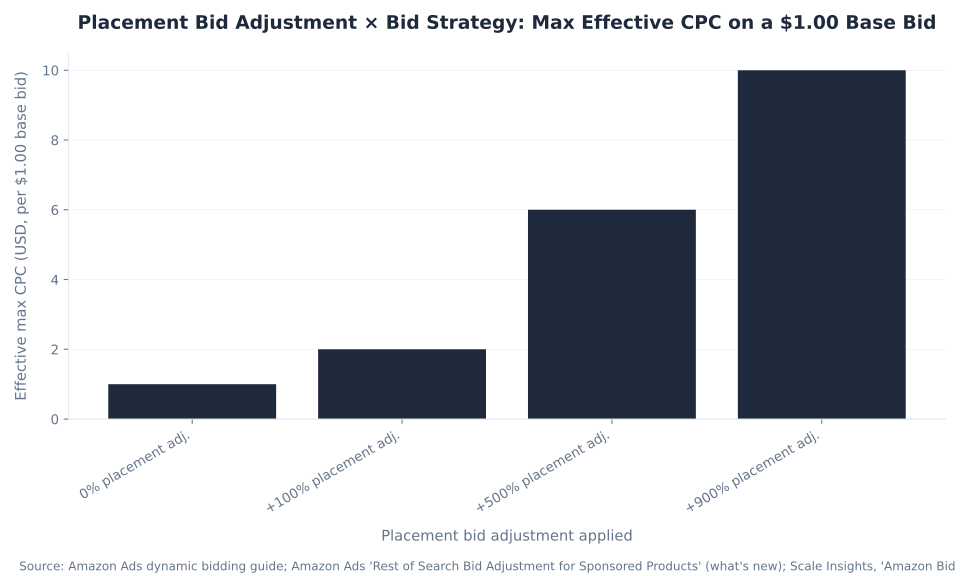
The compounding trap. Placement adjustments and dynamic bid strategies stack multiplicatively. Formula: effective max CPC = base bid × (1 + placement adj%) × (1 + dynamic raise%). A $1.00 base bid with a +900% Top of Search adjustment and Dynamic bids – up and down resolves to a theoretical $20.00 max CPC at Top of Search. Model your effective max CPC before setting large adjustments alongside Up-and-Down. For automating placement adjustment rules, see Amazon Ads optimization & automation.
| Placement adj. applied | Fixed bid — max CPC | Up-and-Down at Top of Search — max CPC |
|---|---|---|
| 0% (no adjustment) | $1.00 | $2.00 |
| +100% adjustment | $2.00 | $4.00 |
| +500% adjustment | $6.00 | $12.00 |
| +900% adjustment | $10.00 | $20.00 |
Formula: effective max CPC = base bid × (1 + placement adj%) × (1 + dynamic raise%). Fixed bid: dynamic raise = 0. Up-and-Down at Top of Search: dynamic raise = +100%. Values assume a $1.00 base bid for illustration — scale proportionally. Sources: Amazon Ads dynamic bidding guide; Scale Insights, "Amazon Bid Modifiers: Top of Search, Rest of Search, and Product Placements".
Amazon Sponsored Products CPC by Category: 2026 Vendor Estimates
Daily vs Lifetime Budgets: A Format Question, Not a Toggle
The most persistent budgeting misconception in Amazon Ads: every campaign offers a choice between a daily budget and a lifetime budget. It does not. Which budget types are available depends on the ad format you are using — not a setting you flip within a single campaign type. Amazon Sponsored Ads has a distinct budget structure for each format.
| Ad format | Daily budget? | Lifetime / flight budget? | Notes |
|---|---|---|---|
| Sponsored Products | Yes — daily only | No lifetime option | Minimum $1/day; averaged across the month (see overspend section). Budget Rules available. |
| Sponsored Brands | Yes | Yes — lifetime option, min $100 | Once type is chosen you cannot switch between daily and lifetime. Lifetime is paced — does not front-load spend. |
| Sponsored Display | Yes | No (daily-based) | CPC or vCPM delivery; daily budget applies. |
| Amazon DSP | Optional (pacing) | Yes — flight / total budget over a date range | Programmatic; budgets planned across a campaign flight, not per-day. |
Sources: AMZ Pathfinder, "Ultimate Guide to Amazon PPC Budget Rules" (Sponsored Products daily-only; SB lifetime min $100); Emplicit, "Amazon Sponsored Brands Budget Rules Explained" (lifetime budget = total spent over campaign life, then stops; paced); Amazon Ads, "Understand Budgets".
The correction for sellers searching "daily vs lifetime budgets in Amazon Ads": if you are running Sponsored Products, there is no lifetime budget option to find. The lifetime budget option lives on Sponsored Brands, where you set a total that the campaign spends down before stopping (minimum $100, paced to avoid front-loading). For Sponsored Products: use the daily budget combined with a campaign end date to cap total spend. The daily averaging mechanism (spending more on high-traffic days, less on slow ones, same monthly ceiling) is the nearest equivalent to a smoothing mechanism — but it is not a lifetime cap.
Amazon SP Bid Strategies: Max Bid Multiplier by Placement Type (× base bid)
How the Daily Budget Overspend Allowance Works
Amazon does not treat the daily budget as a hard daily cap. Instead, it averages your budget across the calendar month — spending more on high-traffic days and recovering on slower ones. The rule changed in March 2023: the default daily overspend allowance for new campaigns increased from 25% to 100%, per Perpetua's verified Amazon budget rollover guide.
| Campaign creation date | Default daily overspend allowance | Monthly spend ceiling |
|---|---|---|
| After March 27, 2023 | Up to 100% over daily budget on a single day | Daily budget × days in month (never exceeded) |
| Before March 27, 2023 | Up to 25% over daily budget on a single day | Daily budget × days in month (never exceeded) |
| Account-wide setting | Standardize all campaigns to 25% or 100% via Account Settings → Campaign Settings | Setting applies account-wide; cannot be reversed to a per-campaign mix |
Source: Perpetua, "Amazon Daily Budgets Rollover Percentage" (campaigns after March 27, 2023: up to 100% default; before: up to 25%; account-wide via Campaign Settings; monthly cap = daily budget × days in month); AMZ Pathfinder, "Ultimate Guide to Amazon PPC Budget Rules" (monthly averaging mechanism). The brief's "25% default / 100% opt-in" framing applies only to legacy pre-March 2023 campaigns. Sellers who created campaigns after March 2023 are already on the 100% default.
Example: A $50/day Sponsored Products budget created after March 2023 on a 30-day month has a monthly ceiling of $1,500 ($50 × 30). On a peak traffic day, Amazon can spend up to $100 (100% overspend). If it does, it recovers that $50 excess on subsequent slower days. The monthly total stays at or below $1,500. This behavior is intentional pacing — not a billing error. For sports equipment PPC and kitchen appliances PPC brands who see consistent overspend on event days (Prime Day, Black Friday), the account-wide 25% cap gives tighter day-to-day control at the cost of traffic on peak days.
Per Amazon Ads' Sponsored Products budget best practices, the daily budget averaging mechanism ensures total monthly spend never exceeds daily budget × days in month — regardless of how much Amazon over-spends on any single day. This is a feature, not a billing anomaly.
Placement Bid Adjustment × Bid Strategy: Max Effective CPC on a $1.00 Base Bid
Automatic vs Manual Campaigns: Discovery vs Control
Amazon Sponsored Products campaigns run in one of two targeting modes. Automatic targeting hands target selection to Amazon's algorithm, which pulls keywords and ASINs from your product listing content. Manual targeting puts selection in your hands at the keyword or product-ASIN level. The two modes serve different functions — and most experienced sellers run both simultaneously. For the full targeting depth across match types, audiences, and product targeting, see Amazon Ads targeting.
| Dimension | Automatic campaigns | Manual campaigns |
|---|---|---|
| Who picks the targets | Amazon — draws from listing title, description, category, and customer search data | You — select specific keywords (broad / phrase / exact) or product ASINs / categories |
| Bid control | Default bid (ad-group level); optional per-match-group bids (Close Match, Loose Match, Substitutes, Complements) | Custom bids per keyword or ASIN target; full negative keyword and product control |
| Best use | Discovery — surface converting search terms at broad coverage; ideal for new product launches | Control — concentrate spend on proven terms; protect ACOS with precise bid caps and negatives |
| Auto match groups | 4 groups: Close Match, Loose Match (keyword-side); Substitutes, Complements (product-side) | N/A — you set match types directly on chosen keywords |
| Recommended usage | Launch phase; ongoing discovery alongside manual; low-effort broadening | Ongoing optimization; ACOS-sensitive categories; brand defense; retargeting competitor ASINs |
Source: SellerMetrics, "Amazon PPC Automatic vs Manual Campaigns" (auto = discovery, manual = control; recommend running both simultaneously). Match group names from Amazon Ads targeting documentation. No quantitative CPC or CVR delta between campaign types cited — no independently verified figure found as of June 2026.
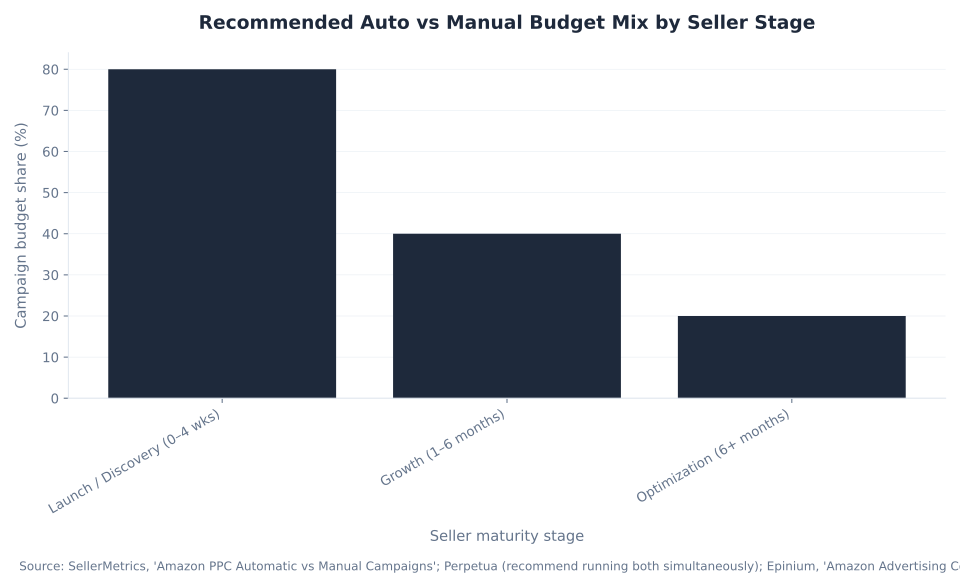
MB Adv Agency applies a graduated budget structure across the product lifecycle: heavy auto campaign allocation in the first four weeks of a launch to surface converting terms, then a progressive shift toward manual campaigns as winning keywords are identified and graduated with profitability-anchored custom bids. The auto campaign never goes to zero — it continues discovering new long-tail terms and seasonal queries as the product matures.
Default, Suggested, and Maximum Profitable Bids
Three bid concepts govern what you pay per click, in order of specificity. Understanding the hierarchy — and why Amazon's suggested bid is not your target — is the single most important discipline in managing Amazon Ads ACOS and ROAS.
| Bid type | What it is | Who sets it | When it applies |
|---|---|---|---|
| Default bid | Ad-group-level maximum CPC that applies to every target without a custom bid | You | Auto campaigns (only lever available); manual campaigns (fallback when no custom bid exists) |
| Suggested bid | Amazon's daily-updated recommendation based on recent winning bids for that keyword or placement | Amazon | Displayed in campaign setup and keyword targeting — accepting it is optional |
| Custom bid | A keyword- or ASIN-specific bid in a manual campaign that overrides the default bid for that target | You | Manual campaigns only; always takes precedence over the default bid for that specific target |
| Maximum profitable bid | Target ACOS × Product Price × Conversion Rate = max CPC | You (calculated from your P&L) | The profitability ceiling below which every custom bid should stay |
Source: Feedvisor, "Amazon Sponsored Products Bids: Default, Suggested & Dynamic (2026)" (default/custom/suggested bid hierarchy; suggested bids run 20–50% above profitable ceiling; max profitable bid formula). Custom bid always overrides the default bid for that specific target per Amazon Ads targeting documentation.
Feedvisor's 2026 analysis found that Amazon's suggested bids run 20–50% above what is profitable for the average seller. Suggested bids are calibrated to Amazon's auction revenue, not your margin. Set your ceiling from: Target ACOS × Product Price × Conversion Rate = max CPC.
MB Adv Agency uses the maximum profitable bid formula as the ceiling for every keyword in manual campaigns, then bids below that ceiling based on historical performance data for each target. Sellers who accept Amazon's suggested bid across the board effectively donate margin to the auction. A $40 product, 20% target ACOS, 5% conversion rate: 0.20 × $40 × 0.05 = $0.40 max CPC. Any custom bid above $0.40 on that keyword overshoots the target ACOS on every winning click.
The Bid Optimization Workflow: Auto to Manual
The most effective Amazon PPC workflow runs automatic and manual campaigns simultaneously: auto campaigns act as the discovery engine, manual campaigns act as the control surface. Amazon Ads optimization & automation covers the bid rules and reporting that make this workflow scalable at volume.
| Seller stage | Auto campaign budget share | Manual campaign budget share | Focus |
|---|---|---|---|
| Launch / Discovery (0–4 weeks) | 80% | 20% | Surface converting search terms; set minimum viable manual with exact-match on product name |
| Growth (1–6 months) | 40% | 60% | Graduate top auto terms into manual with custom bids; add negatives to auto; tighten ACOS |
| Optimization (6+ months) | 20% | 80% | Manual drives proven terms at profitable CPCs; auto maintains discovery for seasonality and new queries |
Editorial allocation framework per SellerMetrics, "Amazon PPC Automatic vs Manual Campaigns". Practical daily test budget: $20–30/day per product (Epinium's Amazon Advertising Cost: CPC Benchmarks 2026). Not sourced from a single vendor study and not mbadv client data. Actual allocation varies by category and margin structure.
The graduation step is the critical moment. When a search term in an automatic campaign accumulates enough clicks to show a pattern — typically 10–15 clicks without a conversion, or confirmed conversion data — add it as a negative exact in the auto campaign and as an exact-match keyword in a manual campaign with a profitability-anchored custom bid. This moves spend from broad auto-targeting on that term to precise manual bidding, eliminating bid waste from the same term competing in two campaigns simultaneously. Run the Search Term Report weekly in active growth phases. MB Adv Agency finds this dual-campaign structure — auto for discovery, manual for scale — produces the most reliable ACOS trajectory across DTC brands on Amazon.
Recommended Auto vs Manual Budget Mix by Seller Stage
Running Amazon Ads in a High-CPC Category?
Supplement brands face $2.50–$7.00+ CPCs. Beauty and skincare sellers compete at $1.20–$2.50. MB Adv Agency pressure-tests bid strategy and budget structure against your actual margin data — before CPC inflation compounds the cost. See our work in supplements & nutrition PPC, beauty products PPC, and electronics PPC.
Talk to our team →Amazon Ads CPC Trends: 2026 Benchmarks and Seasonality
Amazon CPC inflation is structural, not cyclical. Per Epinium's 2026 benchmark report, the blended average CPC has risen more than 60% since 2020 and climbed 8–12% year over year in 2026. Sponsored Display is the fastest-rising format, with CPCs up ~49% year over year — driven by increasing seller adoption and Amazon's expansion of display placements across its owned properties and off-Amazon publisher network.
Seasonality adds a predictable premium on top of the baseline. Q4 (October–December) runs about 30% above the annual average CPC as seller competition for holiday traffic peaks. Prime Day events push CPCs 40–60% above their baseline for the duration of the event window. Sellers who do not account for these premiums — either by pre-adjusting budgets upward or by reducing bids to maintain ACOS — typically see ACOS spike by a matching percentage. For home decor PPC and watches & accessories PPC brands, Q4 is the highest-volume period and warrants a deliberate budget increase paired with placement adjustment reviews.
Q4 CPCs run ~30% above the annual average on Amazon. Prime Day pushes CPCs 40–60% above baseline. Build a seasonal budget plan that pre-funds the Q4 and Prime Day windows rather than reacting in real time. Source: Epinium's Amazon Advertising Cost: CPC Benchmarks 2026.
Skincare PPC on Amazon falls within the broader beauty CPC range ($1.20–$2.50), which has compressed margin for skincare sellers without differentiated listings and above-average conversion rates. Food & beverage PPC sits in the $1.20–$1.50 grocery range with distinct economics: subscribe-and-save structures and repeat-purchase dynamics allow sellers to model lifetime value rather than single-order ACOS — which changes the maximum profitable bid calculation significantly. A brand selling a $20 subscription item with 60% retention can justify a higher launch CPC than the single-order ACOS formula suggests, because first-order losses are offset by subscription revenue.
How CPCs are trending by format: Sponsored Products remains the most efficient format at $0.75–$1.50 per click, capturing high-intent search traffic from shoppers already searching for a product type. Sponsored Brands adds a brand visibility premium ($1.10–$2.50) with different attribution dynamics — brand awareness and competitive displacement are harder to attribute directly to first-click ACOS. Sponsored Display's ~$3.72 average CPC is justified only when retargeting known high-intent audiences (product page visitors who did not convert) or when product-page placements on competitor ASINs demonstrate strong conversion rates in the placement report. See What is Amazon Ads for a format-by-format overview of where each placement type lives in the purchase funnel.
Three Misconceptions That Cost Amazon Sellers Money
These are the most common structural errors in how sellers approach Amazon Ads pricing and budgeting — each refuted with the actual platform behavior, sourced from Amazon documentation or web-verified vendor guides.
Misconception 1: "Amazon Ads has a fixed cost or subscription fee."
False. Amazon Sponsored Products, Sponsored Brands, and Sponsored Display are all cost-per-click products — you pay only when a shopper clicks your ad. The minimum daily budget for Sponsored Products is $1. There is no Amazon Ads subscription, no monthly platform fee, and no pay-to-play access charge. Per Epinium's 2026 benchmark report, Amazon Ads pricing is entirely auction-based: your CPC is the outcome of bidding against other advertisers for each impression. A seller who spends $0 in a given day pays $0. This misconception typically comes from sellers comparing Amazon Ads to subscription-based retail media platforms or confusing Amazon DSP's CPM-based programmatic pricing with the Sponsored Ads CPC model. See Amazon Sponsored Ads for the cost model of each format.
Amazon Ads is pay-per-click. No subscription. No platform fee. Minimum daily budget: $1 for Sponsored Products. You pay only when a shopper clicks — and the CPC is set in a real-time auction, not a rate card.
Misconception 2: "Sponsored Products has a daily-vs-lifetime budget toggle."
False. Sponsored Products campaigns are daily-budget-only. The lifetime budget option does not exist in the Sponsored Products campaign interface. Per AMZ Pathfinder's Amazon PPC Budget Rules guide and Emplicit's Sponsored Brands budget explainer, the lifetime budget option belongs to Sponsored Brands — a distinct ad format with its own campaign structure. A seller searching for a "lifetime cap" on a Sponsored Products campaign will not find one. The correct mental model is which ad format am I using, not which toggle do I flip. Sponsored Products daily-budget averaging (up to ±100% per day, same monthly ceiling) is a smoothing mechanism — it is not a lifetime cap.
Misconception 3: "Your daily budget is a hard daily spending cap."
False. Amazon averages your daily budget across the calendar month. For campaigns created after March 27, 2023, Amazon can spend up to 100% over your daily budget on a single high-traffic day — a $50/day budget can spend $100 on a peak day — compensating on slower days so the monthly total stays at or below daily budget × days in month. Per Perpetua's verified Amazon budget rollover guide, this is intentional pacing, not a billing error. Sellers who react to a single-day overspend by pausing or cutting budgets interrupt the monthly averaging mechanism and lose traffic they already paid for. The overspend allowance setting lives in Account Settings → Campaign Settings and applies account-wide.
Frequently Asked Questions
How much do Amazon ads cost?
Amazon Ads has no subscription and no platform fee. Sponsored Products, Sponsored Brands, and Sponsored Display all run cost-per-click — you pay only when a shopper clicks. The blended average CPC across all formats reached ~$1.18 in 2026, up 8–12% year over year, per Epinium. Category CPCs range from $0.30–$0.75 (Books) to $2.50–$7.00+ (Supplements & Vitamins). By format: Sponsored Products averages $0.75–$1.50; Sponsored Brands $1.10–$2.50; Sponsored Display ~$3.72 (up ~49% year over year). The right question is not what Amazon charges but what a click is worth to you — a function of your target ACOS, product price, and conversion rate. Q4 demand adds ~30% to the annual average CPC; Prime Day pushes CPCs 40–60% above baseline. See supplements & nutrition PPC for the most CPC-intensive Amazon category.
What are the three Sponsored Products bid strategies?
Amazon Sponsored Products offers three bid strategies, set at the campaign level. Dynamic bids – down only (default for new campaigns): Amazon lowers your bid in real time — by up to 100%, down to $0 — when a click looks unlikely to convert, but never raises it above your set amount. Dynamic bids – up and down: Amazon raises your bid when a conversion looks likely (up to +100% for Top of Search, up to +50% for other placements) and lowers it when it does not. Fixed bids: Amazon uses your exact bid for every auction with no automatic adjustment in either direction. The decision rule: new products with no conversion history belong on Down Only to cap downside spend. Products with proven conversion history move to Up and Down. Brand-defense campaigns sit on Fixed. Strategy changes take effect within a few hours. For automating bid adjustments at scale, see Amazon Ads optimization & automation.
Does Sponsored Products have a lifetime budget option?
No. Sponsored Products runs on daily budgets only — there is no lifetime budget option in the Sponsored Products interface. The lifetime budget lives on Sponsored Brands, where you set a total that the campaign spends down before it stops; the minimum Sponsored Brands lifetime budget is $100, and once chosen, the budget type cannot be switched to daily within the same campaign. Sponsored Display also runs daily budgets with no lifetime option. Amazon DSP uses flight budgets planned across a campaign date range rather than per-day amounts. For Sponsored Products, if you want a hard total spend cap, use the daily budget combined with a campaign end date. Amazon averages your daily budget across the calendar month so per-day spend fluctuates, but the monthly total is always capped at daily budget × days in month. See Amazon Sponsored Ads for how budget types differ across all three sponsored ad formats.
What's the difference between automatic and manual Amazon campaigns?
Automatic campaigns let Amazon choose which search terms and products to show your ad against, pulling targets from your listing content. You set a default bid at the ad group level, with optional per-match-group bids across four auto match groups: Close Match, Loose Match (keyword-side), and Substitutes, Complements (product-side). Automatic campaigns are a discovery tool — they surface converting search terms at broad coverage, especially for new product launches. Manual campaigns give you full control: select specific keywords or product ASINs, set custom bids at the individual target level, and add negative targets to prevent wasted spend. The standard workflow runs both simultaneously: use auto to find converting terms, then graduate the best performers into manual campaigns with profitability-anchored custom bids and tight negative lists. SellerMetrics recommends running both at the same time rather than migrating. For targeting depth, see Amazon Ads targeting.
How do I calculate my maximum profitable bid on Amazon?
The maximum profitable bid formula: Target ACOS × Product Price × Conversion Rate = maximum CPC. Example: $30 product, 25% target ACOS, 10% CVR → 0.25 × $30 × 0.10 = $0.75 max CPC. Any bid above this figure overshoots your ACOS target on every winning click. Second example: $40 product, 20% ACOS, 5% CVR → 0.20 × $40 × 0.05 = $0.40 max CPC. Amazon's suggested bids run 20–50% above the average seller's profitable ceiling (Feedvisor 2026) — calibrated to Amazon's revenue, not your margin. To apply: pull your conversion rate from the campaign report (orders ÷ clicks), set your target ACOS from your margin structure, and cap each keyword's custom bid at the calculated maximum. Revisit monthly — conversion rates shift with listing quality, review count, and seasonality. For ACOS and ROAS context, see Amazon Ads ACOS, ROAS & metrics.
Why did my campaign spend more than my daily budget?
Amazon averages your daily budget across the calendar month, not as a hard daily cap. For campaigns created after March 27, 2023, Amazon can spend up to 100% above your daily budget on a single high-traffic day — a $50/day budget can spend $100 on a peak day — recovering the overspend on slower days later in the month. The monthly total never exceeds daily budget × days in month: a $50/day budget on a 30-day month caps total spend at $1,500 regardless of day-to-day swings. For campaigns created before March 27, 2023, the default allowance is 25% over per day rather than 100%. You can standardize the rollover percentage account-wide via Account Settings → Campaign Settings (applies to all campaigns, cannot be reversed to a per-campaign mix). Per Perpetua's verified account-behavior guide, this is intentional pacing — not a billing error. Monthly ceiling is always enforced, so overspend days self-correct within the billing period.
Ready to Pressure-Test Your Bid Strategy?
Before CPC inflation compounds the cost, MB Adv Agency reviews your bid structure, placement adjustments, and auto-to-manual graduation workflow against your real margin data. Especially relevant for home goods and beauty brands brands where CPCs have risen fastest in 2026.
Talk to our team →Methodology
CPC benchmarks draw from three 2026 vendor datasets: Epinium's Amazon Advertising Cost: CPC Benchmarks 2026 (blended CPC, format-level ranges, seasonal premiums, YoY trends); Feedvisor, "Amazon Sponsored Products Bids: Default, Suggested & Dynamic (2026)" (SP blended range, category CPCs for supplements and books, suggested-bid overshoot analysis); and Trellis, "Amazon Ads Benchmarks by Category and Ad Type (2026 Update)" (category CPC ranges for grocery, sports, home, clothing, toys). All figures are vendor estimates — not mbadv client data. Bid strategy specifications sourced from Amazon Ads dynamic bidding guide and verified against Perpetua, "Amazon PPC Advertising Dynamic Bidding Bid Strategy". Budget mechanics sourced from Perpetua, "Amazon Daily Budgets Rollover Percentage", AMZ Pathfinder, "Ultimate Guide to Amazon PPC Budget Rules", Emplicit, "Amazon Sponsored Brands Budget Rules Explained", and Amazon Ads, "Understand Budgets". Reviewed by MB Adv Agency, June 2026.

As a Google Ads expert, I bring proven expertise in optimizing advertising campaigns to maximize ROI.
I specialize in sharing advanced strategies and targeted tips to refine Google Ads campaign management.
Committed to staying ahead of the latest trends and algorithms, I ensure that my clients receive cutting-edge solutions.
My passion for digital marketing and my ability to interpret data for strategic insights enable me to offer high-level consulting that aims to exceed expectations.
Google Partner Agency
We're a certified Google Partner Agency, which means we don’t guess — we optimize withGoogle’s full toolkit and insider support.
Your campaigns get pro-level execution, backed by real expertise (not theory).

4.9 out of 5 from 670+ reviews on Fiverr.
That’s not luck, that’s performance.
Highly recommend Matteo to set up your server side tracking. He has a deep understanding of e-commerce tracking and will go above and beyond to make sure everything is set up correctly and working 100%. If you are scaling your store this set up is non-negotiable in my opinion and there isn't many people who have this much knowledge or put the effort in to get it right. Thanks again!
avorodesign.com
I can only recommend Matteo! He was very patient, professional and very knowledgeable about GA4, Consent Mode v2, and GDPR compliance. Communication was clear, and the setup was done professionally and efficiently. Highly recommend him for anyone needing reliable tracking implementation.

www.natureiki.life
Matteo shines in the realm of online professionals. His work is not only deep in data but also complemented by his proactive communication and cooperation, setting a new standard for freelancers. If you want someone who truly exceeds expectations, look no further. Highly recommended!

www.omanbeverlysmyth.com
Exceptional Service Beyond Expectations - Outstanding Service Impeccable depth, flawless delivery, and exceptional language fluency—this service exceeded all expectations. Highly recommended. Matteo truly ROCKS!!!

ium-paris.com
Top-notch, always highly value working with Matteo. An absolute Google Ads Genius. This is approximately the 8th time I have hired him and he's helped us get 6-7 ROAS. We are excited in continuing to improve our lead flow. Hire this guy if you need Google Ads help. Thanks Matteo!

www.dleeventgroup.com
I finally found the guy who can setup server side tracking and all the ecosystem properly. I definitely recommend Matteo. He is very responsive, kind and wants to dig into things. He configured GA4, Meta, Google Ads, Outbrain and google consent v2 with Cookiebot. Thanks Matteo.

inomega.fr
MB Adv delivered exceptional work with outstanding professionalism and lots of patience, taking time to see effects of changes made and not just do the work and submit it. The proactive communication and video summaries of the work completed made working with Matteo a pleasure, as he consistently went above and beyond. Highly recommended for web analytics projects! We are already working on another project.

www.withnellsensors.co.uk
Working with Matteo on my Google Ads was a game-changer. He's not just a strategist, he's a true partner. He understood my goals and tailored a campaign that perfectly reached my target audience. I'm grateful for his expertise and dedication.
dccargo.com
Click-driven mind
with plastic-brick obsession.
We build Google Ads campaigns with the same mindset we use to build tiny brick worlds: strategy, patience, and zero tolerance for wasted pieces.
Data is our blueprint. Growth is the only acceptable outcome.