Amazon Ads Targeting: Keywords, Products & Geo (2026)
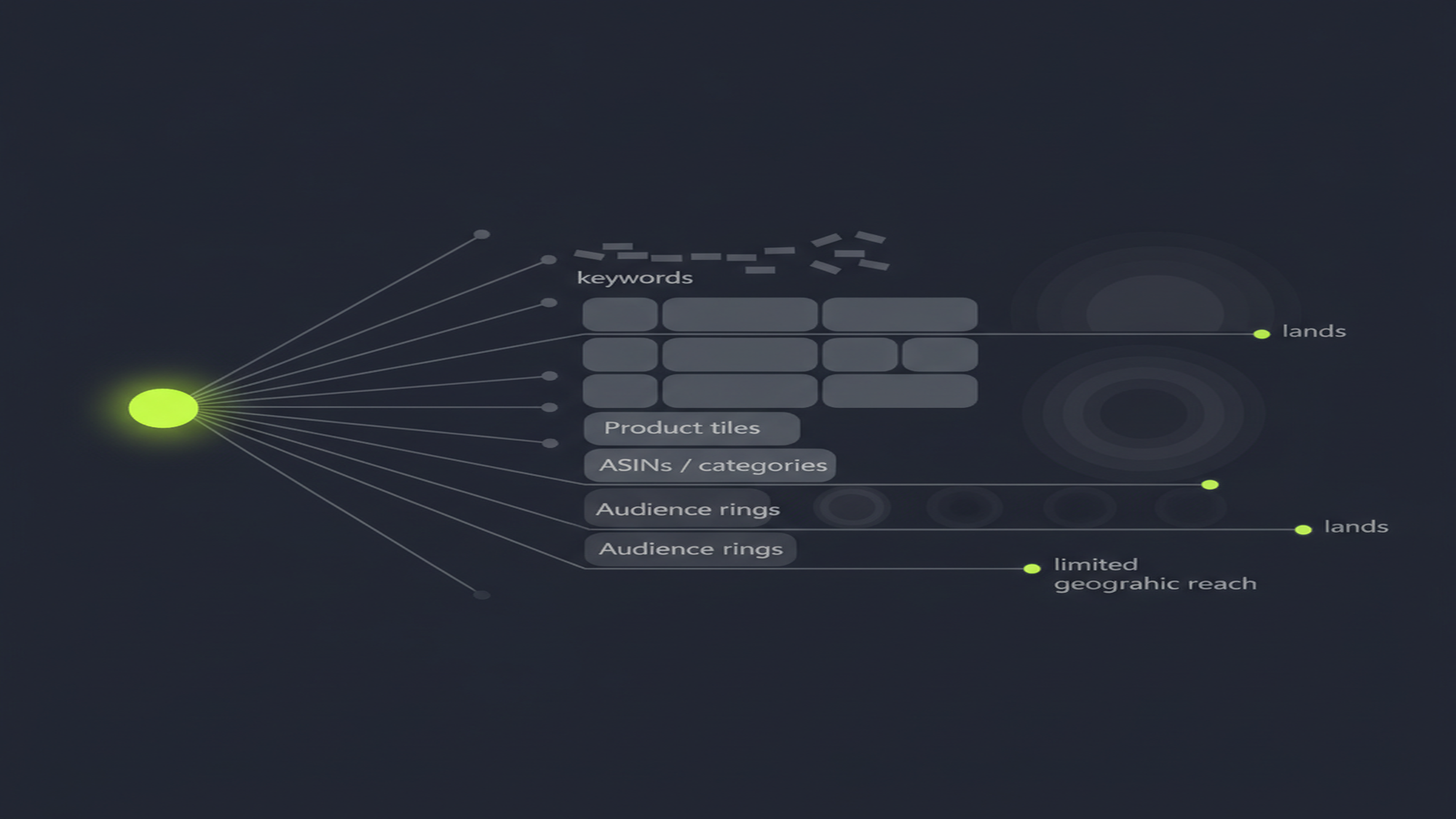
~67%
of all Amazon ad clicks land in the Top of Search row — the single placement targeting fights hardest to win
Source: PPCAssist, “How to Analyze Placement Performance in Amazon PPC” (Feb 2025). Vendor analysis — not mbadv client data.
What Is Amazon Ads Targeting?
Amazon Ads targeting is the set of controls that tell Amazon who and what to match your ad against — keywords a shopper typed, products and categories a shopper is browsing, and (on Sponsored Display and Amazon DSP) audiences defined by who the shopper is. The single most useful reframe is this: targeting on Amazon Sponsored Products is a taxonomy of WHO and WHAT, not WHERE. Search advertisers arrive expecting to name a city or a radius. On Amazon, the levers are matching signals, not map pins — and that one correction resolves most of the confusion.
The honest mental model runs on two axes. The first axis is automatic versus manual: does Amazon pick the matches from your listing, or do you name them yourself? The second axis is keyword versus product versus audience: what signal are you matching on? Amazon's own targeting guide organizes it exactly this way — automatic targeting uses keywords and products similar to the product in your ad, while manual targeting lets you choose keywords or products yourself (Amazon Ads, A guide to targeting with Sponsored Products). Every other concept on this page hangs off those two axes.
Targeting is set inside a campaign, and each ad product exposes a different slice of the toolkit. See Amazon Sponsored Ads for how Sponsored Products, Sponsored Brands, and Sponsored Display differ. The rich audience and geographic controls Sponsored Products lacks all live in Amazon DSP and Streaming TV. MB Adv Agency treats this taxonomy as the foundation every account structure is built on — name the axes first, then choose the matching signal.
The question that trips everyone up. “How do I geo-target my Amazon ads?” has a one-word answer on Sponsored Products and Sponsored Brands: you do not. Granular geo — state, city, DMA, ZIP, and radius — exists only in Amazon DSP. This page corrects that misconception in full further down, under the geographic-targeting section.
What Every Seller Should Know About Amazon Targeting
- Targeting is WHO and WHAT, not WHERE. Sponsored Products matches on keywords (what the shopper typed) and products/categories (what the shopper browses). Audiences and geography are Sponsored Display and Amazon DSP features, not Sponsored Products knobs.
- Automatic targeting has four buckets, each with its own bid. Close Match and Loose Match are keyword-side; Substitutes and Complements are product-side. You bid each group separately — bid up what converts, bid down what wastes.
- Automatic is a permanent discovery engine, not a beginner setting. Mature accounts run auto and manual together: auto finds converting terms and competitor ASINs, manual scales them, and the harvested terms are negated in auto so the two never bid against each other.
- Broad match is now semantic. Since 2025, Broad serves on synonyms and related queries even when your exact keyword is absent (Karooya, Dec 2025). Without a negative-keyword layer, Broad behaves like a discovery campaign, not a targeted one.
- There is no Google-style geo on sponsored ads. State, city, DMA, ZIP, and radius targeting (2 to 100 miles, up to 1,000 locations per line item) exist only in Amazon DSP (Adverio; Amazon Ads). If location genuinely drives your business, that is the reason to evaluate DSP.
Amazon Ads Targeting by the Numbers (2026)
Before choosing a targeting type, anchor on the platform-wide benchmarks that frame what “normal” performance looks like. Ad Badger tracks millions of bids across thousands of Sponsored Products and Sponsored Brands campaigns; the blended 2026 averages below are theirs, not mbadv data.
| Metric | Value | Range / note |
|---|---|---|
| Average CPC | $1.22 | $1.02–$1.27 across Oct 2025–May 2026; up ~$0.10 YoY |
| Average conversion rate | 11.1% | All sponsored ad types blended |
| Average ACOS | 29.6% | Typical 25–36%; Jan 2026 high 32.5%, Oct 2025 low 28% |
| Average CTR | 0.58% | Click-through rate across sponsored placements |
Source: Ad Badger, “Amazon Advertising Benchmarks 2026” — millions of bids across thousands of campaigns, updated monthly. Vendor data, not mbadv client data.
Read these as the gravity the whole page works against. Average CPC of $1.22 sets the floor every bid sits above; the 11.1% blended conversion rate is what Exact-match discipline pushes higher and unsupervised Broad pulls lower; and the 29.6% ACOS is the efficiency line that placement bid adjustments and per-group automatic bidding move in either direction. None of these numbers is a goal in itself — they are the backdrop that makes a targeting decision legible. A category running well below the blended conversion average is a candidate for tighter Exact and ASIN targeting; one running well above it absorbs wider Broad and category reach.
These are blended averages; the right target depends on which targeting type and which category you run. ACOS and ROAS are two sides of the same efficiency story — see Amazon Ads ACOS, ROAS, and metrics for how to read efficiency once a targeting structure is live. The targeting choices on this page are what move those numbers up or down.
Automatic vs Manual Targeting: The Reach-vs-Control Ladder
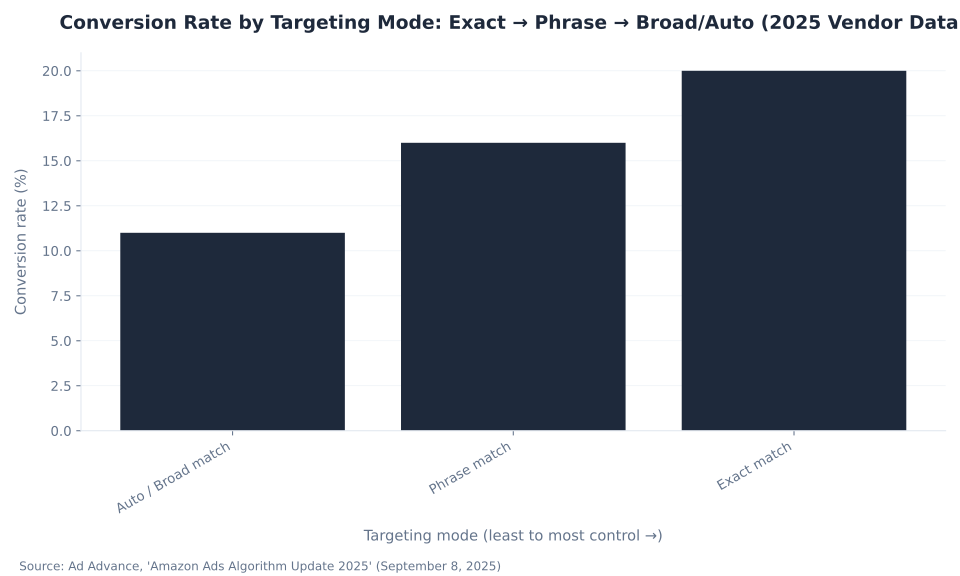
The clearest way to see the targeting tradeoff is conversion rate by mode. Tighter control concentrates spend on proven intent and lifts conversion; wider reach finds new demand at a lower conversion rate. Ad Advance's managed-account analysis of US Sponsored Products campaigns (September 2025) puts numbers on the gradient.
| Targeting mode | Conversion rate | ACOS direction | Role |
|---|---|---|---|
| Exact match (manual) | ~20%+ | Lowest ACOS | Scale proven converters |
| Phrase match (manual) | ~16% (high teens) | Moderate ACOS | Controlled expansion |
| Broad match / Automatic | ~11% (10–12%) | Higher, more volatile | Discovery layer |
Source: Ad Advance, “Amazon Ads Algorithm Update 2025” (Sept 8, 2025). Values are midpoints/floors of stated ranges. Managed-account portfolio analysis, US marketplace — vendor estimate, not mbadv data.
The ladder is not an instruction to abandon Broad and automatic — it is an instruction to use each for its job. Ad Advance also reported that automatic campaigns' share of total impressions jumped ~7 points beginning June 2025, reaching 40%+ of impressions in many accounts, with Loose Match and Substitutes gaining the most share. That makes per-group bid discipline more important, not less. Auto-targeting is only a discovery engine if you mine it — see Amazon Ads reporting and attribution for the Search Term Report that surfaces the keywords and ASINs to promote and negate. For broad-catalog skincare brands, the ladder is how a launch budget migrates from discovery into proven-converter scale.
Automatic Targeting: The Four Match-Type Groups
When you open an automatic Sponsored Products campaign's reports, spend is split across four rows: Close Match, Loose Match, Substitutes, and Complements. These are the four targeting groups Amazon matches your ad across, and each answers a different question. Close Match and Loose Match are keyword-side (what the shopper searched); Substitutes and Complements are product-side (what the shopper is browsing).
| Targeting group | Signal side | What it matches | Where the ad shows |
|---|---|---|---|
| Close Match | Keyword-side | Shoppers using search terms closely related to your product | Search results |
| Loose Match | Keyword-side | Shoppers using search terms loosely / broadly related to your product | Search results (wider, lower-intent) |
| Substitutes | Product-side | Shoppers browsing detail pages of products similar to yours | Competitor / similar product detail pages |
| Complements | Product-side | Shoppers viewing detail pages of products that complement yours | Related / complementary product detail pages |
Sources: Amazon Ads, “A guide to targeting with Sponsored Products” (group definitions; per-group bidding); Omnitail (keyword-side vs product-side split); Trellis, “Amazon Automatic Targeting” (auto as discovery layer).
You can set a single default bid for the whole campaign or a separate bid for each group — and the separate bid is the entire point. Karooya's December 2025 ranking is directional: Close Match tends to deliver the highest conversion and lowest ACOS, Loose Match moderate conversion at higher volume, and Substitutes and Complements lower conversion (niche, but Complements can uncover incremental demand). No sourced numeric conversion figure exists for the individual groups, so treat the ranking as a bidding compass, not a guarantee.
Treat automatic as a harvesting layer. Let auto surface converting search terms in the report, promote those terms into a manual Exact campaign for control, and add them as negatives in the auto campaign so the two do not compete. For footwear brands launching a new line with no keyword history, this auto-to-manual loop is how the first proven converters are found.
Manual Keyword Targeting: Match Types and Negative Keywords
Manual keyword targeting offers three match types — Broad, Phrase, and Exact — in descending order of reach and ascending order of control. The standard structure bids Exact highest and Broad lowest. The 2026 wrinkle is that Broad match has become semantic: it now matches synonyms, related terms, and conceptually adjacent queries even when none of your keyword's words appear. That changes the negatives you need.
| Match type | How it triggers | Reach vs control | Typical use |
|---|---|---|---|
| Broad | Keyword terms in any order, plus plurals, variations, synonyms & related/semantic terms (2025+) | Widest reach, least control | Discovery — pair with aggressive negatives |
| Phrase | Your exact phrase in order; extra words allowed before/after | Medium | Controlled expansion around a known term |
| Exact | Search term matches the keyword exactly (plus close variants: plurals, minor misspellings) | Narrowest reach, most control | Scaling proven converters (bid highest) |
| Negative phrase | Blocks any query containing the full phrase (in order) | — | Block a wasteful theme of searches |
| Negative exact | Blocks only the exact query (incl. plurals) | — | Block one specific converting-but-wrong query |
Sources: Karooya, “Amazon Ads Match Types Explained” (Broad now semantic — synonyms/related terms even without the exact keyword); CaptenAMZ, “Exact Match vs Broad Match 2026” (Broad without negatives functions as a discovery campaign). Vendor reporting — verify wording against the live Amazon help page at publish.
Read the match types and the negatives as one system, not two topics. Because semantic Broad now reaches conceptually adjacent queries, a Broad campaign without a negative-keyword layer is a discovery campaign — budget and read it as one. Negative phrase blocks a wasteful theme; negative exact blocks one specific query. Placement and bidding tune what the match types reach — see Amazon Ads bidding and budgets for descending-bid laddering. For baby product brands, where safety-adjacent searches drift fast, negative hygiene is the difference between Broad as a discovery tool and Broad as a budget leak.
The Five Ways to Tell Amazon Who to Target
The pillar's spine is this: there are five distinct ways to tell Amazon who to target — keyword, product (ASIN), category, audience, and contextual — and each matches on a different signal and lives in a different ad product. Keyword and product/category targeting are Sponsored Products and Sponsored Brands controls. Audience and contextual targeting are Sponsored Display and Amazon DSP controls. Confusing the two is the most common structural error.
| Targeting type | What you target | Refinements / options | Where it lives |
|---|---|---|---|
| Keyword targeting | Shopper search terms | Broad / Phrase / Exact + negatives | Sponsored Products, Sponsored Brands |
| Product (ASIN) targeting | Specific products by ASIN (e.g. a competitor) | Individual ASINs; negative ASINs to exclude | Sponsored Products, Sponsored Brands |
| Category targeting | A whole product category | Refine by brand, price range, star rating, Prime eligibility | Sponsored Products, Sponsored Brands |
| Audience targeting | Who the shopper is / what they did | In-market, lifestyle, interests, life events + views & purchase remarketing | Sponsored Display, Amazon DSP |
| Contextual targeting | Products / categories the shopper is browsing | Categories or competitor products; combine with audiences | Sponsored Display |
Sources: Amazon Ads API, “Sponsored Products product targeting overview” (ASIN + category targeting; brand/price/rating/Prime refinements; negative product targeting); SellerApp (ASIN vs category characterization). Audience/contextual targeting is Sponsored Display / DSP, not Sponsored Products.
Read the right-hand column as a routing map. If you need keywords or ASIN/category conquesting, that is Sponsored Products or Sponsored Brands. If you need audiences — in-market, lifestyle, interests, life events, or views/purchase remarketing — that is Sponsored Display or DSP. Each ad product exposes a different slice of this toolkit; see Amazon Sponsored Ads for the full split. For sports equipment brands with overlapping use cases, mapping each campaign to one row of this table keeps the account legible as it scales.
Product and Category Targeting: Conquesting and Shelf Defense
Product and category targeting is the lever search advertisers do not have. Instead of matching a query, you place your ad on a named ASIN or across a whole category. Target a specific competitor's detail page to conquest — your cheaper, higher-rated product on their listing — or target your own category to defend the shelf so a rival's ad is not the only one a shopper sees. Category targeting refines by brand, price range, star rating, and Prime eligibility.
| Dimension | Product (ASIN) targeting | Category targeting |
|---|---|---|
| What you target | One named competitor product (ASIN) | A whole category of products |
| Intent precision | High — shopper is evaluating a specific alternative | Broad — shopper is browsing the shelf |
| CPC direction | Tends lower | Tends higher |
| Conversion direction | Tends higher | Tends lower |
| Best for | Conquesting a known rival | Reach + shelf defense with brand/price/rating/Prime refinements |
Source: SellerApp, “Amazon Product & Category Targeting Strategies” (directional only — ASIN tends to lower CPC and higher conversion than category; no sourced absolute figures). Directional characterization, not mbadv data.
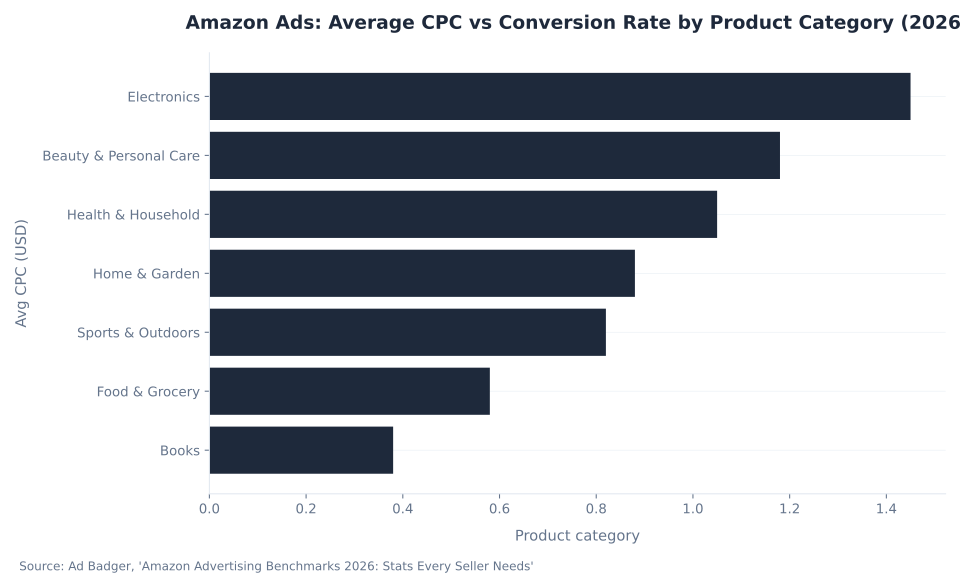
Category economics differ structurally too, which informs where conquesting pays off. Ad Badger's 2026 category benchmarks show an inverse pattern — the highest-CPC categories tend to have the lowest conversion.
| Category | Avg CPC (USD) | Conversion rate | ACOS |
|---|---|---|---|
| Electronics | $1.45 | 9.5% | 29% |
| Beauty & Personal Care | $1.18 | 15.2% | 24% |
| Home & Garden | $0.88 | 11.4% | 31% |
| Sports & Outdoors | $0.82 | 10.3% | 33% |
| Food & Grocery | $0.58 | 16.5% | 21% |
| Books | $0.38 | 18.0% | 19% |
Source: Ad Badger, “Amazon Advertising Benchmarks 2026”. The inverse CPC–conversion pattern is category-structural, not targeting-type-specific. Vendor data, not mbadv data.
MB Adv Agency reads ASIN targeting as the precision instrument and category targeting as the reach instrument: conquest a named rival when you know exactly whose shopper you want, defend the category when the goal is presence. For watch brands and handbags and accessories brands, where a handful of rival ASINs own the consideration set, named-ASIN conquesting is the highest-leverage play on the page.
Placements: Top of Search, Rest of Search, and Product Pages
Targeting decides who you match; placement decides where the matched ad appears. Sponsored Products serves in three placements, and they are not equal. Top of Search is the prime real estate — the first row above organic results, the highest-intent and highest-converting slot. It captures roughly 67% of all Amazon ad clicks (PPCAssist) and converts two to three times better than Rest of Search (Autron). You bid into it with placement bid adjustments now reaching up to +900%.
| Placement | Where the ad shows | Bid adjustment | Notes |
|---|---|---|---|
| Top of Search (first page) | Top row of search results, above organic listings | Up to +900% | Highest-intent, highest-conversion slot; the prime real estate |
| Rest of Search | Remaining search-results slots (after Top of Search) | Up to +900% | Separate adjustment so all three tune independently |
| Product pages | Detail pages — below the title / near reviews / in carousels | Up to +900% | Where ASIN/category conquesting lands; lower conversion than Top of Search |
Sources: Amazon Ads, “Rest of Search Bid Adjustment for Sponsored Products” (up to +900%; all targeting types and bid strategies); Amazon Ads, “Adjust Sponsored Products bids by placement”. Amazon official documentation.
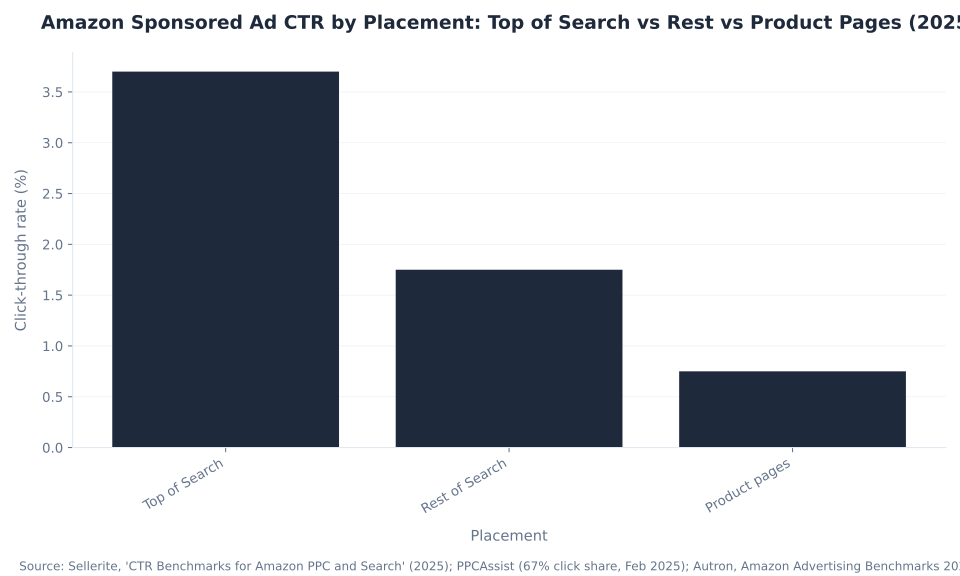
The CTR gap between placements is wide. Sellerite's 2025 analysis of 10,000+ US, UK, and DE ASINs puts Top of Search sponsored CTR at 2.9–4.5%, Rest of Search at 1.2–2.3%, and product pages at 0.5–1.0%.
| Placement | Sponsored CTR range | Midpoint |
|---|---|---|
| Top of Search | 2.9–4.5% | 3.7% |
| Rest of Search | 1.2–2.3% | 1.75% |
| Product pages | 0.5–1.0% | 0.75% |
Sources: Sellerite, “CTR Benchmarks for Amazon PPC and Search” (10k+ US/UK/DE ASINs, $15–$75, 50–500 reviews, late 2025); PPCAssist (Top of Search ~67% click share); Autron (Top of Search converts 2–3× better). Vendor data, not mbadv data.
One caution: placement adjustments compound with dynamic bidding. A $1.00 base bid with a +900% Top of Search adjustment and dynamic bids up-and-down (which adds up to 100%) reaches near $20 for a single auction (ScaleInsights) — calculate the maximum theoretical bid before enabling both. Placement and bidding are two halves of the same lever; see Amazon Ads bidding and budgets for the full mechanics. For kitchen appliance brands defending high-consideration purchases, winning the Top of Search slot on branded terms is the placement worth paying the premium to hold.
Geographic Targeting on Amazon: The Correction
Here is the correction that most pages get wrong. Amazon does not offer Google-style geographic targeting on Sponsored Products or Sponsored Brands. There is no city, state, DMA, ZIP, or radius control on sponsored ads — they serve across the entire marketplace you advertise in, not a geo you draw. Adverio states it plainly: geo-targeting is not available for any type of Sponsored Products or Sponsored Brands ads. Granular geo lives only in Amazon DSP.
| Geo control | Sponsored Products / Sponsored Brands | Amazon DSP |
|---|---|---|
| Country / marketplace | Yes — you serve in the marketplace you advertise in | Yes |
| State | No | Yes (include/exclude) |
| City / DMA | No | Yes |
| ZIP / postal code | No | Yes |
| Radius (around a point) | No | Yes — 2 to 100 mi/km, up to 1,000 locations per line item |
| Dayparting (time-of-day) | Limited (via budget rules / third-party tools) | Yes (native) |
Sources: Adverio, “Is Geo-Targeting on Amazon Worth It?” (no geo on Sponsored Products/Brands; DSP state/city/ZIP); Amazon Ads, “DSP radius targeting” (2 to 100 mi/km, up to 1,000 locations per line item); Intentwise (DSP geo levels). Web-verified 2026.
The strategic answer to “how do I geo-target Amazon ads?” is therefore: you do not, on Sponsored Products — and if location genuinely matters, that is the reason to move that budget into Amazon DSP. The DSP self-serve spend minimum was removed at unBoxed 2025, which makes that path more reachable than the old “DSP needs ~$50K” framing implied; it is still DSP, not Sponsored Products. Adverio notes Amazon briefly tested geo in Sponsored Display around Valentine's Day 2024 and withdrew it. MB Adv Agency states this plainly to clients: the honest answer to geo-targeting on Amazon is usually “that lives in DSP.” The full geo and audience toolkit is detailed in Amazon DSP and Streaming TV. For mattress and sleep brands and outdoor and camping brands with regional demand, DSP is where location control actually exists.
Audience Targeting Lives in Sponsored Display and DSP, Not Sponsored Products
The same correction applies to audiences. Rich audience targeting — in-market, lifestyle, interest, and life-event audiences, plus views and purchase remarketing — is a Sponsored Display and Amazon DSP capability, not a Sponsored Products knob (Amazon Ads targeting guide). Sponsored Display also renamed its product targeting to contextual targeting, so on Display you combine contextual (what the shopper browses) with audiences (who the shopper is). The remarketing layer — re-reaching shoppers who viewed your detail page or bought before — is the retargeting lever most brands underuse, and it is why budget that needs audience precision belongs on Sponsored Display or DSP rather than waiting for a setting Sponsored Products does not have.
Building the Targeting Mix: Auto vs Manual by Account Stage
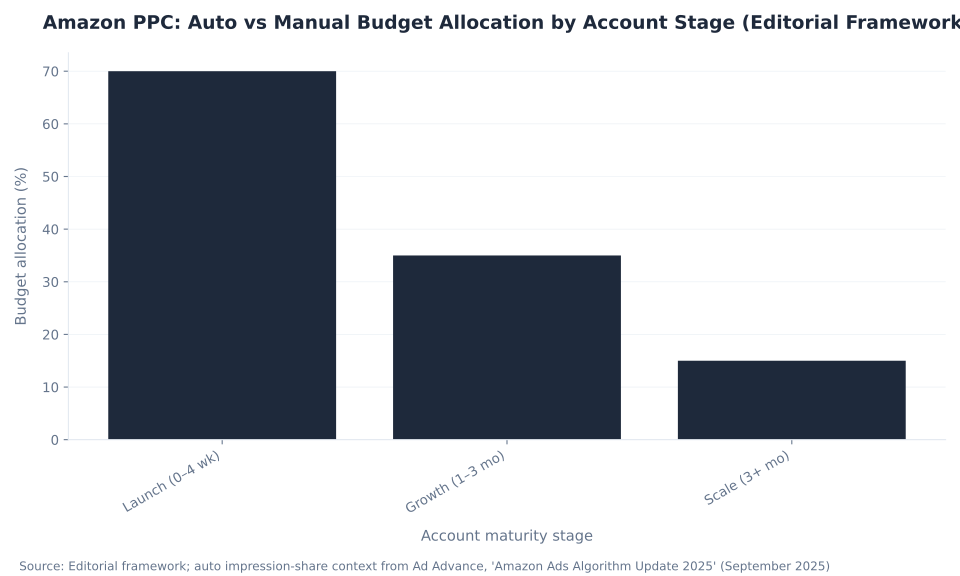
The right targeting mix shifts as an account matures. A new account with no keyword history leans on automatic targeting to discover demand; a scaled account with identified winners leans on manual control while keeping automatic running as a discovery layer. The framework below is editorial — an MB Adv Agency starting point, not a sourced multi-account dataset.
| Account stage | Automatic (% of budget) | Manual (% of budget) | What the stage is doing |
|---|---|---|---|
| Launch (0–4 wk, no data) | 70% | 30% | Auto surfaces converting terms and competitor ASINs with no prior list |
| Growth (1–3 mo, data accruing) | 35% | 65% | Promote Search Term Report winners into manual Exact/ASIN campaigns |
| Scale (3+ mo, winners known) | 15% | 85% | Auto runs as a continuous discovery layer; manual carries the spend |
Source: Editorial framework based on MB Adv Agency strategic practice — not a sourced multi-account study. Auto-impression-share context: Ad Advance (auto reaches ~40%+ of impressions in mature accounts, corroborating that auto keeps running at Scale). Each row sums to 100%.
Within the manual budget at the Scale stage, MB Adv Agency allocates the larger share to keyword targeting (Phrase plus Exact) and the remainder to product/ASIN targeting — the within-manual split is editorial guidance, not a sourced benchmark. The point that holds across every stage: automatic never turns off. Ad Advance's finding that automatic accounts for 40%+ of impressions in mature accounts confirms the discovery engine keeps earning its place. The whole loop — harvest from auto, scale in manual, negate the overlap — is the core of an optimization workflow; see Amazon Ads reporting and attribution for the report that drives it.
The percentages are deliberately round because they are a starting posture, not a prescription. A brand that launches with a strong existing keyword list compresses the Launch stage and tilts manual earlier; a brand entering a crowded category with no history holds the auto-heavy posture longer to let discovery run. What stays constant is the direction of travel — budget migrates from automatic discovery toward manual control as data accumulates, and automatic never reaches zero. MB Adv Agency revisits the split every time the Search Term Report produces a new cohort of proven converters, because each promotion into manual is what justifies trimming the automatic share.
Turn your auto campaigns' search-term data into a manual keyword + ASIN structure
MB Adv Agency builds keyword, product, and audience targeting structures for DTC brands on Amazon — and evaluates when location demand justifies moving budget into Amazon DSP.
Explore skincare PPC →What Changed in Amazon Targeting for 2026
Three shifts reshaped how targeting behaves in 2026, and each changes a default that worked in prior years. Semantic Broad match, a structural rise in automatic-campaign impression share, and a unified placement bid-adjustment ceiling together mean the old “set Broad and forget it” and “auto is for beginners” instincts now actively cost money.
Broad match went semantic. Karooya confirmed in December 2025 that Amazon's Broad match now uses semantic matching — your ad shows for synonyms and related terms even when your exact keyword is absent. CaptenAMZ corroborates that a Broad campaign without negatives behaves like a discovery campaign. The practical consequence: the negative-keyword layer is no longer optional hygiene, it is the control surface that keeps Broad from spending into adjacent intent.
Automatic campaigns now command 40%+ of impressions in many accounts. Ad Advance reported that automatic impression share jumped ~7 points beginning June 2025, with Loose Match and Substitutes gaining the most and Close Match declining. Per-group bidding moved from a nicety to a requirement — a single shared auto bid now leaves money on the table across four very different buckets.
Placement bid adjustments unified at +900%. Amazon extended the Rest of Search bid adjustment to match Top of Search and Product pages — all three now cap at +900%, for every targeting type and every bidding strategy. That gives sellers independent control of all three placements for the first time, and it raises the stakes on the compounding-with-dynamic-bidding math. Efficiency is read through ACOS and ROAS once these levers are live — see Amazon Ads ACOS, ROAS, and metrics. For home decor brands tuning seasonal demand, independent placement control is the lever that earned its own line item in 2026.
Three Misconceptions About Amazon Targeting That Cost Real Money
Three imported assumptions cause the most expensive targeting mistakes on Amazon: hunting for geo controls that do not exist, killing automatic targeting as if it were training wheels, and treating Broad match as if it stayed inside your keyword. Each is declaratively wrong, and each is backed by Amazon documentation or web-verified 2026 platform behavior.
Misconception 1: “Amazon has Google-style geographic targeting.” It does not, on Sponsored Products or Sponsored Brands. Geo-targeting is not available for any type of Sponsored Products or Sponsored Brands ads (Adverio). State, city, DMA, ZIP, and radius targeting (2 to 100 miles, up to 1,000 locations per line item) exist only in Amazon DSP (Amazon Ads). Treating Sponsored Products as if it had Google's radius controls sends advertisers hunting for a setting that does not exist. When location truly matters, the correct move is to evaluate DSP, not the sponsored-ads console.
The honest answer to “how do I geo-target Amazon?” is usually “you don't, on Sponsored Products.” Saying so plainly is exactly what the thin pages this pillar replaced never did — and it is why a real ranking asset across 29 geo-intent keywords is served here with a correction rather than a confirmation.
Misconception 2: “Automatic targeting is a beginner setting you outgrow.” It is a permanent discovery layer. Its four groups continuously surface new converting search terms and competitor ASINs that you promote into manual campaigns (Trellis). Mature accounts run auto and manual at once — auto to find, manual to control — with harvested terms negated in auto so the two never bid against each other. Killing auto throws away the discovery engine.
Misconception 3: “Broad match keeps my ad inside my keyword.” It does not. Since 2025, Broad serves on synonyms, related terms, and conceptually adjacent queries even when none of your keyword's words appear (Karooya). A Broad campaign with no negatives is not tightly targeted — it is a discovery campaign, and should be budgeted and read as one. For skincare brands with crowded ingredient terms, that distinction decides whether Broad builds the account or drains it.
Frequently Asked Questions: Amazon Ads Targeting
Map your search-term data into a deliberate targeting structure
MB Adv Agency turns automatic-campaign discovery into a controlled keyword, product, and audience structure — and tells you straight when your location needs justify moving budget into Amazon DSP. Get in touch to talk through your catalog.
Get in touch →Methodology and Sources
This pillar draws on three source categories: (1) Amazon Ads' own guides, help pages, and API documentation (automatic vs manual targeting; Close Match / Loose Match / Substitutes / Complements; keyword and product targeting; the +900% placement bid adjustments; DSP radius targeting); (2) Amazon official confirmation of the geographic-targeting reality, corroborated by Adverio and Intentwise; and (3) vendor-reported 2026 benchmarks from Ad Badger (platform-wide and category CPC, conversion, and ACOS), Ad Advance (conversion by targeting mode; automatic impression-share shift), Sellerite (CTR by placement), PPCAssist (Top of Search click share), Autron (Top of Search conversion premium), Karooya and CaptenAMZ (semantic Broad match), SellerApp (ASIN vs category direction), and Trellis (automatic as a discovery layer). Every figure traces to a named source; no mbadv client metrics are fabricated, and all agency point-of-view is qualitative. The auto-vs-manual budget framework by account stage is an editorial MB Adv Agency starting point, not a sourced multi-account study. Reviewed by MB Adv Agency, June 2026. Last updated: 2026-06-27.

As a Google Ads expert, I bring proven expertise in optimizing advertising campaigns to maximize ROI.
I specialize in sharing advanced strategies and targeted tips to refine Google Ads campaign management.
Committed to staying ahead of the latest trends and algorithms, I ensure that my clients receive cutting-edge solutions.
My passion for digital marketing and my ability to interpret data for strategic insights enable me to offer high-level consulting that aims to exceed expectations.
Google Partner Agency
We're a certified Google Partner Agency, which means we don’t guess — we optimize withGoogle’s full toolkit and insider support.
Your campaigns get pro-level execution, backed by real expertise (not theory).

4.9 out of 5 from 670+ reviews on Fiverr.
That’s not luck, that’s performance.
Highly recommend Matteo to set up your server side tracking. He has a deep understanding of e-commerce tracking and will go above and beyond to make sure everything is set up correctly and working 100%. If you are scaling your store this set up is non-negotiable in my opinion and there isn't many people who have this much knowledge or put the effort in to get it right. Thanks again!

avorodesign.com
I can only recommend Matteo! He was very patient, professional and very knowledgeable about GA4, Consent Mode v2, and GDPR compliance. Communication was clear, and the setup was done professionally and efficiently. Highly recommend him for anyone needing reliable tracking implementation.

www.natureiki.life
Matteo shines in the realm of online professionals. His work is not only deep in data but also complemented by his proactive communication and cooperation, setting a new standard for freelancers. If you want someone who truly exceeds expectations, look no further. Highly recommended!

www.omanbeverlysmyth.com
Exceptional Service Beyond Expectations - Outstanding Service Impeccable depth, flawless delivery, and exceptional language fluency—this service exceeded all expectations. Highly recommended. Matteo truly ROCKS!!!

ium-paris.com
Top-notch, always highly value working with Matteo. An absolute Google Ads Genius. This is approximately the 8th time I have hired him and he's helped us get 6-7 ROAS. We are excited in continuing to improve our lead flow. Hire this guy if you need Google Ads help. Thanks Matteo!

www.dleeventgroup.com
I finally found the guy who can setup server side tracking and all the ecosystem properly. I definitely recommend Matteo. He is very responsive, kind and wants to dig into things. He configured GA4, Meta, Google Ads, Outbrain and google consent v2 with Cookiebot. Thanks Matteo.

inomega.fr
MB Adv delivered exceptional work with outstanding professionalism and lots of patience, taking time to see effects of changes made and not just do the work and submit it. The proactive communication and video summaries of the work completed made working with Matteo a pleasure, as he consistently went above and beyond. Highly recommended for web analytics projects! We are already working on another project.

www.withnellsensors.co.uk
Working with Matteo on my Google Ads was a game-changer. He's not just a strategist, he's a true partner. He understood my goals and tailored a campaign that perfectly reached my target audience. I'm grateful for his expertise and dedication.

dccargo.com
Click-driven mind
with plastic-brick obsession.
We build Google Ads campaigns with the same mindset we use to build tiny brick worlds: strategy, patience, and zero tolerance for wasted pieces.
Data is our blueprint. Growth is the only acceptable outcome.