Amazon DSP & Streaming TV Ads Guide (2026)
Prime Video Ad-Supported Reach — Amazon Self-Reported, May 2025 Upfront
130M+
US Monthly Ad-Supported Viewers
Ads on by default in the US since January 29, 2024. Global reach: 315 million monthly (unBoxed 2025). Amazon Authenticated Graph covers 90% of US households.
What Is Amazon DSP? Audience-Based Programmatic vs. Intent-Based Sponsored Ads
Amazon DSP (demand-side platform) is a programmatic advertising platform that buys display, video, and audio inventory across Amazon-owned properties and the open web, billed on CPM, targeted by who shoppers are rather than what they are currently searching. It is the structural counterpart to the Sponsored Ads console — and the audience-vs-intent distinction explains everything else about how the two tools fit together.
The Sponsored Ads console (Sponsored Products, Sponsored Brands, Sponsored Display) is intent-based: ads fire when shoppers actively search a keyword or browse an ASIN on Amazon, billed CPC. Amazon DSP is audience-based: ads serve to people Amazon identifies through first-party shopping, streaming, and browsing signals — wherever those people are on Amazon-owned and open-web surfaces — billed CPM. See what Amazon Ads is for the full product family, from Sponsored formats and Stores through to DSP and Streaming TV.
DSP does what the console structurally cannot: reach shoppers who have never searched your category, retarget detail-page viewers off Amazon, run Connected TV creative on Prime Video and Fire TV, and measure all of it back to on-Amazon purchase signal. At unBoxed 2025 (November 10, 2025), Amazon announced a unified Campaign Manager beta that collapses DSP and the Sponsored Ads console into one platform — internal testing showed 67% faster campaign launches. It is a beta rolling out across regions, not complete for every advertiser. Sources: Amazon Ads, Campaign Manager beta; PPC.land, November 2025.
| Dimension | Sponsored Ads Console (SP / SB / SD) | Amazon DSP |
|---|---|---|
| Targeting model | Intent-based — keywords + product/ASIN targeting | Audience-based — first-party shopping, streaming & browsing signals |
| Where ads serve | Mostly on Amazon; Sponsored Display extends some off-Amazon | On and off Amazon — owned properties + open web via Amazon Publisher Direct, Amazon Publisher Services & 3P exchanges + Streaming TV |
| Funnel | Mostly lower-funnel (harvests existing demand) | Full-funnel — awareness, consideration, conversion, retention |
| Ad types | Sponsored Products, Sponsored Brands, Sponsored Display | Programmatic display, online video, Streaming TV, audio; Performance+ & Brand+ AI campaigns |
| Billing | Mostly CPC (cost per click) | CPM / vCPM (cost per thousand impressions) |
| Console | Amazon Ads console | DSP — converging with console in the unified Campaign Manager beta (unBoxed 2025, rolling out) |
Sources: Amazon Ads, “Amazon DSP”; Amazon Ads, “Campaign Manager beta” (unBoxed 2025).
Key Takeaways
- DSP buys audiences; the console buys intent. Sponsored Ads fire on keywords and ASINs (CPC, on-Amazon). Amazon DSP fires on who the shopper is, across Amazon-owned and open-web surfaces (CPM, full-funnel).
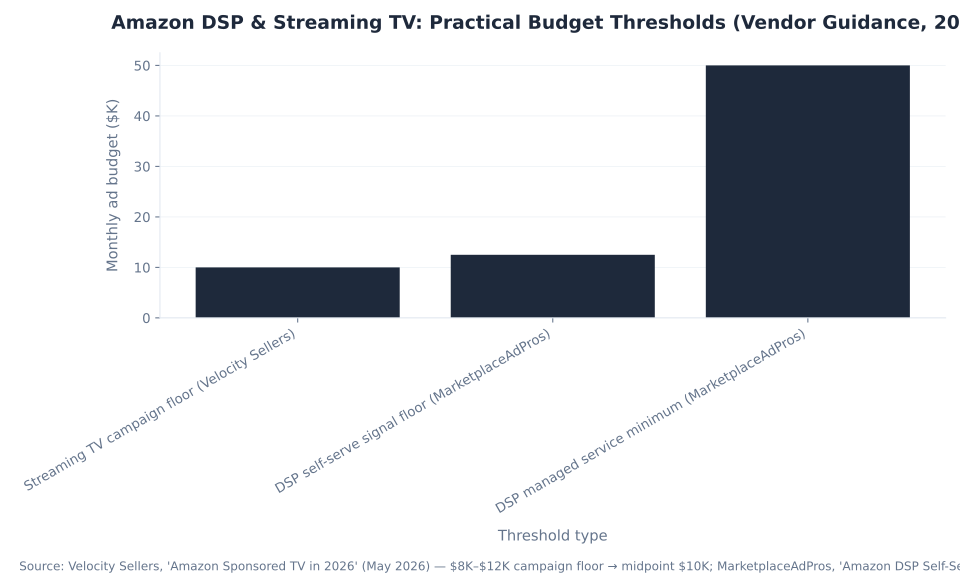
- The $50,000 DSP minimum is gone for self-serve. Amazon removed it at unBoxed 2025. The ~$50K figure now applies only to the managed service. Practitioners cite ~$10K–$15K/month as the budget where the model optimizes meaningfully (MarketplaceAdPros, 2026).
- Streaming TV is one product, not two. Sponsored TV folded into a single “Streaming TV” offering — self-serve, no minimum, any-size business — covering Prime Video, Fire TV, Twitch, and premium open-internet CTV.
- Amazon’s AI campaign types are Performance+ and Brand+. Both launched globally in early 2025 on the AdRelevance model. Amazon’s product is called Performance+. “Performance Max” is Google’s product — never Amazon’s.
- Prime Video reached 130M+ US monthly ad-supported viewers by May 2025 (Amazon self-reported), with ads on by default since January 2024. Global: 315M (unBoxed 2025).
- Off-Amazon reach is a closed loop. DSP reaches open-web publishers via Amazon Publisher Direct and Amazon Publisher Services, and measures those impressions back to on-Amazon purchase through Amazon Attribution and AMC.
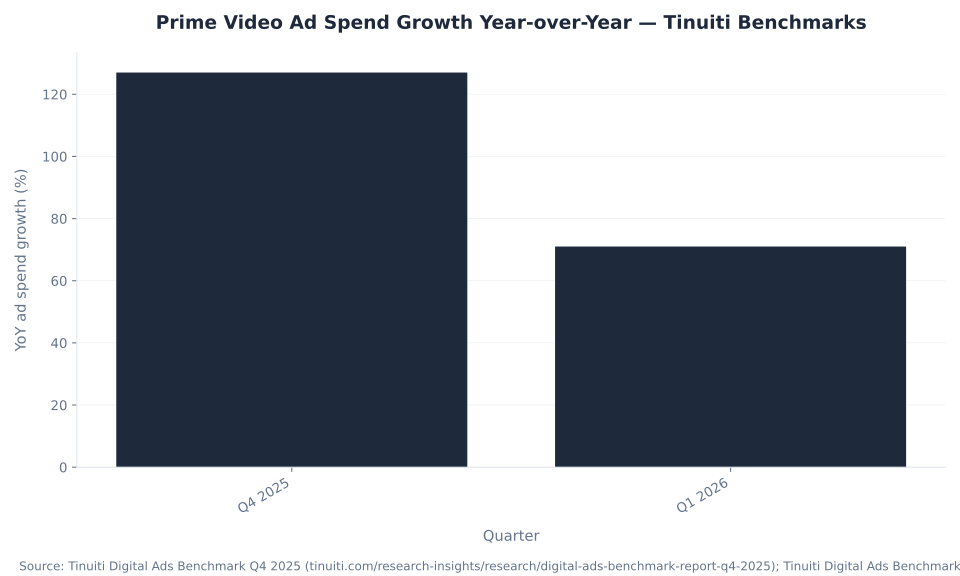
- Prime Video ad spend grew +71% YoY in Q1 2026 after +127% in Q4 2025 (Tinuiti, >$4B managed media). CPMs dipped ~18% QoQ from the Q4 peak — seasonal normalization, not a reversal.
$0
Self-serve DSP minimum (removed unBoxed 2025)
$28–$45
Prime Video CPM (Velocity Sellers vendor est., 2026)
130M+
US monthly Prime Video ad viewers (Amazon, May 2025)
+71%
Prime Video ad spend YoY, Q1 2026 (Tinuiti)
Amazon DSP vs. Sponsored Ads: The Distinction That Explains Every Strategic Decision
Most Amazon brands running Sponsored Products understand intent-based buying: a shopper searches “stainless steel water bottle,” your ad appears. That model efficiently captures existing demand. Amazon DSP solves the adjacent problem: creating demand from shoppers who have not yet searched your category.
The Sponsored Ads console targets the moment of search. DSP targets the person — built from Amazon’s first-party signals (purchase history, streaming habits, browsing patterns) assembled into audience segments: in-market buyers, lifestyle cohorts, lookalike audiences, retargeted detail-page visitors. Those segments follow shoppers wherever they go: Amazon search pages, Fire TV, Twitch, and thousands of third-party sites. See Amazon Ads targeting for the full audience taxonomy including in-market, lifestyle, remarketing, and advertiser-built segments that power DSP and Performance+.
A brand running strong Sponsored Products hits diminishing returns when the highest-intent search inventory is fully saturated. DSP is the demand-creation layer above the console — not a replacement, but the next lever. Amazon Sponsored Ads (Sponsored Products, Brands, Display) are the intent-based formats the unified Campaign Manager is merging with DSP into one console. For brands at the Sponsored Ads ceiling, DSP opens new-to-brand prospecting, cross-category reach, and the open web.
MB Adv Agency has found that brands entering DSP for the first time consistently underestimate the funnel gap. They set ROAS targets calibrated to Sponsored Products and are surprised when DSP delivers CPM-billed awareness impressions rather than immediate conversions. Channel alignment matters more than the budget number — DSP without a Sponsored Products base to close the conversion is a brand-building exercise with no harvest layer beneath it.
For DTC brands in categories like home goods, skincare, and furniture — where consideration windows extend across weeks and purchase decisions happen off the search bar — the audience-based model compounds over time in ways keyword harvesting cannot replicate. The shopper browsing outdoor furniture across four websites before purchasing on Amazon is exactly who DSP targets and retargets through the consideration window, while Sponsored Products waits only for the search-bar intent that follows.
Amazon DSP Minimum Budget: What Changed at unBoxed 2025
Amazon DSP self-serve has no Amazon-imposed minimum spend as of unBoxed 2025. The ~$50,000/month figure that circulated for years applied to Amazon’s managed service — where an Amazon Ads account team operates campaigns — and it still does. Digiday reported at unBoxed 2025 that Amazon rebuilt the DSP front and back end for the mass market and removed the self-serve minimum entirely.
“No minimum” is not the same as “any budget works.” The DSP’s predictive model requires conversion signal to optimize — fewer conversions means less precise targeting. MarketplaceAdPros (2026) cites ~$10,000–$15,000/month as the point where self-serve DSP starts generating enough signal to optimize meaningfully. That is a practitioner recommendation, not an Amazon rule — but it is the honest answer to the question “can I start DSP at $5,000/month?” (The model will underperform at that level.)
| Dimension | Self-Serve DSP | Managed Service |
|---|---|---|
| Amazon-imposed minimum | None — removed at unBoxed 2025 | ~$50,000/month (varies by country) |
| Who operates it | Advertiser or agency in DSP / Campaign Manager console | Amazon Ads account team |
| Practical signal floor | ~$10K–$15K/month (MarketplaceAdPros vendor guidance — not an Amazon rule) | Set by the managed-service minimum |
| Best for | Mid-market brands & agencies wanting hands-on control | Larger brands wanting Amazon to operate campaigns |
| Access path | Directly via DSP console or unified Campaign Manager beta | Through Amazon Ads account team |
Sources: Digiday, “Amazon rebuilds its ad machine for the mass market” (unBoxed 2025, self-serve minimum removed); MarketplaceAdPros, “Amazon DSP Self-Serve vs. Managed 2026” (~$10K–$15K signal floor; ~$50K managed-service characterization). Vendor guidance; not Amazon-published rate cards.
The brands that convert most readily on self-serve DSP are established Amazon sellers with a strong Sponsored Ads base — not first-time advertisers. They already have conversion signal flowing through their account, a catalog generating detail-page views worth retargeting, and the reporting depth to track new-to-brand orders. See Amazon Ads metrics: ACOS, ROAS, and NTB for the full measurement framework. Without those foundations, adding DSP spend creates a measurement void that is difficult to explain to stakeholders.
Amazon Streaming TV: One Product, No Minimum, Prime Video by Default
Amazon Streaming TV is a single self-serve advertising product — no minimum spend, open to businesses of any size — covering Prime Video, Fire TV Channels, Twitch, and premium third-party CTV publishers. The former “Sponsored TV” is now part of this unified offering; the two names no longer describe separate products.
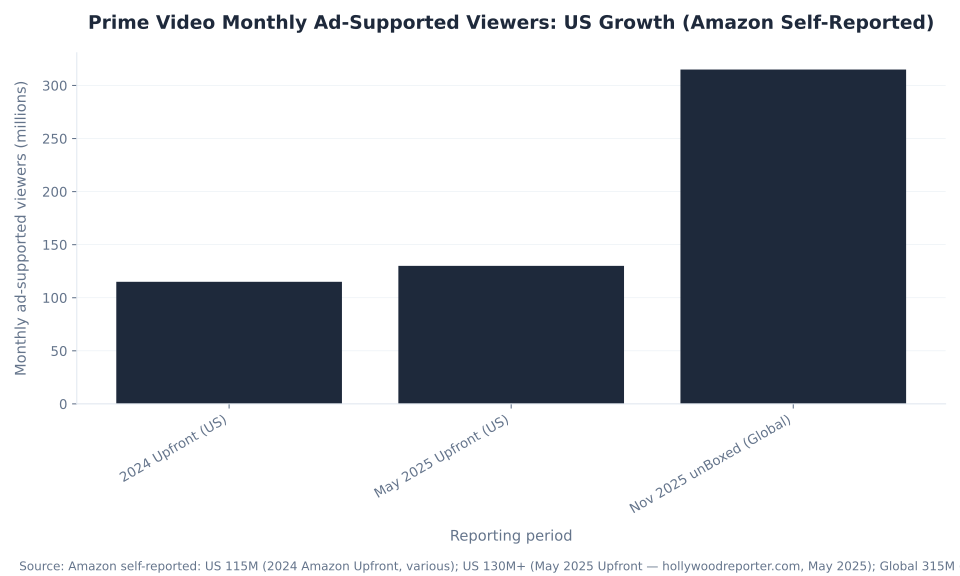
The scale of the Prime Video inventory is the defining fact. Amazon reported 130 million US monthly ad-supported viewers at its May 2025 Upfront, up from 115 million at the 2024 Upfront. By November 2025 (unBoxed), Amazon reported 315 million global monthly ad-supported viewers and an Authenticated Graph covering 90% of US households. US Prime Video ads went default-on January 29, 2024; the ad-free tier is +$2.99/month.
All Streaming TV formats run non-skippable. Prime Video creative specs: 15/30/45/60-second durations (US/CA/MX/JP), 16:9 aspect ratio, minimum 1920×1080 MP4, minimum 15 Mbps bitrate, with an optional interactive “click or scan to add to cart” overlay. Source: Amazon Ads Streaming TV & Prime Video ad specs.
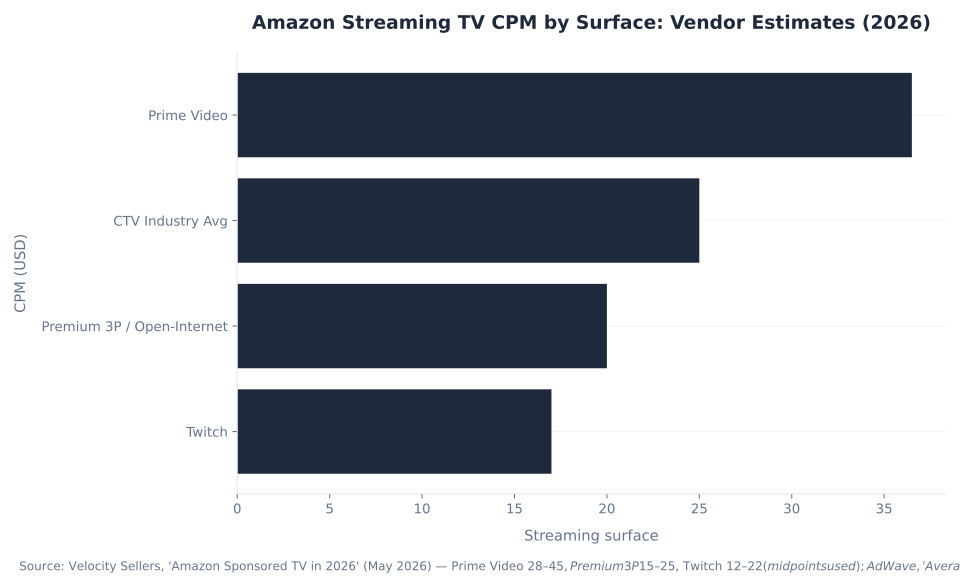
| Inventory / Surface | Format & Specs | Vendor-Cited CPM (attributed) |
|---|---|---|
| Prime Video (shows, movies, live sports incl. Thursday Night Football) | Non-skippable; 15/30/45/60s (US/CA/MX/JP); 16:9, min 1920×1080 MP4; interactive add-to-cart overlay | $28–$45 (Velocity Sellers, May 2026) |
| Fire TV Channels | Non-skippable streaming video; 16:9, min 8 Mbps | — (varies; no sourced figure) |
| Twitch (live streaming) | In-stream video; 15/20/30s typical | $12–$22 (Velocity Sellers, May 2026) |
| Premium 3P / open-internet CTV | Video; third-party apps support 6–90s; 16:9 | $15–$25 (Velocity Sellers, May 2026) |
| Buying access | Self-serve via Streaming TV in Ads console or via Amazon DSP; no minimum spend, any-size business | Billed CPM |
Sources: Amazon Ads, “Sponsored TV — now part of Amazon Ads streaming TV ads offering”; Amazon Ads Streaming TV ad specs; Velocity Sellers, “Amazon Sponsored TV in 2026” (May 2026). CPMs are vendor estimates, not Amazon-published rate cards. Fire TV CPM: no sourced figure; kept qualitative.
The CTV industry average CPM sits around $25 per AdWave Q1 2025, with advanced targeting pushing toward $35–$60. Prime Video’s $28–$45 range reflects mid-level targeting and reached CPM parity with Netflix in Q4 2025 — Tinuiti benchmarks showed Prime Video topping Netflix for the first time that quarter. For beauty products, supplements & nutrition, and watches, running non-skippable video to a purchase-qualified audience at premium-streamer CPMs is the actual value argument — not the inventory name.
Amazon Streaming TV CPM by Surface: Vendor Estimates (2026)
Amazon Performance+ and Brand+: AI Campaign Types Built on AdRelevance
Amazon’s AI-driven DSP campaign types are Performance+ (lower-funnel: prospecting, remarketing, retention) and Brand+ (upper-funnel: awareness) — both launched globally in early 2025 on the AdRelevance predictive model. The product is called Performance+. It is never “Performance Max” — that is Google Ads’ product. Writing the wrong name is the clearest signal that content was not written by someone who runs Amazon campaigns.
Performance+ compresses DSP campaign setup to four clicks: choose goal → choose KPI (CPA or ROAS) → choose tactic (prospecting, remarketing, or retention). AdRelevance handles audience construction and inventory selection automatically, drawing on Amazon’s first-party purchase, streaming, and browsing signals. The control model is a “Glass Box” — automation with visible controls over inventory type, brand safety settings, and audience suppression. Not a black box.
Brand+ is Performance+’s upper-funnel counterpart: same AdRelevance engine, awareness goal, impression-based KPI. Amazon announced both globally in early 2025 and enhanced both at unBoxed 2025 with DCO, insight cards, and new consideration tactics. Running Performance+ and Brand+ together creates a full-funnel automated DSP stack: Brand+ builds awareness, Performance+ closes at the lower funnel. Neither is the same as Sponsored Products “automatic targeting” — that is a console match-type setting, not a DSP campaign type.
| Dimension | Performance+ (AI Campaign Type) | Standard / Manual DSP |
|---|---|---|
| Setup | ~4 clicks: goal → KPI → tactic | Manual line items, audiences, inventory & bid construction |
| Targeting engine | AdRelevance predictive model + advertiser signals | Advertiser-built custom / lookalike / remarketing audiences |
| Funnel role | Lower-funnel: prospecting, remarketing, retention (CPA / ROAS goal) | Any funnel stage, fully advertiser-controlled |
| Awareness counterpart | Brand+ (upper-funnel AI) — pair both for full-funnel automation | Build awareness line items manually |
| Control model | “Glass Box” — automation with visible controls (inventory, brand safety, suppression) | Full manual control end-to-end |
| Not to confuse with | Google “Performance Max” (different platform); SP “automatic targeting” (a console match-type setting) | — |
Sources: Amazon Ads, “Amazon DSP Performance+”; Amazon Ads, “Brand+ and Performance+ Launch Globally”; Pacvue, “Amazon DSP Plus strategy”.
Prime Video Monthly Ad-Supported Viewers: US Growth (Amazon Self-Reported)
Off-Amazon Reach: The Closed Loop That Separates Amazon DSP from Generic Programmatic
Amazon DSP places ads on thousands of premium third-party websites and apps via Amazon Publisher Direct, Amazon Publisher Services, and leading third-party exchanges. Off-Amazon impressions are measured back to on-Amazon purchase outcomes through Amazon Attribution and Amazon Marketing Cloud (AMC) — a closed measurement loop that generic DSPs cannot replicate.
The argument for Amazon DSP over a generic programmatic platform is not the creative formats or the inventory breadth — a generic DSP has both. The argument is the data on both ends: you target with Amazon’s purchase-grade first-party audiences, and you measure the on-Amazon sales impact of those off-Amazon impressions. A shopper who visited your detail page, left without purchasing, and then saw your ad on a news site a week later: Amazon Attribution links that impression to the eventual purchase. The off-Amazon spend is not a measurement black hole.
The measurement architecture matters more after January 1, 2026, when Amazon retired the 14-day view-through attribution window in favor of an ML-based shopping-signal last-touch model. Deeper attribution analysis — cross-channel path-to-purchase, view-through contribution, AMC audience overlap — belongs in the reporting layer covered by the Amazon Ads metrics sibling pillar. At the campaign level, the correct question for off-Amazon DSP spend is not “what ROAS did this line item produce directly?” but “how did branded search volume and new-to-brand order rate change during and after the flight?”
MB Adv Agency has found that advertisers who benchmark off-Amazon DSP spend against on-Amazon last-touch ROAS consistently under-credit the channel. The correct diagnostic is a pre/post comparison of branded search impression share and new-to-brand order rate across a 21–30 day measurement window — not the DSP campaign’s direct-attributed ROAS, which excludes the view-through and halo contributions that represent most of the channel’s actual value.
For categories where brand consideration is built off-platform — jewelry, home decor, outdoor & camping, baby products — the off-Amazon reach layer addresses the consideration window that keyword spend misses entirely. A shopper researching baby monitors across multiple websites before converting on Amazon is exactly who DSP retargets through that window, with the closed loop measuring the on-Amazon outcome.
Prime Video Ad Spend Growth Year-over-Year — Tinuiti Benchmarks
The Unified Campaign Manager Beta: DSP and Sponsored Ads in One Console
At unBoxed 2025 (November 10, 2025), Amazon announced a unified Campaign Manager beta that collapses Amazon DSP and the Sponsored Ads console into a single advertising platform, with internal testing showing 67% faster campaign launches. It is in beta as of June 2026 with broader rollout in progress — not yet available to all advertisers.
The Campaign Manager beta covers North America (US, CA, MX), South America (Brazil), Europe (16 countries), Middle East (7 countries), and Asia-Pacific (6 countries including AU, JP, IN). The same unBoxed keynote introduced Creative Agent (AI-generated ad creative) and Ads Agent (natural-language campaign management), plus the Authenticated Graph — Amazon’s deterministic identity layer reaching 90% of US households — which underpins DSP’s audience precision. Sources: Amazon Ads, Campaign Manager beta announcement; PPC.land, November 2025.
| Dimension | Detail |
|---|---|
| Announcement date | November 10, 2025 (unBoxed conference) |
| What it unifies | Sponsored Products, Sponsored Brands, Sponsored Display + Amazon DSP in one console |
| Beta status (June 2026) | Available to select advertisers and partners; broader rollout in progress — verify current availability at publish |
| Campaign launch speed | 67% faster in internal testing (June–August 2025) |
| Geographic coverage | NA (US/CA/MX), SA (Brazil), EU (16 countries), ME (7 countries), APAC (6 incl. AU/JP/IN) |
Sources: Amazon Ads, Campaign Manager beta; PPC.land; Digiday, unBoxed 2025 coverage.
Four Amazon DSP Misconceptions That Cost Brands Good Decisions
Each claim below circulates in agency pitches, blog posts, and category research. Each is either outdated or wrong. Getting these right is the fastest way to identify whether a DSP recommendation is built on current platform knowledge.
| Misconception | Current Reality |
|---|---|
| “Amazon DSP requires a $50,000 minimum.” | False as of unBoxed 2025. The self-serve DSP minimum was removed at unBoxed 2025. The ~$50K figure now applies only to Amazon’s managed service. Self-serve DSP has no Amazon-imposed minimum, though practitioners recommend ~$10K–$15K/month for adequate optimization signal. (Digiday, 2025; MarketplaceAdPros, 2026) |
| “Amazon’s automated campaign type is Performance Max.” | False — wrong platform. Performance Max is Google Ads’ product. Amazon’s AI campaign types are Performance+ (lower-funnel) and Brand+ (upper-funnel), launched globally in early 2025. (Amazon Ads, 2025) |
| “Sponsored TV and DSP Streaming TV are separate products.” | False. Sponsored TV is now part of Amazon’s single “Streaming TV” offering — one product, self-serve, no minimum, covering Prime Video, Fire TV, Twitch, and premium open-internet CTV. (Amazon Ads Streaming TV product page) |
| “Amazon DSP only reaches shoppers on Amazon.” | False. DSP’s defining capability is off-Amazon reach via Amazon Publisher Direct, Amazon Publisher Services, and third-party exchanges. On-Amazon inventory is the starting point, not the boundary. (Amazon Ads, Amazon DSP) |
Amazon DSP and Streaming TV: When the Channel Earns Its Budget
Amazon DSP and Streaming TV reward brands with an established Amazon presence, measurable conversion signal, and the working capital to run awareness-to-conversion funnels across multi-week measurement windows. Neither is the right first spend for a brand that has not optimized Sponsored Products.
The readiness test for Streaming TV is more demanding than for standard DSP. Velocity Sellers (May 2026) cites $400,000+/month in Amazon revenue — or $750,000+/month combined DTC and Amazon — as the threshold where Streaming TV investment is likely to be recoverable within a campaign flight. Below those figures, the 7–21 day awareness-to-conversion lag and CPM cost structure create a working-capital risk that is difficult to justify against lower-funnel alternatives.
The lag is structural, not a performance deficiency: brand search lift becomes visible around Week 2, new-to-brand order contribution in Weeks 3–4, and the reliable measurement window is 21–30 days. For shoes, sports equipment, and kitchen appliances where basket size justifies upper-funnel investment, the lag is manageable. For low-margin consumables with weekly purchase cycles, it is not.
| Signal | DSP (Programmatic Display / Video) | Streaming TV (Prime Video / Twitch / Fire TV) |
|---|---|---|
| Minimum to start | None (Amazon policy) — ~$10K–$15K/month for meaningful signal (MarketplaceAdPros) | None (Amazon policy) — ~$8K–$12K/month for adequate frequency (Velocity Sellers) |
| Revenue readiness | Strong Sponsored Ads base with measurable NTB & detail-page traffic | $400K+/month Amazon revenue OR $750K+/month combined DTC + Amazon (Velocity Sellers, 2026) |
| Measurement window | 14+ days for display retargeting; AMC for cross-channel view | 21–30 days to capture NTB order contribution reliably (Velocity Sellers, 2026) |
| Works best for | Retargeting detail-page viewers off Amazon; prospecting new-to-brand audiences; retention of past purchasers | Brand awareness for higher-AOV considered-purchase categories; seasonal bursts; new-audience launches |
Sources: Velocity Sellers, “Amazon Sponsored TV in 2026” (May 2026) (revenue thresholds; lag; frequency floor); MarketplaceAdPros, “Amazon DSP Self-Serve vs. Managed 2026” (DSP signal floor). Vendor guidance; not Amazon-published requirements.
For pet supplies, home goods, and baby products — categories with high purchase frequency and compounding LTV — DSP retargeting and retention campaigns often carry the strongest ROAS justification in the program. The audience is warm, the offer repeats, and the detail-page retargeting pool keeps refilling from Sponsored Ads. In those categories, DSP is less upper-funnel brand building and more systematic re-engagement of a shopper pool the console already qualified.
Amazon DSP & Streaming TV: Practical Budget Thresholds (Vendor Guidance, 2026)
Ready to Map Out a Self-Serve DSP or Streaming TV Plan?
MB Adv Agency builds Amazon programmatic strategies for DTC brands — from figuring out the budget where the model optimizes to structuring the full-funnel stack above your Sponsored Ads base. We work with brands across beauty, home decor, outdoor & camping, and other considered-purchase categories where upper-funnel reach compounds.
Get a DSP Consultation →Prime Video Ad Spend Growth and CPM Trends: 2025–2026 Benchmarks
Prime Video ad spend grew +127% year-over-year in Q4 2025 and +71% YoY in Q1 2026, per Tinuiti benchmarks across >$4 billion in annual managed media. The deceleration from Q4 to Q1 reflects platform maturation off a larger base — not a reversal. Q4 holiday demand elevated both spend and CPMs; Q1 returned to the 2025 run-rate.
Q4 2025 marked a pricing inflection: Tinuiti benchmarks showed Prime Video CPMs reaching parity with Netflix, HBO Max, and Disney — and topping Netflix for the first time. That is the signal that Prime Video has graduated from launch-discount CPMs to premium-streamer territory. By Q1 2026, CPMs dipped 18% QoQ from the Q4 holiday peak, returning to the 2025 run-rate rather than declining below it. Sources: Tinuiti Q4 2025 Digital Ads Benchmark Report; Tinuiti Q1 2026 Digital Ads Benchmark Report.
Streaming video as a category added 8% more impressions YoY in Q1 2026 while overall streaming CPMs fell 2% YoY — supply expanding faster than demand, which benefits advertisers entering the channel. 67% of streaming video ad spend went to TV screens in Q1 2026 (vs. mobile or desktop), which reflects the CTV-first shift that makes Prime Video’s large-screen, lean-back placement the highest-attention format in Amazon’s ad stack.
For brands selling through Amazon in higher-consideration categories — kitchen appliances, home decor, watches, outdoor & camping — the Q1 2026 CPM normalization represents a timing opportunity: Prime Video inventory at Q4’s demand quality at pre-holiday CPM rates. That window closes as Q4 2026 approaches and holiday advertiser demand reloads. Prime Video ad spend growing at 71% YoY off a large base means the channel is maturing, not declining — entry costs are now predictable rather than volatile.
Amazon DSP Audience Infrastructure: Shopping Signals, AdRelevance, and the Authenticated Graph
Amazon DSP builds audience segments from three first-party signal streams unavailable to any other platform: purchase history across Amazon's retail operation, streaming behavior on Prime Video and Fire TV, and deterministic household identity through the Authenticated Graph covering 90% of US households. Those signals in combination make Amazon audience data structurally more predictive for product purchase intent than any modeled lookalike built on behavioral cookies.
The Authenticated Graph — announced at unBoxed 2025 — is Amazon's deterministic identity layer: Amazon matches users across devices and surfaces using login data, purchase records, and Prime membership signals. The 90% US household coverage figure (Amazon self-reported, unBoxed 2025 keynote recap) means a single DSP flight reaches the same household deterministically across mobile, Fire TV, and a Prime Video session, with frequency capped across all three touchpoints. That cross-device precision is structurally unavailable to any non-Amazon DSP relying on probabilistic identity graphs.
The segment taxonomy used in both manual DSP and Performance+ includes four types: in-market (shoppers actively researching a category), lifestyle (sustained purchase and browse patterns over time), remarketing (detail-page viewers, add-to-cart abandoners, past purchasers), and advertiser-built (custom segments from first-party data, customer lists, or lookalike expansion). The full audience taxonomy — in-market and lifestyle segment names, lookalike methodologies, suppression logic — is detailed in the Amazon Ads targeting sibling pillar.
| Segment type | Signal basis | Primary DSP use |
|---|---|---|
| In-market | Active category research, recent search and browse signals | Prospecting: reach shoppers in-category before conversion |
| Lifestyle | Sustained purchase and browse patterns across a category | Prospecting: reach buyers with sustained category affinity |
| Remarketing | Detail-page views, add-to-cart events, purchase history on Amazon | Retargeting warm shoppers off Amazon; past-purchaser retention |
| Advertiser-built | Customer lists, first-party CRM data, lookalike expansion | Custom prospecting: reach users similar to known buyer profiles |
Source: Amazon Ads, “Amazon DSP” (audience segment types); Amazon Ads, unBoxed 2025 recap (Authenticated Graph, 90% US households). See Amazon Ads targeting for the full in-market and lifestyle taxonomy.
MB Adv Agency has found that the highest-ROI DSP audience for brands with an established Amazon sales history is the remarketing pool built from detail-page viewers who did not add to cart — a warm signal structurally unavailable to any non-Amazon DSP. That pool, retargeted off Amazon within 7 days of the detail-page visit, consistently delivers stronger new-to-brand conversion contribution than in-market or lifestyle prospecting for brands with sufficient detail-page traffic volume. In-market and lifestyle segments carry broader reach but lower intent density — the right lever for new-to-brand reach, not for closing unconverted intent.
Frequently Asked Questions: Amazon DSP and Streaming TV
Exploring Amazon DSP for Your Category?
Amazon DSP and Streaming TV pay back strongest in considered-purchase verticals with higher AOV and multi-week conversion windows. MB Adv Agency works with brands in skincare, electronics, home goods, and sports equipment — categories where programmatic awareness compounds on top of an existing Sponsored Ads conversion base.
Methodology & Sources
This pillar draws on Amazon Ads' official product and library pages (Amazon DSP, Streaming TV, Performance+, Brand+, Campaign Manager beta, unBoxed 2025 keynote recap), third-party benchmarks from Velocity Sellers (May 2026), MarketplaceAdPros (2026), Tinuiti (Q4 2025 and Q1 2026 Digital Ads Benchmark Reports), AdWave (Q1 2025), and press coverage from Digiday, PPC.land, Hollywood Reporter, Deadline, and StreamTV Insider. CPM and budget figures are vendor characterizations, not Amazon-published rate cards. Amazon reach figures (130M+ US monthly viewers, 315M global, 90% US households via Authenticated Graph) are Amazon self-reported. No MB Adv client data or fabricated performance metrics are included. Cross-referenced against Amazon Ads official library and product pages at advertising.amazon.com. Reviewed by MB Adv Agency, June 2026.

As a Google Ads expert, I bring proven expertise in optimizing advertising campaigns to maximize ROI.
I specialize in sharing advanced strategies and targeted tips to refine Google Ads campaign management.
Committed to staying ahead of the latest trends and algorithms, I ensure that my clients receive cutting-edge solutions.
My passion for digital marketing and my ability to interpret data for strategic insights enable me to offer high-level consulting that aims to exceed expectations.
Google Partner Agency
We're a certified Google Partner Agency, which means we don’t guess — we optimize withGoogle’s full toolkit and insider support.
Your campaigns get pro-level execution, backed by real expertise (not theory).

4.9 out of 5 from 670+ reviews on Fiverr.
That’s not luck, that’s performance.
Highly recommend Matteo to set up your server side tracking. He has a deep understanding of e-commerce tracking and will go above and beyond to make sure everything is set up correctly and working 100%. If you are scaling your store this set up is non-negotiable in my opinion and there isn't many people who have this much knowledge or put the effort in to get it right. Thanks again!

avorodesign.com
I can only recommend Matteo! He was very patient, professional and very knowledgeable about GA4, Consent Mode v2, and GDPR compliance. Communication was clear, and the setup was done professionally and efficiently. Highly recommend him for anyone needing reliable tracking implementation.

www.natureiki.life
Matteo shines in the realm of online professionals. His work is not only deep in data but also complemented by his proactive communication and cooperation, setting a new standard for freelancers. If you want someone who truly exceeds expectations, look no further. Highly recommended!

www.omanbeverlysmyth.com
Exceptional Service Beyond Expectations - Outstanding Service Impeccable depth, flawless delivery, and exceptional language fluency—this service exceeded all expectations. Highly recommended. Matteo truly ROCKS!!!

ium-paris.com
Top-notch, always highly value working with Matteo. An absolute Google Ads Genius. This is approximately the 8th time I have hired him and he's helped us get 6-7 ROAS. We are excited in continuing to improve our lead flow. Hire this guy if you need Google Ads help. Thanks Matteo!

www.dleeventgroup.com
I finally found the guy who can setup server side tracking and all the ecosystem properly. I definitely recommend Matteo. He is very responsive, kind and wants to dig into things. He configured GA4, Meta, Google Ads, Outbrain and google consent v2 with Cookiebot. Thanks Matteo.

inomega.fr
MB Adv delivered exceptional work with outstanding professionalism and lots of patience, taking time to see effects of changes made and not just do the work and submit it. The proactive communication and video summaries of the work completed made working with Matteo a pleasure, as he consistently went above and beyond. Highly recommended for web analytics projects! We are already working on another project.

www.withnellsensors.co.uk
Working with Matteo on my Google Ads was a game-changer. He's not just a strategist, he's a true partner. He understood my goals and tailored a campaign that perfectly reached my target audience. I'm grateful for his expertise and dedication.
dccargo.com
Click-driven mind
with plastic-brick obsession.
We build Google Ads campaigns with the same mindset we use to build tiny brick worlds: strategy, patience, and zero tolerance for wasted pieces.
Data is our blueprint. Growth is the only acceptable outcome.