Amazon Ads Reporting & Attribution Guide (2026)

Amazon Ads Measurement: The Four-Rung Ladder
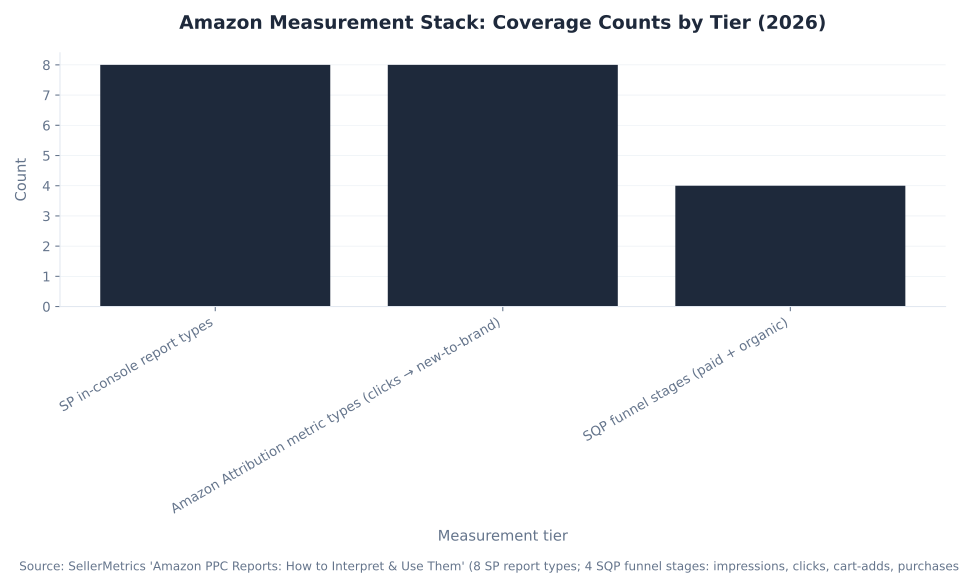
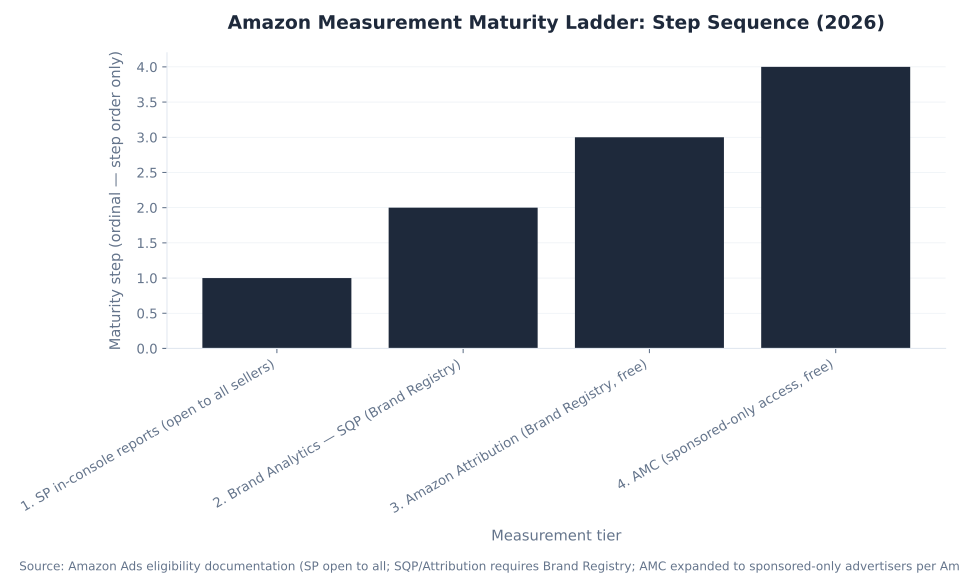
Amazon Ads measurement is a four-rung ladder. Every Amazon advertiser starts at rung one: the in-console Sponsored Products report family, which has eight distinct report types. Brand-registered sellers reach rung two with the Search Query Performance (SQP) report in Brand Analytics. Brands with off-Amazon traffic need rung three: Amazon Attribution, a free measurement product that tags off-Amazon ads and reports the on-Amazon result. The most measurement-mature brands operate at rung four: Amazon Marketing Cloud (AMC), a privacy-safe clean room that Amazon opened to sponsored-ads-only advertisers in 2024–2025.
Most sellers use two or three of the eight in-console reports and wonder why their bid decisions are slow to produce results. The reason is structural: each report answers exactly one class of question. The Search Term Report tells you what shoppers typed; the Targeting Report tells you how each keyword target performed; the Placement Report tells you where your ads served. Using the wrong report for a question produces an answer to a question you weren’t asking. The Amazon Sponsored Ads pillar covers the ad types that generate this data; this pillar maps what you do with it once you have it.
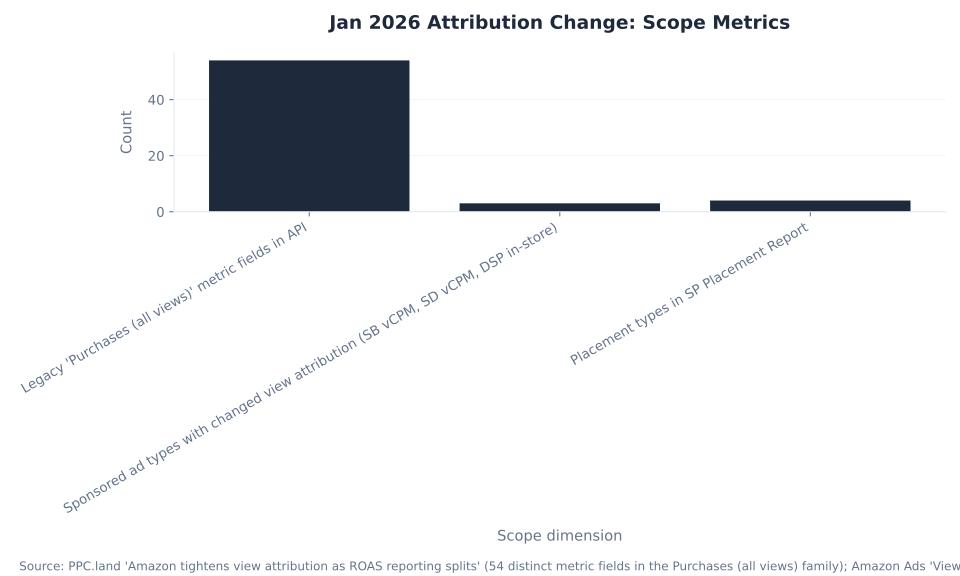
The measurement landscape changed materially on January 1, 2026. Amazon retired the fixed 14-day view-through attribution window for in-store ad placements and replaced it with a machine-learning, last-click attribution model enhanced by purchase signals — Amazon’s own phrasing from the official announcement. The change applies to Sponsored Brands vCPM, Sponsored Display vCPM, and Amazon DSP in-store placements. Click-based attribution is unchanged. For brands running vCPM campaigns, default ROAS metrics are now stricter — not because sales fell, but because view credit became more conservative.
For brands in high-repeat-purchase DTC categories like supplements & nutrition PPC and beauty products PPC, where attribution accuracy shapes budget allocation across Amazon, Meta, and Google simultaneously, the January 2026 change is not an edge case. The ROAS benchmarks set in 2025 under the old 14-day view model are not the same numbers Amazon reports by default in 2026. Recalibrating those benchmarks — rather than chasing the legacy “all views” figures — is the central measurement task for 2026.
The arc of this pillar: In-console SP reports → Search Term Report vs SQP (the most commonly confused distinction in Amazon reporting) → Amazon Attribution (off-Amazon measurement, free) → Amazon Marketing Cloud (clean room, now open to sponsored-ads-only sellers). Each rung reveals what the one below it cannot see.
The Amazon Ads ACOS, ROAS & metrics pillar covers what ACOS, ROAS, TACOS, and new-to-brand mean numerically. This pillar covers where those numbers come from and which report surfaces each one. Reading a ROAS figure without knowing which attribution model and which click window produced it is how accounts end up chasing phantom performance changes.
Key Takeaways
Five things to know about Amazon Ads reporting and attribution in 2026 before touching a campaign:
- Amazon’s Sponsored Products console has eight distinct report types. Each answers one class of question. The Search Term Report surfaces what shoppers typed; the Targeting Report surfaces how your keyword and product targets performed; the Placement Report surfaces where your ads served. They are not interchangeable.
- The Search Term Report and the Search Query Performance (SQP) report are two different tools. The STR lives in the Sponsored Products Ads console and shows paid clicks only. The SQP is a Brand Analytics report (Brand Registry required) that covers the entire query — paid and organic — with market-share metrics.
- On January 1, 2026, Amazon retired the 14-day view-through attribution window for in-store placements and replaced it with an ML-enhanced last-click model. Click attribution is unchanged. Falling view-attributed ROAS in 2026 vs 2025 is a measurement change, not a sales decline.
- Amazon Attribution is free. Any Brand Registry seller, vendor, KDP author, or agency can set up Attribution tags to measure how off-Amazon traffic converts on Amazon — at no additional cost to Amazon.
- Amazon Marketing Cloud is no longer DSP-only. Since September 2025, any advertiser running Sponsored Products, Sponsored Brands, or Sponsored Display can access AMC, including the Ads Agent that converts natural-language questions into AMC SQL queries.
Amazon Reporting & Attribution: Key Numbers at a Glance (2026)
Every figure below traces to a named source. No mbadv client benchmarks are presented here; all numbers are platform-published or independently verified vendor research.
| Metric | Value | Source |
|---|---|---|
| SP in-console report types | 8 | SellerMetrics, 2026 |
| SP click window — Seller Central (3P) | 7 days | Feedvisor, 2026 |
| SP click window — Vendor Central (1P) | 14 days | Feedvisor, 2026 |
| Old in-store view window (retired Jan 1, 2026) | 14 days | Amazon Ads, 2026 |
| New on-Amazon view window (Jan 1, 2026) | Shorter — exact length not published by Amazon | Amazon Ads, 2026 |
| Legacy “all views” metric fields retained in parallel | 54 | PPC.land, 2026 |
| Amazon Attribution cost | Free | Amazon Ads, 2026 |
| Amazon Attribution metric types reported | 8 (clicks, DPV, DPV rate, ATC, purchases, units sold, product sales, new-to-brand) | Amazon Ads, 2026 |
| Amazon Q2 2025 ad revenue | ~$16 billion (+22% YoY) | Marketing Dive, Sept 2025 |
| Amazon US advertising audience | 300 million+ | Marketing Dive, Sept 2025 |
The Sponsored Products Report Family: Eight Reports, Eight Questions
The Sponsored Products in-console reporting tab exposes eight distinct report types. Each answers exactly one class of question about campaign performance. Using the Targeting Report to answer the Search Term Report’s question — or pulling the Advertised Product Report when you need the Purchased Product Report — produces answers to questions you were not asking. The map below resolves the confusion.
| Report | What it shows | Use it to |
|---|---|---|
| Search Term Report | Actual customer search terms and competitor ASINs that triggered paid ad clicks; with 7-day sales, ACOS, ROAS, orders, units, CVR | Harvest new keywords; add negative keywords; find competitor ASIN targets |
| Targeting Report | Performance of every target you set — keywords, products, categories, brands — with impressions, clicks, spend, and sales per target | Adjust bids; pause losing targets; scale winners |
| Advertised Product Report | Performance for each ASIN you advertised that received at least one impression; excludes other products bought through the ad | Identify which of your listings the ads actually moved |
| Purchased Product Report (sellers only) | ASINs customers bought after clicking your ad that you did not target — cross-sell and halo signal | Spot cross-sell revenue; find new ASIN product-target candidates |
| Placement Report | Performance across 4 placements: Top of search, Rest of search, Product pages, Remarketing off Amazon | Set placement bid adjustments (up to +900% for Top of search and Product pages) |
| Search-Term Impression Share Report | Your impression share per search term versus other advertisers competing for the same term | Find high-value terms where you are under-exposed relative to your competitive position |
| Campaign Report | Roll-up performance across all your SP campaigns for account-level health and budget allocation | Account-level budget review; flag campaigns burning spend at high ACOS |
| Performance Over Time Report | Clicks, average CPC, and spend summarized over a chosen period | Track CPC trends and spot spend drift before it compounds |
Source: SellerMetrics, “Amazon PPC Reports: How to Interpret & Use Them” (report types, Placement Report 4 placements, Purchased Product Report sellers-only); Amazon Ads, “Targeting with Sponsored Products” (Search Term Report, placement bid adjustments). Report names and availability drift; verify against the live Ads console before publish.
The Purchased Product Report is the most underused report in the family and is available to sellers only — vendors do not have access. It reveals ASINs customers bought after clicking your ad, including products you never targeted. A shopper clicks a whey protein ad and buys a shaker bottle from the same brand catalog: that shaker ASIN appears in the Purchased Product Report as untargeted halo revenue. Those untargeted ASINs with purchase volume are direct inputs for Amazon Ads product-targeting campaigns.
The Placement Report splits performance across four confirmed placement categories: Top of search, Rest of search, Product pages, and Remarketing off Amazon. Amazon allows placement bid adjustments of up to +900% on Top of search and Product pages. For high-CVR keywords where first-position placement demonstrably lifts conversion rate, that ceiling is the lever. The Amazon Ads optimization & automation pillar covers the bid-and-prune workflow these reports feed.
The Amazon Search Term Report vs the Search Query Performance (SQP) Report
The Search Term Report and the Search Query Performance (SQP) report are two separate tools that answer fundamentally different questions. Conflating them is the most common reporting error in Amazon Ads management: advertisers pull the SQP from Brand Analytics, treat it as an ad report, and make bid decisions against organic-inclusive data they misread as paid-only performance.
| Dimension | Search Term Report | Search Query Performance (SQP) |
|---|---|---|
| Where it lives | Sponsored Products Ads console → Reports tab | Brand Analytics (requires Brand Registry) |
| Traffic covered | Paid clicks only — your ads only | Paid + organic — the entire query on Amazon |
| Data grain | Search term × campaign / ad group | Search query × ASIN; brand-level |
| Key metrics | Impressions, clicks, 7-day sales, ACOS, ROAS, orders, units, CVR | Total search impressions; your impression share, click share, cart-add share, purchase share |
| Attribution / time window | SP click attribution (7-day Seller Central; 14-day Vendor Central) | Funnel tracked on a 24-hour window |
| The question it answers | “How did my ads perform on this search term?” | “How does my brand rank on this query vs the whole market?” |
| Best use | Keyword harvesting, negative pruning, per-term bid moves | Market-share strategy, listing conversion diagnosis, demand sizing |
Sources: Helium 10, “Amazon’s Search Query Performance (SQP) Report and Why It Matters” (Brand Analytics; search-query + ASIN grain; 24-hour funnel window; paid + organic; impression/click/cart-add/purchase share metrics); SellerMetrics (Search Term Report paid-click metrics).
The numbers in the two reports are not comparable on a one-to-one basis. The SQP funnel tracks on a 24-hour window; the Search Term Report uses the SP click attribution window (7 days for Seller Central, 14 days for Vendor Central). More fundamentally, the SQP includes organic traffic that the Search Term Report never sees. A query where your brand has strong organic ranking but weak paid share will look very different in each report. Making bid decisions with SQP data treats organic volume as ad-driven demand — and leads to overbidding on terms where organic is already doing the work.
The SQP’s share metrics — impression share, click share, purchase share — are its most valuable dimension. They show where your brand sits in the competitive landscape for a given query, across both paid and organic channels. A high purchase share with low impression share signals strong listing conversion but poor discovery. A high impression share with low purchase share signals exposure without conversion — a listing or pricing problem, not a bid problem. Using SQP to diagnose conversion before spending on beauty PPC campaigns or food & beverage PPC is one of the first things MB Adv Agency checks in a new account audit.
How to Mine the Search Term Report for Keywords and Negatives
The Search Term Report is the engine of keyword harvesting and negative pruning — the two most impactful recurring tasks in Sponsored Products management. The workflow below runs the same way regardless of category or account size.
Step 1: Pull the report over a 30–60 day window. A shorter window produces statistically thin data; a window longer than 90 days dilutes seasonal signals. Run the report at the ad group level or campaign level, covering any auto and manual campaigns with meaningful click volume. Filter to search terms with at least 3–5 clicks before acting on CVR or ACOS figures.
Step 2: Sort by orders descending and identify converting terms not yet in a manual exact-match campaign. These are keyword-harvest candidates: search terms where customers clicked your auto campaign (or a broad/phrase keyword) and bought, but where you have no manual exact-match keyword capturing that intent efficiently. Exact-match keywords in manual campaigns give precise bid control that auto campaigns and broad-match keywords cannot provide.
Step 3: Add harvested terms as exact-match keywords in a manual campaign. Set the initial bid at the category-appropriate CPC level, not at a flat default. Monitor for the first 2–3 weeks before adjusting. The goal is to give high-converting search terms their own, dedicated bid rather than letting them compete inside an auto campaign where Amazon controls placement.
Step 4: Sort by spend descending with zero or low orders and flag high-ACOS terms. These are waste candidates. Add the worst performers as negative exact-match or negative phrase keywords in the relevant campaigns. Prioritize terms with 5+ clicks and zero orders over the window, especially in auto campaigns where broad intent attracts irrelevant queries.
Step 5: Negate harvested terms back in the auto campaign. Once a term is in a manual exact-match campaign, add it as a negative exact-match in the corresponding auto campaign. Without this step, the auto campaign continues to bid on the same term, splitting impression share between auto and manual and diluting budget control. This is the most commonly skipped step in the harvesting loop.
Step 6: Repeat on a cadence. For active accounts, run this workflow every 2–4 weeks. New search terms accumulate continuously in auto campaigns; the Search Term Report surfaces them. This cycle is the core of the Search Term Report → keyword expansion → bid precision loop described in the Amazon Ads optimization & automation pillar.
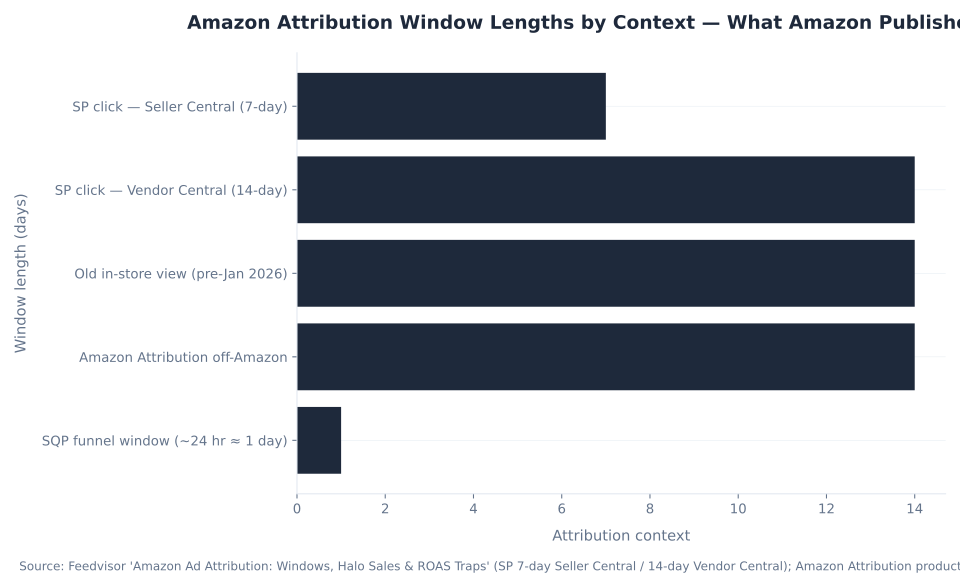
Amazon Attribution Window Lengths by Context — What Amazon Publishes (2026)
The January 2026 Attribution Model Change: What Amazon Changed and What It Didn’t
On January 1, 2026, Amazon retired the fixed 14-day view-through attribution window for in-store ad placements and replaced it with what Amazon calls a “last-click attribution model enhanced by purchase signals” — a machine-learning model that evaluates whether a given ad view actually influenced the purchase before crediting it. This is the single highest-drift fact in Amazon Ads attribution: any source still describing the 14-day view window as current is describing the retired model.
| Dimension | OLD (through Dec 31, 2025) | NEW (from Jan 1, 2026) |
|---|---|---|
| View attribution method | Fixed 14-day view-through window — any view in the prior 14 days could earn conversion credit | Last-click attribution model enhanced by purchase signals — ML evaluates whether a view genuinely influenced the purchase |
| Window length | 14 days | Shorter — Amazon states “shorter window to reflect shopper behavior”; exact length not published |
| Applies to | Amazon Store ads view credit | Sponsored Brands (vCPM), Sponsored Display (vCPM), Amazon DSP in-store placements |
| Click attribution | Unchanged | Unchanged — only view-based credit is affected |
| Legacy figures | Were the default | Retained in parallel as “all views” metrics (e.g. Purchases (all views)), 54 distinct fields, for YoY comparison |
| Offsite DSP exception | 14-day click / 14-day view | Offsite DSP delivery retains 14-day click / 14-day view — change applies to in-store placements only [verify against live Amazon documentation before publish] |
| Reported conversion impact | — | Feedvisor: estimated 15–30% reduction in view-attributed conversions; Code3: “double-digit declines in attributed DSP revenue” — both vendor estimates; underlying sales unchanged |
Sources: Amazon Ads, “View attribution updates for Amazon Store ads” (last-click enhanced by purchase signals; SB/SD vCPM + DSP in-store; “all views” 14-day legacy; click attribution unchanged; 30+ countries); PPC.land (54 metric fields; ROAS split); Code3 (offsite DSP exception; “double-digit declines”); Feedvisor (15–30% reduction estimate — Feedvisor’s own analysis, not Code3’s figure).
Three things about the January 2026 change that must not be invented or misattributed: (1) Amazon does not publish the exact new window length — do not invent a number; Amazon states only “shorter window to reflect shopper behavior.” (2) The 15–30% reduction figure is Feedvisor’s analysis; Code3’s article uses “double-digit declines” without a specific range — these are separate vendor estimates. (3) The offsite DSP exception (retaining 14-day click/14-day view) is reported by Code3 and is consistent with Amazon’s “in-store placements” language, but is not confirmed in Amazon’s headline announcement — verify before asserting. For the programmatic surfaces most affected by this change, see the Amazon DSP & Streaming TV pillar.
Amazon Measurement Stack: Coverage Counts by Tier (2026)
Reading Your ROAS Under the New Attribution Model
The first thing most brands noticed after January 1, 2026 was a drop in view-attributed conversions on their DSP and vCPM Sponsored Brands and Display dashboards. Feedvisor estimates a 15–30% reduction in view-attributed conversions under the new model; Code3 observed “double-digit declines in attributed DSP revenue” across their client base in 2026 reporting. Underlying sales did not fall. The measurement became more conservative.
Amazon retained the legacy 14-day view figures in a parallel metric family called “all views” — 54 distinct metric fields including Purchases (all views), Sales (all views), and others. These “all views” metrics are available alongside the new default figures, enabling year-over-year comparison without forcing a direct comparison of two incompatible models. If your 2026 ROAS targets were set using 2025 figures, you need to restate those benchmarks against the new default model — not against the “all views” legacy family — or you will spend 2026 chasing numbers that no longer represent the model Amazon uses by default.
The correct 2026 response: Set new ROAS floor benchmarks against the new default model. Use the “all views” columns for historical comparison only. Do not present the “all views” ROAS to stakeholders as the current performance metric — it reflects the retired model.
Amazon was not alone. Meta eliminated its 7-day and 28-day view-through attribution windows on January 12, 2026 — just 11 days after Amazon’s change — as reported by PPC.land. Both platforms moved toward more conservative view attribution in the same month. For brands running cross-platform campaigns across Amazon vCPM, Meta social, and Google Display simultaneously, January 2026 changed the view-attribution baseline on multiple channels at once. Attribution audits that compare 2026 blended ROAS against 2025 blended ROAS without accounting for both changes will produce misleading conclusions. MB Adv Agency’s first recommendation to accounts affected by the January 2026 change was to establish clean 2026 benchmarks from the new default model rather than reconciling against pre-change figures that no longer reflect current platform behavior.
Jan 2026 Attribution Change: Scope Metrics
Amazon Attribution: Measuring the On-Amazon Impact of Off-Amazon Marketing
The Sponsored Products report family shows only what happened after a shopper clicked an Amazon ad. It is blind to everything that drove them to Amazon first — the influencer post, the Meta retargeting ad, the Google Shopping click, the email. Amazon Attribution is the measurement product that closes that gap: it tracks how off-Amazon marketing channels convert to on-Amazon sales, and it is free.
| Dimension | Amazon Attribution | Amazon Marketing Cloud (AMC) |
|---|---|---|
| What it measures | The on-Amazon impact of off-Amazon marketing (paid search, social, display, video, email) | Cross-channel path-to-purchase joining Sponsored Ads + DSP + Attribution + retail signals |
| How it works | Attribution tags placed in the off-Amazon ad’s destination URL; Amazon tracks on-Amazon result | Privacy-safe clean room — SQL queries over pseudonymized event-level signals; aggregated output only |
| Cost | Free | Free |
| Eligibility | Brand Registry sellers, vendors, KDP authors, agencies | DSP advertisers and sponsored-ads-only advertisers (eligibility expanded 2024–2025) |
| Key output | Clicks, DPV, DPV rate, add-to-cart, purchases, units sold, product sales, new-to-brand (8 metric types; 14-day window) | Custom SQL analyses: path-to-conversion, reach/frequency, audience overlap, incrementality; activatable audiences |
| 2026 update | Production-grade across major marketplaces; 14-day attribution window unchanged by Jan 2026 model change | Ads Agent in AMC (unBoxed 2025, Nov 11, 2025; Amazon Bedrock) converts natural language to AMC SQL |
| Maturity rung | Step 3 — prove external traffic converts on Amazon | Step 4 — full cross-channel, privacy-safe clean-room analysis |
Sources: Amazon Ads, “Amazon Attribution” (free; Brand Registry/vendor/KDP/agency; 8 metric types; 14-day window); Amazon Ads, “Expanding AMC eligibility” (sponsored-only access); Marketing Dive, Sept 2025; PPC.land, Nov 2025 (Ads Agent).
Amazon Attribution: Setup, Channels, and What Gets Measured
Amazon Attribution is production-grade, free, and available in the major Amazon marketplaces. Most brands that would benefit from it haven’t turned it on. MB Adv Agency has found that the majority of brands driving paid social, influencer, and paid search traffic to their Amazon listings have never activated Amazon Attribution — leaving the on-Amazon conversion data from their off-Amazon media spend completely invisible.
Eligibility: Amazon Attribution is available to Brand Registry professional sellers, vendors (1P suppliers), KDP (Kindle Direct Publishing) authors, and agencies managing eligible accounts. Sellers who have not completed brand enrollment in Amazon Brand Registry cannot access Attribution — that eligibility gate is the primary barrier for early-stage sellers. Agencies can access Attribution on behalf of eligible clients through their Amazon Ads account.
How setup works: For each off-Amazon ad or channel, the advertiser creates an Amazon Attribution tag — a URL parameter that gets appended to the destination link pointing to an Amazon product detail page or Store. When a shopper clicks that tagged link and takes an action on Amazon, Attribution records the result. There is no pixel on the Amazon product page; the measurement is managed server-side by Amazon. Tags are created in the Amazon Attribution console and can be applied to paid search (Google, Bing), paid social (Meta, TikTok, Pinterest), display, video, email, and organic content links.
What gets measured: Amazon Attribution reports eight metric types on a 14-day attribution window from the first click: clicks to the product detail page, detail-page views (DPV), DPV rate, add-to-cart (ATC), purchases, units sold, total product sales, and new-to-brand customers. The new-to-brand metric is particularly valuable for DTC brands running acquisition campaigns on Meta or TikTok — it shows how many of the Amazon purchases from that channel were first-time customers to the brand, not existing buyers re-purchasing. For brands in acquisition-heavy categories like fashion PPC and outdoor & camping PPC, new-to-brand attribution from off-Amazon channels is a primary KPI.
One critical note: Amazon Attribution’s 14-day attribution window was not changed by the January 1, 2026 model update. The January 2026 change applied specifically to view-based credit on in-store placements (Sponsored Brands vCPM, Sponsored Display vCPM, DSP in-store). Amazon Attribution’s window is a click-based 14-day window for off-Amazon traffic — a structurally different measurement context. The two changes are independent.
Amazon Marketing Cloud: Clean-Room Analysis Now Open to Any Amazon Advertiser
Amazon Marketing Cloud (AMC) is a privacy-safe clean room that joins Sponsored Ads, DSP, Amazon Attribution, and Amazon retail signals at the pseudonymized event level. SQL queries run over this combined data to produce aggregated insights — path-to-purchase, reach and frequency, audience overlap, incrementality, and more. AMC is free to use as a platform; the underlying ad spend is the cost. It is the top rung of the measurement maturity ladder.
| Dimension | Detail |
|---|---|
| Core function | Privacy-safe clean room joining Sponsored Ads, DSP, Amazon Attribution, and retail signals at pseudonymized event level; aggregated output only |
| Query interface | Custom SQL over event-level signals; no-code UI with pre-built templates for common analyses (Sept 2025 expansion) |
| Eligibility (Oct 2024) | AMC opened to sponsored-ads-only advertisers via Amazon Ads Partner Network (unBoxed 2024, Oct 15, 2024); prior requirement was Amazon DSP |
| Eligibility (Sept 2025) | Extended to all advertisers running Sponsored Products, Sponsored Display, Sponsored Brands, or Sponsored TV; no DSP required |
| Ads Agent in AMC | AI query assistant built on Amazon Bedrock; converts natural-language questions to AMC SQL; launched Nov 11, 2025 (unBoxed 2025); user reviews before execution |
| Cost | Free as a platform; cost is limited to the ad spend being analyzed |
Sources: Amazon Ads, “Amazon Marketing Cloud”; Amazon Ads, “Expanding AMC eligibility”; Marketing Dive, Sept 22, 2025; PPC.land, Nov 11, 2025.
The eligibility story is significant. AMC was effectively a DSP-buyer luxury for most of its existence. Removing the DSP prerequisite in 2024–2025 opened path-to-purchase analysis, reach/frequency capping, and audience overlap measurement to sponsored-ads-only sellers — the majority of Amazon advertisers. Combined with the Ads Agent (announced November 11, 2025 at unBoxed 2025, built on Amazon Bedrock), which converts natural-language questions into AMC SQL, the technical floor dropped as well. Brands in high-consideration DTC categories like watches PPC, handbags & accessories PPC, and electronics PPC — where customers interact with multiple touchpoints before purchasing — now have a practical path to path-to-purchase analysis without a DSP contract or SQL expertise. The measurement context is Amazon’s 300 million+ US advertising audience and ~$16 billion in Q2 2025 ad revenue — the largest first-party retail signal set in US e-commerce.
Amazon Measurement Maturity Ladder: Step Sequence (2026)
Build a Reporting Stack That Actually Shows You What’s Working
MB Adv Agency builds measurement frameworks for Amazon brands in categories where attribution accuracy shapes every budget decision — including supplements & nutrition, beauty, food & beverage, and electronics. That means the full stack: in-console report setup, Search Term Report harvest cadence, Amazon Attribution tagging for off-Amazon channels, and AMC reporting where warranted.
Get an Attribution Audit →Amazon Click Attribution Windows: Seller Central, Vendor Central, and Off-Amazon
Click attribution in Amazon Ads is not universal. The window depends on ad type and account type. Benchmarking ROAS between a Seller Central account and a Vendor Central account — or between Sponsored Products and Sponsored Brands — without accounting for window differences produces invalid comparisons.
| Ad type / context | Click window | View window |
|---|---|---|
| Sponsored Products — Seller Central (3P) | 7 days | N/A (SP is click-only) |
| Sponsored Products — Vendor Central (1P) | 14 days | N/A (SP is click-only) |
| Sponsored Brands (click) | 14 days | New ML model (Jan 2026) |
| Sponsored Display (click) | 14 days | New ML model (Jan 2026) |
| Amazon DSP — offsite placements | 14 days | 14 days (unchanged by Jan 2026 change — verify) |
| Amazon Attribution (off-Amazon traffic) | 14 days | N/A (click-based; unchanged by Jan 2026 change) |
Sources: Feedvisor, “Amazon Ad Attribution: Windows, Halo Sales & ROAS Traps” (SP 7-day Seller Central / 14-day Vendor Central; SB/SD 14-day click); Code3 (offsite DSP exception retaining 14-day click/view).
The 7-day vs 14-day distinction between Seller Central and Vendor Central is load-bearing for any account that switches account types or for any comparison between 3P and 1P performance data. A seller migrating from 3P to 1P (or running both simultaneously) will see attributed sales attribution windows change under otherwise identical campaign conditions. This is not a performance change — it is a measurement-window change. See the Amazon Ads ACOS, ROAS & metrics pillar for how these windows feed the ROAS and TACOS calculations.
Common Amazon Reporting Misconceptions — Corrected
Three misconceptions travel widely in Amazon Ads communities and produce measurable harm when acted on. The corrections below are declarative, backed by Amazon documentation and independent verification.
Misconception 1: The Search Term Report and the Search Query Performance (SQP) report are the same report. They are not. The Search Term Report is a Sponsored Products advertising report that shows only the search terms that triggered a paid ad click, in the Ads console, with your campaign’s attributed sales and ACOS. The SQP report is a Brand Analytics report (Brand Registry only) that shows the entire query — total search impressions on Amazon and your brand’s impression share, click share, and purchase share across both paid and organic, on a 24-hour funnel window. They answer different questions (how my ads did vs how my brand ranks in the market), use different attribution windows, and should never be reconciled one-to-one. Treating them as interchangeable is the most common reporting error MB Adv Agency finds in new account audits.
Misconception 2: Amazon still uses a 14-day view-through attribution window. That was retired on January 1, 2026. Since that date, Amazon attributes view-based conversions with a “last-click attribution model enhanced by purchase signals” (Amazon’s own phrasing) over a shorter window whose exact length Amazon does not publish. The old 14-day view figures survive only as the parallel “all views” metric family (e.g. Purchases (all views)), available for historical comparison. Click-based attribution is unchanged. Any source describing the 14-day view window as current is describing the retired model.
Misconception 3: Amazon Attribution costs money, and AMC requires a DSP contract. Both are false. Amazon Attribution is free — there is no platform fee; costs are limited to the off-Amazon media spend it measures. Amazon Marketing Cloud is also free. And AMC no longer requires a DSP buy: since September 2025, any advertiser running Sponsored Products, Sponsored Brands, or Sponsored Display can access AMC. These two eligibility myths keep sellers stuck at console-only reporting when the next two rungs of the measurement ladder are free and accessible.
Amazon Ads Reporting & Attribution: Frequently Asked Questions
Not Sure What Your Attribution Is Actually Telling You?
If the January 2026 attribution model change reshaped your view-attributed ROAS — or if you have off-Amazon traffic running with no Amazon Attribution set up — get in touch for a measurement audit. MB Adv Agency works with DTC Amazon brands in eyewear, food & beverage, and pet supplies to stand up reporting stacks that reflect current platform behavior.
Talk to MB Adv Agency →Methodology
This pillar consolidates three absorbed URLs (“understanding-sponsored-products-performance-reports,” “what-is-the-search-term-report,” “introduction-to-amazon-attribution”) into a single authoritative reference. All numbers are sourced from Amazon Ads documentation, Amazon Ads help center, or named independent sources: SellerMetrics (SP report family, placements), Feedvisor (click windows, 15–30% attribution impact estimate), Code3 (“double-digit declines” in DSP attributed revenue, offsite DSP exception), PPC.land (54 “all views” metric fields, Meta Jan 2026 window change, AMC Ads Agent), Helium 10 (SQP report structure and 24-hour window), Marketing Dive (AMC Sept 2025 expansion, Amazon 300M+ audience, Q2 2025 $16B ad revenue). No mbadv client metrics are presented anywhere; all MB Adv attributions are qualitative experience claims. Last-updated: June 2026. Reviewed by MB Adv Agency, June 2026.

As a Google Ads expert, I bring proven expertise in optimizing advertising campaigns to maximize ROI.
I specialize in sharing advanced strategies and targeted tips to refine Google Ads campaign management.
Committed to staying ahead of the latest trends and algorithms, I ensure that my clients receive cutting-edge solutions.
My passion for digital marketing and my ability to interpret data for strategic insights enable me to offer high-level consulting that aims to exceed expectations.
Google Partner Agency
We're a certified Google Partner Agency, which means we don’t guess — we optimize withGoogle’s full toolkit and insider support.
Your campaigns get pro-level execution, backed by real expertise (not theory).

4.9 out of 5 from 670+ reviews on Fiverr.
That’s not luck, that’s performance.
Highly recommend Matteo to set up your server side tracking. He has a deep understanding of e-commerce tracking and will go above and beyond to make sure everything is set up correctly and working 100%. If you are scaling your store this set up is non-negotiable in my opinion and there isn't many people who have this much knowledge or put the effort in to get it right. Thanks again!

avorodesign.com
I can only recommend Matteo! He was very patient, professional and very knowledgeable about GA4, Consent Mode v2, and GDPR compliance. Communication was clear, and the setup was done professionally and efficiently. Highly recommend him for anyone needing reliable tracking implementation.

www.natureiki.life
Matteo shines in the realm of online professionals. His work is not only deep in data but also complemented by his proactive communication and cooperation, setting a new standard for freelancers. If you want someone who truly exceeds expectations, look no further. Highly recommended!

www.omanbeverlysmyth.com
Exceptional Service Beyond Expectations - Outstanding Service Impeccable depth, flawless delivery, and exceptional language fluency—this service exceeded all expectations. Highly recommended. Matteo truly ROCKS!!!

ium-paris.com
Top-notch, always highly value working with Matteo. An absolute Google Ads Genius. This is approximately the 8th time I have hired him and he's helped us get 6-7 ROAS. We are excited in continuing to improve our lead flow. Hire this guy if you need Google Ads help. Thanks Matteo!

www.dleeventgroup.com
I finally found the guy who can setup server side tracking and all the ecosystem properly. I definitely recommend Matteo. He is very responsive, kind and wants to dig into things. He configured GA4, Meta, Google Ads, Outbrain and google consent v2 with Cookiebot. Thanks Matteo.

inomega.fr
MB Adv delivered exceptional work with outstanding professionalism and lots of patience, taking time to see effects of changes made and not just do the work and submit it. The proactive communication and video summaries of the work completed made working with Matteo a pleasure, as he consistently went above and beyond. Highly recommended for web analytics projects! We are already working on another project.

www.withnellsensors.co.uk
Working with Matteo on my Google Ads was a game-changer. He's not just a strategist, he's a true partner. He understood my goals and tailored a campaign that perfectly reached my target audience. I'm grateful for his expertise and dedication.

dccargo.com
Click-driven mind
with plastic-brick obsession.
We build Google Ads campaigns with the same mindset we use to build tiny brick worlds: strategy, patience, and zero tolerance for wasted pieces.
Data is our blueprint. Growth is the only acceptable outcome.