Amazon Ads Optimization & Automation (2026 Guide)

Ad Badger, millions of optimized bids
Amazon Ads survey, n=300 US, 2025
Adobe Analytics via Digital Commerce 360
Amazon Ads Optimization: Two Problems Under One Pillar
Amazon Ads optimization splits into two distinct challenges. The first is immediate and diagnostic: a campaign is broken, impressions are flat or zero, ACOS is climbing, and something specific is wrong. The second is strategic and ongoing: Amazon's AI is absorbing more of what sellers once did manually, and the question is what to hand over and what to keep. Both challenges belong together because the second is the future answer to the first.
This pillar covers the hands-on optimization playbook—the ordered low-impressions checklist, the weekly search-term-to-negatives loop, listing-conversion-first ACOS debugging, and the 2026 seasonal calendar—alongside Amazon's full automation stack: DSP Performance+ and Brand+, the unBoxed 2025 agentic tools (Ads Agent and Creative Agent), and Alexa for Shopping, which replaced Rufus on May 13, 2026. Rufus is not a current Amazon product—any source that describes it as active is factually wrong.
The optimization mechanics here apply across all Sponsored ad formats. See Amazon Sponsored Products, Brands & Display for a breakdown of the three ad types, Amazon Ads bidding & budgets for bid strategies and placement adjustments, and Amazon ACOS, ROAS & metrics for break-even calculations and the TACOS framework. Reporting tools and the January 1, 2026 attribution model change are in Amazon Ads reporting & attribution. Audience and keyword targeting mechanics are in Amazon Ads targeting.
Five Things This Pillar Teaches
- Low impressions is a delivery problem, not a creative one. The causes are eligibility (Featured Offer / stock), bid suppression, budget exhaustion, and keyword relevance—in that order.
- The weekly search-term-to-negatives loop is the highest-ROI optimization move. Vendors estimate 20–40% of un-audited ad spend goes to irrelevant search terms (Ecomparagon).
- High ACOS is usually behind the ad, not in it. Fix listing conversion before touching bids. Check TACOS before cutting a campaign that is building organic rank.
- Amazon's AI automation has crossed into agentic campaign management. Performance+, Brand+, Ads Agent, and Creative Agent are live, named products—not future announcements.
- Rufus was retired May 13, 2026. The current AI shopping assistant on Amazon is Alexa for Shopping. Any source describing Rufus as active is factually wrong as of that date.
Why Amazon Ads Stop Showing: The Delivery Gate Model
An Amazon Sponsored Products ad that is not showing has been blocked by one of four delivery gates, in this order: the listing's eligibility to serve, the bid's ability to clear the auction, the budget's availability for the day, and the keyword's relevance to the listing. Creative and ad copy are the last thing to check, not the first.
The Featured Offer (Buy Box) is the most common silent blocker. Amazon's Sponsored Products ads run only to the seller who holds the Featured Offer on the ASIN. A seller who does not own the Buy Box—even as the only seller on the listing—will not serve ads. Out-of-stock items pause automatically. This single gate accounts for the majority of "why isn't my ad showing?" cases, and it has nothing to do with keyword strategy or creative quality (Five Star Commerce; Marketplace Valet).
The second gate is the bid. Dynamic bidding—Amazon's default mode on Sponsored Products—lowers your bid on clicks it predicts will not convert. In a starved campaign with a bid near the floor, dynamic bidding reduces the effective bid below the auction clearing price. The fix is specific: switch to Fixed bids, which forces Amazon to use exactly the number you entered (AdLabs). The third gate is the daily budget: a budget exhausted by 10 AM produces a flat impression graph for the rest of the day. The fourth gate is keyword relevance: if the keyword you are bidding on does not appear in the product title, bullets, or backend search terms, Amazon's relevance model deprioritizes the ad against a listing that contains the term (AI Hello). Amazon surfaces several of these checks in a Diagnostics view inside the Sponsored Products console.
The mental model: Eligibility → Bid → Budget → Keyword relevance. Any seller who rewrites keywords before confirming Featured Offer status is solving the wrong problem.
Troubleshooting Amazon Ads: The Symptom → Cause → Fix Matrix
The table below covers the seven most common Amazon Ads performance failures, ordered from most- to least-frequent by practitioner consensus. Each row maps a symptom to its likeliest cause and the specific fix—not a generic "optimize your campaign" instruction.
One structural note before the checklist: if you are debugging a ROAS drop that appeared in early 2026 without any change in spend or traffic quality, check the January 1, 2026 attribution model change first. Amazon retired 14-day view-through attribution in favor of ML shopping-signal last-touch on that date. A ROAS swing in early 2026 is frequently a reporting artifact from the model change, not a campaign problem. See Amazon Ads reporting & attribution before adjusting bids in response to a post-January 2026 ROAS shift.
| Symptom | Most likely cause | Fix |
|---|---|---|
| Zero / very low impressions | Not winning Featured Offer (Buy Box) or product out of stock | Sponsored Products only serve to the Buy Box owner; restock or win the Featured Offer (price, fulfillment, account health) and ads resume automatically |
| Low impressions | Bid too low / dynamic bidding suppressing it in background | Raise bid toward Amazon's suggested range; for a starved campaign switch to Fixed bids so Amazon uses the number you set |
| Impressions stop mid-day / flatline | Daily budget exhausted early | Raise daily budget or activate budget rules; check the "out of budget" flag in the Sponsored Products console |
| Ad shows "Ineligible" or "Not approved" | Suppressed or policy-ineligible listing (image, content, restricted category) | Fix the listing-quality or policy issue (main image on white, no prohibited claims), resolve suppression, resubmit |
| Impressions but no clicks | Weak main image / title / price in search results; wrong placement | Improve thumbnail, title, and price competitiveness; review the placement report; test Top-of-Search adjustment only after confirming conversion rate |
| Clicks but no sales (high ACOS) | Irrelevant search terms and/or low listing conversion rate | Mine Search Term Report → add negatives weekly; fix the detail page (A+ content, reviews, images, price); verify break-even ACOS vs. margin |
| Low impressions on a specific keyword | Low keyword relevance — term not in listing copy | Add the keyword to title, bullets, or backend search terms; pair with a competitive bid so Amazon scores the ad as relevant |
Sources: Amazon Ads Help "Troubleshoot your campaign for impressions" (eligibility/budget/bid checks); Five Star Commerce (Buy Box / Featured Offer requirement); AdLabs (dynamic bidding → Fixed bids); Marketplace Valet.
MB Adv Agency recommends running the Diagnostics check inside the Sponsored Products console first whenever a new campaign launches with flat impressions—it eliminates the eligibility and budget gates in seconds, so the remaining failure modes (bid level, keyword relevance) can be isolated and resolved in one to two targeted adjustments.
The Search Term Report to Negatives Loop: The Highest-ROI Weekly Task
Vendors estimate that 20–40% of ad spend in un-audited Amazon accounts flows to irrelevant search terms that generate clicks but no sales—the direct cause of inflated ACOS (Ecomparagon). The fix is not a bid change. It is a weekly discipline: pull the Search Term Report for the trailing 60 days, identify every customer search query that consumed budget without producing a conversion, and add it as a negative keyword.
The same report, read in reverse, is a keyword discovery engine. Search terms that convert inside an automatic campaign are graduation candidates: pull them into a manual exact-match campaign where you control the bid directly. This is the core of the portfolio structure that separates discovery (auto campaign, lower bid) from defense (manual exact-match, bid calibrated to target ACOS). For targeting mechanics that feed into the discovery process, see Amazon Ads targeting.
The discipline that matters is cadence: weekly, not monthly. Irrelevant spend compounds daily. An account that reviews the Search Term Report once a month has already lost three weeks of budget to terms it would have negated on day seven. MB Adv Agency's standard protocol applies this discipline weekly across every active Sponsored Products campaign, regardless of account size, and treats the report as both the diagnosis and the cure for ACOS inflation (SellerQI).
Deduplication rule: Add every negated term as a negative exact on the automatic campaign. Without this step, auto and manual campaigns bid against each other on the same query—driving your own CPC up.
The optimization-levers table below maps each common campaign goal to its primary lever and the trade-off to watch. For bid strategy mechanics, see Amazon Ads bidding & budgets.
| Goal | Primary lever | Trade-off / watch-out |
|---|---|---|
| Cut wasted spend / lower ACOS | Search Term Report → negative keywords, weekly | Over-negating starves discovery; negate on spend-with-no-sales over a threshold, not a single click |
| Stop overpaying per click | Dynamic bids — down only + maximum-profitable-bid ceiling | Caps downside but can under-deliver on proven winners; upgrade to Up & Down once conversion rate is stable |
| Win more high-intent placements | Placement bid adjustments (Top of Search / Product pages, up to +900%) | Adjustments stack with Up & Down bidding → effective CPC can balloon; read the placement report before raising |
| Improve conversion (the real ACOS fix) | Listing / creative: main image, A+ content, Sponsored Brands video, reviews, price | Slower than a bid change but compounding; a 5%→12% CVR lift beats any bid adjustment |
| Discover new converting terms | Automatic campaigns (low bid) → graduate winners to exact-match manual | Keep auto and manual de-duplicated with negatives so they do not bid against each other on the same query |
| Scale spend without losing efficiency | Monitor TACOS; raise budgets on falling-TACOS campaigns; test DSP Performance+ | A high ACOS with a low or falling TACOS signals the flywheel is working — do not cut it |
Sources: Amazon Ads library (dynamic bidding, Sponsored Products optimization guidance), advertising.amazon.com/library; Ecomparagon (20–40% wasted spend estimate; weekly negatives discipline); Wings2Sky (listing-conversion-first debugging); SellerQI (ACOS vs. TACOS framing).
Debugging High ACOS: Fix the Listing Before Touching the Bid
High ACOS is a symptom. The root cause is almost always behind the ad—in the listing—not in the campaign settings. A detail page that converts at 5% instead of 12% makes every click cost more in wasted potential, and no bid reduction fixes a page that does not close the sale (Wings2Sky).
The correct debugging order: confirm traffic is relevant first (Search Term Report, negative keywords), then confirm the listing converts (main image, title, A+ content, reviews, price, Featured Offer status), and only then adjust bids. A click from a high-intent search term that converts at 8% is a solved problem. A click from a broad, irrelevant match that converts at 1% is an ACOS crisis at any bid level.
The metric that reframes the analysis is TACOS (Total Advertising Cost of Sale: total ad spend ÷ total store revenue including organic sales). If campaign ACOS reads 35% but TACOS is 12%, paid spend is building organic rank and driving free traffic—the flywheel is working. Cutting spend in that scenario kills the organic momentum that keeps TACOS low (SellerQI). For break-even ACOS calculations by margin and the TACOS framework, see Amazon ACOS, ROAS & metrics.
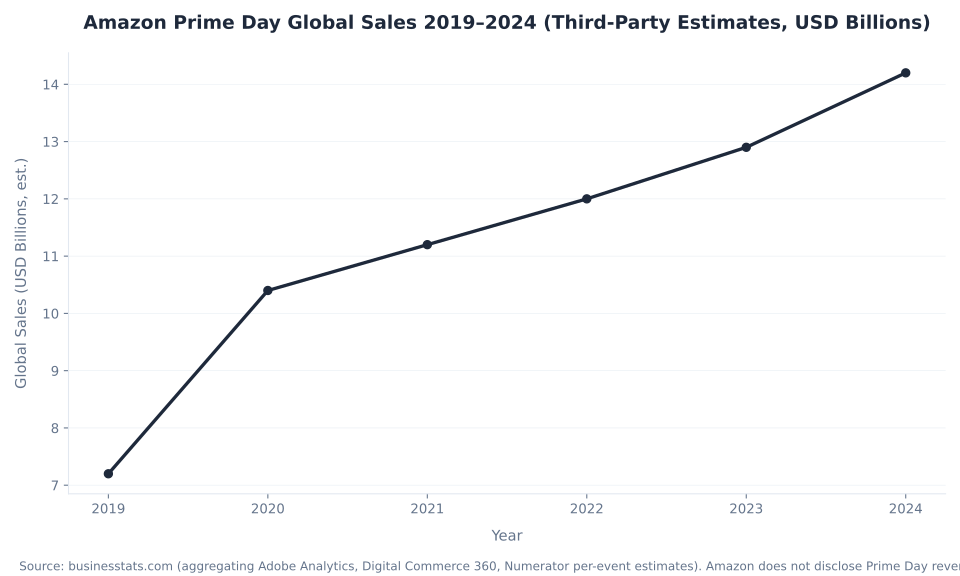
Peak-season context matters for ACOS interpretation. Amazon Prime Day 2026 moved to June 23–26—four days—and Day 1 US e-commerce sales reached $8.3 billion, +5.3% year over year (Adobe Analytics via Digital Commerce 360). With the full four-day event forecast at $26.3 billion (+9% YoY), a spike in ad spend and ACOS during that window is expected—not a signal to cut campaigns. Third-party estimates of global Prime Day sales show the event has grown from $7.2 billion in 2019 to $14.2 billion in 2024 (businesstats.com, aggregating Adobe Analytics, Digital Commerce 360, Numerator; Amazon does not disclose Prime Day revenue).
| Year | Event timing | Global sales est. (USD B) | YoY growth |
|---|---|---|---|
| 2019 | July, 2-day | $7.2B | — |
| 2020 | October (COVID-19 delay), 2-day | $10.4B | +44% |
| 2021 | June, 2-day | $11.2B | +8% |
| 2022 | July, 2-day | $12.0B | +7% |
| 2023 | July, 2-day | $12.9B | +7.5% |
| 2024 | July, 2-day | $14.2B | +10% |
Source: businesstats.com aggregating Adobe Analytics, Digital Commerce 360, Numerator per-event estimates. Amazon does not disclose Prime Day revenue — all figures are third-party estimates with ±8–20% margin of error. 2020 event held in October due to COVID-19. 2026 Day 1 US-only figure ($8.3B) excluded — different scope (US only, single day, Adobe Analytics methodology).
Amazon Prime Day Global Sales 2019–2024 (Third-Party Estimates, USD Billions)
The 2026 Amazon Seasonal Campaign Calendar
Amazon's 2026 peak season moved earlier: Prime Day shifted from July to June 23–26, creating a first half dominated by Big Spring Sale (March) and a summer Prime Day. The second half follows the BFCM structure, with CPCs at their annual high. For every event, the work that produces results happens in the lead-up—organic rank and ad relevance scores are built over weeks, not hours.
| Event | 2026 window | The lead-time move |
|---|---|---|
| Big Spring Sale | Mar 25–31, 2026 (open to all shoppers) | Build deal pages and ramp branded-keyword bids 2 weeks prior; first major Q1/Q2 demand spike |
| Prime Day | Jun 23–26, 2026 (moved to June; 4 days; Prime-member event) | Run awareness build-up 2–4 weeks before; raise budgets and defensive bids during; harvest the post-event remarketing window |
| Prime Big Deal Days | Early–mid October 2026 (exact date not yet announced) | Q4 kickoff event; lock creative and budget caps before the date drops; momentum carries into BFCM |
| Black Friday | Nov 27, 2026 | Highest CPCs of the year; enforce strict negatives and placement focus; avoid running out of budget before noon |
| Cyber Monday | Nov 30, 2026 | Extend BFCM budgets through the weekend; the single largest digital-sales day concentration of the year |
| Q4 long tail | Through late December + early Jan (gift-card redemptions) | Shift to fast-ship messaging; maintain spend through the post-holiday gift-card redemption spike |
Sources: About Amazon "Prime Day 2026" (Jun 23–26; moved to June), aboutamazon.com/prime-day; CNBC Select "Amazon's Big Spring Sale 2026" (Mar 25–31), cnbc.com; Trellis "Amazon Peak Season 2026" (Prime Big Deal Days October; Black Friday Nov 27 / Cyber Monday Nov 30). Prime Big Deal Days 2026 exact date not officially announced as of June 2026 — confirm before campaign launch.
Budget planning benchmarks for peak events come from Perpetua's seasonal framework: Big Spring Sale typically requires +50–75% vs. regular spend; Prime Day +150–300%; and the BFCM window +200–400% (Perpetua). These are editorial planning guides, not data from a multi-advertiser study. Top Prime Day and BFCM keywords see 20–40% higher CPCs than baseline; category leaders in competitive verticals see spikes of 40–60% above baseline at major events (Epinium). A seller who enters Prime Day without campaigns already active, bids pre-raised, and budgets pre-doubled is starting the race behind.
For seasonal peak planning support across DTC categories, see fashion PPC services, electronics PPC services, kitchen appliances PPC services, and pet supplies PPC services.
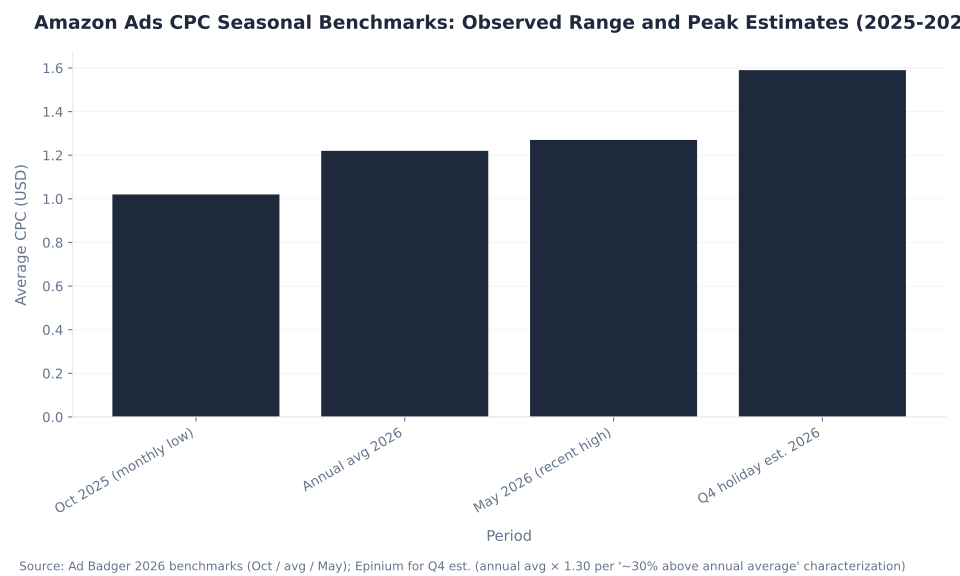
Amazon Ads CPC Seasonal Benchmarks: Observed Range and Peak Estimates (2025-2026)
Creative Asset Optimization: Specs and the AI Production Layer
Creative optimization on Amazon operates on two layers: the technical specifications that govern what is eligible to serve, and the AI tools that now produce creative at no media cost. Both matter. A well-specified creative that does not convert is waste; an AI-generated creative that fails spec review never serves.
Sponsored Brands Video auto-plays muted in search results, making burned-in captions effectively required. The format specification: MP4 or MOV, under 500 MB, 16:9 at 1920×1080, between 6 and 45 seconds. For custom lifestyle images in Sponsored Brands campaigns, Amazon guidance specifies the product as the clear focal point, occupying at least 40% of the frame, at a minimum image dimension of 1,200×628 pixels (EzCommerce). Confirm all specs against the live Amazon Ads creative specs page before launch—specs change.
| Format | Spec / requirement | Practitioner note |
|---|---|---|
| SBV video file | MP4 or MOV; <500 MB; 16:9; 1920×1080; 6–45 sec | Plays muted — burned-in captions are required for message delivery |
| SBV custom thumbnail | JPG or PNG; 1200×628 min; <1 MB | Shown before autoplay; should reinforce the product, not a generic lifestyle scene |
| SB custom lifestyle image | 1200×628 min; product occupying ≥40% of frame | Product must be the visual focal point; ambient lifestyle elements are secondary |
| SP main image | White background; product filling ≥85% of frame; ≥1000px on longest side | Non-compliant main images trigger listing suppression and kill all ad delivery |
Sources: Amazon Ads SBV ad specs (MP4/MOV, 500MB, 1920×1080); EzCommerce (40% frame, 1200×628 custom image guidance). Confirm against live Amazon Ads spec page before launch.
Creative Studio (generally available since October 15, 2024) generates display, video, audio, and Streaming TV creative from a conversational brief, built on AWS Bedrock with Amazon Nova and Anthropic Claude as foundation models (per About Amazon). Creative Agent (open beta since November 11, 2025, US-first) extends this to agentic production: conversational brief input, with beta capability of 10–15 ad variations per product in under five minutes (novadata.io, citing Creative Agent beta). The practical implication: the cost of producing a video creative is collapsing toward zero. The durable edge shifts to brief quality and brand judgment—knowing what good looks like and editing the machine's output.
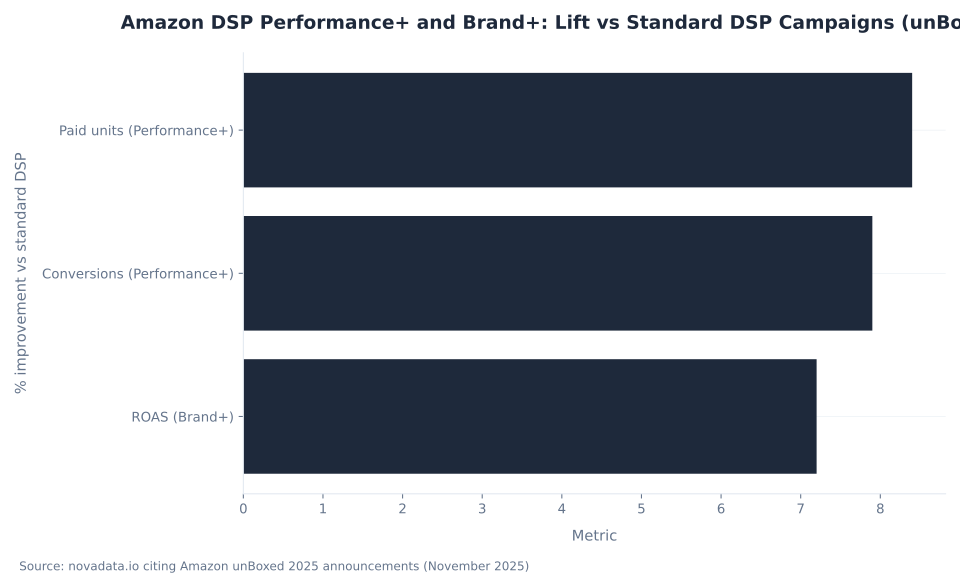
Amazon DSP Performance+ and Brand+: Lift vs Standard DSP Campaigns (unBoxed 2025)
Amazon Ads CPC Benchmarks: What You Actually Pay in 2026
Amazon does not publish platform-wide CPC data. The two closest independent sources: Ad Badger (based on millions of bids optimized daily from its managed-campaign user base) and Epinium (broader advertiser sample). Both show a 2026 average CPC in the $1.18–$1.22 range, up roughly $0.10 from 2025 (Ad Badger; Epinium).
| Period | Average CPC (USD) | Source / note |
|---|---|---|
| Oct 2025 (observed monthly low) | $1.02 | Ad Badger active-campaign dataset |
| Annual average 2026 | $1.22 | Ad Badger; +$0.10 YoY vs. 2025 |
| May 2026 (recent observed high) | $1.27 | Ad Badger; reflects pre-Prime Day budget ramp |
| Q4 holiday est. (Nov–Dec 2026) | $1.35–$1.45 | Epinium: "~30% above annual average"; range calculated at $1.22 × 1.30 |
Ad Badger 2026 benchmarks (Oct low, annual avg, May high — Ad Badger user base only, not platform-wide Amazon data). Epinium (Q4 est.; annual avg alternative: $1.18; category leaders 40–60% spike above baseline at major events). Amazon does not publish CPC data. Q4 est. is calculated from Epinium's characterization — not a guarantee for any individual advertiser.
The seasonal range matters as much as the annual average. Ad Badger's observed monthly low in October 2025 was $1.02; the May 2026 high of $1.27 reflects pre-Prime Day budget ramp ahead of the June 23–26 event. During peak events, head terms in competitive categories clear $2.50–$4.00 per click even as the blended platform CPC stays at $1.22. The 20–40% CPC spike on top Prime Day and BFCM keywords (Trellis) is a separate phenomenon from the annual average and explains why categories with aggressive head-term bidding see disproportionate cost spikes during events.
For CPC dynamics by DTC vertical, see beauty products PPC services, supplements & nutrition PPC services, and food & beverage PPC services—categories where auction pressure and CPC dynamics vary significantly from the platform average.
Amazon's AI & Automation Stack: Current Names and Status (Mid-2026)
Amazon's advertising AI is not a single product—it is a named stack at different maturity stages. The table below is the anti-drift reference for mid-2026: correct product names, what each tool does, and current status. It supersedes any source that calls Amazon's AI campaign type "Performance Max" (that is Google's product) or describes Rufus as a live Amazon assistant (retired May 13, 2026).
| Tool | What it does | Status (mid-2026) |
|---|---|---|
| DSP Performance+ | AI conversion-focused DSP campaign on Amazon's AdRelevance predictive model; ~4-click setup; handles audience selection, bidding, pacing | Live globally (since early 2025); enhanced at unBoxed 2025. NOT "Performance Max" — that is Google's product |
| DSP Brand+ | AI awareness/consideration DSP campaign; consideration tactics added December 2025; upper-funnel counterpart to Performance+ | Live globally |
| Ads Agent | Agentic assistant: recommends audiences and keywords, adjusts campaign pacing across hundreds of campaigns simultaneously, writes AMC SQL from natural-language prompts | Open beta from unBoxed (Nov 11, 2025); US-first |
| Creative Studio + Creative Agent | Generative AI creative — display, video, audio, Streaming TV — from a conversational brief; built on AWS Bedrock (Amazon Nova + Anthropic Claude per Amazon) | Creative Studio GA (Oct 15, 2024); Creative Agent open beta (Nov 11, 2025), US-first, global expansion 2026 |
| AMC Skills (via Ads Agent) | Natural-language layer over Amazon Marketing Cloud — converts plain-English questions into SQL, builds audiences; removes the "must know SQL" barrier to AMC | Announced unBoxed 2025; beta US |
| Alexa for Shopping (replaced Rufus) | AI shopping assistant in the main Amazon search bar; answers questions, generates AI overviews, side-by-side comparisons; accessible without Prime or Echo device | Rufus retired May 13, 2026; ad placements inside responses rolling out. Do not describe Rufus as current |
| Alexa+ Agentic Ads | In-conversation format where a shopper completes a purchase without leaving the Alexa interface; beta with Papa John's and The Orchard (Sony) | Announced Cannes Lions June 2026; newly launched beta — describe as forward-looking |
Sources: Amazon Ads DSP Performance+; Amazon Ads — Ads Agent; Amazon Ads — Creative Agent; About Amazon (Bedrock — Nova + Claude); CNBC (Rufus retired May 13, 2026); Digiday (Alexa+ Agentic Ads, Cannes 2026). Re-verify all tool names, status, and dates at publish — this is the fastest-aging content in the pillar.
DSP Performance+ runs on Amazon's AdRelevance predictive model, which stitches shopping signals, Prime Video behavior, Subscribe & Save data, and Alexa interaction history into a conversion probability score. At Amazon unBoxed 2025, Amazon reported Performance+ delivered +8.4% paid units and +7.9% conversions vs. standard DSP campaigns; Brand+ delivered +7.2% ROAS (novadata.io, citing Amazon's unBoxed 2025 announcements — not independently audited). The H&R Block case study at unBoxed 2025 showed +144% full-funnel conversion lift and -35% cost per acquisition vs. prior DSP campaigns (novadata.io, citing H&R Block at the event — a mature advertiser result, not a typical SMB baseline). Amazon DSP's share of total Amazon ad spend grew from 17.7% to 23.4% year over year, with DSP driving 36.5% new-to-brand sales in Q1 2025 in the US (novadata.io). DSP Performance+ and Brand+ are Amazon DSP products; the Amazon-managed DSP path for brands ready to move beyond Sponsored Products is covered in Amazon DSP & Streaming TV. For DTC brands in relevant verticals, see home goods PPC services and mattress & sleep PPC services.
Ads Agent and Creative Agent: What Amazon's Agentic Layer Actually Does
Ads Agent (open beta since November 11, 2025, US-first) is Amazon's agentic campaign management assistant. It recommends audiences and keywords, adjusts pacing across hundreds of campaigns simultaneously, and writes Amazon Marketing Cloud SQL queries from natural-language prompts—eliminating the SQL barrier to AMC analysis (Amazon Ads).
Early beta testers reported 30–40% time savings on campaign management tasks and 12–18% ACOS improvement via AI-driven bid optimization (novadata.io, citing unnamed beta testers—not an Amazon-verified controlled study; attribute accordingly and confirm current status at publish). AMC Skills—the natural-language query layer Ads Agent enables—means a seller who previously needed SQL to build a "clicked-but-did-not-convert" retargeting audience in Amazon Marketing Cloud can now request it in plain English. For the full AMC and attribution context, see Amazon Ads reporting & attribution.
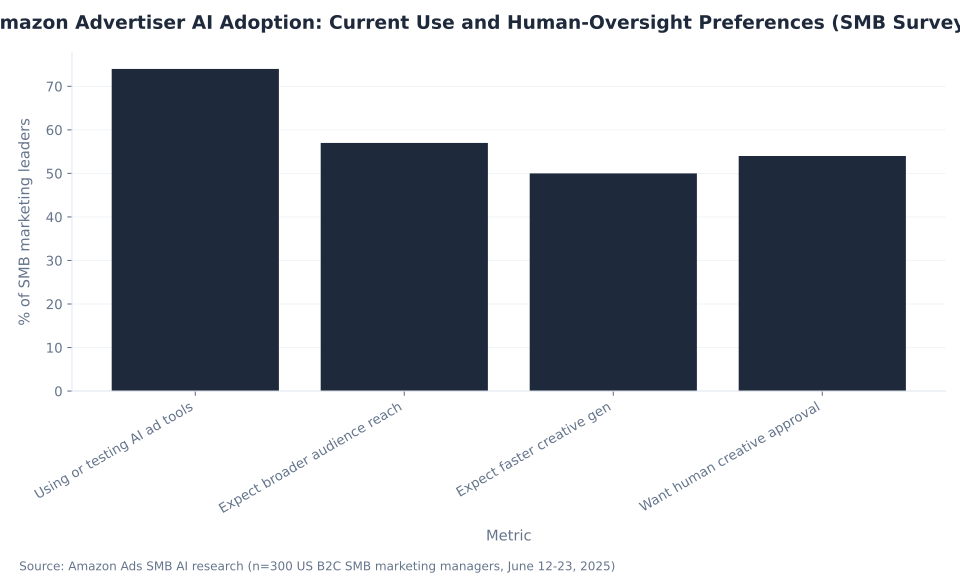
Amazon's SMB research (n=300 US B2C marketing managers, June 12–23, 2025, part of a 4,100-person global study) documents the advertiser-side reality: 74% of SMB marketing leaders are already using or testing AI advertising tools, saving an estimated 5.6 hours per week—roughly 30 working days per year. Simultaneously, 35% feel overwhelmed by the available AI tool options, and 43% lack clarity on where to start (Amazon Ads SMB AI research, 2025).
| Metric | % of SMB marketing leaders |
|---|---|
| Currently using or testing AI advertising tools | 74% |
| Expect AI to improve audience reach | 57% |
| Expect AI to accelerate creative content generation | 50% |
| Want human final approval over creative content | 54% |
| Want human control over budget allocation decisions | 41% |
| Want human judgment on cultural/emotional context | 34% |
| Feel overwhelmed by available AI tool options | 35% |
Source: Amazon Ads, "SMBs predict accelerated growth with AI advertising tools" (n=300 US B2C SMB marketing managers; June 12–23, 2025; part of a 4,100-person global study across 14 countries). Self-reported expectations — not measured campaign outcomes. Amazon commissioned this research.
The 54% who want human final approval over creative and the 41% who want human budget control are identifying exactly the right boundary. Creative Agent produces 10–15 ad variations in under five minutes; without brand judgment to select and refine those variations, the output is statistically average. Average creative in a category where every competitor uses Creative Agent is not a differentiator. The strategy and the guardrails stay human. For DTC brands managing Amazon across beauty, supplements, and home categories, see beauty products PPC, supplements & nutrition PPC, and home goods PPC.
Amazon Advertiser AI Adoption: Current Use and Human-Oversight Preferences (SMB Survey 2025)
Managed Amazon Ads
Your impressions are flat. Your ACOS is climbing. We know which lever to pull first.
MB Adv Agency manages retail-media campaigns for DTC brands across beauty, supplements, electronics, pet supplies, and home goods. If your campaigns are underperforming, the root cause is usually one of three things—and we find it fast.
What Amazon's AI Does Not Replace: Strategy and Guardrails
The honest assessment of Amazon's agentic AI layer in 2026: it handles mechanical, high-volume work at scale—pacing, query-writing, first-draft creative, broad DSP prospecting—and it does that work tirelessly and without coordination cost. What it does not handle is strategy.
Strategy in Amazon Ads means decisions that require context the algorithm does not have. A product with a 45% margin tolerates a different ACOS ceiling than one at 18%. A brand in launch mode accepts temporary ACOS inefficiency to capture a ranking position that pays out over two years. A mature ASIN with a review moat defends its position differently than a new entrant still building velocity. Performance+ optimizes for conversions given a budget and a goal; it does not know that this specific product's margin structure makes a 30% ACOS the correct target for the next 90 days.
The 54% of SMB advertisers who want human final approval over creative content (Amazon Ads SMB survey, 2025) are drawing the right boundary. Creative Agent produces 10–15 variations in minutes—but without brand judgment to select and edit those variations, the output is statistically average. In a category where every competitor runs Creative Agent, average output is the floor, not the edge.
MB Adv Agency's operating view on automation: hand the AI the work it executes at scale and consistency no human team can match—pacing across hundreds of campaigns, negatives-at-volume across a large account, DSP prospecting on AdRelevance, first-draft creative variations. Keep ownership of the decisions that require brand and margin context: target ACOS by product lifecycle stage, brand defense logic, margin floors, and the judgment of when to let a Performance+ campaign run wide versus when to cap spend while the underlying listing quality is rebuilt. Automation removes the busywork. It does not remove the need for someone who knows what "good" means for a specific brand, category, and competitive position.
For DTC brands managing Amazon alongside other paid channels, see handbags & accessories PPC, furniture PPC, and eyewear & sunglasses PPC.
Three Misconceptions About Amazon Ads That Waste Budget
These are the most common misdiagnoses in Amazon advertising. Each one directs sellers toward a fix that does not address the actual problem—and actively makes the account worse.
Misconception 1: "Low impressions mean I should raise my bid." Usually false, and the misdiagnosis wastes time and money. The correct first question is not "is my bid high enough?" but "is my listing even eligible to serve?" A seller who does not hold the Featured Offer, whose product is out of stock, or whose listing is suppressed for a policy violation will see zero impressions regardless of bid level. Raising the bid in those scenarios achieves nothing. And dynamic bidding—Amazon's default—can suppress delivery without any change to the bid you entered. The delivery-gate model (eligibility → bid → budget → keyword relevance) is the correct mental model. Keyword relevance is the last item to check, not the first (Five Star Commerce; AdLabs).
Misconception 2: "Amazon's automated campaign type is called Performance Max." Performance Max is a Google product. Amazon's AI-driven, conversion-optimized campaign type lives in Amazon DSP and is called Performance+. Its awareness-focused counterpart is Brand+. Both run on Amazon's AdRelevance model, which draws on shopping, streaming, Subscribe & Save, and Alexa data—not the Google Signals and Asset Groups that define Performance Max (Amazon Ads). The two names are not interchangeable, and writing "Performance Max" in an Amazon Ads context is a tell that the content was assembled from Google training data.
Misconception 3: "Rufus is Amazon's AI shopping assistant." Amazon retired the standalone Rufus chatbot on May 13, 2026, replacing it with Alexa for Shopping—an AI assistant embedded in the main Amazon search bar, accessible to any signed-in US customer without a Prime membership or Echo device (CNBC; Canopy Management). Alexa for Shopping answers shopping questions, generates AI product overviews, and offers side-by-side comparisons. Ad placements inside its responses are rolling out in 2026. Alexa+ Agentic Ads—the format that lets a shopper complete a purchase entirely within the Alexa conversation—was announced at Cannes Lions June 2026 with beta partners Papa John's and The Orchard (Digiday; MediaPost). Any article that still names Rufus as a live Amazon product is factually wrong as of May 13, 2026.
Frequently Asked Questions
Why are my Amazon Sponsored Products ads not getting impressions?
Amazon Sponsored Products ads stop serving for four reasons, checked in this order: you do not hold the Featured Offer (Buy Box), your product is out of stock, your daily budget is exhausted, or the keyword you're targeting lacks relevance to the listing. The Featured Offer requirement is the most common silent blocker—Sponsored Products ads run only to the seller who holds the Buy Box on a given ASIN. A seller who is not the Buy Box winner, even as the only seller on the listing, will see zero impressions regardless of bid. Out-of-stock items pause automatically. Budget exhaustion appears as a mid-day flatline in the impression graph; check the "out of budget" flag in the Sponsored Products console. Dynamic bidding (Amazon's default) can also suppress delivery by reducing your bid on clicks it predicts will not convert—switch to Fixed bids to verify the bid you entered is entering the auction. Amazon surfaces the eligibility and budget checks in the Diagnostics view inside the Sponsored Products console. Run that first before adjusting keywords or creative.
What is a good ACOS for Amazon Ads?
There is no universal good ACOS—the correct target is your break-even ACOS, which equals your profit margin percentage. If your margin is 35%, any ACOS below 35% is profitable on ads; above 35% loses money. A $1.22 average CPC (Ad Badger 2026 benchmarks) translates to different break-even points by product price and conversion rate. Before cutting spend on a high-ACOS campaign, check your TACOS (total ad spend ÷ total store revenue including organic sales). A campaign running at 30% ACOS with a 10% TACOS is building organic rank and generating free traffic as a byproduct—cutting it destroys that momentum. ACOS is an ad-efficiency metric; TACOS is the business-health metric. The two numbers together define whether a campaign is working, not ACOS alone. Category benchmarks vary: competitive categories (supplements, electronics, beauty) run materially different ACOS ranges from less competitive niches. Break-even ACOS calculations by margin and the full ACOS/ROAS/TACOS framework are in the Amazon ACOS, ROAS & metrics guide.
What is the difference between ACOS and TACOS on Amazon?
ACOS (Advertising Cost of Sale) measures ad efficiency: ad spend ÷ ad-attributed sales. If you spend $100 generating $400 in ad-attributed sales, ACOS is 25%. TACOS (Total Advertising Cost of Sale) measures business health: total ad spend ÷ total store revenue including organic sales not attributed to ads. If that same $100 in ads accompanies $600 in organic store revenue, TACOS is 10% ($100 ÷ $1,000). A seller who cuts ad spend because ACOS looks high, without checking TACOS, destroys the paid-traffic flywheel that builds organic ranking momentum. Paid ads drive keyword rank; rank drives free organic traffic; organic traffic reduces TACOS even as ACOS stays elevated. ACOS tells you whether each ad dollar is efficient. TACOS tells you whether advertising benefits the entire business. In launch mode, running an above-break-even ACOS to accelerate ranking is the correct strategy—TACOS is the metric that validates or refutes it. If TACOS is falling or stable, the flywheel is working.
Is Rufus still Amazon's AI shopping assistant?
No. Amazon retired the standalone Rufus chatbot on May 13, 2026, replacing it with Alexa for Shopping—an AI assistant embedded in Amazon's main search bar, accessible to any signed-in US customer without a Prime membership or Echo device (CNBC; Canopy Management). Alexa for Shopping draws on Alexa conversation history across all Echo devices—not just Amazon shopping history—and provides AI-generated product overviews, side-by-side comparisons, and question-answering directly in the search bar. Before retirement, Rufus had reached over 300 million customers (Canopy Management, citing Amazon's announcement context). The Rufus recommendation and shopping-history signals were folded into Alexa for Shopping at the time of the transition. For advertisers, the relevant development is ad placements inside Alexa for Shopping's responses, which are rolling out across 2026. Alexa+ Agentic Ads—an in-conversation format where shoppers complete purchases without leaving the Alexa interface—was announced at Cannes Lions June 2026. Any article describing Rufus as a live product is factually wrong as of May 13, 2026.
What is Amazon Performance+ and how is it different from Performance Max?
Performance+ is an Amazon DSP campaign type optimized for conversions, built on Amazon's AdRelevance predictive model. AdRelevance combines shopping signals, Prime Video behavior, Subscribe & Save data, streaming history, and Alexa interactions into a conversion probability score. Performance+ campaigns set up in about four clicks—campaign type, budget, conversion goal, creative—with the model handling audience selection, bidding, and pacing. At Amazon unBoxed 2025, Amazon reported Performance+ delivered +8.4% paid units and +7.9% conversions vs. standard DSP campaigns (novadata.io, citing Amazon's announcement—not independently audited). Brand+ is Performance+'s awareness-focused counterpart, adding consideration tactics in December 2025. Performance Max is an entirely different product from an entirely different platform: Google's AI-driven campaign type running across Search, Display, YouTube, Gmail, and Discover. The two names are not interchangeable. Performance+ is Amazon. Performance Max is Google. They share no infrastructure, no data model, and no auction mechanics. Writing "Performance Max" for Amazon is a reliable indicator of Google-ads content applied to the wrong platform.
How does the search term to negatives workflow work on Amazon?
Pull the Search Term Report from the Amazon Ads console for the trailing 60 days—longer if the campaign is low-volume. The report shows every actual customer search query that triggered your ad and received a click, along with clicks, spend, and conversions for each query. Filter for queries with spend above a defined threshold and zero conversions—a common starting point is 1× your target cost-per-order. Every query meeting that filter is a candidate for negative exact match. Add each as a negative keyword at the campaign or ad group level. Simultaneously, filter the same report for queries with spend and at least one conversion that you are not currently targeting in a manual exact-match campaign—those are graduation candidates. Add them to a manual campaign with a bid calibrated to your target ACOS. Repeat this process weekly, not monthly. Wasted spend compounds daily; a monthly cadence wastes three weeks of budget on queries you would have negated on day seven. De-duplicate auto and manual campaigns with cross-negatives to prevent them bidding against each other.
Retail Media Audit
Impressions stalled. ACOS climbing. Wondering which Amazon AI tools are worth turning on?
We help DTC brands diagnose Amazon campaign health, implement the search-term-to-negatives discipline, set up Performance+ and Brand+, and navigate the shift from Rufus to Alexa for Shopping.
Get a retail-media audit →Methodology
This pillar consolidates six absorbed pages covering Amazon Ads troubleshooting, ACOS debugging, creative asset optimization, seasonal campaign planning, AI/automation, and emerging features. Data sources: Ahrefs keyword data (June 2026, US); Ad Badger 2026 Amazon Ads benchmark dataset (millions of optimized bids; Ad Badger user base, not platform-wide); Epinium CPC benchmark analysis; Amazon Ads SMB AI research (n=300 US B2C SMB marketing managers; June 12–23, 2025; part of a 4,100-person global study); novadata.io citing Amazon unBoxed 2025 announcements (Performance+ and Brand+ lift figures; Ads Agent beta metrics); Adobe Analytics via Digital Commerce 360 (Prime Day 2026 Day 1 US e-commerce data); businesstats.com aggregating Adobe Analytics/DC360/Numerator (Prime Day global estimates 2019–2024); Trellis and Perpetua seasonal planning frameworks; Amazon Ads product documentation (advertising.amazon.com). All CPC and lift figures are attributed to named vendors—Amazon does not publish CPC or sales benchmarks. No MB Adv Agency client metrics appear in this pillar; all MB Adv POV is qualitative. Last updated: June 2026. Reviewed by MB Adv Agency, June 2026.

As a Google Ads expert, I bring proven expertise in optimizing advertising campaigns to maximize ROI.
I specialize in sharing advanced strategies and targeted tips to refine Google Ads campaign management.
Committed to staying ahead of the latest trends and algorithms, I ensure that my clients receive cutting-edge solutions.
My passion for digital marketing and my ability to interpret data for strategic insights enable me to offer high-level consulting that aims to exceed expectations.
Google Partner Agency
We're a certified Google Partner Agency, which means we don’t guess — we optimize withGoogle’s full toolkit and insider support.
Your campaigns get pro-level execution, backed by real expertise (not theory).

4.9 out of 5 from 670+ reviews on Fiverr.
That’s not luck, that’s performance.
Highly recommend Matteo to set up your server side tracking. He has a deep understanding of e-commerce tracking and will go above and beyond to make sure everything is set up correctly and working 100%. If you are scaling your store this set up is non-negotiable in my opinion and there isn't many people who have this much knowledge or put the effort in to get it right. Thanks again!
avorodesign.com
I can only recommend Matteo! He was very patient, professional and very knowledgeable about GA4, Consent Mode v2, and GDPR compliance. Communication was clear, and the setup was done professionally and efficiently. Highly recommend him for anyone needing reliable tracking implementation.
www.natureiki.life
Matteo shines in the realm of online professionals. His work is not only deep in data but also complemented by his proactive communication and cooperation, setting a new standard for freelancers. If you want someone who truly exceeds expectations, look no further. Highly recommended!

www.omanbeverlysmyth.com
Exceptional Service Beyond Expectations - Outstanding Service Impeccable depth, flawless delivery, and exceptional language fluency—this service exceeded all expectations. Highly recommended. Matteo truly ROCKS!!!
ium-paris.com
Top-notch, always highly value working with Matteo. An absolute Google Ads Genius. This is approximately the 8th time I have hired him and he's helped us get 6-7 ROAS. We are excited in continuing to improve our lead flow. Hire this guy if you need Google Ads help. Thanks Matteo!

www.dleeventgroup.com
I finally found the guy who can setup server side tracking and all the ecosystem properly. I definitely recommend Matteo. He is very responsive, kind and wants to dig into things. He configured GA4, Meta, Google Ads, Outbrain and google consent v2 with Cookiebot. Thanks Matteo.

inomega.fr
MB Adv delivered exceptional work with outstanding professionalism and lots of patience, taking time to see effects of changes made and not just do the work and submit it. The proactive communication and video summaries of the work completed made working with Matteo a pleasure, as he consistently went above and beyond. Highly recommended for web analytics projects! We are already working on another project.

www.withnellsensors.co.uk
Working with Matteo on my Google Ads was a game-changer. He's not just a strategist, he's a true partner. He understood my goals and tailored a campaign that perfectly reached my target audience. I'm grateful for his expertise and dedication.
dccargo.com
Click-driven mind
with plastic-brick obsession.
We build Google Ads campaigns with the same mindset we use to build tiny brick worlds: strategy, patience, and zero tolerance for wasted pieces.
Data is our blueprint. Growth is the only acceptable outcome.