Amazon Ads Metrics: ACOS, ROAS & TACOS (2026)

Cross-category median ACOS — Amazon Sponsored Products (Autron, 2026)
32.48%
Healthy or not depends on your margin — not the average.
$1.18
Avg CPC (Ad Badger 2026)
0.59%
Avg CTR (Autron 2026)
11.55%
Avg CVR (Autron 2026)
Source: Autron, "Amazon PPC Benchmarks by Category (2026)," June 2026. Ad Badger 2026 avg ACOS: 29.6% (account-level portfolio). Vendor estimates — not mbadv data.
What Is ACOS on Amazon? Formula, Definition & What It Measures
ACOS (Advertising Cost of Sales) = ad spend ÷ ad revenue × 100. It measures how many cents you spent in ads for every dollar of ad-attributed sales. Amazon's official ACOS guide confirms the formula with a worked example: $50 ad spend ÷ $100 ad revenue = 50% ACOS. Lower ACOS means your ads generated more revenue per dollar spent.
ACOS is a channel-efficiency ratio, not a profitability statement. It only sees ad-attributed sales — not organic sales, not your cost of goods, not Amazon referral fees or FBA costs. As of January 1, 2026, Amazon replaced its 14-day view-through attribution window with a shopping-signal enhanced last-touch model, so the "ad revenue" in your ACOS calculation now reflects that model by default. The mechanics behind that change — and what it means for historical comparisons — are covered in Amazon Ads reporting and attribution. The short version: a campaign’s ACOS from before January 2026 is not directly comparable to its post-January figure.
The most expensive misconception in Amazon advertising is that a lower ACOS is always better. It is not. There is a ceiling on how low ACOS should go, and that ceiling is your break-even ACOS — the ACOS at which the ad generates zero profit. An ACOS well below break-even means you are under-investing in visibility you can profitably afford. The break-even identity, verified against Amazon’s own guide: break-even ACOS = your pre-ad profit margin. A product with a 36% pre-ad margin can run up to 36% ACOS and still break even on the ad. Driving it to 15% when the margin is 36% leaves profitable reach on the table.
Key Takeaways
- ACOS = ad spend ÷ ad sales × 100. ROAS = ad sales ÷ ad spend. They are arithmetic reciprocals: 25% ACOS = 4× ROAS, 20% ACOS = 5× ROAS.
- Break-even ACOS equals your pre-ad profit margin — not 100%. 100% ACOS means ad sales equal ad spend before product costs; your actual break-even is your margin percentage.
- TACOS (total ad spend ÷ total sales) is the strategic health metric. Falling TACOS at stable spend means organic sales are compounding faster than ad spend — the flywheel working.
- CVR on Amazon = orders ÷ clicks (not impressions — that is CTR’s denominator).
- Search-term impression share is paid SOV only — your share of ad impressions for a term, not organic results. Third-party tools model total SOV separately.
- New-to-Brand metrics are not available on Sponsored Products. NTB requires Sponsored Brands, Sponsored Display, or Amazon DSP.
- No universal "good ACOS" exists. Amazon states this explicitly. The right target sits between your break-even ACOS and your desired net margin, set per campaign objective.
32.48%
Cross-category avg ACOS
(Autron medians, 2026)
$1.22
Avg CPC (Ad Badger 2026)
+$0.10 YoY
0.58%
Avg CTR (Ad Badger 2026)
Flat vs prior years
11.1%
Avg CVR (Ad Badger 2026)
Orders ÷ clicks
Sources: Ad Badger, "Amazon Advertising Benchmarks 2026"; Autron, "Amazon PPC Benchmarks by Category (2026)". Vendor estimates — not mbadv data.
Amazon Ads Metrics: Definitions & Formulas at a Glance
Every number on your Amazon Ads dashboard traces to one of nine metrics. The table below defines each one, states the exact formula, and shows what dimension of performance it measures. ACOS and ROAS encode the same information — they are reciprocals. TACOS adds the organic dimension that ACOS cannot see. SIS and NTB are the forward-looking metrics that predict whether your category position is strengthening or eroding.
| Metric | What it measures | Formula |
|---|---|---|
| ACOS (Advertising Cost of Sales) | Ad spend as % of ad-attributed sales. Lower = more efficient ad spend per dollar of sales. | Ad spend ÷ Ad revenue × 100 |
| ROAS (Return on Ad Spend) | Ad revenue returned per $1 of ad spend. The arithmetic reciprocal of ACOS. | Ad revenue ÷ Ad spend |
| Break-even ACOS | The ACOS at which the ad generates zero profit. Equals your pre-ad profit margin. | = Pre-ad profit margin % |
| TACOS (Total Advertising Cost of Sales) | Ad spend as % of total sales (ad + organic). Falling TACOS = organic flywheel compounding. | Total ad spend ÷ Total sales (ad + organic) × 100 |
| CPC (Cost Per Click) | Average price paid per click on a Sponsored ad. | Ad spend ÷ Clicks |
| CTR (Click-Through Rate) | Share of impressions that became clicks — creative and relevance signal. | Clicks ÷ Impressions × 100 |
| CVR (Conversion Rate) | Share of clicks that became orders — listing, price, and offer signal. | Orders ÷ Clicks × 100 |
| Search-Term Impression Share (SIS) | Your account’s share of all ad impressions for a search term (paid Share of Voice). Impression rank = ordinal position vs competitors. | Your impressions ÷ Total advertiser impressions for the term × 100 |
| New-to-Brand (NTB) | Ad-attributed order from a shopper with no purchase from the brand on Amazon in the prior 365 days. Not available on Sponsored Products. | % of orders NTB = NTB orders ÷ Total ad orders × 100 |
Sources: Amazon Ads, "What is ACOS?" (ACOS/ROAS formulas, break-even tied to margin); Amazon Ads, "New-to-brand metrics" (NTB definition, 365-day lookback); Perpetua, "Search Term Impression Share" (SIS = share of total ad impressions for a term). CVR = orders ÷ clicks (Amazon’s standard definition).
Three practical notes on formula precision. First, CVR on Amazon is orders divided by clicks — not impressions. Impressions are CTR’s denominator. Conflating them produces a CVR number that is 100× too small. Second, the "ad revenue" in every ACOS and ROAS calculation now uses Amazon’s 2026 default attribution model; pre-2026 figures used the 14-day view-through window. Third, impression share measures paid visibility only — Helium 10 and Pacvue model total SOV (including organic results) separately from Amazon’s SIS report, which covers paid placements only.
ACOS vs ROAS: The Same Number, Two Formats
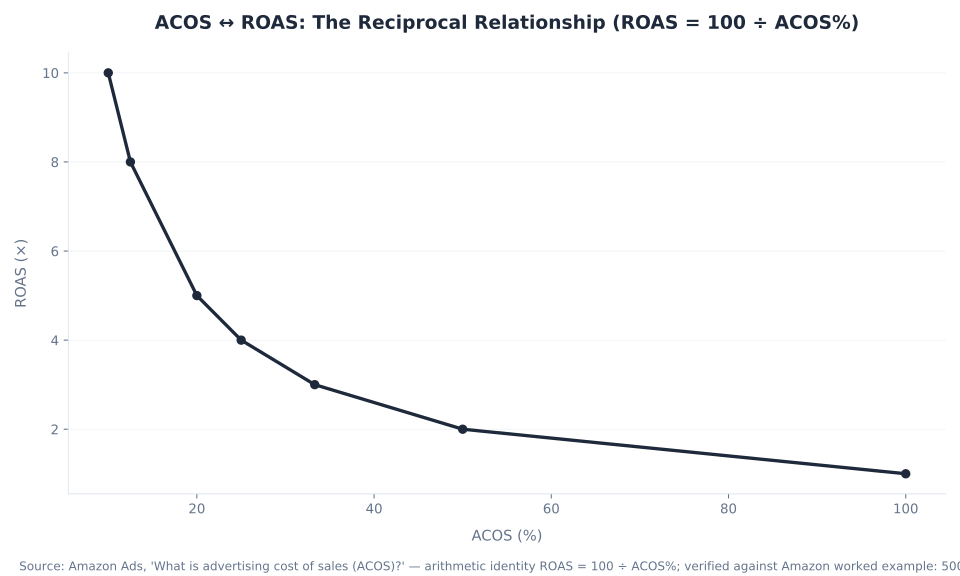
ACOS and ROAS are not two different metrics — they are the same efficiency ratio expressed in different units. ACOS is a percentage (spend as a share of revenue); ROAS is a multiplier (revenue per dollar of spend). The conversion formula is ROAS = 100 ÷ ACOS%, which means 25% ACOS = 4× ROAS, 20% ACOS = 5× ROAS, and 50% ACOS = 2× ROAS. Amazon’s official guide identifies ROAS as "the opposite of ACOS" and demonstrates the reciprocal with two worked examples.
| ACOS | ROAS | Read as |
|---|---|---|
| 10% | 10× | $10 of ad revenue per $1 spent |
| 12.5% | 8× | $8 per $1 |
| 20% | 5× | $5 per $1 |
| 25% | 4× | $4 per $1 — Amazon’s own worked example ($500 spend / $2,000 sales) |
| 33.3% | 3× | $3 per $1 |
| 50% | 2× | $2 per $1 — Amazon’s second worked example ($50 spend / $100 sales) |
| 100% | 1× | Ad sales equal ad spend — break-even on the ad transaction only, before product costs |
Source: arithmetic identity (ROAS = 100 ÷ ACOS%) verified against Amazon Ads, "What is ACOS?" (worked examples: $500/$2,000 = 25% ACOS = 4.0× ROAS; $50/$100 = 50% ACOS = 2.0× ROAS); corroborated by Brand Builder University, "ACOS vs ROAS".
The practical consequence of the reciprocal: inconsistency across tools is the only real risk. Sponsored Products campaigns default to ACOS in the Amazon console; DSP campaigns typically report in ROAS. A team that reads one report in ACOS and another in ROAS without converting can misread identical performance as a divergence. The metric that genuinely adds new information — because it includes organic sales that neither ACOS nor ROAS can see — is TACOS, covered in the section below. See Amazon Ads optimization and automation for how search-term harvesting and bid rules translate an ACOS target into spend decisions.
Break-Even ACOS: Why It Equals Your Profit Margin
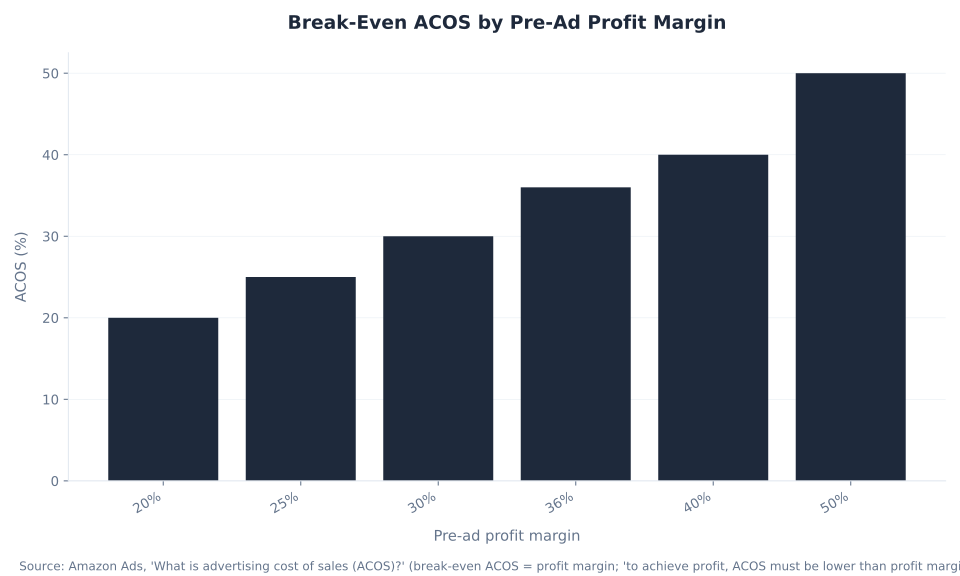
Break-even ACOS is the maximum ACOS you can run before the ad generates zero net profit from the sale. Amazon’s ACOS guide states this directly: "to achieve profit, the Amazon ACOS must be lower than the profit margin." The identity: break-even ACOS = pre-ad profit margin %. Pre-ad profit margin is what remains after subtracting COGS, referral fee, and FBA fees from the selling price — before subtracting ad cost.
The Feedvisor $25 product worked example. Feedvisor’s 2026 ACOS guide traces the calculation step by step: (1) Start with selling price: $25.00. (2) Subtract COGS + shipping: −$8.00. (3) Subtract Amazon referral fee (15%): −$3.75. (4) Subtract FBA fulfillment fee: −$3.86. (5) Subtract other variable costs: −$0.30. (6) Total non-ad costs = $15.91. Pre-ad profit = $25 − $15.91 = $9.09. Break-even ACOS = $9.09 ÷ $25 × 100 = 36.4%. To achieve a 15% net margin on this product, the target ACOS = 36.4% − 15% = 21.4%.
| Pre-ad profit margin | Break-even ACOS | Target ACOS to net ~10 pts margin |
|---|---|---|
| 20% | 20% | ≤10% |
| 25% | 25% | ≤15% |
| 30% | 30% | ≤20% |
| 36% (Feedvisor $25 product example) | 36.4% | ≤21.4% (for 15% net) |
| 40% | 40% | ≤30% |
| 50% | 50% | ≤40% |
Sources: Amazon Ads, "What is ACOS?" ("to achieve profit, ACOS must be lower than the profit margin" — establishes break-even = margin identity); Feedvisor, "Amazon ACoS 2026" ($25 product: COGS $8 + referral $3.75 + FBA $3.86 + other $0.30 = $15.91 total non-ad costs; pre-ad profit $9.09; break-even 36.4%; target 21.4% for 15% net). Third column is illustrative arithmetic only — actual target ACOS depends on campaign objective.
Break-even ACOS is not 100%. A 100% ACOS means ad sales equal ad spend — you broke even on the ad transaction alone, before accounting for the cost of the product. Your actual break-even is the pre-ad margin of the product.
Target ACOS is set between break-even and the desired net margin, deliberately, per objective. A launch campaign acquiring rank and reviews runs at or above break-even. A mature defense campaign on a high-review ASIN runs well below. Neither is wrong — the error is applying the same target ACOS to every campaign regardless of objective. Amazon Ads bidding and budgets covers how dynamic bidding and placement adjustments translate an ACOS target into bid and budget decisions.
ACOS ↔ ROAS: The Reciprocal Relationship (ROAS = 100 ÷ ACOS%)
What Is a Good ACOS on Amazon? 2026 Category Benchmarks
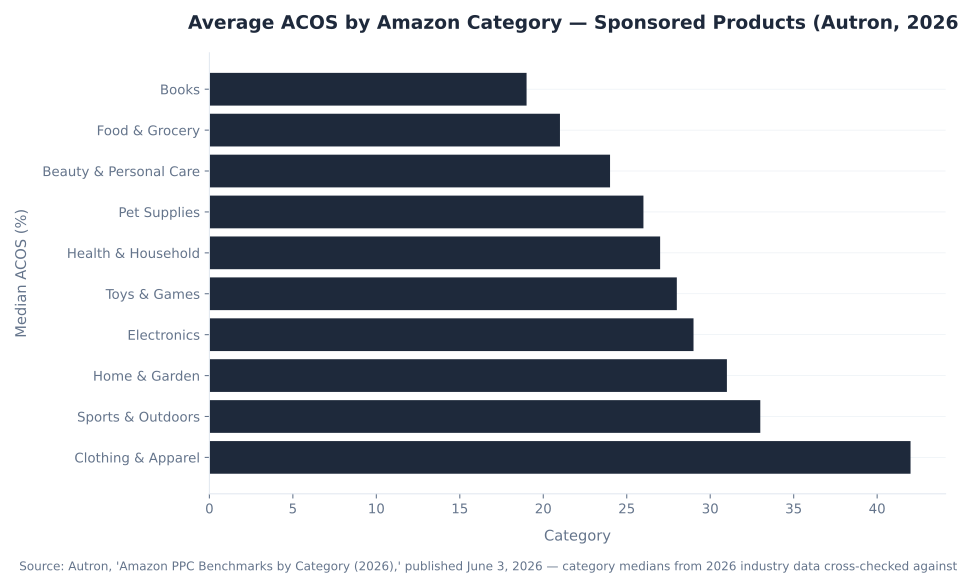
Amazon states explicitly: there is no specific number for a good ACOS. The correct benchmark is your own break-even ACOS (Table 3 above). Category medians from Autron’s June 2026 benchmark report provide a sanity check against competitors in the same space — not a target. A 38% ACOS in Clothing & Apparel (category median 42%) is outperforming the field; a 38% ACOS in Books (median 19%) signals a structural problem with bidding or listing quality.
| Category | Median ACOS | CPC | CTR | CVR |
|---|---|---|---|---|
| Books | 19% | $0.38 | 0.22% | 18.0% |
| Food & Grocery | 21% | $0.58 | 0.39% | 16.5% |
| Beauty & Personal Care | 24% | $1.18 | 0.47% | 15.2% |
| Pet Supplies | 26% | $0.91 | 0.43% | 14.0% |
| Health & Household | 27% | $1.05 | 0.41% | 13.8% |
| Toys & Games | 28% | $0.78 | 0.35% | 12.1% |
| Electronics | 29% | $1.45 | 0.28% | 9.5% |
| Home & Garden | 31% | $0.88 | 0.32% | 11.4% |
| Sports & Outdoors | 33% | $0.82 | 0.30% | 10.3% |
| Clothing & Apparel | 42% | $0.72 | 0.38% | 8.6% |
| Cross-category average | 32.48% | $1.18 | 0.59% | 11.55% |
Primary source: Autron, "Amazon PPC Benchmarks by Category (2026)," June 3, 2026 (category medians cross-checked against Autron managed accounts). Cross-checked against Ad Badger 2026 (account-level avg ACOS 29.6%, CPC $1.22, CTR 0.58%, CVR 11.1%) and Trellis 2026 (overall ACOS target 20–40%; CPC $0.75–$3.50+; CTR 0.3–0.6%; CVR 8–15%). Autron vs Ad Badger ACOS gap (32.48% vs 29.6%) is methodological: Autron weights by category median, Ad Badger by account volume. These are vendor estimates — not mbadv data.
Three structural patterns in the data. First, CVR and ACOS move inversely across categories: Books and Food & Grocery have the lowest ACOS and the highest CVR, because high purchase intent at low CPCs produces efficient conversion. Electronics runs 29% ACOS with only 9.5% CVR — high CPCs and comparison-shopping behavior compress the ratio. Second, the Clothing & Apparel median (42%) is an outlier driven by high return rates, broad keyword competition, and thin margins common in fashion PPC. Third, CPC is rising: Ad Badger reports CPC up ~$0.10 year-over-year, with a May 2026 peak of $1.27. CTR is flat for the first time since 2019 — competition has compressed visibility without compressing click rates further. Brands in beauty PPC, skincare PPC, and supplements & nutrition PPC face the highest CPC-to-margin pressure: Beauty median CPC $1.18 at a 24% category ACOS suggests margins in the 28–35% range to maintain profitability.
Break-Even ACOS by Pre-Ad Profit Margin
What Is TACOS? The Strategic Health Metric for Amazon Brands
TACOS (Total Advertising Cost of Sales) = total ad spend ÷ total sales (ad + organic) × 100. The "+ organic" in the denominator is what distinguishes TACOS from ACOS and makes it the strategic metric. Perpetua’s worked example: $2,500 ad spend ÷ $30,000 total sales = 8.33% TACOS. If that same account had $20,000 in ad-attributed sales, its ACOS would be 12.5% — a completely different picture of efficiency for the same ad spend.
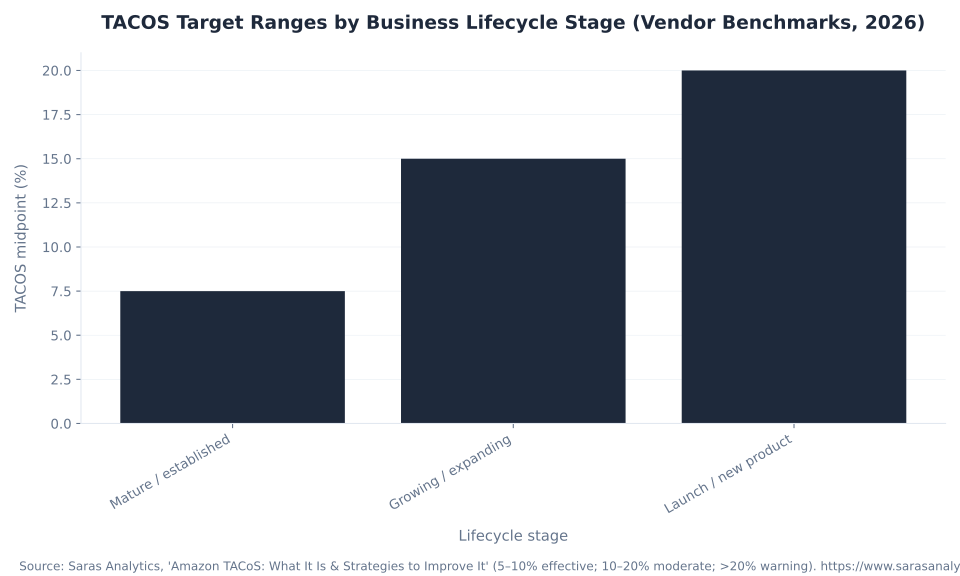
TACOS trend direction is the diagnostic. NovaData summarizes the interpretation: falling TACOS means organic sales are growing faster than ad spend — the Amazon flywheel is compounding. Rising TACOS at rising spend means ads are doing all the work and organic is flat. Saras Analytics adds the profitability framing: if TACOS falls below the organic profit margin, the overall business is profitable after advertising. No per-category TACOS dataset is publicly available; the lifecycle ranges below are directional vendor-cited figures from Saras, NovaData, and Perpetua.
| Brand stage | TACOS range | Interpretation | Source |
|---|---|---|---|
| Mature / established | 5–10% | Strong organic flywheel; ads support rank without carrying the business | Saras Analytics, NovaData |
| Growing / expanding | 10–20% | Investing in awareness; organic is building but ads still carry significant volume | Saras Analytics, NovaData |
| Launch / new product | 15–25%+ | Expected at launch; seeds rank and reviews. Vendors flag >20% as long-term warning sign | Saras Analytics, Perpetua |
| Concerning (any stage) | >25% | Over-reliant on paid; organic is not compounding at a sustainable rate | NovaData |
Sources: Saras Analytics, "Amazon TACoS" (5–10% effective; 10–20% moderate; >20% warning sign); NovaData, "What Is TACoS?" (<10% strong flywheel; 10–20% growing; >25% over-reliant); Perpetua, "Amazon Total ACoS" (explicitly avoids prescribing universal targets due to wide variability). No public per-category TACOS dataset exists. Present as directional vendor-cited ranges, not guaranteed benchmarks.
Brands in pet supplies PPC, food & beverage PPC, and home goods PPC often reach mature TACOS ranges (5–10%) within 12–18 months when organic rank compounds from a strong initial launch. Categories with high return rates — clothing, electronics — sustain higher TACOS longer because repeat-purchase cycles are slower and brand loyalty is harder to build on Amazon.
Average ACOS by Amazon Category — Sponsored Products (Autron, 2026)
New-to-Brand Metrics: Real Customer Acquisition vs Repeat Buyers
New-to-Brand (NTB) metrics classify each ad-attributed order as either a first-time brand buyer or a repeat customer, using a rolling 365-day lookback. Amazon’s NTB help documentation defines the threshold: if the shopper has not purchased from the brand on Amazon in the prior 365 days, the order is New-to-Brand. The lookback is rolling, not lifetime — a customer from 14 months ago qualifies as NTB.
| Metric | Definition | Available on |
|---|---|---|
| NTB Orders | Count of ad-attributed orders from first-time brand buyers (no purchase from brand in prior 365 days) | Sponsored Brands (SB), Sponsored Display (SD), Amazon DSP |
| NTB Sales | Revenue from NTB orders | SB, SD, Amazon DSP |
| % of Orders NTB | NTB orders ÷ total ad orders × 100 — share of orders from new customers | SB, SD, Amazon DSP |
| % of Sales NTB | NTB sales ÷ total ad sales × 100 — share of ad revenue from new customers | SB, SD, Amazon DSP |
| NTB Order Rate (SB only) | NTB orders ÷ clicks × 100 — rate of new-customer acquisition per click | Sponsored Brands only |
| All NTB metrics | Not available on Sponsored Products (SP) — the most-used Amazon ad format | NOT on Sponsored Products |
Sources: Amazon Ads, "Sponsored ads new-to-brand metrics" (canonical definition, 365-day lookback, metric family, format availability); SellerStack, "New-to-Brand (NTB) Metrics on Amazon"; Adbrew, "How to Use Amazon New-To-Brand Metrics" (SP exclusion confirmed; NTB order rate worked example).
The SP exclusion matters more than most sellers realize. Sponsored Products generates the majority of Amazon ad sales for most accounts — yet it produces zero NTB data. A brand-defense campaign on its own brand keywords can run a 10% ACOS while acquiring almost no new customers; the ACOS looks exceptional but the campaign is only harvesting people already searching the brand name. To measure real acquisition cost, NTB analysis requires Sponsored Brands or Sponsored Display campaigns. The NTB Order Rate on Sponsored Brands — NTB orders ÷ clicks — is the cleanest per-click acquisition cost signal. Adbrew’s example: 60 NTB orders out of 2,000 clicks = 3% NTB order rate. This is what justified that SB campaign’s higher ACOS: every three clicks, the brand acquired a net-new customer.
MB Adv Agency pairs ACOS with %-NTB on every Sponsored Brands and Sponsored Display campaign. A higher ACOS on a prospecting campaign reads correctly as the acquisition cost of net-new customers — not waste. The decision to scale or cut is made against the NTB rate, not ACOS alone.
Search-Term Impression Share: Amazon’s Paid Share of Voice
Search-term impression share (SIS) is your account’s percentage of total ad impressions for a given search term across all advertisers. Perpetua’s report on the SIS metric provides the example: a 40% SIS on "running shoes" means your ads captured 40% of all paid impressions for that term — competitors took the other 60%. Impression rank is the ordinal counterpart: Rank 1 = highest impression share among all advertisers; Rank 3 = two competitors generated more impressions than you.
| Dimension | Paid SOV (Amazon SIS report) | Total SOV (Helium 10, Pacvue, etc.) |
|---|---|---|
| What it measures | Your share of ad impressions for a search term across all advertisers | Your share of all SERP appearances (paid + organic) for a search term |
| Data source | Amazon Search Term Impression Share (SIS) report — native to console | Third-party models from Helium 10, Pacvue, and similar tools |
| Impression rank | Ordinal position: Rank 1 = most impressions among all advertisers for that term | Not applicable in the same form; tools report share % |
| Organic visibility | Not included — paid placements only | Included — models the entire SERP including organic positions |
| Leading-indicator value | High — paid visibility shifts before sales rank reacts | High — total visibility is the full competitive picture |
Sources: Perpetua, "Amazon Search Term Impression Share Report" (SIS = account-wide share of total ad impressions for a term; impression rank = ordinal position; 40% SIS example); Helium 10, "What Is Amazon Share of Voice?" (total/organic SOV across full SERP); Pacvue, "Ultimate Guide to Share of Voice in Retail Media" (paid vs total SOV in retail media).
SIS is a leading indicator. ACOS, sales, and units are trailing metrics — by the time they move, the category has already shifted. When a competitor floods a head term, your impression share erodes first; sales rank and ACOS follow weeks later. Tracking SIS weekly on the 10–20 terms that drive the most revenue gives an early-warning signal to act before the P&L confirms what already happened. Amazon Ads targeting covers how keyword structure and match type selection determine which terms contribute to your SIS.
One precision the glossary pages consistently blur: Amazon’s SIS report measures paid SOV only. It does not capture organic positions, organic clicks, or competitor organic ranks. Third-party tools model total SOV across the full SERP — that is a different and broader signal. Both matter; neither is a substitute for the other. Use Amazon’s SIS report for weekly paid-visibility tracking; use a total-SOV tool for quarterly category share analysis and competitor positioning audits. Brands in categories like electronics PPC and home decor PPC with highly competitive head terms find SIS rank the most actionable weekly metric for protecting category position.
Which Amazon Ads Metrics to Watch by Campaign Objective
No single metric governs all campaign types. ACOS is the right efficiency lens for Sponsored Products harvest campaigns; TACOS is the right strategic lens for brand health; NTB rate is the right acquisition lens for Sponsored Brands prospecting. The table below maps objective to the metric stack that gives the clearest read.
| Objective | Primary metric | Secondary metric | Leading indicator |
|---|---|---|---|
| Harvest / defend (brand terms) | ACOS vs break-even ACOS | CVR (listing quality signal) | %-NTB (on SB/SD — are you growing the base?) |
| Launch / rank building | TACOS 30-day trend | Impression share rank on head terms | CVR improvement over 4-week cohorts |
| Prospecting / acquisition (SB, SD) | %-NTB orders & NTB order rate | ACOS vs break-even | SIS rank on non-brand category terms |
| Brand health / portfolio view | TACOS over 90 days | NTB orders (total new customers/mo) | ROAS by format (SB vs SP vs SD) |
| Competitive defense | Impression share rank on competitor terms | ACOS vs break-even | SIS trend vs prior 30 days |
Framework draws on metric definitions from Amazon Ads (ACOS/NTB), Perpetua (SIS/TACOS), and Saras Analytics (TACOS lifecycle). Not a guaranteed playbook — metric priority shifts by category and account maturity.
Sellers in watches & jewelry PPC, outdoor & camping PPC, and handbags & accessories PPC typically weight TACOS most heavily because repeat-purchase rates are lower and new-customer acquisition is the primary growth lever. Categories with subscription or replenishment dynamics — food & grocery DTC PPC — weight NTB less heavily because customer lifetime value justifies a higher acquisition-phase ACOS.
TACOS Target Ranges by Business Lifecycle Stage (Vendor Benchmarks, 2026)
Unsure Whether Your ACOS Is Healthy for Your Margin?
MB Adv Agency works with DTC and marketplace brands to set the right target ACOS and TACOS for their margins. We help brands in beauty, supplements, pet supplies, and other Amazon-first categories read the metrics correctly and act on them.
Get a Retail Media Metrics Review →TACOS vs ACOS: Why a Falling TACOS Is the Strategic Win
A campaign can show a 40% ACOS — above the category median, a number that triggers concern — while TACOS quietly falls from 18% to 12% over the same quarter. These two numbers are not contradictory. The 40% ACOS reflects the ad channel working hard in competitive terms. The falling TACOS reflects organic sales growing faster than ad spend — the ads seeding rank, reviews, and repeat purchase, which then compound as organic traffic. ACOS cannot see that organic growth; TACOS can.
The flywheel signal: if TACOS falls while ad spend is flat or rising, organic sales are outgrowing spend. That is the brand strengthening. If TACOS rises while ACOS holds steady, organic is eroding — the brand is becoming more dependent on paid to maintain the same sales level.
The inverse can also be true: a "great" ACOS of 12% while TACOS rises from 8% to 15% means organic is eroding and ads are compensating. The business looks efficient at the ad level while the underlying organic engine stalls. This is the most common pattern MB Adv Agency identifies in accounts that report good ACOS numbers but declining category rank: the ACOS metric hides the organic signal that TACOS exposes. Reading TACOS over at least 90-day windows before evaluating any single campaign’s ACOS is how we distinguish a genuinely efficient account from one that is winning an efficiency metric while losing the business.
See Amazon Sponsored ads for how Sponsored Products, Sponsored Brands, and Sponsored Display each contribute differently to the TACOS calculation — SP drives most ad-attributed sales and dominates ACOS; SB and SD contribute disproportionately to organic rank and NTB acquisition, which is why their ACOS looks "worse" in isolation.
Three Amazon Metrics Misconceptions That Cost Sellers Money
Misconception 1: “A lower ACOS is always better.”
This is the most expensive misconception in Amazon advertising. An ACOS far below break-even means you are under-investing in visibility you can profitably afford. Amazon’s own ACOS guide is clear: "to achieve profit, ACOS must be lower than the profit margin" — which means the target is below your margin, not as far below as possible. A 15% ACOS on a 45%-margin product is not a trophy; it is evidence you capped reach to protect a number that did not need protecting. Lower ACOS is only better when it is not purchased at the cost of rank, organic compounding, or new-customer acquisition.
Misconception 2: “Break-even ACOS is 100%.”
This is a category error. 100% ACOS means ad sales equal ad spend — the ad transaction broke even before product costs. Your actual break-even includes COGS, referral fees, and FBA fees. On the Feedvisor $25 example, break-even ACOS is 36.4% — not 100%. Running at 100% ACOS while selling a $25 product that costs $15.91 to make and fulfill is a loss of $15.91 per sale. The 100% figure circulates because it is the break-even for the ad spend itself, stripped of all product economics — a number with no operational meaning for a seller.
Misconception 3: “ACOS tells you whether the account is profitable.”
ACOS is a channel-efficiency ratio. It compares ad spend to ad-attributed sales and knows nothing about COGS, referral fees, FBA costs, returns, or organic sales. An account at break-even ACOS is at $0 ad profit per sale, not account profit. Saras Analytics and NovaData both frame TACOS — not ACOS — as the profitability health metric because TACOS captures total revenue, including the organic sales that ad spend generates indirectly. Account-level profitability requires a margin model: revenue minus COGS, fees, ad spend, and returns — a calculation that starts after ACOS, not with it.
Frequently Asked Questions: Amazon Ads Metrics
Need a Second Opinion on Your Amazon Metrics?
Not sure whether your ACOS is healthy for your margin, or whether your TACOS trend signals growth or erosion? Get in touch for a retail-media metrics review. We work with DTC brands across eyewear, mattress & sleep, food & grocery DTC, and other marketplace-first categories.
Talk to MB Adv Agency →Methodology
Formula benchmarks draw from Amazon Ads, "What is ACOS?" and Amazon Ads, "New-to-brand metrics". Category benchmarks from Autron, "Amazon PPC Benchmarks by Category (2026)," June 3, 2026, cross-checked against Ad Badger, "Amazon Advertising Benchmarks 2026" and Trellis, "Amazon Ads Benchmarks 2026". TACOS lifecycle ranges from Saras Analytics and NovaData (2026). SIS data from Perpetua (2026). NTB definitions from Amazon Ads and SellerStack (2026). Break-even ACOS worked example from Feedvisor (2026). All benchmarks are vendor estimates from managed-account datasets — not mbadv client data. Last updated: June 2026. Reviewed by MB Adv Agency, June 2026.

As a Google Ads expert, I bring proven expertise in optimizing advertising campaigns to maximize ROI.
I specialize in sharing advanced strategies and targeted tips to refine Google Ads campaign management.
Committed to staying ahead of the latest trends and algorithms, I ensure that my clients receive cutting-edge solutions.
My passion for digital marketing and my ability to interpret data for strategic insights enable me to offer high-level consulting that aims to exceed expectations.
Google Partner Agency
We're a certified Google Partner Agency, which means we don’t guess — we optimize withGoogle’s full toolkit and insider support.
Your campaigns get pro-level execution, backed by real expertise (not theory).

4.9 out of 5 from 670+ reviews on Fiverr.
That’s not luck, that’s performance.
Highly recommend Matteo to set up your server side tracking. He has a deep understanding of e-commerce tracking and will go above and beyond to make sure everything is set up correctly and working 100%. If you are scaling your store this set up is non-negotiable in my opinion and there isn't many people who have this much knowledge or put the effort in to get it right. Thanks again!
avorodesign.com
I can only recommend Matteo! He was very patient, professional and very knowledgeable about GA4, Consent Mode v2, and GDPR compliance. Communication was clear, and the setup was done professionally and efficiently. Highly recommend him for anyone needing reliable tracking implementation.

www.natureiki.life
Matteo shines in the realm of online professionals. His work is not only deep in data but also complemented by his proactive communication and cooperation, setting a new standard for freelancers. If you want someone who truly exceeds expectations, look no further. Highly recommended!

www.omanbeverlysmyth.com
Exceptional Service Beyond Expectations - Outstanding Service Impeccable depth, flawless delivery, and exceptional language fluency—this service exceeded all expectations. Highly recommended. Matteo truly ROCKS!!!

ium-paris.com
Top-notch, always highly value working with Matteo. An absolute Google Ads Genius. This is approximately the 8th time I have hired him and he's helped us get 6-7 ROAS. We are excited in continuing to improve our lead flow. Hire this guy if you need Google Ads help. Thanks Matteo!

www.dleeventgroup.com
I finally found the guy who can setup server side tracking and all the ecosystem properly. I definitely recommend Matteo. He is very responsive, kind and wants to dig into things. He configured GA4, Meta, Google Ads, Outbrain and google consent v2 with Cookiebot. Thanks Matteo.

inomega.fr
MB Adv delivered exceptional work with outstanding professionalism and lots of patience, taking time to see effects of changes made and not just do the work and submit it. The proactive communication and video summaries of the work completed made working with Matteo a pleasure, as he consistently went above and beyond. Highly recommended for web analytics projects! We are already working on another project.

www.withnellsensors.co.uk
Working with Matteo on my Google Ads was a game-changer. He's not just a strategist, he's a true partner. He understood my goals and tailored a campaign that perfectly reached my target audience. I'm grateful for his expertise and dedication.

dccargo.com
Click-driven mind
with plastic-brick obsession.
We build Google Ads campaigns with the same mindset we use to build tiny brick worlds: strategy, patience, and zero tolerance for wasted pieces.
Data is our blueprint. Growth is the only acceptable outcome.