What Is Amazon Ads? Platform Overview (2026)

Amazon Advertising Services Revenue — FY2025
$68.6B
Amazon’s reported Advertising Services revenue for FY2025 — up 22.1% year over year, making Amazon the third-largest ad business on earth behind Google and Meta. Built on closed-loop first-party shopping intent, not reach.
Source: Amazon Q4 2025 earnings press release (February 2026); Marketing Dive, February 2026
What Is Amazon Ads?
Amazon Ads is a retail media network — the advertising platform operated by Amazon.com that lets sellers, brands, and non-endemic advertisers reach shoppers on Amazon’s owned properties and across a broad network of third-party publishers. Its structural advantage over conventional digital advertising is a closed loop: a shopper types a keyword, sees an ad, and completes the purchase inside the same platform, giving Amazon measurement from search intent to actual transaction using first-party logged-in data. No walled garden — Google, Meta, or otherwise — can replicate that signal without a retail transaction to close it.
The platform spans six major product types: Sponsored Products, Sponsored Brands, Sponsored Display, Amazon DSP, Streaming TV, and Brand Stores — covering the full funnel from a CPC keyword ad at the moment of purchase intent to non-skippable streaming video building brand awareness at the top. The framing that “Amazon Ads is basically search advertising” understates both the breadth of the platform and the measurement advantage that runs through all of it.
From Amazon Marketing Services to Amazon Ads: Why the Name Change Matters
Amazon launched its advertising business as Amazon Marketing Services (AMS) around 2012, initially serving first-party vendors. In September 2018, Amazon retired the AMS, Amazon Media Group (AMG), and Amazon Advertising Platform (AAP) names and consolidated everything under Amazon Advertising — AMS became the Advertising Console, AAP became Amazon DSP. The brand simplified further to Amazon Ads, the current name (site: advertising.amazon.com). Any guide referring to “AMS” as a current product uses terminology retired seven years ago. Sources: Tinuiti — Amazon Advertising rebranding; Omnitail — History of Amazon Ads; Jungle Scout — What Are Amazon Marketing Services.
The direction every rename points is consolidation. At unBoxed 2025, Amazon announced a unified Campaign Manager (beta, still rolling out mid-2026) to bring DSP and self-serve into one interface. Build campaigns in the current Advertising Console now, but plan for a transition workflow review when the unified interface reaches your account.
Key Takeaways
- Amazon Ads = retail media, not search advertising. The closed loop from intent to purchase, attributed on first-party transaction data, is what separates it from Google or Meta.
- $68.6 billion in FY2025 ad revenue (+22.1% YoY) — the third-largest ad business on earth, behind only Google and Meta (Amazon Q4 2025 earnings).
- Sponsored Products is the universal entry point. No Brand Registry required, no spend minimum, daily budget set by the seller, average CPC $1.22 in 2026 (Ad Badger, vendor estimate).
- Brand Registry gates every brand-building surface. Sponsored Brands, Sponsored Display, Stores, Posts, Brand Analytics — all require a pending or registered trademark.
- Amazon holds roughly 80% of US retail media ad spend (eMarketer, 2025). Competitors bid on your branded and category terms whether or not you show up.
The Amazon Ads Product Map — What You Can Actually Buy
Amazon Ads is not Sponsored Products alone. Sponsored Products accounts for roughly two-thirds to nearly three-quarters of Amazon’s total ad revenue (Sequence Commerce; Marketing LTB, 2026), but the platform spans six distinct product types — from CPC search ads at the bottom of the funnel to non-skippable streaming video at the top. The table below maps every major surface, its billing model, and whether Brand Registry gates it.
| Ad product | What it does | Billing | Brand Registry? | Funnel role |
|---|---|---|---|---|
| Sponsored Products | CPC ads promoting a single listing in search results and on product detail pages | CPC | Not required — universal entry point | Bottom (conversion) |
| Sponsored Brands | Logo + headline banner with multiple products or video; three formats including Sponsored Brands Video | CPC | Required | Mid (brand consideration) |
| Sponsored Display | Self-service display and retargeting on and off Amazon; audience and product/contextual targeting | CPC / vCPM | Required (most sellers) | Mid-lower (retargeting) |
| Amazon DSP | Programmatic display, video, and audio across Amazon-owned and third-party inventory; self-serve minimum removed (unBoxed 2025) | CPM / vCPM | Not strictly required (brand-oriented) | Full-funnel (mostly upper) |
| Streaming TV | Non-skippable video across Prime Video, Fire TV, and Twitch; 315M global monthly viewers (Amazon internal data, Nov 2025) | CPM | Not required (Sponsored TV open to all sellers) | Upper (awareness) |
| Brand Stores | Free, multi-page brand storefront at amazon.com/{brand} | Free | Required | Brand hub / destination |
Sources: Amazon Ads official product pages; amazon-ads shared verified-facts baseline (web-verified 2026-06-26). Product mechanics, not market data. Unified Campaign Manager (beta) and DSP self-serve minimum removal announced at unBoxed 2025 — re-confirm at publish. Variety, November 2025 (315M viewer figure, Amazon internal data).
Three points the product map makes clear. First, Sponsored Products is the only surface with no Brand Registry prerequisite — every brand-building format requires a pending or registered trademark. Second, Amazon DSP opened to mid-size brands when the self-serve minimum was removed at unBoxed 2025; the old $50,000 managed-service threshold no longer applies to self-serve access. Third, depth on each format lives in the sibling pillars: Amazon Sponsored Ads covers the sponsored-ads trio; Amazon DSP and Streaming TV covers programmatic and video; Amazon Stores covers the free storefront.
The common comparison to “Amazon’s version of Google search ads” misses the measurement model. Amazon attributes to actual purchases using first-party transaction data — not clicks or modeled conversions. A brand running both platforms is buying two different things: modeled intent on Google, confirmed purchase signal on Amazon. The Amazon Ads vs Google Ads guide builds out the structural differences in detail.
Why Are Amazon Ads Essential for E-Commerce Success?
Amazon commands roughly 80% of US retail media ad spend (eMarketer, 2025), which means the dominant share of retail advertising dollars competing in your categories flows through Amazon’s auction. Competitors bid on your branded and category keywords whether or not you participate. The accurate strategic model is not “ads or organic” — it is a flywheel where paid sales lift sales velocity, sales velocity drives organic rank, and a declining TACOS (total ad cost of sales) over time signals the two reinforcing each other. Ignoring the platform does not neutralize competitor bids; it concedes the shelf.
| Metric | Figure | What it means for advertisers |
|---|---|---|
| Amazon global ad revenue, FY2025 | $68.6B (+22.1% YoY) | Third-largest ad business on earth — built on closed-loop purchase intent, not reach |
| US retail media ad spend, 2026 forecast | $69.3B (+17.8% YoY) | Fastest-growing major US digital channel — a category Amazon effectively created |
| Amazon’s US retail media share, 2025 | ~80% (eMarketer ~79.7%) | Amazon ≈ the retail media category in the US — competitors are already here |
| Prime Video ad-supported reach, Nov 2025 | 315M monthly viewers (global, Amazon internal data) | Streaming TV inventory at broadcast scale — upper funnel without a TV-buying team |
| Avg. Sponsored Products CPC, 2026 | $1.22 blended avg (range ~$0.38–$1.45 by category) | Low entry cost; daily budget set by seller — a small catalog starts at a few dollars a day |
| Sponsored Products share of Amazon ad revenue | Roughly two-thirds to nearly three-quarters | The platform’s biggest line item — start here, expand later |
Sources: Marketing Dive (FY2025 revenue +22.1%; Amazon Q4 2025 earnings); eMarketer — Retail Media Ad Spending Forecast H1 2026 ($69.3B US retail media 2026; Amazon ~80% share); Variety, November 2025 (315M viewers, Amazon internal data); Ad Badger 2026 (CPC $1.22, vendor estimate — verify at publish). All market figures are third-party estimates.
The table’s most actionable row is the CPC. At a blended average of $1.22 in 2026 (Ad Badger; vendor estimate — CPCs spike during Prime Day and Q4), Sponsored Products is one of the most efficient intent-buying mechanisms in digital advertising. Electronics brands face CPCs above $1.45 and beauty brands compete in one of Amazon’s highest-bid categories — but the audience quality is identical in every vertical: logged-in shoppers with stated purchase intent. See Amazon Ads metrics for the ACOS and TACOS framework.
A strong organic listing no longer defends itself. Ad-supported placements occupy the highest-visibility positions in Amazon search results and on product detail pages. An advertiser with a 4.7-star listing, 1,000 reviews, and strong organic rank still loses above-the-fold real estate to competitors running Sponsored Products on that ASIN’s branded and category keywords. Organic rank plus paid coverage is the correct target — not one or the other.
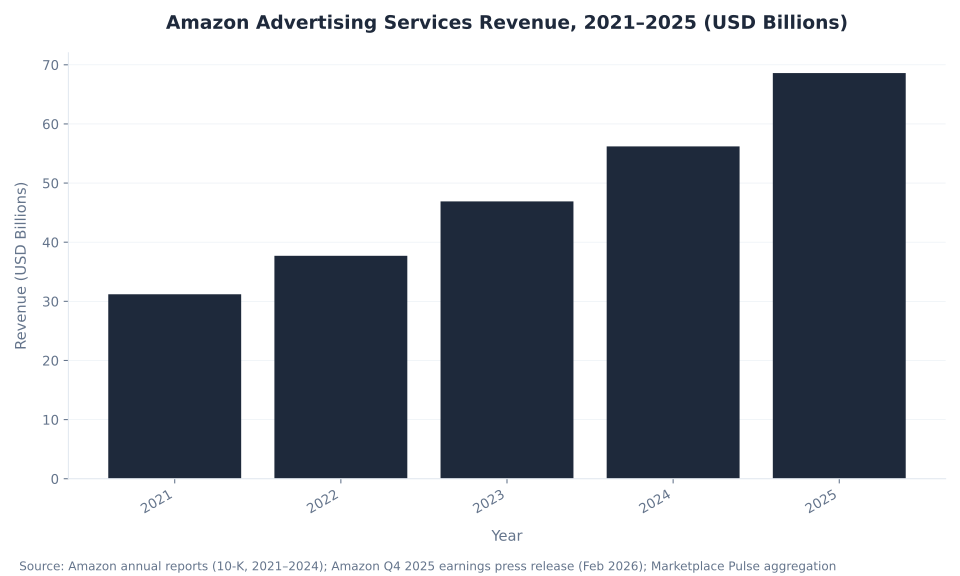
Amazon Advertising Services Revenue, 2021–2025 (USD Billions)
The Brand Registry Gate — Two Tiers, One Decision
Brand Registry is the single fact a new Amazon advertiser must understand before planning a platform strategy. Sponsored Products is the universal entry point — available to any seller with a live listing, no trademark required. Every other major surface — Sponsored Brands, Sponsored Display, Brand Stores, Posts, Brand Follow, Brand Analytics, and Amazon Attribution — requires Brand Registry, which in turn requires a pending or registered trademark from a supported government IP office. Source: Amazon Brand Registry official page; SellerLabs, 2026.
The practical implication is two tiers of platform access. An unregistered seller is Sponsored-Products-only. A registered brand unlocks the full suite: logo-and-headline banner ads via Sponsored Brands (including Sponsored Brands Video in three formats), retargeting on and off Amazon via Sponsored Display, a free multi-page Brand Store, Post content, Brand Follow, and the analytical tools — Brand Analytics, Search Query Performance — needed to measure brand health. Amazon’s IP Accelerator program connects sellers with IP attorneys and grants Brand Registry access while a trademark application is pending, compressing the timeline considerably for most product categories.
Brand Registry is not a budget prerequisite — it is a trademark documentation requirement. The access gap between Sponsored Products and the full platform is a trademark filing, not a spend threshold.
Registering the trademark is the concrete first action the gate imposes. For a seller operating under their own brand name without a trademark: file the trademark, join the IP Accelerator program for provisional Brand Registry access during the application, then activate Sponsored Brands, Sponsored Display, and a Brand Store in sequence as the account matures. MB Adv Agency works with brand owners at the trademark-pending stage and consistently finds that IP Accelerator cuts the activation timeline from 6–12 months to 4–8 weeks for sellers in supported trademark classes.
Sponsored TV (the non-skippable video product inside Streaming TV) does not require Brand Registry — making it one of the few upper-funnel surfaces open to an unregistered seller. The full Streaming TV and DSP suite is covered in Amazon DSP and Streaming TV. For what the Brand Store unlocks once Brand Registry is active, see Amazon Stores.

Build on Amazon
Start an Amazon Ads Strategy That Scales
From a first Sponsored Products campaign to full-funnel DSP, MB Adv Agency helps e-commerce brands build Amazon advertising strategies that grow with the account, not just the spend. Talk to us about your catalog, ACOS targets, and Brand Registry status.
Get Amazon Ads advice →Amazon Ads Revenue Growth: Five Years to the Top Three
Amazon’s Advertising Services segment grew from $31.2 billion in 2021 to $68.6 billion in 2025 — a compound annual growth rate of roughly 21.8% — built almost entirely on one product type (Sponsored Products) and one measurement advantage (closed-loop purchase attribution on first-party transaction data). The chart below plots the five-year step using Amazon’s own reported income statement figures. Source: Marketplace Pulse; Amazon 10-K filings (2021–2024); Marketing Dive (FY2025, Amazon Q4 2025 earnings, February 2026).
US retail media ad spend is forecast at $69.3 billion in 2026, up 17.8% year over year, per eMarketer’s H1 2026 forecast. Amazon and Walmart together are projected to capture roughly 89% of the incremental spend added in 2026. At that concentration, the category and the platform are effectively synonymous for most US e-commerce verticals.
Two structural changes from unBoxed 2025 matter for 2026 planning: the removal of Amazon DSP’s self-serve minimum (opening programmatic display and audio to brands that previously needed managed service) and the ongoing beta rollout of the unified Campaign Manager that will consolidate DSP and self-serve into one interface. Build in the current console now; budget for a workflow review when the unified interface reaches your account.
Can Small Businesses Succeed with Amazon Ads?
The question MB Adv Agency hears most from new Amazon sellers is not “how do I run ads?” — it is “can it work for a business my size?” The direct answer: Sponsored Products has no Brand Registry requirement, no spend minimum, and a daily budget the seller sets. At a blended CPC of $1.22 (Ad Badger, 2026, vendor estimate), a three-ASIN test at $5 per ASIN per day costs $15/day and generates measurable ACOS data within a week. The constraint is not budget — it is listing readiness: reviews, main-image quality, and pricing determine whether the click converts once it lands.
The sequencing MB Adv Agency recommends for a seller starting from zero: run Sponsored Products on automatic targeting first and use the search term report to learn where Amazon categorizes the product. Once ACOS is below target on auto, move to manual campaigns on the converting terms and let the organic-rank flywheel build. Register the trademark in parallel — not because Brand Registry is needed to start, but because Sponsored Brands and a Brand Store become the next efficiency levers once unit economics are working. The Amazon Sponsored Ads pillar maps the Sponsored Products → Brands → Display progression in full.
Verticals where small brands find the fastest payoff share one characteristic: replenishment. Supplements and nutrition brands, pet supply sellers, and beauty and personal care brands all benefit from Amazon’s Subscribe & Save mechanic, which compounds lifetime value after the initial ad-driven conversion. Electronics and furniture brands face higher CPCs and longer decision cycles but build profitable Sponsored Products campaigns by concentrating on bottom-funnel keywords with strong imagery. Fashion sellers face the most structural complexity due to size and style fragmentation, but conversion data in a well-run campaign remains measurable by category.
Frequently Asked Questions: What Is Amazon Ads?
Next in the Amazon Ads series
Sponsored Products, Brands & Display — In Depth
The Amazon Sponsored Ads guide covers Sponsored Products auto and manual targeting, Sponsored Brands video formats, Sponsored Display audience targeting, and how to sequence all three formats as the account grows.
Read the Sponsored Ads guide →Methodology & Sources
This pillar consolidates eight absorbed URLs from the mbadv.agency Amazon Ads cluster. Revenue figures ($31.2B–$68.6B, 2021–2025) are from Amazon’s 10-K filings and Q4 2025 earnings press release, aggregated by Marketplace Pulse. Retail media market size and share are from eMarketer’s Retail Media Ad Spending Forecast H1 2026. Prime Video reach (315M global monthly viewers) is from Amazon’s November 2025 disclosure via Variety and Deadline. CPC data ($1.22 blended 2026 average) is from Ad Badger’s managed-account aggregation (vendor estimate; verify at publish). Sponsored Products’ revenue share is bracketed across Sequence Commerce (~68%) and Marketing LTB (~72%). Brand Registry mechanics are from Amazon’s Brand Registry page and SellerLabs’ 2026 guide. No mbadv client metrics appear in this article. Last updated: June 2026. Reviewed by MB Adv Agency, June 2026.

As a Google Ads expert, I bring proven expertise in optimizing advertising campaigns to maximize ROI.
I specialize in sharing advanced strategies and targeted tips to refine Google Ads campaign management.
Committed to staying ahead of the latest trends and algorithms, I ensure that my clients receive cutting-edge solutions.
My passion for digital marketing and my ability to interpret data for strategic insights enable me to offer high-level consulting that aims to exceed expectations.
Google Partner Agency
We're a certified Google Partner Agency, which means we don’t guess — we optimize withGoogle’s full toolkit and insider support.
Your campaigns get pro-level execution, backed by real expertise (not theory).

4.9 out of 5 from 670+ reviews on Fiverr.
That’s not luck, that’s performance.
Highly recommend Matteo to set up your server side tracking. He has a deep understanding of e-commerce tracking and will go above and beyond to make sure everything is set up correctly and working 100%. If you are scaling your store this set up is non-negotiable in my opinion and there isn't many people who have this much knowledge or put the effort in to get it right. Thanks again!
avorodesign.com
I can only recommend Matteo! He was very patient, professional and very knowledgeable about GA4, Consent Mode v2, and GDPR compliance. Communication was clear, and the setup was done professionally and efficiently. Highly recommend him for anyone needing reliable tracking implementation.
www.natureiki.life
Matteo shines in the realm of online professionals. His work is not only deep in data but also complemented by his proactive communication and cooperation, setting a new standard for freelancers. If you want someone who truly exceeds expectations, look no further. Highly recommended!

www.omanbeverlysmyth.com
Exceptional Service Beyond Expectations - Outstanding Service Impeccable depth, flawless delivery, and exceptional language fluency—this service exceeded all expectations. Highly recommended. Matteo truly ROCKS!!!
ium-paris.com
Top-notch, always highly value working with Matteo. An absolute Google Ads Genius. This is approximately the 8th time I have hired him and he's helped us get 6-7 ROAS. We are excited in continuing to improve our lead flow. Hire this guy if you need Google Ads help. Thanks Matteo!
www.dleeventgroup.com
I finally found the guy who can setup server side tracking and all the ecosystem properly. I definitely recommend Matteo. He is very responsive, kind and wants to dig into things. He configured GA4, Meta, Google Ads, Outbrain and google consent v2 with Cookiebot. Thanks Matteo.
inomega.fr
MB Adv delivered exceptional work with outstanding professionalism and lots of patience, taking time to see effects of changes made and not just do the work and submit it. The proactive communication and video summaries of the work completed made working with Matteo a pleasure, as he consistently went above and beyond. Highly recommended for web analytics projects! We are already working on another project.
www.withnellsensors.co.uk
Working with Matteo on my Google Ads was a game-changer. He's not just a strategist, he's a true partner. He understood my goals and tailored a campaign that perfectly reached my target audience. I'm grateful for his expertise and dedication.
dccargo.com
Click-driven mind
with plastic-brick obsession.
We build Google Ads campaigns with the same mindset we use to build tiny brick worlds: strategy, patience, and zero tolerance for wasted pieces.
Data is our blueprint. Growth is the only acceptable outcome.