Google Ads adds Security Tasks in Access and security: why the new Summary tab matters
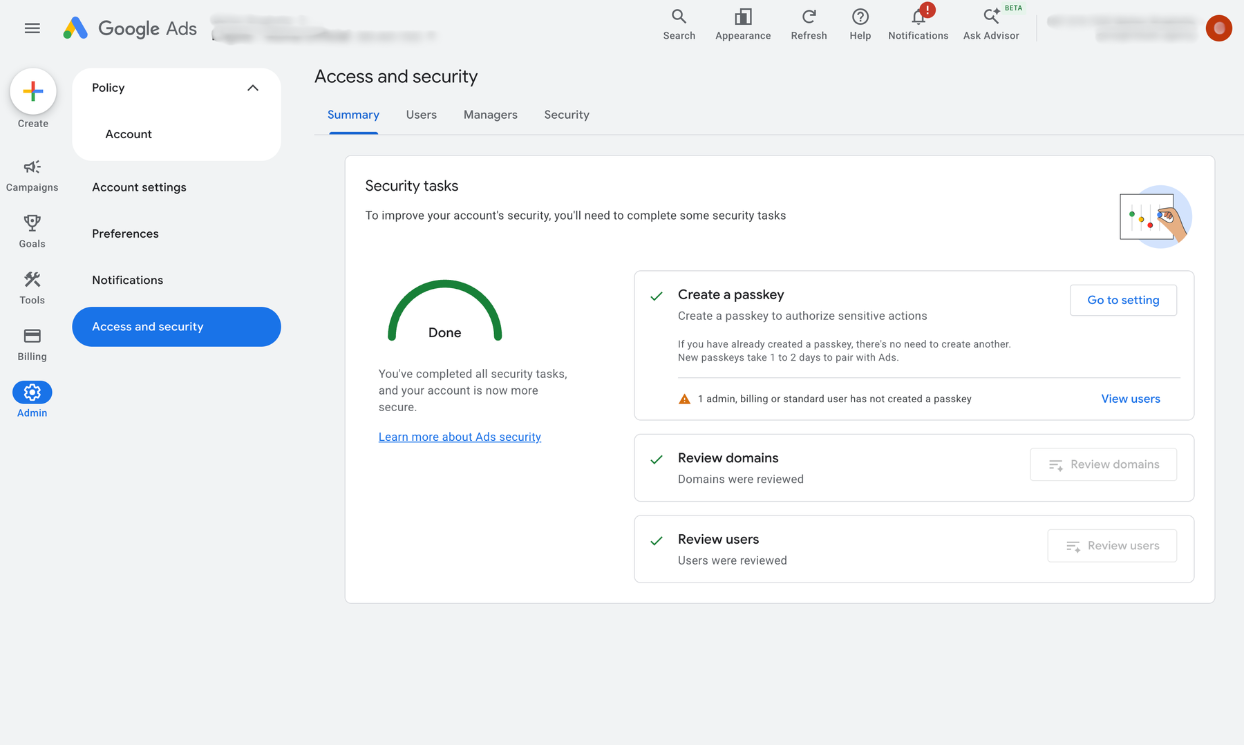
Google Ads has introduced a small but meaningful update inside **Access and security**: a new **Summary** tab that brings key account protection checks into one place. On the surface, this looks like a simple interface improvement. In practice, it signals something more important about how Google wants advertisers to manage accounts: security is no longer a background admin task, but part of routine account governance.
For teams that already treat conversion tracking, billing integrity, and account structure as operational priorities, this change makes sense. Security has often been handled reactively in Google Ads—reviewed after a user change, an agency transition, or a suspicious login event. By surfacing recommended actions directly in the interface, Google is nudging advertisers to treat account protection as a recurring maintenance layer rather than an exception.
The new Summary tab appears under **Admin > Access and security** and highlights specific **Security Tasks**. At the moment, the recommendations focus on three areas: setting up a passkey, reviewing listed domains, and reviewing user access. None of these actions are new in principle. What is new is the way Google has packaged them into a centralized checkpoint.
That matters because one of the persistent issues in Google Ads account management is not lack of controls, but lack of visibility. Most mature accounts already have multiple stakeholders involved: internal marketing teams, freelance specialists, agencies, analysts, developers, finance contacts, and sometimes external partners with varying levels of access. Over time, this creates administrative drift. Users remain attached to accounts longer than necessary. Domains stay listed after migrations or rebrands. Authentication settings are left at whatever standard was acceptable when the account was first configured.
By consolidating these checks, Google is reducing the friction involved in reviewing account security. That may sound minor, but in operational terms it is useful. The easier a platform makes a task to revisit, the more likely that task becomes part of standard process.
A more realistic view of account hygiene
The most valuable aspect of this update is not the passkey recommendation itself or the domain review prompt in isolation. It is the framing. Google Ads is effectively placing security review alongside the broader set of account validations that experienced practitioners already perform.
In real-world PPC management, account quality is rarely just about campaign performance. A well-run Google Ads account also depends on infrastructure: conversion measurement must be reliable, billing must be stable, user permissions must be current, and admin settings must reflect the actual business environment. Security Tasks fit naturally into that same category.
This is especially relevant for agencies and in-house teams managing multiple accounts across different business units or regions. In those environments, access management tends to become decentralized. Someone needs urgent access for reporting, another user is added during a website migration, an old consultant is never removed, or a domain remains associated with the account long after it stops being used. None of these issues necessarily causes immediate problems, which is exactly why they persist.
The Summary tab does not solve governance by itself, but it creates a clearer prompt to review it.
Why these three checks matter
The passkey recommendation reflects a broader shift in authentication standards. For advertisers with high-spend accounts or sensitive billing access, stronger authentication is not optional in practical terms, even if many teams still treat it as secondary to campaign work. A compromised Google Ads login can affect budgets, creatives, business data, and linked assets across the Google ecosystem. Encouraging passkey adoption is Google’s way of pushing more resilient login security without requiring users to navigate separate account settings blindly.
The domain review task is also more significant than it first appears. Domains in Google Ads often intersect with ad approval, brand control, tracking consistency, and account legitimacy. Outdated or unauthorized domains can create confusion, especially in organizations that have gone through mergers, replatforming, agency changes, or international expansion. Reviewing domains is not only a security exercise; it is also a governance check on whether the account still reflects the current business footprint.
User access review is probably the most immediately practical of the three. Inactive users and unnecessary permissions are among the most common forms of account clutter. They rarely attract attention until there is a problem: a compliance review, an ownership dispute, or an unauthorized change. Regular access review is one of the simplest ways to reduce avoidable risk in Google Ads, yet it is often neglected because it does not feel urgent. By surfacing it in the Summary tab, Google is making that neglect harder to justify.
Useful, but not complete
There is a tendency to overread interface updates as strategic transformations. This is not that. The new Summary tab is helpful, but it remains a prompt layer, not a full security management framework.
It will improve visibility, especially for smaller teams or busy account managers who benefit from a centralized reminder system. But it does not replace internal processes. It does not define permission standards for different roles. It does not resolve ownership ambiguity between client and agency accounts. It does not automatically identify every risky configuration. And it does not remove the need for periodic audits across linked assets such as GA4, Google Tag Manager, Merchant Center, or business email systems that may indirectly affect Google Ads operations.
That limitation is worth keeping in mind. Security in paid media is rarely isolated to one interface. A Google Ads account can be technically secure while still depending on weak surrounding systems. The Summary tab improves one layer of oversight, but mature advertisers will still need broader operational discipline.
A sensible direction for the platform
Even with those limitations, this is a smart addition. Google Ads has become increasingly complex, and not all meaningful improvements come from bidding, reporting, or AI-driven campaign controls. Sometimes the most useful updates are the ones that reduce preventable operational risk.
The new Security Tasks area does exactly that. It gives account teams a clearer place to validate authentication, domain integrity, and user access without treating those checks as exceptional events. For experienced advertisers, that is the real value: not new functionality, but better integration of security into normal account maintenance.
As Google Ads continues to evolve, updates like this suggest a more mature view of account management—one where performance and protection are not separate conversations. That is a sensible direction, and one that most serious advertisers should welcome.

As a Google Ads expert, I bring proven expertise in optimizing advertising campaigns to maximize ROI.
I specialize in sharing advanced strategies and targeted tips to refine Google Ads campaign management.
Committed to staying ahead of the latest trends and algorithms, I ensure that my clients receive cutting-edge solutions.
My passion for digital marketing and my ability to interpret data for strategic insights enable me to offer high-level consulting that aims to exceed expectations.
Google Partner Agency
We're a certified Google Partner Agency, which means we don’t guess — we optimize withGoogle’s full toolkit and insider support.
Your campaigns get pro-level execution, backed by real expertise (not theory).
4.9 out of 5 from 670+ reviews on Fiverr.
That’s not luck, that’s performance.
Highly recommend Matteo to set up your server side tracking. He has a deep understanding of e-commerce tracking and will go above and beyond to make sure everything is set up correctly and working 100%. If you are scaling your store this set up is non-negotiable in my opinion and there isn't many people who have this much knowledge or put the effort in to get it right. Thanks again!
avorodesign.com
I can only recommend Matteo! He was very patient, professional and very knowledgeable about GA4, Consent Mode v2, and GDPR compliance. Communication was clear, and the setup was done professionally and efficiently. Highly recommend him for anyone needing reliable tracking implementation.

www.natureiki.life
Matteo shines in the realm of online professionals. His work is not only deep in data but also complemented by his proactive communication and cooperation, setting a new standard for freelancers. If you want someone who truly exceeds expectations, look no further. Highly recommended!

www.omanbeverlysmyth.com
Exceptional Service Beyond Expectations - Outstanding Service Impeccable depth, flawless delivery, and exceptional language fluency—this service exceeded all expectations. Highly recommended. Matteo truly ROCKS!!!
ium-paris.com
Top-notch, always highly value working with Matteo. An absolute Google Ads Genius. This is approximately the 8th time I have hired him and he's helped us get 6-7 ROAS. We are excited in continuing to improve our lead flow. Hire this guy if you need Google Ads help. Thanks Matteo!

www.dleeventgroup.com
I finally found the guy who can setup server side tracking and all the ecosystem properly. I definitely recommend Matteo. He is very responsive, kind and wants to dig into things. He configured GA4, Meta, Google Ads, Outbrain and google consent v2 with Cookiebot. Thanks Matteo.
inomega.fr
MB Adv delivered exceptional work with outstanding professionalism and lots of patience, taking time to see effects of changes made and not just do the work and submit it. The proactive communication and video summaries of the work completed made working with Matteo a pleasure, as he consistently went above and beyond. Highly recommended for web analytics projects! We are already working on another project.

www.withnellsensors.co.uk
Working with Matteo on my Google Ads was a game-changer. He's not just a strategist, he's a true partner. He understood my goals and tailored a campaign that perfectly reached my target audience. I'm grateful for his expertise and dedication.

dccargo.com
Click-driven mind
with plastic-brick obsession.
We build Google Ads campaigns with the same mindset we use to build tiny brick worlds: strategy, patience, and zero tolerance for wasted pieces.
Data is our blueprint. Growth is the only acceptable outcome.