How the new Google Ads Transparency Center custom date ranges transform competitor research and seasonal campaign strategy
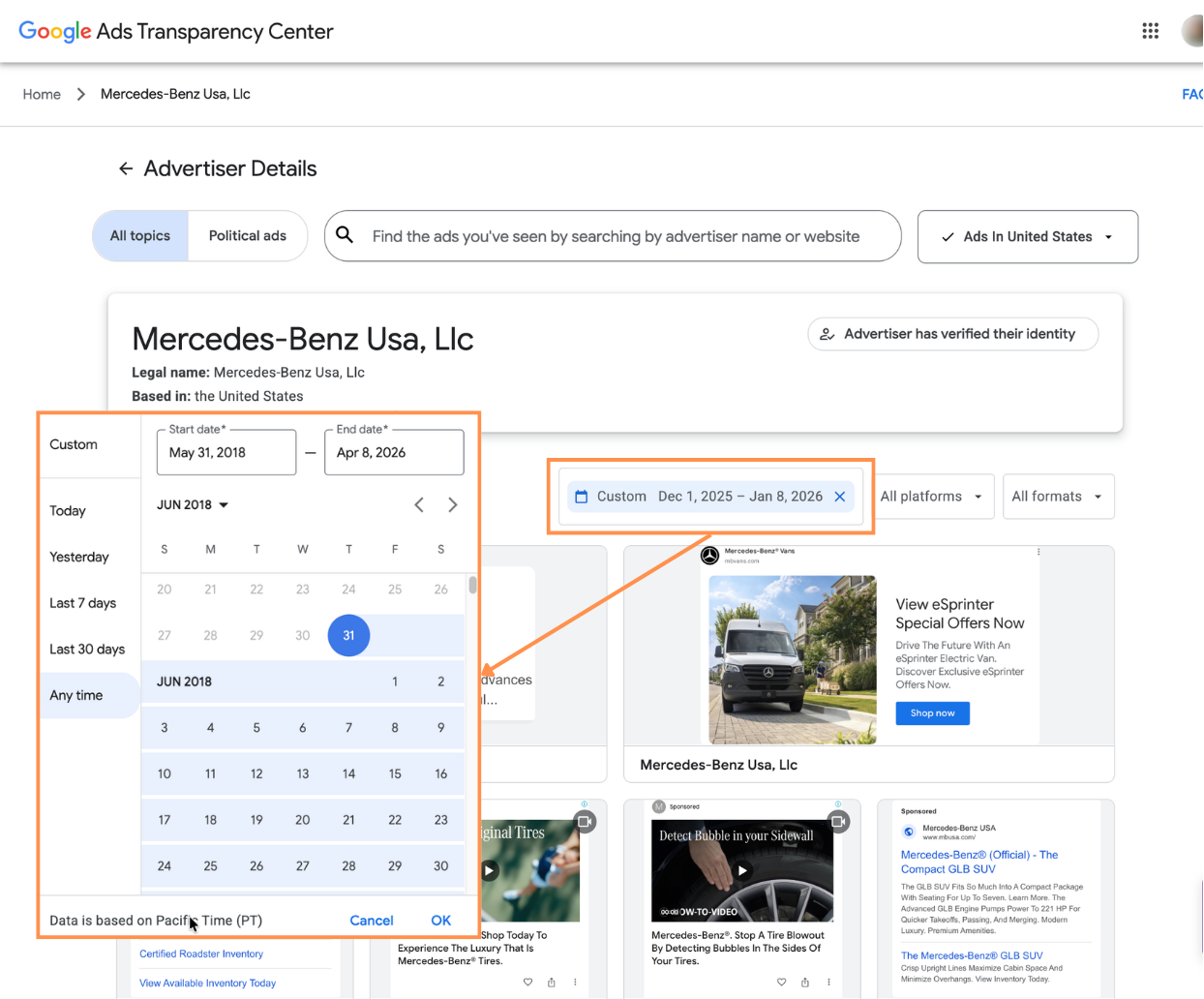
Google quietly made a small interface update to the Google Ads Transparency Center that has outsized strategic value: you can now filter ad history by custom date ranges, not just broad presets like “last 30 days” or “last year.”
For anyone working seriously with Google Ads—whether in-house, agency, or freelance—this turns the Transparency Center from a static archive into something much closer to a planning and research tool. It lets you study how advertisers behave around specific commercial moments, test windows, and product pushes, instead of drowning in an undifferentiated feed of “all ads ever.”
What actually changed
Until now, the Transparency Center was useful but blunt. You could see:
- Which creatives a brand has run
- Rough timing of campaigns
- High-level patterns in formats and messaging
The limitation was time granularity. If you wanted to understand what a competitor did around Black Friday, you were stuck with generic ranges that blended:
- Pre-promo testing
- Main sale activity
- Post-promo clean-up or evergreen messaging
The new custom date range filter fixes that. Once you search for an advertiser and open their ad library, you can define the exact timeframe you care about—down to specific start and end dates—and see only the ads that were active in that window.
In practical terms, this means you can now reconstruct campaign logic, not just admire the output.
Why custom ranges matter more than they sound
Most advertisers don’t run one monolithic “Q4 campaign.” They run sequences: tease, test, launch, scale, taper. When all of that is mixed into one broad date range, you lose the nuance that actually drives performance.
Narrow windows expose the structure behind the strategy.
Consider a two- to three-week period before a major sale or launch. In that window you’ll often see:
- Soft “coming soon” or “get ready” messaging
- Early access or waitlist angles
- Creative A/B tests around price framing, urgency, or value props
- Experiments with different formats and placements before budget is fully committed
When you can isolate just that pre-promo period, you start to distinguish:
- Always-on brand or generic activity (what they consider baseline)
versus
- Time-bound, revenue-critical campaigns (what they bet the quarter on)
That distinction is exactly what’s been obscured by coarse date filters.
Seasonal and event-based analysis becomes realistic
Seasonality is where the new filter earns its keep. Many of the highest-stakes decisions in Google Ads are seasonal: Q4 retail, travel peaks, tax season, B2B budget cycles, and so on.
With custom ranges in the Ads Transparency Center, you can:
- Look specifically at the two weeks before Black Friday last year and see how competitors warmed up their audiences
- Compare the core promo window (e.g., Black Friday weekend) against the immediate post-promo phase to see how quickly they normalized offers
- Analyze multiple years of the same period to identify patterns in timing, messaging, and offer depth
From a planning perspective, this helps answer questions like:
- When do the biggest players actually start pushing hard?
- Do they lean on discounts, bundles, or value-adds in the highest-pressure windows?
- How long do they sustain heavy promo messaging before reverting to evergreen creative?
You’re not just copying ad copy; you’re reverse-engineering timing and posture.
Better visibility into creative and testing strategy
Custom date ranges also give you a clearer view of how sophisticated advertisers think about creative iteration. If you zoom into a defined test window—say, the first 10–14 days of a new product launch—you can often see a pattern like:
- Initial wave of conceptually varied creatives (different angles, hooks, and CTAs)
- Rapid pruning of weaker variants
- Consolidation around one or two winning narratives, often with incremental refinements
Over a broader range, that evolution is hard to perceive. Over a tight range, it becomes obvious which assets are exploratory and which are scaled.
This is particularly useful if you:
- Run your own structured creative testing and want benchmarks on pace and variety
- Need to justify more systematic experimentation to stakeholders
- Are looking for inspiration on how to frame similar offers without blindly copying language
You’re essentially observing how other teams manage the tension between experimentation and consistency.
Timing and budget signals, even without spend data
The Transparency Center doesn’t expose actual budgets or bids, and that’s unlikely to change. But timing patterns, density of creatives, and the overlap of formats can still act as proxies for investment decisions.
With custom ranges, you can infer things like:
- When a brand moves from exploratory to committed spend
If you see a small variety of creatives in one week, then a large, consistent cluster the next, that shift usually marks a go/no-go decision.
- How aggressively they support specific product lines
Some launches will have a dense, multi-format presence over a short window; others will be barely visible. That tells you how they prioritize.
- Whether they lean on short bursts or longer flights
Some advertisers favor intense, short-lived pushes; others run moderate pressure over longer periods. Custom ranges let you compare those modes across campaigns.
These are imperfect signals, but they’re far better than looking at a year of ads and trying to guess where the real money went.
Strategic uses that go beyond “competitor spying”
It’s tempting to frame this purely as a competitor analysis feature. It is that, but it’s also a way to reality-check your own assumptions about campaign design.
You can, for example:
- Compare your Q4 structure to the actual behavior of category leaders
Are you starting too late? Testing too little? Over-relying on one message?
- Validate whether your “always-on” strategy looks truly always-on compared to others
If your supposed evergreen activity is thin outside of promo windows, that’s a useful signal.
- Benchmark the complexity of your account
If you’re running one generic campaign through a crucial period while top advertisers segment by audience, product, and intent, the gap becomes obvious.
The point is not to copy. It’s to calibrate. The Transparency Center with custom date ranges gives you an external reference for what “serious” looks like in your market.
Limitations and caveats worth remembering
Despite the upgrade, this is still an incomplete view of reality. A few constraints matter:
- You only see what ran, not what worked
High visibility doesn’t equal high performance. Some of the most prominent creatives may have been failures.
- Offline and non-Google channels are invisible
You’re seeing one slice of a broader media mix. Don’t over-interpret Google Ads data in isolation.
- You can’t see targeting, bidding, or audience logic
Creative and timing are visible; strategy under the hood is not. Many performance gains come from those hidden levers.
Used properly, the Transparency Center is a context tool, not a blueprint.
A small UI change with strategic consequences
Custom date ranges in the Google Ads Transparency Center don’t introduce any new data. They reorganize what was already there in a way that makes it strategically legible.
For practitioners, the real value lies in being able to separate:
- Baseline, always-on activity
from
- Focused, time-bound campaigns that carry disproportionate revenue impact
That separation is what allows you to study pre-promo behavior, launch sequences, and test windows with enough clarity to inform your own planning.
In a landscape where most accounts are already structurally complex, tools that help us see patterns in time—rather than just lists of assets—are increasingly important. This update nudges the Transparency Center a little closer to that kind of instrument.

As a Google Ads expert, I bring proven expertise in optimizing advertising campaigns to maximize ROI.
I specialize in sharing advanced strategies and targeted tips to refine Google Ads campaign management.
Committed to staying ahead of the latest trends and algorithms, I ensure that my clients receive cutting-edge solutions.
My passion for digital marketing and my ability to interpret data for strategic insights enable me to offer high-level consulting that aims to exceed expectations.
Google Partner Agency
We're a certified Google Partner Agency, which means we don’t guess — we optimize withGoogle’s full toolkit and insider support.
Your campaigns get pro-level execution, backed by real expertise (not theory).

4.9 out of 5 from 670+ reviews on Fiverr.
That’s not luck, that’s performance.
Highly recommend Matteo to set up your server side tracking. He has a deep understanding of e-commerce tracking and will go above and beyond to make sure everything is set up correctly and working 100%. If you are scaling your store this set up is non-negotiable in my opinion and there isn't many people who have this much knowledge or put the effort in to get it right. Thanks again!

avorodesign.com
I can only recommend Matteo! He was very patient, professional and very knowledgeable about GA4, Consent Mode v2, and GDPR compliance. Communication was clear, and the setup was done professionally and efficiently. Highly recommend him for anyone needing reliable tracking implementation.

www.natureiki.life
Matteo shines in the realm of online professionals. His work is not only deep in data but also complemented by his proactive communication and cooperation, setting a new standard for freelancers. If you want someone who truly exceeds expectations, look no further. Highly recommended!

www.omanbeverlysmyth.com
Exceptional Service Beyond Expectations - Outstanding Service Impeccable depth, flawless delivery, and exceptional language fluency—this service exceeded all expectations. Highly recommended. Matteo truly ROCKS!!!

ium-paris.com
Top-notch, always highly value working with Matteo. An absolute Google Ads Genius. This is approximately the 8th time I have hired him and he's helped us get 6-7 ROAS. We are excited in continuing to improve our lead flow. Hire this guy if you need Google Ads help. Thanks Matteo!

www.dleeventgroup.com
I finally found the guy who can setup server side tracking and all the ecosystem properly. I definitely recommend Matteo. He is very responsive, kind and wants to dig into things. He configured GA4, Meta, Google Ads, Outbrain and google consent v2 with Cookiebot. Thanks Matteo.

inomega.fr
MB Adv delivered exceptional work with outstanding professionalism and lots of patience, taking time to see effects of changes made and not just do the work and submit it. The proactive communication and video summaries of the work completed made working with Matteo a pleasure, as he consistently went above and beyond. Highly recommended for web analytics projects! We are already working on another project.

www.withnellsensors.co.uk
Working with Matteo on my Google Ads was a game-changer. He's not just a strategist, he's a true partner. He understood my goals and tailored a campaign that perfectly reached my target audience. I'm grateful for his expertise and dedication.

dccargo.com
Click-driven mind
with plastic-brick obsession.
We build Google Ads campaigns with the same mindset we use to build tiny brick worlds: strategy, patience, and zero tolerance for wasted pieces.
Data is our blueprint. Growth is the only acceptable outcome.