Google Shopping now shows unit pricing in product ads: why it matters for feed optimization
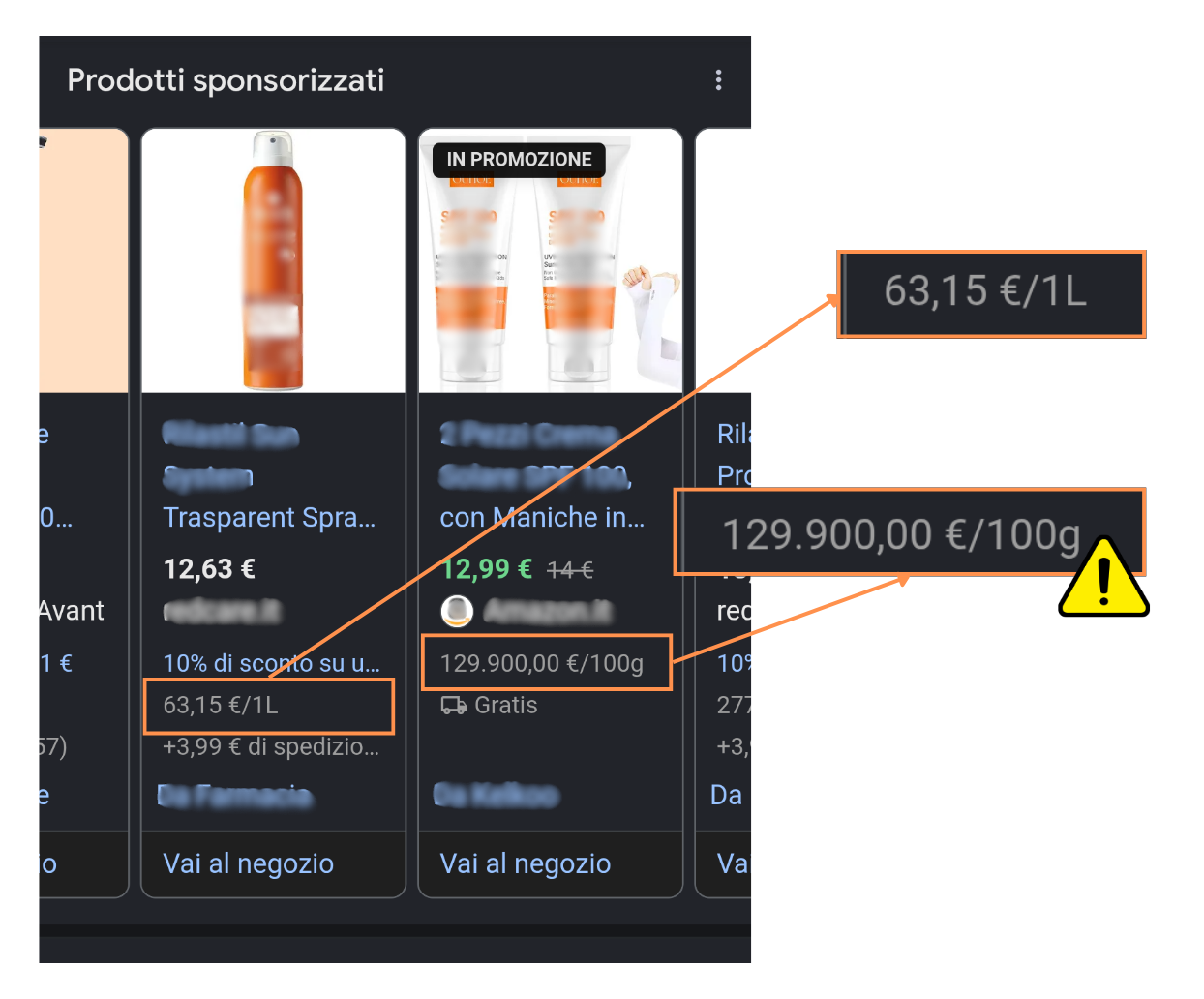
A small but meaningful change is appearing in Google Shopping ads: in some placements, Google is now surfacing the `unit_pricing_measure` attribute directly beneath the product price. In practical terms, that means a user may see not only the total selling price, but also a normalized reference such as price per 100 ml, per kg, or per item.
On the surface, this looks like a minor feed enhancement. In reality, it says quite a lot about the direction of Shopping: more product data, more context inside the ad, and more pre-click qualification before the user ever reaches the product page.
For advertisers working in categories where pack size, weight, volume, or count materially affect perceived value, this is not just an interface detail. It changes how products are compared in the auction and how users interpret price competitiveness.
A feed-level signal with commercial consequences
What matters here is where the information comes from. Google is not generating unit pricing from campaign settings, promotional annotations, or landing page interpretation. It is pulled from Merchant Center feed attributes, specifically `unit_pricing_measure` and, where relevant, `unit_pricing_base_measure`.
That distinction matters because it reinforces a broader trend in Google Ads: feed quality is increasingly inseparable from ad quality. In Shopping and Performance Max environments especially, advertisers do not control messaging in the same way they do in text ads. Product data has become the creative input. The more complete, structured, and commercially meaningful the feed is, the more useful the ad can become.
Unit pricing is a good example of that dynamic. A brand can have strong bidding, good imagery, and competitive shipping, but if its feed lacks the attributes Google needs to standardize value comparisons, it may still look less transparent than a competitor.
Why unit pricing changes the comparison dynamic
In many Shopping categories, headline price is a poor proxy for actual value. A 250 ml skincare product can look expensive next to a 100 ml competitor if the ad shows only the total product price. The same issue applies to supplements, detergents, beverages, pet food, and pantry goods. Users often compare visible prices quickly and imperfectly, especially on mobile, where screen space compresses nuance.
By surfacing unit pricing directly in the ad, Google introduces a second layer of price interpretation. That can reduce what might be called price perception bias: the tendency for users to assume the lower total price is the better deal, even when the normalized price suggests the opposite.
This is particularly relevant for advertisers selling premium pack sizes, concentrated formulas, bulk formats, or products with unusual dimensions. A larger pack that initially looks expensive may become more competitive when the ad also shows a lower price per unit. In that sense, unit pricing does not simply add information. It can reframe the commercial narrative of the product before the click.
That has obvious implications for click quality. If users can evaluate value more accurately inside the Shopping ad, some clicks that would previously have been driven by superficial price comparisons may disappear. But that is not necessarily a loss. Better-informed clicks tend to be more commercially useful than curiosity clicks that bounce once the user realizes the pack size or format is different from what they assumed.
This favors advertisers with disciplined feed architecture
The advertisers most likely to benefit are not necessarily those with the lowest prices. They are the ones with cleaner product data and a feed strategy that reflects how customers actually compare products.
Google can only display unit pricing when the feed supports it correctly. That means using the proper value format for the relevant measure type, whether weight, volume, area, length, or unit count. Where comparison needs standardization, `unit_pricing_base_measure` becomes important as well. Without that structure, normalized pricing cannot be rendered consistently.
This is one more reason Merchant Center should not be treated as a passive product export. Too many accounts still operate with a minimalist feed philosophy: title, image, price, availability, and little else. That may be enough to get products eligible, but it is no longer enough to maximize how products present in increasingly information-rich Shopping environments.
In practice, the accounts that tend to outperform in Shopping are often the ones that treat feed enrichment as an ongoing optimization discipline, not a setup task.
Not every category will feel the impact equally
Unit pricing will matter most where quantity ambiguity affects purchase decisions. Cosmetics, food, supplements, household cleaning, and similar categories are obvious examples because users routinely evaluate products across different sizes and formats.
In other verticals, the effect may be limited or inconsistent. If the category does not rely on standardized size comparison, the presence of unit pricing is less commercially relevant. And even in eligible categories, visibility will likely vary by placement, device, and Google’s own judgment about when the information improves the ad experience.
That is worth emphasizing: adding the attribute does not mean Google will always show it. As with many Merchant Center enhancements, eligibility and display are not the same thing. Advertisers should think of this as increasing the ad’s informational potential rather than unlocking a guaranteed annotation.
A subtle shift in pre-click qualification
There is also a broader strategic angle here. Google has steadily moved more decision-making material into ad surfaces: ratings, shipping information, promotions, return signals, and now more explicit pricing context. The common thread is clear. Google wants users to make more informed decisions before clicking.
For advertisers, that often creates short-term discomfort because richer ad disclosures can reduce raw click volume. But from a performance standpoint, this usually aligns with efficiency. If unit pricing filters out users who would have rejected the product after seeing the product page details, then the ad is doing part of the qualification work earlier in the funnel.
That can be especially useful in categories where CPCs are high and margins are sensitive. A click that never happens can be just as valuable as a conversion when it prevents wasted spend.
The real takeaway
Google showing unit pricing in Shopping ads may look like a modest product update, but it reflects a larger truth about modern retail media on Google: structured product data increasingly shapes commercial performance.
For marketers already managing mature Shopping programs, this is less about a new tactic and more about a familiar principle becoming more visible. Feed completeness is no longer just a compliance issue or a secondary optimization layer. It is part of how price, value, and competitiveness are communicated in the auction itself.
As Google continues to expand what can be surfaced from Merchant Center, the gap between basic feeds and strategically enriched feeds will likely become more consequential. Unit pricing is just one attribute, but it points in a clear direction.

As a Google Ads expert, I bring proven expertise in optimizing advertising campaigns to maximize ROI.
I specialize in sharing advanced strategies and targeted tips to refine Google Ads campaign management.
Committed to staying ahead of the latest trends and algorithms, I ensure that my clients receive cutting-edge solutions.
My passion for digital marketing and my ability to interpret data for strategic insights enable me to offer high-level consulting that aims to exceed expectations.
Google Partner Agency
We're a certified Google Partner Agency, which means we don’t guess — we optimize withGoogle’s full toolkit and insider support.
Your campaigns get pro-level execution, backed by real expertise (not theory).

4.9 out of 5 from 670+ reviews on Fiverr.
That’s not luck, that’s performance.
Highly recommend Matteo to set up your server side tracking. He has a deep understanding of e-commerce tracking and will go above and beyond to make sure everything is set up correctly and working 100%. If you are scaling your store this set up is non-negotiable in my opinion and there isn't many people who have this much knowledge or put the effort in to get it right. Thanks again!

avorodesign.com
I can only recommend Matteo! He was very patient, professional and very knowledgeable about GA4, Consent Mode v2, and GDPR compliance. Communication was clear, and the setup was done professionally and efficiently. Highly recommend him for anyone needing reliable tracking implementation.

www.natureiki.life
Matteo shines in the realm of online professionals. His work is not only deep in data but also complemented by his proactive communication and cooperation, setting a new standard for freelancers. If you want someone who truly exceeds expectations, look no further. Highly recommended!

www.omanbeverlysmyth.com
Exceptional Service Beyond Expectations - Outstanding Service Impeccable depth, flawless delivery, and exceptional language fluency—this service exceeded all expectations. Highly recommended. Matteo truly ROCKS!!!

ium-paris.com
Top-notch, always highly value working with Matteo. An absolute Google Ads Genius. This is approximately the 8th time I have hired him and he's helped us get 6-7 ROAS. We are excited in continuing to improve our lead flow. Hire this guy if you need Google Ads help. Thanks Matteo!

www.dleeventgroup.com
I finally found the guy who can setup server side tracking and all the ecosystem properly. I definitely recommend Matteo. He is very responsive, kind and wants to dig into things. He configured GA4, Meta, Google Ads, Outbrain and google consent v2 with Cookiebot. Thanks Matteo.

inomega.fr
MB Adv delivered exceptional work with outstanding professionalism and lots of patience, taking time to see effects of changes made and not just do the work and submit it. The proactive communication and video summaries of the work completed made working with Matteo a pleasure, as he consistently went above and beyond. Highly recommended for web analytics projects! We are already working on another project.

www.withnellsensors.co.uk
Working with Matteo on my Google Ads was a game-changer. He's not just a strategist, he's a true partner. He understood my goals and tailored a campaign that perfectly reached my target audience. I'm grateful for his expertise and dedication.

dccargo.com
Click-driven mind
with plastic-brick obsession.
We build Google Ads campaigns with the same mindset we use to build tiny brick worlds: strategy, patience, and zero tolerance for wasted pieces.
Data is our blueprint. Growth is the only acceptable outcome.