Google Ads Campaign Types: The 2026 Decision Matrix
45%
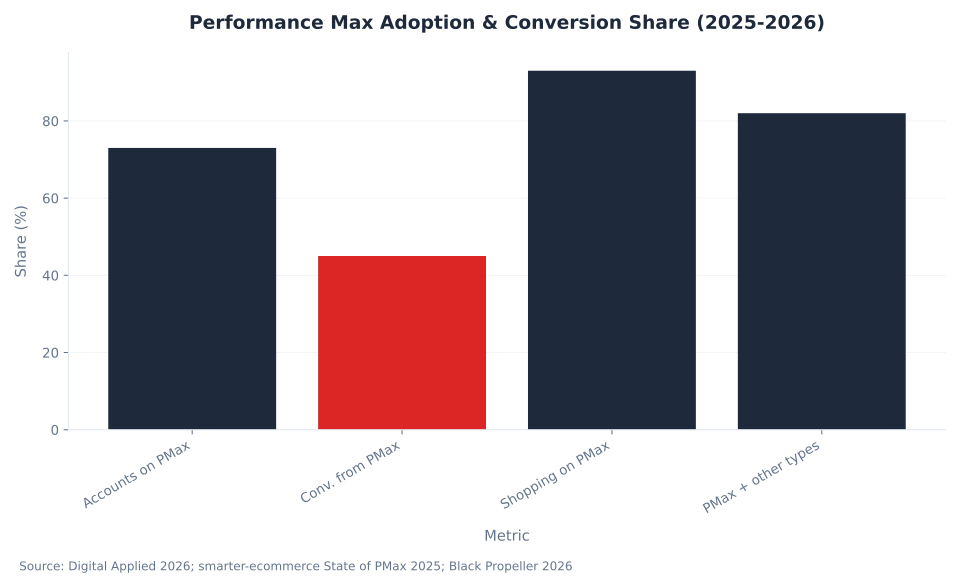
of all Google Ads conversions now flow through Performance Max — yet 82% of PMax advertisers run it alongside Search or Shopping, not as a standalone replacement.
Source: Digital Applied 2026 · smarter-ecommerce State of PMax 2025
What Are Google Ads Campaign Types?
Google Ads campaign types are structural containers that determine where ads appear, which signals Google's AI uses to bid, and which conversion objectives a campaign optimizes for. Eight types are active as of May 2026: Search, Performance Max, Shopping, Demand Gen, Display, Video, App, and AI Max for Search. Each type maps to a distinct inventory, a distinct bidding mandate, and a distinct stage of the buying funnel. Selecting the wrong type for an objective changes the fundamental economics of spend — it is not a configuration error that self-corrects.
The real decision is campaign-type-by-objective, not campaign-type-by-channel. Performance Max runs on Search inventory — and so does AI Max for Search — but the two types optimize for different accounts at different maturity stages. Shopping campaigns overlap in inventory with PMax yet give advertisers direct control over product-level bidding that PMax abstracts away. Assigning the wrong type routes budget toward users structurally unlikely to convert from that placement; running the right types in defined roles compounds performance across the full funnel.
Two campaign types have been retired since 2024: Discovery (auto-upgraded to Demand Gen by March 2024) and Video Action Campaigns (auto-upgraded to Demand Gen by April 2026). One type is actively retiring: Dynamic Search Ads, which Google begins auto-upgrading to AI Max for Search in September 2026. Any account strategy that references these three as current options works from outdated information — the product catalog shifted materially across an 18-month span.
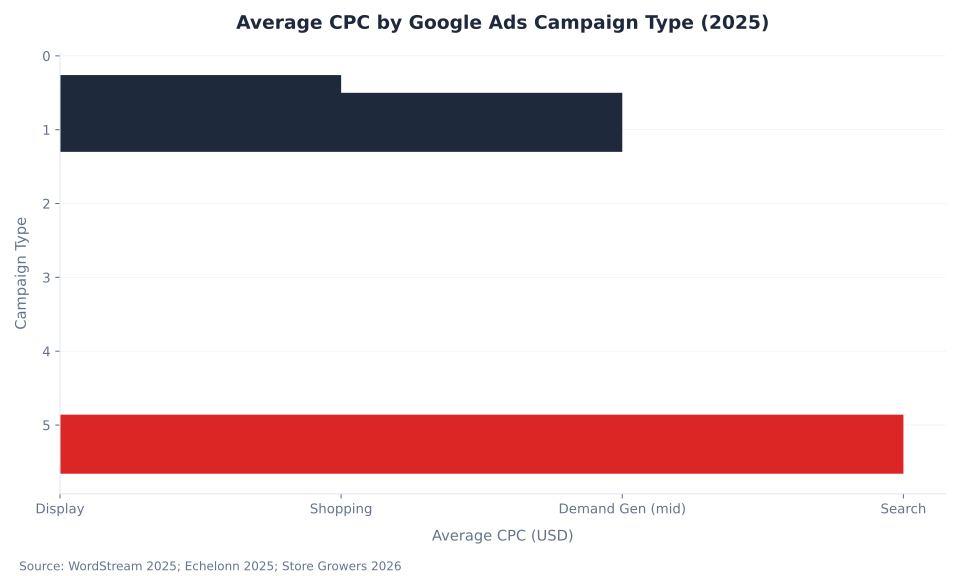
For legal PPC, financial services PPC, and other high-intent lead-gen verticals, campaign-type selection directly controls cost-per-lead. Search averages $5.26 CPC all-industry; Demand Gen runs $0.30–$1.50 CPC. That differential is strategic rather than a bargain: Demand Gen reaches users before intent forms, while Search captures declared intent. Mapping each type to its correct funnel position is where account-structure decisions generate compound returns — or compound waste.
Key Takeaways
- Eight campaign types are active as of May 2026. Search, Performance Max, Shopping, Demand Gen, Display, Video, App, and AI Max for Search. Discovery and Video Action Campaigns are fully retired.
- PMax accounts for 45% of Google Ads conversions but does not replace Search. 82% of PMax advertisers run it alongside other campaign types. Cutting Search removes branded-query control and the impression share data that signals competitive threats.
- Demand Gen is the current upper-funnel visual campaign. It absorbed Discovery in March 2024 and Video Action Campaigns in April 2026, adding YouTube video, carousel formats, and lookalike audiences to Discovery's original Discover and Gmail placements.
- DSA auto-upgrade to AI Max begins September 2026. AI Max adds keywordless reach, text customization, and URL expansion — capabilities DSA never had. Advertisers depending on DSA for long-tail coverage need a migration plan before that deadline.
- App campaigns operate under a closed mandate. They optimize exclusively for installs and in-app events across Search, Play Store, YouTube, and Display. No other campaign type optimizes for Play Store placement.
- Display is not a primary conversion driver for most accounts. At 0.46% CTR and $0.63 CPC, Display belongs in retargeting and upper-funnel reach — not as the primary acquisition mechanism against Search's 7.52% all-industry conversion rate.
73%
of Google Ads accounts run at least one PMax campaign
Digital Applied 2026
$5.26
avg Search CPC all industries — up 12.88% YoY
WordStream 2025
+33%
conversion lift when product feeds are added to Demand Gen
Google Ads Help 2025
The 2026 Google Ads Campaign Type Taxonomy
The active campaign-type roster changed materially between 2022 and 2026. Smart Shopping was consolidated into Performance Max in 2022. Discovery was retired into Demand Gen in March 2024. Video Action Campaigns followed in April 2026. AI Max for Search exited beta in April 2026. The table below reflects the actual product catalog and its transition status as of May 2026 — three types are retired or retiring, and eight remain active.
| Campaign Type | Status | Inventory | Key Notes |
|---|---|---|---|
| Search | Active | Google Search SERP + Search Partners | Keyword-based; primary intent-capture type; avg CPC $5.26 |
| Performance Max | Active | Search, Display, YouTube, Discover, Gmail, Maps | Launched globally Nov 2021; 45% of all Google Ads conversions; 73% account adoption |
| Shopping (Standard) | Active | Google Search, Shopping tab | Distinct from PMax; Merchant Center feed; avg CPC $0.66–$0.77 |
| Demand Gen | Active | YouTube, Discover feed, Gmail | Replaced Discovery (Mar 2024); absorbed Video Action Campaigns (Apr 2026) |
| Display | Active (migrating) | Google Display Network (3M+ sites/apps) | Migration tool to Demand Gen rolling out Jun 2026; standalone Display retiring ~2027 |
| Video (YouTube) | Active | YouTube + partner sites | Awareness/reach/views only; action video now routes through Demand Gen |
| App | Active | Search, Play Store, YouTube, Display | Single-objective only: installs and in-app events; budget = 50× target CPI |
| AI Max for Search | Active (GA Apr 2026) | Google Search SERP | DSA replacement; keywordless reach + text customization; DSA auto-upgrades Sep 2026 |
| Dynamic Search Ads | Retiring Sep 2026 | Google Search SERP | Auto-upgrade to AI Max begins Sep 2026; no new DSA campaigns after that date |
| Discovery | Retired Mar 2024 | — | All campaigns auto-upgraded to Demand Gen; search queries now resolve to Demand Gen |
| Video Action Campaigns | Retired Apr 2026 | — | New VAC creation ended Apr 2025; auto-upgrade to Demand Gen completed Apr 2026 |
Sources: Google blog 2021; Accelerated Digital Media 2024; Google Ads Help — Video Action Campaigns; Google blog Apr 2026
The pattern is consistent: Google migrates action-oriented types into higher-automation products. What remains distinct — Search, Standard Shopping, Video-awareness, App — is where manual control and data transparency still deliver value that full automation cannot replicate. Standard Shopping remains distinct because product-level ROAS visibility and bid granularity are not available in PMax's reporting interface.
For furniture PPC, supplements PPC, and pet supplies PPC, Standard Shopping versus PMax is a live 2026 decision. 93% of Google Shopping retailers run PMax; those maintaining Standard Shopping alongside it are managing catalogs where product-level ROAS variance exceeds what PMax's automated bidding handles cleanly.
Campaign Type by Objective: The Decision Matrix
Every Google Ads campaign type serves a primary objective. The structural error in most account builds is assigning a campaign type to an objective it was not designed for — running Display as the primary conversion driver, using PMax before the account has conversion history, or mixing awareness and conversion budget into a single campaign type. The matrix below maps each active type to its primary and secondary objectives across the full funnel.
| Campaign Type | Awareness | Consideration | Conversion | App Installs | Catalog/Product Sales |
|---|---|---|---|---|---|
| Search | — | Secondary | Primary | — | — |
| Performance Max | Secondary | Secondary | Primary | — | Primary |
| Shopping (Standard) | — | Secondary | Primary | — | Primary |
| Demand Gen | Primary | Primary | Secondary | — | Secondary (with feed) |
| Display | Primary | Secondary | Retargeting only | — | — |
| Video (YouTube) | Primary | Secondary | — | — | — |
| App | — | — | — | Primary | — |
| AI Max for Search | — | Secondary | Primary | — | — |
Editorial synthesis from Google Ads Help; WordStream 2025; Store Growers 2026. "Primary" = best-fit; "Secondary" = viable but not the lead use case; "—" = not the right tool.
The matrix reveals two structural rules. First, Search, Standard Shopping, and Performance Max are the only types with a "Primary" conversion designation — and PMax requires verified conversion history to function as designed. Second, no type earns "Primary" status for both Awareness and Conversion simultaneously, because the signal requirements for each are incompatible: awareness campaigns optimize for reach and impressions; conversion campaigns require a measurable downstream event.
Campaign type selection also determines which Google Ads bidding strategies are available. Search supports Target CPA, Target ROAS, Maximize Conversions, Enhanced CPC, and manual CPC. Performance Max supports only Target CPA and Target ROAS — manual control is not available by design. The bidding constraint map is a direct downstream consequence of campaign-type selection, and it affects budget efficiency for every dollar above the account's minimum viable spend threshold.
Benchmark Metrics by Campaign Type
Benchmark data across campaign types is not directly comparable — each type optimizes for a different signal, reaches a different audience stage, and measures a different outcome. Reading Search CTR against Display CTR as if they measure the same thing produces the flawed conclusion that Display is more cost-efficient. The table below presents each type's benchmarks in context, with the caveat that Shopping CVR as a standalone campaign-type figure is not available from the sourced datasets and is omitted rather than extrapolated. Track these against Google Ads metrics and KPIs for a full performance benchmark framework.
| Campaign Type | Avg CTR | Avg CPC | Avg CVR (ecommerce) | Source |
|---|---|---|---|---|
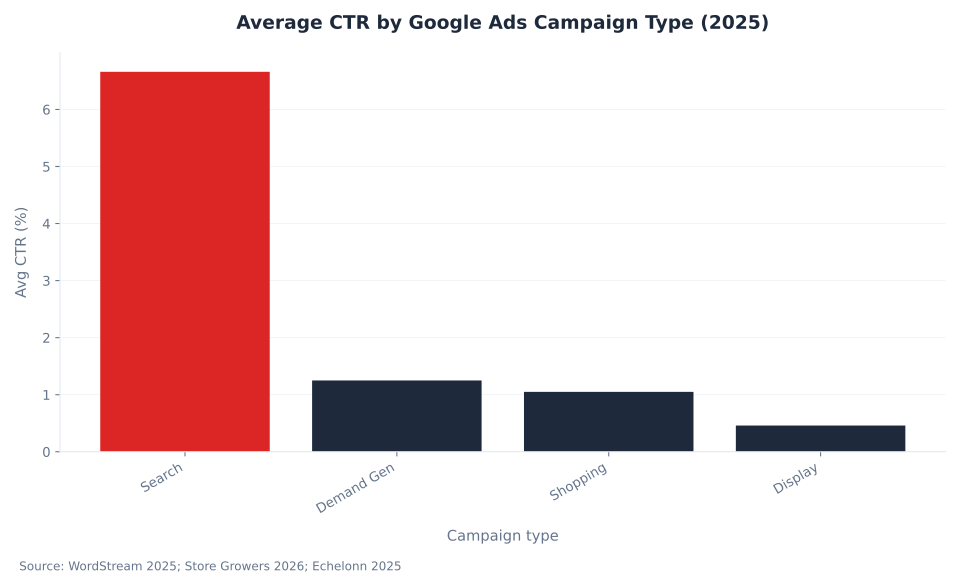
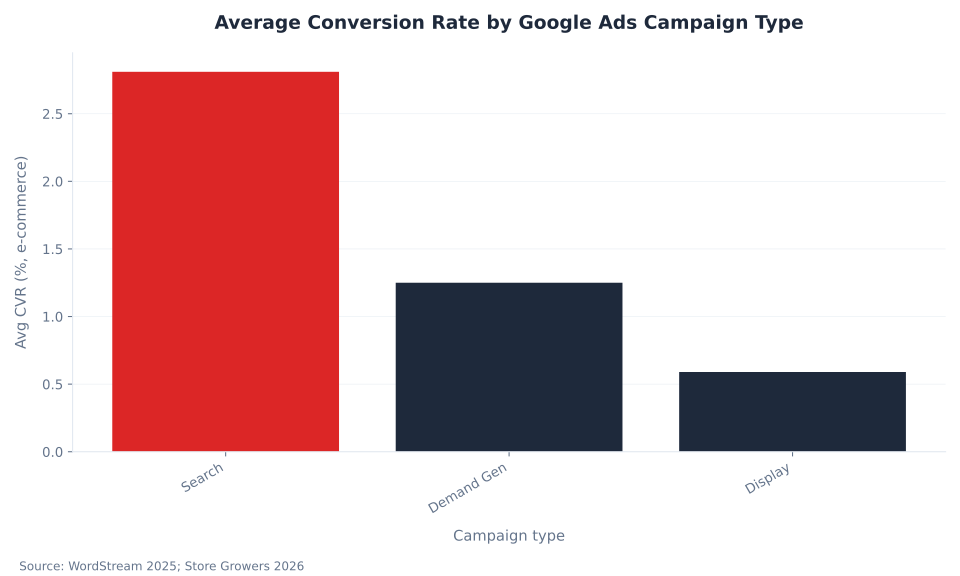
| Search | 6.66% | $5.26 | 2.81% | WordStream 2025 |
| Display | 0.46% | $0.63 | 0.59% | WordStream 2025 |
| Shopping (Standard) | 0.8%–1.3% | $0.66–$0.77 | — | Echelonn 2025; Store Growers 2026 |
| Demand Gen | 0.5%–2.0% | $0.30–$1.50 | 0.5%–2.0% | Store Growers 2026 |
| Video (YouTube) | — | $0.02–$0.06 CPV | — | Digital Applied 2026 |
Search and Display figures: WordStream Google Ads Benchmarks 2025 (16,000+ US campaigns, Apr 2024–Mar 2025). Shopping: Echelonn 2025; Store Growers 2026. Demand Gen: Store Growers Demand Gen Benchmarks 2026. Shopping CVR not available as a standalone campaign-type figure; cell omitted. Video CPC is cost-per-view (CPV), not CPC.
Search CVR (7.52%) is 12.7× higher than Display CVR (0.59%) for ecommerce — but Search CPC ($5.26) is 8.3× higher than Display CPC ($0.63). The math resolves to CPA, not raw cost: for most non-retargeting use cases, Search CPA beats Display CPA because intent drives completion rates that cost alone cannot compensate for.
Source: WordStream Google Ads Benchmarks 2025
The Search-versus-Display CPC comparison is the most misused benchmark in Google Ads. Display at $0.63 CPC looks like a bargain against Search at $5.26. The CVR math resolves it: 100 Display conversions at 0.59% CVR and $0.63 CPC = 16,949 clicks × $0.63 = $10,678 spend. 100 Search conversions at 2.81% CVR and $5.26 CPC = 3,559 clicks × $5.26 = $18,720 spend. Display CPA beats Search CPA for ecommerce at these benchmarks — but that advantage reverses in service categories with lower Display CVR and higher Search intent quality. The structural error is using Display as the primary cold-audience conversion mechanism, not the cost comparison itself.
Shopping's CPC range of $0.66–$0.77 is the lowest absolute cost of any purchase-intent format on Google — and Shopping CPCs experienced 16% peak YoY cost inflation in Q3 2025, the highest cost growth of any Google campaign type that period. For fashion PPC and other product-feed-dependent categories, Shopping CPC inflation is the budget pressure to model into 2026 forecasts.
Average CPC by Google Ads Campaign Type (2025)
Performance Max Campaigns: Scale Without Structural Loss
Performance Max launched to all Google Ads advertisers globally in November 2021. By early 2026 it accounts for 45% of all Google Ads conversions across 73% of active accounts. PMax runs across every Google surface — Search, Display, YouTube, Discover, Gmail, and Maps — from a single campaign. Its AI allocates budget and inventory in real time based on conversion signals, which is both its primary advantage and its primary control risk.
| Metric | Figure | Source |
|---|---|---|
| Google Ads accounts running at least one PMax campaign (global) | 73% | Digital Applied 2026 |
| US advertiser adoption | 75% | smarter-ecommerce State of PMax 2025 |
| UK advertiser adoption | 84% | smarter-ecommerce State of PMax 2025 |
| Share of all Google Ads conversions attributed to PMax (early 2026) | 45% | Digital Applied 2026; Black Propeller 2026 |
| Peak PMax share of total Google Ads spend | ~82% (May 2024) | smarter-ecommerce State of PMax 2025 |
| PMax spend-share monthly decline (early 2025) | −0.65%/month (~6% total) | smarter-ecommerce State of PMax 2025 |
| Google Shopping retailers that run PMax | 93% | SEO Design Chicago 2025 |
| PMax advertisers running it alongside other campaign types | 82% | Optmyzr study, 24,702 PMax campaigns, 2024 |
Sources: Digital Applied 2026; smarter-ecommerce State of PMax 2025 (4,000+ campaigns); Search Engine Journal / Optmyzr hybrid strategy study
The 82% hybrid figure is the most operationally important stat in the table. The 2022–2024 "PMax-only" experiment produced accounts where branded impression share declined and search terms report visibility disappeared. The spend-share decline of −0.65%/month in early 2025 reflects the correction: Standard Shopping and Brand Search are recapturing budget from PMax in accounts where control and data transparency matter more than automation breadth.
PMax negative keywords: fully available in the Google Ads UI since January 23, 2025.
The limit was expanded from 100 to 10,000 negative keywords per PMax campaign in March 2025. Shared negative keyword lists became available in August 2025. Add negatives via the PMax campaign → Keywords section, the same interface used for Search campaigns. No support request required.
Source: Google Ads Help — Negative keywords in Performance Max campaigns
MB Adv Agency uses campaign-level negative keyword lists and audience exclusions on every PMax campaign to prevent branded-query cannibalization from keywordless expansion. Without negatives, PMax's broad inventory access absorbs branded search queries at market CPC rates, which are higher than a tightly managed brand Search campaign — and without the impression share metrics that flag when a competitor is bidding on your brand terms.
PMax requires verified conversion history: Google recommends at least 30 conversions in the prior 30 days before launching with Target CPA bidding. Accounts without that volume should build conversion history through Search first. First-party audience signals — customer lists, website visitors — materially improve PMax's initial targeting efficiency. For conversion measurement setup, see Google Ads conversion tracking and attribution. For audience signal architecture, see Google Ads audience targeting.
Performance Max Adoption & Conversion Share (2025-2026)
Demand Gen Campaigns: What Replaced Google Discovery
Discovery campaigns no longer exist. All Discovery campaigns were auto-upgraded to Demand Gen by March 2024. Demand Gen is now the single home for visual, engagement-driven inventory across YouTube, Discover, and Gmail. Any strategy document referencing Discovery campaigns as a current option describes a product that ceased to exist over two years ago.
| Date | Event | Source |
|---|---|---|
| May 2023 | Demand Gen announced at Google Marketing Live as Discovery replacement | Search Engine Land 2023 |
| Oct 2023 | All Discovery campaigns eligible to upgrade to Demand Gen | Accelerated Digital Media 2024 |
| Mar 2024 | All remaining Discovery campaigns auto-upgraded; Discovery no longer selectable | Accelerated Digital Media 2024 |
| Apr 2025 | Google removes ability to create new Video Action Campaigns | Google Ads Help |
| Q2 2025 | Auto-upgrade of existing Video Action Campaigns to Demand Gen begins | Google Ads Help |
| Apr 2026 | Final Video Action Campaigns automatically upgraded; type fully retired | Google Ads Help |
| May 2025 | AI Max for Search announced at Google Marketing Live; beta launch | Google blog May 2025 |
| Apr 15, 2026 | AI Max for Search exits beta; available to all advertisers globally | Google blog Apr 2026 |
| Jun 2026 | Display campaign migration tool rolls out; standalone Display begins transition to Demand Gen | Search Engine Journal; Google Ads Help |
| Sep 2026 | DSA auto-upgrade to AI Max begins; new DSA campaigns can no longer be created | Google blog Apr 2026 |
Sources: Search Engine Land 2023; Accelerated Digital Media 2024; Google Ads Help — Video Action Campaigns; Google blog — AI Max May 2025; Google blog — DSA upgrade Apr 2026
Demand Gen is not a cosmetic rename of Discovery. It retains Discovery's original placement footprint — Discover feed and Gmail — and adds YouTube video inventory (in-stream, Shorts, in-feed), carousel formats, lookalike audiences, product feeds, and enhanced channel-level reporting. The product feeds integration is the most consequential addition: advertisers who added product feeds to Demand Gen saw a 33% increase in conversions without a CPA increase, per Google's own data from 2025. Advertisers using at least three of four Demand Gen best practice areas saw 40% more conversions. Demand Gen also delivered 26% more conversions per dollar YoY in 2025, driven by 60+ AI improvements.
Demand Gen uses a mixed billing model: CPC for Discover image ads and Gmail (charged on engagement); CPM for YouTube video and Discover video (charged on attention). Benchmark CPCs run $0.30–$1.50 across placements, with Discover CPCs ($0.20–$0.80) lower than the campaign average. Post-learning ROAS benchmarks run 2×–5× after the 2–4 week learning period.
For B2B and lead-gen advertisers, Demand Gen reaches users before they form the intent that Search captures. It earns its budget line when the account has a Search foundation and the incremental goal is demand creation upstream of that funnel. For real estate PPC and dental PPC where Search CPCs run high, Demand Gen builds brand consideration cost-effectively in the weeks before a user forms specific search intent.
For local advertisers running Flagstaff HVAC PPC or Missoula legal PPC, Demand Gen's lookalike pools are smaller in smaller metros. Search remains the primary acquisition type; Demand Gen is an optional brand-building layer in those markets.
Average CTR by Google Ads Campaign Type (2025)
Search, Shopping, and Display: The Intent-Driven Foundation
Search campaigns capture declared intent — users who typed a specific query into Google Search. With an all-industry average CTR of 6.66%, CPC of $5.26, and ecommerce CVR of 2.81%, Search remains the highest-intent format in Google's inventory. The 12.88% YoY CPC increase signals continued competition for Search inventory across most verticals; for HVAC PPC and plumbing PPC, local Search CPCs in competitive metros run well above the all-industry average.
Search campaign structure is determined by keyword match types: exact match for precision, phrase match for intent-adjacent reach, and broad match for maximum expansion — each with a different impression-to-conversion ratio. The account architecture question for Search is always match type discipline: too broad and spend leaks into irrelevant queries; too narrow and impression share collapses. For local service businesses running Missoula plumbing PPC or Dallas auto repair PPC, geographic + service keyword combinations in exact and phrase match are typically the tightest path to acceptable CPA.
Google Shopping Campaigns
Standard Shopping campaigns run on Google Search and the Shopping tab using a Merchant Center product feed. They do not use keyword targeting — instead, Google matches products to queries based on feed data: title, description, price, and GTIN. The average CPC of $0.66–$0.77 is the lowest of any purchase-intent format, but Shopping CPCs experienced 16% peak YoY inflation in Q3 2025 — the highest cost growth of any Google campaign type that period.
MB Adv Agency has found that maintaining Standard Shopping alongside Performance Max in product-heavy accounts preserves the product-level ROAS visibility that PMax's reporting interface does not expose. When a single product or category is dragging blended ROAS below target, Standard Shopping's product-group segmentation surfaces it; PMax's campaign-level reporting does not. For pet supplies PPC and supplements PPC where SKU-level margin variance is wide, this granularity is operationally load-bearing.
Display Campaigns
Display campaigns reach users across Google's Display Network — 3M+ sites and apps. At $0.63 CPC and 0.46% CTR, Display looks efficient in isolation, but its 0.59% ecommerce CVR versus Search's 2.81% determines the actual CPA math. Display earns its budget in two roles: retargeting audiences that demonstrated intent on Search, and upper-funnel reach in categories with long offline purchase cycles (automotive, home goods, apparel).
Running Display as the primary cold-audience conversion mechanism is the most common structural error in Google Ads accounts — it mistakes low CPC for efficiency without accounting for the CVR gap. Standalone Display is also migrating to Demand Gen beginning June 2026; advertisers on Display-only campaigns should plan the transition now.
| Metric | Search | Display | Shopping |
|---|---|---|---|
| Average CPC | $5.26 | $0.63 | $0.66–$0.77 |
| Average CTR | 6.66% | 0.46% | 0.8%–1.3% |
| Average CVR (ecommerce) | 2.81% | 0.59% | — |
| CPC YoY Change | +12.88% | — | ~+16% peak Q3 2025 |
| Primary use case | Intent capture — leads, sales | Retargeting, upper-funnel reach | Product discovery + purchase |
Search and Display: WordStream Google Ads Benchmarks 2025 (16,000+ campaigns). Shopping CPC: Echelonn 2025; CPC inflation: smarter-ecommerce 2025. Shopping CVR not available as a campaign-type-specific figure from sourced datasets.
AI Max for Search: The Active DSA Migration with a September 2026 Deadline
AI Max for Search launched at Google Marketing Live on May 21, 2025, exited beta on April 15, 2026, and is now available to all advertisers globally. Dynamic Search Ads auto-upgrade to AI Max begins in September 2026 — at that point, no new DSA campaigns can be created, and existing DSA campaigns convert automatically. This is a live migration with a fixed deadline, not a future product announcement.
| Capability | Dynamic Search Ads (retiring) | AI Max for Search (current) |
|---|---|---|
| Reach mechanism | Dynamic ad targets (URL rules, page content crawl) | Keywordless — crawls landing pages + ads to find queries keyword lists never covered |
| Ad copy | Dynamically generated headlines from page content | Text customization — rewrites copy to match search intent, draws from multiple ad assets |
| Landing page routing | Final URL expansion via dynamic ad targets | Final URL expansion — routes users to the most relevant page on the site, not just the designated URL |
| Keyword compatibility | Runs alongside existing keyword campaigns | Integrates keywordless and keyword targeting in a single campaign-level setting |
| Status | Retiring Sep 2026 — no new campaigns after that date | General availability since Apr 15, 2026 |
Sources: Google blog — AI Max May 2025; Google blog — DSA upgrade Apr 2026
AI Max for Search is not "smarter broad match." Broad match expands keyword matching within the keyword paradigm. AI Max for Search adds three capabilities that broad match does not have: keywordless reach (crawls your landing pages and ads to surface queries your keyword list never covered), text customization (rewrites ad copy to match search intent using assets from your ad group), and final URL expansion (routes users to the most relevant page on your site, not just the URL you designated). DSA offered URL expansion through dynamic ad targets; AI Max integrates all three into a single campaign-level setting.
For advertisers who have relied on DSA for long-tail query coverage — common in roofing PPC, legal PPC, and other service verticals with large keyword universes — the voluntary migration path is to begin testing AI Max now, before the September 2026 forced upgrade. The migration from DSA to AI Max is not automatic performance improvement: the keywordless expansion requires the same negative keyword discipline that PMax requires, and the text customization feature needs sufficient ad asset variety to work effectively. Accounts with thin ad copy libraries should expand their asset inventory before enabling AI Max. For keyword strategy context, see Google Ads keywords and match types.
Accounts in Austin, TX or Chicago, IL relying on DSA for service-area page coverage should plan migration during Q2–Q3 2026. The URL expansion behavior of AI Max routes traffic to pages not previously targeted by DSA dynamic ad targets — auditing landing page relevance before migration is the standard pre-migration step.
Video Campaigns and App Campaigns: Closed Mandates
Video campaigns and App campaigns are the two Google Ads types with the clearest mandates. Video campaigns — now exclusively awareness and reach objectives — run on YouTube and partner sites at a benchmark CPM of $9.29 for standard placements ($8.15 for small-to-mid advertisers) and CPV of $0.02–$0.06 for TrueView formats. YouTube Shorts CPM runs lower at $4.00; Connected TV inventory commands $14.20–$18.50 CPM at the premium end. Video campaigns do not optimize for conversion events — that function moved to Demand Gen when Video Action Campaigns were retired in April 2026.
App Campaigns: The Single-Objective Type
App campaigns are the only campaign type in Google Ads with a genuinely closed objective set. They run on Google Search, Play Store, YouTube, and Google Display Network, and they optimize exclusively for app installs or in-app events. No other campaign type can optimize for Play Store placement. No other conversion type belongs in an App campaign.
Google's official App campaign budget guidance is ratio-based: for install-volume campaigns, set daily budget at 50× your target CPI. For in-app action campaigns, set daily budget at 10× your target CPA (20× is optimal). Example: target CPI = $3 → recommended daily budget = $150/day. At $10 CPI — typical for finance apps — the formula produces $500/day, which is where that figure originates in documentation. It is a ratio output, not a Google-published hard floor.
When to Stack Campaign Types: Account Structure by Budget Tier
Running multiple campaign types is the practitioner norm, not the exception — 82% of PMax advertisers use it alongside other types. The structural question is which types to stack at which budget tier, and which jobs each type owns in the stack. Overlap without role definition produces attribution noise and budget cannibalization; defined roles with clear objective assignments produce compound performance.
| Account Scenario | Recommended Stack | Rationale |
|---|---|---|
| E-commerce, $3K–$10K/mo budget | Search (brand) + Standard Shopping OR PMax | Protect brand terms; single acquisition type until conversion history is established |
| E-commerce, $10K–$50K/mo budget | Brand Search + Standard Shopping + PMax (with audience signals) | Standard Shopping for product-level ROAS control; PMax for broad acquisition; brand Search to protect impression share |
| Lead gen, $5K–$20K/mo budget | Brand Search + Non-brand Search (tightly matched) | Search is the primary lead source for declared intent; PMax added only after 30+ conversions/month |
| Lead gen, $20K+/mo with demand gap | Brand Search + Non-brand Search + Demand Gen | Demand Gen feeds consideration upstream; Search captures intent downstream |
| Mobile app publisher | App campaigns (installs) + App campaigns (in-app actions) | Separate install and action campaigns to avoid bid strategy conflict; no other type optimizes for Play Store |
| Any account with DSA | Begin AI Max migration by Q2 2026 | DSA auto-upgrade begins Sep 2026; voluntary migration allows controlled testing before the forced deadline |
Editorial synthesis. Budget thresholds are working minimums based on MB Adv Agency campaign management experience, not Google-published hard floors.
The standard 2026 e-commerce stack is Brand Search + Standard Shopping + PMax, each with a distinct budget line and explicit negative keyword coordination. Brand Search protects impression share and search terms data that PMax's keywordless expansion would otherwise absorb. Standard Shopping captures product-comparison queries with SKU-level ROAS visibility. PMax handles full-funnel acquisition across all Google inventory. MB Adv Agency seeds PMax audience signals from Search and Shopping remarketing lists to compress the learning period. See Google Ads audience targeting for the signal architecture behind PMax optimization.
Average Conversion Rate by Google Ads Campaign Type
Not sure which campaign type your account needs?
MB Adv Agency audits campaign structure against objective and budget tier — and identifies the type misalignments that create spend waste before it compounds.
View financial services PPC services →Four Misconceptions About Google Ads Campaign Types
The four misconceptions below appear consistently in account audits and strategy documents. Each one maps directly to a campaign type the market misunderstands — and each produces a predictable spend pattern that underperforms against what the correctly-configured alternative delivers.
Misconception 1: "Performance Max replaces Search campaigns." False. PMax runs across all Google inventory including Search, but does not replace a dedicated Search campaign. Without Brand Search running in parallel, PMax absorbs branded queries at market CPC rates — higher than a tightly managed brand campaign — without the impression share data that signals competitor activity. Google's guidance frames PMax as a complement to keyword-based Search. The standard 2026 structure is Brand Search + Non-brand Search + PMax, each with distinct budget lines and campaign-level negatives.
MB Adv Agency has found that accounts that cut Search in favor of PMax-only structures see branded impression share decline within 60 days — and lose the search terms report visibility that surfaces competitor bid activity on brand terms. The hybrid stack (Brand Search + PMax) costs marginally more in management overhead and pays back in brand defense and data quality.
Misconception 2: "Discovery campaigns are an option for upper-funnel visual advertising." False — they have not existed since March 2024. All Discovery campaigns were auto-upgraded to Demand Gen by March 2024. Any strategy document that references Discovery as a current campaign option is more than two years out of date. The preserved redirect anchor (discovery-campaigns-in-google-ads-reach-new-audiences) on this pillar exists precisely because searches for "Discovery campaigns" remain live — Demand Gen is the current product that resolves those queries.
Misconception 3: "Display campaigns are best for conversions because CPCs are low." False for most accounts. Display at $0.63 CPC versus Search at $5.26 CPC looks like an 8× efficiency gain. The problem is CVR: Display converts at 0.59% for ecommerce versus Search at 2.81%. Running Display as the primary cold-audience conversion mechanism against a CPA target produces CPAs that exceed Search in most categories, not beat them. Display earns its place in retargeting (audiences that demonstrated intent on Search) and upper-funnel reach in categories with long offline purchase cycles.
Misconception 4: "AI Max for Search is just smarter broad match." False. Broad match expands keyword matching within the keyword paradigm. AI Max for Search adds three capabilities that broad match does not have: keywordless reach (crawls landing pages and ads to find queries your keyword list never covered), text customization (rewrites ad copy to match search intent), and final URL expansion (routes users to the most relevant landing page, not just the designated URL). DSA offered a version of URL expansion via dynamic ad targets; AI Max integrates all three into a single campaign-level setting — and replaces DSA entirely from September 2026 onward.
Campaign Type Considerations by Industry
E-commerce & DTC
Shopping + PMax stack: fashion PPC, furniture PPC, pet supplies PPC, supplements PPC
High-Value Lead Gen
Search-first structure: legal PPC, dental PPC, financial services PPC, real estate PPC
Local Services
Search + geo targeting: plumbing PPC, HVAC PPC, roofing PPC
Local Markets
Austin automotive PPC, Flagstaff HVAC PPC, Missoula legal PPC
Frequently Asked Questions: Google Ads Campaign Types
Ready to audit your campaign structure?
MB Adv Agency works with mid-market brands and agencies managing $10K–$100K/month in Google Ads spend. Campaign-type-by-objective alignment is the starting point of every engagement.
Contact MB Adv Agency →Methodology
Cost and performance benchmarks draw from four primary sources: WordStream Google Ads Benchmarks 2025 (16,000+ US campaigns, April 2024–March 2025) for Search and Display CPC, CTR, and CVR; smarter-ecommerce State of Performance Max 2025 (4,000+ campaigns) for PMax adoption and spend-share data; Store Growers Demand Gen Benchmarks 2026 for Demand Gen CTR, CPC, CVR, and ROAS; and Echelonn 2025 for Shopping CPC. Campaign type status and transition timelines are sourced directly from Google Ads Help documentation and official Google blog announcements. MB Adv Agency attribution reflects qualitative operational experience; no client performance data or proprietary benchmarks are cited. Last updated: May 2026. Reviewed by MB Adv Agency, May 2026.

As a Google Ads expert, I bring proven expertise in optimizing advertising campaigns to maximize ROI.
I specialize in sharing advanced strategies and targeted tips to refine Google Ads campaign management.
Committed to staying ahead of the latest trends and algorithms, I ensure that my clients receive cutting-edge solutions.
My passion for digital marketing and my ability to interpret data for strategic insights enable me to offer high-level consulting that aims to exceed expectations.
Google Partner Agency
We're a certified Google Partner Agency, which means we don’t guess — we optimize withGoogle’s full toolkit and insider support.
Your campaigns get pro-level execution, backed by real expertise (not theory).

4.9 out of 5 from 670+ reviews on Fiverr.
That’s not luck, that’s performance.
Highly recommend Matteo to set up your server side tracking. He has a deep understanding of e-commerce tracking and will go above and beyond to make sure everything is set up correctly and working 100%. If you are scaling your store this set up is non-negotiable in my opinion and there isn't many people who have this much knowledge or put the effort in to get it right. Thanks again!
avorodesign.com
I can only recommend Matteo! He was very patient, professional and very knowledgeable about GA4, Consent Mode v2, and GDPR compliance. Communication was clear, and the setup was done professionally and efficiently. Highly recommend him for anyone needing reliable tracking implementation.
www.natureiki.life
Matteo shines in the realm of online professionals. His work is not only deep in data but also complemented by his proactive communication and cooperation, setting a new standard for freelancers. If you want someone who truly exceeds expectations, look no further. Highly recommended!

www.omanbeverlysmyth.com
Exceptional Service Beyond Expectations - Outstanding Service Impeccable depth, flawless delivery, and exceptional language fluency—this service exceeded all expectations. Highly recommended. Matteo truly ROCKS!!!
ium-paris.com
Top-notch, always highly value working with Matteo. An absolute Google Ads Genius. This is approximately the 8th time I have hired him and he's helped us get 6-7 ROAS. We are excited in continuing to improve our lead flow. Hire this guy if you need Google Ads help. Thanks Matteo!
www.dleeventgroup.com
I finally found the guy who can setup server side tracking and all the ecosystem properly. I definitely recommend Matteo. He is very responsive, kind and wants to dig into things. He configured GA4, Meta, Google Ads, Outbrain and google consent v2 with Cookiebot. Thanks Matteo.
inomega.fr
MB Adv delivered exceptional work with outstanding professionalism and lots of patience, taking time to see effects of changes made and not just do the work and submit it. The proactive communication and video summaries of the work completed made working with Matteo a pleasure, as he consistently went above and beyond. Highly recommended for web analytics projects! We are already working on another project.
www.withnellsensors.co.uk
Working with Matteo on my Google Ads was a game-changer. He's not just a strategist, he's a true partner. He understood my goals and tailored a campaign that perfectly reached my target audience. I'm grateful for his expertise and dedication.
dccargo.com
Click-driven mind
with plastic-brick obsession.
We build Google Ads campaigns with the same mindset we use to build tiny brick worlds: strategy, patience, and zero tolerance for wasted pieces.
Data is our blueprint. Growth is the only acceptable outcome.