
Heading

ChatGPT Ads vs Google, social & retail media — the honest 2026 read
900M weekly users · ~$0.1B ad pilot · vs $224.53B Google Search
ChatGPT Ads is a real, fast-growing, but tiny-and-early channel — a test-and-learn line, not a Google or Meta replacement. The audience is enormous; the ad business is a rounding error today.
ChatGPT reached 900M weekly active users (OpenAI-reported, Feb 27 2026) · its ad pilot is about $0.1B annualized (estimated) · OpenAI’s and Barclays’ ~$100B-by-2030 figure is an aggressive projection, not consensus — eMarketer reads standalone-chatbot ad revenue at ~$5B by 2030 (TechCrunch, Alphabet FY2025, eMarketer, The Information)
ChatGPT Ads vs Google, Social & Retail Media: the Honest Verdict
Here is the bottom line before any table: ChatGPT Ads is a real, fast-growing, but tiny-and-early advertising channel — a test-and-learn line, not a Google or Meta replacement. Ads have served inside ChatGPT since February 9, 2026, to logged-in US adults on the Free and Go tiers, and OpenAI opened a self-serve Ads Manager in May 2026. That is genuine. What is equally genuine is the scale gap: the audience is enormous and the ad business is a rounding error. ChatGPT reached 900M weekly active users, yet its ad pilot is on the order of $0.1B annualized (estimated) against Google Search’s $224.53B and Meta’s roughly $195B a year.
A “live but still-expanding pilot” is the right frame. Real ads serve to real users and real advertisers buy, but geography, formats, and pricing are visibly still in flux — the UK went live around June 2026, CPC bidding arrived in May, and the minimum spend was removed. So the channel is worth understanding now and worth testing small — it is not yet worth reallocating a Google or Meta budget into. This page organizes the comparison honestly: the maturity gap, the reach curve, the market-forecast tension, the zero-click shift that makes the opportunity real, and the head-to-head on models, targeting, measurement, and pricing. It links out to the mechanics pillars — what ChatGPT Ads are and how ChatGPT Ads work — rather than re-explaining them here.
| Question | The honest, sourced read |
|---|---|
| Is ChatGPT Ads real? | Yes — a live in-market pilot serving real ads to real users since February 9, 2026 (Free + Go tiers). |
| Is the audience big? | Yes — 900M weekly active users, OpenAI-reported (Feb 27, 2026); plus 50M paying consumer subs and 9M+ business users. |
| Is the ad business big? | No — the ad pilot is about $0.1B annualized (estimated), against Google Search’s $224.53B (Alphabet FY2025). |
| Should you reallocate Google/Meta budget? | No — treat it as a small test-and-learn line, not a reallocation. No public rate card, no lookalike targeting, no ROAS column at launch. |
| Will it reach $100B by 2030? | That is OpenAI’s internal projection and Barclays’ $102B model — forecasts, not consensus. eMarketer reads standalone-chatbot ad revenue at only ~$5B by 2030. |
Sources: TechCrunch (900M WAU, Feb 27 2026); Alphabet FY2025 earnings; eMarketer, US AI advertising forecast 2026; The Information (OpenAI/Barclays projections). Not mbadv client data.
MB Adv Agency frames the channel the same way for every advertiser who asks about it: the paid-media programs we run — Google Ads, Meta, and the broader paid mix — are the proven core, and a five-month-old channel like ChatGPT Ads is a line item you test against that core, not a swap for it. That honest sizing is the whole point of this comparison. Start with the flagship overview for what the channel is, then use this page to right-size the opportunity.
The Maturity Gap: a ~$0.1B Pilot vs $200B+ Incumbents
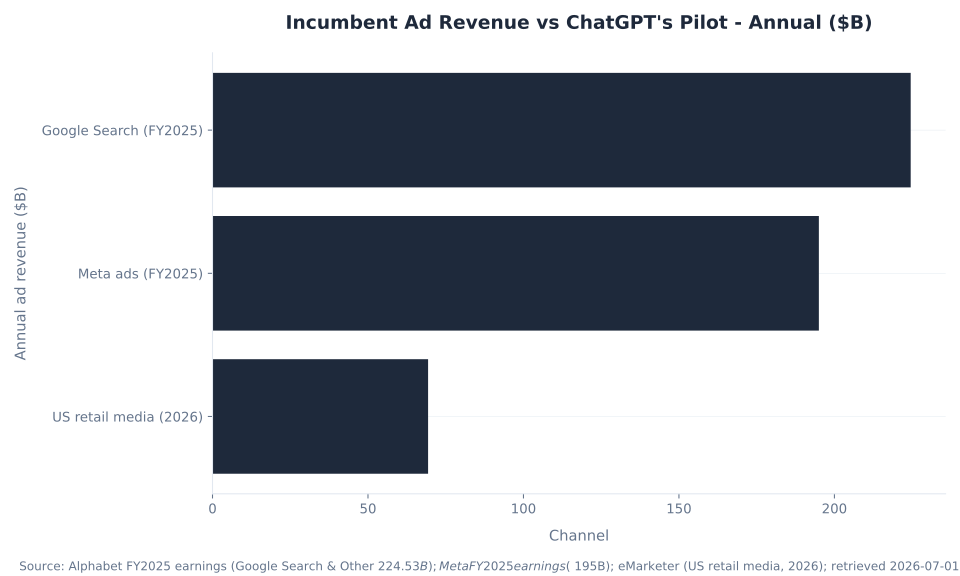
The single most grounding number in this whole comparison is the scale gap. Google’s Search & Other advertising brought in $224.53B in Alphabet’s FY2025, and total Alphabet advertising was $294.69B. Meta’s advertising revenue was roughly $195B. US retail media — Amazon and its peers — is a $69.33B market in 2026 by eMarketer’s count. Against all of that, ChatGPT’s ad pilot is on the order of $0.1B annualized. It is a rounding error today, and saying so plainly is the honest starting point.
Two cautions on that $0.1B. First, it is an estimate, not a reported figure: OpenAI has not published ad revenue, so the number is an order-of-magnitude read consistent with a five-month-old pilot on the Free and Go tiers with no public rate card. It is used here only as a ceiling — a “rounding error versus the incumbents” marker — never as a precise line. Second, the gap reframes the loudest headline in the category. OpenAI’s own $100B-by-2030 ambition would be about 45% of Google Search’s entire current business; eMarketer’s realistic read of standalone-chatbot ad revenue, ~$5B by 2030, is smaller than a single quarter of Google Search today. The chart beside this section plots the three reported incumbent figures so the scale is visible at a glance.
| Channel | Annual ad revenue | Period | Source |
|---|---|---|---|
| Google Search & Other | $224.53B | FY2025 | Alphabet earnings |
| Alphabet total advertising | $294.69B | FY2025 | Alphabet earnings |
| Meta advertising | ~$195B | FY2025 | Meta earnings |
| US retail media | $69.33B | 2026 | eMarketer |
| ChatGPT ads pilot | ~$0.1B (annualized, estimated) | 2026 | Reported / estimated |
Sources: Alphabet FY2025 earnings; Meta FY2025 earnings; eMarketer (US retail media, 2026). The ~$0.1B ChatGPT figure is an order-of-magnitude estimate, not a reported line item — OpenAI has not published ad revenue. Not mbadv client data.
The practical takeaway for a media plan is simple. The incumbents are where the budget belongs, and a Google Ads / PPC audit is the right way to baseline that mature core. ChatGPT Ads is a small experimental line you fund on top — and MB Adv Agency reads it exactly that way for the advertisers it works with. For the shopping-intent comparison inside retail media, the Amazon Ads vs Google Ads breakdown is the closest sibling.
ChatGPT’s Reach: 400M → 900M Weekly Active Users
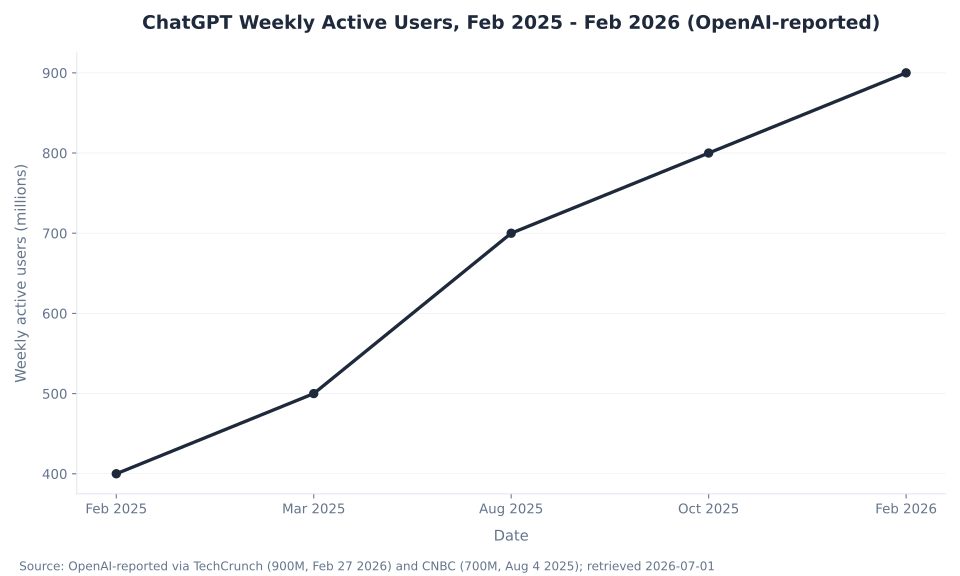
The reason anyone takes the channel seriously is the audience. OpenAI-reported ChatGPT weekly active users climbed from 400M in February 2025 to 900M by February 27, 2026 — more than doubling in a year. On top of that reach sit 50M paying consumer subscribers and 9M+ business users. As an audience, this is one of the fastest-growing surfaces on the internet, and the chart beside this section plots the full curve.
One correction is load-bearing here, because it is the number most often misquoted: the 900M figure is weekly active users, not “1B monthly active users.” The “1B” that circulates is 1B downloads — ChatGPT was the fastest app to a billion downloads (July 2025, Sensor Tower) — and downloads are not monthly actives. OpenAI reports weekly active users, so the honest phrasing is “900M weekly active users as of February 27, 2026.” Getting this right is what separates a citable page from a hype page.
| Date | Weekly active users | Source |
|---|---|---|
| Feb 2025 | 400M | OpenAI-reported (TechCrunch) |
| Mar 2025 | 500M | OpenAI-reported (TechCrunch) |
| Aug 4, 2025 | 700M | OpenAI-reported (CNBC) |
| Oct 6, 2025 (DevDay) | 800M | OpenAI-reported (TechCrunch) |
| Feb 27, 2026 | 900M | OpenAI-reported (TechCrunch) |
Sources: TechCrunch (900M, Feb 27 2026); CNBC (700M, Aug 4 2025). These are weekly active users — 900M weekly, not “1B MAU.” Only 1B downloads is verified (Jul 2025, Sensor Tower). Not mbadv client data.
Hold the two facts next to each other and the thesis writes itself: the audience is real and the ad business is not yet. A surface with 900M weekly users is strategically important the moment it carries ad inventory — but importance is not the same as revenue, and the revenue is still a pilot. For where that audience is heading and what it means for advertisers, see the future of AI and conversational advertising.
The AI-Ad Market Forecasts: eMarketer vs OpenAI vs Barclays
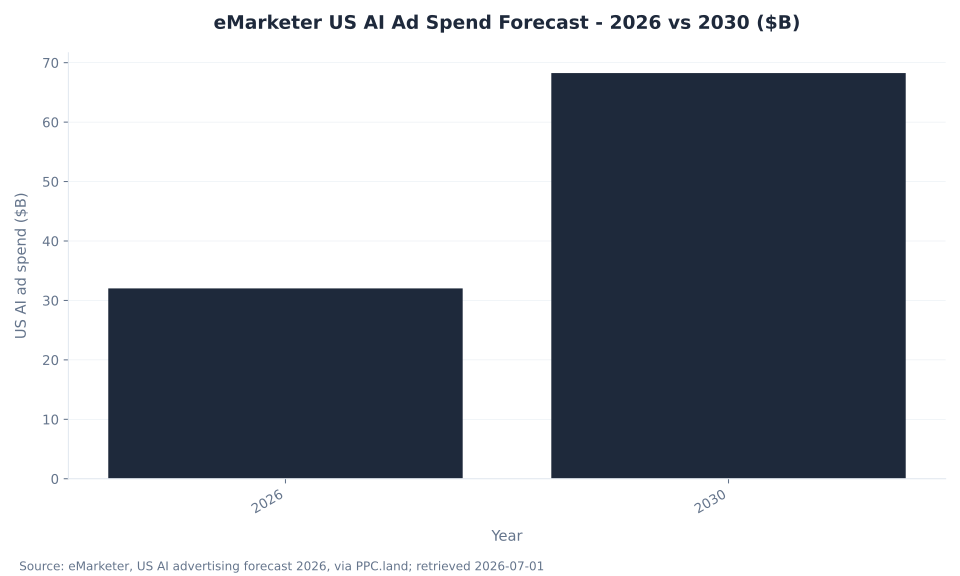
This is the section where the biggest citation magnet and the biggest trap live in the same place, so read the labels carefully: every figure below is a forecast, and they diverge sharply. eMarketer projects US AI ad spend rising from $32.03B in 2026 to $68.25B in 2030. OpenAI’s own internal projection is $2.5B in 2026, $11B in 2027, and $100B in 2030. Barclays models a similar $2.4B climbing to $102B by 2030. Those last two numbers are what get quoted as “ChatGPT is coming for Google’s ad business.”
Here is the discipline that keeps this page honest, and it is the pillar’s single most important guardrail: the ~$100B-by-2030 figure is not consensus. It is OpenAI’s internal projection and Barclays’ aggressive model — both forecasts. eMarketer’s independent read is far lower for the part that actually matters here: of that $68.25B total US AI ad spend in 2030, more than 80% is “AI-adjacent” — ads that sit next to AI content, not inside a chatbot — and standalone-chatbot ad revenue, ChatGPT plus its peers, is only about $5B by 2030. The chart beside this section anchors on eMarketer’s defensible total-market bars while the annotation carries the tension. Present both reads; never state $100B as a settled fact.
| Source | 2026 | 2027 | 2030 | What it measures |
|---|---|---|---|---|
| eMarketer — US AI ad spend | $32.03B | — | $68.25B | Total US AI ad spend (80%+ “AI-adjacent,” not inside chatbots) |
| eMarketer — standalone chatbots | <$1B | — | ~$5B | ChatGPT + peer chatbot ad revenue only |
| OpenAI internal (via Axios / The Information) | $2.5B | $11B | $100B | OpenAI’s own ad-revenue projection (aggressive) |
| Barclays model | $2.4B | — | $102B | Modeled OpenAI ad revenue (users 0.7B→1.7B; ARPU $3.50→$60) |
Sources: eMarketer, US AI advertising forecast 2026 via PPC.land; The Information (OpenAI $100B / Barclays $102B). The gap is the story: OpenAI’s and Barclays’ ~$100B is an outlier against eMarketer’s ~$5B standalone-chatbot read. Not mbadv client data.
Why does the gap exist? Because the two camps model different things. OpenAI and Barclays extrapolate from a huge advertisable-user base and a rising ARPU toward Google-scale economics; eMarketer prices in how early, how category-limited, and how trust-constrained in-chatbot advertising still is. For the advertiser, the takeaway is not to pick a winner but to plan for the floor: size ChatGPT Ads to eMarketer’s conservative chatbot read, and treat any move toward OpenAI’s projection as upside you did not budget on.
Why the Opportunity Exists: the Zero-Click / AI-Search Shift
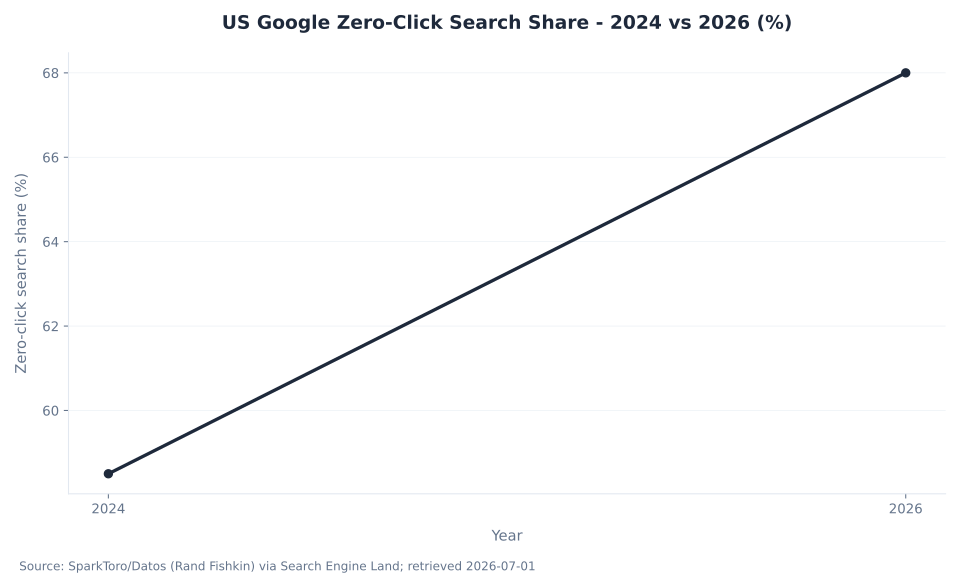
The ad business is tiny, so why does a new in-answer ad channel matter at all? Because the behavior underneath it is shifting fast and for real. US Google zero-click searches — searches that end without a click to an external site — rose from 58.5% in 2024 to about 68% in early 2026, per SparkToro and Datos. Gartner projects traditional search-engine volume down 25% by 2026 as people move to AI chatbots and agents. As answers replace clicks, the answer itself becomes the surface where attention lives — and where ad inventory gains strategic value even while it is financially small.
The corroborating signals point the same way. Bain finds about 80% of consumers now rely on AI-generated summaries for at least 40% of their searches. Adobe Analytics measured retail traffic from generative-AI sources up 693% year over year in the 2025 holiday season, with AI-referred shoppers converting 31% higher. Semrush reports ChatGPT outbound referrals up 206% year over year. None of these is an ad-revenue number — they are demand-side, behavioral signals — and that is exactly why they matter: they explain why the inventory will get more valuable before the revenue catches up. The chart beside this section plots the zero-click trend line that anchors the shift.
| Signal | Value | Source |
|---|---|---|
| US Google zero-click searches | 58.5% (2024) → ~68% (early 2026) | SparkToro / Datos |
| Traditional search-engine volume | −25% by 2026 (to AI chatbots / agents) | Gartner |
| Consumers relying on AI summaries | ~80% for ≥40% of searches | Bain |
| Retail traffic from generative-AI sources | +693% YoY (2025 holiday) | Adobe Analytics |
| ChatGPT outbound referrals | +206% YoY | Semrush |
Sources: SparkToro / Datos via Search Engine Land; Gartner (2024-02-19); Bain; Adobe Analytics; Semrush. The 2026 zero-click value is 68.01% for the first four months of 2026, shown as ~68%. Not mbadv client data.
One honest caveat on the zero-click figure: the 2024 number is a full-year read and the 2026 number covers the first four months of 2026, so treat the pair as a directional trend, not a like-for-like annual comparison. The organic side of this same shift — generative engine optimization, AI Overviews, and answer engines — is covered in how AI is changing SEO, the closest cross-glossary sibling to this pillar.
How the Ad Models Differ: ChatGPT vs Google Search vs Meta vs Retail Media
Set the four channels side by side and the differences are structural, not cosmetic. A ChatGPT ad is a single sponsored card at the bottom of a chat answer, selected on the context of the current conversation. A Google Search ad is a text unit on the results page, selected on the keyword intent of a query. A Meta ad is feed or story creative, selected on interest and behavior plus lookalikes. A retail-media ad is a sponsored product, selected on shopping intent at the point of purchase. Same word, “ad,” four different buying signals.
The auction mechanics differ too. ChatGPT runs a relevance-weighted second-price auction over eligible conversations, where relevance can outweigh bid — it is not a plain highest-bidder auction, and it selects on the intent of the current chat rather than an exact-match keyword. Google’s Ad Rank multiplies bid by quality against a keyword query. Meta runs a value-based auction. Retail media runs second- or first-price auctions on product placements. The anchor table below lays out all six dimensions so the head-to-head is legible in one view.
| Dimension | ChatGPT Ads | Google Search Ads | Meta / social ads | Retail media (Amazon etc.) |
|---|---|---|---|---|
| Ad unit | Sponsored card in a chat answer | Text ad on the SERP | Feed / story creative | Sponsored product / brand |
| Buying signal | Contextual (conversation topic / intent) | Keyword / query intent | Interest / behavior + lookalikes | Shopping intent (in-cart) |
| Targeting available | Contextual + geo + first-party (no demo / interest / lookalike) | Keywords, audiences, demo, geo | Demo, interest, behavior, lookalike | Product, category, shopper |
| Auction | Relevance-weighted second-price | Ad Rank (bid × quality) | Value-based auction | Second-price / first-price |
| Measurement | OpenAI-native pixel / CAPI / Insights (no ROAS at launch, no fixed attribution window) | Deep, mature (GA4, attribution) | Mature (Meta Pixel / CAPI) | Retailer-native + MMM |
| Maturity | Live pilot (Feb 2026) | 25+ years | 15+ years | ~10 years |
Sources: chatgpt-ads shared verified facts (surfaces, targeting, auction, measurement) and the sibling ad-platform glossaries for the Google, Meta, and Amazon columns. This is the comparison the pillar is built around. Not mbadv client data.
The maturity row is the honest punchline: Google Search has been refined for more than 25 years, Meta for more than 15, retail media for about 10, and ChatGPT Ads has existed as a live pilot since February 2026. That is not a knock — it is a reason to test rather than reallocate. For the mechanics behind the ChatGPT column, see how ChatGPT Ads work; for the SERP model it is measured against, see Google Ads campaign types and the social side in what Meta Ads are. The challenger-versus-Google pattern also plays out in Microsoft Ads vs Google Ads and, on the video side, YouTube Ads vs other video platforms.
Targeting, Formats & Measurement Compared
This is where the “early” in “real but early” shows most clearly. ChatGPT’s targeting is contextual first: it matches ads to the topic and intent of the current chat, using what OpenAI calls context hints rather than exact-match keywords. On top of that it offers US geo targeting down to state, DMA, and ZIP, and first-party custom audiences built from a hashed CSV upload with include and exclude lists. That is the whole toolkit — and the honest, load-bearing point is what is absent.
ChatGPT Ads has no demographic targeting, no interest targeting, no device targeting, no placement targeting, and no lookalike audiences. Those simply do not exist in the product today, and any guide that claims otherwise is inventing capability. Google and Meta offer all of them, refined over more than a decade. On formats, ChatGPT runs a single sponsored card — headline, short description, image, and destination link — with early tests of dynamic CTA buttons and an e-commerce card pulling price and reviews; Google and Meta run deep format libraries. The matrix below is the honest capability comparison.
| Capability | ChatGPT Ads | Google / Meta |
|---|---|---|
| Contextual targeting | Yes — core mechanism (current conversation topic / intent) | Yes |
| Geo targeting | Yes — US state / DMA / ZIP | Yes |
| First-party custom audiences | Yes — hashed CSV upload, include / exclude (no lookalikes) | Yes |
| Demographic / interest / device / placement targeting | No — does not exist in the product | Yes |
| Lookalike audiences | No | Yes |
| Ad format | One sponsored card (headline, description, image, link); early tests of dynamic CTAs and an e-commerce format | Rich, mature format libraries |
| Conversion measurement | OpenAI-native pixel (oaiq) + Conversions API + Insights | GA4 / Meta Pixel / CAPI, deep and mature |
| ROAS column at launch | No — not exposed at launch | Yes |
| Fixed attribution window | No — only a CAPI 7-day ingestion limit (not an attribution window) | Yes (configurable) |
Sources: chatgpt-ads shared verified facts (targeting §3, measurement §6) and OpenAI’s measurement-pixel developer docs. Demographic, interest, device, placement, and lookalike targeting are confirmed absent — do not assume they exist. Not mbadv client data.
Measurement follows the same pattern. ChatGPT’s stack is OpenAI-native: a JavaScript pixel, a server-to-server Conversions API, and an Insights API for impressions, clicks, spend, CTR, CPC, and CPM. Two honest limits matter for any comparison. There was no ROAS or conversion column exposed in reporting at launch, and there is no OpenAI-published attribution window — the only real time boundary is a 7-day ingestion limit in the Conversions API, which is not the same thing. For the full measurement picture see measuring ChatGPT Ads performance and the targeting detail in ChatGPT Ads targeting and audiences; the mature counterparts are Google audience targeting, Google conversion tracking and attribution, and Meta audience targeting.
Pricing Compared, Honestly
The honest answer on ChatGPT-ad pricing is short: OpenAI has not published a public rate card. There is no official CPM and, since self-serve opened, no minimum spend. The only price OpenAI itself publishes is a recommended CPC max bid of $3 to $5 per click — and that is a recommended bid guide, not a charged price. This is the most misquoted fact in the category, so it bears stating precisely: no one is charged “$3 to $5 per click” as a rate; that range is guidance for what to bid.
What is confirmed is the shape of the buying options. ChatGPT Ads launched on CPM, added CPC bidding on May 5, 2026, and turned on CPA bidding for select advertisers on May 28, 2026, built on the conversion pixel. The reported price signals — and these are labeled reported for a reason — come from Digiday’s verified Ads Manager screenshots: a CPM of about $60 at launch eroding to about $25 within roughly ten weeks. OpenAI did not confirm those figures, so they belong in the conversation as reported, never as an official rate. The $200K minimum spend that made early headlines applied only to the gated beta and has been removed for self-serve.
| Item | Value | Status |
|---|---|---|
| Official public rate card | None published | CONFIRMED absent |
| Only OpenAI-published price | Recommended $3–5 CPC max bid (a bid guide, not a charged price) | CONFIRMED |
| Buying models live | CPM (launch) + CPC (May 5, 2026) + CPA (May 28, 2026, select) | CONFIRMED |
| Reported CPM | ~$60 at launch → ~$25 within ~10 weeks | REPORTED (Digiday screenshots; OpenAI unconfirmed) |
| Minimum spend | $200K (early gated beta) → removed for self-serve (~May 5, 2026) | CONFIRMED (minimum removed) |
Sources: chatgpt-ads shared verified facts (§5); Digiday (reported CPM $60→$25); Adweek ($200K minimum, later removed). Never write “ChatGPT charges $3–5 per click” — $3–5 is a recommended max bid, not a charged price. Not mbadv client data.
Against that, Google and Meta run transparent, mature auctions with well-understood cost structures — the reason a Google Ads / PPC audit can baseline expected cost per result before you ever test a new channel. For the full ChatGPT pricing picture see how much ChatGPT Ads cost; for the mature comparisons, see Google bidding strategies, Meta cost, budgeting and bidding, and how a shopping-intent channel prices inventory in Amazon Sponsored Ads.
What the Other AI Platforms Are Doing
A tempting narrative says “every AI platform is racing to add ads.” The dated record says the picture is mixed. The strongest counter-example is Perplexity: it launched sponsored follow-up questions in November 2024, then fully dropped ads on February 18, 2026, going subscription-only and citing trust — “we are in the accuracy business.” A leading answer engine tested in-answer advertising and walked away. That is the single most important fact for anyone assuming the whole category is a one-way gold rush.
The incumbents are moving, but by different paths and on different timelines. Google added ads to AI Overviews in May 2025 and expanded them through the year. Microsoft launched Copilot ads — “Copilot Monetize” — in April 2025, including an immersive Showroom format. Amazon is rolling Sponsored Products and Brands into its Rufus shopping assistant on a CPC basis, beta to general availability. And OpenAI’s ChatGPT ads went live as a pilot on February 9, 2026. Five platforms, five different postures — one of which is a full retreat. The table below dates each move.
| Platform | Ad move | Date | Status |
|---|---|---|---|
| Perplexity | Sponsored follow-up questions (CPM >$50) → fully dropped ads on trust grounds | Nov 2024 → Feb 18, 2026 | Dropped (subscription-only) |
| Ads in AI Overviews (US), expanded through 2025 | May 2025 | Live | |
| Microsoft | Copilot ads (“Copilot Monetize”); Showroom format | Apr 2025 | Live |
| Amazon | Sponsored Products / Brands inside Rufus (CPC) | 2025 (beta→GA) | Rolling out |
| ChatGPT (OpenAI) | Sponsored card, Free / Go tiers; self-serve Ads Manager | Live Feb 9, 2026 | Live pilot |
Sources: Search Engine Land (Perplexity dropped ads, Feb 18 2026), corroborated by MacRumors; Google, Microsoft, and Amazon 2025 announcements via the chatgpt-ads shared verified facts. Not mbadv client data.
For advertisers, the read is to watch the whole field rather than bet the plan on any single platform’s trajectory. Where the channel and the trust debate head next — including the Perplexity reversal and the answer-integrity question — is covered in the future of AI and conversational advertising. The commerce layer, which is organic product discovery rather than advertising, is a separate story in ChatGPT shopping and Instant Checkout.
Where the Comparison Cluster’s Search Demand Sits
The demand behind this comparison is real and measurable. The head term “chatgpt ads” runs 3,600 US searches a month (11,000 global) at a keyword difficulty of 42, and its SERP already carries paid ads and an AI Overview — a sign the intent is commercial and contested. Around it sits a cluster: “ai advertising” at 3,500, “openai ads” at 1,000, and the competitor-comparison term “perplexity ads” at 350. The table below shows the full set.
Two reading notes keep this honest. First, “ai advertising” is a mixed-intent term — much of its volume skews toward AI creative-generation tools, the software that writes ads, rather than the ad channel this pillar sizes; the comparison intent lives in the head term and the long-tail “vs” queries. Second, “generative ai advertising” carries the lowest difficulty in the set at KD 24, which makes it the most winnable framing for the honest market read. The demand pattern overall skews toward news and “is-it-live” curiosity, which is exactly the question this page answers with dated numbers.
| Term | US volume | Global | KD | CPC |
|---|---|---|---|---|
| chatgpt ads | 3,600 | 11,000 | 42 | $8.00 |
| ai advertising | 3,500 | 7,400 | 53 | $1.20 |
| openai ads | 1,000 | 1,900 | 59 | $8.00 |
| perplexity ads | 350 | 1,000 | 39 | $12.00 |
| generative ai advertising | 350 | 500 | 24 | $7.00 |
| agentic commerce | 5,600 | 15,000 | 50 | — |
Source: pillar data JSON (Ahrefs Keywords Explorer, US, 2026-07-01). “ai advertising” skews toward AI creative-generation tools — this pillar answers the ad-channel intent, not the ad-maker cluster. Not mbadv client data.
Because the collection is brand-new, there is no Search Console history to lean on — the demand table is the Ahrefs read, dated to July 1, 2026. That greenfield status is itself a reason to treat every figure on this page as a dated snapshot in a fast-moving category, and to re-verify before any refresh.
How to Decide if ChatGPT Ads Belongs in Your Media Plan
If the honest verdict is “test, don’t reallocate,” the practical question is how to run that test well. Here is a six-step decision routine that mirrors the HowTo steps in this guide’s structured data. Work it in order, because each step de-risks the next.
Step 1 — Confirm eligibility and fit. Check that you are in a live market (the US, or the UK and other markets now rolling out), that your audience overlaps the Free and Go tiers, that your category is on OpenAI’s allowed list (lifestyle and household goods, local services, travel and experiences, digital products and education), and that your product suits contextual discovery inside a conversation. Step 2 — Size it as a test budget, not a reallocation. Carve a small experimental line; keep your Google and Meta programs fully funded. Step 3 — Set up measurement first. Install the OpenAI pixel and the Conversions API, define your standard events, and expect no ROAS column and no fixed attribution window — plan your reporting around that reality rather than assuming a Google-style dashboard.
Step 4 — Use contextual context-hints plus geo. Describe the conversations and topics where your product is relevant, add US geo targeting, and accept that there is no demographic, interest, or lookalike targeting to lean on. Step 5 — Benchmark on incremental conversions, not vanity clicks. Compare the channel against your Google and Meta baseline on genuine incremental conversions, using the pixel and Conversions API to measure real outcomes. Step 6 — Re-evaluate quarterly. Pricing, formats, geographies, and policies are still shifting month to month, so revisit the test on a quarterly cadence and let the incremental-conversion data, not the hype, decide whether the line grows.
That routine is how MB Adv Agency would frame a first ChatGPT Ads test for an advertiser it already runs paid search and social for: measurement first, small budget, incremental benchmark, honest quarterly review. It keeps the new channel in proportion — a test line beside a proven core, sized to eMarketer’s conservative read rather than OpenAI’s aggressive one.
Sizing a New Channel Against a Proven Core
Want a read on where ChatGPT Ads fits in your paid-media mix?
MB Adv Agency runs the paid-media programs — Google Ads, Meta, and the broader paid mix — that a new channel like ChatGPT Ads slots into. Talk to our team about test-sizing it honestly against your proven core.
Talk to our team →The Thesis, Restated: the Audience Is Real, the Ad Business Is Tiny
Every number on this page serves one thesis, and it is worth stating cleanly one more time: ChatGPT’s audience is real and its ad business is tiny. Those are not in tension — they are the two halves of an honest read. A surface with 900M weekly active users is one of the most valuable audiences on the internet. An ad pilot on the order of $0.1B annualized is a rounding error next to Google Search’s $224.53B. Both are true at once, and holding them together is what keeps expectations right-sized.
The trajectory is what makes it interesting rather than dismissible. The reach curve is steep, the zero-click shift is genuine, and OpenAI is expanding the product monthly — CPC and CPA bidding, geo targeting, custom audiences, international markets. So the channel is on a real upward path. But a path is not a destination: the forecasts that put it at Google scale by 2030 are OpenAI’s and Barclays’ own aggressive projections, and the independent read from eMarketer keeps standalone-chatbot ad revenue near $5B by 2030. Plan for the floor, treat the ceiling as upside, and you will never be caught over-committed to a channel that is still finding its shape.
For a paid-media advertiser, the operational conclusion is steady: keep the budget in the mature channels, run ChatGPT Ads as a measured test, and revisit quarterly. The mechanics for doing that well live in the sibling pillars — how ChatGPT Ads work and how much ChatGPT Ads cost — while this page keeps the market frame honest.
The $100B Trap: Why the Forecast Tension Is the Whole Story
The most common misconception about this channel — and the biggest hype trap — is that ChatGPT Ads is on track to overtake Google’s ad business by 2030. The ~$100B-by-2030 figure that fuels this is OpenAI’s own internal projection, echoed by Barclays’ $102B model. Both are aggressive forecasts. eMarketer’s independent read puts standalone-chatbot ad revenue at only about $5B by 2030. Both belong in the conversation; only one should ever be stated as a fact-in-the-making. Presenting $100B as settled is the error this page exists to prevent.
Three more misconceptions deserve the same declarative correction. First, “ChatGPT Ads can replace your Google or Meta budget” — no: a $0.1B pilot with a limited category whitelist, no public rate card, and no lookalike targeting is a test-and-learn channel, not a replacement. Second, “every AI platform is racing to add ads” — no: Perplexity tested ads from November 2024 and dropped them entirely on February 18, 2026, on trust grounds. Third, “ChatGPT ads cost $3 to $5 per click” — no: that range is a recommended max bid, not a charged price, and it is the only price OpenAI publishes.
The through-line across all four is the same discipline MB Adv Agency applies to any emerging channel: separate the audience from the revenue, separate forecasts from facts, and separate a recommended bid from a charged price. Get those three separations right and ChatGPT Ads becomes easy to size correctly — a genuine, fast-growing, but still-tiny line worth watching and testing, not a budget to move today. That is the honest comparison, and it is the one that survives contact with a fast-moving product.
ChatGPT Ads vs Google & Social Ads: FAQ
Baseline the Mature Channel First
Test ChatGPT Ads against a proven Google and Meta core
A Google Ads / PPC audit baselines the channel you would test a newcomer against, and our PPC services run the paid mix a channel like ChatGPT Ads slots into.
Google Ads / PPC audit →All PPC servicesMethodology & Sources
Every number in this comparison traces to a named, dated source, and each figure is labeled by type. The reach curve — 400M to 900M weekly active users — is OpenAI-reported via TechCrunch and CNBC, and it is weekly active users, not monthly. The market-size figures are forecasts: eMarketer’s US AI ad spend of $32.03B (2026) to $68.25B (2030) and its ~$5B standalone-chatbot read come from eMarketer via PPC.land, while OpenAI’s $100B and Barclays’ $102B projections come from The Information.
The incumbent scale figures are company earnings: Google Search & Other at $224.53B and total Alphabet advertising at $294.69B from Alphabet’s FY2025 report, and Meta advertising at roughly $195B from Meta’s FY2025 report; US retail media at $69.33B is eMarketer’s 2026 read. The zero-click shift is a measured study from SparkToro / Datos via Search Engine Land, with Gartner’s −25% search-volume projection from Gartner. The Perplexity reversal is dated to Search Engine Land and MacRumors. Reported price signals are from Digiday and Adweek, labeled reported throughout. Search demand is from Ahrefs Keywords Explorer (US, July 1, 2026).
Two disciplines govern the whole page. First, no WordStream or LocaliQ figure appears anywhere — those publish paid-search cost benchmarks that have no bearing on a brand-new conversational-ad channel, so they are a category error here. Second, MB Adv Agency has no ChatGPT-Ads service page and no client dataset for this channel, so the point of view stays qualitative: the paid-media programs we run, and the honest sizing we would give an advertiser weighing a new channel. No mbadv client metric appears anywhere in this guide. This is a fast-moving product, so treat every number as a dated snapshot — last updated July 1, 2026 — and re-verify before any refresh. To discuss where ChatGPT Ads fits your paid-media mix, talk to our team.