Microsoft Audience Network: Audience Ads Guide 2026

1B+
customers reachable across MSAN properties
Source: Microsoft Advertising, "Display and Native ads" — MSN, Outlook.com, Microsoft Edge, Microsoft Casual Games + premium partner network combined. Marketing-stated figure; verify at publish.
What Are Audience Ads? The Microsoft Audience Network (MSAN) Explained
Audience ads are Microsoft Advertising's (formerly Bing Ads) native and display ad format, served exclusively across the Microsoft Audience Network (MSAN) — a premium native and display network that is structurally separate from the Microsoft Search Network. MSAN reaches up to 1 billion customers across four owned-and-operated property groups — MSN, Microsoft Outlook, Microsoft Edge, and Microsoft Casual Games — plus a curated premium partner network. The targeting layer runs on audience intelligence signals: search history, browse behavior, page content, demographics, and LinkedIn profile data fused by Microsoft's AI and machine learning, rather than keyword queries.
Audience ads embed natively into content environments — news feeds on MSN, the inbox layer on Outlook.com, new-tab cards in Microsoft Edge, gaming surfaces within Microsoft Casual Games — rather than appearing on Bing search results pages. Users encountering audience ads are consuming content, not expressing a purchase query. That passive-intent context is the reason audience ads carry lower CTRs than search ads: it is a structural feature of the inventory, not a performance failure. See the Microsoft Advertising overview for how MSAN fits within the full platform, and Microsoft Ads audience targeting for the in-market, custom, and LinkedIn audiences that power MSAN campaigns.
Microsoft's official description of the targeting layer: audience ad experiences are "anchored in the consumer audience understanding from Microsoft's audience intelligence, which includes search and web activity, LinkedIn profile data, demographic and customer data" (Microsoft Learn, "Audience Ads"). Third-party practitioners commonly shorthand this as the "Microsoft Graph" — a colloquial label, not Microsoft's official term. The operative distinction from purely contextual display: the inventory looks native but the targeting is search-and-LinkedIn-fed. For more on how practitioners describe the data layer, see Adcore's MSAN overview.
| Placement / property | Format type | Notes |
|---|---|---|
| MSN (MSN.com homepage, news feeds, slideshows) | Native + display + video | 500M+ monthly readers; largest MSAN surface; ad matches feed and slideshow look |
| Microsoft Outlook (Outlook.com web mail) | Native (inbox-style) | 63M+ consumer subscribers; ad serves natively within the inbox environment |
| Microsoft Edge (new-tab / homepage cards) | Native + display | New-tab and homepage card placements in the Edge browser |
| Microsoft Casual Games | Native + display + video | 3B+ minutes played/month; Microsoft's current official placement name — not "Xbox" |
| Premium partner network | Native + display | Curated high-quality publisher partner sites beyond Microsoft-owned properties |
| NOT the SERP | — | Audience ads do not appear on Bing search results pages — that is the Microsoft Search Network |
Sources: Microsoft Learn, "Audience Ads" (placements: MSN, Outlook, Microsoft 365, Microsoft Casual Games + partner sites; updated 2026-06-05); Microsoft Advertising, "Display and Native ads" (Edge, Outlook, Bing outside SERP, Casual Games + publisher partners; up to 1B customers); SteerAds, "Microsoft Audience Network guide 2026" (MSN ~350–400M, Outlook ~400M global MAU). Reach sub-metrics (500M+/63M+/3B+) are Microsoft Advertising marketing-stated; verify at publish. Official gaming placement name is "Microsoft Casual Games" — not "Xbox."
Audience campaigns are one of six structured campaign types in Microsoft Advertising; see Microsoft Ads campaign types for where Audience campaigns sit relative to Search, Shopping, DSA, Smart, and Performance Max.
Key Takeaways
- MSAN is a separate network from Search. The Microsoft Audience Network serves native and display ads on MSN, Outlook, Edge, and Microsoft Casual Games — not on Bing search results pages. The two networks have separate placements, separate intent profiles, and separate KPI benchmarks.
- Audience ads are likely running in your account right now. Microsoft automatically extends Search campaign creative into native placements ("Search Ads Extended to Native"). If you run Search campaigns and have never filtered the Ad Distribution column, MSAN spend is very likely already present.
- The LinkedIn targeting layer is structurally unique. MSAN is the only native/display inventory where advertisers can target by LinkedIn Company, Industry, Job Function, and Job Seniority (added June 16, 2026). For B2B advertisers, this is the primary reason to run dedicated Audience campaigns.
- Dynamic remarketing requires a full feed-plus-UET stack. Product-level retargeting on MSAN needs a Microsoft Merchant Center feed, UET tags carrying
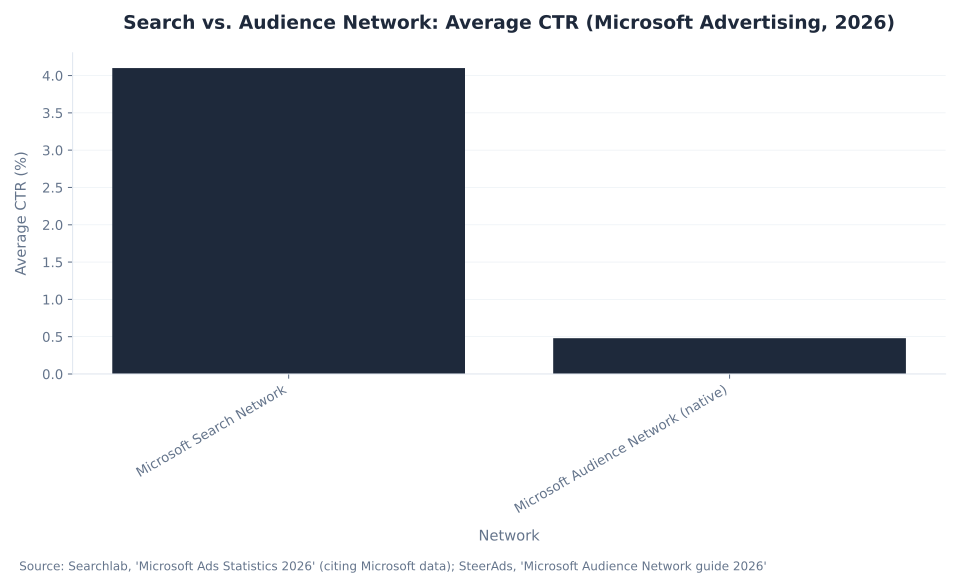
ecomm_prodidandecomm_pagetype, and a dynamic remarketing audience list of at least 300 users. A basic remarketing list without a product feed does not qualify. - Never judge audience ads on search CTR benchmarks. The Microsoft Search Network averages 4.1% CTR cross-industry; MSAN native averages 0.48% (Searchlab 2026). The gap is a structural feature of passive-intent native inventory. See Microsoft Ads bidding and budget for how automated bid strategies work across both networks.
1B+
customers reachable across MSAN (Microsoft Advertising)
0.48%
average MSAN native CTR cross-category (Searchlab 2026)
300
minimum users for dynamic remarketing list eligibility (Microsoft Help)
MSAN Property Reach: Microsoft's Owned-and-Operated Inventory
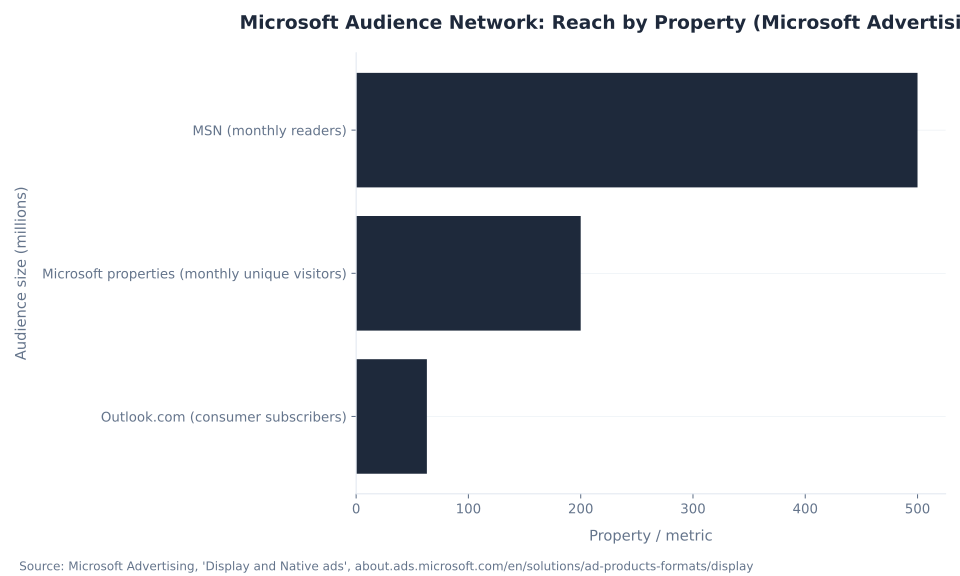
Microsoft Advertising states total reach across all MSAN properties at up to 1 billion customers. The sub-metrics below break that figure down by property group, as stated on the Microsoft Advertising Display and Native ads product page. These are marketing-stated figures, not independently audited audience counts.
| Property / metric | Figure (Microsoft-stated) | Unit |
|---|---|---|
| MSN | 500M+ | Monthly readers |
| Microsoft properties (combined) | 200M+ | Monthly unique visitors |
| Microsoft Outlook.com | 63M+ | Consumer subscribers |
| Microsoft Casual Games | 3B+ | Minutes played per month (different unit — not comparable to user counts above) |
| MSAN total (all properties) | Up to 1 billion | Customers (Microsoft-stated combined reach) |
Source: Microsoft Advertising, "Display and Native ads," about.ads.microsoft.com/en/solutions/ad-products-formats/display. All figures are official Microsoft Advertising marketing-stated claims; verify against the live page at publish. Third-party corroboration: SteerAds (2026) estimates MSN at ~350–400M global MAU, Outlook.com at ~400M global MAU.
Microsoft Search Network vs. Microsoft Audience Network: The Intent Gap
The Microsoft Search Network and the Microsoft Audience Network are parallel but structurally incomparable systems. The Search Network (Bing, Yahoo, AOL, DuckDuckGo, Ecosia + syndication partners) serves keyword-triggered ads to users actively typing a query — active, explicit intent. MSAN serves native and display ads to users consuming content on MSN, Outlook, Edge, and Microsoft Casual Games — passive, inferred intent driven by audience signals with no keywords involved.
| Dimension | Microsoft Search Network | Microsoft Audience Network (MSAN) |
|---|---|---|
| Where it serves | Bing, Yahoo, AOL, DuckDuckGo, Ecosia + syndication (the SERP) | MSN, Outlook.com, Edge, Microsoft Casual Games + premium partners (native/display) |
| Ad trigger | Keywords + match types + user query | Audience / intent signals — no keywords |
| Intent level | Active / explicit (user is searching) | Passive / inferred (user is consuming content) |
| Ad formats | Text / responsive search ads + extensions | Responsive native (image), feed-based dynamic, video |
| Avg CTR (cross-industry, 2026) | 4.1% (Searchlab 2026) | 0.48% native avg (Searchlab 2026) — 4–8× lower than Search; a feature, not a failure |
| Best for | Capturing existing demand | Awareness, prospecting, B2B LinkedIn reach, product retargeting |
| Reporting label | Ad distribution = Search | Ad distribution = Audience |
Sources: Searchlab, "Microsoft Ads Statistics 2026" (Search CTR 4.1%; MSAN native CTR 0.48% citing Microsoft MSAN data); ClickCease, "Is Microsoft Search cleaner than Microsoft Audience Network?" (intent / placement / CTR distinction); SteerAds, "Microsoft Audience Network guide 2026" (native CTR 4–8× lower than Search); Microsoft Learn, "Audience Ads" (Ad distribution reporting).
Never blend Search and Audience rows in the same performance report. The MSAN native CTR (0.48% avg) is structurally ~8× below the Search Network CTR (4.1% avg). When both distribution types roll up into a single campaign-level view, the native impressions dilute blended CTR and distort CPL and CVR calculations. Add the Ad Distribution column in reporting and segment before drawing any conclusions.
MB Adv Agency has found that blending Search and Audience metrics in a single report view is one of the most common account-structure errors in Microsoft Advertising — the structurally lower native CTR depresses blended averages and leads to premature campaign cuts on Search campaigns that are actually performing well once the Audience rows are isolated.
The SearchQueryPerformanceReport and ShareOfVoiceReport in Microsoft Advertising do not include Audience Network metrics even when AdDistribution is included as a column. Use the standard campaign performance report with Ad Distribution filtered to "Audience" for MSAN-only views, or to "Search" for clean Search-only metrics.
Audience Ads Formats and Creative Specifications
Microsoft Audience Network supports three native and display formats plus an automatic extension of Search creative. For dedicated Audience campaigns (CampaignType = Audience), advertisers can run responsive image ads assembled from text and image assets, feed-based dynamic ads generated from a Merchant Center product catalog, or video placements across MSN and partner surfaces.
| Format | API type | Description | Key requirement |
|---|---|---|---|
| Responsive (native image) ad | ResponsiveAd | Image + text assets assembled by Microsoft into the native format of each placement | At least one 1.91:1 landscape image; short headline 30 chars; long headline 90 chars |
| Feed-based (dynamic) ad | Audience campaign with ShoppingSetting | Auto-generated product ads from a Merchant Center catalog — the basis of dynamic remarketing | Microsoft Merchant Center store + linked product feed (FTP/SFTP or Content API) |
| Video | Video placement | Video creative in native/in-feed placements across MSN and MSAN surfaces | Available across MSAN per Microsoft "display, native, and video placements" |
| Search ads extended to native | Extension of Search campaigns | Search creative auto-extended into MSAN native placements — on by default | 4 image extensions covering supported aspect ratios to qualify for all placements |
Source: Microsoft Learn, "Audience Ads" (responsive vs feed-based; search-extended-to-native; Merchant Center feed; ad format types). Verify at publish.
For responsive native ads, the creative asset requirements are specific to placements. Microsoft assembles the headline, description, image, and logo into the native format of each surface — MSN news card, Outlook inbox unit, Edge new-tab card — so providing assets that cover all supported aspect ratios is the determinant of full placement coverage.
| Asset | Specification |
|---|---|
| Short headline | 30 characters maximum |
| Long headline | 90 characters maximum |
| Description | 90 characters maximum |
| Images | Up to 15 images (JPEG or PNG); at minimum one 1.91:1 (landscape) aspect ratio required; provide four images covering all supported aspect ratios for full placement coverage |
| Logo | 1:1 aspect ratio; 600 KB maximum file size |
| Image Annotations (fallback) | If no image extensions are provided on a Search campaign extended to native, Microsoft auto-assigns editorially reviewed licensed stock images. To opt out, contact Microsoft support. |
Sources: Veuno, "Microsoft Ad Specs 2026"; thebrief.ai, "Microsoft ad specifications 2026"; Microsoft Learn, "Audience Ads." Verify at publish — creative character limits and image specs drift as Microsoft updates placement surfaces. Confirm against the live Microsoft Learn Image Data Object Remarks before publish.
LinkedIn Profile Targeting on MSAN: The B2B Differentiator
Because Microsoft owns LinkedIn, MSAN is the only native and display inventory in the market where advertisers can target using LinkedIn's declared professional profile data — not behavioral inference approximating professional identity, but actual declared fields from LinkedIn profiles. This makes MSAN structurally different from every other display or native network for B2B campaigns.
Four LinkedIn profile targeting dimensions are available at the ad-group level for both Audience campaigns and Search campaigns. On June 16, 2026, Microsoft added Job Seniority as a fourth dimension, expanding from Company, Industry, and Job Function (PPC.land, June 2026; Search Engine Land, June 2026). The launch covered 29 markets, including the United States; major Western European markets (UK, Germany, France) were not in the initial rollout — verify current market availability at publish for non-US campaigns.
| Dimension | In Audience campaigns | In Search campaigns | Notes |
|---|---|---|---|
| Company | Yes | Yes | Target by specific company name (LinkedIn-declared) |
| Industry | Yes | Yes | ~150+ LinkedIn industries (Software, Financial Services, IT, Legal, Healthcare, etc.) |
| Job Function | Yes | Yes | Engineering, Finance, IT, Legal, Marketing, Sales, Operations, and others |
| Job Seniority | Yes | Yes | Added June 16, 2026 — 10 levels: CXO, VP, Director, Manager, Senior, Entry, Owner, Partner, Training, Volunteer. Available in 29 markets incl. US. |
Sources: Microsoft Learn, "Audience Ads" (ad-group-level LinkedIn criteria); DigitalApplied, "Microsoft Ads LinkedIn Job Seniority Targeting 2026 B2B Guide"; PPC.land, Search Engine Land (June 16, 2026 launch; 29-market availability; major W. European markets not included in initial rollout). Verify current market list at publish for non-US campaigns.
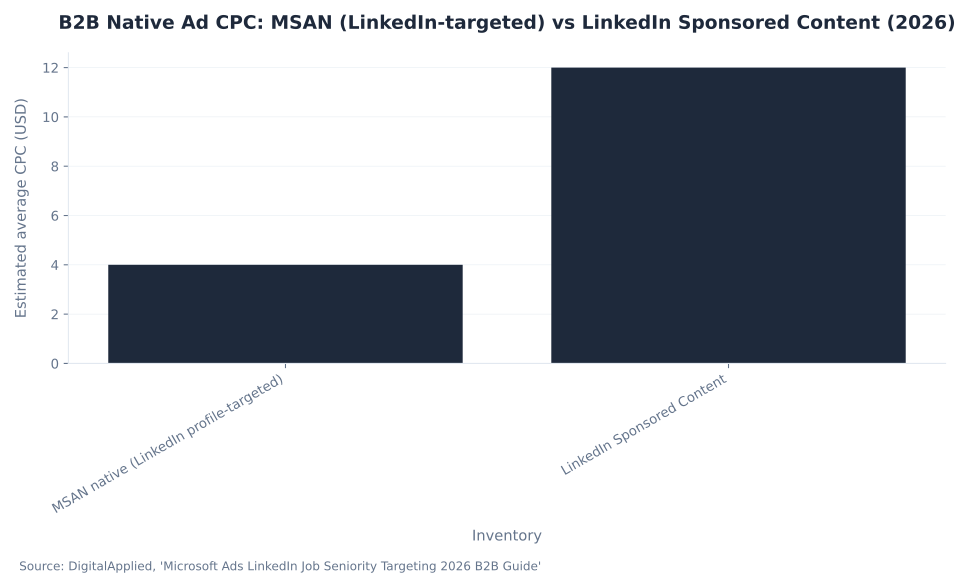
The B2B cost case for LinkedIn-targeted MSAN: vendor estimates (DigitalApplied, 2026) place B2B clicks at $2–6 on MSAN vs $8–15+ on LinkedIn Sponsored Content for comparable professional targeting. These are industry-estimated ranges, not MB Adv client data — actual CPCs vary by campaign objective, bid competition, audience size, and industry. The structural reason for the gap: MSAN serves at Microsoft Advertising's auction-based CPC rates, while LinkedIn Sponsored Content commands premium inventory pricing.
MB Adv Agency runs Microsoft Audience Network campaigns for B2B clients using LinkedIn profile targeting — combining Job Function and Job Seniority filters on MSN and Outlook placements reaches decision-maker segments at CPCs well below LinkedIn's own native inventory, with the added reach of Microsoft's 1B+ user ecosystem. For B2B verticals that benefit most from MSAN's LinkedIn layer, see SaaS and software PPC, financial services PPC, IT and managed IT services PPC, and consulting PPC.
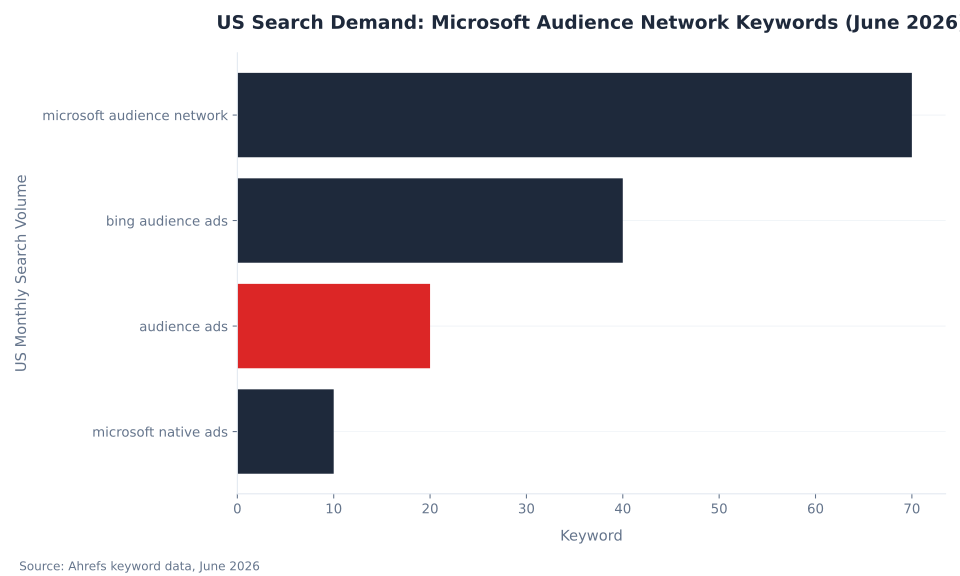
US Search Demand: Microsoft Audience Network Keywords (June 2026)
Dynamic Remarketing on MSAN: Feed-Plus-UET Setup
Dynamic remarketing on MSAN shows users ads featuring the specific products they viewed — current price, product image, direct link back — across MSN, Outlook, and Edge. It is not a toggle or an audience-builder checkbox: it requires a product feed, UET tag parameters, and a dynamic remarketing list that reaches at least 300 users before it becomes eligible to target.
The five visitor types define which behavioral segment each dynamic remarketing list captures. Each targets a distinct point in the purchase funnel, and each list requires its own 300-user threshold before activation. Microsoft's dynamic remarketing lists help documentation and the ProductAudience API data object both confirm the five types and the eligibility threshold.
| Visitor type | Qualifying behavior | Funnel position |
|---|---|---|
| General Visitors | Visited any page on the site | Top of funnel — broadest segment, largest list |
| Product Searchers | Used on-site search or browsed category / subcategory pages | Upper-mid funnel — intent signal stronger than General Visitors |
| Product Viewers | Viewed a specific product detail page | Mid funnel — product-level interest confirmed |
| Shopping Cart Abandoners | Added a product to cart but did not complete purchase | Lower funnel — highest recency urgency; typically the highest-priority segment to activate |
| Past Buyers | Completed a purchase | Post-conversion — loyalty / repurchase targeting |
Sources: Microsoft Help, "Dynamic remarketing lists: Remarketing for products" (visitor types; ≥300-user eligibility; membership duration 1–180 days); Microsoft Learn, ProductAudience Data Object (API-level confirmation of all five types and MembershipDuration range). Note: the Help Center page at help.ads.microsoft.com/apex/index/3/en/56910 can block automated fetches — verify visitor types and threshold against the live page at publish.
MB Adv Agency has found that Shopping Cart Abandoners is consistently the highest-priority dynamic remarketing segment to activate first — the combination of recency and product-level specificity produces the most efficient return once the 300-user threshold is reached. General Visitors lists reach the threshold fastest for smaller sites, making them a useful activation step to establish the infrastructure before narrower segments accumulate sufficient users.
Membership duration for all visitor types is configurable between 1 and 180 days. The 300-user minimum applies within the configured duration window — a list set to 30 days must accumulate 300 qualifying visitors within those 30 days before it targets. For DTC advertisers running product retargeting on MSAN, see fashion PPC, furniture PPC, beauty products PPC, and supplements and nutrition PPC.
Microsoft Audience Network: Reach by Property (Microsoft Advertising, 2026)
Search Ads Extended to Native: The On-by-Default MSAN Behavior
Microsoft automatically extends Search campaign creative into Audience Network native placements — a feature called "Search Ads Extended to Native." An advertiser running only Search campaigns is very likely already spending on MSAN, whether they chose to or not. Microsoft Advertising's own Q&A community forums document a high volume of advertisers asking how to opt out of audience ads they did not knowingly enable.
The auto-extension assembles search creative assets — ad title, description text, URL, ad extensions including image extensions — into the native format of each MSAN placement. The ad renders natively to the surface: as an inbox-style unit in Outlook, as a news-card in MSN, as a new-tab card in Edge. To qualify for all Audience ad placements, an advertiser must associate four image extensions covering the supported aspect ratios. Without image extensions, Microsoft uses Image Annotations: editorially reviewed licensed stock images auto-matched to the ad. Opting out of Image Annotations requires contacting Microsoft support directly.
The diagnostic move: Add the Ad Distribution column to any standard Microsoft Advertising performance report. Filter for "Audience" to isolate MSAN spend from Search spend. The SearchQueryPerformanceReport and ShareOfVoiceReport do not include Audience metrics — use standard campaign or ad group performance reports with the AdDistribution column for accurate segmentation.
MB Adv Agency has found that the first useful action most accounts can take with MSAN is to segment reporting — adding the Ad Distribution column and filtering for Audience — before drawing any performance conclusions. The lower native CTR silently dilutes blended Search campaign metrics when both distribution types roll up into a single view, making Search campaigns appear to underperform when they are actually performing normally.
| Prerequisite | Requirement | Notes |
|---|---|---|
| Microsoft Merchant Center store | Required | Store must be created and linked before feed submission |
| Product catalog feed | Required | FTP/SFTP or Content API; fields: id, item_group_id, title, price, image_link |
| UET tag with dynamic params | Required | ecomm_prodid must match feed's id/item_group_id; ecomm_pagetype values: homepage, searchresults, category, product, cart, purchase |
| Dynamic remarketing audience list | Required | Select visitor type; set membership duration (1–180 days); list is not eligible to target until it reaches ≥300 users |
| Audience campaign (CampaignType = Audience) | Required | Must have ShoppingSetting configured; associate the dynamic remarketing list at the ad group level |
Sources: Microsoft Learn, "Audience Ads" (Merchant Center feed; search-extended-to-native; image annotations); Microsoft Help, "Dynamic remarketing lists" (visitor types; ≥300-user eligibility; membership duration 1–180 days; UET ecomm params); Microsoft Learn, ProductAudience data object (API-level corroboration of all five visitor types and membership duration range).
Search vs. Audience Network: Average CTR (Microsoft Advertising, 2026)
MSAN Keyword Demand: Search Context and SEO Framing
The four primary keywords driving this pillar sum to 140 US monthly searches — thin by absolute volume standards, but the intent is uniform: practitioners searching for a definition of what the Microsoft Audience Network is and whether to use it. The cluster's only clicked page ("what-are-audience-ads") ranked for 38 keywords at average position 25.3 with a single click in 90 days, driven by the top keyword "audience ads" (20 US vol, $15.00 CPC). That anchor is preserved in this pillar's audience-ads H2 section.
| Keyword | US Monthly Vol | KD | CPC (USD) | Intent |
|---|---|---|---|---|
| microsoft audience network | 70 | 35 | $4.00 | Informational / commercial / branded |
| bing audience ads | 40 | 1 | — | Informational / branded (legacy name variant) |
| audience ads ★ cluster winner anchor | 20 | 36 | $15.00 | Informational / commercial |
| microsoft native ads | 10 | — | — | Informational |
Source: Ahrefs keyword data, US, June 2026. CPC values in USD (raw Ahrefs cents ÷ 100). "bing audience ads" KD = 1 — near-zero resistance, legacy-name variant of the same informational intent. "audience ads" at $15.00 CPC reflects the commercial density of that branded term despite low volume. Do not present as mbadv client data.
Three Misconceptions About the Microsoft Audience Network
Three misconceptions about MSAN appear consistently in account audits and documentation across the industry. Each is addressable with reference to Microsoft's own documentation or verified platform behavior.
Misconception 1: "The Audience Network is just contextual display — like the Google Display Network with a Bing logo." Generic explanations describe MSAN as Microsoft's display network and stop there. The structural differentiator is the data behind the targeting. Audience ads are matched using consumer intent signals — search history, browse behavior, page content, and demographic information — fused with AI and machine learning, and enriched by LinkedIn profile data that Microsoft uniquely owns (Microsoft Learn, "Audience Ads"). The inventory looks like display; the targeting is search-and-LinkedIn-fed. Treating MSAN as generic contextual display undersells precisely the differentiator that makes it worth testing for B2B and retargeting use cases.
Misconception 2: "Audience ads only run when I build a dedicated Audience campaign." Microsoft automatically extends Search-campaign creative into native placements ("Search Ads Extended to Native") — so spend appears under "Audience" distribution without the advertiser ever creating an Audience campaign. The correct mental model: MSAN is partly opt-out (native extension of Search, on by default) and partly opt-in (a deliberately built Audience campaign). Confusing the two is how advertisers either over-credit MSAN performance or unknowingly fund native impressions they did not intend to buy. Microsoft's own Q&A forums document the opt-out question regularly.
Misconception 3: "Dynamic remarketing is the same as standard remarketing — just with product ads." Standard remarketing re-shows existing Search or Audience ads to a UET-built list of past visitors. Dynamic remarketing generates product-specific ads from a Merchant Center catalog and has extra prerequisites: the catalog feed, UET tags carrying ecomm_prodid and ecomm_pagetype, and a dynamic remarketing list that reaches at least 300 users before becoming eligible to target. An advertiser with only a basic UET remarketing list and no product feed cannot run dynamic remarketing, regardless of list size.
MSAN by Industry: B2B, DTC, and Lead Generation
MSAN's strongest use cases cluster around three advertiser profiles: B2B companies that want LinkedIn-targeted professional reach at lower CPCs than LinkedIn native; DTC and e-commerce advertisers running feed-based dynamic remarketing; and lead-generation verticals using MSAN as an awareness layer above their Search campaigns.
B2B — LinkedIn-targeted professional reach: SaaS, financial services, IT, and consulting advertisers are the natural fit for MSAN's LinkedIn dimension targeting. Running Director+ IT decision-makers or CFO-level finance audiences on MSN and Outlook reaches professional segments on content they consume daily — at CPCs a fraction of LinkedIn's own Sponsored Content. PPC management for SaaS and software, financial services, IT and managed IT services, and consulting all benefit from this targeting layer. Austin and Chicago markets with dense B2B concentrations see particularly strong MSAN performance for this profile.
DTC and e-commerce — feed-based dynamic remarketing: Advertisers with a Merchant Center feed and UET integration can use dynamic remarketing to re-engage product viewers and cart abandoners across MSN, Outlook, and Edge with the exact products they browsed. This is particularly effective for higher-consideration purchases where the browse-to-buy window extends multiple days. Verticals that see consistent dynamic remarketing lift on MSAN include fashion, beauty products, furniture, and supplements and nutrition.
Lead generation — upper-funnel awareness: Legal, dental, and other high-value lead-gen verticals use MSAN as an awareness layer to reach in-market audiences on premium content surfaces before they conduct a search. MSAN's in-market audiences for legal services and healthcare are a natural complement to Search. See legal PPC and dental PPC for how MSAN fits alongside Search in a full-funnel approach. For local practitioners in smaller markets, Missoula legal PPC, Flagstaff HVAC PPC, and Flagstaff roofing PPC show how MSAN's awareness reach complements local Search campaigns.
B2B Native Ad CPC: MSAN (LinkedIn-targeted) vs LinkedIn Sponsored Content (2026)
Running Microsoft Advertising without checking the Audience Network?
MB Adv Agency audits whether your Search spend is quietly funding MSAN — and whether a dedicated Audience campaign with LinkedIn targeting makes sense for your account. B2B, DTC, and lead-gen verticals all have different MSAN plays.
See SaaS PPC services →MSAN Native vs. LinkedIn Sponsored Content: Cost and Reach Comparison
For B2B advertisers, the practical question is whether LinkedIn-targeted native ads on MSAN are cost-competitive with LinkedIn's own Sponsored Content. The answer is structurally yes — but with important scope limitations.
Vendor estimates (DigitalApplied, 2026) place B2B clicks at about $2–6 on MSAN vs $8–15+ on LinkedIn Sponsored Content for comparable professional targeting — a 2–4× CPC gap. The structural reason: MSAN ads enter Microsoft Advertising's auction at its CPC rates, while LinkedIn Sponsored Content commands LinkedIn's own premium inventory pricing. The tradeoff is placement environment: LinkedIn Sponsored Content appears within LinkedIn's professional feed, where users are in a professional-intent context; MSAN appears within MSN, Outlook, and Edge, where users are in a content-consumption context. For brand awareness and retargeting, MSAN's reach and lower CPCs are the stronger play. For high-intent professional decision-maker engagement, LinkedIn's own inventory remains competitive despite the premium pricing.
Microsoft Advertising overall shows a structural cost advantage vs Google Ads: average CPC of about $1.54 on Microsoft vs $2.96 on Google — a 33–40% lower CPC across the platform (NaMedia Experts, "Microsoft Ads vs Google Ads 2026 Benchmarks"). MSAN native inventory sits within this lower-cost ecosystem. The B2B cost-comparison figures are vendor estimates — not mbadv client data — and actual CPCs vary by campaign objective, bid competition, audience size, and industry.
MSAN Campaign Use Cases by Advertiser Profile
B2B / SaaS
LinkedIn-targeted Audience campaigns
Company + Job Function + Seniority targeting on MSN and Outlook. CPCs $2–6 vs $8–15+ on LinkedIn native. Best for Director+ decision-maker segments.
DTC / E-commerce
Dynamic remarketing via Merchant Center feed
Product-level retargeting for Cart Abandoners and Product Viewers. Requires Merchant Center feed, UET ecomm params, and ≥300-user list threshold.
Lead Generation
In-market audience awareness on premium content
Legal, dental, financial services: MSAN in-market audiences on MSN/Outlook for upper-funnel reach before the Search query. Complements Search campaigns, does not replace them.
Frequently Asked Questions: Microsoft Audience Network
Not sure if your Microsoft Advertising account is running MSAN spend you didn't plan for?
MB Adv Agency audits Search campaigns for unintended Audience Network spend, builds dedicated MSAN Audience campaigns with LinkedIn targeting, and sets up dynamic remarketing for DTC advertisers with Merchant Center feeds. Get in touch to discuss your account.
Audit my Microsoft Ads account →Methodology
Placement, format, targeting, and remarketing data draw from Microsoft Learn ("Audience Ads," updated 2026-06-05), Microsoft Advertising's Display and Native ads product page, and Microsoft Help ("Dynamic remarketing lists," "LinkedIn Profile Targeting"). Keyword demand figures are from Ahrefs (US, June 2026). CTR benchmarks — Search Network 4.1% and MSAN native 0.48% — are from Searchlab ("Microsoft Ads Statistics 2026," citing Microsoft data); MSAN native CTR range 0.4–0.8% B2B / 0.6–1.1% premium B2C is from SteerAds ("Microsoft Audience Network guide 2026"). B2B CPC comparison ($2–6 MSAN vs $8–15+ LinkedIn native) is from DigitalApplied ("LinkedIn Job Seniority Targeting 2026 B2B Guide") — vendor estimate, not MB Adv client data. LinkedIn Job Seniority launch date (June 16, 2026, 29 markets) sourced from PPC.land and Search Engine Land. Reviewed by MB Adv Agency, June 2026.

As a Google Ads expert, I bring proven expertise in optimizing advertising campaigns to maximize ROI.
I specialize in sharing advanced strategies and targeted tips to refine Google Ads campaign management.
Committed to staying ahead of the latest trends and algorithms, I ensure that my clients receive cutting-edge solutions.
My passion for digital marketing and my ability to interpret data for strategic insights enable me to offer high-level consulting that aims to exceed expectations.
Google Partner Agency
We're a certified Google Partner Agency, which means we don’t guess — we optimize withGoogle’s full toolkit and insider support.
Your campaigns get pro-level execution, backed by real expertise (not theory).

4.9 out of 5 from 670+ reviews on Fiverr.
That’s not luck, that’s performance.
Highly recommend Matteo to set up your server side tracking. He has a deep understanding of e-commerce tracking and will go above and beyond to make sure everything is set up correctly and working 100%. If you are scaling your store this set up is non-negotiable in my opinion and there isn't many people who have this much knowledge or put the effort in to get it right. Thanks again!
avorodesign.com
I can only recommend Matteo! He was very patient, professional and very knowledgeable about GA4, Consent Mode v2, and GDPR compliance. Communication was clear, and the setup was done professionally and efficiently. Highly recommend him for anyone needing reliable tracking implementation.

www.natureiki.life
Matteo shines in the realm of online professionals. His work is not only deep in data but also complemented by his proactive communication and cooperation, setting a new standard for freelancers. If you want someone who truly exceeds expectations, look no further. Highly recommended!

www.omanbeverlysmyth.com
Exceptional Service Beyond Expectations - Outstanding Service Impeccable depth, flawless delivery, and exceptional language fluency—this service exceeded all expectations. Highly recommended. Matteo truly ROCKS!!!
ium-paris.com
Top-notch, always highly value working with Matteo. An absolute Google Ads Genius. This is approximately the 8th time I have hired him and he's helped us get 6-7 ROAS. We are excited in continuing to improve our lead flow. Hire this guy if you need Google Ads help. Thanks Matteo!

www.dleeventgroup.com
I finally found the guy who can setup server side tracking and all the ecosystem properly. I definitely recommend Matteo. He is very responsive, kind and wants to dig into things. He configured GA4, Meta, Google Ads, Outbrain and google consent v2 with Cookiebot. Thanks Matteo.

inomega.fr
MB Adv delivered exceptional work with outstanding professionalism and lots of patience, taking time to see effects of changes made and not just do the work and submit it. The proactive communication and video summaries of the work completed made working with Matteo a pleasure, as he consistently went above and beyond. Highly recommended for web analytics projects! We are already working on another project.

www.withnellsensors.co.uk
Working with Matteo on my Google Ads was a game-changer. He's not just a strategist, he's a true partner. He understood my goals and tailored a campaign that perfectly reached my target audience. I'm grateful for his expertise and dedication.
dccargo.com
Click-driven mind
with plastic-brick obsession.
We build Google Ads campaigns with the same mindset we use to build tiny brick worlds: strategy, patience, and zero tolerance for wasted pieces.
Data is our blueprint. Growth is the only acceptable outcome.