What Is Microsoft Advertising? The Bing Ads Guide

Microsoft Search Network — Unique Monthly Searchers
724M
The de-duplicated audience your search ads reach across the Microsoft Search Network — Bing, Yahoo, AOL, DuckDuckGo, Ecosia, and syndication partners — from a single Microsoft Advertising campaign. Distinct from Bing’s separately reported 1 billion+ monthly active users, which measures a broader engagement surface rather than the addressable search audience.
Source: Microsoft Advertising audience data; Searchlab, Microsoft Ads Statistics 2026
What Is Microsoft Advertising (and What Happened to Bing Ads?)
Microsoft Advertising is the second-largest paid search platform, reaching 724 million unique monthly searchers across the Microsoft Search Network — Bing, Yahoo, AOL, DuckDuckGo, Ecosia, and syndication partners — from a single ad account (source: Searchlab, Microsoft Ads Statistics 2026, citing Microsoft Advertising audience data). Before April 2019 it was called Bing Ads. The platforms are identical: same account, same keyword auctions, same conversion tags. Bing Ads was renamed Microsoft Advertising on April 29, 2019 — a branding correction, not a platform overhaul.
Microsoft’s own rebrand announcement stated plainly what the new name was meant to reflect: advertisers were not buying placement on one search engine — they were buying reach across a network of search properties plus a native display inventory, all managed from one account. Sources: Microsoft Advertising, Bing Ads is now Microsoft Advertising (April 2019); Search Engine Land, Bing Ads rebrands as Microsoft Advertising (April 29, 2019). What did not change: the account structure, keyword auction mechanics, Universal Event Tracking (UET) conversion tag, and all campaign settings. The rename was the extent of what changed.
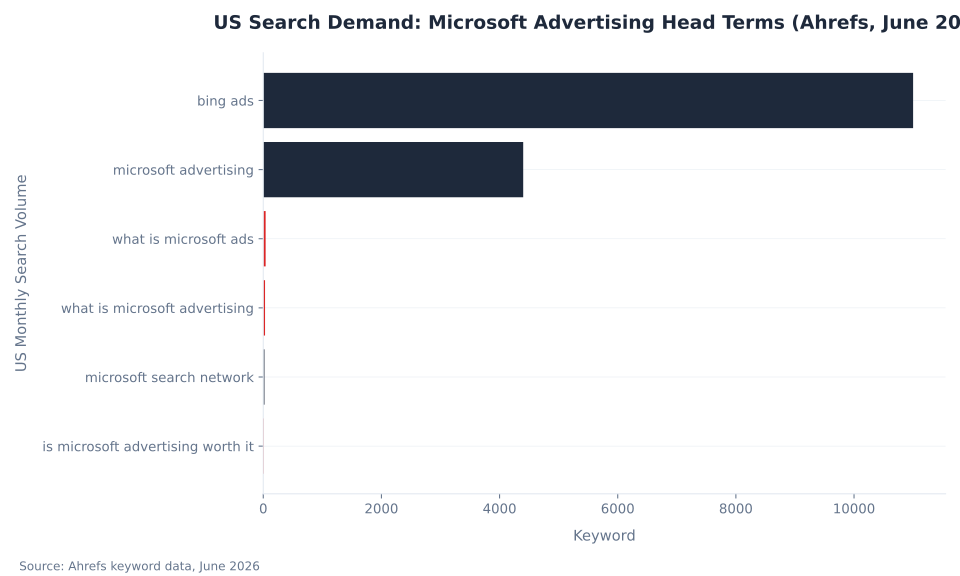
“Bing Ads” persists in conversation because Bing remains the consumer search brand that end users see — the search bar at bing.com, the default engine in Microsoft Edge. But the advertising product — the account you log into at ads.microsoft.com, the inventory you buy, the performance you measure — has been Microsoft Advertising since 2019. The SEO opportunity in that naming split is precise: “bing ads” draws 11,000 US monthly searches while “microsoft advertising” draws 4,400 (Ahrefs, June 2026). A page that addresses both terms and explicitly clarifies their equivalence captures both streams.
The naming clarification also matters strategically. “Microsoft Advertising” signals that one ad buy covers the whole Microsoft Search Network — not just Bing — which changes both the reach math and the competitive framing a buyer uses when deciding whether to open a second paid-search account. For the full cost and reach comparison, see Microsoft Ads vs Google Ads. For how an account is organized once you have one, see Microsoft Ads account structure.
Key Takeaways
- Microsoft Advertising and Bing Ads are the same platform — Bing Ads was renamed Microsoft Advertising on April 29, 2019. The account, keyword auctions, and conversion tags carried over unchanged.
- The Microsoft Search Network reaches 724 million unique monthly searchers across Bing, Yahoo, AOL, DuckDuckGo, Ecosia, and syndication partners from a single ad buy. Bing’s separately reported 1 billion+ monthly active users is a different, broader metric.
- Average CPCs on Microsoft Advertising run ~33% lower than comparable Google queries — Microsoft’s own stated benchmark, replicated in Searchlab 2026 and NaMedia Experts 2026. Thinner advertiser auctions, not lower click quality, drive the gap.
- The audience skews older (~70% aged 35–65), more affluent (~40% with household income above $75K), and more college-educated — a structural match for finance, legal, B2B SaaS, and considered-purchase DTC advertisers.
- Microsoft is the only search platform with LinkedIn-sourced professional targeting — Company, Industry, Job Function, and (since June 2026) Job Seniority — because it owns LinkedIn. No other search engine has access to a professional graph at this scale.
- In 2026, Microsoft repositioned the platform as an “AI discovery and commerce platform,” shipping AI Max for Search, Copilot Checkout, and Brand Agents — reframing the “is it growing or declining?” question away from legacy Bing market-share comparisons.
The Microsoft Search Network: What One Ad Buy Actually Covers
A search campaign in Microsoft Advertising serves across the entire Microsoft Search Network from a single account — Bing, Yahoo, AOL, DuckDuckGo, Ecosia, and syndication partners. The 724 million unique monthly searcher figure is the de-duplicated ad-reach count across this network (source: Microsoft Advertising Search Network audience data; Searchlab 2026). It is a different metric from Bing’s 1 billion+ monthly active users, which measures broader engagement across Bing surfaces, not the addressable search audience. Conflating them overstates what a single ad buy reaches.
The Search Network is also distinct from the Microsoft Audience Network (MSAN), which is the separate native and display inventory covering MSN, Outlook, Microsoft Start, and publisher partner sites. A search campaign buys Search Network reach; an Audience campaign buys MSAN reach. The two networks run on separate targeting and placement logic. Do not apply the 724 million figure to MSAN reach claims.
| Metric | Figure (2026) | What it means for advertisers |
|---|---|---|
| Search Network unique searchers | ~724M unique monthly searchers worldwide | The de-duplicated reach across the full network — the planning figure for ad reach |
| Bing monthly active users | 1 billion+ (milestone crossed) | A broader engagement metric — not the ad-reach figure; keep these separate |
| US desktop search share — Bing alone | ~14% (Statcounter, Mar 2026) | Strongest share figure; US desktop is Microsoft’s high-water mark |
| US desktop share — Bing + Yahoo | ~19% (Statcounter, Mar 2026) | Combined Microsoft network desktop reach in the US |
| Global all-device search share | ~4–5% (Statcounter, 2026) | Mobile pulls this down sharply; set volume expectations accordingly outside US desktop |
| Audience income skew | ~40% of US users with HHI > $75K | Skews affluent — strong fit for finance, legal, B2B, and considered-purchase DTC |
Sources: Searchlab — Microsoft Ads Statistics 2026 (reach, share, income; citing Microsoft Advertising / Statcounter / Comscore); Microsoft Advertising — Search Network audience data. Figures are point-in-time; re-confirm at publish.
Microsoft’s strongest market position is US desktop. For advertisers running desktop-heavy campaigns — common in legal PPC and financial services PPC — the US desktop share is the operative reach number, not the global average. Set volume expectations with that calibration; the Microsoft Ads vs Google Ads comparison covers absolute volume differences in detail.
| Dimension | Microsoft Advertising | Google Ads |
|---|---|---|
| Where ads run | Microsoft Search Network (Bing, Yahoo, AOL, DuckDuckGo, Ecosia + partners) & Audience Network | Google Search, YouTube, Display, Shopping, partner network |
| Avg. search CPC | ~$1.37–$1.54 — about 33% lower on comparable queries | ~$2.06–$2.96 |
| Audience skew | Older (~70% aged 35–65), more affluent, more college-educated | Broadest demographic across all ages |
| Signature targeting | LinkedIn-sourced: Company, Industry, Job Function, Job Seniority | In-market, affinity, custom-intent (no professional-profile data) |
| Advertiser competition | Low — est. ~6% of paid-search budgets (some reports 8–15%) | High — the default first channel for most advertisers |
| Best role | Incremental efficiency layer; B2B, finance, legal, affluent DTC | Primary scale channel; broad reach and volume |
Sources: Searchlab — Microsoft Ads Statistics 2026 (CPC, audience; citing WordStream / Comscore); NaMedia Experts — Microsoft Ads vs Google Ads 2026 Benchmarks (CPC, budget allocation). CPC figures are vendor estimates; re-confirm at publish.
Why Advertise on Microsoft Advertising: The Cost, Audience, and Competitive Logic
Microsoft Advertising’s defining property is not a bigger audience than Google — it is a different and underbought one at a structurally lower cost. Average search CPCs on Microsoft run ~$1.37–$1.54, compared to ~$2.06–$2.96 on Google for comparable queries (sources: NaMedia Experts 2026; Searchlab 2026). Microsoft’s own oft-repeated line — “on average 33% lower CPC” — is consistent across all major third-party benchmarks. The structural reason: Microsoft Advertising attracts an estimated ~6% of paid-search budgets (NaMedia Experts 2026), meaning auctions are thinner and cost-per-click reflects that imbalance.
The audience character compounds the cost advantage for the right verticals. ~70% of Bing users fall in the 35–65 age band; ~40% of US Bing users report household income above $75K; a separate estimate puts ~41% above $100K (Searchlab 2026, citing Microsoft Advertising / Comscore; Amra & Elma 2026, citing Microsoft data). The audience is older, more likely to hold a college degree, and more likely to be in a professional role than the average Google searcher. For verticals where the buyer fits that profile — financial services PPC, legal PPC, SaaS & software PPC, furniture PPC, and HVAC PPC — the demographic skew is a targeting advantage. The audience is smaller than Google’s but better matched to these buyers and available at lower cost per click.
MB Adv Agency’s view: Microsoft Advertising is rarely a replacement for Google — it is the incremental efficiency layer you add once Google is dialed in. Same buyer intent, same queries, 33% lower cost, and competitors largely not bidding against them. That gap is the actual opportunity.
The flip side is real and worth stating plainly: a smaller audience means smaller absolute click and conversion volume. Verticals that need broad demographic reach — fashion PPC targeting Gen Z, gaming, or entry-level consumer electronics — see the older audience skew as a genuine constraint rather than an advantage. For those cases, Google is the primary channel and Microsoft Advertising does not add proportionate incremental reach. The diagnostic before adding Microsoft Advertising: check your own customer demographics. If your buyer is 35+, desktop-heavy, and earns above-median income, Microsoft Advertising is worth the account setup. For local-service advertisers already working with MB Adv Agency in major markets, see PPC management in Chicago and plumbing PPC for examples of where Microsoft’s lower CPC makes local search budgets stretch further.
US Search Demand: Microsoft Advertising Head Terms (Ahrefs, June 2026)
LinkedIn Profile Targeting: Microsoft’s Structural Differentiator
Because Microsoft acquired LinkedIn in December 2016 for $26.2 billion, Microsoft Advertising is the only search platform that can apply LinkedIn-sourced professional profile data to both search and audience campaigns. No other search engine has this capability because no other search engine owns a professional graph at scale. The targeting dimensions available as of June 2026: Company (specific employer names), Industry (150+ LinkedIn industry categories), Job Function (Engineering, Finance, IT, Legal, Marketing, Sales, Operations, and others), and Job Seniority — ten levels including CXO, VP, Director, Manager, Senior, and Entry — added in June 2026 across 29 markets (sources: Microsoft Advertising Help, LinkedIn profile targeting; PPC.land, Microsoft Advertising adds job seniority to LinkedIn profile targeting (June 2026)).
The practical B2B implication: LinkedIn-targeted search campaigns on Microsoft Advertising have been estimated at ~$2–$6 per click for professional targeting, versus $8–$15+ per click on LinkedIn’s native ad platform for equivalent targeting (source: DigitalApplied 2026; Stackmatix 2026 — vendor estimates, not mbadv data). The targeting data is identical in both cases, because it comes from the same LinkedIn profile graph. The only difference is the surface. For a B2B company targeting IT directors at mid-market firms, LinkedIn-targeted Microsoft search campaigns deliver the same professional precision as LinkedIn Sponsored Content — at search-economy CPCs. See SaaS & software PPC for how that plays out in practice.
MB Adv Agency treats LinkedIn profile targeting as Microsoft’s true moat — not the lower CPCs, which any advertiser on a thin auction can access, but the professional targeting data that only Microsoft holds. For financial services PPC advertisers targeting senior decision-makers and for legal advertisers reaching corporate counsel, this targeting layer is frequently the difference between a Microsoft budget that earns its allocation and one that does not. A search campaign with Job Seniority = Director or VP and Industry = Financial Services costs a fraction of LinkedIn Sponsored Content targeting the same profile.

Ready to add Microsoft Advertising to your paid-search mix?
MB Adv Agency builds and manages Microsoft Ads campaigns for B2B, financial services, legal, and local service advertisers — with LinkedIn-profile targeting and Google Ads import workflows that have accounts live in days.
See SaaS & B2B PPC services →AI Max, Copilot, and the 2026 Platform Repositioning
At Microsoft Advertising Activate 2026 (June 2026), Microsoft explicitly repositioned the platform as an “AI discovery and commerce platform” — a deliberate departure from the “paid search” framing it had used for years. The strategic premise: AI assistants like Copilot become a primary search and purchase surface, and Microsoft owns one of the few at consumer scale. Sources: Microsoft Advertising, Activate 2026 — Key Takeaways (June 2026); ALMCorp, Microsoft Advertising Activate 2026 Recap.
Four features define this repositioning:
- AI Max for Search — broader query matching, asset personalization, smarter URL routing, and placement inside Copilot Search and Copilot Answers. In open pilot from May 2026.
- Offer Highlights — an ad format inside Copilot conversations surfacing free shipping, pickup availability, and returns policy. Announced Activate 2026.
- Copilot Checkout — reduces purchase friction inside AI-driven interactions; the merchant remains the merchant of record. Announced Activate 2026.
- Brand Agents — AI-powered shopping assistants for merchant sites, connected to Microsoft Clarity. Announced Activate 2026.
What this means for a beginner deciding whether to open a Microsoft Advertising account: the “is it dying?” question — premised on legacy Bing market-share charts — is the wrong frame. Microsoft is not arguing that advertisers should choose it over Google on the classic search-results page. It is arguing that Copilot becomes a net-new ad surface, and that Microsoft owns one of the few generative AI assistants at consumer scale. Whether that bet materializes is unproven as of 2026. The near-term practical answer: Copilot-surface placements via AI Max are available now, and advertiser competition on them is thin. For SaaS & software PPC advertisers and for Microsoft Ads campaign types that support AI Max, early Copilot placement is a low-cost test while the auction remains sparse. Verify all AI product names against the Microsoft Advertising blog at publish — this product category moves fast.
Can Microsoft Ads Work for Small Businesses?
Yes — with a clear-eyed understanding of what the tradeoffs are. Microsoft Advertising has a purpose-built SMB on-ramp: Smart Campaigns, a fully automated campaign type that a small business gets live in minutes without managing keywords, bids, or ad copy manually (source: Microsoft Advertising, Smart Campaigns get-started page). The ~33% lower average CPC also stretches a small budget further on comparable queries. For a local HVAC company in Flagstaff, AZ or a law firm in Missoula, MT, Microsoft Advertising competes on local desktop search at materially lower CPCs and against fewer advertisers than Google.
The honest constraint: a smaller audience means smaller absolute click and conversion volume. Microsoft Advertising adds incremental reach on top of Google — it does not multiply what Google already delivers. The ROI calculation for an SMB is straightforward: the same ad spend delivers more clicks at a lower CPC, or the same click volume at a lower total cost, compared to spreading the entire budget on Google alone. That incremental math holds cleanest for local service businesses (HVAC, plumbing, legal, dental) where the buyer is already on the 35+ desktop-searcher demographic that Microsoft indexes well.
A small business with an existing Google Ads account can get Microsoft Advertising live in under an hour by importing campaigns directly via the “Import from Google Ads” feature — keywords, ads, and budgets carry over, requiring only bid and audience adjustments to account for the smaller scale. For hands-on setup and ongoing management, see PPC management in Austin, TX. For the full breakdown of campaign types including Smart and Performance Max structures, see Microsoft Ads campaign types.
Search Network Reach
724M
Unique monthly searchers across Bing, Yahoo, AOL, DuckDuckGo, Ecosia, and partners. Source: Microsoft Advertising audience data; Searchlab 2026.
Average CPC Advantage
~33%
Lower average CPC on comparable queries versus Google — Microsoft’s own stated benchmark, confirmed by NaMedia Experts 2026 and Searchlab 2026.
Audience: Aged 35–65
~70%
Share of Bing users in the 35–65 age band. Source: Searchlab 2026, citing Microsoft Advertising / Comscore.
Paid-Search Budget Share
~6%
Estimated share of paid-search budgets going to Microsoft Ads — the thin-auction driver of lower CPCs. Source: NaMedia Experts 2026.
Frequently Asked Questions
What is the difference between Bing Ads and Microsoft Advertising?
Bing Ads and Microsoft Advertising are the same platform. Microsoft renamed Bing Ads to Microsoft Advertising on April 29, 2019. The rename was a branding event, not a platform overhaul: Microsoft stated that “Bing Ads” undersold the product’s actual scope — advertisers were buying reach across the full Microsoft Search Network (Bing, Yahoo, AOL, DuckDuckGo, Ecosia, and syndication partners), not placement on a single search engine. Nothing about the account structure, keyword auction mechanics, Universal Event Tracking (UET) conversion tag, or campaign settings changed at the rename. The advertising product a user logs into at ads.microsoft.com has been called Microsoft Advertising since 2019. “Bing Ads” persists in conversation because Bing remains the visible consumer search brand — the search bar at bing.com, the default engine in Microsoft Edge. For advertisers, the practical consequence is simple: any reference to “Bing Ads” in guides, documentation, or keyword research predating April 2019 refers to the same platform now named Microsoft Advertising.
How does Microsoft Advertising’s lower average CPC translate to budget efficiency?
Microsoft Advertising CPCs average ~$1.37–$1.54 versus ~$2.06–$2.96 on Google for comparable queries — a ~33% lower cost per click, which is Microsoft’s own published benchmark and is consistent across major third-party reports (Searchlab 2026; NaMedia Experts 2026). The budget math at benchmark averages: a $2,000 monthly spend on Google at a $2.50 average CPC delivers ~800 clicks. The same $2,000 on Microsoft at a $1.50 average CPC delivers ~1,333 clicks — 67% more volume for identical spend. Alternatively, to reach the same 800 clicks, the Microsoft budget is ~$1,200, freeing $800 for reallocation or additional Google volume. These are illustrative calculations using network-average CPCs; actual CPCs vary by industry, keyword, and match type — re-confirm against your own account data before planning. The structural driver of lower CPCs is lower advertiser competition, not lower click quality. Microsoft attracts an estimated ~6% of paid-search budgets while reaching a material share of US desktop search, producing thinner auctions and lower clearing prices.
Which advertisers benefit most from Microsoft Advertising’s audience demographics?
The Microsoft Search Network audience skews older, more affluent, and more professional than Google’s average searcher: ~70% of Bing users fall in the 35–65 age band, ~40% of US users report household income above $75K (Searchlab 2026, citing Microsoft Advertising / Comscore). For verticals where the buyer fits that profile — financial services, legal, B2B SaaS, managed IT, and considered-purchase home goods — the demographic skew is a targeting advantage. The budget math illustrates the case: at benchmark CPCs (Microsoft ~$1.50, Google ~$2.50), a $3,000 monthly legal marketing budget delivers ~2,000 clicks on Microsoft versus ~1,200 on Google. At a 3% click-to-lead rate: 2,000 × 3% = 60 leads (Microsoft) versus 1,200 × 3% = 36 leads — 67% more leads per dollar. Run this calculation against your own actual CPCs and conversion rates for an accurate projection. Verticals requiring broad reach across younger demographics — Gen Z fashion, gaming, entry-level consumer electronics — see the older skew as a genuine constraint rather than an advantage.
What is AI Max for Search in Microsoft Advertising?
AI Max for Search is Microsoft Advertising’s AI-powered campaign expansion feature, available in open pilot from May 2026. It operates across three dimensions. Query matching: AI Max broadens which searches trigger your ads beyond your exact keyword list, using machine learning to match searcher intent rather than literal terms. Asset personalization: the system generates or combines ad copy elements — headlines, descriptions — to match the specific query and audience context. URL routing: rather than directing every click to the ad’s default landing page, AI Max routes users to the most relevant page on the site for the specific search. Beyond classic search results, AI Max places ads inside Copilot Search and Copilot Answers — Microsoft’s generative AI assistant surfaces — extending campaign reach beyond the standard SERP. AI Max is opt-in and runs alongside standard search campaigns. It is the mechanism through which Microsoft’s “AI discovery and commerce platform” repositioning connects to active search campaigns. Verify the feature name and status against the Microsoft Advertising blog before enabling — Microsoft restructures AI product names frequently.
MB Adv Agency
Want to know if Microsoft Advertising fits your paid-search budget?
We build and manage Microsoft Ads accounts across B2B, legal, financial services, and local service verticals — with LinkedIn-profile targeting and full Google import setup. If you’re ready to add an efficient second channel, reach out to discuss next steps. For the full cost and reach breakdown, see Microsoft Ads vs Google Ads. For campaign structure, see Microsoft Ads campaign types.
Talk to us →Data and methodology: Keyword volume and CPC figures from Ahrefs, June 2026 (operator-supplied). CPC benchmark comparisons from Searchlab, Microsoft Ads Statistics 2026 (citing WordStream / Comscore) and NaMedia Experts, Microsoft Ads vs Google Ads 2026 Benchmarks. Reach and market-share figures from Microsoft Advertising Search Network audience data and Statcounter (March 2026), via Searchlab 2026 and Affinco 2026. Audience demographic data (age, household income) from Searchlab 2026 citing Microsoft Advertising / Comscore, and Amra & Elma 2026 citing Microsoft data. LinkedIn profile targeting dimensions from Microsoft Advertising Help (answer/56905); Job Seniority rollout from PPC.land and Search Engine Land, June 2026. AI Max for Search and Activate 2026 repositioning from Microsoft Advertising Activate 2026 Key Takeaways (June 2026) and ALMCorp recap. Smart Campaigns from Microsoft Advertising get-started page. Rename date from Microsoft Advertising official announcement (April 29, 2019) and Search Engine Land. Reviewed by MB Adv Agency, June 2026.

As a Google Ads expert, I bring proven expertise in optimizing advertising campaigns to maximize ROI.
I specialize in sharing advanced strategies and targeted tips to refine Google Ads campaign management.
Committed to staying ahead of the latest trends and algorithms, I ensure that my clients receive cutting-edge solutions.
My passion for digital marketing and my ability to interpret data for strategic insights enable me to offer high-level consulting that aims to exceed expectations.
Google Partner Agency
We're a certified Google Partner Agency, which means we don’t guess — we optimize withGoogle’s full toolkit and insider support.
Your campaigns get pro-level execution, backed by real expertise (not theory).

4.9 out of 5 from 670+ reviews on Fiverr.
That’s not luck, that’s performance.
Highly recommend Matteo to set up your server side tracking. He has a deep understanding of e-commerce tracking and will go above and beyond to make sure everything is set up correctly and working 100%. If you are scaling your store this set up is non-negotiable in my opinion and there isn't many people who have this much knowledge or put the effort in to get it right. Thanks again!
avorodesign.com
I can only recommend Matteo! He was very patient, professional and very knowledgeable about GA4, Consent Mode v2, and GDPR compliance. Communication was clear, and the setup was done professionally and efficiently. Highly recommend him for anyone needing reliable tracking implementation.

www.natureiki.life
Matteo shines in the realm of online professionals. His work is not only deep in data but also complemented by his proactive communication and cooperation, setting a new standard for freelancers. If you want someone who truly exceeds expectations, look no further. Highly recommended!

www.omanbeverlysmyth.com
Exceptional Service Beyond Expectations - Outstanding Service Impeccable depth, flawless delivery, and exceptional language fluency—this service exceeded all expectations. Highly recommended. Matteo truly ROCKS!!!
ium-paris.com
Top-notch, always highly value working with Matteo. An absolute Google Ads Genius. This is approximately the 8th time I have hired him and he's helped us get 6-7 ROAS. We are excited in continuing to improve our lead flow. Hire this guy if you need Google Ads help. Thanks Matteo!
www.dleeventgroup.com
I finally found the guy who can setup server side tracking and all the ecosystem properly. I definitely recommend Matteo. He is very responsive, kind and wants to dig into things. He configured GA4, Meta, Google Ads, Outbrain and google consent v2 with Cookiebot. Thanks Matteo.

inomega.fr
MB Adv delivered exceptional work with outstanding professionalism and lots of patience, taking time to see effects of changes made and not just do the work and submit it. The proactive communication and video summaries of the work completed made working with Matteo a pleasure, as he consistently went above and beyond. Highly recommended for web analytics projects! We are already working on another project.

www.withnellsensors.co.uk
Working with Matteo on my Google Ads was a game-changer. He's not just a strategist, he's a true partner. He understood my goals and tailored a campaign that perfectly reached my target audience. I'm grateful for his expertise and dedication.
dccargo.com
Click-driven mind
with plastic-brick obsession.
We build Google Ads campaigns with the same mindset we use to build tiny brick worlds: strategy, patience, and zero tolerance for wasted pieces.
Data is our blueprint. Growth is the only acceptable outcome.