
Microsoft Ads Bidding & Budget: 2026 Strategy Guide

$1.54
Microsoft Advertising average search CPC (Q1 2026) — 48% below Google's $2.96 average
Source: NaMedia Experts, Microsoft Ads vs. Google Ads 2026 Benchmarks
Microsoft Advertising Bidding and Budget: How the System Works
Microsoft Advertising (formerly Bing Ads) runs a real-time auction for every search query. Position is decided by Ad Rank = Quality Score × Bid — not by the highest bid alone. The advertiser with the best product of bid and relevance wins, which means a tightly built campaign with a Quality Score of 8 regularly outranks a competitor bidding twice as much with a Quality Score of 4. Six bid strategies are selectable for new campaigns in 2026, and every automated strategy requires Microsoft's Universal Event Tracking (UET) tag to function.
The platform's average search CPC of $1.54 (Q1 2026, NaMedia Experts) is materially below Google Ads' $2.96 average on comparable query types. For advertisers already running Google Ads, Microsoft Advertising is the same auction mechanic — Ad Rank, Quality Score, bid adjustments — at a structurally lower CPL ceiling. The bid strategies differ in one important way: standalone Target CPA and Target ROAS were sunset for newly created campaigns on August 4, 2025. They are now optional targets you set inside Maximize Conversions and Maximize Conversion Value respectively. See Microsoft Ads campaign types for how bid strategy availability varies by campaign type.
Three budget levers sit alongside the bid strategy: the daily budget (a pacing target that Microsoft can exceed by up to 100% on a high-traffic day, bounded by a monthly cap), shared budgets that pool spend across campaigns, and seasonality adjustments — a temporary conversion-rate signal for automated bidding, expanded to portfolio bid strategies in April 2026. None of these is a hard per-day ceiling in the way most advertisers assume.
The Auction: Ad Rank = Quality Score × Bid
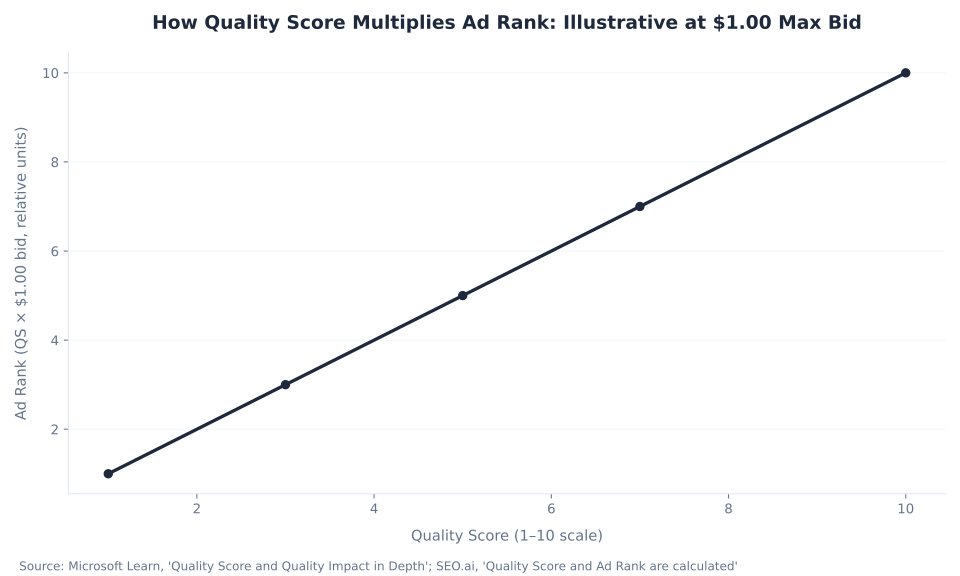
Every time a user searches on the Microsoft Search Network, Microsoft scores every eligible ad with Ad Rank = Quality Score × Bid. Ads sort by Ad Rank descending; the ad with the highest Ad Rank takes the top position. Because Quality Score and bid are multiplied, improving Quality Score from 5 to 10 — at zero incremental spend — has the same Ad Rank effect as doubling the max bid. The cheapest route to better position is almost always relevance, not a larger bid. Source: SEO.ai, iVirtual.
Microsoft also factors real-time context signals at auction time: device, geographic location, time of day, audience segment membership, and the precise query string. These signals feed into the automated bid strategies' decision to push bids up or down relative to your base — which is exactly why bid adjustments layer cleanly on top of any strategy including Manual CPC.
Honest limit: Unlike Google Ads, Microsoft does not publish a CPC pricing formula. The Ad Rank ranking logic is clear and documented. The precise price paid per click is not derivable from public documentation — Microsoft's own Help Center confirms Ad Rank order but does not disclose the second-price auction formula. Source: Microsoft Learn.
Quality Score, impression share, and average CPC are the primary signals that tell you whether your auction position is improving — see Microsoft Ads reporting and metrics for the metrics to track after you set your strategy.
Key Takeaways
- Ad Rank = Quality Score × Bid. Relevance beats spend — a Quality Score 8 ad at a lower bid outranks a Quality Score 4 ad at twice the bid.
- Standalone Target CPA and Target ROAS are gone for new campaigns (since August 4, 2025). You now set them as optional targets inside Maximize Conversions and Maximize Conversion Value. Portfolio bid strategies still expose them directly.
- Enhanced CPC still exists on Microsoft. Google deprecated it by March 2025; Microsoft did not. It is the safest first step away from full manual bidding on a thin-data account.
- Automated bidding requires UET. Maximize Conversions, Maximize Conversion Value, and the Target CPA / ROAS goals need conversion signal from Microsoft's UET tag. Without it, the algorithm has no outcome to optimize toward.
- Daily budget ≠ hard daily ceiling. Microsoft can spend up to 100% over your daily budget on a high-traffic day. The guarantee is monthly: total spend stays at or below daily budget × 30.4.
- Seasonality adjustments expanded in April 2026. Portfolio bid strategies can now receive short-term conversion-rate signals for events of 3–7 days — a sale, an enrollment window, a tax-prep surge.
- Bid adjustments stack multiplicatively. Device + location + audience adjustments all compound on the same search. Stacking three large positive adjustments pays multiples of your intended base bid.
6
Bid strategies for new campaigns (post-Aug 2025)
1–10
Quality Score scale (3 components)
+900%
Maximum positive bid adjustment (device)
×30.4
Daily budget multiplier for monthly spend cap
Microsoft Advertising vs. Google Ads: 2026 Cost Benchmarks
Microsoft Advertising's structural CPC advantage over Google Ads is the primary commercial argument for running both platforms. Industry CPC benchmarks show Microsoft's average search CPC at roughly 48% below Google's for comparable query types. The CPC gap does not mean Microsoft is cheaper per conversion — that depends on audience quality and conversion rate — but it does mean more clicks per dollar of budget before the auction, which benefits legal PPC, financial services PPC, and real estate PPC advertisers competing in high-CPL verticals where every dollar of bid room matters.
| Metric | Microsoft Advertising | Google Ads | Source note |
|---|---|---|---|
| Average search CPC | ~$1.54 | ~$2.96 | NaMedia Experts 2026 — aggregate vendor estimate |
| CPC differential | ~33–48% lower on comparable queries (platform-reported range) | Microsoft marketing claim; NaMedia Experts corroboration | |
| Typical budget share (paid search) | ~6% | ~94% | NaMedia Experts 2026 — "underutilized channel" framing |
These are aggregate cross-industry averages from NaMedia Experts (2026) and Searchlab (2026). Individual account CPCs vary by vertical — dental PPC and SaaS / software PPC both run materially above these cross-industry averages on both platforms. These are directional benchmarks, not per-vertical guarantees.
Bing Ads Bidding Strategy: All Six Options Explained
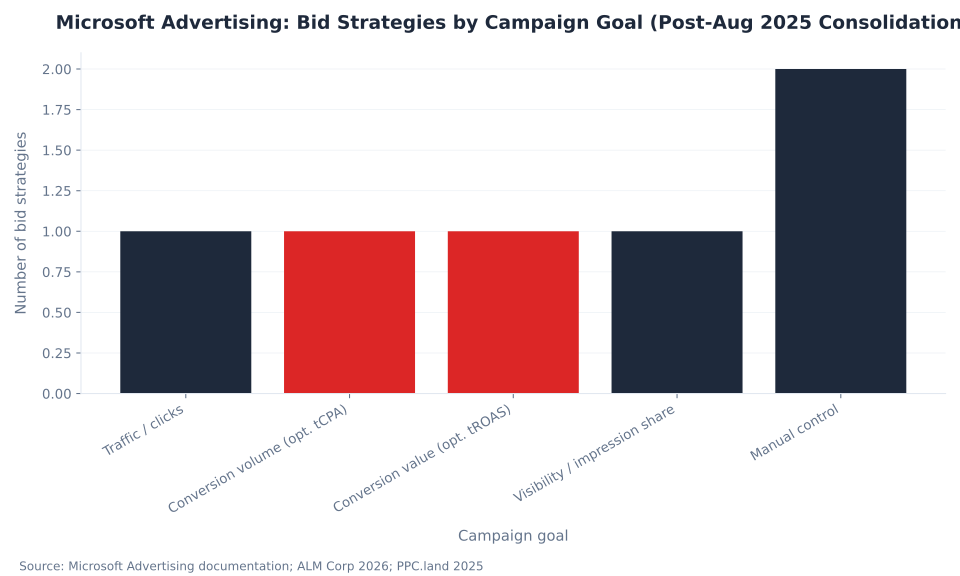
Six bid strategies are available for new Microsoft Advertising campaigns in 2026. Standalone Target CPA and Target ROAS were sunset for newly created campaigns on August 4, 2025 — they are now optional targets set inside Maximize Conversions and Maximize Conversion Value respectively. Existing campaigns on the legacy standalone strategies keep running. Portfolio bid strategies still expose Target CPA and Target ROAS directly. The underlying optimization algorithm is unchanged — only the setup interface moved. Sources: PPC.land, Search Engine Land.
The March 2026 date associated with this change is a separate UI-simplification rollout — Microsoft made the bidding interface reflect the August 2025 product change more clearly. These are two distinct events; the product change (strategy consolidation) happened August 4, 2025; the UI simplification was announced March 19, 2026. Source: Search Engine Land, March 2026.
| Strategy | What it does | Optional CPA/ROAS target | Needs UET? | Best for |
|---|---|---|---|---|
| Manual CPC | You set every keyword/ad-group max bid | — | No | Tiny accounts; full control; no conversion data yet |
| Enhanced CPC (ECPC) — default | Nudges manual bids up when a conversion looks likely, down when it doesn't; honors your average base bid | — | Recommended | Bridge from manual to automation; least data needed |
| Maximize Clicks | Auto-sets bids for the most clicks within budget | — | No | Traffic goals without conversion data |
| Maximize Conversions | Auto-bids for the most conversions within budget | Target CPA (optional — replaces the standalone strategy) | Yes | Lead-gen; volume at a cost ceiling |
| Maximize Conversion Value | Auto-bids for the most total conversion value within budget | Target ROAS (optional — replaces the standalone strategy) | Yes + revenue values passed | E-commerce; value-based bidding |
| Target Impression Share | Auto-bids to hit a chosen % of impressions at a chosen page position | — | No | Brand defense; top-of-page visibility |
| Standalone Target CPA / Target ROAS | Sunset for newly created campaigns since Aug 4, 2025. Now set as optional parameters inside the strategies above. Still available inside portfolio bid strategies; existing campaigns continue unchanged. | |||
The strategy ladder runs: Manual CPC → Enhanced CPC → Maximize Conversions or Maximize Conversion Value. Each step adds automation and reduces manual bid-by-keyword control. Moving up the ladder without adequate conversion signal — especially skipping UET — causes the automated strategies to optimize toward proxies rather than real outcomes. See Microsoft Ads conversion tracking with UET before enabling any conversion-based strategy.
Portfolio bid strategies let you manage multiple campaigns under a single optimization goal with shared budget or shared bid constraints. They remain unchanged by the August 2025 consolidation and still expose standalone Target CPA and Target ROAS as direct selectable strategy types. Source: ALM Corp (2026).
Bid Adjustments: Device, Location, Demographics, and Schedule
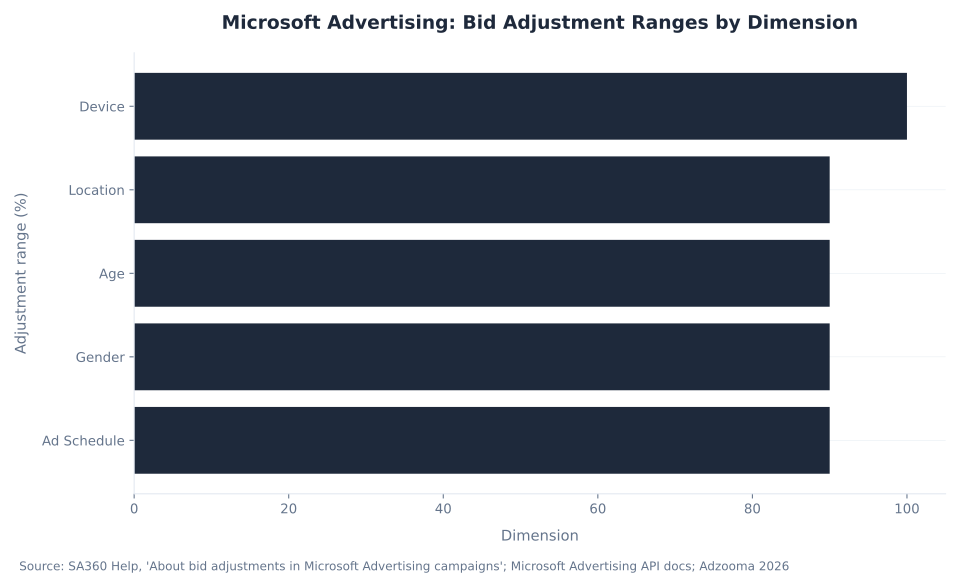
Bid adjustments are percentage multipliers applied on top of your base bid strategy. You set them at campaign or ad-group level by dimension — device, location, age, gender, ad schedule, or audience — and Microsoft applies all that match the same search as combined multipliers. The adjustment ranges are wide: device runs from −100% (full exclusion) to +900%; location, demographics, and schedule run from −90% to +900%. Sources: SA360 Help, Adzooma.
| Dimension | Negative floor | Positive ceiling | Set at | Notes |
|---|---|---|---|---|
| Device (desktop / mobile / tablet) | −100% | +900% | Campaign / ad group | −100% = complete device exclusion; the only dimension with a full-exclusion floor |
| Location (country / region / city / radius) | −90% | +900% | Campaign / ad group | Stacks with device when both apply to the same search |
| Age (5 brackets: 18–24, 25–34, 35–49, 50–64, 65+) | −90% | +900% | Campaign / ad group | Demographic adjustment |
| Gender (Male / Female; 3-value in Audience) | −90% | +900% | Campaign / ad group | Demographic adjustment |
| Ad schedule (day / hour) | −90% | +900% | Campaign | Set bid adjustments by day of week and time of day |
| Audience (remarketing / in-market / similar) | −90% | +900% | Campaign / ad group | "Bid only" vs "Target and bid" mode changes delivery scope |
For HVAC PPC and plumbing PPC advertisers, the highest-value adjustments are typically device (mobile searches dominate emergency service intent) and location radius (tight service-area targeting). For SaaS / software PPC and IT and managed services PPC accounts, B2B demographic adjustments — age 25–49, desktop — routinely out-convert mobile/younger segments.
Microsoft Advertising: Bid Strategies by Campaign Goal (Post-Aug 2025 Consolidation)
Quality Score: The 1–10 Ranking Signal
Microsoft Advertising Quality Score ranges from 1 (lowest) to 10 (highest). It is calculated from three components — expected click-through rate, ad relevance, and landing page experience — each rated Below Average, Average, or Above Average. The overall 1–10 score aggregates these three sub-scores. Microsoft does not publish the exact percentage weighting of each component; the formula for converting the three sub-scores to the composite 1–10 number is not disclosed. Sources: Microsoft Learn, iVirtual.
| Component | What it measures | Sub-rating | Primary lever to improve it |
|---|---|---|---|
| Expected click-through rate | Predicted likelihood that users click your ad relative to competing ads at the same position | Below Average / Average / Above Average | Ad copy relevance; headline match to query; call-to-action clarity |
| Ad relevance | How closely the ad copy matches the intent and language of the search query | Below Average / Average / Above Average | Tight keyword-to-ad group mapping; include the target keyword in ad headlines |
| Landing page experience | How well the landing page delivers what the searcher expected; measured in part by early-exit (bounce) rate after click | Below Average / Average / Above Average | Keyword-to-page content match; page load speed; clear next action on landing |
The practical implication of the Ad Rank formula: improving Quality Score from 5 to 10 — by tightening ad copy and landing page relevance — doubles Ad Rank at zero incremental bid cost. That is the same effect as doubling the maximum CPC bid. For fashion PPC and roofing PPC accounts where average CPC is already material, the Quality Score investment routinely pays more per dollar than a bid increase.
Microsoft Advertising: Bid Adjustment Ranges by Dimension
Daily Budget: What the Limit Actually Means
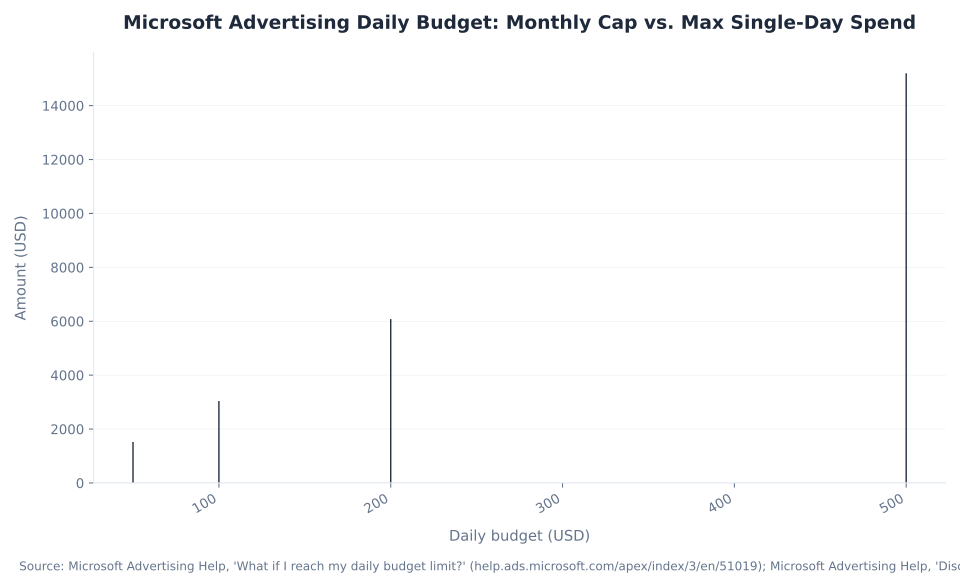
A Microsoft Advertising daily budget is a pacing target, not a hard ceiling. On a high-traffic day, Microsoft can spend up to 100% over the daily figure. The guarantee is monthly: total spend for the calendar month stays at or below daily budget × 30.4 (the average number of days per month). Slow days offset the overspend from fast days. Source: Microsoft Advertising Help — What if I reach my daily budget limit?.
| Daily budget | Monthly cap (daily × 30.4) | Max single-day spend (daily × 2) |
|---|---|---|
| $50 | $1,520 | $100 |
| $100 | $3,040 | $200 |
| $200 | $6,080 | $400 |
| $500 | $15,200 | $1,000 |
These are caps, not targets. Actual spend depends on auction competition, search volume, and quality-driven impression share. An account set to $100/day on a thin search volume query set does not reach $200 on any single day regardless of the cap — it only over-delivers when demand is there to fill the inventory.
Shared Budgets: Fix Chronic Underspend Across Campaigns
A shared budget pools spend across multiple campaigns under a single daily allocation. Microsoft allocates dynamically toward whichever campaigns have available impressions that day, rather than holding budget against each campaign's individual allowance regardless of volume.
The primary use case: accounts with several campaigns where individual per-campaign daily budgets cause chronic underspend. If three campaigns are each set to $50/day but Campaign A only has $20 of search volume available, its $30 surplus stays locked — it does not flow to Campaigns B or C. A shared $150/day budget lets Microsoft push that surplus toward whichever campaigns have impressions available, increasing total utilization without increasing total budget.
MB Adv Agency uses shared budgets as the default structure for multi-campaign Microsoft accounts with fewer than 50 daily conversions — accounts thin enough that individual budget caps routinely hit before the auction opportunity is exhausted. For accounts with deep volume in every campaign, per-campaign budgets provide clearer spend visibility and easier reallocation.
How Quality Score Multiplies Ad Rank: Illustrative at $1.00 Max Bid
Automated Bidding Requires UET Conversion Tracking
Maximize Conversions, Maximize Conversion Value, and the Target CPA / Target ROAS goals all require conversion signal from Microsoft's Universal Event Tracking (UET) tag and conversion goals. Without UET, the algorithm has no outcome to bid toward and falls back to optimizing for clicks — the same behavior as Maximize Clicks. UET is a prerequisite, not an optional enhancement. See Microsoft Ads conversion tracking with UET for implementation requirements.
| Bid strategy | UET required? | Without UET, strategy does what? |
|---|---|---|
| Manual CPC | No | Bids exactly as set; no adjustment |
| Enhanced CPC | Recommended (uses conversion signal) | Adjusts based on CTR signals only; conversion-signal benefit is absent |
| Maximize Clicks | No | Optimizes for clicks normally — no conversion dependency |
| Maximize Conversions | Yes — required | Cannot learn; behaves like Maximize Clicks without conversion data |
| Maximize Conversion Value | Yes — required + revenue values passed | Cannot optimize value without revenue data; no fallback value signal |
| Target Impression Share | No | Optimizes for impression share normally |
Microsoft does not publish a minimum-conversions-per-week threshold for automated strategies (Google publishes a 50 conversions/month guideline; Microsoft does not). In practice, accounts with fewer than 15–30 conversions per month are poor candidates for Maximize Conversions — Enhanced CPC is the more stable choice until conversion volume grows. For PPC management in Austin and PPC management in Chicago clients, MB Adv Agency runs Enhanced CPC by default on new Microsoft accounts until the conversion signal is established.
How Bid Adjustments Stack — and Why Stacking Multiplies Fast
When multiple bid adjustments apply to the same search, Microsoft combines all of them. The combination is multiplicative: a +50% device modifier and a +40% location modifier do not produce +90% — they compound. The practical ceiling across all adjustments combined is very high, and accounts that set large positive adjustments across several dimensions simultaneously routinely pay multiples of their intended base bid without noticing.
| Adjustment applied | Modifier | Effective max bid |
|---|---|---|
| Base bid only | ×1.0 | $2.00 |
| + Mobile device +50% | ×1.5 | $3.00 |
| + Location +40% | ×1.5 × 1.4 | $4.20 |
| + Audience (remarketing) +60% | ×1.5 × 1.4 × 1.6 | $6.72 (3.4× base) |
MB Adv Agency treats bid adjustments as surgical modifiers — applied to one dimension at a time, with the others held flat until the single-dimension effect is validated in the data. Stacking three large positive adjustments before any conversion data exists is one of the fastest ways to exhaust a Microsoft budget against unqualified traffic. For legal PPC accounts where CPCs are already high, a compounded 3.4× effective bid against the wrong demographic can consume a week's budget in hours.
Portfolio Bid Strategies: Where Standalone tCPA and tROAS Live
Portfolio bid strategies manage multiple campaigns under a shared optimization goal. They were not affected by the August 2025 consolidation: portfolio strategies still expose Target CPA and Target ROAS as direct selectable types. For advertisers who need shared optimization across campaigns with different budget ceilings — common in financial services PPC and multi-brand accounts — portfolio strategies are the correct tool, and the standalone tCPA/tROAS options remain available within them.
Choosing the Right Bid Strategy: A Decision Framework
The correct bid strategy depends on three variables: conversion data volume, campaign goal, and account maturity. The strategy ladder — Manual CPC → Enhanced CPC → Maximize Conversions → Maximize Conversion Value — is sequential, not a menu. Skipping steps without the prerequisite data degrades performance faster than staying at the prior level. Which bid strategy and budget type are available also varies by campaign type — see Microsoft Ads campaign types.
| Account situation | Recommended strategy | Why |
|---|---|---|
| New account, no UET, no conversion history | Enhanced CPC | Automation without conversion dependency; safe starting point |
| UET installed, <15 conversions/month | Enhanced CPC | Thin signal makes Maximize Conversions unstable; ECPC uses what signal exists |
| Lead-gen, 15+ conversions/month, no hard CPL ceiling | Maximize Conversions | Volume optimization with enough signal to learn |
| Lead-gen, 15+ conversions/month, defined CPL ceiling | Maximize Conversions + Target CPA | Sets the cost guardrail without switching to a different strategy type |
| E-commerce, revenue values passed to UET | Maximize Conversion Value (+ optional Target ROAS) | Optimizes for revenue, not just conversion count |
| Brand defense; top-of-page visibility goal | Target Impression Share | Directly bids for impression position; no conversion dependency |
| Multiple campaigns, shared optimization goal | Portfolio bid strategy (tCPA or tROAS available here) | Cross-campaign optimization with standalone Target CPA / ROAS still selectable |
For HVAC PPC in Flagstaff and legal PPC in Missoula — local service accounts with narrow geographic targeting and seasonal demand — Enhanced CPC combined with tight location bid adjustments (−90% outside the service radius, +30–50% inside the primary service area) typically delivers better CPL stability than Maximize Conversions on accounts under 20 monthly conversions.
Microsoft Advertising Daily Budget: Monthly Cap vs. Max Single-Day Spend
Bidding strategy not converting at the cost you need?
MB Adv Agency builds and manages Microsoft Advertising bid strategies for legal, dental, financial services, and other high-CPL verticals. Strategy audit, UET validation, and full account management.
Request a Microsoft Ads Audit →Data-Driven Attribution and Seasonality Adjustments: 2026 Updates
Two Microsoft Advertising changes in 2026 reshape how bidding strategies receive and act on conversion signal. First, data-driven attribution — which distributes conversion credit across all ad touchpoints rather than assigning it entirely to the last click — rolled out to all Microsoft Advertising accounts by end of May 2026, per the Microsoft Advertising May 2026 blog. Source: ALM Corp, Microsoft Advertising Data-Driven Attribution.
Data-driven attribution changes the conversion count reported for each keyword, ad, and audience segment — and therefore changes the signal Maximize Conversions and Maximize Conversion Value optimize toward. Accounts migrating from last-click attribution see keyword-level conversion counts redistribute, sometimes significantly, across the path to conversion. This is not a performance change; it is a measurement change. The practical consequence for bidding: if you use a Target CPA parameter inside Maximize Conversions, verify that the target is calibrated against data-driven attribution data rather than the legacy last-click baseline.
Second, seasonality adjustments — a temporary signal to automated bidding to expect a short-term spike or dip in conversion rates — expanded to portfolio bid strategies in April 2026, with full availability confirmed by May 2026. Sources: ALM Corp, PPC News Feed.
Seasonality adjustments are event tools, not routine tuning. The correct use case: a 3-day promotional sale, a school enrollment window, a tax-preparation surge — any short, predictable, significant event where conversion rate diverges materially from the historical baseline. Setting a seasonality adjustment for ongoing conditions (a new landing page, a permanent price change) disrupts the algorithm's long-term learning without the intended short-term benefit.
MB Adv Agency applies seasonality adjustments for clients in roofing PPC and HVAC PPC around storm season peaks and for roofing PPC in Flagstaff and other high-seasonal markets where conversion rates swing 3–5× between off-peak and peak weeks. The adjustment signals the strategy not to over-correct downward during the ramp-up days before the peak materializes in the data.
Four Common Misconceptions About Microsoft Ads Bidding
Most of the stale guidance on Microsoft Advertising bidding traces to three sources: guides written before August 2025 (still listing tCPA and tROAS as standalone strategies), Google Ads assumptions transposed wholesale onto a different product, and misreadings of the daily budget rule. The four most consequential errors:
1. "Microsoft discontinued Target CPA and Target ROAS."
They were not removed — they were folded in. Standalone tCPA and tROAS are no longer selectable for newly created campaigns (since August 4, 2025). You now set them as optional targets inside Maximize Conversions and Maximize Conversion Value. Existing campaigns keep their legacy strategy. Portfolio bid strategies still expose both directly. Microsoft states: "there is no functional change in the bidding strategies." Sources: PPC.land, ClickGuard.
2. "A higher bid wins the top position."
Position is decided by Ad Rank = Quality Score × Bid, not by the highest bid alone. A well-built ad with Quality Score 8 at a $1.00 bid (Ad Rank 8) outranks an ad with Quality Score 4 at a $1.50 bid (Ad Rank 6). The cheapest path to better position is almost always relevance, not a larger bid. Source: SEO.ai.
3. "Automated bidding works without conversion tracking."
Maximize Conversions and Maximize Conversion Value cannot optimize without UET conversion signal. Without it, the algorithm has no outcome to bid toward and behaves like Maximize Clicks. UET is a hard prerequisite, not an optional add-on. This error is especially common for Google Ads advertisers standing up Microsoft for the first time: they assume the tracking from Google carries over. It does not — see Microsoft Ads conversion tracking with UET for the separate setup process.
4. "My daily budget is the maximum I can be charged in a single day."
No — Microsoft can spend up to 100% over the daily budget on a high-traffic day. The real guarantee is on the monthly total: spend stays at or below daily budget × 30.4. A $100/day budget can produce a $200 day; the monthly cap is $3,040. Source: Microsoft Advertising Help — What if I reach my daily budget limit?.
Frequently Asked Questions About Microsoft Ads Bidding and Budget
What is a Bing Ads bidding strategy in 2026, and what has changed?
A Bing Ads bidding strategy — now officially a Microsoft Advertising bid strategy — is the rule that determines how the platform sets or adjusts your max CPC for each auction. In 2026, six strategies are available for newly created campaigns: Manual CPC, Enhanced CPC, Maximize Clicks, Maximize Conversions (with optional Target CPA), Maximize Conversion Value (with optional Target ROAS), and Target Impression Share. The major 2025 change: standalone Target CPA and Target ROAS were sunset as independent strategies for new campaigns on August 4, 2025. They now function as optional cost or return targets set inside Maximize Conversions and Maximize Conversion Value respectively. Existing campaigns on the old standalone strategies keep running without forced migration, and portfolio bid strategies still expose tCPA and tROAS directly. Google Ads advertisers transferring campaigns to Microsoft need to remap their strategy setup accordingly.
How does the Microsoft Advertising ad auction work?
Every search on the Microsoft Search Network triggers a real-time auction. Microsoft scores each eligible ad with Ad Rank = Quality Score × Bid. Quality Score is a 1–10 composite built from three components: expected click-through rate, ad relevance, and landing page experience — each rated Below Average, Average, or Above Average. The ad with the highest Ad Rank wins the top position. At auction time Microsoft also applies real-time context signals — device, location, time of day, audience segment — which feed into automated bid strategy decisions. Unlike Google Ads, Microsoft does not publish a CPC pricing formula; the exact cost-per-click derivation is not disclosed in public documentation. The practical implication: improving Quality Score from 5 to 10 doubles Ad Rank at zero incremental spend — the same effect as doubling your max bid.
What is Microsoft Advertising Quality Score and what are its three components?
Microsoft Advertising Quality Score is a 1–10 rating that measures how relevant and useful an ad is compared to other ads targeting the same keyword at the same position. The score is built from three components. First, expected click-through rate: the predicted likelihood that a user clicks the ad, rated Below Average / Average / Above Average relative to other ads on that keyword. Second, ad relevance: how closely the ad copy matches the intent and language of the search query. Third, landing page experience: how well the destination page delivers what the searcher expected, measured in part by early-exit rate after the click. Each component is rated independently. Microsoft does not publish the percentage weight of each component in the overall 1–10 composite — the exact mathematical mapping is not disclosed. Quality Score is updated continuously as the ad accumulates click and impression data.
When should I use Enhanced CPC instead of Maximize Conversions?
Enhanced CPC is the correct choice when an account has fewer than 15 conversions per month or when UET conversion tracking is not yet fully configured. Maximize Conversions needs enough historical conversion signal to optimize reliably — on thin-data accounts it behaves erratically, bidding aggressively on auctions that do not convert because the algorithm has no clear signal of what a conversion looks like. Enhanced CPC uses existing conversion signal where available and falls back to CTR-based signals where it does not, while honoring your average base bid so spend does not run away. Google deprecated Enhanced CPC for Search and Display by March 2025; Microsoft still offers it, making ECPC the cleanest first automation step on the platform for advertisers moving off fully manual bidding without enough data for Maximize Conversions. Once conversion volume is established, Maximize Conversions with an optional Target CPA is the next step.
How do Microsoft Ads bid adjustments work, and can I stack them?
Bid adjustments are percentage multipliers applied on top of your base max bid for a specific dimension: device (−100% to +900%), location, age, gender, ad schedule, and audience (all −90% to +900%). When more than one adjustment applies to the same search — for example, a mobile device adjustment and a location adjustment both firing on the same query — Microsoft combines all of them. The combination is multiplicative: a +50% device modifier plus a +40% location modifier does not produce +90%; the effective bid at a $2.00 base becomes $2.00 × 1.5 × 1.4 = $4.20. Adding a +60% audience adjustment compounds this further to $6.72 — 3.4× the base bid. The practical guidance is to apply adjustments one dimension at a time, validate the conversion data for that dimension, then add the next — not to stack multiple large positive adjustments before any performance data exists.
What happens when my Microsoft Ads daily budget runs out — is there a hard cap?
A Microsoft Advertising daily budget is a pacing target, not a hard ceiling. On a high-traffic day, Microsoft can spend up to 100% over the stated daily budget — a $100 daily budget can result in $200 of spend on a peak day. The real guarantee is on the monthly total: Microsoft ensures total month spend does not exceed daily budget × 30.4 (the average days per month). Slow days offset the fast ones. Example: a $100/day budget has a monthly cap of $3,040. If Microsoft spent $200 on Monday, it paces more conservatively later in the month to stay under the $3,040 ceiling. For accounts where true daily spend control is a requirement — such as clients with strict per-day billing constraints — shared budgets with a lower daily figure are the safer configuration, understanding that single-day spend still follows the same 100% over-delivery rule. Source: Microsoft Advertising Help, "What if I reach my daily budget limit?"
Evaluating Microsoft Advertising for your industry?
MB Adv Agency manages Microsoft Advertising accounts for HVAC, roofing, IT and managed services, dental, and other verticals. Talk to us about whether the channel fits your acquisition economics.
Talk to MB Adv →Methodology
Bid strategy and auction mechanics draw from Microsoft Learn, Microsoft Advertising API documentation, and ALM Corp (2026). August 2025 consolidation dates corroborated by PPC.land, Search Engine Land, and ClickGuard. Bid adjustment ranges from SA360 Help and Adzooma. CPC benchmarks from NaMedia Experts (2026). Seasonality adjustment rollout from ALM Corp. Reviewed by MB Adv Agency, June 2026.

As a Google Ads expert, I bring proven expertise in optimizing advertising campaigns to maximize ROI.
I specialize in sharing advanced strategies and targeted tips to refine Google Ads campaign management.
Committed to staying ahead of the latest trends and algorithms, I ensure that my clients receive cutting-edge solutions.
My passion for digital marketing and my ability to interpret data for strategic insights enable me to offer high-level consulting that aims to exceed expectations.
Google Partner Agency
We're a certified Google Partner Agency, which means we don’t guess — we optimize withGoogle’s full toolkit and insider support.
Your campaigns get pro-level execution, backed by real expertise (not theory).

4.9 out of 5 from 670+ reviews on Fiverr.
That’s not luck, that’s performance.
Highly recommend Matteo to set up your server side tracking. He has a deep understanding of e-commerce tracking and will go above and beyond to make sure everything is set up correctly and working 100%. If you are scaling your store this set up is non-negotiable in my opinion and there isn't many people who have this much knowledge or put the effort in to get it right. Thanks again!

avorodesign.com
I can only recommend Matteo! He was very patient, professional and very knowledgeable about GA4, Consent Mode v2, and GDPR compliance. Communication was clear, and the setup was done professionally and efficiently. Highly recommend him for anyone needing reliable tracking implementation.

www.natureiki.life
Matteo shines in the realm of online professionals. His work is not only deep in data but also complemented by his proactive communication and cooperation, setting a new standard for freelancers. If you want someone who truly exceeds expectations, look no further. Highly recommended!

www.omanbeverlysmyth.com
Exceptional Service Beyond Expectations - Outstanding Service Impeccable depth, flawless delivery, and exceptional language fluency—this service exceeded all expectations. Highly recommended. Matteo truly ROCKS!!!

ium-paris.com
Top-notch, always highly value working with Matteo. An absolute Google Ads Genius. This is approximately the 8th time I have hired him and he's helped us get 6-7 ROAS. We are excited in continuing to improve our lead flow. Hire this guy if you need Google Ads help. Thanks Matteo!

www.dleeventgroup.com
I finally found the guy who can setup server side tracking and all the ecosystem properly. I definitely recommend Matteo. He is very responsive, kind and wants to dig into things. He configured GA4, Meta, Google Ads, Outbrain and google consent v2 with Cookiebot. Thanks Matteo.

inomega.fr
MB Adv delivered exceptional work with outstanding professionalism and lots of patience, taking time to see effects of changes made and not just do the work and submit it. The proactive communication and video summaries of the work completed made working with Matteo a pleasure, as he consistently went above and beyond. Highly recommended for web analytics projects! We are already working on another project.

www.withnellsensors.co.uk
Working with Matteo on my Google Ads was a game-changer. He's not just a strategist, he's a true partner. He understood my goals and tailored a campaign that perfectly reached my target audience. I'm grateful for his expertise and dedication.

dccargo.com
Click-driven mind
with plastic-brick obsession.
We build Google Ads campaigns with the same mindset we use to build tiny brick worlds: strategy, patience, and zero tolerance for wasted pieces.
Data is our blueprint. Growth is the only acceptable outcome.